A Survey on Security in Software Defined
Vehicular Cloud
Shashidhara D 1, Dr. Mohan H. S2
12nd Sem, M.Tech, CNE, 2Professor and HOD Dept of ISE SJB Institute of Technology Bengaluru.
Abstract: vehicular cloud computing is a hybrid technology embedded system. Cloud vehicles carry the information of traffic and road conditions and infotainment. It is foundation of internet based vehicular technology and intelligent based transportation system. The intelligent transportation consists of wide range of sensors produces valuable data. Software defined vehicle are share the collected data with other vehicles and authorities for secure decision making and safely driving. The insightful vehicles are focused by digital assaults. In this paper we talk about programming characterized vehicular cloud (sdvc) offers the different security and protection angles. Sdvc main security issues are authentication, message integrity, non-repudiation, confidentiality and privacy.
Keywords: SDVC, VANET, VC, PKI, RSU.
I. INTRODUCTION
In a vehicular Ad-hoc Network vehicles are one inside the another vehicles remote correspondence with each other straight forwardly. In recently main significant research area is VANET (vehicular ad hoc network). VANET is moving vehicles in a wireless network, it receives the wireless signal from RSU(Road segment unit). RSU are send the signal to moving vehicles and receive the signal from moving vehicles. Vehicles are moving from one place to another place with secure data by using the intelligence vehicular network. Vehicular system give an assets like settled stockpiling gadget, high processing power and programmable interfaces. Mobile cloud is a new techniques used by mobility driver vehicles service as a pay as you use and mobility vehicles process large amount of data on demand. Vehicle drivers can share the information in the cloud . VANETs contains huge number of uses and offers their security improvements, the vehicular condition in view of IEEE 802.11p principles it give essential radio norms. The radio communication between each other for example vehicle-to-vehicle (V2V) communication and vehicle-to-infrastructure (V2I) communication. The range between 400 and 900m. in traditional VANET uses PKI(public key infrastructure) for a security, PKI uses only two set of key pairs is called public key ad private key. PKI satisfy the fundamental security except privacy. [1] a security component for SDVC to fulfill essential security necessities including confirmation, message uprightness, non-renouncement, privacy, and to safeguard security in a concentrated SDVC engineering. In the proposed security component, the unified VC controller creates the key sets, which use gather signature [5] to confirm vehicles in SDVC. The SDVC controller determines cryptographic keys to secure the message trade in SDVC. Likewise, the SDVC controller creates a vehicles' pen name to protect security.
The distributed computing worldview has empowered the misuse of overabundance registering power. The boundless number of vehicles on avenues, roadways and parking areas will be dealt with as copious and underutilized computational assets, which can be utilized for giving open administrations. Consistently, numerous vehicles, invest hours in a parking structure, garage or parking garage. The stopped vehicles are an endless unexploited asset, which is as of now basically squandered. These elements make vehicles the ideal possibility for hubs in a distributed computing system. Some vehicle proprietors may consent to lease abundance on board assets, like the holders of immense figuring and storerooms who lease their overabundance limit and advantage financially. The voyagers ordinarily stop their autos in airplane terminal parking spots while they are voyaging. The air terminal specialist resolution the vehicles' figuring assets and take into account on request access to this parking structure server farm. Likewise, the drivers stuck in movement blockage will concur give their on board registering assets to help city activity specialists run complex reproductions intended to evacuate clog by rescheduling the movement lights of the city.
with the metropolitan activity administration focuses alone because of the absence of sufficient computational assets. We expect that, the vehicles are equipped for tackling issues much of the time that may require an uncertain time for a unified framework. At last, by utilizing self-composed self-sufficient assets, vehicles will serve on request progressively to determine extensive, significant issues of unforeseen events. The new vehicular mists will help settle specialized difficulties and add to complex transportation frameworks with their advancing conduct. The Vehicular Cloud Computing can be characterized as takes after:
"A gathering of generally self-governing vehicles whose corporate registering, detecting, correspondence and physical assets can be facilitated and progressively allotted to approved clients."
The VC idea is a further stride to collect the computational and situational awareness of drivers out in the open and the more noteworthy bit of the populace. A definitive concentration of the VC is to offer on request answers for unusual occasions in a proactive manner. We should diagram the auxiliary, useful and behavioral attributes of VCs and perceive the free participation of vehicular assets as a special component of VCs. VCs can offer a brought together consolidation and revamped administration of on board offices. VC can adjust progressively as indicated by the changing application prerequisites and framework situations.
Sooner rather than later an immense organization of VCs will be built up impromptu with the arrangement of mitigating monstrous crises since crisis clearing notwithstanding a potential cataclysmic event that will nullify the standing framework and prompt bedlam with versatile systems. Along these lines, an organization of VCs will offer a choice emotionally supportive network for some time and turn into the brief foundation substitution.
II. RELATED WORK
[1] Authors have contributed with on security in software defined vehicular network based applications and services. Drawbacks is trusted third party itself thief there is no guarantee correct information send. [2] Authors have contributed with A Generic Cloud Computing Model For Vehicular Ad Hoc Networks, generate a different models for different security services. [3] Authors have contributed with Software-Defined Vehicular Cloud Architecture for Resource Sharing, in distributed computing how to resource are sharing in vehicular network. [4] Authors have contributed with A Security and Privacy Review of VANETs. [7] creators have contributed for encryption and decoding marks with uneven encryption strategies utilized for secure data sharing.
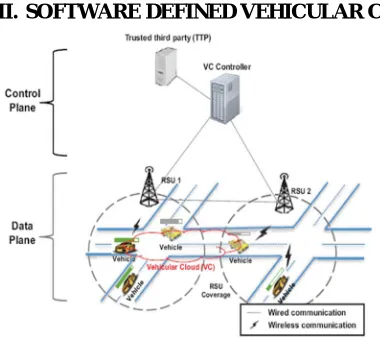
[image:3.612.208.398.404.576.2]III. SOFTWARE DEFINED VEHICULAR CLOUD
Figure 1. Software-defined VC architecture.
A. Authentication procedure
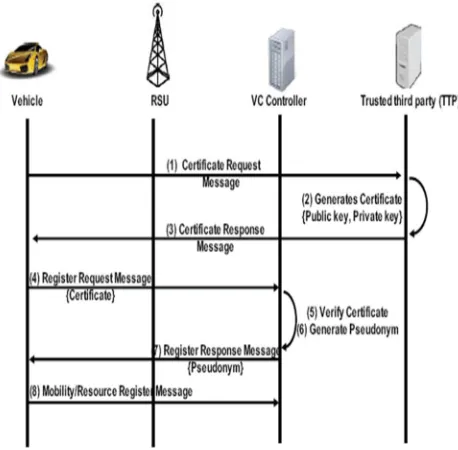
Figure 2 demonstrates the operation technique of verification of a vehicle. As a matter of first importance, all vehicles send an authentication ask for message to the TTP (Step 1). The authentication ask for message incorporates vehicle data (e.g., electronic tag (ELP)). From that point forward, the TTP creates a vehicle's testament and sends the authentication to the vehicle (Steps 2-3). At the point when a vehicle chooses to take an interest in VC, the vehicle initially confirms itself to the SDVC controller utilizing the endorsement. The vehicle sends an enroll ask for message including the endorsement to the SDVC controller (Step 4). In light of the got enroll ask for message, the SDVC controller confirms the declaration and produces a nom de plume (5-6). In particular, the SDVC controller refreshes the nom de plume to safeguard vehicle's security. The SDVC controller then sends to an enlist reaction message including the pen name the vehicle. After verification to the SDVC controller, the vehicle sends to the versatility and asset data including the pen name the SDVC controller occasionally with a specific end goal to partake in SDVC. In light of the got data, the SDVC controller keeps up a worldwide view on all vehicles assets and versatility data for the VC arrangement.
Figure 2. Authentication of vehicle to the SDVC controller.
B. Key Generation/Distribution Procedure
[image:4.612.204.433.239.464.2]Figure 3. Key generation and distribution.
C. Applications for VANETs
A wide range of accommodation and business applications have been proposed for VANETs by specialists in [6] and wellbeing applications have been proposed by the US Department of Transportation in [5]. With such a variety of vehicles on the streets/roadways having so much registering force and sensors, it is clear and coherent to use this information to frame a variety of scattered sensor systems or very portable specially appointed systems. A portion of the applications that have been suggested for VANETs include:
Security applications: Notifications for accidents, perils on the streets (elusive or wet street conditions), petty criminal offense notices, bend speed notices, crisis gadgets brake light, pre-crash detecting, co-agent forward impact notices, and so forth. This could likewise incorporate creating cautioning messages that illuminate drivers of moving toward crisis vehicles.
Comfort applications: Navigation, individual directing and so on., Congestion exhortation, toll accumulation, stopping accessibility data, and so on. Additionally, in catastrophe circumstances, the basic things are power disappointment and system breakdown. The associated vehicles can assume an extremely huge part in such circumstances as they have on-board batteries and numerous sensors including cameras, and so forth., in this way giving profitable pictures and SOS calls. The vehicular system can turn into the crisis correspondence instrument. Likewise, street and climate conditions can be checked by sharing the information from on-board vehicle sensors.
Business applications: Vehicle diagnostics trades for keeping away from conceivable auto issues, area based administrations, for example, ads and diversion, i.e., information/video transfer, long range interpersonal communication refreshes, and so forth. In the applications examined over, the vehicles are sharing data in V2V and V2I interchanges that incorporates their position data and furthermore data of street conditions. Besides, the driver may need to settle on life-sparing choices in view of the data got (e.g., crisis brake light, forward crash cautioning). It is accordingly important that the protection, unwavering quality, and honesty of the messages are guaranteed with the goal that moves can be made in a brief moment after the data is gotten because of the rates required on account of vehicles.
IV. FUTURE WORK AND CONCLUSION
The main aim of these paper is security for cloud vehicles. To overcome TTP thief problem implement two way authentication and Kerberos.
REFERENCES
[1] Myeongsu Kim, Insun Jang, Sukjin Choo, and Sangheon Pack “On Security in Software-Defined Vehicular Cloud” feb. 2016
[2] S. Bitam, A. Mellouk, and S. Zeadally, “VANET-Cloud: A Generic Cloud Computing Model For Vehicular Ad Hoc Networks,” IEEE Wireless Communications, vol. 22, no. 1, pp. 96-102, Feb. 2015
[3] S. Choo, I. Jang, M. Kim, and S. Pack, “Software-Defined Vehicular Cloud Architecture for Resource Sharing,” in Proc. International Conference on Distributed Computing and Networking (ICDCN) 2016, Jan. 2016
[4] F. Qu, Z. Wu, F-Y. Wang, and W. Cho, “A Security and Privacy Review of VANETs,” IEEE Transactions On Intelligent Transportation Systems, vol. 16, no. 6, pp. 2985-2996, Dec. 2015
Technology, vol. 56, no. 6, pp. 3442-3456, Nov. 2007
[7] J. Hubaux, S. Capkun, and J. Epfl, “The security and privacy of smart vehicles,” IEEE Security Privacy, vol. 2, no. 3, pp. 49-55, May 2004.
[8] Faezipour, M.; Nourani, M.; Saeed, A.; Addepalli, S. Progress and Challenges in Intelligent Vehicle Area Networks. Commun. ACM 2012, 55, 90–100. [9] Haas, J.J.; Hu, Y.; Laberteaux, K.P. Real-World VANET Security Protocol Performance. In Proceedings of the IEEE GLOBECOM 2009, Global