Traffic Sign Recognition Using SVM
Mr. Jayateerth Pandhari1, Mr N. M. Wagdarikar2
1, PG Student, VLSI and ES, SKNCOE, Vadgaon (BK), Pune, India
2Assistant Professor, VLSI and Embedded System, SKNCOE, Vadgaon (BK), Pune, India
Abstract: A few applications require data about road furniture. Some portion of the assignment is to study all traffic signs. This
must be accomplished for a large number of km of street, and the activity should be rehashed occasionally. The paper proposes a
pipeline for the efficient location and acknowledgment of traffic signs from such pictures. The errand is trying, as enlightenment
conditions change consistently, impediments are visit, sign positions and introductions fluctuate considerably, and the genuine signs are far less comparable among equivalent sorts than one may anticipate. Here one can see blend of 2D and 3D strategies to enhance comes about past the cutting edge, which is still particularly engrossed with single view examination. For the underlying location in single edges, an arrangement of shading and shape-based criteria is utilized. They yield an arrangement of competitor sign examples. The choice of such competitors considers a noteworthy accelerate over a sliding window approach
while keeping comparative execution. A speedup is additionally accomplished through a proposed efficient limited assessment of
AdaBoost locators. The 2D discoveries in different perspectives are in this manner joined to create 3D theories. A Minimum
Description Length definition yields the arrangement of 3D traffic signs that best clarifies the 2D recognitions.
Key words: Adaboost locators, 2d recognitions
I. INTRODUCTION
Movement sign discovery and acknowledgment have been a vital issue for research as of late: [1], [2], [3], [4], [5], [6] are some of these works. In this presentation a general portrayal of the condition of specialty of division is given and in the presentation of [7] a general diagram of the best in class about shape order for movement signs is given. Essentially, the structure of these sort of frameworks has two phases: one for the location and one for the acknowledgment. The discovery stage is typically in view of shading division in a given shading space. In [8], a proportion of the RGB parts is utilized expecting the red segment as reference. In [9], a comparative proportion was utilized where the reference is the whole of the three RGB parts. A binarization is played out numerous circumstances utilizing diverse limits in the YUV shading space in [10]. In [11], the correct limits for Hue and Saturation groups are connected. A non-straight change over the Hue and Saturation segments are connected in [1] and two look-into tables are utilized for the thresholding. In [12] the information picture pixels are arranged into two classes: chromatic and colorless, and afterward the red edge of round movement sign is distinguished. For the acknowledgment organize a wide range of arrangements have been proposed. A Neural Network (NN) is utilized for the arrangement taking after the Adaptive Resonance Theory worldview in [1]. In [10] the distinguishing proof of signs is completed by a standardized relationship based example coordinating utilizing an activity sign database. In [13], the proposed sign acknowledgment framework comprises of a nonlinear correlator. The scene and the reference example are both Fourier changed and nonlinearly altered. The relationship plane between the info and the reference signs is acquired by the backwards Fourier change. In [14] the acknowledgment is done utilizing coordinating interest (MP) in two procedures: preparing and test. The preparation procedure finds an arrangement of best MP channel based for every street sign. The testing procedure extends the information obscure street sign to various arrangement of MP channel bases to locate the best match. The identified sign is standardized and is associated with the majority of the model in [2], a flat and vertical removal of ± 3 pixels is permitted. A large portion of these works demonstrate halfway answers for the general issue of activity sign location and acknowledgment and none of them show similar outcomes with other technique.
We have made an activity sign picture database test set that can be utilized to assess movement sign location and acknowledgment calculations. Two unique strategies for identification and characterization of activity signs as indicated by their shape have been created. The primary technique depends on Distance to Borders estimation and straight SVM and it is exhibited in this paper. The other depends on FFT connected to the mark of the blob gotten from division and it is exhibited in [7].
of particular examples like activity signs. Be that as it may, it would be a mix-up to trust that their acknowledgment is not to a great degree testing. To be valuable, both false positive and false negative rates must be low. That is the reason as of now quite a bit of this work is still completed by human administrators. There are all the conventional issues of varieties in lighting, foundation, posture, and of impediments by different items, see Fig. 2a. What's more, these signs are regularly not as decisively institutionalized as one would expect (this likewise relies on upon the nation; our dataset was obtained in Belgium.
The activity sign identification issue is customarily illuminated by one of the accompanying methodologies:
A. The specific extraction of windows of intrigue, trailed by their arrangement [3, 14, 17, 19].
B. Exhaustive sliding window based arrangement [1, 21, 22].
Approach (i) misuses the saliency activity signs display by outline. Few intrigue locales is chosen in the pictures, through quick and shabby strategies. These intrigue areas are then subjected to a more complex order. Shockingly, such approach dangers to ignore activity signs if their accepted saliency has been traded off. See Fig. 12 for a few cases. Approach (ii) considers all areas or "windows" in the picture. As the quantity of competitor windows is enormous, the order procedure effectively ends up noticeably recalcitrant [22]. Extra limitations like least and most extreme window sizes help to prune that number, to the detriment of the quantity of times a similar sign can be distinguished in picture sets of the sort we utilize. Commonly, a fell order is connected [1], with the end goal that additional time is put resources into the all the more encouraging windows and by far most can again be disposed of rapidly. A solitary sign frequently brings about numerous location in covering windows, with the end goal that a non-most extreme concealment is required as a post-handling step.
II. LITERATURESURVEY
A. Background
These days innovation advancement has made that it is conceivable to drive a mechanical vehicle naturally on streets. A shrewd transportation framework (ITS) is a general term for an extensive variety of advances consolidated into customary transportation foundation and vehicles. These frameworks can incorporate roadway sensors, in-vehicle route administrations, electronic message signs, and activity administration and observing. ITS innovations are as a rule generally conveyed to augment transportation wellbeing and efficiency[1]. It expects to oversee elements that are normally inconsistent with each other, for example, vehicles, loads, and courses to enhance security and diminish vehicle wear, transportation times and fuel costs[2]. Savvy Transportation Systems differ in innovations connected, from essential administration frameworks, for example, auto route, activity light control frameworks, holder administration frameworks, variable message signs or speed cameras to checking applications, for example, security CCTV frameworks, and afterward to more propelled applications which incorporate live information and criticism from various different sources, for example, continuous climate, connect deicing frameworks, and so forth. Furthermore, prescient strategies are being created, to permit propelled demonstrating and correlation with authentic pattern data[2]. Street signs discovery and acknowledgment is an essential piece of ITS, which offer approaches to gather the continuous activity information for preparing at a focal office. It can be acknowledged in two distinctive ways: — Information correspondence innovations in light of appropriated and unavoidable applications. — Intelligent discovery and acknowledgment in light of manmade brainpower and picture examination. A few qualities of both strategies for street signs discovery and acknowledgment have been appeared in table 1.1.
Table 1.1 Some characteristics of Road sign detection and recognition.
case, the execution of data discovery and acknowledgment utilizing AI and picture examination innovations is to mount an advanced camera on every vehicle. In complex continuous condition, none of these two strategies can be supplanted totally by another. Really, the blend of both techniques makes the framework more steady and solid to give higher security. This venture is to execute street sign acknowledgment in view of AI and picture investigation advances, which applies a machine learning strategy, Support Vector Machines, to perceive street sign with two sorts of computerized signs, paired picture and Zernike minutes.
B. History
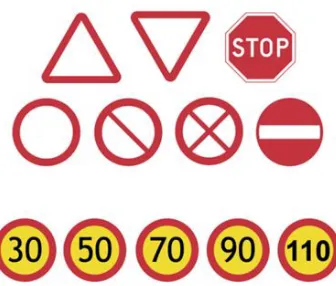
[image:4.612.223.391.261.404.2]Shape-based Recognition As of late there are has been a surge of papers portraying street sign acknowledgment strategies. One of the focuses supporting the utilization of shape data for street signs acknowledgment is the need to standard hues among the nations. Frameworks depend on hues should be tuned by moving starting with one nation then onto the next. The other point in this contention is the way that hues change as light and reflectance properties shift. In circumstances in which it is hard to concentrate shading data, for example, dusk time and evening, shape identification will be a decent alternative[5]. This venture concentrates on perceiving seven classifications of street signs (figure) and five speed restrain signs. Since contrasting and different classifications these street signs are more imperative and more hard to be arranged by PCs.
Fig Categories of Road sign and speed limits
III.PROPOSEDMETHODOLOGY
In the wake of presenting SVM hypothesis, this part concentrates on the usage of street signs acknowledgment utilizing SVM. To build the SVM characterization show, LIBSVM, a library for bolster vector order and relapse, is refered to in this venture. A few sections of the source code are altered, so that the library has the component of protest situated structure and can be collected and developed all the more effortlessly.
These street signs will be perceived by shape data as it were. At the end of the day, the shading properties of the street signs will be overlooked amid characterization handle. Heaps of street sign specimens will be utilized for preparing the learning machine, while new street sign examples will be utilized to check this machine.
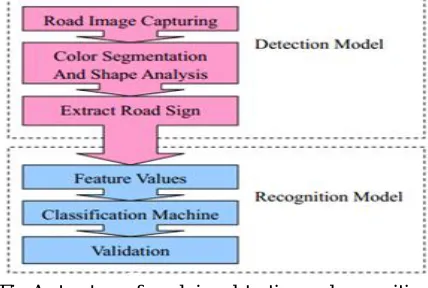
The street sign pictures that utilized for acknowledgment are paired picture with 36× 36 pixels. Obviously, the picture estimate, 36× 36 pixels, is not just accessible. Really, other size of the paired picture, for instance 28 × 28 pixels, is additionally practicable. Be that as it may, every one of the information tests of street sign must utilize a similar picture measure in one examination. Two sorts of highlight estimations of these pictures, double picture portrayal and Zernike minutes, are introduced utilizing exceptional portrayal to the SVM for preparing and test. Information standardization is a vital procedure that scales and equitably conveys the information into an adequate range to decrease the unpredictability of calculation. Figure demonstrates a square outline of street signs order utilizing SVM. The consequences of two sorts of highlight qualities are investigated and looked at in part four.
A. Information Normalization
procedure of information standardization is redundant for each issue. To decide whether the information standardization is essential for a specific issue is subject to the info highlights and the limited area of portions. Doing the procedure of information standardization for each issue is prescribed, since the procedure is exceptionally straightforward and it will never make the issues more confounded.
Double Representation: Binary portrayal is the most direct and least complex strategy to exhibit a paired picture; 0 indicates dark pixels while 1 means white pixels. In this venture since every twofold picture is spared in 36× 36 pixels, so absolutely there are 1296 characteristics for one information vector. Figure 3.2 demonstrates a case of no passage street signs.
[image:5.612.199.413.226.370.2]Picture Normalization: To accomplish the example acknowledgment that is independent of picture size, position and introduction, the separated component of a picture ought to be interpretation, scale and turn invariants. Zernike minutes have properties of turn invariance, however to do the interpretation and scale invariants, the picture should be standardized before ascertaining Zernike minutes.
Fig A structure of road sign detection and recognition
IV.RESULTS
V. CONCLUSION
This paper proposes another strategy for ordering the states of movement signs in view of the ability of SVMs. The examples we utilize are produced by the four DtB vectors for each sign and, in our point, we utilize a straight characterization taking development of its low computational cost. Trial comes about demonstrate that our framework is powerful under different conditions than the ones specified here. In this manner, in the following phase of acknowledgment loud blobs will be rejected by the low comparability between the inward range of activity signs and hopeful blobs.
REFERENCES
[1] Bahlmann, C., Zhu, Y., Ramesh, V., Pellkofer, M., Koehler, T.: A system for traffic sign detection, tracking, and recognition using color, shape, and motion
information. In: IEEE Intelligent Vehicles Symposium (2005)
[2] Bosch, A., Zisserman, A., Munoz, X.: Representing shape with a spatial pyramid kernel. In: Proceedings of the 6th ACM interna- tional conference on Image and video retrieval, pp. 401–408. ACM Press, New York, NY, USA (2007)
[3] Broggi, A., Cerri, P., Medici, P., Porta, P., Ghisio, G.: Real time road signs recognition. In: Intelligent Vehicles Symposium, 2007 IEEE, pp. 981–986 (2007) [4] Brostow, G.J., Shotton, J., Fauqueur, J., Cipolla, R.: Segmenta- tion and recognition using structure from motion point clouds. In: European Conference on
Computer Vision (2008)
[5] Doubek, P., Perdoch, M., Matas, J., Sochman, J.: Mobile mapping of vertical traffic infrastructure. In: Proceedings of the 13th Com- puter Vision Winter Workshop, pp. 115–122. Slovenian Pattern Recognition Society, Ljubljana, Slovenia (2008)