Technology (IJRASET)
Enhanced Academic Performance Evaluation
Technique Using Fuzzy System
V. Anurag Rao1, Jageshwer Shriwas 2, S R Tandan3, Shagufta Farzana4 1
M.Tech Scholar, Department of Computer Science and Engineering
2,3,4
Assistant Professor, Department of Computer Science and Engineering
Abstract— In this paper, we have proposed fuzzy logic based enhanced academic performance evaluator system by increasing the number of attributes to achieve high degree of reliability and accuracy. In this paper we have added more functionality to obtain better performance, our system is not only combining examination evaluation pattern, but also other parameters related to academic activities are concern for approximate measurement of performance.
Keywords— Academic Performance Fuzzy Logic, Membership Function
I. INTRODUCTION
Education system play vital role for the development of society and nation building, Quality factor of educational institution are backbone of social development. Quality parameter of educational system is determined only by the student performance.
Student academic performance evolution is primary concern because they are the future of the nation. Fuzzy logic system is best available methodology to predict the uncertain values i.e student behaviour. Academic performance is mainly concern with those uncertain values like semester exam, curriculum activities, personality development etc.
In student performance evaluation in particular, fuzzy techniques have been adapted for evaluation based on numerical scores obtained in an assessment and for assessing prior educational achievement based on evidence such as academic certificates. Much attention has also been given to adopting fuzzy approaches for the evaluation of teaching using a computer, in particular in Intelligent Tutoring Systems (ITS) and Computer Assisted Instruction (CAI). For instance, in fuzzy approaches were proposed for determining the level of a student's understanding of a certain subject matter in the context of ITS [1].
The focus of attention of this research work is an evaluation of student academic performance. It proposes the use of a fuzzy logic techniques and fuzzy rule induction approach to obtain user-comprehensible knowledge from historical data to justify any evaluation. This research work shows the advantages of the approach in student performance evaluation as it can be built not only based on information in a given dataset but also allowing expert knowledge to be added if such knowledge is available. Information induced from the dataset, especially that not formerly known by experts in the domain, can be very useful in developing fuzzy models for practical applications [2].
II. RELATED WORK
Evaluation of student academic performance usually consists of several components, each involving a number of judgments often based on imprecise data. This imprecision arises from human (teacher/tutor) interpretation of human (students) performance. Arithmetical and statistical methods have been used for aggregating information from these assessment components. These methods have been accepted by many educational institutions around the world although there are limitations with these traditional approaches. In this proposed study, it is argued that the current method of classifying and grading student academic performance using arithmetical and statistical techniques does not necessarily offer the best way to evaluate human acquisition of knowledge and skills. It is expected that reasoning based on fuzzy models will provide an alternative way of handling various kinds of imprecise data, which often reflects the way people think and make judgments.
Technology (IJRASET)
III. PROPOSED WORK
A. Traditional Approach
[image:3.612.43.510.313.538.2]The aim and objective of this research is determining students’ performance using a fuzzy logic model in place of Traditional pattern, the proposed approach addresses the below mention research questions [1]:
Figure 1: Fuzzy Expert System for Academic Performance Evaluation [1].
This is existing approach proposed by [1] in which they considered only examination pattern for student academic performance Existing approaches of performance evaluation system only dealt with only examination pattern that is related to (semester exam ) but some more important attributes like sports activities, curriculum and personality development (we can define it as a complete academic development or academic growth) which is missing in traditional evaluation system.
B. Proposed System
The proposed technique has given extra attention to such attributes because making academic evolution is not only based semester exam, the success of system increase by increasing number of parameter. In the proposed approach we have taken following parameters for performance measurement,
1) Semester Exam Performance 2) Sports Activities
3) Cultural Activities 4) Social Awareness
Figure 2: Fuzzy Expert System for Enhanced Model for Academic Performance Evaluation (Single Version)
Semester 1
Semester 2
Fuzzy Logic
Performance
Semester Exam
Sports Activities
Fuzzy Logic Controller
Performance
Cultural Activities
Social Awareness Semester Marks
Activities
[image:3.612.70.522.566.708.2]Technology (IJRASET)
IV. FUZZY LOGIC CONTROLLER
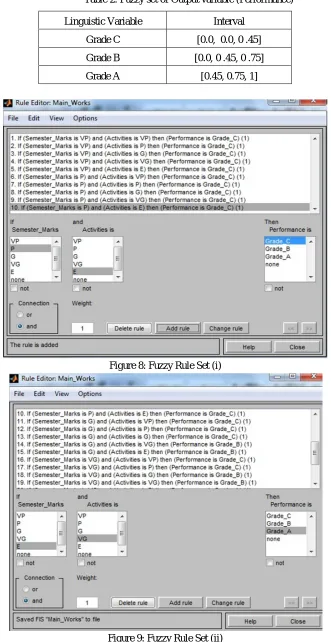
The proposed view of system, this system consist of basic three blocks
A. Fuzzy Input (Semester Marks, Activities)
B. Fuzzy Logic Controller
C. Fuzzy Output : In term of performance
Academic Performance Evaluation with Fuzzy Logic Controller :
1) Fuzzification
[image:4.612.163.451.198.433.2]2) Inference Rule
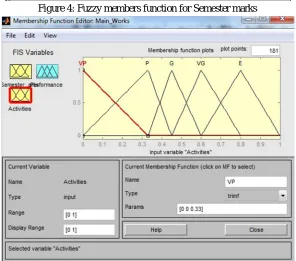
Figure 4: Fuzzy members function for Semester marks
[image:4.612.159.455.434.695.2]Technology (IJRASET)
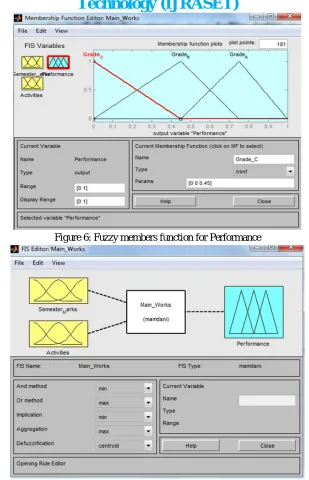
[image:5.612.158.454.294.543.2]Figure 6: Fuzzy members function for Performance
Figure 7: Complete View of Fuzzy Input and Output
[image:5.612.177.433.597.707.2]V. FUZZY INFERENCE RULE
Table 1: Fuzzy set of input variable (Semester Marks, Activities)
Linguistic Variable Interval
Very Poor (VP) [0.0, 0.0, 0 .33]
Poor (P) [0.0, 0 .33, 0 .45]
Good (G) [0.33, 0.45, 0 .60]
Very Good (VG) [0.45, 0 .60, 0 .80]
Technology (IJRASET)
Table 2: Fuzzy set of Output variable (Performance)
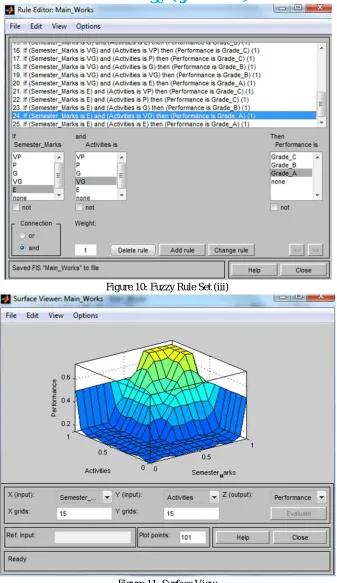
[image:6.612.141.472.83.725.2]Figure 8: Fuzzy Rule Set (i)
Figure 9: Fuzzy Rule Set (ii) Linguistic Variable Interval
Grade C [0.0, 0.0, 0 .45]
Grade B [0.0, 0 .45, 0 .75]
Technology (IJRASET)
Figure 10: Fuzzy Rule Set (iii)
Figure 11: Surface View
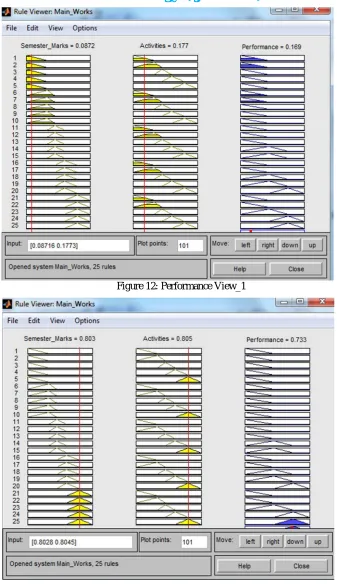
VI. EXPERIMENT RESULTS
Technology (IJRASET)
Figure 12: Performance View_1
Figure 12: Enhanced Performance View_2
VII. CONCLUSION
Technology (IJRASET)
considering important academic attributes relevant to students instead of targeting only semester examination based evaluation.
VIII. ACKNOWLEDGMENT
I would like to thank my research supervisor Mr. Jageshwer Shriwas for his valuable support throughout the research work. I also like to thank Mr. S R Tandan, Ms. Shagufta Farzana for their important suggestions and co-operation received during research work.
REFERENCES
[1] Ramjeet Singh Yadav et al. Modeling Academic Performance Evaluation Using Soft Computing Techniques: A Fuzzy Logic ApproachInternational Journal on Computer Science and Engineering (IJCSE) Vol. 3 No. 2 Feb 2011 pp. 676-686
[2] D. W. Patterson, “Introduction to Artificial Intelligence and Expert Systems”, Prentice Hall of India Private Limited, New Delhi, pp. 326-327, 2006.
[3] [2] The Mathworks, “Fuzzy Logic Toolbox User’s Guide”, The Mathworks Inc. Retrieved September 10 2009 from http://www.mathworks.com/access/helpdesk/help/pdf_doc/fuzzy/fuzzy.pdf.
[4] G. Gokmen, T. C. Akinci, M. Tektas, N. Onat. G. Kocyigit, N. Tektas, “Evaluation of Student Performance in Laboratory Applications Using Fuzzy Logic”, Procedia Social and Behavioral Science, pp 902-909, 2010.
[5] L.A. Zadeh, “Fuzzy sets,” Information and Control,” vol 8, pp. 338-353, 1965.
[6] N.P. Padhy, “Artificial intelligence and Intelligent System,” Oxford University Press, p.p. 337, 2005.
[7] S. Singh, R.S. Yadav, D. Singh, “Fuzzy inference Mechanism and Rule Induction Algorithm for Performance Evaluation”, proceedings of National Conference on Advances and Trends Web Based Computing (ATWBC-2010) organized by Department of Computer Science and Applications, M.G. Kashi Vidyapith, Varanasi, India, pp 86-93, 2010.
[8] S.M. Bai and S.M. Chen, “A new method for students’ learning achievement evaluation using fuzzy membership functions,” Proceeding of the 11th Conference
of Artificial Intelligence and Applications, Kaohsiung, Taiwan, Republic of China, pp. 177-184, 2006.
![Figure 1: Fuzzy Expert System for Academic Performance Evaluation [1]. This is existing approach proposed by [1] in which they considered only examination pattern for student academic performance](https://thumb-us.123doks.com/thumbv2/123dok_us/8579231.860339/3.612.70.522.566.708/academic-performance-evaluation-existing-approach-considered-examination-performance.webp)