S H O R T R E P O R T
Open Access
Comparison of cytosine base editors and
development of the BEable-GPS database
for targeting pathogenic SNVs
Ying Wang
1†, Runze Gao
2,3,4†, Jing Wu
2†, Yi-Chun Xiong
1, Jia Wei
1, Sipin Zhang
2, Bei Yang
5, Jia Chen
2,3*and
Li Yang
1,2*Abstract
A variety of base editors have been developed to achieve C-to-T editing in different genomic contexts. Here, we compare a panel of five base editors on their C-to-T editing efficiencies and product purity at commonly editable sites, including some human pathogenic C-to-T mutations. We further profile the accessibilities of 20 base editors to all possible pathogenic mutations in silico. Finally, we build the BEable-GPS (Base Editable prediction of Global Pathogenic SNVs) database for users to select proper base editors to model or correct disease-related mutations. The in vivo comparison and in silico profiling catalog the availability of base editors and their broad applications in biomedical studies.
Keywords:Base editing, Base editor, CRISPR/Cas, Cytidine deaminase, Pathogenic mutation
Background
A number of base editors (BEs) [1–6], which combine different APOBEC (apolipoprotein B mRNA editing
en-zyme, catalytic polypeptide-like)/AID
(activation-in-duced deaminase) cytidine deaminase family members [7, 8] with distinct CRISPR/Cas proteins [9, 10], have
been developed to achieve programmable C-to-T
changes in different sequence contexts or backgrounds. Distinct to Cas nucleases, which trigger homology-directed repair (HDR)-mediated gene correction by cleaving DNA double strands, BEs induce base changes in targeted genomic regions independent of the gener-ation of DNA double-strand breaks (DSB) generally. Guided by the Cas moiety, BEs catalyze direct C-to-T changes with its fused cytidine deaminase moiety. A ura-cil DNA glycosylase inhibitor (UGI) is fused to BEs to prevent unintended mutagenesis during the process of
base editing [1, 2], and additional UGIs co-expressed in trans with BEs (enhanced BE, eBE) further enhance the efficiency and fidelity of base editing [11]. BEs hold the potential to be used for correcting and creating
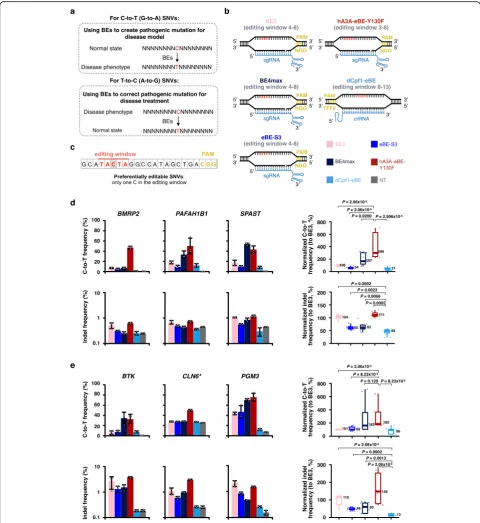
patho-genic point mutations (Fig. 1a) [12–14]. However, BEs
with different Cas proteins, e.g., Cas9 or Cas12a (also known as Cpf1), and different deaminases, e.g., rat APO-BEC1 (rA1) or human APOBEC3A (hA3A), have not been directly compared for their utility in creating or correcting pathogenic point mutations. More import-antly, a database comprehensively cataloging pathogenic point mutations that can be corrected or created by dif-ferent BEs has been lacking. In this study, we experi-mentally compare a panel of five BEs for their editing efficiency and product purity at sites of human patho-genic C-to-T mutations that can be created or corrected by the same panel of BEs. We further profile the accessi-bilities of 20 BEs to all reported human pathogenic-related T-to-C or C-to-T point mutations in silico and build a BEable-GPS (Base Editable prediction of Global Pathogenic SNVs) database to provide a resource for po-tential gene therapies and biomedical studies.
© The Author(s). 2019Open AccessThis article is distributed under the terms of the Creative Commons Attribution 4.0 International License (http://creativecommons.org/licenses/by/4.0/), which permits unrestricted use, distribution, and reproduction in any medium, provided you give appropriate credit to the original author(s) and the source, provide a link to the Creative Commons license, and indicate if changes were made. The Creative Commons Public Domain Dedication waiver (http://creativecommons.org/publicdomain/zero/1.0/) applies to the data made available in this article, unless otherwise stated. * Correspondence:[email protected];[email protected]
†Ying Wang, Runze Gao and Jing Wu contributed equally to this work.
2School of Life Science and Technology, ShanghaiTech University, Shanghai
201210, China
1
CAS Key Laboratory of Computational Biology, CAS-MPG Partner Institute for Computational Biology, Shanghai Institute of Nutrition and Health, Shanghai Institutes for Biological Sciences, University of Chinese Academy of Sciences, Chinese Academy of Sciences, Shanghai 200031, China
Full list of author information is available at the end of the article Wanget al. Genome Biology (2019) 20:218
Results and discussion
The combination of different cytidine deaminases with dis-tinct Cas proteins extends the scope of base editing in dif-ferent sequence contexts or backgrounds; however, it also results in variable targeting preferences, which hampers the direct comparison of BEs. To solve this problem, we se-lected five BEs, including BE3 [1], eBE-S3 [11], BE4max [15], hA3A-eBE-Y130F [6], and dCpf1-eBE [5], to compare their base editing efficiency and product purity at the same genomic target sites. These selected five BEs have similar widths of editing window (~ 5 bp) for comparison (Fig.1b).
At three previously reported target sites [5] that can be edited by all five BEs, BE4max and hA3A-eBE-Y130F in-duced higher C-to-T editing frequencies than the other
examined BEs in 293FT cells (Additional file 1: Figure
S1a, b), while hA3A-eBE-Y130F also exhibited slightly higher indel frequencies (Additional file1: Figure S1a, c). The relatively high indels induced by hA3A-eBE-Y130F are likely caused by the high cytidine deamination activity of its hA3A moiety [16,17]. Although showing the lowest editing frequencies among all five tested BEs, dCpf1-eBE induced fewer indels and non-C-to-T conversions than the other BEs did (Additional file 1: Figure S1a, c) and therefore yielded purer editing products (Additional file1: Figure S1d). Assumedly, the catalytically dead Cpf1 moiety in dCpf1-eBE makes its low editing frequency but high product purity (Additional files3,4,5, and6).
We next sought to compare the performance of these BEs to create human pathogenic C-to-T SNVs. Among re-ported pathogenic C-to-T SNVs [18], we selected three sites, at which all five BEs have overlapping editing win-dows (Additional file1: Figure S2a). Importantly, the cyto-sine in each of the three selected sites is the only cytocyto-sine in the editing window, referred to as preferentially editable SNVs (Fig. 1c). Theoretically, the C-to-T conversions at these three target sites could be used to mimic human genetic disorders (Additional file1: Figure S2b). At these sites, BE4max and hA3A-eBE-Y130F also induced higher levels of editing frequencies than the other examined BEs in 293FT cells (Fig. 1d, top), consistent with the results obtained at non-pathogenic target sites (Additional file1: Figure S1). Notably, only hA3A-eBE-Y130F yielded
effi-cient base editing at the loci of BMRP2 (Fig. 1d, top),
while no obvious editing was induced by the other BEs. The indel frequencies induced by dCpf1-eBE were lower
than those induced by the other BEs (Fig. 1d, bottom).
Meanwhile, the C-to-T fraction induced by dCpf1-eBE was significantly higher than those by the other BEs (Add-itional file1: Figure S2c), showing that dCpf1-eBE yielded purer editing products.
Another important application of BEs is to correct patho-genic mutations, which theoretically could be used in pre-clinic or pre-clinic studies [19]. To test base editing efficiency and precision in correcting pathogenic mutations of these
BEs, we took advantage of ABEmax [15] to first create T-to-C mutations and then to correct them by the
aforemen-tioned five BEs (Additional file 1: Figure S3). Three
reported pathogenic T-to-C/A-to-G SNV sites that can be preferentially corrected by all five BEs were selected for cor-rection study (Additional file1: Figure S3a, b). These
patho-genic T-to-C/A-to-G mutations were generated by
ABEmax individually in 293FT cells (Additional file1: Fig-ure S3c), and single-colony-derived cell lines with corre-sponding T-to-C mutations were further confirmed by Sanger sequencing (Additional file1: Figure S3d). These T-to-C/A-to-G mutations that mimic pathogenic SNVs were further corrected by five tested BEs. As shown in Fig. 1e (top), BE4max and hA3A-eBE-Y130F induced higher effi-ciencies than the other examined BEs. Notably, only hA3A-eBE-Y130F yielded efficient base editing at the loci ofCLN6 (Fig. 1e, top), while the others induced editing similar to the background level. As expected, dCpf1-eBE induced purer editing products than the other BEs though it in-duced low levels of C-to-T correction efficiency (Fig. 1e, bottom and Additional file1: Figure S4).
We further compared three representative BEs, includ-ing hA3A-eBE-Y130F with the highest editinclud-ing efficiency, dCpf1-eBE with the purest editing product, and eBE-S3 with intermediate editing efficiency and product purity (Fig. 1d, e and Additional file1: Figure S1), at additional sites for their editing efficiencies and product purities. Of note, these three selected BEs all express three extra copies of free UGI to enhance editing performance. As expected, hA3A-eBE-Y130F induced the highest editing frequency and dCpf1-eBE yielded the purest C-to-T editing product (Additional file1: Figure S5, S6), at eight genomic target sites (Additional file1: Figure S5, includ-ing three sites that have been examined with five tested BEs in Additional file1: Figure S1) as well as eight target sites where C-to-T conversions create pathogenic SNVs (Additional file 1: Figure S6, including three sites that have been examined with five tested BEs in
Add-itional file 1: Figure S2). Meanwhile, we also compared
these three representative BEs at the same sites in an-other human cell line U2OS and obtained similar results (Additional file1: Figures S7, S8).
As BEs can be used to introduce base substitutions to
mimic or revert the pathogenic SNVs (Fig. 1), we set up
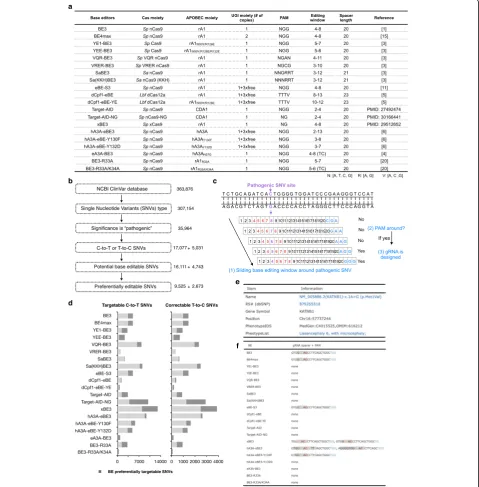
to computationally profile all human pathogenic C-to-T or T-to-C SNVs to determine which types of BEs might be more suitable for creating or correcting mutations. Twenty BEs with different PAM sequences and editing windows, including the five aforementioned ones, were used for this in silico analysis. The PAM sequences and editing windows of these 20 BEs are listed in Fig.2a.
For all pathogenic SNVs reported in the NCBI ClinVar database (Fig.2b), we searched their flanking regions to find nearby PAM sequences that could fit the pathogenic SNV
into the editing windows of examined BEs. Based on the ex-istence of PAM sequences, we predicted whether a given SNV could be potentially edited by a specific BE (Fig.2c). With 20 analyzed BEs, about 94.34% of 17,077 pathogenic C-to-T SNVs could be generated by at least one BE to
[image:4.595.59.539.90.578.2]broad applications of BEs for human disease study and po-tential treatment.
To conveniently access the information of these base editable pathogenic point mutations, we constructed a BEable-GPS (http://www.picb.ac.cn/rnomics/BEable-GPS) database for annotation. A“search”function is available to query pathogenic SNVs according to gene symbols, gen-omic locations or disease phenotypes, and their accessibil-ities to different BEs (Additional file1: Figure S9a). With selected BEs, all targetable pathogenic SNVs in queried lo-cations or disease phenotypes can be retrieved in the out-put list (Additional file1: Figure S9b). By clicking“Link” button next to a selected SNV, its name (NCBI ClinVar ID), related dbSNP number, chromosome position, gene
symbol, related phenotype ID (Fig. 2e), and designed
gRNA spacer sequences with the corresponding PAMs highlighted for all applicable BEs (Fig.2f) are available for further survey.
An online“analysis” function is also available to design specific gRNAs for editable cytosines/guanines from any input sequence (Additional file 1: Figure S10a). Of note, users can also define a specific PAM sequence, editing window, and spacer length to find specific base editable sites for further analysis (Additional file 1: Figure S10a, bottom). All cytosines or guanines that are targetable by the analyzed BEs will be listed together with specific
gRNA spacer sequences (Additional file 1: Figure S10b).
This online“analysis” function thus expands the applica-tion of the BEable-GPS database from pathogenic SNV sites to almost all editable cytosines and guanines. For both search and analysis functions, users can select the union or the intersection of these 20 analyzed BEs for sur-vey and comparison (Additional file1: Figures S9a, S10a).
It will be of interest for researchers to access BEable-GPS and embedded toolsets for their experimental designs to model or correct disease-related mutations. Of note, to reduce substantial off-target mutations, engineered BEs have been continuously developed for precise base editing [20]. We will keep updating this database by including more BEs to provide additional choices for the study of pathogenic mutations and by incorporating off-target pre-diction to suggest cautions in the future.
Methods
Cell culture and transfection
293FT and U2OS cells from ATCC were tested to exclude mycoplasma contamination and not authenticated. For base editing in genomic DNA, 293FT and U2OS cells were seeded in a 24-well plate at a density of 1 × 10⁵cells/
well and transfected with 250μl serum-free Opti-MEM
containing 2.52μl Lipofectamine LTX (Invitrogen/Life
Technologies), 0.84μl Lipofectamine Plus (Invitrogen/Life Technologies), 0.5μg BE expression vector (BE3, eBE-S3, BE4max, hA3A-eBE-Y130F or dCpf1-eBE, respectively),
and 0.34μg crRNA or sgRNA-expressing plasmid. After
72 h, the genomic DNA was extracted from the cells with QuickExtract DNA Extraction Solution for subsequent analyses.
To generate T-to-C/A-to-G mutations that mimic pathogenic SNV sites individually at the BTK,CLN6, and PGM3 loci, 293FT cells were seeded into a six-well plate at a density of 3 × 10⁵cells per well and transfected with 250μl serum-free Opti-MEM containing 7.56μl Lipofec-tamine LTX (Invitrogen/Life Technologies), 2.52μl
Lipo-fectamine Plus (Invitrogen/Life Technologies), 1.5μg
ABEmax, and 1.02μg sgRNA-expressing plasmid (sgBTK,
sgCLN6 or sgPGM3, respectively). The genomic DNAs of
single-cell colonies were individually purified, and
ABEmax-created T-to-C mutations were validated by Sanger sequencing (Additional file2).
Targeted DNA sequencing and data analysis
Targeted genomic sites were PCR amplified, and an indexed DNA library was prepared for deep sequencing. Indel frequencies were calculated by dividing reads con-taining at least one inserted and/or deleted nucleotide by all the mapped reads at the same region. Base substi-tution frequencies were calculated by dividing base sub-stitution reads by total reads.
BE editable analysis of pathogenic SNVs
The pathogenic mutation sites were downloaded from the
NCBI ClinVar database. “Single-nucleotide variants
(SNVs)”of“pathogenic”significance were extracted for fur-ther analysis. The SNV names including “C>T”or “G>A” were identified as pathogenic C-to-T/G-to-A SNVs. The SNV names including“T>C” or “A>G” were identified as pathogenic T-to-C/A-to-G SNVs. The flanking sequence (30 nucleotides upstream and downstream of the SNV site) was extracted from genome sequence according to the co-ordinate (GRCh38) of SNVs for targetable analysis.
Statistical analysis
P values were calculated from one-tailed Wilcoxon rank
sum test in this study.
Supplementary information
Supplementary informationaccompanies this paper athttps://doi.org/10. 1186/s13059-019-1839-4.
Additional file 1:Figure S1.Comparison of base editors at overlapped target sites in 293FT cells.Figure S2.Three pathogenic SNVs that can be created by BEs in 293FT cells.Figure S3.Three T-to-C mutations are cre-ated by ABEmax in 293FT cells to mimic pathogenic T-to-C/A-to-G SNVs. Figure S4.Comparison of product purity at three ABEmax-generated T-to-C mutations that can be corrected by BEs in 293FT cells.Figure S5. Comparison of base editing outcomes at eight overlapped target sites in 293FT cells.Figure S6.Comparison of base editing outcomes at eight pathogenic SNVs in 293FT cells.Figure S7.Comparison of base editing outcomes at eight overlapped target sites in U2OS cells.Figure S8.
Comparison of base editing outcomes at eight pathogenic SNVs in U2OS cells.Figure S9.Construction of BEable-GPS website for base editable pathogenic SNVs.Figure S10.Function of gRNA design embedded in the BEable-GPS website.
Additional file 2:Table S1.Oligos used for CBE-gRNA-expressing plas-mid construction.Table S2.Oligos used for ABEmax-gRNA-expressing plasmid construction.Table S3.gRNA target sequences and PCR primers for amplifying genomic DNA.
Additional file 3:Table S4.Calculation of indels of base editing results in Fig.1and Additional file1: Figures S1–S4.
Additional file 4:Table S5.Calculation of base substitutions of base editing results in Fig.1and Additional file1: Figures S1–S4.
Additional file 5:Table S6.Calculation of indels of base editing results in Additional file1: Figures S5–S8.
Additional file 6:Table S7.Calculation of base substitutions of base editing results in Additional file1: Figure S5–S8.
Additional file 7.Review history.
Acknowledgements
We like to thank Gordon Carmichael for the critical reading of this manuscript and all lab members for the discussion.
Peer review information
Yixin Yao was the primary editor on this article and managed its editorial process and peer review in collaboration with the rest of the editorial team.
Review history
The review history is available as Additional file7.
Authors’contributions
LY and JC conceived, designed, and supervised the project. YW performed the bioinformatics analyses with the help of Y-CX on database, supervised by LY. RG and JWu performed the experiments with the help of SZ, supervised by JC. JWei prepared libraries for deep sequencing, supervised by LY. LY, BY, and JC wrote the paper with inputs from all the authors. All authors read and approved the final manuscript.
Funding
This work was supported by grants 2018YFA070227 (J.C.) and 2018YFC1004602 (J.C.) from MoST and 31730111 (L.Y.), 31822016 (J.C.), 81872305 (J.C.), and 31600654 (J.C.) from NSFC.
Availability of data and materials
BEable-GPS is available athttp://www.picb.ac.cn/rnomics/BEable-GPS. The core source code of BEable-GPS used for gRNA design for pathogenic SNVs are freely available under the MIT license athttps://github.com/suduwoniu/ BEable-GPS[21], and an archival version of this code is available on Zenodo with DOIhttps://doi.org/10.5281/zenodo.3460965[22]. Targeted deep se-quencing datasets are available at the NCBI Gene Expression Omnibus with accession code GSE136749 (https://www.ncbi.nlm.nih.gov/geo/query/acc. cgi?acc= GSE136749) [23] and National Omics Data Encyclopedia with access number NODE: OEP000459 (https://www.biosino.org/node/project/detail/ OEP000459) [24].
Ethics approval and consent to participate Not applicable.
Consent for publication Not applicable.
Competing interests
The authors declare that they have no competing interests.
Author details
1
CAS Key Laboratory of Computational Biology, CAS-MPG Partner Institute for Computational Biology, Shanghai Institute of Nutrition and Health, Shanghai Institutes for Biological Sciences, University of Chinese Academy of Sciences, Chinese Academy of Sciences, Shanghai 200031, China.2School of Life
Science and Technology, ShanghaiTech University, Shanghai 201210, China.
3CAS Center for Excellence in Molecular Cell Science, Shanghai Institute of
Biochemistry and Cell Biology, Chinese Academy of Sciences, Shanghai 200031, China.4University of Chinese Academy of Sciences, Beijing 100049, China.5Shanghai Institute for Advanced Immunochemical Studies,
ShanghaiTech University, Shanghai 201210, China.
Received: 29 May 2019 Accepted: 27 September 2019
References
1. Komor AC, Kim YB, Packer MS, Zuris JA, Liu DR. Programmable editing of a target base in genomic DNA without double-stranded DNA cleavage. Nature. 2016;533(7603):420–4.
2. Nishida K, Arazoe T, Yachie N, Banno S, Kakimoto M, Tabata M, Mochizuki M, Miyabe A, Araki M, Hara KY, et al. Targeted nucleotide editing using hybrid prokaryotic and vertebrate adaptive immune systems. Science. 2016; 353(6305):aaf8729.
3. Kim YB, Komor AC, Levy JM, Packer MS, Zhao KT, Liu DR. Increasing the genome-targeting scope and precision of base editing with engineered Cas9-cytidine deaminase fusions. Nat Biotechnol. 2017;35(4):371–6. 4. Gehrke JM, Cervantes O, Clement MK, Wu Y, Zeng J, Bauer DE, Pinello L,
Joung JK. An APOBEC3A-Cas9 base editor with minimized bystander and off-target activities. Nat Biotechnol. 2018;36(10):977–82.
5. Li X, Wang Y, Liu Y, Yang B, Wang X, Wei J, Lu Z, Zhang Y, Wu J, Huang X, et al. Base editing with a Cpf1-cytidine deaminase fusion. Nat Biotechnol. 2018;36(4):324–7.
6. Wang X, Li J, Wang Y, Yang B, Wei J, Wu J, Wang R, Huang X, Chen J, Yang L. Efficient base editing in methylated regions with a human APOBEC3A-Cas9 fusion. Nat Biotechnol. 2018;36(10):946–9.
7. Yang B, Li X, Lei L, Chen J. APOBEC: from mutator to editor. J Genet Genomics. 2017;44(9):423–37.
8. Yang B, Yang L, Chen J. Development and application of base editors. CRISPR J. 2019;2(2):91–104.
9. Komor AC, Badran AH, Liu DR. CRISPR-based technologies for the manipulation of eukaryotic genomes. Cell. 2017;168(1–2):20–36. 10. Knott GJ, Doudna JA. CRISPR-Cas guides the future of genetic engineering.
Science. 2018;361(6405):866–9.
11. Wang L, Xue W, Yan L, Li X, Wei J, Chen M, Wu J, Yang B, Yang L, Chen J. Enhanced base editing by co-expression of free uracil DNA glycosylase inhibitor. Cell Res. 2017;27(10):1289–92.
12. Kim K, Ryu SM, Kim ST, Baek G, Kim D, Lim K, Chung E, Kim S, Kim JS. Highly efficient RNA-guided base editing in mouse embryos. Nat Biotechnol. 2017; 35(5):435–7.
13. Liu Z, Lu Z, Yang G, Huang S, Li G, Feng S, Liu Y, Li J, Yu W, Zhang Y, et al. Efficient generation of mouse models of human diseases via A and BE-mediated base editing. Nat Commun. 2018;9(1):2338.
14. Li J, Liu Z, Huang S, Wang X, Li G, Xu Y, Yu W, Chen S, Zhang Y, Ma H, et al. Efficient base editing in G/C-rich regions to model androgen insensitivity syndrome. Cell Res. 2019;29:174–6.
15. Koblan LW, Doman JL, Wilson C, Levy JM, Tay T, Newby GA, Maianti JP, Raguram A, Liu DR. Improving cytidine and adenine base editors by expression optimization and ancestral reconstruction. Nat Biotechnol. 2018; 36(9):843–6.
16. Ito F, Fu Y, Kao SA, Yang H, Chen XS. Family-wide comparative analysis of cytidine and methylcytidine deamination by eleven human APOBEC proteins. J Mol Biol. 2017;429(12):1787–99.
17. Lei L, Chen H, Xue W, Yang B, Hu B, Wei J, Wang L, Cui Y, Li W, Wang J, et al. APOBEC3 induces mutations during repair of CRISPR-Cas9-generated DNA breaks. Nat Struct Mol Biol. 2018;25(1):45–52.
18. Landrum MJ, Lee JM, Benson M, Brown G, Chao C, Chitipiralla S, Gu B, Hart J, Hoffman D, Hoover J, et al. ClinVar: public archive of interpretations of clinically relevant variants. Nucleic Acids Res. 2016;44(D1):D862–8. 19. Rees HA, Liu DR. Base editing: precision chemistry on the genome and
transcriptome of living cells. Nat Rev Genet. 2018;19:770–88. 20. Grünewald J, Zhou R, Garcia SP, Iyer S, Lareau CA, Aryee MJ, Joung JK.
Transcriptome-wide off-target RNA editing induced by CRISPR-guided DNA base editors. Nature. 2019;569:433–7.
21. Wang Y, Gao R, Wu J, Xiong Y, Wei J, Zhang S, Yang B, Chen J, Yang L. BEable-GPS: gRNA design tools for pathogenic SNVs. GitHub Repository.
22. Wang Y, Gao R, Wu J, Xiong Y, Wei J, Zhang S, Yang B, Chen J, Yang L. BEable-GPS: gRNA design tools for pathogenic SNVs. Zenodo Respository.
https://doi.org/10.5281/zenodo.3460965. Accessed 25 Sept 2019. 23. Yang L, Chen J, Yang B, Wang Y, Gao R, Wu J, Xiong Y, Wei J, Zhang S.
Comparison of cytosine base editors and development of the BEable-GPS database for targeting pathogenic SNVs. Gene Expression Omnibus.https:// www.ncbi.nlm.nih.gov/geo/query/acc.cgi?acc=GSE136749. Accessed 25 Sept 2019.
24. Wang Y, Gao R, Wu J, Xiong Y, Wei J, Zhang S, Yang B, Chen J, Yang L. Comparison of cytosine base editors and development of the BEable-GPS database for targeting pathogenic SNVs. The National Omics Data Encyclopedia (NODE).https://www.biosino.org/node/project/detail/ OEP000459. Accessed 25 Sept 2019.
Publisher’s Note
Springer Nature remains neutral with regard to jurisdictional claims in published maps and institutional affiliations.