Technology (IJRASET)
Cloud Computing in India: Challenges, Progress
and Future
Shraddha Kulkarni
Computer Engineering – Third Year, LDRP-Institute of Research and Technology, KSV University, Gandhinagar, Gujarat
Abstract— Cloud Computing is one of the emerging fields of Technologies in today's time. In the recent times, it has taken the usage of Internet to an all together different level. The concept of 'pay-for-what-you-use' makes it completely affordable and flexible. India, due to its huge and strong IT Industry has been one of the major markests for all the Cloud providers. This paper presents the current scenario of Cloud services in India, the steps taken for its advancement in the main working sector and where it stands compared to other countries. It also highlights the major points that hinder India from using this Technology which majorly includes the Privacy and Security issues. Citing the advantages, even the government has been taking steps to utilize the benefits of the Cloud in the country.
Keywords— Gartner Report, Data privacy, Cybercrime, Internet connectivity, Meghraj, ERP.
I. INTRODUCTION
Cloud is an acronym of the phrase: Common, Location-independent, Online Utility that is available on Demand. Cloud Computing environment provides internet based platform which are used for computer Technology. Cloud computing collects all the computing resources and manages them automatically. With the advancement of Internet, the Concept of getting everything online arose. Realizing this need, the big companies like Amazon, Google and Microsoft came up with a model called “Cloud Computing”, which can be termed as a highly innovative concept of utilizing different Hardware and software services independent of any platform at reasonable rates without any kind of risk involved. The customer pay for the cloud services they require and in return they get the services which were not available in their devices.
National Institute of Standards and Technology(NIST) defines Cloud Computing as a model for enabling ubiquitous, convenient, on-demand network access to a shared pool of configurable computing resources (e.g., networks, servers, storage, applications and services) that can be rapidly provisioned and released with minimal management effort or service provider interaction.[1]
II. OVERVIEW
This section gives an overview of Cloud computing and its various models and types that are currently present in the market. This particular technology has its own advantages and disadvantages which are summarized as well.
A. Service Models
This section discusses about the various cloud service models available:
1) SaaS (Software as a Service): Provider of SaaS has full administrative rights for its application and is responsible for deployment, maintenance and update. The capability provided to the consumer is to use the provider’s applications running on a cloud infrastructure. The applications are accessible from various client devices through either a thin client interface, such as a web browser (e.g., web-based email), or a program interface [NIST]. Cloud Users have no control over the OS or the hardware, all that is handled by the Provider.By opting for SaaS, one can avoid the issue of replacing the old hardware and maintaining infrastructure, instead they can focus on the job they want to accomplish, hence saving time and cost of hiring technical staff. Examples: Google Apps, CRM apps such as SalesForce.com, Skydrive, DropBox.
2) PaaS (Platform as a Service): PaaS is a service where application/software can be build, tested and deployed as a single Unit. It's an environment of developing applications, languages for writing programs and compiler to test it. PaaS is useful for application builders, developers and Testers. Customer has no control over the hardware and operating system. By opting for PaaS, the Customer can concentrate on Application Development and everything else will be maintained by the provider. PaaS providers in India are Wolf Frameworks and OrangeScape.
Technology (IJRASET)
Customers choose between different OS, databases and platforms.
B. Cloud Deployment Models
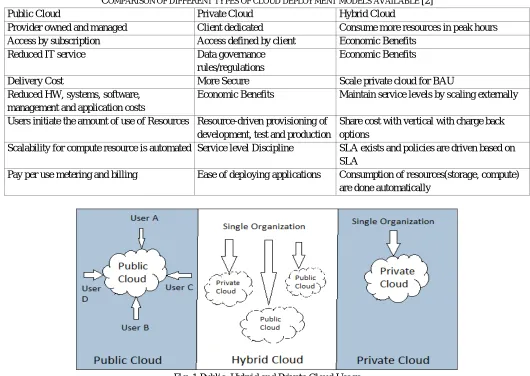
TABLEI
COMPARISON OF DIFFERENT TYPES OF CLOUD DEPLOYMENT MODELS AVAILABLE [2]
Public Cloud Private Cloud Hybrid Cloud
Provider owned and managed Client dedicated Consume more resources in peak hours Access by subscription Access defined by client Economic Benefits
Reduced IT service Data governance rules/regulations
Economic Benefits
Delivery Cost More Secure Scale private cloud for BAU Reduced HW, systems, software,
management and application costs
Economic Benefits Maintain service levels by scaling externally
Users initiate the amount of use of Resources Resource-driven provisioning of development, test and production
Share cost with vertical with charge back options
Scalability for compute resource is automated Service level Discipline SLA exists and policies are driven based on SLA
[image:3.612.39.569.129.505.2]Pay per use metering and billing Ease of deploying applications Consumption of resources(storage, compute) are done automatically
Fig. 1 Public, Hybrid and Private Cloud Usage
C. Advantages and Disadvantages of Cloud Computing 1) Advantages
a) Cost Reduction: Cloud computing saves a lot of money as real time investment in the purchase of any kind of hardware or software is reduced, and in addition, the cost of its maintenance is minimized drastically.
b) Scalability: Cloud Services charge for what they use like electricity and water. And as the user's need is increased, he can increase his server space accordingly. Levels the playing Field: The cost of licensing software and retail servers is reduced due to sharing of IT resources.
c) Easier Collaboration: Cloud services allow us to access any time from computer, so communication becomes easier for people working together.
d) Affordable: By using the services, the user can cut the investment expenditures on hardware and software Licenses.
e) Scalable and Flexible: The services can be scaled up or downwards to meet the varying demands of the business.
f) Efficiency: It's user-friendly and efficient, as it gives rights to employees to use the database from everywhere by using any PC, mobile device or browser.
2) Disadvantages
Technology (IJRASET)
framework, it still is an anxiety.
b) Risks of losing Internet Connection: If there is no Internet Connection, the database accessing is very difficult or in most cases not possible.
c) Limited resources for customization: Cloud computing might not provide depth customization and integration as per needed by the customer.
d) Availability: If cloud services goes down unexpectedly leaving you without important information for hours or more, in that case Reliability becomes one more challenge.
e) Data Mobility and ownership: Cancelling the service of cloud, what is the assurity that the customer's personal data will wipe out and not be used?
f) Privacy: The amount of data collected by the companies, it's storage and usage, is a matter of concern.
III. CLOUD COMPUTING: INDIA’S PERSPECTIVE
With cloud computing market getting mature globally, including in the developing countries, India has witnessed a lot of activities in this segment. While many brands and entrepreneurs have forayed into this category, some existing ones also attracted significant investments.
A. Reports and Outcomes
This section summarizes some of the reports and survey that have been conducted in India for Cloud Computing. Basically it represents where India stands among all the developing and developed countries. As the numbers are displayed, the progress as yet and opportunities that lies ahead become clearer.
1) Gartner's Report: According to Gartner's recent report, Cloud computing will constitute the bulk of IT spending by 2016. This particular firm has been analyzing India's development in the particular field since last few years. Every year it has put out numbers and statistics to support its research. The reports have clearly suggested that India's has come up a long way and has continued to created opportunities for young minds. Below is an overview of reports published by Gartner in all these years:
TABLEIII
TABLE SUMMARIZING GARTNER’S YEARLY CLOUD COMPUTING REPORTS
Year Gartner Report Predictions
2012 The public cloud services market forecast in India was $315 million for 2012, according to the particular year's outlook by Gartner, Inc. [3]
2013 In 2013’s Gartner Report, it predicted that from 2013 through 2017, $4.2 billion would be spent on cloud services in India. $1.8 billion of which will be spent on software as a service (SaaS).
Infrastructure as a service (IaaS), including cloud compute, storage and print services is expected to grow 41.8 percent in 2013 to $62.5 million.
Business cloud services revenue in Process as a Service (BPaaS) is expected to grow from $67 million in 2013 to $180 million in 2017.
The public cloud services market in India is on pace to grow 37.5 percent in 2013 to total $434 million.[3] 2014 Public India was forecasted to be $555 million, according to Gartner, Inc. 2014 Report. [5]
2015 IaaS will total $100 million in 2015, an increase of 25 percent over last 2014. Spending on cloud management/security will grow 36.6 percent to $82 million. SaaS will grow 33.4 percent to $302 million this year.
Gartner predicts high rates of spending on cloud services in India to continue through 2019 when the market is expected to reach $1.9 billion.
According to the research firm Gartner, public cloud services spending in 2015 was $731 million.[4]
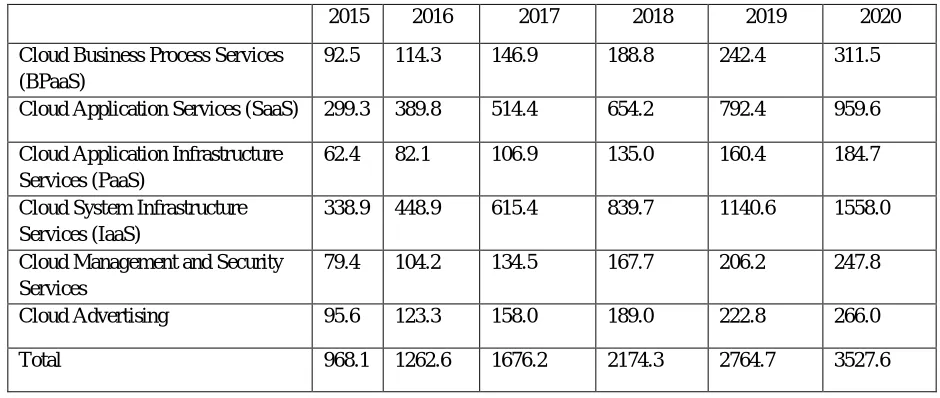
2016 The public cloud services market in India is projected to grow 30.4 percent in 2016 to total $1.26 billion, according to Gartner. The highest growth will come from cloud system infrastructure services (infrastructure as a service [IaaS]), which is projected to grow 32.5 percent in 2016, with platform as a service (PaaS) projected to grow 31.7 percent.
The IaaS segment will remain the fastest-growing segment in 2016, forecast to reach $448.9 million.
Technology (IJRASET)
TABLEIIIII
INDIA PUBLIC CLOUD SERVICES FORECAST (MILLIONS OF USDOLLARS)[5]
2015 2016 2017 2018 2019 2020
Cloud Business Process Services (BPaaS)
92.5 114.3 146.9 188.8 242.4 311.5
Cloud Application Services (SaaS) 299.3 389.8 514.4 654.2 792.4 959.6
Cloud Application Infrastructure Services (PaaS)
62.4 82.1 106.9 135.0 160.4 184.7
Cloud System Infrastructure Services (IaaS)
338.9 448.9 615.4 839.7 1140.6 1558.0
Cloud Management and Security Services
79.4 104.2 134.5 167.7 206.2 247.8
Cloud Advertising 95.6 123.3 158.0 189.0 222.8 266.0
Total 968.1 1262.6 1676.2 2174.3 2764.7 3527.6
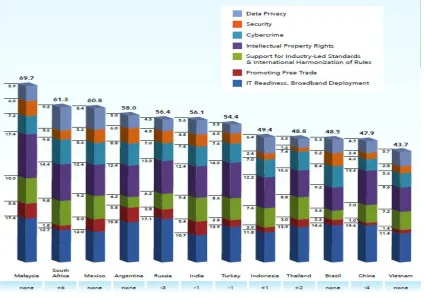
[image:5.612.70.540.107.306.2]2) BAS's Report: According to BAS's Survey of Growth of different countries in the field of Cloud Computing, India, in 2016, was ranked 18th among 24 countries that were surveyed. The below is ranking of different countries for the year 2016, topped by Japan followed by US, Germany. [6]
Technology (IJRASET)
Fig. 3 Bar graph showing statistics of Developing countries
In spite of gradual and steady growth of India in this field, its position in this poll has been disappointing. But when compared to other countries of the world, which are far more advanced and technologically ahead, there are aspects where India needs a boost. BAS's Report has also listed out the points which led to the nation's fall from 17th Rank in 2013 to 18th, mainly stating that this is due to its poor result in relation to promoting free trade and international standards. Besides this, India's Privacy and Security factors have also been a matter of concern. All this are the points which needs a proper attention at this point of time, and the Government as well as the IT industry and all Educational institutions need to cope up with this fast-paced growth. [6]
Below are India's Score, the Issues faced, its' Strength and the solutions:
a) Data Privacy: 5.6/10
b) Security: 4.8/10
c) Cybercrime: 7.8/10
d) Intellectual Property: 12.4/20
e) Support for Industry LED Standards & International Harmonization of rules: 9.4/10
f) Promoting Free Trade: 5.4/10 [6]
3) CII: Cisco Consulting Services in 2013 forecasted that Public cloud computing in India will grow 36% in 2013 to total USD 443 Million, up from USD 326 Million in 2012. The Indian IT-BPO vendors can develop their social media, mobility, analytics and cloud computing (SMAC) strategies and cross the USD 225 Billion mark by 2020. [7]
4) Microsoft IDC study: In its report, it claimed that Cloud computing will generate some 14 Million new jobs worldwide by 2015, and India alone will create over 2 Million jobs. [7]
5) EMC and Zinnov Management Consulting: They stated that India would require at least 100,000 professionals in private cloud alone by 2015. [7]
B. India’s Concerns and Solutions
Technology (IJRASET)
As a country, the biggest challenges that India is facing are Privacy of users personal and confidential data, Issues concerning Security, Cybercrime and lack of good Internet connectivity which is the basic requirement for this service. Below all those areas have been discussed in details and the possible solutions.
1) Data Privacy a) Concerns:
i) India does not have a stand-alone data protection law, and the protections that are available are contained in a mix of statutes, rules and guidelines. The most prominent provisions are contained in the Information Technology Act 2000, as amended by the Information Technology Amendment Act 2008. However, the scope and coverage of these rules is limited:
ii) The majority of the provisions only apply to “sensitive personal information”;
iii) The provisions are restricted to corporate entities undertaking the automated processing of data;
iv) Consumers are only able to take enforcement action in relation to a small subset of the provisions.[8]
v) The ITA contains a number of provisions that can, in some cases, safeguard online privacy, or in other cases, dilute online privacy. Provisions that serve to dilute user privacy speak to access by law enforcement to user's personal information stored by body corporate collection and monitoring of internet traffic data and real time monitoring, interception, and decryption of online communications. Additionally, legislative gaps in the ITA serve to weaken the privacy of online users. For example, the ITA does not address questions and circumstances like the evidentiary status of social media content in India, merging and sharing of data across databases, whether individuals can transmit images of their own “private areas” across the internet, if users have the right to be notified of the presence of cookies and do-not track options, the use of electronic personal identifiers across data bases, and if individuals have the right to request service providers to take down and delete their personal content. [9]
vi) A study conducted by Prof Ponnurangam Kumaraguru (PK) and Niharika Sachdeva for PreCog at IIIT- Delhi, who claimed to have covered over 10,000 people in India, have said that About 75% of the participants had never read the privacy any website that they interact with and about the same percentage of participants had never read the privacy policy of a website before sharing his/her information. The study also says the citizens have misinformed mental models of the privacy situation, as "participants felt there were privacy laws where as there is no privacy law in India." One of the patterns that were observed across participants was that, all of them felt very concerned about financial privacy. The study says, "It is also important for policy makers to comprehend sentiment and opinion of masses for structuring effective laws and policies for citizens of India." [10]
vii) A Study, conducted August 2013, by EMC Privacy Index revealed that Indians ranked first among 15 countries for their willingness to trade privacy for online convenience.(Higher the value greater is the willingness to trade privacy for convenience). The survey also indicated that 57 % of Indian consumers are willing to trade their privacy for convenience – significantly above the global average of 29%. [11]
viii) According to these figures, it's clear that most of the Indian users have very less knowledge of the privacy laws in India. For Cloud computing to develop in the country, it's imperative for the government to educate the users about data privacy and enforce stricter privacy controls via legal means. Awareness needs to be spread so Internet's privacy concerns in India could be resolved.
2) Future frameworks for privacy in India:
a) The Report of the Group of Experts on Privacy: In October 2012 the Report of the Group of Experts on Privacy was published by a committee of experts chaired by Justice A.P. Shah. The report creates a set of recommendations for a privacy framework and legislation in India. Most importantly, the Report recognizes privacy as a fundamental right and defines nine National Privacy Principles that would apply to all data controllers both in the private sector and the public sector. This would work to ensure that businesses and governments are held accountable to protecting privacy and that legislation and practices found across sectors, states/governments, organizations, and governmental bodies are harmonized. The privacy principles are in line with global standards including the EU, OECD, and APEC principles on privacy. [9]The Report also envisions a system of co-regulation, in which the National Privacy Principles will be binding for every data controller, but Self Regulatory Organizations at the industry level will have the option of developing principles for that specific sector. The principles developed by industry must be approved by the privacy commissioner and be in compliance with the National Privacy Principles. [9]
Technology (IJRASET)
TABLEIVI
TABLE EXPLAINING THE NINE NATIONAL PRINCIPLES [9]
Principle 1: Notice
A data controller shall give simple to understand notice of its information
practices to all individuals, in clear and concise language, before any personal information is collected from
them.
Principle 2: Choice and Consent A data controller shall give individuals choices with regard to providing their personal information, and take individual consent only after providing notice of its information practices. Only after consent has been
taken will the data controller collect, process, use, or disclose such information to third parties, except in
the case of authorized agencies.
Principle 3: Collection Limitation A data controller shall only collect
personal information from data subjects as is necessary for the purposes identified for such collection, regarding which notice has
been provided and consent of the individual taken. Such collection shall
be through lawful and fair means.
Principle 4: Purpose Limitation Personal data collected and processed by data controllers should be adequate and relevant to the purposes for which they are processed. A data controller shall collect, process, disclose, make available, or otherwise use personal information only for the purposes as stated in the notice after taking consent of individuals. If there is a change of purpose, this must be notified to the individual.
Principle 5: Access and Correction Individuals shall have access to personal information about them held by a data controller; shall be able to seek correction, amendments, or deletion such information where it is inaccurate; be able to confirm that a data controller holds or is processing information about them; be able to obtain from the data controller a copy of the personal data.
Principle 6: Disclosure of Information A data controller shall only disclose personal information to third parties after providing notice and seeking informed consent from the individual for such disclosure. Third parties are bound to adhere to relevant and applicable privacy principles. Disclosure for law enforcement purposes must be in accordance with the laws in force.
Principle 7: Security
A data controller shall secure personal information that they have either collected or have in their custody, by reasonable security safeguards against loss, unauthorized access, destruction, use, processing, storage, modification, deanonymization, unauthorized disclosure [either accidental or incidental] or other reasonably foreseeable risks.
Principle 8: Openness A data controller shall take all necessary steps to implement practices, procedures, policies and systems in a manner proportional to the scale, scope, and sensitivity to the data they collect, in order to ensure compliance with the privacy principles, information regarding which shall be made in an intelligible form, using clear and plain language, available to all individuals.
Principle 9: Accountability The data controller shall be accountable for complying with measures which give effect to the privacy principles. Such measures should include mechanisms to implement privacy policies; including tools, training, and education; external and internal audits, and requiring organizations or overseeing bodies extend all necessary support to the Privacy Commissioner and comply with the specific and general orders of the Privacy Commissioner.
Technology (IJRASET)
Roundtables was to gain public feedback to a privacy framework in India. Topics discussed during the meetings included, how to define sensitive personal information vs. Personal information, if co-regulation should be a model adopted as a regulatory framework, and what should be the legal exceptions to the right to privacy.[9]Clearly, privacy is an emerging and increasingly important field in India’s internet society. The first step towards this is the enactment of a comprehensive privacy legislation recognizing privacy as a fundamental right. The Report of the Group of Experts on Privacy and the government considering a draft privacy bill are all steps in the right direction.
3) Security and Cybercrime a) Concerns:
i) The Information Technology Act 2000 includes provisions that enable the use of electronic signatures in most transactions. As per the Information Technology Act, the government is required to notify / empanel a list of agencies to deal with security audits and to prescribe independent standards. However, no such notification has happened to date. [8]
ii) The Indian Computer Emergency Response Team (CERT-IN) was set up by the Department of Information Technology under the Information Technology Act 2000 to implement India’s filtering regime. This includes administering the prohibition against publishing obscene content and the filtering of websites. CERT-IN was empowered in 2003 to review complaints and act as the sole authority for issuing blocking instructions to the Department of Telecommunications. [8]In March 2015, the Supreme Court of India ruled Section 66A of the Information Technology Act 2000 unconstitutional. Section 66A imposes punishment for sending offensive messages through a communication service. Section 67 of the same act includes an offense of “publishing of information which is obscene in electronic form.” This is a very broad provision as it covers “any material which is lascivious or appeals to the prurient interest.” The constitutionality of Section 67 has not been questioned before the court. [8]In 2011, further rules — the Information Technology (Due Diligence Observed by Intermediaries Guidelines) Rules 2011 — were introduced by the Ministry of Communications and Information Technology. They require websites to provide a response to takedown notices on objectionable content, including anything “grossly harmful” or “harassing” within 36 hours of being notified. They also require Internet service providers and social networking sites to bar certain types of content under terms-of-service agreements with users. Intermediaries are not required to act on objectionable content prior to official notification by a government authority or court. In May 2011, the government issued a clarifying notice relating to these rules, stating that any questions of interpretation would be resolved by the courts and not by government. [8]
iii) IoT is essential part of Digital India project of Indian government that is already heading towards rough waters in the absence of adequate cyber security and civil liberties protections. On the legal framework front, IoT has yet to be suitably regulated around the world. India has no dedicated law for IoT and some guidance can be found from the Information Technology Act, 2000 (IT Act, 2000). Indian government has issued the draft IOT Policy of India and Revised Draft IOT Policy of India but they are not sufficient to manage the complicated techno legal issues of IoT. [12]
iv) The biggest hurdles before the mobile related uses in India pertain to use of weak encryption standards and non use of mobile cyber security mechanisms in India. Absence of encryption laws in India has further made the mobile security very weak in India. The ever evolving mobile malware are further increasing the woes of mobile users’ worldwide. As on date the malware are defeating cyber security products and services with ease. It is high time for India to seriously work upon mobile cyber security aspects as soon as possible. The policy decisions in this regard must be taken urgently and must be implemented as soon as possible.
v) Electronic authentication (authentication) is a very useful service provided it is safe, secure and reliable. We have no e-authentication policy in India. Even we have no legal framework for e-e-authentication in India. So as on date we have no legal framework for authentication in India, no authority that can deal with authentication in India and no policy framework for e-authentication in India that has been implemented at the national level. We have no encryption usage policy of India that can ensure cyber security of e-authentication in India. The cyber security trends in India 2011 by Perry4Law Techno Legal Base (PTLB) indicate that cyber security in India is still ignored by various stakeholders. [12]
b) Progress and Future Framework:
i) Perry4Law Organization (P4LO): This organization would help national and international IoT stakeholders in formulation and implementation of techno legal frameworks so that adoption and use of IoT can be as smooth and hassle free as possible. [12]
Technology (IJRASET)
encryption. Till now the Central Government has not prescribed any “modes or methods” of encryption usage in India.
We are compromising the cyber security of India, mobile security of India and mobile governance in India by insisting upon a weak encryption infrastructure. Mobile cyber security in India is not up to the mark and unencrypted communication would further increase the risks. India needs to upgrade its intelligence infrastructure that is in real mess. Intelligence agencies need to develop intelligence gathering and analysis skills so that situations like the present one can be taken care of. E-surveillance is not a substitute for cyber skills and Indian government and its agencies must realize this truth as soon as possible. However, the call is for the Indian government to take that is shying away from taking a well informed decision in this regard. [13]
iii) Cybercrime laws consistent with the Budapest Convention on Cybercrime: Although India is not a signatory to the Convention on Cybercrime, the core criminal provisions contained in the Information Technology Act 2000 closely follow the prohibitions contained in the Convention. Some provisions regarding international cooperation in investigations and enforcement that are present in the Convention are not present in Indian law. Also, requirements for data retention during an investigation that are contained in the Cybercrime Convention are also not present in Indian law. These inconsistencies do not detract from the general alignment between the Convention and the Information Technology Act. [8]
iv) National Encryption Policy: In September 2015, the Department of Electronics and Information Technology released a draft National Encryption Policy. The proposed policy stated that applications using encryption would need to store plain text versions of all data for 90 days so that the content could be examined by the police if required. However, the proposal was the subject of immediate criticism and controversy and was withdrawn by the government after only a few days. The government has asked the department to develop a completely new encryption policy. [13]
v) Promoting free trade: Although the Indian government has generally taken a technology-neutral approach, it is important to note that the 2008 amendments to the Information Technology Act included a provision that would allow the government to determine what modes of encryption companies and individuals may use:
Section 84A: “The government may, for secure use of the electronic medium and for promotion of e-governance and e-commerce, prescribe the modes or methods for encryption.”
At the time of writing, no rules have been issued under Section 84A. So, Cloud computing services are not able to operate free from laws or policies that mandate or establish preferences the use of certain products (including, but not limited to types of software), services, standards or technologies. [8]
C. Broadband Deployment
Both the Internet and the Smartphone industry have seen sharp curves in distribution and consumption patterns in the past decade in India. In fact, both are observed to be mutually exclusive in this thriving digital era.
a) Concerns: This is the major concern which hinders India in the path of development in the field of Cloud Computing. In BSA's 2016 Report, India ranks last among the 24 countries in this particular field, lagging behind even the countries like Indonesia, Argentina, Poland and Vietnam. Being the 2nd most populated nation in the world, India's serves as a good market for the Digital and Electronic industry but despite that due to India's poor background and limited use of Internet, compared to other countries, companies have hesitated to enter the Indian market. It's important to spread more awareness and make the technology reach to every corner of the country. [8]
b) Future Framework for better Connectivity:
i) National Broadband Plan: The Telecommunications Regulatory Authority of India (TRAI) revisited its previous plan for the rollout of the National Optic Fiber Network (NOFN), subsequent to the release of the Digital India program in 2014. The revisited plan was addressed in detail in the report released by the Department of Telecommunication’s Committee on the National Optic Fiber Network in March 2015. The report details the intention to work in partnership with private organizations to build the optic fiber network, in particular, targeting nonmetropolitan communities in all states and union territories. The new timeline extended the goal to reach 250,000 local government areas (gram panchayats) by two years to 2016. [8]
Technology (IJRASET)
[image:11.612.170.461.109.198.2]i) Internet Penetration
Fig. 4 Internet Penetration Percentage comparison of different countries
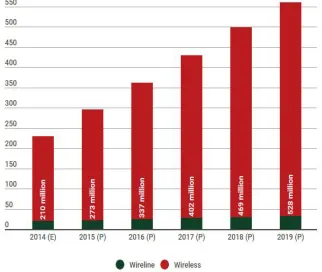
The numbers speak for it, according to the report; India has shown steady increases in the Internet users from 2014(E) to 2019(P). There is consistency of rise in the number of net surfers by at least 50 million annually (close to the population of South Africa) from 2014 to 2019 taking the projected values to be at least 560 million users by the end of 2019. Adding to that, even the Internet bandwidth availability has said to have seen a 29 per cent rise reaching a 2Mbps average speed in the country. [14]
ii) India Internet Connections
Fig. 5 Bar graph predicting India’s Internet connectivity
[image:11.612.151.473.357.629.2]Technology (IJRASET)
[image:12.612.168.463.105.314.2]iii) Mobile Internet Users
Fig. 6 Bar graph predicting number of Mobile Internet Users in India
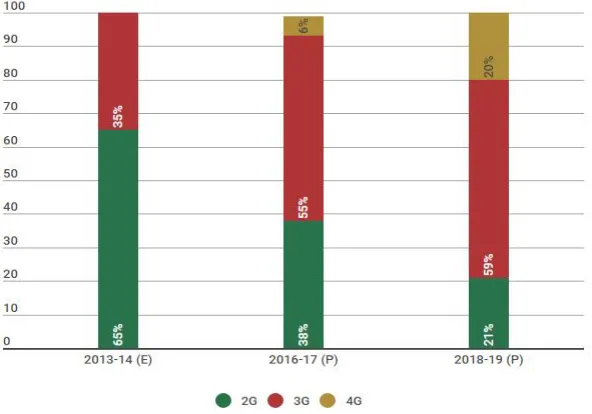
However, majority of the mobile-based Internet users survive on Edge (2G) network, the rolling out of 3G and 4G is also expect to boost the growth. With Airtel, Vodafone and Reliance Jio opening the gates, the revenues from data services from an expected 38%:55%:6% [2G, 3G, 4G] in 2016-17 is expected to change to 21%:58%:20% respectively in 2018-19. [14]
iv) Revenues from 2G,3G and 4G
Fig. 7 Bar graph predicting the growth of 2g, 3g and 4g for upcoming years
[image:12.612.166.462.417.624.2]Technology (IJRASET)
Facebook exploring drone technology, all of them experimenting closely to boost Internet penetration in India. [14]
D. Effect on IT based Indian Companies and Start-ups
1) Cloud ERP is a pristine method advocated for deploying ERP using cloud architecture. It provides a good alternative to costly age-old on-premise systems. Cloud ERP solutions are opening up new avenues for start-ups in India to do business with their clients, interact with their employees, stakeholders and suppliers. A cloud based ERP solution can be customised according to the requirements of the organisation without affecting the agility of its workforce.
2) The initial cost of cloud-based ERP is typically lower because of the fact that the organisations simply implement the required software and access the data through their internet connection. The cloud ERP provider hosts and maintains the entire IT infrastructure, ensures the data is secure with the system is always running and the product enhancements are rolled out painlessly to your solution without breaking previously implemented customizations. It may be stated that cloud-based ERP solutions can act in a proactive way to make your business grow by leaps and bounds. [15]
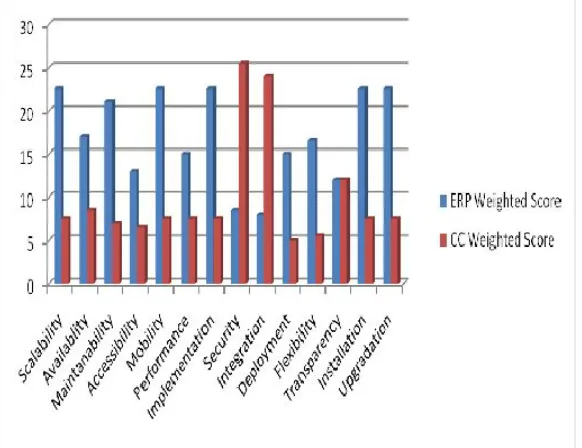
3) SMEs are leading the way for entering new global markets and for innovations in the emerging economic order. In India 95% of the industrial units are SMEs which give over 50% of the industrial output. Thus SMEs form the backbone of the Indian economy. In a paper published by professors of IIIT-Allahabad, they have given out alternative solutions to traditional ERP system for SMEs, which incur huge cost during implementation. . For the study, IT people from 30 North Indian SMEs were interviewed. Below is a graph presenting the findings of their research work. [16]
[image:13.612.172.463.306.530.2]Fig. 8 Bar graph comparing Cloud Computing and ERP System Implementation for SMEs
Figure shows that ERP has high weight age score in terms of every factor except for security and integration. The Cloud computing services (CCS) enabled system would be a perfect solution and would be cost saving and reduce the difficulty of handling data. In the cloud computing environment the SMEs will not have to own the infrastructure so they can abstain from any capital expenditure and instead they can utilize the resources as a service and pay as per their usage.
4) A survey conducted by Frost & Sullivan shows that cloud adoption by SMBs in India as growing at a CAGR of 25 percent. According to a study conducted by Forrester, about 89 percent Indian enterprises believe that the cloud computing model is relevant to their organisation and nearly 79 percent respondents in India say they currently have either already taken cloud-based initiatives, or are planning to implement cloud or 'as-a-service' approach, in the next 12 months. This clearly points towards the growing realisation and acceptance of a cloud-based model for growth. [15]
Technology (IJRASET)
business. What's more, IT is taking its rightful place as a very useful tool that just enables one's business and doesn't need maintenance or management. [15]
TABLEVII
TABLE LISTING COMPANIES AND START-UPS ACTIVELY INVOLVED IN CLOUD COMPUTING IN INDIA[17] Top IT Companies and Start-ups
Rank Company City
1 Tata Consultancy Services Mumbai
2 Infosys Bangalore
3 Wipro Limited Bangalore
4 InstaCompute - Tata Communication Mumbai
5 Zenith Infotech Limited Mumbai
6 Cipher Cloud San Jose, USA
7 Cirrologix Private Limited Bangalore 8 Ctrls Datacenters Limited Hyderabad 9 Clogeny Technologies Private Limited Chennai
10 App Point Bangalore
Other Companies
Alpinesoft IT Solutions New Delhi
Blue Pi Consulting Gurgaon
Brio Technologies Hyderabad
Clicklytics Bangalore
E. MeghRaj : An Indian Government Initiative
In February’14, Shri. Kapil Sibal, Minister of Communications and Information Technology, here today launched the National Cloud under ‘MeghRaj’ Initiative. The National Cloud is being implemented by NIC.
In order to utilise and harness the benefits of Cloud Computing, Government of India has embarked upon an ambitious initiative – ‘GI Cloud’ which has been named as ‘MeghRaj’. The focus of this initiative is to accelerate delivery of e-services in the country while optimizing ICT spending of the Government. This will ensure optimum utilization of the infrastructure and speed up the development and deployment of eGov applications. The architectural vision of GI Cloud encompasses a set of discrete cloud computing environments spread across multiple locations, built on existing or new (augmented) infrastructure, following a set of common protocols, guidelines and standards issued by the Government of India. Two Policy reports viz., ‘GI Cloud Strategic Direction Paper’ and ‘GI Cloud Adoption and Implementation Roadmap’ have been prepared by the Department of Electronics & Information Technology (DeitY).
The National Cloud will help the departments to procure ICT services on demand in the OPEX model rather than investing upfront on the CAPEX. The Cloud Services available are Infrastructure as a Service (IaaS), Platform as a Service (PaaS), Software as a Service (SaaS) and Storage as a Service (STaaS). Some of the features of the National Cloud include self service portal, multiple Cloud solutions, secured VPN access and multi location Cloud. NIC is providing Cloud services under the umbrella of ‘MeghRaj’.[18]
IV. CONCLUSIONS
Technology (IJRASET)
essential for Cloud services, has been coped up by public and private companies who have come up with better network strategies and plans for the public. With cloud providing services like PaaS, IaaS and SaaS, it has been a savior for small scale businesses in India which, till date, had been implementing the ERP system. Due to high population, India has always been one of the important markets for all kinds of services worldwide. Government and private bodies have been taking many big and important steps for the growth of Cloud services in India. Big companies and start-ups in the country have now been using this technique in their workspace which makes storage and retrieval of data much efficient and easy. With everything in place, soon India will be competing with the top countries of the world in terms of Cloud services, this might take some time but the future seems bright.
V. ACKNOWLEDGMENT
I want to acknowledge all the faculties of LDRP-ITR, Gandhinagar, who have showed immense faith in me and thought I could do the work. All the teachers have been very supportive and have helped me out to understand various important sections of the topic. I would also want to acknowledge my friends who have been supportive and helped me with editing of the material.
REFERENCES
[1] NIST:US Department of Commerce "The NIST Defination of Cloud Computing" http://nvlpubs.nist.gov/nistpubs/Legacy/SP/nistspecialpublication800-145.pdf by P Mell,2011 Special Publication 800-145.
[2] Suresh, A.Srinivasan "A Practical Approach for Learning and Implementation 1st Edition".
[3] Sony Shetty "Gartner Says Indian Public Cloud Services Market on Pace To Total $434 Million In 2013" http://www.gartner.com/newsroom/id/2590717 Mumbai, India, September 17, 2013.
[4] Sony Shetty "Gartner Says Indian Public Cloud Services Market Will Reach $731 Million in 2015" http://www.gartner.com/newsroom/id/3156617 Mumbai, India, October 26, 2015.
[5] Sony Shetty "Gartner Says Public Cloud Services in India Forecast to Reach $1.26 Billion in 2016" http://www.gartner.com/newsroom/id/3308117 Mumbai, India, May 5, 2016.
[6] BSA:TheSoftwareAlliance "2016 BSA Global Cloud Computing Scorecard- Confronting new Challenges"
http://cloudscorecard.bsa.org/2016/pdf/BSA_2016_Global_Cloud_Scorecard.pdf .
[7] Meha Agrawal "Cloud computing in India: Current status and future forecasts by various research firms" http://www.iamwire.com/2013/11/cloud-computing-india-current-status-future-forecasts-research-firms/21548 November 1, 2013.
[8] BSA:TheSoftware Alliance "Country Report and Score card for India" http://cloudscorecard.bsa.org/2016/pdf/country_reports/2016_Country_Report_India.pdf. [9] "Internet Privacy in India" http://cis-india.org/telecom/knowledge-repository-on-internet-access/internet-privacy-in-india.
[10] PTI "Most Indians ignorant about privacy issues on Internet, social media: Study" http://articles.economictimes.indiatimes.com/2012-12-09/news/35705476_1_privacy-issues-personally-identifiable-information-privacy-invasion Updated: Dec 09, 2012.
[11] Harikrishnan Srinivasan "Perceptions of online data protection & individual privacy in India" http://www.tribenautix.com/internet-data-privacy-in-india/ January 15, 2015.
[12] PTLB "Center Of Excellence (CoE) For Internet Of Things (IoT) In India" http://cybersecurityofindia.blogspot.in/2016/07/center-of-excellence-coe-for-internet_8.html Friday, July 8, 2016.
[13] Geeta Dalal "Indian Encryption Policy Must Be Formulated" http://ictps.blogspot.in/2011/08/indian-encryption-policy-must-be.html Tuesday, August 23, 2011. [14] Krishna Vamsi, New Delhi "Internet users in India to grow by at least 50 million yearly till 2020: report"
http://indianexpress.com/article/technology/tech-news-technology/internet-users-in-india-to-grow-by-50-million-yearly-till-2020-report/ Updated: April 13, 2016 3:10 pm.
[15] Biswas Nair, Aashna Cloudtech "Cloud ERP solutions opening up new avenues for startups in India" http://www.firstpost.com/business/biztech/cloud-erp-solutions-opening-up-new-avenues-for-startups-in-india-2000459.html.
[16] Monika Sharma, Ashwani Mehra, Haresh Jola, Anand Kumar, Dr.Madhvendra Misra, Ms.Vijayshri Tiwari IIIT-A "Scope of cloud computing for SMEs in India " https://arxiv.org/ftp/arxiv/papers/1005/1005.4030.pdf JOURNAL OF COMPUTING, VOLUME 2, ISSUE 5, MAY 2010 ISSN 2151-9617.