Technology (IJRASET)
©IJRASET: All Rights are Reserved
1019
Optimized Data Rate Using Destructive
Interference Technique for Tiered Networks
Miss. M. Subedha begam.1, Miss. J. Revathi.2, Miss. S. Achaiya.3, Miss. R. Gomathy4 1,2,3,4
Sri Ganesh College of Engineering and Technology, Puducherry, India.
Abstract— Our project deals with uplink interference management system using interference alignment technique. Uplink interference generated by macro cell users will be mitigated by providing proper coordination of macro cell users with the closest fem to cell base station. We first create the number of node or operational connections in a macro cell and check its feasibility with respect to fem to cell then we check it in near reality scenario. This paper is intended to introduce energy efficient routing protocol, known as Position Responsive Routing Protocol (PRRP) and Interference Alignment with Destructive Interference to enhance energy efficiency of fem to cell and reduce the interference in the channel which Combinely reduces the transmission overhead and saves the power for fem to cell with increasing signal level. Position responsive routing protocol differs in several ways than other existing routing techniques. Position response routing protocol approach allows fair distribution of gateway\cluster head selection, maximum possible distance minimization among nodes and gateways\cluster heads to utilize less energy. Position responsive routing protocol shows significant improvement of 45% in energy efficiency of wireless sensor network life time as a whole by increasing coverage life of individual nodes. Furthermore PRRP shows drastic increases for data throughput and provide better solution to routing energy hole due to it fair distributed approach of gateway selection.
Index Terms— PRRP, Alignment, Macro cell
I. INTRODUCTION
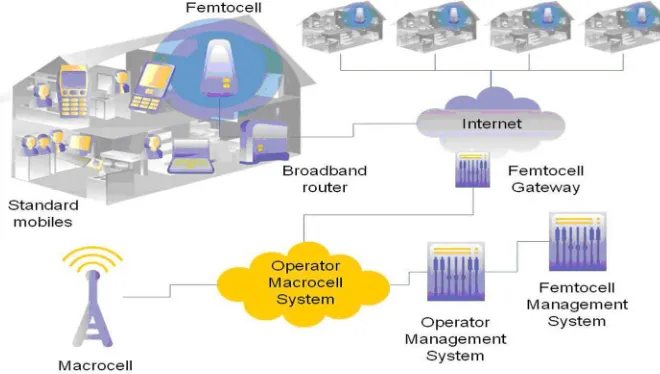
[image:2.612.149.479.499.686.2]In telecommunications, a fem to cell is a small, low-power cellular base station, typically designed for use in a home or small business. A broader term which is more widespread in the industry is small cell, with fem to cell as a subset. It connects to the service provider’s network via broadband (such as DSL or cable); current designs typically support four to eight active mobile phones in a residential setting depending on version number, and eight to 16 active mobile phones in enterprise settings. A fem to cell allows service providers to extend service coverage indoors or at the cell edge, especially where access would otherwise be limited or unavailable. Although much attention is focused on WCDMA, the concept is applicable to all standards, including GSM, CDMA2000, TD-SCDMA, WiMAX and LTE solutions.
Technology (IJRASET)
©IJRASET: All Rights are Reserved
1020
Use of fem to cell benefits both the mobile operator and the consumer. For a mobile operator, the attractions of a fem to cell are improvements to both coverage, especially indoors, and capacity. Coverage is improved because fem to cell can fill in the gaps and eliminate loss of signal through buildings. Capacity is improved by a reduction in the number of phones attempting to use the main network cells and by the off-load of traffic through the user's network (via the internet) to the operator's infrastructure. Instead of using the operator's private network (microwave links, etc.), the internet is used.
Consumers benefit from improved coverage since they have a base-station inside their building. As a result, the mobile phone (user equipment) achieves the same or higher data rates using less power, thus battery life is longer. They may also get better voice quality. The carrier may also offer more attractive tariffs, e.g., discounted calls from home. Fem to cell is an alternative way to deliver the benefits of Fixed–mobile convergence (FMC). The distinction is that most FMC architectures require a new (dual-mode) handset which works with existing unlicensed spectrum home/enterprise wireless access points, while a fem to cell-based deployment will work with existing handsets but requires installation of a new access point that uses licensed spectrum.
Many operators have launched fem to cell service, including Vodafone, SFR, AT&T, Sprint Nextel, Verizon, T-Mobile US, Zain, Mobile TeleSystems, and Orange. In 3GPP terminology, a Home Node B (HNB) is a 3G fem to cell. A Home eNode B (HeNB) is an LTE fem to cell.
Typically the range of a standard base station may be up to 35 kilometres (22 mi), a microcell is less than two kilometers wide, a picocell is 200 meters or less, and a fem to cell is in the order of 10 meters, although AT&T calls its product, with a range of 40 feet (12 m), a "microcell".AT&T uses "AT&T 3G MicroCell" as a trade mark and not necessarily the "microcell" technology, however.
II. PROPOSED SYSTEM
Position Responsive Routing Protocol (PRRP) and Interference Alignment with Destructive Interference
Our work is intended to introduce energy efficient routing protocol, known as Position Responsive Routing Protocol to enhance energy efficiency of WSN. Position responsive routing protocol differs in several ways than other existing routing techniques.
Position responsive routing protocol shows significant improvement of 45% in energy efficiency of wireless sensor network life time as a whole by increasing battery life of individual nodes. This increamentation in energy value is directly proportional to range of transmission. Furthermore PRRP shows drastic increases for data throughput and provide better solution to routing energy hole due to it fair distributed approach of gateway selection.Energy efficient routing protocol with assumptions closer to the real.We propose the Interference Alignment Technique with Destructive Interference.
We first design near practical network and provide necessary details like coverage area, transmission energy , Number of nodes etc.
Then we check for practical network effect of node. The graph for Dominant Macro cell Interferers Vs. Min SINR will be checked .Later we implement the system and compare our data rate output with existing system.
III. WORKING OPERATION
Several routing protocols have been developed recently to address the energy efficiency issue. WSNs routing protocols normally specified in following types.
Flat routing Protocols Hierarchal routing Protocols Location based routing Protocols
Hierarchal routing protocols work in cluster formation and considered to be more energy efficient due to their unique characteristics. Recently proposed Cluster based Energy Efficient Location Routing Protocol (CELRP), also belongs to Hierarchal type. In CELRP sensor nodes are normally distributed into clusters and divided into different quadrants. Each quadrant contains two clustering and sensor nodes that transmit data with two hops data transmission [36]. CH is selected based on the node with maximum residual energy and minimum distance to the base station in each cluster. While the CH which has the highest energy residual is chosen as the CH Leader between all the other CHs. CELRP applies Greedy algorithm among cluster heads and forward data to the sink. The collection works as nodes sends data to CH and then CH forward their data to the sink through CH leader by minimizing number of hops.
Technology (IJRASET)
©IJRASET: All Rights are Reserved
1021
formation of clusters, network divided into four quadrants and then it forms clusters. In second phase it selects CH and CH leader on the basis of its energy and finally with third phase it transfer data to the sink. CELRP has main limitations like its number of children nodes is high in the clusters and secondly its CHleader choosing mechanism works on the basis of energy level, in most of the cases CHleader is not the closest to CH, hence it causes more energy drain because of longer distance. At the same time it uses Greedy approach for data transmission which also causes loss of energy efficiency.
Hence it is highly needed to design an energy efficient routing protocol with assumptions closer to the real, we are position responsive routing protocol (PRRP) WSN routing protocol which is more energy efficient than the existing protocols.
We also proposed the Interference Alignment Technique with Destructive Interference. We first design near practical network and provide necessary details like coverage area, transmission energy, Number of nodes etc. Then we check for practical network effect of node. The graph for Dominant Macro cell Interferers vs. Min SINR will be checked .Later we implement the system and compare our data rate output with existing system.
Technology (IJRASET)
©IJRASET: All Rights are Reserved
1022
V. CODING
function varargout = untitled(varargin) % UNTITLED MATLAB code for untitled.fig
Technology (IJRASET)
©IJRASET: All Rights are Reserved
1023
%
% H = UNTITLED returns the handle to a new UNTITLED or the handle to % the existing singleton*.
%
% UNTITLED('CALLBACK',hObject,eventData,handles,...) calls the local % function named CALLBACK in UNTITLED.M with the given input arguments. %
% UNTITLED('Property','Value',...) creates a new UNTITLED or raises the % existing singleton*. Starting from the left, property value pairs are % applied to the GUI before untitled_OpeningFcn gets called. An
% unrecognized property name or invalid value makes property application % stop. All inputs are passed to untitled_OpeningFcn via varargin. %
% *See GUI Options on GUIDE's Tools menu. Choose "GUI allows only one % instance to run (singleton)".
%
% See also: GUIDE, GUIDATA, GUIHANDLES
% Edit the above text to modify the response to help untitled
% Last Modified by GUIDE v2.5 11-Mar-2016 16:57:56
% Begin initialization code - DO NOT EDIT gui_Singleton = 1;
gui_State = struct('gui_Name', mfilename, ... 'gui_Singleton', gui_Singleton, ...
'gui_OpeningFcn', @untitled_OpeningFcn, ... 'gui_OutputFcn', @untitled_OutputFcn, ... 'gui_LayoutFcn', [] , ...
'gui_Callback', []); if nargin && ischar(varargin{1})
gui_State.gui_Callback = str2func(varargin{1}); end
if nargout
[varargout{1:nargout}] = gui_mainfcn(gui_State, varargin{:}); else
gui_mainfcn(gui_State, varargin{:}); end
% End initialization code - DO NOT EDIT
% --- Executes just before untitled is made visible.
function untitled_OpeningFcn(hObject, eventdata, handles, varargin) % This function has no output args, see OutputFcn.
% hObject handle to figure
Technology (IJRASET)
©IJRASET: All Rights are Reserved
1024
% varargin command line arguments to untitled (see VARARGIN)
% Choose default command line output for untitled handles.output = hObject;
% Update handles structure guidata(hObject, handles);
% UIWAIT makes untitled wait for user response (see UIRESUME) % uiwait(handles.figure1);
% --- Outputs from this function are returned to the command line. function varargout = untitled_OutputFcn(hObject, eventdata, handles) % varargout cell array for returning output args (see VARARGOUT); % hObject handle to figure
% eventdata reserved - to be defined in a future version of MATLAB % handles structure with handles and user data (see GUIDATA)
% Get default command line output from handles structure varargout{1} = handles.output;
% --- Executes on button press in pushbutton2.
function pushbutton2_Callback(hObject, eventdata, handles) % hObject handle to pushbutton2 (see GCBO)
% eventdata reserved - to be defined in a future version of MATLAB % handles structure with handles and user data (see GUIDATA)
clc;
x=100; y=100;
%x and y Coordinates of the Sink sink.x=1.5*x;
sink.y=0.5*y;
%Number of Nodes in the field
n=input('Enter The Number of Nodes:-');
Technology (IJRASET)
©IJRASET: All Rights are Reserved
1025
optimum=1;
%Initial Energy in Joules EInitial=0.1;
%Eelec=Etx=Erx Et=50*10^-9; Er=50*10^-9;
%Transmit Amplifier types Ef=10*10^-12;
Eamp=0.0013*10^-12; %Data Aggregation Energy EDA=5*10^-9;
%%
%Percentage of nodes than are advanced m=0.0;
%\alpha a=1;
%maximum number of rounds rmax=100;
%%
%Computation of do do=sqrt(Ef/Eamp);
%Creation of the Random Sensor Network figure(1);
for i=1:1:n
S(i).xd=rand(1,1)*x; XR(i)=S(i).xd; S(i).yd=rand(1,1)*y; YR(i)=S(i).yd; S(i).G=0; S(i).type='N';
temp_rnd0=i;
if (temp_rnd0>=m*n+1) S(i).E=EInitial; S(i).ENERGY=0;
plot(S(i).xd,S(i).yd,'o', 'MarkerSize', 5, 'MarkerFaceColor', 'm'); hold on;
end
if (temp_rnd0<m*n+1) S(i).E=EInitial*(1+a); S(i).ENERGY=1;
plot(S(i).xd,S(i).yd,'+', 'MarkerSize', 5, 'MarkerFaceColor', 'r'); hold on;
Technology (IJRASET)
©IJRASET: All Rights are Reserved
1026
S(n+1).xd=sink.x; S(n+1).yd=sink.y;
plot(S(n+1).xd,S(n+1).yd,'o', 'MarkerSize', 12, 'MarkerFaceColor', 'g');
%First Iteration figure(1);
countCHs=0; rcountCHs=0; cluster=1; countCHs;
rcountCHs=rcountCHs+countCHs; flag_first_dead=0;
for r=0:1:rmax
if(mod(r, round(1/p) )==0) for i=1:1:n
S(i).G=0; S(i).cl=0; end
end
hold off;
%Number of dead nodes dead=0;
%Number of dead Advanced Nodes dead_a=0;
%Number of dead Normal Nodes dead_n=0;
%counter for bit transmitted to Bases Station and to Cluster Heads packets_TO_BS=0;
packets_TO_CH=0;
%counter for bit transmitted to Bases Station and to Cluster Heads
PACKETS_TO_CH(r+1)=0; PACKETS_TO_BS(r+1)=0;
figure(1);
for i=1:1:n
%Dead node testing if (S(i).E<=0)
plot(S(i).xd,S(i).yd,'red .', 'MarkerSize', 5, 'MarkerFaceColor', 'y'); dead=dead+1;
Technology (IJRASET)
©IJRASET: All Rights are Reserved
1027
dead_a=dead_a+1; end
if(S(i).ENERGY==0) dead_n=dead_n+1; end
hold on; end
if S(i).E>0 S(i).type='N';
if (S(i).ENERGY==0) plot(S(i).xd,S(i).yd,'o'); end
if (S(i).ENERGY==1)
plot(S(i).xd,S(i).yd,'+', 'MarkerSize', 5, 'MarkerFaceColor', 'g'); end
hold on; end end
plot(S(n+1).xd,S(n+1).yd,'x');
STATISTICS(r+1).DEAD=dead; DEAD(r+1)=dead;
DEAD_N(r+1)=dead_n; DEAD_A(r+1)=dead_a;
plot(S(n+1).xd,S(n+1).yd,'o', 'MarkerSize', 5, 'MarkerFaceColor', 'r'); plot(S(n+1).xd,S(n+1).yd,'x');
%When the first node dies if (dead==1)
if(flag_first_dead==0) first_dead=r; flag_first_dead=1; end
end
countCHs=0; cluster=1; for i=1:1:n if(S(i).E>0)
temp_rand=rand; if ( (S(i).G)<=0)
%Election of Cluster Heads
if(temp_rand<= (p/(1-p*mod(r,round(1/p))))) countCHs=countCHs+1;
packets_TO_BS=packets_TO_BS+1; PACKETS_TO_BS(r+1)=packets_TO_BS;
Technology (IJRASET)
©IJRASET: All Rights are Reserved
1028
S(i).G=round(1/p)-1; C(cluster).xd=S(i).xd; C(cluster).yd=S(i).yd;
plot(S(i).xd,S(i).yd,'k*', 'MarkerSize', 5, 'MarkerFaceColor', 'y');
distance=sqrt( (S(i).xd-(S(n+1).xd) )^2 + (S(i).yd-(S(n+1).yd) )^2 ); C(cluster).distance=distance;
C(cluster).id=i; X(cluster)=S(i).xd; Y(cluster)=S(i).yd; cluster=cluster+1;
%Calculation of Energy dissipated distance;
if (distance>do)
S(i).E=S(i).E- ( (Et+EDA)*(4000) + Eamp*4000*( distance*distance*distance*distance )); end
if (distance<=do)
S(i).E=S(i).E- ( (Et+EDA)*(4000) + Ef*4000*( distance * distance )); end
Energy_disp(r+1) = S(i).E; end
end end end
STATISTICS(r+1).CLUSTERHEADS=cluster-1; CLUSTERHS(r+1)=cluster-1;
Ecalc=0;d1=0;d2=0;E1=0;E2=0;min=0;distance1=0;distance2=0; %Election of Associated Cluster Head for Normal Nodes
for i=1:1:n
if ( S(i).type=='N' && S(i).E>0 ) if(cluster-1>=1)
min_dis=sqrt( (S(i).xd-S(n+1).xd)^2 + (S(i).yd-S(n+1).yd)^2 ); min_dis_cluster=1;
for c=1:1:cluster-1
temp=sqrt( (S(i).xd-C(c).xd)^2 + (S(i).yd-C(c).yd)^2 ) ; if ( temp<min_dis )
min_dis=temp; min_dis_cluster=c; end
end
if(min_dis>do)
Esmall=( Et*(4000) + Eamp*4000*( min_dis * min_dis * min_dis * min_dis)); else
Esmall=( Et*(4000) + Ef*4000*( min_dis * min_dis)); end
Technology (IJRASET)
©IJRASET: All Rights are Reserved
1029
if(i~=j && S(j).E>0)
d1=sqrt( (S(i).xd-S(j).xd)^2 + (S(i).yd-S(j).yd)^2 ) ;
d2=sqrt( (S(j).xd-C(min_dis_cluster).xd)^2 + (S(j).yd-C(min_dis_cluster).yd)^2 ) ; if(d1>do)
E1=( Et*(4000) + Eamp*4000*( d1 * d1 * d1 * d1)); else
E1=( Et*(4000) + Eamp*4000*( d1 * d1)); end
if(d2>do)
E2=( Et*(4000) + Eamp*4000*( d2 * d2 * d2 * d2)); else
E2=( Et*(4000) + Eamp*4000*( d2 * d2)); end
Ecalc=E1+E2; if(Ecalc<min) min=Ecalc; optimum=j; distance1=d1; distance2=d2; end
end end
if(Ecalc<Esmall) if(distance1>do)
S(i).E=S(i).E- ( Et*(4000) + Eamp*4000*( distance1 * distance1 * distance1 * distance1)); S(optimum).E=S(optimum).E-( (Er + EDA)*4000 );
else
S(i).E=S(i).E- ( Et*(4000) + Eamp*4000*( distance1 * distance1)); S(optimum).E=S(optimum).E-( (Er + EDA)*4000 );
end
if(distance2>do)
S(optimum).E=S(optimum).E-( Et*(4000) + Eamp*4000*( distance2 * distance2 * distance2 * distance2)); else
S(optimum).E=S(optimum).E-( Et*(4000) + Eamp*4000*( distance2 * distance2)); end
else
if (min_dis>do)
S(i).E=S(i).E- ( Et*(4000) + Eamp*4000*( min_dis * min_dis * min_dis * min_dis)); end
if (min_dis<=do)
S(i).E=S(i).E- ( Et*(4000) + Ef*4000*( min_dis * min_dis)); end
end
if(min_dis>0)
distance=sqrt( (S(C(min_dis_cluster).id).xd-(S(n+1).xd) )^2 + (S(C(min_dis_cluster).id).yd-(S(n+1).yd) )^2 ); S(C(min_dis_cluster).id).E = S(C(min_dis_cluster).id).E- ( (Er + EDA)*4000 );
if (distance>do)
Technology (IJRASET)
©IJRASET: All Rights are Reserved
1030
distance*distance*distance*distance )); end
if (distance<=do)
S(C(min_dis_cluster).id).E=S(C(min_dis_cluster).id).E- ( (Et+EDA)*(4000) + Ef*4000*( distance * distance )); end
PACKETS_TO_CH(r+1)=n-dead-cluster+1; end
S(i).min_dis=min_dis;
S(i).min_dis_cluster=min_dis_cluster;
end end end hold on;
countCHs;
rcountCHs=rcountCHs+countCHs; sum=0;
for i=1:1:n if(S(i).E>0)
sum=sum+S(i).E; end
end avg=sum/n;
STATISTICS(r+1).AVG=avg; sum;
warning('OFF'); [vx,vy]=voronoi(X,Y); plot(X,Y,'r*',vx,vy,'b-'); hold on;
voronoi(X,Y); axis([0 x 0 y]);
end
% --- Executes on button press in pushbutton3.
function pushbutton3_Callback(hObject, eventdata, handles) % hObject handle to pushbutton3 (see GCBO)
% eventdata reserved - to be defined in a future version of MATLAB % handles structure with handles and user data (see GUIDATA) close all;
clear; clc;
Technology (IJRASET)
©IJRASET: All Rights are Reserved
1031
y=100;
%x and y Coordinates of the Sink sink.x=1.5*x;
sink.y=0.5*y;
%Number of Nodes in the field
n=input('Enter The Number of Nodes:-');
%Optimal Election Probability for cluster head p=0.2;
optimum=1;
%Minimum SINR Required at the MBS
EInitial=input('Enter the Minimum SINR Required at the MBS:-')
%Eelec=Etx=Erx Et=50*10^-9; Er=50*10^-9;
%Transmit Amplifier types Ef=10*10^-12;
Eamp=0.0013*10^-12; %Data Aggregation Energy EDA=5*10^-9;
%%
%Percentage of nodes than are advanced m=0.0;
%\alpha a=1;
%maximum number of rounds rmax=100;
%%
%Computation of do do=sqrt(Ef/Eamp);
%Creation of the Random Sensor Network figure(1);
for i=1:1:n
S(i).xd=rand(1,1)*x; XR(i)=S(i).xd; S(i).yd=rand(1,1)*y; YR(i)=S(i).yd; S(i).G=0; S(i).type='N';
temp_rnd0=i;
Technology (IJRASET)
©IJRASET: All Rights are Reserved
1032
S(i).E=EInitial; S(i).ENERGY=0;
plot(S(i).xd,S(i).yd,'o', 'MarkerSize', 5, 'MarkerFaceColor', 'm'); hold on;
end
if (temp_rnd0<m*n+1) S(i).E=EInitial*(1+a); S(i).ENERGY=1;
plot(S(i).xd,S(i).yd,'+', 'MarkerSize', 5, 'MarkerFaceColor', 'r'); hold on;
end end
S(n+1).xd=sink.x; S(n+1).yd=sink.y;
plot(S(n+1).xd,S(n+1).yd,'o', 'MarkerSize', 12, 'MarkerFaceColor', 'g');
%First Iteration figure(1);
countCHs=0; rcountCHs=0; cluster=1; countCHs;
rcountCHs=rcountCHs+countCHs; flag_first_dead=0;
for r=0:1:rmax
if(mod(r, round(1/p) )==0) for i=1:1:n
S(i).G=0; S(i).cl=0; end
end
hold off;
%Number of dead nodes dead=0;
%Number of dead Advanced Nodes dead_a=0;
%Number of dead Normal Nodes dead_n=0;
%counter for bit transmitted to Bases Station and to Cluster Heads packets_TO_BS=0;
Technology (IJRASET)
©IJRASET: All Rights are Reserved
1033
%counter for bit transmitted to Bases Station and to Cluster Heads
PACKETS_TO_CH(r+1)=0; PACKETS_TO_BS(r+1)=0;
figure(1);
for i=1:1:n
%Dead node testing if (S(i).E<=0)
plot(S(i).xd,S(i).yd,'red .', 'MarkerSize', 5, 'MarkerFaceColor', 'y'); dead=dead+1;
if(S(i).ENERGY==1) dead_a=dead_a+1; end
if(S(i).ENERGY==0) dead_n=dead_n+1; end
hold on; end
if S(i).E>0 S(i).type='N';
if (S(i).ENERGY==0) plot(S(i).xd,S(i).yd,'o'); end
if (S(i).ENERGY==1)
plot(S(i).xd,S(i).yd,'+', 'MarkerSize', 5, 'MarkerFaceColor', 'g'); end
hold on; end end
plot(S(n+1).xd,S(n+1).yd,'x');
STATISTICS(r+1).DEAD=dead; DEAD(r+1)=dead;
DEAD_N(r+1)=dead_n; DEAD_A(r+1)=dead_a;
plot(S(n+1).xd,S(n+1).yd,'o', 'MarkerSize', 5, 'MarkerFaceColor', 'r'); plot(S(n+1).xd,S(n+1).yd,'x');
%When the first node dies if (dead==1)
if(flag_first_dead==0) first_dead=r; flag_first_dead=1; end
end
Technology (IJRASET)
©IJRASET: All Rights are Reserved
1034
cluster=1; for i=1:1:n if(S(i).E>0)
temp_rand=rand; if ( (S(i).G)<=0)
%Election of Cluster Heads
if(temp_rand<= (p/(1-p*mod(r,round(1/p))))) countCHs=countCHs+1;
packets_TO_BS=packets_TO_BS+1; PACKETS_TO_BS(r+1)=packets_TO_BS;
S(i).type='C'; S(i).G=round(1/p)-1; C(cluster).xd=S(i).xd; C(cluster).yd=S(i).yd;
plot(S(i).xd,S(i).yd,'k*', 'MarkerSize', 5, 'MarkerFaceColor', 'y');
distance=sqrt( (S(i).xd-(S(n+1).xd) )^2 + (S(i).yd-(S(n+1).yd) )^2 ); C(cluster).distance=distance;
C(cluster).id=i; X(cluster)=S(i).xd; Y(cluster)=S(i).yd; cluster=cluster+1;
%Calculation of Energy dissipated distance;
if (distance>do)
S(i).E=S(i).E- ( (Et+EDA)*(4000) + Eamp*4000*( distance*distance*distance*distance )); end
if (distance<=do)
S(i).E=S(i).E- ( (Et+EDA)*(4000) + Ef*4000*( distance * distance )); end
Energy_disp(r+1) = S(i).E; end
end end end
STATISTICS(r+1).CLUSTERHEADS=cluster-1; CLUSTERHS(r+1)=cluster-1;
Ecalc=0;d1=0;d2=0;E1=0;E2=0;min=0;distance1=0;distance2=0; %Election of Associated Cluster Head for Normal Nodes
for i=1:1:n
if ( S(i).type=='N' && S(i).E>0 ) if(cluster-1>=1)
Technology (IJRASET)
©IJRASET: All Rights are Reserved
1035
for c=1:1:cluster-1
temp=sqrt( (S(i).xd-C(c).xd)^2 + (S(i).yd-C(c).yd)^2 ) ; if ( temp<min_dis )
min_dis=temp; min_dis_cluster=c; end
end
if(min_dis>do)
Esmall=( Et*(4000) + Eamp*4000*( min_dis * min_dis * min_dis * min_dis)); else
Esmall=( Et*(4000) + Ef*4000*( min_dis * min_dis)); end
for j=1:1:n
if(i~=j && S(j).E>0)
d1=sqrt( (S(i).xd-S(j).xd)^2 + (S(i).yd-S(j).yd)^2 ) ;
d2=sqrt( (S(j).xd-C(min_dis_cluster).xd)^2 + (S(j).yd-C(min_dis_cluster).yd)^2 ) ; if(d1>do)
E1=( Et*(4000) + Eamp*4000*( d1 * d1 * d1 * d1)); else
E1=( Et*(4000) + Eamp*4000*( d1 * d1)); end
if(d2>do)
E2=( Et*(4000) + Eamp*4000*( d2 * d2 * d2 * d2)); else
E2=( Et*(4000) + Eamp*4000*( d2 * d2)); end
Ecalc=E1+E2; if(Ecalc<min) min=Ecalc; optimum=j; distance1=d1; distance2=d2; end
end end
if(Ecalc<Esmall) if(distance1>do)
S(i).E=S(i).E- ( Et*(4000) + Eamp*4000*( distance1 * distance1 * distance1 * distance1)); S(optimum).E=S(optimum).E-( (Er + EDA)*4000 );
else
S(i).E=S(i).E- ( Et*(4000) + Eamp*4000*( distance1 * distance1)); S(optimum).E=S(optimum).E-( (Er + EDA)*4000 );
end
if(distance2>do)
S(optimum).E=S(optimum).E-( Et*(4000) + Eamp*4000*( distance2 * distance2 * distance2 * distance2)); else
Technology (IJRASET)
©IJRASET: All Rights are Reserved
1036
else
if (min_dis>do)
S(i).E=S(i).E- ( Et*(4000) + Eamp*4000*( min_dis * min_dis * min_dis * min_dis)); end
if (min_dis<=do)
S(i).E=S(i).E- ( Et*(4000) + Ef*4000*( min_dis * min_dis)); end
end
if(min_dis>0)
distance=sqrt( (S(C(min_dis_cluster).id).xd-(S(n+1).xd) )^2 + (S(C(min_dis_cluster).id).yd-(S(n+1).yd) )^2 ); S(C(min_dis_cluster).id).E = S(C(min_dis_cluster).id).E- ( (Er + EDA)*4000 );
if (distance>do)
S(C(min_dis_cluster).id).E=S(C(min_dis_cluster).id).E- ( (Et+EDA)*(4000) + Eamp*4000*( distance*distance*distance*distance ));
end
if (distance<=do)
S(C(min_dis_cluster).id).E=S(C(min_dis_cluster).id).E- ( (Et+EDA)*(4000) + Ef*4000*( distance * distance )); end
PACKETS_TO_CH(r+1)=n-dead-cluster+1; end
S(i).min_dis=min_dis;
S(i).min_dis_cluster=min_dis_cluster;
end end end hold on;
countCHs;
rcountCHs=rcountCHs+countCHs; sum=0;
for i=1:1:n if(S(i).E>0)
sum=sum+S(i).E; end
end avg=sum/n;
STATISTICS(r+1).AVG=avg; sum;
warning('OFF'); [vx,vy]=voronoi(X,Y); plot(X,Y,'r*',vx,vy,'b-'); hold on;
voronoi(X,Y); axis([0 x 0 y]);
Technology (IJRASET)
©IJRASET: All Rights are Reserved
1037
figure(2);
r=input('Number of Aligned Macro cell Users:-'); for r=2:1:r
ylabel('Min SINR required at MBS '); xlabel('Number of aligned Macro cell users ');
plot([r r+1],[STATISTICS(r+1).AVG STATISTICS(r+2).AVG],'g'); hold on;
end
% --- Executes on button press in pushbutton4.
function pushbutton4_Callback(hObject, eventdata, handles) % hObject handle to pushbutton4 (see GCBO)
% eventdata reserved - to be defined in a future version of MATLAB % handles structure with handles and user data (see GUIDATA) clc
clear all
%% INTIALIZING PART figure(1)
pc=1; % TRANSMITTING POWER FOR CONFERENCING LINK ps=1; % TRANSMITTING POWER FOR SOURCE TO RELAY LINK no=1;
fik=0.8; % CHANNEL GAIN FOR CONFERENCING LINK
pr=1; % TRANSMITTING POWER FOR RELAY TO DESTINATION LINK N=500;
j=0+1i; choice=2; me=1; vari=2;
hi=chgain2(N,choice,me,vari); gi=chgain2(N,choice,me,vari);
i=0; p=0.2; N1=500; %%
M1=(p*N1)-1;
M=linspace(0,M1,500); for i=1:length(M)
term=((pc*fik*mean(hi))./(pc*fik+ps*mean(hi)+no)); mhudf(i)=(1/(M(i)+1)).*(((mean(hi))*(term*i))); ri(i)=((1/2)*log2((1+(M(i)+1).*(ps/no).*mhudf(i)))); end
N1=50;
N=linspace(0,500,500); for j=1:length(N)
Technology (IJRASET)
©IJRASET: All Rights are Reserved
1038
% rmac(j)=log2(mean(q0(j)).^2/no); % mhu(j)=(((1/N(j)).*sqrt((mean(gi))*j)));
% rmac(j)=(1/2)*log2((pr/no).*(N(j).^2).*(mhu(j).^2)); eqo(j)=(sqrt(pr)*sqrt(mean(gi)*j));
rmac=log2(eqo/sqrt(no)); end
rmac;
n=linspace(0,500,20); rdf=bsxfun(@ min,ri,rmac); rdf=rdf(:,1:M1);
rdf=rdf(:,1:5:end); % rdf(1)=0 ; plot(n,rdf,'rs-') hold on %% p=0.2; fik=0.72; N=500; M1=(p*N)-1; N=M1+1;
hi=chgain2(N,choice,me,vari); gi=chgain2(N,choice,me,vari); ai5=1/mean(gi);
for k=1:N N=k;
hk=chgain2(N,choice,me,vari); ai1(k)=ps.*mean(sum(hi)).*k; ai11=(ai1).^2;
ai23=ai1.*(1+((ps.*mean(hi)+no)./pc.*fik)); ai3(k)=ai1(k)+ai23(k);
ai4(k)=1/ai3(k); ai2(k)=ai4(k).*ai5; ai(k)=sqrt(ai2(k)); end
%% for N=1:N
q11(N)=(ai(N).*gi).*N; end
j=0;
M=linspace(1,N,M1); for j=1:N
for k=1:length(M) q12(j)=hi;
end end for j=1:N
Technology (IJRASET)
©IJRASET: All Rights are Reserved
1039
%%
M=linspace(1,N,M1); for k=1:length(M)
q2(k)=((ai(k).*gi).^2.*hi).*M(k); end
for k=1:length(M)
q31(k)=(abs(ai2(k)).*(ps.*mean(hi)+no./pc.*fik).*(gi.^2).*hi); end
for i=1:M1
% b1(i)=ps.*pr.*q1(i).^2;
% b2(i)=((pr.*q2(i)+(pr.*q31(i))+1).*no); % b3(i)=(1+(b1(i)./b2(i)));
% b4(i)=1/2.*log2(b3(i)) % b5=1/2.*b4(i)
a12(i)=2*log2(sqrt(ps.*pr/no).*q1(i))-log2(pr.*q2(i)+(pr.*q31(i))+1); % b1=ps.*pr.*(q1(i).^2);
end
a12=a12(:,6:4:end); i=linspace(0,500,24); plot(i,a12,'b-.o') hold on
% axis([0 500 0 4.5])
p=0.01; for N=1:N
q11(N)=(ai(N).*gi).*N; end
j=0;
M=linspace(1,N,M1); for j=1:N
for k=1:length(M) q12(j)=hi;
end end for j=1:N
q1(j)=(q11(j).*q12(j)); end
grid on
xlabel('Relays'); ylabel('Rate(bits/s/Hz)')
legend('Data Rate of Conventional Amplification','Data Rate of Fem to cell','location','southeast')
VI. CONCLUSION
Technology (IJRASET)
©IJRASET: All Rights are Reserved
1040
propose to enhance the transmission range to much larger extent.
VII. ACKNOWLEDGEMENT
We thank our Mrs.S.SEMMALAR HOD, Ph.D (Department of Electronics and Communication Engineering) to help us for creating this paper with his sincere guidance and Technical Expertise in the field of communication. The help of our guide
Mrs.S.SEMMALAR M.E,Ph.D, Department of ECE, Sri Ganesh College of Engineering And Technologyis really immense and once again we thank her for her great motivation. We thank Sri Ganesh college of engineering and Technology to provide us such a standard educational environment so that we are able to understand the minute concepts in the field of Engineering.
REFERENCES
[1] V. Chandrasekhar, J. Andrews, and A. Gatherer, “Fem to cell networks: a survey,” IEEE Commun. Mag., vol. 46, no. 9, pp. 59–67, Sept. 2008.
[2] Picochip, “The case for home base stations,” White Paper, Apr. 2007.
[3] S. Verdu, Multiuser Detection. Cambridge University Press, 1998.
[4] R. Yates, “A framework for uplink power control in cellular radio systems,” IEEE J. Sel. Areas Commun., vol. 13, no. 7, pp. 1341–1348, Sept. 1995.
[5] C. Rose, S. Ulukus, and R. Yates, “Wireless systems and interference avoidance,” IEEE Trans. Wireless Commun., vol. 1, no. 3, pp. 415–428, July 2002.
[6] W. M. Jang, B. R. Vojcic, and R. L. Pickholtz, “Joint transmitter-receiver optimization in synchronous multiuser communications over multipath channels,”
IEEE Trans. Commun., vol. 46, pp. 269-278, Feb. 1998.
[7] H. Jo, C. Mun, J. Moon, and J. Yook, “Interference mitigation using uplink power control for two-tier fem to cell networks,” IEEE Trans.Wireless Commun.,
vol. 8, no. 10, pp. 4906–4910, Oct. 2009.
[8] V. Chandrasekhar and J. G. Andrews, “Uplink capacity and interference avoidance for two-tier fem to cell networks,” IEEE Trans. WirelessCommun., vol. 8,
no. 7, pp. 3498–3509, July 2009.
[9] V. R. Cadambe and S. A. Jafar, “Interference alignment and degrees of freedom region for the K user interference channel,” IEEE Trans. Inf.Theory, vol. 54,
no. 8, Aug. 2008.
[10] K. S. Gomadam, V. R. Cadambe, and S. A. Jafar, “A distributed numerical approach to interference alignment and applications to wireless interference
networks,” IEEE Trans. Inf. Theory, vol. 57, no. 6, pp. 3309–3322, June 2011.
[11] D. A. Schmidt, C. Shi, R. A. Berry, M. L. Honig, and W. Utschick, “Minimum mean squared error interference alignment,” in Proc. 2009Asilomar Conf.
Signals, Syst., Comput., pp. 1106–1110.
[12] S. W. Peters and R. W Heath, Jr., “Cooperative algorithms for MIMO interference channels,” IEEE Trans. Veh. Technol., vol. 60, no. 1, pp. 206–218, Jan.
2011.
[13] S. Ulukus and A. Yener, “Iterative transmitter and receiver optimization for CDMA networks,” IEEE Trans. Wireless Commun., vol. 3, no. 6, pp. 1974–1979,
Nov. 2004.
[14] H. Lv, T. Liu, X. Hou, and C. Yang, “Adaptive interference alignment for fem to cell networks,” in Proc. 2010 IEEE Int. Conf. Signal Process.
[15] F. Pantisano, M. Bennis, W. Saad, and M. Debbah, “Cooperative interference alignment in fem to cell networks,” in Proc. 2011 IEEEGlobal Telecommun.
Conf.
[16] W. Shin, W. Noh, K. Jang, and H. Choi, “Hierarchical interference alignment for downlink heterogeneous networks,” IEEE Trans. WirelessCommun., vol. 11,
no. 12, pp. 4549–4559, Dec. 2012.
[17] T. Weber, I. Maniatis, A. Sklavos, and Y. Liu, “Joint transmission and detection integrated network (JOINT), a generic proposal for beyond 3G systems,” in
Proc. 2002 Int. Conf. Telecommun., vol. 3, pp. 479–483.
Subedha begam.Mcurrently pursuing her B.Tech from Sri Ganesh college of Engineering and Technology from the stream of Electronics and Communication Engineering. Her area of interest are Java,C,C++ and Networking.
Revathi.J currently pursuing her B.Tech from Sri Ganesh College of Engineering and Technology from the stream of Electronics and Communication Engineering. His area of interest are Wireless communication,C and C++.
Technology (IJRASET)
©IJRASET: All Rights are Reserved