Behavior Study of Fly-Ash Based Bricks and
Analysis of R.C Frame Infill Using ETABS
Adarsh Kumar S1, Rame Gowda M2
1P.G. Student, 2Professor
1,2Depatment of Civil Engineering, Adi Chunchanagiri Institute of Technology, Chikmagalur, Karnataka
Abstract: In many green building materials fly ash brick also included. Fly ash bricks can be suitably used in masonry like clay bricks. The manufacture of fly ash bricks will be more economical if the manufacturing unit is nearer to the thermal power plant. In this work development of high strength and economical fly-ash bricks is carried out. It is also necessary to utilize some other material like lime, quarry dust and cement. Experiments are conducted for four proportions by keeping lime and cement constant, fly-ash and quarry dust quantity is varying in range. Tests are conducted for water absorption and compressive strength and flexure strength for 7, 14, 21 and 28 days age of curing. By considering the high strength fly ash brick infill property for building, analysis is carried out to evaluate strength and also to provide effective performance against the lateral loading. Analysis also done by taking sample of multi-storey building by using E-TABS and compare the results obtained with conventional clay brick.
Keywords: Brick infill, Fly ash bricks, Lime, Storey displacement, Storey drift.
I. INTRODUCTION
In the construction field, the present scenario is developing the economical and ecofriendly material is a great concern, by developing high strength building material by utilizing agriculture and industrial wastes. Usually in design of R.C frame building, only weight of the infill considered and it is treated as non-structural element but in practice even infill panel also provide the stiffness to building, which improve the resistance against dynamic loading, many building in urban area are soft-storey because for parking purpose were failed due to dynamic loading in past earthquake. It is because of reducing the stiffness which increases stress in column, resulting in failure of building.
II. LITERATUREREVIEW
Tabin Rushad (2011) conducted experimental studies on Lime-Soil-Fly ash brick. The result obtained by the above experimental study compressive strength increases by increasing lime proportional. the pressure moulded brick having higher compressive strength with respective to pressure load. Natan C Patel et all(2013),Carried out the experimental study on Glass fiber fly ash brick by using the different materials like lime, fly ash, glass fiber and sand, kheda dust for brick manufacturing. It is found that compressive strength goes on increases by increasing the percentage of glass fiber, for 1% of fiber get maximum compressive strength after 21days curing, but using the glass fiber in development of brick is uneconomical. Geological study is carried out on the behavior of fly ash based bricks by Saravana Raja Mohan et al (2013), Fly ash bricks shows better results against sulphate attack for which experiment is conducted of cycles of salt exposure,. It means nil Efflorescence. When compare to clay bricks ,fly ash bricks is 10.60% lighter. A. Sumathi (2014) ,conducted experimental study to find the optimum mix percentage of fly ash brick. From the results it was found that among the seven proportions the maximum optimized compressive strength is obtained for optimal mix percentage of Flyash-15% Lime-30% Gypsum-2% Quarry dust-53%. Experimental study carried out on of fly ash bricks and comparing with clay brick by Aakash Suresh Pawar (2014). Manufactured fly ash brick having high load carrying capacity and it is better than commercially available common clay bricks. Fly ash-clay bricks give nil efflorescence. The characteristics values of fly ash bricks are excellent.
III.MATERIALSUSED
All paragraphs must be indented. All paragraphs must be justified, i.e. both left-justified and right-justified.
A. Fly ash
which is responsible for the high strength of compound. The properties of fly ash are shown in table below. TABLEIPROPERTIES OF FLY ASH
Sl
No. Properties
Results
obtained Range as per IS Code
1 Specific Gravity 2.19 1.90-2.55 [IS 2720(part-III/sec-I):1980]
2 Maximum Dry
Density 1.4(g/cc) 0.9-1.6 [IS 2720(XVI):1987]
3 Permeability 4.2x10
-4
(cm/sec)
4x10⁻⁴- 8x10⁻⁴ [IS
2720(XVII):1986]
4 Compression
Index 0.3 0.05-0.4 [IS 2720(IV):1985]
5 Coefficient of
uniformity 3.08 3.1-10.7 [IS 2720(IV):1985]
B. Lime sludge
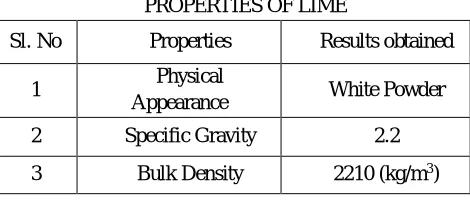
[image:3.612.128.484.102.269.2]In construction of building lime is an important binding material. It is basically Calcium oxide (CaO) in natural combined with magnesium oxide (MgO) compound possessing cementitious properties by reaction of Lime and Fly ash at ordinary temperature.
TABLE 2 PROPERTIES OF LIME
Sl. No Properties Results obtained
1 Physical
Appearance White Powder
2 Specific Gravity 2.2
3 Bulk Density 2210 (kg/m3)
C. Quarry dust
During the extraction of granite rock, quarry dust is one of the major by product. It is overcome all the drawback of river sand which is economical and eco-friendly.It can be used as an effective filler material instead of fine aggregate.
TABLE 3
PROPERTIES OF QUARRY DUST
D. Cement
Cement is a pulverised material obtained by burning a mixture of calcarious and argillaceous material at high temperature along with addition of some quantity of gypsum. Ordinary Portland Cement (OPC) 43 grade conforming to IS: 8112 – 1989 is used in this experimental work.
Sl No. Properties Results obtained
Range as per IS: 2386(part III): 1963
1 Specific
Gravity 2.56 2.54-2.600,
2 Bulk Density 1750 (Kg/m3) 1720-1810
[image:3.612.189.424.345.447.2]TABLE 4: PROPERTIES OF CEMENT (OPC 43)
E. Quantity estimation
The total quantity of each material as per the different proportion and total number of brick required for the experiment investigation is calculated in kg.
1) Fly Ash = (2.45+2.1+1.75+1.4) x 48 = 369.6 kg 2) Quarry Dust = (0.35+0.70+1.05+1.4) x 48 = 168 kg 3) Lime = (0.525 x 4) x 48 = 100.8 kg
4) Cement = (0.175 x 4) x 48 = 33.6 kg
[image:4.612.221.401.489.565.2]By assuming weight of single brick 3.5kg according IS 12894:2002, the required quantity of brick manufacture for four mix design as follows.
TABLE 5: VARIOUS MIX PROPORTION
Sl. no Fly-ash (%) Quarry dust (%) Lime (%) Cement (%) Total (%)
1 70 10 15 5 100
2 60 20 15 5 100
3 50 30 15 5 100
4 40 40 15 5 100
F. Water content for different proportions
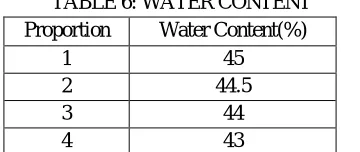
Amount of water content for different proportions was not available in IS codes and any articles were the reference was taken. It was decided with the number of trial and error methods. Finally the water content achieved for the plastic mix of the raw materials for various proportions are mentioned.
TABLE 6: WATER CONTENT Proportion Water Content(%)
1 45
2 44.5
3 44
4 43
The brick mould used for the development of fly ash based bricks was of size (190mm*90mm*90mm)i.e.,(As per IS 13757:1993).
G. Analysis of R.C.C Frame Infill using ETABS
After experiment study and obtaining optimum design mix, assign the characteristic of 28days cured brick, which having maximum required property, By using the E-TABS tool study is carried on reinforced concrete multi storied building for bare frame and with infill wall frame models. In this study infill wall is considered as a soft storey .analysis includes the effect of infills in multi storied building against seismic loading .there are mainly two infill wall that is fly ash and clay brick. Fly ash infill brick characteristics is assigned as per the result obtained by the experiments. For clay brick infill characteristics is assigned by conventional clay bricks. Types of models are,
1) Model 1-G+10 Bare frame with clay infill mass 2) Model 2-G+10 bare frame with fly ash infill mass
3) Model 3-G+10 Clay brick infilled frame with open ground storey
Sl No. Properties Results Requirementkas per IS:8112-1989 1 Specific gravity 3.15 3.15
2 Fineness 3% Not more than 10% 3 Normal consistency 30% -
4) Model 4-G+10 fly ash brick infilled frame with open ground storey
H. Detailed specification on R.C.C frame building
In model number of bays, spacing, storey height, grade of concrete, grade of steel is assumed as per the IS 1893(part-1) 2002 analysis is carried out.
1) In X-direction number of bays is 4 2) In Y-direction number of bays is 4 3) 5m Spacing in X-direction 4) 4m Spacing in Y-direction 5) Infill thickness is 230mm 6) Each storey height is 3.5 m 7) Grade of concrete M30 8) Grade of steel Fe500
9) Dimension of column (600mmx600mm) 10) Dimension of beam (230mmx450mm) 11) Live load 3.5kN/m2
12) Floor finish 1.5kN/m2
13) Seismic zone: zone 3
I. Properties of infill brick material 1) Fly ash brick bricks infill
Material type: Isotropic Mass/volume: 1715 Kg/m3
Weight/volume: 17 kN/m3
Modulus of elasticity: 5302 N/mm2
Poisson’s ration: 0.16
Compressive strength: 9.64 N/mm2
2) Clay brick infill Material type: Isotropic. Mass/volume: 1800 Kg/m3
Weight/volume: 18 kN/m3
Modulus of elasticity: 1925 N/mm2
Poisson’s ratio: 0.16
Compressive strength: 3.5 N/mm2
IV.RESULTSANDDISCUSSION
Materials used for experimental investigation are satisfied the required condition. The results obtained are discussed and reported in tables and graphs.
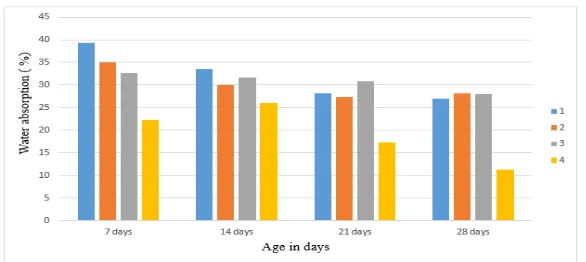
[image:5.612.166.459.581.712.2]A. Water Absorption
Observation: The water absorption for various proportions is altering to a large extent with respect to the mix. The water absorption is maximum in the curing period for 7 days for the first proportion (39.37%) while it is decreased in the fourth proportion for the curing period of 28 days (11.28%).
[image:6.612.172.455.140.372.2]B. Compressive strength of bricks
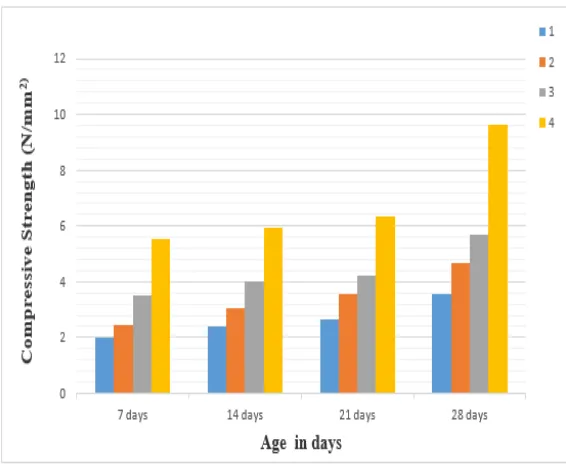
Fig. 2 Graph of compressive strength versus age in days
Observation: it is observed the of compressive strength is the main criteria for the conclusion of mechanical properties, here the compressive strength was conducted for various proportions of fly ash and quarry dust and clear observation was made for 7, 14, 21 and 28 days strength. Results obtained vary from 1.98 to 3.57 MPa for the first proportion, 2.47 to 4.68 MPa for the second
proportion, 3.50 to 5.67 MPa for the third proportion and 5.55 to 9.64 MPa for the fourth proportion. Compressive strength is maximum in the case of fourth proportion due to the presence of 40% of quarry dust and 40% of fly ash.
C. Flexural strength of bricks
Fig. 3 Graph on flexure strength versus age in days
[image:6.612.179.447.494.646.2]dust to a greater extent.
D. Cost Feasibility
The cost of the brick from first proportion is cheapest and is goes on increasing with the proportion. The fourth proportion has the maximum rate of Rs. 2.98 per brick but that too is less when compared to the normal clay bricks. The cost of a brick is almost half when compared with the normal clay bricks. Hence the Fly Ash based bricks developed in the laboratory is economic one.
E. Results of Model Analysis
[image:7.612.175.457.238.420.2]After experiment study fourth proportion of 28 days cured having higher quality .analysis is carried on by assigning required characteristic of fourth proportion developed fly ash bricks and it is compared with conventional clay bricks. Soft storey building frame used for the analysis. Analysis is carried by two type of model that is bare frame model and infill model, for both fly ash and clays brick.
Fig. 4 Infill model and Bare model
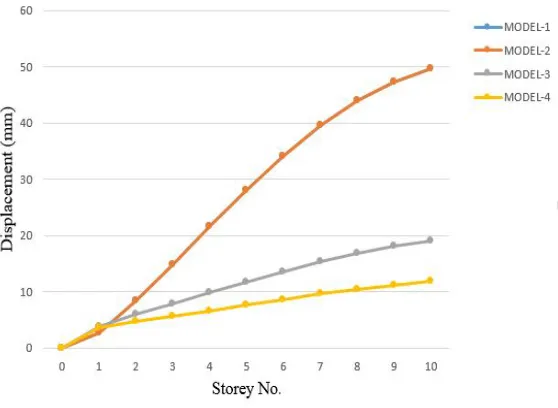
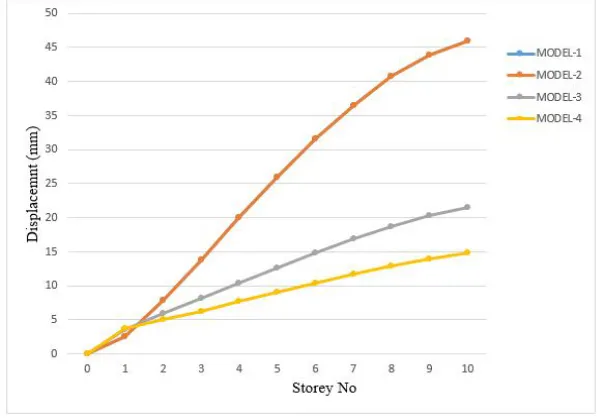
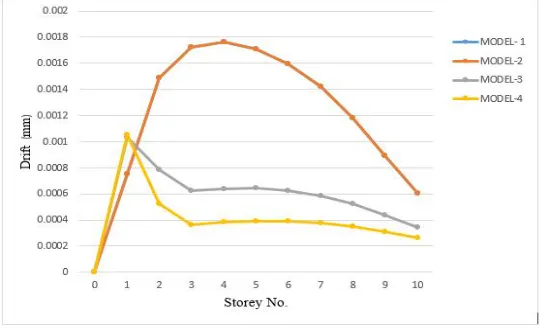
After the analysis it is absorbed that displacement and storey drift in X direction is maximum for load combination Dcon8 that is 1.5(dead+EQX).In Y direction maximum displacement and storey drift having in load combination Dcon10 that is 1.5(dead+EQY).EQX is lateral load in X direction and EQY is lateral load in Y direction.
1) Story displacement
[image:7.612.197.476.499.703.2]By the above graph model-1 and model-2 having same value, which is overlapped in graph, it is clear that by adding masses of infill weight it not give effective result on seismic loads. Fly ash infill model-4 having 1.6 times the lesser displacement that of model-3 which having clay brick infill. Thus it is observed that fly ash brick infill model provides higher stiffness to frame when compare clay brick model.
Fig. 6 Graph of storey versus displacement in Y direction
By the above graph model-1 and model-2 having same value, which is overlapped in graph, it is clear that by adding masses of infill weight it not give effective result on seismic loads.Model-4 having lower displacement when compare to other three models. Displacement in Y direction in linearly reduces from model-2 to model-4. Fly ash infill model-4 having 1.4 times the lesser displacement that of model-3 which having clay brick infill. Thus it is observed that fly ash brick infill model provides higher stiffness to frame when compare clay brick model.
2) Story drift
Fig. 7 Graph of storey versus drift in X direction
[image:8.612.186.478.458.634.2]Fig. 8 Graph of storey versus drift in Y direction
By the above graph model-1 and model-2 having same value, which is overlapped in graph, it is clear that by adding masses of infill weight it not give effective result on seismic loads.Model-4 having lower storey drift when compare to other three models storey drift in Y direction in linearly reduces from model-2 to model-4 after storey1. Fly ash infill model-4 having 1.8 times the lesser storey drift that of model-3 which having clay brick infill. Thus it is observed that fly ash brick infill model provides higher stiffness to frame when compare clay brick model.
V. CONCLUSIONS
A. Few important conclusions are drawn by the experimental results obtained in the laboratory.
1) The Compressive Strength, Flexural Strength and Bulk Density of the fourth proportion bricks is higher on 28 days age of curing.
2) Water Absorption of the fourth proportion bricks is minimum on 28 days of curing.
3) Regarding cost feasibility too, fly ash bricks are economical than first class conventional bricks. 4) Fly ash bricks are lightweight, due to large mass of fly ash in every proportion.
5) Fly ash brick infill provides the more stiffness to the frame which reduce the effect of lateral load when compare to conventional bricks.
6) During the analysis of any building it is necessary to consider have infill characteristic which gives effective results.
VI.ACKNOWLEDGMENT
The heading of the Acknowledgment section and the References section must not be numbered.
Causal Productions wishes to acknowledge Michael Shell and other contributors for developing and maintaining the IEEE LaTeX style files which have been used in the preparation of this template. To see the list of contributors, please refer to the top of file IEEETran.cls in the IEEE LaTeX distribution.
REFERENCES
[1] Mehta P. K, Duggal S,Abhishek Kumar, K, Tabin Rushad S, Experimental Studies on Lime-Soil-Fly Ash Bricks,International8journal Of Civil And Structural Engineering .Vol.1, No.4, 2011
[2] Prof. Jayeshkumar Pitroda, Nutan C. Patel, Fly Ash Brick:Glass Fibre The Innovative Concept For Getting Higher Strength Brick. International Journal of Innovative Research in Science, Engineering and Technology ,Vol. 2, Issue 3, March 2013
[3] A.Sumathi ,K.Saravana Raja Mohan,Compressive Strength Of Fly Ash Bricks. International Journal of ChemTechResearch CODEN(USA):IJCRGGISSN:0974-4290 Vol.7, No.01, pp 28-36 .2014-2015
[4] H N Rajendra Prasad1, H G Vivek Prasad2, D Yogesh Gowda4, Nikitha Marina Lobo5 and Sree Pushpak Gowda U S6, An Approach For.Alternative Solution In Brick Manufacturing. International Journal of Science, Environment ,ISSN 2278-3687 (O) and Technology, Vol. 3, No 3, 2014, 1105 – 1114. [5] Hashim K Abdul Azeez3, Nesiya Yoosaf1, Remya Raju2, Comparative Study of Multi-storeyed RC Building With Open Ground Storey Having Different
Type Infill Walls. International Journal of Engineering Trends and Technology (IJETT) – Vol.28, No.7, October 2015
[6] Aakash Suresh Pawar , International Journal Of Research in Engineering and Technology, Engineering properties of clay bricks with use of fly ash. Vol. 2, No.04.2014
[8] Md.Irfanullah1And.Viswanathan.B.Patel2,Sesmic8analysis.of.RC.Frame.Building.With,Influence.of.Infill7panel,International5journal1of8recent.Technology. and.Engineering, ISSN;2277-3878 ,Vol.2.Issue-4,September 2013.
[9] Mohammad H.Jinya,V.R.Patel,Analysis Of Rc Frame With And Without Masonry Infill Wall With Different Stiffness With Outer Central Opening,International Journal Of Research In Engineering Of Technology,Vol.3, Isssue;6.Jan-2014.
[10] Shaharban P.S, Manju P.M,Behaviour Of Reinforced Concrete Frame With Infill Walls Under Sesmic Loads Using Etabs,International Journal of Civil Engineering And Technology,Vol.5,Issue 12,December-2014.
[11] IS: 13757 = 1993: Burnt Clay Fly Ash Building Bricks.
[12] IS:3812 = 1981: Fly ash for use as pozzolana & admixtureReaffirmed 1992. [13] IS:6491 = 1972: Method of sampling of fly ash.