Analysis and Classification of Software
Engineering Risks
Rashmi Dhruv
Guru Premsukh Memorial College of Engineering(GGSIPU,Delhi)
Abstract—Despite various methods that exist in software risk management, software projects have a high rate of failure. When complexity and size of the projects are increased, managing software development becomes more difficult. In these projects the need for more analysis and risk assessment is vital. In this paper, a classification for software risks is specified. Then relations between these risks using risk tree structure are presented. Analysis and assessment of these risks are done using probabilistic calculations. This analysis helps qualitative and quantitative assessment of risk of failure. Moreover it can help software risk management process. This classification and risk tree structure can apply to some software tools.
Keywords—Risk analysis, Risk assessment, Risk classification, Risk tree.
I. INTRODUCTION
Software project management (SPM) has become a critical task. It involves the management of all issues involved in the development of software project namely scope and objective identification, evaluation, planning, project development methods, software effort and cost estimation, activity planning, monitoring and control, risk management and resource allocation [1,2,3].
Software projects face many risks in their lifecycle. Risk is any potential situation or event that could negatively affect a project's ability. A risk is an exposure to loss or injury or a factor, thing, element, or course that involves uncertain danger [4, 19, 20]. Project Risk Management Institute has developed guidelines for risk management. These guidelines include risk management planning, risk identification, qualitative risk analysis, quantitative risk analysis, risk response planning and risk monitoring and tracking. For each step, it defines inputs, tools, techniques and outputs [21].
Software risk management is a part of SPM. It is very important for software projects. Software risk management steps were presented by Barry Boe hm [5] and possess two primary steps. The first one is risk assessment and the second is risk control. Risk assessment involves risk identification, risk analysis and risk prioritization. Risk identification produces a list of the project risk items using several techniques [6, 7, 8]. Risk analysis assesses the loss probability and loss magnitude for each identified risk and risk prioritization produces a ranked ordering of the risk items identified and analyzed. Various methods exist for risk
analysis[3].The risk management cycle represents basic
activities, processes and main flows of information between them [9]. But in this paper, we concentrate on risk analysis and assessment.
This paper is organized as follows: in section II software risk management is discussed. In section III classifications of software risks are presented. In section IV, the structure of risk tree and its probabilistic calculations is introduced. In section V risk tree structures for software engineering risks are presented. The conclusions are given in section VI.
II. SOFTWARE RISK MANAGEMENT
There are many concepts about software risk management [6, 7, 8, 9]. But in this section some cases and processes that serve in software risk management which is required for our structure have been discussed.
A. Risk Index
As risks are identified, they can be categorized by impact (I) and likelihood of occurrence (LO). When these two factors are multiplied, risks can be characterized as high, medium, or low. Risk prioritized within a risk index (RI) by a single measure that determines its importance to the project and the relative visibility, response and reporting required. This index is necessary for prioritization of risk [6, 19].
B. Risk Analysis
project. The outcome of the risk analysis would be the creation or review of the risk register to identify and quantify risk elements to the project and their potential impact.There are a few well-known types of risk analysis that can be used [21]. In software engineering, risk analysis is used to identify the high-risk elements of a project. It provides ways of documenting the impact of risk mitigation strategies. Risk analysis has also been shown to be important in the software design phase to evaluate criticality of the system, where risks are analyzed and necessary countermeasures are introduced [13]. The purpose of risk analysis is to understand risk better and to verify and correct attributes. A successful analysis includes essential elements like problem definition, problem formulation, data collection [14].
C. Risk Assessment
Risk assessment incorporates risk management and risk analysis. Many risk assessment methodologies exist [15] that focus on different types of risks. Risk assessment requires correct descriptions of the target system and all security features. For assessment to be useful, a risk referent level must be defined. For most software projects; performance, cost, support and schedule also represent risk referent levels [6, 8].
III. RISK CLASSIFICATION
The primary purpose of classifying risk is to get a collective viewpoint on a group of factors, which will help the managers to identify the group that contributes the maximum risk. A scientific way of approaching risks is to classify them based on risk attributes. Risk classification is an economical way of analyzing risks and their causes by grouping similar risks together into classes [21].
Software risks can be internal or external. The internal risks come from risk factors within the organization. The external risks come from out of the organization and are difficult to control. Software risks can be grouped into project risks, process risks, and product risks. This classification system can be easily applied to internal risks [16, 17, 18].
Risks can be divided into three general types [22]: project, business, and technical risks. Also, software development risk can be classified into three classes: product engineering, development environment and program constraint. Another type of software risk can be grouped into scheduling risks and quality risks. In addition, risks can be categorized into performance risks, cost risks support risks and schedule risks [6]. In general, there are many risks in the software engineering. It is very difficult or impossible to identify all of them.
A. Classifying Software Risks
In this section software engineering project risks are categorized. Software project risks can affect requirements, scheduling, cost, quality and business. Therefore, classification on the basis of these groups can be done. Tables I to IV represent these classifications. These risks are gotten through studies and experiences in projects.
TABLE I
SOFTWARE REQUIREMENT RISKS
Lack of analysis for
change of Change extension of
Requirem ent
requireme nts Lack of report for
requirements Poor definition of requirements Ambiguity of
requirements Change of requirements Inadequate of
requirements Impossible requirements Invalid requirements
TABLE II SOFTWARE COST RISKS
Lack of good estimation in projects
Unrealistic schedule The hardware does not
work well Human errors
Lack of
testing Lack of monitoring
Complexity of
architecture Large size of architecture Extension of
requirements change The tools does not work well
Personnel change Management change
Technology change Environment change
Lack of reassessment of management cycle
TABLE III
SOFTWARE SCHEDULING RISKS
Inadequate Budget Change of requirements Extension of requirement
change
Human Errors
Inadequate Knowledge about tools
about techniques
Long term training for personnel
Lack of employment of manager experience Lack of enough skill Lack of good
Estimation in Projects Lack of accurate system
domain Definition
Lack of Goals specifications
Difficulty of implementation
Disagreement between members
Lack of tools Shortage of personnel Tools Failure Technology change Lack of agreement
between customer and developer
Slow management cycle
Supply budget in inappropriate time
Environment Change
[image:4.612.50.565.94.550.2]Lack of good guidelines
TABLE IV
SOFTWARE BUSINESS RISKS
The products that no one want them
The products that are not suitable with total strategy The products that sellers do not know how to sell them
Failure in total budget Failure in committment
Failure in management because of change in different people
IV. RISK TREE
Risk tree analysis and assessment can simply be described as an analytical technique. It is a graphical model of various combinations of risks that result in the occurrence of the predefined undesired event. To analyze using risk tree, it is necessary to specify the undesired state of the system. This state may be the failure of the system or of a subsystem. Then a list is made of all the possible ways in which these events can occur. Each of the possible ways is then examined independently to find out how it can occur [23].
A. Risk Tree Construction
Risk tree possesses many events. The lowest level events are called primary events. In the middle, intermediate events exist and the highest level event is called the top event. Also, all the events are connected in a tree by gates that show the relationship between successive levels of the tree.
Generally, the risk tree is represented by three types of graphic symbols: logic gates, events and transfer triangles. Risk tree depicts the logical interrelationships of the basic events that lead to the top events [23, 24].
B. Risk Tree Assessment
The probabilistic assessment of risk tree consists of calculating the probability of a top event starting from the probabilities of the primary events. But this can be done directly when the risk tree does not have any repeated events. When the risk tree possesses repeated events, for exact calculations, minimal sets of the risk tree should be passed [24]. The risk tree model can be converted into a mathematical model to compute the probabilities. The example of "AND" and "OR" operators are represented in Fig. 1 and Fig. 2 and equations for them are also shown [24]:
Fig. 1 AND Gate Fig. 2 OR Gate
P(S) =P (A).P (B) (1)
P(S) =1-(1-P (A)) (1-P (B)) (2)
In general, equation for AND gate is shown in following formula:
P= (3)
Also the equation for OR gate is shown in following formula:
P=1- (4)
Equivalent probability equation for OR gate is also presented in following relation:
P(S)=P(A)+P(B)-P(A).P(B)=1-(1-P(A))(1-P(B)) (5)
In above equations, nis the number of input events to the gates, piis the probability of failure of the input events and it is assumed that the input events are independent. But if the inputs are dependent on each other, the equations will be changed. The following equation is used for AND gate that inputs are dependent:
P(S) =P (A).P (B|A) =P (B).P (A|B) (7) And for OR gate is:
S= A B (8)
P(S)=P(A)+P(B)-P(A∩B)=P(A)+P(B)-P(A).P(B|A) (9)
Some risk events are dependent on each other. If one of them does not occur, the other one does not occur either. Perhaps two or more risks must happen simultaneously to result in a top event. These risks can be shown with AND gates. Maybe risks are dependent on each other and if only one of them occurs, a top event is created. These risk events can be shown with OR gates.
V. SOFTWARE RISK TREE STRUCTURES
The risk events in software engineering projects can be associated with component hardware failures, human errors, software component failure or any other pertinent events that can lead to the undesired outcome. Either one can result in a top risk. The top risk can be cost risks, schedule risks, quality risks, maintenance risks, business risks or risks that are not foreseen. In this section, structure of risk tree for classifications that are shown in section III is presented.
A. Software Requirements Risk Tree
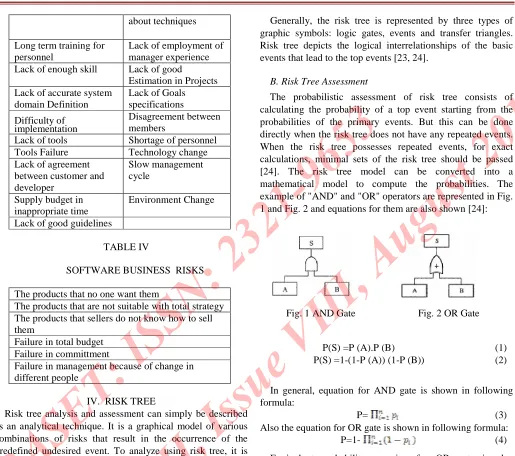
Software engineering requirements face risks which are represented. In this section the risk tree structure for them are proposed. Software requirements risk tree model is presented in Fig. 3. For example in this tree, inadequate report and unclear report are two events that if occur together, the ambiguous requirements happens, so they are connected with AND gate. For assessing the probability of top event, probability starting from primary events should be calculated. Each event is specified by a variable and labels L1, L2, and L3are outputs of gates which are represented in
Fig. 3. Their probability relations are shown in following relations:
P (A) =P (a1).P (a2) (10)
P(C) =1-(1-P (a3)). (1-P (A)) (11)
P (B) =1-(1-P (a6)). (1-P (a7)) (12)
P (L1) =1-(1-P (a4)). (1-P (a5)) (13)
P (L2) =1-(1-P (B)). (1-P (a8)) (14)
P (L3) =P (L2).P (a9) (15)
P (D) =1-(1-P (C)). (1-P (L1)). (1-P (L2)).(1-P(L3)) (16)
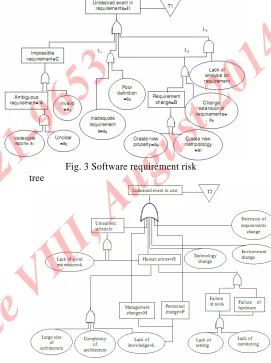
B. Software Cost Risk Tree
Software cost risks depend on the cost of the projects. These risks damage software projects and increase the cost
[image:5.612.317.588.150.513.2]of them. Some events exist that are caused by human errors. Human errors also result in unrealistic schedule. These relationships and other risk events are represented in Fig. 4.
Fig. 3 Software requirement risk tree
Fig. 4 Software cost risk tree
The probability evaluation is also calculated like previous section. In this tree, some events possess equal probabilities. Following relations depend on these events:
P (H) =P (K) (17)
P (L) =P (M) =P (P) (18)
C. Software Quality Risk Tree
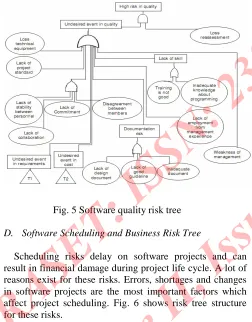
[image:5.612.51.296.412.658.2]disagreement between customer and developer, etc. In Fig. 5, these relationships are shown by risk tree.
[image:6.612.319.566.102.332.2]The risks that are mentioned and shown for requirements and costs can affect the quality of software. Therefore, transfer symbol is used in quality risk tree. Transfers "T1" and "T2" point to the software requirement risk tree and software cost risk tree. There are sub-trees of software quality risk tree. All the previous calculations for these two sub-trees, can be used in software quality risk tree. The large size of the quality risk tree indicates that many risks treat quality of software projects.
Fig. 5 Software quality risk tree
D. Software Scheduling and Business Risk Tree
Scheduling risks delay on software projects and can result in financial damage during project life cycle. A lot of reasons exist for these risks. Errors, shortages and changes in software projects are the most important factors which affect project scheduling. Fig. 6 shows risk tree structure for these risks.
[image:6.612.51.303.256.578.2]Business risks endanger projects and products, threatening the durability of the projects after production. Each of the factors that are listed in table IV can connect together with OR gate to construct risk tree structure for business risks.
Fig. 6 Software scheduling risk tree
E. Risk Tree Analysis and Assessment Method
In risk tree analysis method, software risks are classified at first. Then risks are identified in each group. Afterwards, primary or basic risk events, intermediate events, top event, and the necessary sub-tree are found. All these require that managers have a complete knowledge about the projects. Then the risk tree can be constructed. Likelihood and impact must be assigned to each event and failure. Then probabilities starting from primary events to the top event are calculated. The events are ordered according to their probabilities. Maximum probability indicates the importance of those events; therefore, it is necessary to attend more to them. Managers should use solutions to prevent risks from occurring or reduce undesirable incidents.
The presented classifications and risk tree structures can apply with some software tools. Fault Tree Creation and Analysis Program, Fault Tree Tool or Relax Fault Tree can be used for this analysis. These tools have facilities that help users to create tree symbols and construct the risk tree structures.
VI. CONCLUSION
projects qualitatively and quantitatively.
This approach is concentrated on analysis and assessment. In general it helps software risk management process. Probability of each event, especially top event can be calculated. In this model the evaluating risks is also possible. Ranking these probabilities assist managers to find high-risk events and prioritize them. This can result in more attention to be paid to high risk events. It allows the managers to apply suitable approaches to these events to reduce or prevent risks. Also, it can help managers to manage software risks and calculate the probability of the top event for risks separately.
Some software tools are introduced in this paper. These tools can use the classifications and structures are presented in this paper to create software risk tree.
REFERENCES
[1] Rita C. Nienaber, Andries Barnard, "A Generic AgentFramework to Support the Various Software Project Management Processes", Interdisciplinary Journal of Information, Knowledge, and Management,
Vol. 2, 2007
[2] Ronald P. Higuera, Yacov Y. Haimes, "Software Risk Management", Carnegie Mellon University, Pittsburgh, 1996
[3] Ray C.Williams, Goerge J.Pandelios, Sandra G.Behrens, "Software Risk Evaluation Method Description", version 2.0, Software Engineering Institute,Carnegie Mellon University, 1999
[4] Anatoliy Antonov, Vladimir Nikolov, Yanka Yanakieva, "Risk Simulation in Project Management System", International Conference on Computer Systems and Technologies- Compsystech, 2006
[5] Barry W. Boehm, "Software Risk Management Principles and Practices", Defense Advanced Research Projects Agency, IEEE Software, 8(1): 1991, PP. 32-41
[6] Roger S. Pressman, Ph.D., "Software Engineering a Practitioners Approach", 5th Edition, McGraw-Hill, 2001, pp. 145-159
[7] Marcio de Oliveira Barros, Claudia Maria Lima Werner, Guilherme Horta Travassos," Supporting Risks in Software
Project Management", The Journal of Systems and Software, Published by Elsevier Inc, 2002
[8] Ayad Ali Keshlaf, Khairuddin Hashim, "A Model and Protorype Tool to Manage Software Risks", First Asia-Pasific Conferance IEEE, 2000
[9] Jyrki Kontio, "The Riskit Method for Software Risk Management", version 1.00, Institute for Advanced Computer Studies and Department of Computer Science, University Of Maryland ,1999
[10] Linda. Westfal, "Software Risk Management", the Westfal Team, 2001
[11] Jakub Miller, Janusz Gorski, "Risk Identification Patterns for Software Projects", Published in Foundations of Computing and Decision Sciences, Vol. 29, No. 1-2, 2004, PP. 115-131
[12] Lawrence E. Hyatt, Linda H. Rosenberg, Ph.D., "A Software Quality Model and Metrics for Identifying Project Risks and Assessing Software Quality", 1996
[13] Yudistira Asnar, Paolo Giorgini, "Risk Analysis as part of the Requirements Engineering Process" University of Trento, Department of Information and Communication Technology, 2007
[14] Bryan L. McKinney, David R. Engfer, "Formulating Risk into Research and Engineering Projects", Crystal Ball User Conference, 2004
[15] Aagedal J. O., den Braber F., Dimitrakos T., Gran B. A., Raptis D., Stolen K., "Model-based Risk Assessment to Improve Enterprise Security", 5th International Enterprise Distributed Object Computing Conference ,
Switzerland, IEEE, 2002, PP. 51-62
[16] Marvin J. Carr, Suresh L. Konda, Ira Monarch, F.Carol Ulrich, Clay F.Walker, "Taxonomy-Based Risk Identification", Carnegie Mellon university, Pittsburgh Pennsylvania, 1993
[17] Robert Armstrong, Gillian Adens, "Management Software Project Risk", 2004
[19] Daniel D. Galorath, Michael W. Evans, "Software Sizing Estimation and Risk Management", Auerbach Publications, United States of America, 2006, pp. 339-393
[20] Philippe Kruchten, "The Rational Unified Process an Introduction",Third edition, Addison Wesley, 2003, chapter 7
[21] C.Ravindranath Pandian, "Applied Software Risk Management a Guide for Software Project Managers", Auerbach Publications, United States of America, 2007, Chapters 2,3,5
[22] John D. McGregor, David A. Sykes, "A Practical Guide to Testing Object-Oriented Software", Addison-Wesley, 2001, pp. 87-92
[23] Yacov Y. Haimes, "Risk Modeling, assessment, and Management", second edition, John Wiley & Sons, INC., Publication, 2004, pp. 525-540