Software Project Selection Under Requirement
Perspective
Santanu Kr. Misra#1, Bijoyeta Roy*2
1,2
Department of Computer Science and Engineering, Sikkim Manipal Institute of Technology
Abstract—The primary aim of this paper is to develop and demonstrate an integrated model by which selection of suitable software project based on specific requirements for any organization can be easily done. In this paper, an integrated model is proposed by combining AHP, DEMATEL, and QFD into a single evaluation model in a multi-criteria environment. The proposed integrated model firstly identifies the technical requirements followed by the customer requirements. AHP method of this approach finds the priority values among alternatives based on each technical requirement. DEMATEL method identifies the weights of customer’s requirements. Finally QFD method finds the overall score among all alternatives. The numerical results show that the new approach is superior to standard methods for software project selection and also presents indexing among alternatives to show the optimality and robustness of the proposed model. This research does not consider the time constraints. It makes a significant contribution to any organization where one can compare the financial performance of the organization by selecting the right decision model.
Keywords— Software selection, AHP (Analytical Hierarchy Process), DEMATEL (Decision Making Trial and Evaluation Laboratory), QFD (Quality Function Deployment), Multi-criteria environment.
I. INTRODUCTION
The demand for dependable and qualitative software packages is unceasingly growing. In response to support this demand software companies have been producing variety of software packages that are customizable and tailored to meet specific needs of the organization. Severe market competition has dramatically transformed the business environment with the result that companies need to reduce total costs, maximize return on investment, and shorten lead times, and be more responsive to customer demands. Highly dynamic markets call for effective software systems to enhance competitive advantage (Wei et al., 2005). Software automates and integrates the business processes and allows information sharing in different business functions. In addition software supports the finance, human resources, operations and logistic aspect, sales and market and other business processes. At the
same time it improves the performance of the organization’s
function by controlling those factors (Hallikainen et al., 2006). Although organization can develop their own software, however other ones may prefer ready product to shorten application cycle. The vendors sell software which is developed in different operating system and available database in market. The best suitable software product selection yields
positive results like increasing productivity, timely delivery, reduction of setup time, reduction of purchasing cost. The task of software package selection has become more complex due to (i) difficulty in accessing applicability of software packages to the business needs of the organization due to availability of large number of software packages in the market, (ii) existence of incompatibilities between various hardware and software systems, (iii) lack of technical knowledge and experience to decision makers, and (iv) ongoing improvements in information technology (Lin et al., 2006). Other perspectives on software selection focus on the criteria that organizations consider in selecting commercial software (Wei et al., 2005). Therefore in this selection multi criteria decision making approach plays an important role. Multi criteria decision making (MCDM) approach is used in order to: (1) Help decision-makers to choose the best criteria from
specific requirements considering both qualitative and quantitative factors.
II. LITERATURE REVIEW
In recent literature regarding the software selection ( Sen. and Baracl, 2010) emphasized a fuzzy quality function deployment approach for determining which of the
non-functional requirements are important to a company’s
software selection decision, based on and integrated with its functional requirements. Solution provided in this study not only assists decision makers in acquiring software requirements and defining selection criteria, but also supports determining the relative importance of these criteria.
Previously the authors (Sen et al., 2009) in their paper “An
integrated decision support system dealing with qualitative
and quantitative objectives for enterprise software selection”
proposed a hierarchical objective structure that contains both qualitative and quantitative objectives are used to evaluate software products systematically [9]. This approach uses a heuristic algorithm, a fuzzy multi-criteria decision making procedure and a multi objective programming model to make final selection decision. (Dias-Neto and Travassos, 2009) proposed a strategy to select model-based testing approaches for software projects called Porantim [8]. Porantim is based on a body of knowledge describing model-based testing approaches and their characterization attributes and a process to guide by adequacy and impact criteria regarding the use of this sort of software technology that can be used by software engineers to select model-based testing approaches for software projects. (Kettunen and Laanti, 2005) in their literature proposed a comparative selection model. Some real-life project case examples are examined against this model. The selection matrix expresses how different process models answer to different questions, and indeed there is not a single process model that would answer all the questions. This paper investigates the software process model selection in the context of large market-driven embedded software product development for new telecommunications equipment. ( Jadhav and Sonar, 2011) emphasized (i) generic methodology for software selection, (ii) software evaluation criteria, and (iii) hybrid knowledge based system (HKBS) approach to assist decision makers in evaluation and selection of the software packages [2]. That also evaluates and compares HKBS approach with the widely used existing software evaluation techniques such as analytic hierarchy process (AHP) and weighted scoring method (WSM). (Claudia Ayala et al., 2011) discusses about the actual industrial practice of component selection in order to provide an initial empirical basis that
allows the reconciliation of research and industrial endeavors. (Yazgan et al., 2009) proposed an ANN model has been designed and trained with ANP results in order to calculate ERP (Enterprise Resource Planning) software priority. The artificial neural network (ANN) model is trained by results obtained from ANP [1]. In literature majority of methods tried to reduce the comparisons required to evaluate appropriate one from many application against many requirements with the help of some process. (Ghorbani and Rabbani,2009) proposed multi-objective algorithm for project selection problem by increasing expected benefits and minimize the absolute variation of allotted resource between each successive time periods. (Vidal et al., 2011) defines a measure of project complexity in order to assist decision-making when analyzing several projects in a portfolio, or when studying different areas of a project. (Wei et al., 2005) proposed an AHP based solution for ERP selection. (Badri et al. 2001) presented a 0–1 goal programming model to select an IS (Information System) project considering multiple criteria including benefits, hardware, software and other costs, risk factors, preferences of decision makers and users, completion time, and training time constraints. (Lai et al., 1999) discussed a case study for selecting a multimedia authoring system using the AHP method. After gone through all these literature, it is clear that there is hardly any literature which focuses on the selection of software product based on organizational requirements. Rather maximum literatures focuses on to reduce the complexity of risk factors, reduce complexity of selection process, motivates on quantitative and qualitative factors for software selection. Some of the literature focuses on the AHP based priority ranking but do not get indexation using sensitivity analysis for robustness of the selection process. Since AHP is based on the subjective judgment of the decision makers, therefore error is inevitable in the system. To reduce the error researchers use integration of subjective factor measure and objective factor measure. In this model AHP provides priority values of the alternatives, DEMATEL provides weights of criteria. Combining these two, QFD finds ranking of alternatives. DEMATEL is one of very efficient multi criteria decision making method but hardly appears in the past literature review for software selection purpose. Therefore, extensive literature review reveals the following drawbacks of the existing methodologies:
Robustness of the system has not been discussed in the existing models.
In most of the cases, researchers focus on the flexibility rather optimality and the system does not give the optimal ranking.
Our model extends the previous work that uses fuzzy QFD done by (Sen. and Baracl, 2010), for ranking of the alternatives. The extensions of our approach target the following observations on existing models:
The proposed model for software selection encounters all these above limitations and extends in several ways. The objective of the model is to select appropriate software for an organization having maximum capacities of technical requirements and customer requirements. In this model, integrated AHP, DEMATEL, and QFD propose the selection model for the efficient software considering both qualitative and quantitative aspects.
The organization of the paper is as follows. The next section highlights the problem definition, and then the subsequent sections discuss the procedures of the proposed model and the validation of the proposed model giving a numerical application of the proposed model. Finally it highlights the outcomes and benefits of the proposed model under the heading of discussion and conclusion.
III. PROBLEM DEFINITION
The analytical model for software selection under Multi-Criteria Decision Making (MCDM) approach is to reduce the amount of manual work done by the decision-makers to select an efficient and robust software package for the organization. Selection of inappropriate software package affects business processes and functioning of the organization. MCDM approach refers to making preference decisions over the available alternatives using specified criteria. Goal of MCDM is: (i) To help decision-makers to choose the best alternatives, (ii) To sort out the alternatives that seems good among the set of available alternatives, and (iii) To rank the alternatives in decreasing order of performance. The task of software selection is often assigned under schedule pressure and evaluators may not have time or experience to plan selection process in detail. Hence, selecting a software package that caters to
the needs of the organization is time-consuming. Thus, a need for an efficient approach was felt which will solve all the problems. The aim of the work is to design an analytical model to ease the software selection process satisfying MCDM approach. The proposed analytical model has the quality to decide whether a software package will be feasible or not for an organization. In this connection the following criteria are taken into consideration:
Customer’s criteria: Attractive technology, throughput, reliability, license cost, and security.
Technical criteria: Communication protocol support, upgradability, backward compatibility, modularity.
In a typical organizational scenario four different software packages that are prospective to fulfil the organizational requirements are taken into consideration. The proposed model will provide optimum ranking among the alternatives and makes decision makers effectual to take robust decision.
IV. APPLIED METHODS A. Analytical Hierarchy Process (AHP)
The Analytical Hierarchy Process is a powerful and flexible multi criteria decision making method that can be applicable in variety of decision making situation from simple to complex situation. It is specially used to quantify managerial judgment of the relative importance of each of several conflicting criteria used in decision making process. In this method a problem is put into a hierarchical structure as follows:
a) The overall objective of the decision. b) Factors or criteria for the decision. c) Sub factors under those factors. d) Decision option.
The steps involved in AHP model are as follows:
Step-1: List the overall goal, criteria and decision alternatives. Step-2: Develop a pair wise comparison matrix. Rate the relative importance between each pair of decision alternatives
The matrix lists the alternatives horizontally and vertically and has the numerical rating comparing the horizontal (first) alternative with the vertical (second) alternative.
Step-3: Develop a normalized matrix by dividing each number in a column in the pair wise comparison matrix by its column sum.
Step-4: Develop a priority vector. Average each row of the normalized matrix. The row average forms the priority vector of alternative preferences with respect to the particular criterion.
Step-5: Calculate the consistency ratio [CI, RI and CR]. Calculate the eigenvector or the relative weights and for each matrix of order n. Compute consistency ratio using , RI= Random Inconsistency = and CR= . The acceptable CR range varies according to the size of matrix. That is 0.05 for the 3 by 3 matrix, 0.08 for a 4 by 4 matrix and 0.1 for all larger matrices, n>=5.
Step-6: Develop the overall priority vector by multiplying normalized matrix of criteria with the priority matrix of decision alternatives which is formed with priority vectors of different criteria. With this priority values judgment can be taken. [3,7]
B. DEMATEL (Decision-Making Trial and Evaluation Laboratory)
DEMATEL method, originally developed by the Science and Human Affairs Program of the Battelle Memorial Institute of Geneva between 1972 and 1976, is to study and resolve the complicated and intertwined problem group through undertaking of specific problematique, the cluster of intertwined problems and contribute to identification of workable solutions by a hierarchical structure ( Hsin-Hung et al., 2010).This method is one of structural modeling techniques which can identify the interdependence among the elements of a system by portraying the basic concept of contextual relationships and the strength of influence among the element [9]. The procedure of DEMATEL method according to (Hsin-Hung et al, 2010), (Liang and Gwo-Hshiung, 2011), (Tinghao and Kuo-Shun, 2012) is as follows: Step 1: Compute the average matrix. Each respondent was asked to evaluate the direct influence between any two factors
by an integer value from 0, 1, 2 and 3, representing no influence, low influence, medium influence and high influence, respectively. The notation of represents the degree to which the respondent believes factor i affects factor j. For i = j, the diagonal elements are set to zero. For each respondent an n x n non-negative matrix can be presented as , where, k is the number of respondents with and n is the number of factors and , , ,….., are the matrices from H respondents. To take into account all opinions from H respondents, the average matrix
is as follows:
(1)
Step2: Calculate the normalized initial direct-relation matrix D by
, D= A x S (2)
where (3)
and each matrix D falls between zero and one.
Step 3: Calculate the total relation matrix T by , where I is the identity matrix. Define r and c as sum of rows and sum of columns of matrix T, respectively. Suppose be the sum of i-th row in matrix T, then summarizes both direct and indirect effects given by factor i to the other factors. If denotes the sum of j-th column in matrix T, then shows both direct and indirect effect by factor j from the other factors. When j= i, the sum shows the total effects give and received by factor i. Thus + indicates the degree of importance that factor i plays in the entire system. In contrast, the difference
depicts the net effect that factor i contributes to the system. Step 4: Calculate the normalized degree of importance of all factors using formula .
Quality Function Deployment (QFD) is a structured, multi-disciplinary technique for product definition that maximizes value to the customer. The application of the QFD process is an art that varies somewhat from practitioner to practitioner. Using QFD model a company can translate customer requirements (CR) to business or technical requirements (TR) that will be implemented. The needs of the customer are generally stated a vague language. Thus, QFD requires a
matrix to interpret the customer’s voice in reaching their goal.
The task of the QFD team is to list the technical requirements (TRs). These requirements are most likely to affect the CRs.
The QFD team evaluates how the competitors’ compare among themselves and achieved the customer’s satisfaction.
This evaluation helps to fix technical targets [12]. From the QFD matrix, the discrepancies, if any, between the customers’
perception and the QFD team’s correlation of CR and TR can
be easily understood (Bhattacharya et al., 2005). The Figure 1 describes House of Quality, and its various room which solves various purpose in calculation of score finalize.
The “Whats” room contains the most important customer
requirements. The Customer Importance rankings provide prioritization of customer requirements, while the Customer Competitive Assessment allows us to spot strengths and weaknesses of all decision alternatives. Completion of the "How’s" room is done in the next step where Technical measures are done to fulfil customer’s requirements.
Completion of “How’s" room, the decision makers begin to explore the relationships between all "Whats" and all "How’s" to complete the“Relationships Matrix”room. Once the Relationships Matrix room has been completed, the decision makers can then move on to the Absolute Score and Relative Score rooms. This is where the decision maker creates a model or hypothesis as to how decision alternatives contributes to customer satisfaction based on the Importance Ratings and the Relationship Matrix values. There are times in many products where customer requirements translate into physical design elements which conflict with one another; these conflicts are usually reflected in the product "how’s". The Correlation Matrix room is used to help resolve these conflicts by highlighting those "how’s" which have are share the greatest conflict. Technical Competitive Assessment room is the room where engineering applies the measurements identified during the construction of the "How’s" room. Here is where the decision maker tests the hypothesis created in the Relative Score room. It helps the decision maker to confirm that it has created "how’s" that makes sense that really does accurately measure
characteristics leading to customer satisfaction. The last room of Target Values contains the recommended specifications for the decision alternatives. These specifications will have been well thought out, reflecting customer needs, competitive offerings and any technical trade-off required because of either design or manufacturing constraints.
V. VALIDATION OF PROPOSED MODEL
A production organization wants to purchase a suitable software package for its organizational purpose. In this connection a decision making team has been formed to choose the appropriate software package from a set of four equally prospective packages namely S1, S2, S3, S4. The technical criteria for selecting the best software package are considered to be Communication Protocol Support (CPS), Upgradability (U), Backward Compatibility (BC) and Modularity (M) and
the customer requirements criteria’s that are considered are
Attractive Technology(AT), Throughput(T), Reliability(R), License cost(LC) and Security(S).
Phase 1: Computation of priority values of alternatives
The priority ranking among alternatives is calculated using AHP. Pair wise comparison matrices considering all alternatives with respect to all technical criteria are calculated
by Saaty’s nine point scale (Table8). The result of pair wise
comparison among ‘n’ alternatives is represented in a [n x n]
matrix. The elements of the matrices are is either 1 if i= j; or is if and . The pair wise comparison matrix
with respect to criteria ‘communication protocol support’ is
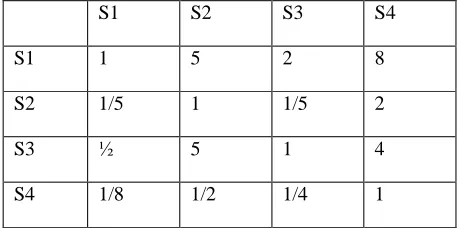
[image:6.612.306.537.559.673.2]shown in Table1.
TABLE 1: Pair-wise comparison matrix for criterion
‘communication protocol support’
S1 S2 S3 S4
S1 1 5 2 8
S2 1/5 1 1/5 2
S3 ½ 5 1 4
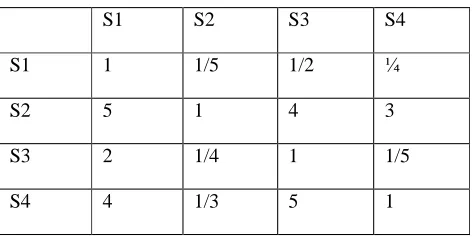
Similarly the pair wise comparison matrices with respect to the other criteria are shown in successive Table 2, Table 3, and Table 4.
TABLE 2: Pair-wise comparison matrix for criterion
‘upgradability’
S1 S2 S3 S4 S1 1 1/2 1/4 3 S2 2 1 1/2 5
S3 4 2 1 7
S4 1/3 1/5 1/7 1
TABLE 3: Pair-wise comparison matrix for criterion
‘backward compatibility’
S1 S2 S3 S4 S1 1 1/5 1/2 ¼
S2 5 1 4 3
S3 2 1/4 1 1/5 S4 4 1/3 5 1
TABLE 4: Pair-wise comparison matrix for criterion
‘modularity’
S1 S2 S3 S4 S1 1 1/3 5 3
S2 3 1 6 5
S3 1/5 1/6 1 ¼ S4 1/3 1/5 4 1
After formation of pair wise comparison matrices the Eigen vectors, RI, CI and CR are calculated applying the steps
mentioned in AHP section. The priority values of all alternatives as well as their consistency ratio are shown in the Table 5.
TABLE 5: Priority values of alternatives w.r.t criteria CPS U BC M S1 0.529 0.147 0.074 0.267 S2 0.094 0.281 0.520 0.550 S3 0.314 0.514 0.105 0.054 S4 0.063 0.059 0.300 0.128 C.R 0.0252 0.0117 0.0851 0.0651
Phase 2: Computation of criteria weights
To achieve importance among criteria the weights of all
criteria (customers’) are calculated using DEMATEL method.
[image:7.612.39.275.367.492.2]8 experts and specialists who had sufficient experience and skill in software development were requested to express their opinions in form of direct relation matrix. The average matrix, , of all direct relation matrices is then formed using . This is shown in the Table6 below.
TABLE 6: Average relation matrix
AT T R L S
Referring the step 2 and step 3 mentioned in the DEMATEL section, normalized initial direct relation matrix (D) and total relation matrix (T) have been calculated.
and
The influence values of all criteria over the system are calculated from the total relation matrix (T) and have shown in the Table7.
TABLE 7: The influences of criteria over system Criteria (ri+cj) Normalized (ri+cj)
AT 15.414 0.188 T 16.185 0.197 R 17.421 0.212 LC 16.503 0.201 S 16.389 0.200
These normalized (ri + cj) values are considered as the weight
factors of the respective criteria and are assigned as weight of customer requirements in QFD model.
TABLE 8. Saaty’s nine point scale
Phase 3: Rating among alternatives
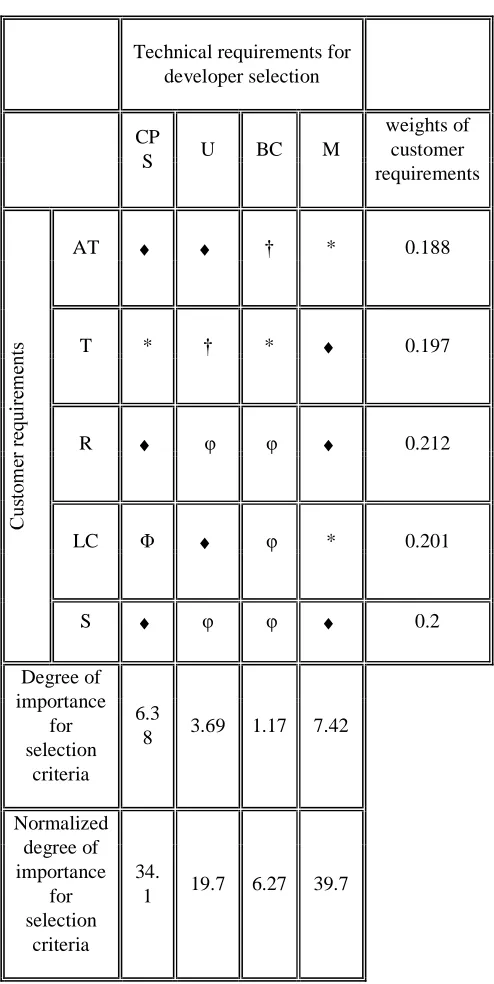
Alternatives ratings are calculated using QFD model. In addition with customer requirements the technical requirements are also considered and degree of importance of the selected technical criteria are calculated through the QFD model and shown in the Table 9.
The meaning associated with the notations given in Table 9 is given below:
: Very strong = 9;
◊:strong = 7; *: moderate=5;
¤: weak=2;
†: veryweak=1;
Φ: No relationship exist=0.
Compared to 2nd alternative, the 1st alternative
Numerical rating
Extremely preferred 9 Very strongly preferred 7 Strongly preferred 5 Moderately preferred 3 Equally preferred 1 Intermediate judgment between two
adjacent judgment
TABLE 9: QFD matrix for software selection
Technical requirements for developer selection
CP
S U BC M
weights of customer requirements
AT † * 0.188
T * † * 0.197
R φ φ 0.212
LC Φ φ * 0.201
S φ φ 0.2 Degree of
importance for selection
criteria
6.3
8 3.69 1.17 7.42
Normalized degree of importance
for selection
criteria
34.
1 19.7 6.27 39.7
The next job of the team is to find out the ranking of alternatives with respect to their scores obtained from overall score calculation of QFD model, considering the normalized
degree of importance of the selected criteria. This is shown in the Table 10.
TABLE 10: Scores of alternatives Priority values of
alternatives
I.R
Inconsisten cy (%) S1 S2 S3 S4
CPS 0.52 0.09 0.31 0.06 .02 2.52 U 0.14 0.28 0.51 0.05 .01 1.17 BC 0.07 0.52 0.10 0.30 .08 8.51 M 0.26 0.55 0.05 0.12 .06 6.51 Scor
e
32 33.8 23.7 10.2
From the Table 10 it is clear that Software2> Software1>Software3> Software4, i.e the Software2 has precedence over Software1 which has precedence over Software3 and Software4. Thus the Software2 is selected as it has highest overall score.
VI. DISCUSSION AND CONCLUSION
problem that arises from the traditional QFD model. Incorporating license cost component in the proposed integrated AHP/DEMATEL/QFD model justifies the implementation of software selection in a manufacturing firm from an economic point of view. The proposed methodology can provide a firm with an objective method for making a proper selection satisfying the overall requirements. Decision-makers have to make decisions when the volume of information is very condensed, and the type of information is
[image:10.612.63.471.216.560.2]much unstructured. To save considerable effort in arriving at an eclectic decision, cardinal and ordinal factors are taken into consideration simultaneously while evaluating the selection process and an extensive pairwise comparison of factors is carried out with appropriate and expert information articulation. In short, the methodology applied here is a sound alternative to use in an unstructured, conflicting, multi-criteria environment.
Fig 1. House of Quality
REFERENCES
[1] H. R Yazgan, S. Boran , and K. Goztepe, “An ERP
software selection process with using artificial neural network
based on analytic network process approach”, Expert Systems
with Applications. Vol. 36 no. 5, pp. 9214-9222, 2011.
[2] A. Jadhav , R. M Sonar, “Framework for evaluation and
selection of the software packages: A hybrid knowledge based system approach”, The Journal of Systems and Software, Vol. 84, pp.1394–1407, 2011.
[3] L.Alexandre, M. Franck and J. Claude, “Using a Delphi
process and the Analytic Hierarchy Process (AHP) to evaluate
Hows (Technical Measure) Correlatio
n matrix
Relationship Matrix
Target Values
Technical Competitive Assessment
Absolute Score
Relative Score
Customer Competitiv
e Assessment
(rating) Whats
(Customer Requirements
)
the complexity of projects”, Expert System with Application, Vol. 38, no.5, pp.5388-5405, 2011.
[4] C.G Sen, H. Baracli, “Fuzzy quality function deployment
based methodology for acquiring enterprise software selection requirements”, Expert Systems with Applications, Vol. 37, pp 3415–3426, 2010.
[5] S .Dhar, A. Ray, and R. Bera, “Design Simulation and
Sensitivity analysis of Vertical Handover algorithm for
vehicular communication”, International journal of computer
Science and Software Technology, Vol. l3, No.2, pp-103-117, 2010
[6] S. Ghorbani, and M. Rabbani, “A new multi objective algorithm for project selection problem”, Advances in
Engineering Software, Vol. 40, pp 9-14, 2009.
[7] S. Balli, and S. Korukoglu, “Operating system selection
using fuzzy AHP and TOPSIS methods”, Mathematical and
Computational Applications, Vol. 14, No.2, pp 119–130,2009.
[8] D. Neto, A. Claudio and T.G Horta, (2009), “Model-based
testing approaches selection for software projects”,
Information and Software Technology Vol. 51, pp. 1487– 1504, 2009.
[9] C. G., Sen, H. Baraclı, S. Sen, and H. Baslıgil, “An
integrated decision support system dealing with qualitative
and quantitative objectives for enterprise software selection”,
Expert Systems with Applications, Vol. 36, pp. 5272–5283, 2009.
[10] J. Otamendi, J. M Pastor and A. Garcia,” Selection of the simulation software for the management of the operations at
an international airport”, Simulation Modeling Practice and
Theory, Vol. 16, pp. 1103–1112,2008.
[11] Chun-Chin Wei, Chen-Fu Chien, Mao-Jiun J. Wang “An
AHP based approach to ERP system selection”, International
Journal of Production Economics, Vol. 96 , pp. 47–62, 2005. [12] A. Bhattacharyya,. B. Sarkar, S. K. Mukherjee,
“Integrating AHP and QFD for robot selection under
requirement perspective”, International Journal of Production