5
X
October 2017
Experimental Study on Partial Replacement of
Cement by Marble Powder & Quarry Dust
K. Dharani1, N.dhanaseker2 Asst. Professor¹, PG Student2,
1, 2
Department of Civil Engineering JCT College Engineering & Tech, Coimbatore,Tamil Nadu, IndiaAnna University, Chennai, Tamil Nadu, India
Abstract: the present study is aimed to utilize Waste marble powder and quarry sand as partial replacement of cement and comparing it with conventional concrete. This experimental investigation is carried out by M30 grade of concrete is produced by
replacing cement with 0%, 10%, 20% & 30% of Marble Powder & Quarry dust. It is found that the studies of concrete made of waste marble powder and quarry dust increases the workability reduction at 10% and 30% respectively. Therefore the quarry dust and waste marble powder should be used in construction works and then the natural resources would be used efficiently. Keywords: Marble Powder, Quarry dust, Compressive Strength, Split Tensile Strength
I. INTRODUCTION
Concrete is a composite material composed with fine and coarse aggregate is mixed together with dry Portland cement and water, the mixture forms a fluid slurry that is easily poured and moulded into shape. The cement reacts chemically with the water and other ingredients to form a hard matrix that binds the materials together into a durable stone-like material that has many uses. Cement and concrete production consumes enormous amounts of natural resources and aggregates, thereby causing substantial energy and environmental losses. So we have to rectify this problem by using replacement of various materials to composite materials.
Marble is a metamorphic rock composed of recrystallized carbonate minerals most commonly calcite or dolomite. Marble may be foliated. Geoygists use the term marble to refer to metamorphosed limestone. A large amount of waste is generated during sawing, grinding and polishing process. The result is that the marble waste which is 20% of total marble quarried has reached as high millions of tons. Generally the marble wastes are being dumped in any nearby pit or vacant space near the marble processing industries, although notified areas have been marked for dumping the same. This leads to increased environmental risks as dust pollution spreads alongside for a large area. In the dry season, the dust dries up, floats in the air, flies and deposits on crops and vegetation. In addition, the deposition of such generated huge amount of fine wastes certainly creates necrotic ecological conditions for flora and fauna changing landscapes and habitats. Now a day’s marble waste is one of the causes of environmental problems around the world. Therefore, max. Utilization of marble waste in various industrial sectors, especially the construction, agriculture, glass and paper industries would help to protect the environment.
Quarry dust as a by- product from crushing process during quarrying activities is one of those Material that have recently gained attention to be used as concreting aggregates , especially as fine aggregate . In concrete production in could be used as a partial or full replacement of nature sand. This kind of waste material that is generated from the stone crushing industry which is abundantly available to the extent of 200 million tons per annum which has landfill disposal problems and health and environmental hazards.
II. MATERIALPROPERTIES
A.
Materials Used
1)
Cement:
Portland pozzolona cement of ultra tech brand was used and it was conforming to IS 1489-1991.
Tests were conducted to find the properties of cement and the results are tabulated in Table A.
SL. NO
Physical Properties of Cement
Value
1 Specific Gravity 3.25
2 Grade of Cement PPC53
3 Fineness Test 340Kg/M2
5 Initial Setting Time
105min
6 Final Setting time 310min
Table A: Physical Properties of Cement
2)
Fine Aggregate:
Locally available river sand was used as fine aggregate. Tests are conducted to find the
properties of fine aggregate and test results are tabulated in table 3 B.
SL. NO
Tests Value
1 Specific Gravity 2.76
2 Water absorption 1.5%
[image:3.612.216.397.175.251.2]3 Sieve Analysis Zone II
Table B: Physical Properties of Fine Aggregate
3)
Coarse Aggregate:
Coarse aggregate was crushed stone which was available locally. Maximum size
chosen was 10mm down. Tests are conducted to find the properties of coarse aggregate and the results are
tabulated in Table C.
SL. NO
Tests Value
1 Specific Gravity 2.92
2 Size Of aggregate 20MM
3 Fineness Modulus 5.20
4 Water absorption 2.0%
5 Impact Value 15.25%
[image:3.612.218.407.321.433.2]6 Crushing Strength 25.5%
Table C: Physical Properties of Coarse Aggregate
4)
Coarse Aggregate:
Marble is a metamorphic rock resulting from the transformation of a pure limestone.
The purity of the marble is responsible for its color and appearance: it is white if the limestone is
composed solely of calcite (100% CaCO3). Chemically, marbles are crystalline rocks composed
predominantly of calcite, dolomite or serpentine minerals. A large quantity of powder is generated during
the cutting process. The result is that the mass of marble waste which is 20% of total marble quarried has
reached as high as millions of tons. Leaving these waste materials to the environment directly can cause
environmental problem and the results are tabulated in Table D.
SL. NO
Composition of Marble Powder
Compositio n Value
1 SiO2 13.8
2 Cao 43.2
3 Mgo 2.7
4 Al2O3 2.5
5 Fe2O3 1.90
6 So3 0.07
7 K20 0.6
8 Cl 0.03
9 Na2o 0.9
Table D: Chemical Composition of Marble Powder
5)
Quarry dust:
Quarry dust is a kind of waste material that is generated from the stone crushing industry
which is abundantly available to the extent of 200 million tonnes per annum which has landfill disposal
problems and health and environmental hazards. Quarry sand which is a residue tailing or other
non-voluble waste material after the extraction and processing of rocks to form fine particles less than
4.75mm.The Quarry sand can be an economic alternative to the river sand since river sand is expensive
due to excessive cost of transportation from natural sources and also large scale depletion of these sources
creates environmental problems. Crushed sand less than 4.75 mm is produced from hard granite rock
using state of crushing plants. Production of quarry fines is a consequence of extraction and processing in
a quarry and collected from the near-by quarry. The amount produced depends on the rock type, amount
of fragmentation by blasting and type of crushing used. The product is washed to remove excess fines to
get sand of excellent shape, gradation free from silt, clay and unwanted contamination. Specific gravity
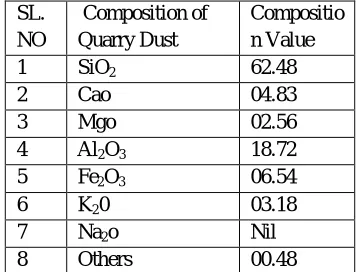
tests were conducted and found as 2.93. and the results are tabulated in Table E.
SL. NO
Composition of Quarry Dust
Compositio n Value
1 SiO2 62.48
2 Cao 04.83
3 Mgo 02.56
4 Al2O3 18.72
5 Fe2O3 06.54
6 K20 03.18
7 Na2o Nil
[image:4.612.216.395.293.429.2]8 Others 00.48
Table E: Chemical Composition of Quarry dust
III.METHODOLOGY
The concrete mix design was done in accordance IS: 10262(1982). In this project 30 grade are used the mix ratio is 1:129:2.46. By
using this proportion value is the volume of cement, fine aggregate and coarse aggregate are estimated. The Portland Pozzolona Cement (OPC-53GRADE), Good stone aggregate and natural sand of Zone-III was used as coarse aggregate and fine aggregate. For this study cubes (150×150×150mm), cylinder (150mm dia&300mm height) were casted by replacement of cement by marble powder and quarry dust increasing the strength then further test are conducted such as workability then it will be casted.
IV.CURINGOFCONCRETE
After Completion of Casting of concrete, the mould should be removed 24 hours and cured by using portable
water. The specimen is fully immersed in portable water for specific age of 7, 14, 28 days. After the
completion of curing it will be tested.
V. TESTRESULTSANDDISCUSSIONS
A.
Experiment No.1: Compressive test on Concrete cube
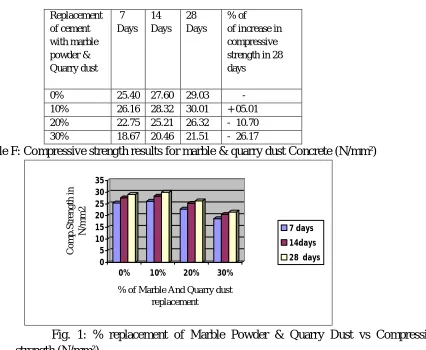
In this test Marble powder and Quarry dust has been partially replaced in the ratio of 0%, 10% 20% and 30%,
by weight of cement in concrete. The strength results obtained from the experimental investigations. The
results are tabulated in Table F.
Replacement of cement with marble powder & Quarry dust 7 Days 14 Days 28 Days % of of increase in compressive strength in 28 days
0% 25.40 27.60 29.03 -
10% 26.16 28.32 30.01 + 05.01
20% 22.75 25.21 26.32 - 10.70
30% 18.67 20.46 21.51 - 26.17
Table F: Compressive strength results for marble & quarry dust Concrete (N/mm²)
0 5 10 15 20 25 30 35 C o m p .S tr e n g th in N /m m 2
0% 10% 20% 30%
% of Marble And Quarry dust replacement
7 days 14days 28 days
Fig. 1: % replacement of Marble Powder & Quarry Dust vs Compressive
strength (N/mm²)
B.
Experiment No.2: Split Tensile test on Cylindrical cube
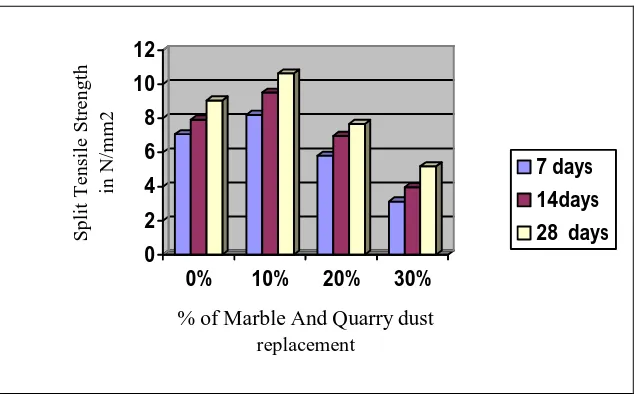
In this test Marble powder and Quarry dust has been partially replaced in the ratio of 0%, 10% 20% and 30%,
by weight of cement in concrete. The strength results obtained from the experimental investigations. The
results are tabulated in Table G.
1) Result tables
Replacement of cement with marble powder & Quarry dust 7 Day s 14 Days
28 Days % of
of increase in Split tensile in 28 days
0% 7.07 7.92 9.02 -
10% 8.21 9.51 10.63 + 11.78
20% 5.80 6.79 7.67 - 14.70
[image:5.612.133.559.66.416.2]30% 3.13 3.96 5.18 - 26.47
[image:5.612.190.429.516.658.2]0 2 4 6 8 10 12 S pl it T e ns il e S tr e ngt h in N /m m 2
0% 10% 20% 30%
% of Marble And Quarry dust replacement
[image:6.612.166.483.72.269.2]7 days 14days 28 days
Fig. 2: % replacement of Marble Powder & Quarry Dust vs Split Tensile strength (N/mm²)
VI.CONCLUSIONS
Based on the results and observation made in this experimental research study. The following conclusions are drawn.
A. It has been observed that the experimental result for the 10% replacement of marble powder & Quarry dust to PPC has increase
in strength in comparison with 0% and 10% replacement. Beyond 20% replacement of marble powder, the strength was decreased.
B. As the percentage of marble powder & Quarry dust increases the compressive strength of concrete tends to increase up to
certain percentage and then start’s decreasing with the increase of Marble powder & Quarry dust content. This mix concrete performed better when compared to ordinary concrete up to 10% replacement of marble powder Quarry dust.
C. The results of compression & split-tensile test indicated that the strength of concrete increases with respect to the percentage of
Marble powder & Quarry dust and also control the workability increases during mixing of concrete.
D. Based on the test results of Marble powder & Quarry dust Concrete, it can be concluded that, Marble powder & Quarry dust can
increase the overall strength of the concrete when used up to a 10% Cement replacement with w/c ratio of 0.46. Marble powder and Quarry dust are the valuable pozzolanic materials and it can potentially be used as a partial replacement for cement and fine aggregate respectively. This could reduce the environmental problems.
REFERENCES
[1] Veena G. Pathan, Md.GulfamPathan “Feasibility and need of use of Waste marble powder in concrete production”, ICAET, pp 23-26.
[2] S.D. Anitha Selva Sofia, R. Gayathri, G. Swathi, and G.Prince arulraj, “Experimental Investigation on Quarry dust concrete with chemical admixture”, International Journal of Latest Research in Science and Technology, Vol. 2,Issue. 2,pp-94,March-April 2013.
[3] Venkata Sairam Kumar N, Dr. B. Panduranga Rao, Krishna Sai M.L.N, Experimental study on partial replacement of cement with quarry dust, International Journal of Advanced Engineering Research and Studies E-ISSN:2249–8974.
[4] Noha M. Soliman, Effect of using Marble Powder in Concrete Mixes on the Behavior and Strength of R.C. Slabs, International Journal of Current Engineering and Technology ISSN 2277 - 4106 Vol.3, No.5 (December 2013).
[5] Ramarao Chimata, Venkateswara Rao.J „Innovative Use of Quartzite Rock Dust and Effect of Glass Fibers in Rigid Pavements‟ International Journal for Research in Applied Science & Engineering Technology (IJRASET) Vol. 3 Issue IX, September 2015.
[6] MD Mahboob Ali “ strength characteristics of concrete with the partial replacement of cement by marble powder dust and sand by stone dust” International journal of engineering research and application ISSN – 2248 – 9622 ,Vol. 4, Issue 9 (version 1), pp. 203 – 209.September 2014.
[7] Sudhir S. Kapgate and S. R. Satone (2013), “Effect of quarry dust as partial replacement of sand in concrete”, Indian streams research journal 3(5), 2230-7850. [8] Sudhir S. Kapgate and S. R. Satone (2013), “Effect of quarry dust as partial replacement of sand in concrete”, Indian streams research journal 3(5), 2230-785 [9] .Bansal and P.Bhuvaneshwari (2016),” An partial replacement of cement by with waste marble powder in concrete” International Journal of Current
Engineering and Technology ISSN- 3 (5), 2320-8163