How to cite this paper: Bazzaz, Md.M., Khaliq, Q.A., Karim, Md.A., Al-Mahmud, A. and Khan, Md.S.A. (2015) Canopy Tem-perature and Yield Based Selection of Wheat Genotypes for Water Deficit Environment. Open Access Library Journal, 2: e1917. http://dx.doi.org/10.4236/oalib.1101917
Canopy Temperature and Yield Based
Selection of Wheat Genotypes for
Water Deficit Environment
Md. Mahfuz Bazzaz
1, Qazi Abdul Khaliq
2, Md. Abdul Karim
2, Abdullah Al-Mahmud
1*,
Md. Shawquat Ali Khan
11Bangladesh Agricultural Research Institute, Gazipur, Bangladesh
2Bangabandhu Sheikh Mujibur Rahman Agricultural University, Gazipur, Bangladesh Email: [email protected], *[email protected]
Received 21 September 2015; accepted 9 October 2015; published 14 October 2015
Copyright © 2015 by authors and OALib.
This work is licensed under the Creative Commons Attribution International License (CC BY).
http://creativecommons.org/licenses/by/4.0/
Abstract
The experiment was conducted with thirty-five wheat genotypes at the research field of the De-partment of Agronomy of the Bangabandhu Sheikh Mujibur Rahman Agricultural University from November 2011 to March 2012 to screen out the wheat genotypes for drought tolerance of thir-ty-five wheat genotypes under water deficit condition. The experiment was carried out in a split- plot design comprising two water regimes in main plot and thirty-five wheat genotypes were placed randomly in sub-plot with three replications. From this experiment, it was found that water deficit condition severely reduced the plant height, number of effective tillers m−2, spike length, number of spikelets spike−1, number of grains spike−1 and thousand grain weight. Based on the percentage of yield reduction, the genotypes BARI Wheat 26, Sourav, BAW 1169 and BAW 1158 were categorized in tolerant group exhibited low yield reduction (>30%) and the genotypes Seri, Pavon, BAW 1166, BAW 1167, BAW 1171 and BAW 1173 were ranked in susceptible group due to very low yielding ability with high yield reduction which ranged from 50.01% to 59.17% in water deficit condition. The maximum increased canopy temperature was recorded in the genotypes BAW 1166, BAW 1167, Seri, Pavon and BARI Wheat 25. The minimum was in the genotypes BARI Wheat 26, BAW 1157, Sourav, BAW 1169 and Gourab. The highest MP, GMP and STI values were recorded in the geno-types BARI Wheat 26, BAW 1158, Sourav, BAW 1169 and BAW 1170. Our results revealed that BARI Wheat 26, BAW 1158, Sourav, BAW 1169 and BAW 1170 were more capable to tolerate water defi-cit condition.
Keywords
Wheat Genotypes, Canopy Temperature, Tolerance Indices, Water Deficit Subject Areas: Plant Science
OALibJ | DOI:10.4236/oalib.1101917 2 October 2015 | Volume 2 | e1917
1. Introduction
Wheat, next to rice is the staple food of the people in Bangladesh grown over an area of 3.74 million hectares with an annual production of about 1 million metric tons with an average of 2.60 t·ha−1[1]. This production is less than that of other wheat growing countries because about one third of the total area under wheat in Bangla-desh falls in the rainfed regions where water stress limit plant growth and productivity either because of unex-pected dry periods or very low or no rainfall [2]. Monsoon rains provide 80% annual precipitation in Bangladesh, and when this is reduced, water deficit becomes a significant problem. Most of the farmers in Bangladesh grow wheat without irrigation due to scarcity of water [3]. Moreover, it is well known that the ground water table in Bangladesh is declining day by day. As a result wheat faces water deficit that reduces grain yield drastically. Water having paramount importance in the plants, is essentially required at every stage of plant growth from seed germination to plant maturation. Crop plants require adequate water to grow at an optimum rate. Cultivated crops can’t show its full genetic potential for yield due to certain environmental limitations especially water deficit.
Canopy temperature is related to plant water stress because the evaporative cooling involved in transpiration may cool leaves below ambient air temperature. If soil water is limiting, plant water stress develops, transpira-tion decreases and the canopy temperature rises. Plants with adequate supply of water maintained their canopy temperature below the air temperature, whereas the plants with inadequate supply of water exhibited their cano-py temperature above the air temperature [4]. Blum et al., [5] used canopy temperatures of drought stressed wheat genotypes to characterize yield stability under various moisture conditions. Many researchers also used canopy temperature as tool of screening against drought in many crops like, Sorghum [6]; potato [7]; wheat [8]; tomato [9] and cotton [10].
Selecting wheat genotypes that could tolerate drought stress and produce acceptable yield has been the major challenge for the wheat breeders in the past 50 years [11]. It is the need of time to develop varieties, which have drought tolerant potential to increase area under cultivation and yield of wheat. The relative yield performance of genotypes in drought stress and more favorable environments seems to be a common starting point in the se-lection of genotypes for use in breeding for dry environments [12]. Some researchers believe in selection under favorable condition [13] while selection in the target stress condition has been highly recommended too [14]. Some researchers have chosen a mid-way and believe in selection under both favorable and stress conditions [15] [16]. However in order to further extend the work on developing water stress tolerant wheat cultivars in Ban-gladesh, this study was planned and undertaken for assessing the thirty-five wheat genotypes for water stress environment based on canopy temperature, yield and drought tolerance indices.
2. Materials and Methods
2.1. Experimental Site, Soil and Climate
The experiment was carried out at the research field of the Bangabandhu Sheikh Mujibur Rahman Agricultural University (BSMRAU), Salna, Gazipur from November, 2011 to March, 2012 on an upland soil. It is located at the center of Madhupur Tract (24˚05' North latitude and 90˚16' East longitude) at an elevation of 8.4 m above the sea level. The soil of the experimental field belongs to Salna series of Shallow Red-Brown Terrace soil type (AEZ 28) with silty clay texture in surface and silty clay loam in sub-surface region of the soil [17] [18]. The experimental site is situated in the sub-tropical region characterized by heavy rainfall during the months from July to September and scanty or no rainfall in the rest of the year.
2.2. Test Crop
Thirty-five wheat genotypes including most of the popular varieties, some advanced lines and some lines from abroad collected from Wheat Research Centre of Bangladesh Agricultural Research Institute, Nashipur, Dinaj-pur, Bangladesh were used in the present study.
2.3. Land Preparation
expe-OALibJ | DOI:10.4236/oalib.1101917 3 October 2015 | Volume 2 | e1917
riment field just before preparing the plot. The individual plots were prepared by making ridges (8 - 10 cm high) around the each plot to restrict the lateral run off of fertilizer with irrigation water.
2.4. Experimental Design and Treatments
The experiment was carried out in a split-plot design comprising two water regimes in main plot and 35 wheat genotypes were placed randomly in sub-plot with three replications. The water regimes were 1) Control (four ir-rigations were applied at crown root initiation, booting, anthesis and grain filling stages), and 2) Water deficit stress (irrigation was stopped after crown root initiation stage i.e. 20 days after sowing and the crop was pro-tected from rainfall by rainout shelter). Thirty-five wheat genotypes including most of the popular varieties and some advanced lines collected from Wheat Research Centre (WRC) of Bangladesh Agricultural Research Insti-tute (BARI), Dinajpur were Prodip, Shatabdi, Sourav, Gourab, Sufi, Kanchan, Seri, Pavon, Barkat, Balaka, Ag-hrani, Akbar, BARI Wheat 26, Protiva, Ananda, Bijoy, BARI Wheat 25, BAW 1151, BAW 1157, BAW 1158, BAW 1159, BAW 1160, BAW 1161, BAW 1162, BAW 1163, BAW 1164, BAW 1165, BAW 1166, BAW 1167, BAW 1168, BAW 1169, BAW 1170, BAW 1171, BAW 1172 and BAW 1173. The unit plot size was consisted of 6 rows each of 2.5 m long having a row to row distance of 20 cm.
2.5. Sowing of Seeds, Fertilizer Application and Intercultural Operation
Wheat seeds at the rate of 120 kg·ha−1 were sown in line by hand on November 24, 2011. Seeds were placed continuously in lines by making narrow and shallow furrows with iron rod and covered with soil by hand. After sowing of seeds light irrigation was given to ensure uniform germination of seeds. Fertilizers were applied @ 100-60-40-20-1 kg·ha−1 N-P2O5-K2O-S in the form of urea, triple super phosphate, muriate of potash and
gyp-sum, respectively. Two-third of urea and total amount of other fertilizers were applied during final land prepara-tion. The rest amount of urea was top dressed at crown root initiation stage (20 days after sowing) followed by first irrigation. Intercultural operations were done uniformly in each plot to ensure normal growth of the crop. Weeding and mulching were done simultaneously in the experimental plot for two times, firstly at 15 days after sowing (DAS) and secondly, at 35 DAS. Thinning was also done at 14 DAS.
2.6. Measurement of Canopy Temperature
Canopy temperature was measured with an infrared thermometer (Model THI-500, TASCO, Japan) at 12:30 pm on the day. The thermometer was held so that the sensor viewed only the canopy at an oblique angle above the horizontal; this position gave an elliptical canopy target [19] and prevented the thermometer from sensing the soil surface when the leaves were rolled. All canopy temperature measurements were made five places in a plot and in a south facing direction to minimize sun angle effects as suggested by Turner et al., [20].
2.7. Tolerance Indices
Stress tolerance and susceptibility indices including relative performance (RP), mean productivity (MP), geome-tric mean productivity (GMP), tolerance (TOL), stress susceptibility index (DSI), stress tolerance index (STI), and yield stability index (YSI) for water deficit environment were calculated based on grain yield under water deficit stress and control conditions. Stress tolerance attributes were calculated by the following formulae:
Variable measured under stress condition Relative performance
Variable measured under control condition
= [21] (1)
Mean productivity (MP) and Tolerance (TOL) was calculated according to Gupta et al., [22]
Yp Ys
Mean productivity 2
+
= (2)
(
) (
)
OALibJ | DOI:10.4236/oalib.1101917 4 October 2015 | Volume 2 | e1917
2
GMP= (Yns Yws)× (4)
(
)(
)
(
)
2 Yns Yws STIXns
= (5)
where,
Yws = mean yields of a given genotype in water stress (WS) conditions; Yns = mean yields of a given genotype in non-stress (NS) conditions and; Xns = mean of all genotypes under non-stress (NS) condition.
( )
Stress susceptibility ind
Yws 1
Yns ex S
DII SI
−
= (6)
where,
Yws = mean yields of a given genotype in WS condition; Yns = mean yields of a given genotype in NS condition; DII = Drought intensity index.
The drought intensity index (DII) for each water regime was calculated as
(
)
DII= −1 Xws Xns (7) where,
Xws = mean of all genotypes under WS condition; Xns = mean of all genotypes under NS conditions.
(
)
Yield stability index YSI =Yws Yns (8) where,
Yws = mean yields of a given genotype in WS condition; Yns = mean yields of a given genotype in NS condition.
2.8. Statistical Analysis
Recorded data were analyzed by statistically using the software MSTATC (Developed by the Department of Crop and Soil Sciences, Michigan State University, East Lansing, MI 48824 USA). Significance between treat-ments were tested by using least significant difference test (LSD) at p < 0.05 level.
3. Results and Discussion
3.1. Relative Value of Plant Height and Flag Leaf Length
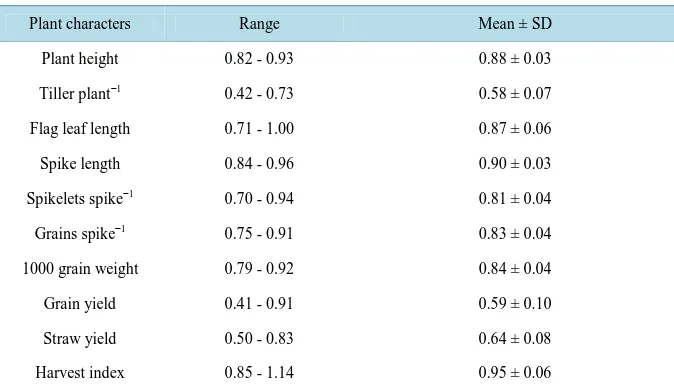
The means and the ranges of relative value of ten characters of the 35 wheat genotypes subjected to water defi-cits are given in Table 1. The Relative value of plant height, calculated as the ratio of the height of stressed plants and that of non-stressed plants, ranged from 0.90 to 0.99 with an average of 0.95. Relative value of plant height of more than 0.90 was found in seven genotypes. Similarly, the relative value of flag leaf length ranged from 0.71 to 1.00 with an average of 0.87. Malik and Hasan [24] and Khanzada et al., [25] have earlier reported that shoot length of wheat genotypes significantly reduced under water stress condition. Reduction in plant height in wheat due to drought was reported by [26] [27] and [28]. Sangtarash [29] also reported that the flag leaf length of wheat was significantly affected by water stress.
3.2. Relative Value of Yield Attributes and Yield
OALibJ | DOI:10.4236/oalib.1101917 5 October 2015 | Volume 2 | e1917 Table 1. Range and mean of relative value of yield and yield attributes in 35 wheat genotypes
under control and water deficit condition.
Plant characters Range Mean ± SD
Plant height 0.82 - 0.93 0.88 ± 0.03
Tiller plant−1 0.42 - 0.73 0.58 ± 0.07
Flag leaf length 0.71 - 1.00 0.87 ± 0.06
Spike length 0.84 - 0.96 0.90 ± 0.03
Spikelets spike−1 0.70 - 0.94 0.81 ± 0.04
Grains spike−1 0.75 - 0.91 0.83 ± 0.04
1000 grain weight 0.79 - 0.92 0.84 ± 0.04
Grain yield 0.41 - 0.91 0.59 ± 0.10
Straw yield 0.50 - 0.83 0.64 ± 0.08
Harvest index 0.85 - 1.14 0.95 ± 0.06
Akram [30] observed that number of tillers m−2 was affected significantly by different water stress treatments. The relative value of spike length and grains spike−1 ranged from 0.84 to 0.96 and 0.75 to 0.91 with an average of 0.90 and 0.95, respectively. This result is in agreement with the findings of Mirbahar et al., [31] who ob-served that spike length of wheat decreased more in stress susceptible genotypes and less in stress tolerant ones. Khanzada et al., [25] and Qadir et al., [32] have earlier reported that water stress throughout vegetative and re-productive development caused a significant reduction in number of grains spike−1 in wheat. Elhafild [33] dem-onstrated that drought stress resulted in reduced pollination and reduced the number of grains spike−1. Water deficit also caused remarkable variation in 1000-grain weight and the relative value of 1000-grain weight ranged from 0.79 to 0.92 with an average of 0.84. This result is in agreement with those reported by Khan et al.,
[34] and Qadir et al., [32] who observed that 1000-grain weight in wheat was reduced mainly due to increasing water stress. The relative value of grain yield also varied significantly among the genotypes and ranged from 0.41 to 0.91 with an average of 0.59. The relative straw yield and harvest index values ranged from 0.50 to 0.83 and 0.85 to 1.14 with a corresponding mean of 0.64 and 0.95, respectively. The reason for lower grain yield under water stress condition was mainly due to reduction in number of effective tillers plant−1, spike length, number of grains spike−1 and 1000-grain weight. The average yield loss in wheat due to drought stress estimated by Bayoumi et al., [26] and Khakwani et al., [27] were 43.20 and 58% - 82%, respectively. Chandler and Singh [35] also reported that both grain yield and biological yield in wheat showed maximum sensitivity to moisture stress.
3.3. Ranking of Genotypes on the Basis of Yield Reduction
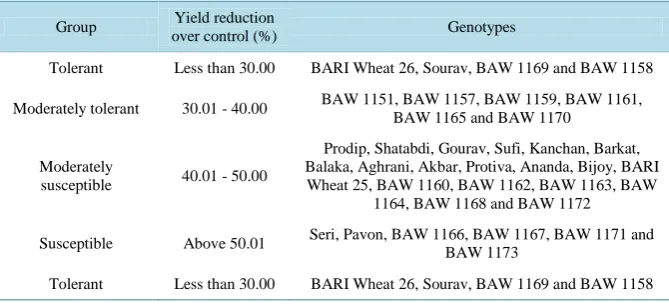
Thirty-five wheat genotypes were ranked on the basis of their yield reduction due to water deficit over control
(Table 2). A hypothetical scale was made to categorize the genotypes in different rank order on the basis of
yield reduction. Genotypes were ranked into four groups as tolerant (less than 30% yield reduction), moderately tolerant (30.01% - 40.00% yield reduction), moderately susceptible (40.01% - 50.00% yield reduction) and sus-ceptible (above 50.01% yield reduction). Four genotypes were categorized in tolerant group because they were relatively more productive both under control and water deficit conditions, and exhibited low yield reduction due to water deficit stress. Similarly, six genotypes were found moderately tolerant as they gave lower yield than the tolerant ones but higher yield than the susceptible genotypes. A large number of genotypes tested in this ex-periment were grouped as moderately susceptible due to higher yield reduction in water deficit condition. Seven genotypes were ranked in susceptible group due to their very low yielding ability and very high yield reduction which ranged from 50.01% to 59.17% in water deficit condition. The average grain yield of wheat genotypes was reduced by 43.2% as reported by Bayoumi et al., [26] and by 50% as reported by Nouri-Ganbalani et al.,
OALibJ | DOI:10.4236/oalib.1101917 6 October 2015 | Volume 2 | e1917 Table 2. Ranking of thirty-five wheat genotypes on the basis of their yield reduction.
Group Yield reduction
over control (%) Genotypes
Tolerant Less than 30.00 BARI Wheat 26, Sourav, BAW 1169 and BAW 1158
Moderately tolerant 30.01 - 40.00 BAW 1151, BAW 1157, BAW 1159, BAW 1161, BAW 1165 and BAW 1170
Moderately
susceptible 40.01 - 50.00
Prodip, Shatabdi, Gourav, Sufi, Kanchan, Barkat, Balaka, Aghrani, Akbar, Protiva, Ananda, Bijoy, BARI Wheat 25, BAW 1160, BAW 1162, BAW 1163, BAW
1164, BAW 1168 and BAW 1172
Susceptible Above 50.01 Seri, Pavon, BAW 1166, BAW 1167, BAW 1171 and BAW 1173
Tolerant Less than 30.00 BARI Wheat 26, Sourav, BAW 1169 and BAW 1158
3.4. Canopy Temperature
Canopy temperature measured at anthesis stage varied significantly among the genotypes due to water deficit presented in Figure 1. The canopy temperature in wheat genotypes ranged from 23.35˚C to 25.65˚C in control and it increased up to 25.50˚C to 29.47˚C under water deficit condition at anthesis stage. The highest increase in canopy temperature (25%) was recorded in the genotype BAW 1166, and it was close to that in BAW 1167 (24%), Seri (23%), Pavon (21%) and BARI Wheat 25 (21%). The lowest increase in canopy temperature was recorded in BARI Wheat 26 (6%) which was followed by those in BAW 1157 (8%), Sourav (8%), BAW 1169 (9%) and Gourab (9%). Canopy temperature in wheat genotypes increased under water deficit condition might have occurred due to increased respiration and decreased transpiration as a result of stomata closure. This result is in agreement with the findings of [36] who reported that leaf temperature in drought stressed wheat plant was higher than in well-watered plants at both vegetative and anthesis stages. They also reported that the plants that showed a lower leaf temperature also showed a higher photosynthetic rate. The lower photosynthetic rate in plants exposed to higher temperature might have resulted from increased respiration [37]. Winter et al., [38] also found significant differences in leaf temperature between drought stressed and irrigated plants, but not among the wheat genotypes.
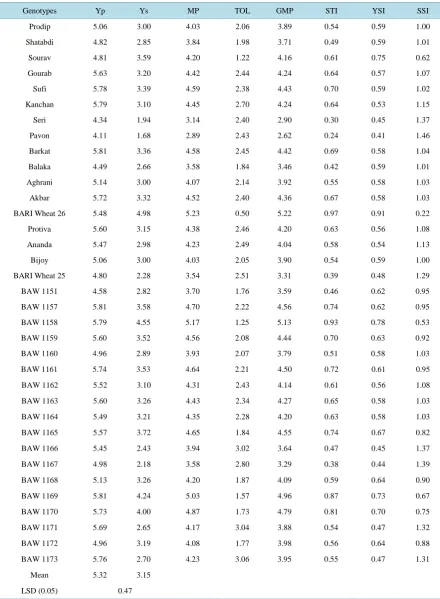
3.5. Selection of Genotypes Based on Stress Tolerance Indices
OALibJ | DOI:10.4236/oalib.1101917 7 October 2015 | Volume 2 | e1917
Table 3. Tolerance indices of thirty-five wheat genotypes under variable water regimes.
Genotypes Yp Ys MP TOL GMP STI YSI SSI
Prodip 5.06 3.00 4.03 2.06 3.89 0.54 0.59 1.00
Shatabdi 4.82 2.85 3.84 1.98 3.71 0.49 0.59 1.01
Sourav 4.81 3.59 4.20 1.22 4.16 0.61 0.75 0.62
Gourab 5.63 3.20 4.42 2.44 4.24 0.64 0.57 1.07
Sufi 5.78 3.39 4.59 2.38 4.43 0.70 0.59 1.02
Kanchan 5.79 3.10 4.45 2.70 4.24 0.64 0.53 1.15
Seri 4.34 1.94 3.14 2.40 2.90 0.30 0.45 1.37
Pavon 4.11 1.68 2.89 2.43 2.62 0.24 0.41 1.46
Barkat 5.81 3.36 4.58 2.45 4.42 0.69 0.58 1.04
Balaka 4.49 2.66 3.58 1.84 3.46 0.42 0.59 1.01
Aghrani 5.14 3.00 4.07 2.14 3.92 0.55 0.58 1.03
Akbar 5.72 3.32 4.52 2.40 4.36 0.67 0.58 1.03
BARI Wheat 26 5.48 4.98 5.23 0.50 5.22 0.97 0.91 0.22
Protiva 5.60 3.15 4.38 2.46 4.20 0.63 0.56 1.08
Ananda 5.47 2.98 4.23 2.49 4.04 0.58 0.54 1.13
Bijoy 5.06 3.00 4.03 2.05 3.90 0.54 0.59 1.00
BARI Wheat 25 4.80 2.28 3.54 2.51 3.31 0.39 0.48 1.29
BAW 1151 4.58 2.82 3.70 1.76 3.59 0.46 0.62 0.95
BAW 1157 5.81 3.58 4.70 2.22 4.56 0.74 0.62 0.95
BAW 1158 5.79 4.55 5.17 1.25 5.13 0.93 0.78 0.53
BAW 1159 5.60 3.52 4.56 2.08 4.44 0.70 0.63 0.92
BAW 1160 4.96 2.89 3.93 2.07 3.79 0.51 0.58 1.03
BAW 1161 5.74 3.53 4.64 2.21 4.50 0.72 0.61 0.95
BAW 1162 5.52 3.10 4.31 2.43 4.14 0.61 0.56 1.08
BAW 1163 5.60 3.26 4.43 2.34 4.27 0.65 0.58 1.03
BAW 1164 5.49 3.21 4.35 2.28 4.20 0.63 0.58 1.03
BAW 1165 5.57 3.72 4.65 1.84 4.55 0.74 0.67 0.82
BAW 1166 5.45 2.43 3.94 3.02 3.64 0.47 0.45 1.37
BAW 1167 4.98 2.18 3.58 2.80 3.29 0.38 0.44 1.39
BAW 1168 5.13 3.26 4.20 1.87 4.09 0.59 0.64 0.90
BAW 1169 5.81 4.24 5.03 1.57 4.96 0.87 0.73 0.67
BAW 1170 5.73 4.00 4.87 1.73 4.79 0.81 0.70 0.75
BAW 1171 5.69 2.65 4.17 3.04 3.88 0.54 0.47 1.32
BAW 1172 4.96 3.19 4.08 1.77 3.98 0.56 0.64 0.88
BAW 1173 5.76 2.70 4.23 3.06 3.95 0.55 0.47 1.31
Mean 5.32 3.15
LSD (0.05) 0.47
OALibJ | DOI:10.4236/oalib.1101917 8 October 2015 | Volume 2 | e1917 Figure 1. Canopy temperature of wheat genotypes as affected by control and water
deficit at anthesis stages.
Table 4. Correlation coefficients between yield and stress tolerance indices.
Yp Ys MP TOL GMP STI YSI SSI
Yp 1.00
Ys 0.62** 1.00
MP 0.86** 0.93** 1.00
TOL 0.12 −0.71** −0.40* 1.00
GMP 0.81** 0.96** 0.99** −0.49** 1.00
STI 0.78** 0.97** 0.99** −0.53** 0.99** 1.00
YSI 0.28 0.92** 0.73** −0.92** 0.79** 0.81** 1.00
SSI −0.28 −0.92** −0.73** 0.92** −0.79** −0.81** −1.00** 1.00
Yp = Control yield, Ys = Water deficit yield, MP = Mean productivity, TOL = Tolerance, GMP = Geometric mean productivity, STI = Stress
toler-ance index, YSI = Yield stability index, SSI = Stress susceptibility index, **Indicates correlation is significant at the 0.01 level, *Correlation is
signifi-cant at the 0.05 level.
that a small value of TOL is desirable, selection for this parameter would tend to favor low yielding genotypes. A larger value of TOL and SSI show relatively more sensitivity to water deficit, thus a smaller values of TOL and SSI are favored. Several authors noticed that selection based on these two indices favors genotypes with low yield under non-stress conditions and high yield under stress conditions [41]. Likewise TOL and SSI, the YSI was positively correlated with the yield under water deficit but not related with the yield under control condi-tion.
3.6. Correlation between Yield and Stress Tolerance Indices
[image:8.595.87.537.305.457.2]OALibJ | DOI:10.4236/oalib.1101917 9 October 2015 | Volume 2 | e1917
4. Conclusion
Water deficit condition severely reduced the plant height, number of effective tillers m−2, spike length, number of spikelets spike−1, number of grains spike−1 and TGW. Based on the percentage of yield reduction the geno-types BARI Wheat 26, Sourav, BAW 1169 and BAW 1158 were categorized in tolerant group because they ex-hibited low yield reduction (>30%) and the genotypes Seri, Pavon, BAW 1166, BAW 1167, BAW 1171 and BAW 1173 were ranked in susceptible group due to their very low yielding ability and very high yield reduction which ranged from 50.01 to 59.17% in water deficit condition. The highest increase in canopy temperature (25%) was recorded in the genotype BAW 1166, and it was close to that in BAW 1167 (24%), Seri (23%), Pavon (21%) and BARI Wheat 25 (21%). The lowest increase in canopy temperature was recorded in BARI Wheat 26 (6%) which was followed by those in BAW 1157 (8%), Sourav (8%), BAW 1169 (9%) and Gourab (9%). The maxi-mum values for MP, GMP and STI were noted in the genotypes BARI Wheat 26, BAW 1158, Sourav, BAW 1169 and BAW 1170. So, on the basis of canopy temperature, yield and drought tolerant indices for selecting the wheat genotypes for water deficit environment, BARI Wheat 26, BAW 1158, Sourav, BAW 1169 and BAW 1170 may be considered.
Recommendations
Wheat genotypes showed wide range of genetic variability in water deficit tolerance which could be considered as a potential source of breeding material. The genotypes BARI Wheat 26, BAW 1158, Sourav, BAW 1169 and BAW 1170, could be considered as relatively water deficit tolerant. Different physiological and biochemical in-dicators of water deficit tolerance could be studied for final conclusion. Finally, Multi-location/adaptive trials in severe drought prone areas may be carried out to confirm their performances.
Acknowledgements
Appreciation is extended to Director General of Bangladesh Agricultural Research Institute for permission to pursue higher studies leading to Ph.D. with scholarship and allowing leave on deputation. I also would like to express my whole hearted gratefulness and appreciation to the Department of Agronomy, Bangabandhu Skeikh Mujibur Rahman Agricultural University Gazipur for providing facilities of this study.
References
[1] Anonymous (2011) Year Book of Agricultural Statistics of Bangladesh, Bangladesh Bureau of Statistics (BBS), Minis-try of Planning, Government of the People’s Republic of Bangladesh.
[2] Khaliq, I., Shah, S.A.H., Ahsan, M. and Khalid, M. (1999) Evaluation of Spring Wheat (Triticum aestivum L.) for Drought Field Conditions. A Morphological Study. Pakistan Journal of Biological Sciences, 2, 1006-1009.
http://dx.doi.org/10.3923/pjbs.1999.1006.1009
[3] Ahmed, S.M., Razzaque, M.A., Saha, N.K. and Sufian, M.A. (1986) Varietal Development of Wheat for Irrigated and Water Stress Situations and Some Ideas on Future Research Requirements. Proceedings of Third National Training
Workshop, BARI, WRC, CIMMYT/CIDA Wheat Program, 66-73.
[4] Buttar, G.S., Singh, C.J., Ahuja, M.S. and Saini, K.S. (2005) Canopy Temperature: A Method to Estimate Plant Water Stress and Scheduling Irrigation in Cotton and Wheat. Journal of Agricultural Physics, 5, 79-83.
[5] Blum, A., Shpiler, L., Golan, G. and Mayer, J. (1989) Yield Stability and Canopy Temperature of Wheat Genotypes under Drought Stress. Field Crops Research, 22, 289-296. http://dx.doi.org/10.1016/0378-4290(89)90028-2
[6] Chaudhuri, U.N. and Kanemasu, E.T. (1982) Effect of Water Gradient on Sorghum Growth, Water Relations and Yield. Canadian Journal of Plant Science, 62, 599-607. http://dx.doi.org/10.4141/cjps82-090
[7] Stark, J.C., Pavek, J.J. and McCann, I.R. (1991) Using Canopy Temperature Measurements to Evaluate Drought To-lerance of Potato Genotypes. Journal of the American Society for Horticultural Science, 116, 412-415.
[8] Lopes, M.S. and Reynolds, M.P. (2010) Partitioning of Assimilates to Deeper Roots Is Associated with Cooler Cano-pies and Increased Yield under Drought in Wheat. Functional Plant Biology, 37, 147-156.
http://dx.doi.org/10.1071/FP09121
[9] Rao, N.K.S., Bhatt, R.M. and Sadashiva, A.T. (2001) Tolerance to Water Stress in Tomato Cultivars. Photosynthetica,
38, 465-467. http://dx.doi.org/10.1023/A:1010902427231
OALibJ | DOI:10.4236/oalib.1101917 10 October 2015 | Volume 2 | e1917
[11] Lopez, C., Banowetz, G.M., Peterson, C.J. and Kronstad, W.E. (2003) Dehydrin Expression and Drought Tolerance in Seven Wheat Cultivars. Crop Science, 43, 577-582. http://dx.doi.org/10.2135/cropsci2003.0577
[12] Clarke, J.M., De Pauw, R.M. and Townley-Smith, T.M. (1992) Evaluation of Methods for Quantification of Drought Tolerance in Wheat. Crop Science, 32, 728-732. http://dx.doi.org/10.2135/cropsci1992.0011183X003200030029x [13] Betran, F.J., Beck, D., Banziger, M. and Edmeades, G.O. (2003) Genetic Analysis of Inbred and Hybrid Grain Yield
under Stress and Non-Stress Environments in Tropical Maize. Crop Science, 43, 807-817. http://dx.doi.org/10.2135/cropsci2003.8070
[14] Rathjen, A.J. (1994) The Biological Basis of Genotype × Environment Interaction: Its Definition and Management. Proceedings of the 7th Assembly of the Wheat Breeding Society of Australia, Adelaide, 25-30 September 1994, 13-17.
[15] Byrne, P.F., Bolanos, J., Edmeades, G.O. and Eaton, D.L. (1995) Gains from Selection under Drought versus Multilo-cation Testing in Related Tropical Maize Populations. Crop Science, 35, 63-69.
http://dx.doi.org/10.2135/cropsci1995.0011183X003500010011x
[16] Rajaram, S. and Van Ginkle, M. (2001) Mexico, 50 Years of International Wheat Breeding. In: Bonjean, A.P. and An-gus, W.J., Eds., The World Wheat Book: A History of Wheat Breeding, Lavoisier Publishing, Paris, 579-604.
[17] Brammer, H. (1971) Soil Resources. Soil Survey Project Bangladesh. AGL. St. Pak. 6. Technical Reports. UNDP/ FAO.
[18] Shaheed, S.H. (1984) Soils of Bangladesh. General Soil Types. Soil Resources Development Institute (SRDI), Dhaka.
[19] O’Toole, J.C. and Real, J. (1984) Canopy Target Dimensions for Infrared Thermometry. Agronomy Journal, 76, 863- 865. http://dx.doi.org/10.2134/agronj1984.00021962007600050035x
[20] Turner, N.C., O’Toole, J.C., Cruz, T.T., Namuco, O.S. and Ahmad, S. (1986) Response of Seven Diverse Rice Culti-vars to Water Deficits. I. Stress Development, Canopy Temperature, Leaf Rolling and Growth. Field Crops Research,
13, 257-271. http://dx.doi.org/10.1016/0378-4290(86)90027-4
[21] Asana, R.D. and Williams, R.F. (1965) The Effect of Temperature Stress on Grain Development in Wheat. Australian Journal of Agricultural Research, 16, 1-3. http://dx.doi.org/10.1071/AR9650001
[22] Gupta, N.K., Gupta, S. and Kumar, A. (2001) Effect of Water Stress on Physiological Attributes and Their Relation-ship with Growth and Yield in Wheat Cultivars at Different Growth Stages.Journal of Agronomy and Crop Science,
186, 55-62. http://dx.doi.org/10.1046/j.1439-037x.2001.00457.x
[23] Fernandez, G.C.J. (1992) Effective Selection Criteria for Assessing Stress Tolerance. In: Kuo, C.G., Ed., Proceedings of the International Symposium on Adaptation of Vegetables and Other Food Crops in Temperature and Water Stress, AVRDC Publication, Tainan, 257-270.
[24] Malik, M.A and Hassan, F. (2002) Response of Wheat Genotypes on Suppression of Weeds under Rainfed Conditions. Pakistan Journal of Agriculture, Agricultural Engineering and Veterinary Sciences, 18, 18-22.
[25] Khanzada, B.S., Ala, A., Yasin Ashraf, M., Shirazi, M.U., Alam, S.M., Ansari, R., Ali, M., Ali, M., Mujataba, S.M. and Khan, M.A. (2001) Effect of Water Stress on Yield and Yield Components of Different Guar (Cyamopsis tetrago-naloba L.) Genotypes. Pakistan Journal of Biological Sciences, 4, 371-374.
[26] Bayoumi, T.Y., Eid, M.H. and Metwali, E.M. (2008) Application of Physiological and Biochemical Indices as a Screening Technique for Drought Tolerance in Wheat Genotypes. African Journal of Biotechnology, 7, 2341-2352. [27] Khakwani, A.A., Dennett, M.D., Munir, M. and Abid, M. (2012) Growth and Yield Response of Wheat Varieties to
Water Stress at Booting and Anthesis Stages of Development. Pakistan Journal of Botany, 44, 879-886.
[28] Nouri-Ganbalani, A., Nouri-Ganbalani, G. and Hassanpanah, D. (2009) Effect of Drought Stress Condition on the Yield and Yield Components of Advanced Wheat Genotypes in Ardabil, Iran. Journal of Food, Agriculture & Envi-ronment, 7, 228-234.
[29] Sangtarash, M.H. (2010) Responses of Different Wheat Genotypes to Drought Stress Applied at Different Growth Stages. Pakistan Journal of Biological Sciences, 13, 114-119. http://dx.doi.org/10.3923/pjbs.2010.114.119
[30] Akram, M. (2011) Growth and Yield Components of Wheat under Water Stress of Different Growth Stages. Bangla-desh Journal of Agricultural Research, 36, 455-468. http://dx.doi.org/10.3329/bjar.v36i3.9264
[31] Mirbahar, A.A., Markhand, G.S., Mahar, A.R., Abro, S.A. and Kanhar, N.A. (2009) Effect of Water Stress on Yield and Yield Components of Wheat (Triticum aestivum L.) Varieties. Pakistan Journal of Botany, 41, 1303-1310. [32] Qadir, G., Saeed, M. and Cheema, M.A. (1999) Effect of Water Stress on Growth and Yield Performance of Four
Wheat Cultivars. Pakistan Journal of Biological Sciences, 1, 236-239.
[33] Elhafild‚ R., Smith, D.H., Karrou, M. and Samir, K. (1998) Morphological Attributes Associated with Early Season Drought Tolerance in Spring Wheat in a Mediterranean Environment. Euphytica, 101, 273-282.
OALibJ | DOI:10.4236/oalib.1101917 11 October 2015 | Volume 2 | e1917
[34] Khan, A.J., Azam, F., Ali, A., Tariq, M. and Amin, M. (2005) Inter-Relationship and Path Co-Efficient Analysis for Biometric Traits in Drought Tolerant Wheat (Triticum aestivum L.). Asian Journal of Plant Sciences, 4, 540-543. http://dx.doi.org/10.3923/ajps.2005.540.543
[35] Chandler, S.S. and Singh, T.K. (2008) Selection Criteria for Drought Tolerance in Spring Wheat (Triticum aestivum L.). In: Appels, R., Eastwood, R., Lagudah, E., Langridge, P. and Mackay, M., Eds., The 11th International Wheat Genetics Symposium Proceedings, Series: Coping with Wheat in a Changing Environment Abiotic Stresses, Sydney University Press, Lynne, 1-3.
[36] Siddique, M.R.B., Hamid, A. and Islam, M.S. (2000) Drought Stress Effects on Water Relations of Wheat. Botanical Bulletin of Academia Sinica, 41, 35-39.
[37] Jones, H.G. (1983) Plants and Microclimate: A Quantitative Approach to Environmental Plant Physiology. Cambridge University Press, London.
[38] Winter, S.R., Musick, J.T. and Porter, K.B. (1988) Evaluations of Screening Techniques for Breeding Drought-Resis- tant Winter Wheat. Crop Science, 28, 512-516. http://dx.doi.org/10.2135/cropsci1988.0011183X002800030018x [39] Rosielle, A.A. and Hamblin, J. (1981) Theoretical Aspects of Selection for Yield in Stress and Non-Stress
Environ-ments. Crop Science, 21, 943-946. http://dx.doi.org/10.2135/cropsci1981.0011183X002100060033x
[40] Fischer, R.A. and Maurer, R. (1978) Drought Resistance in Spring Wheat Cultivars. Australian Journal of Agricultural Research, 29, 897-912. http://dx.doi.org/10.1071/AR9780897
[41] Golabadi, M., Arzani, A., Maibody, S.A.M. (2006) Assessment of Drought Tolerance in Segregating Populations in Durum Wheat. African Journal of Agricultural Research, 5, 162-171.
[42] Farshadfar, E. and Sutka, J. (2002) Screening Drought Tolerance Criteria in Maize. Acta Agronomica Hungarica, 50, 411-416. http://dx.doi.org/10.1556/AAgr.50.2002.4.3
[43] Christian, A.S., Serena, R.R., Perez, F.I., Enriquez, B.C., Gallegos, J.A.A., Vallejo, P.R., Wassimi, N. and Kelley, J.D. (1997) Improving Common Bean Performance under Drought Stress. Crop Science, 37, 43-50.