Knowledge based Analysis of Software Defined Radio
for Wireless Communication: A Preliminary Survey
M. Srilatha
Assistant professor Department of ECE Vardhaman college of
Engineering
R. Hemalatha
Assistant professor Department of ECE University College of
Engineering, OU
T. Sri Aditya
Programmer Department of ECE Vardhaman college of
Engineering
P. Anantha
Sravanthi
Assistant professor Department of ECE
Bhoj Reddy Engineering College
for Women
ABSTRACT
The need of wireless access in many applications like voice and high data rate multi-media is rapidly growing and latest wireless communication systems serving this need through advanced resource management, and improved transmission technologies resulting in very small communication devices. During this optimization, communication systems must be designed for transparent insertion of new technologies at virtually every stage. The upgradation should not disturb the communication between upgraded devices. To satisfy future needs in spectrum access and spectrum efficiency, Software Defined Radios (SDR) was introduced as a new technology in 1970s. Software Defined Radio (SDR) has become significant in research since it substitutes conventional implementation on wireless communication system.
The technical progress and conception of SDR has led to the evolution of high-performance digital signal processors and required software to become key enabling technologies. This survey paper identifies the enabling technologies and research areas resulting in development of Software Defined Radios (SDR). Transmitter and Receiver architectures of SDR are also discussed and their feasibility for a reconfigurable radio application is investigated.
Keywords
Wireless communications, SDR, FPGA, DSP.
1.
INTRODUCTION
Development of semiconductor technology both in performance capability and cost has led to new radio technologies [2, 3]. Software Defined Radio is one among those technologies. SDR becomes next revolutionary stage of wireless technology, with support from government, civil and commercial agencies. Due to the flexibility offered by SDR, it is hard to define in unique manner. However, SDRs, have characteristics [12] makes them unique in comparison to other types of radios. As the name implies, SDR is a radio that has the ability to be altered through the use of software or re-configurable logic. Usually this is done with general-purpose digital signal processors (DSPs) or field programmable gate arrays (FPGAs).
The rapid growth of radio technology [19] has brought more wireless [13] applications into day to day life. The mobile devices [7] can give high speed and complex computation outstanding to the advance in computing ability of the
Phone, or UMPC (Ultra-Mobile PC). Most of these mobile devices are associated with Wi-Fi, Wi-MAX or other wireless modules making people able to access services anywhere. However, different radio technologies and protocol standards need to be realized using different IC (Integrated Circuit) chips. How to integrate various protocols and radio frequency (RF) chips into a small device [18] is the most important challenge in near future. Therefore, there is a design balance between the application type and the size reduction in user device.
The conventional hardware radio system consists of similar elements like filters, converters, modulators and demodulators. This kind of hardware is expensive and less compatible with other components, making SDR popular [15]. Without integration of different components, this technology is useful to develop many applications. Most radio and wireless related applications could be achieved and users can use SDR on personal wireless device by simply changing different software modules in SDR platform. For example, the vendors could integrate GSM (Global System for Mobile Communications), WCDMA (Wide band Code Division Multiple Access), GPRS (General Packet Radio Service), Wi-Fi, Wi-MAX or Bluetooth in a single device and update the newest radio modules by downloading software modules. Some military radio communication device supports more than 20 different communicational standards [10] (U.S. DoD Joint Tactical Radio System (JTRS) program). Consequently, the user device development is to decrease its size and the number of chips with increased number of radio applications. To satisfy this, the base protocol of software modules, ADC/DAC conversion of hardware radios and multi-band antennas are necessary. Although the concept of SDR has been anticipated for a long time, the realization was stuck due to insufficient technology until recent years. Most products and research developments of SDR focus on voice transmission.
2.
MOTIVATION
Problems faced by industry of wireless communication are mainly due to implementation of wireless networking equipment and terminals completely in hardware are:
• Air interface and link-layer protocols differ among various geographies, which causes compatibility issues while the utilization of global roaming facilities for subscribers who travel frequently across different geographical locations and handset vendors in building multi-mode handsets because of high cost and bulky nature of handsets.
Cost-effectiveness and utilization benefits offered by SDR has created tremendous interest in wireless communication industry by replacing regular hardware upgradation with software modules running on a basic hardware platform which allows changeover of networks from one generation to another, since it involves only software upgrade. However, SDR technology suffers from some factors like higher processing power (MIPS) requirement, higher power consumption and expensive at initial stages. Replacing SDR technology in place of a complete hardware solution the above factors need to be considered for utilization. Ex: SDR technology may not be suitable in pagers while it may offer remarkable benefits when used to implement base-stations
3.
HISTORY OF SOFTWARE DEFINED
RADIO
In SDR [2, 3, 20], the traditional hardware is replaced by software modules which is depicted in Figure 1. Many mobile communication standards are developed and new standards anticipated as a result of researches in progress since past decades. Each mobile communication standard requires suitable hardware circuit which may be different from hardware used for other standards. Efforts are in progress to develop systems which are capable of supporting multiple mobile communication standards with only software changes that will overcome the setbacks of existing mobile communication standards which are primarily regional and not global. The development of SDR was started in 1970’s. At that time Very Large Frequency radios based on 8085 microprocessor connected
[image:2.595.315.544.317.565.2]Software Radio Hardware Radio
Figure 1. Hardware Radio and Software Radio
with an ADC are used by the ground forces of USA and Great Britain. By the time of late 1970’s the progress in this technology has led the development of first Software Radio (US Air Force’s Integrated Communications Navigation and Identification Avionics system). It was integrated with a
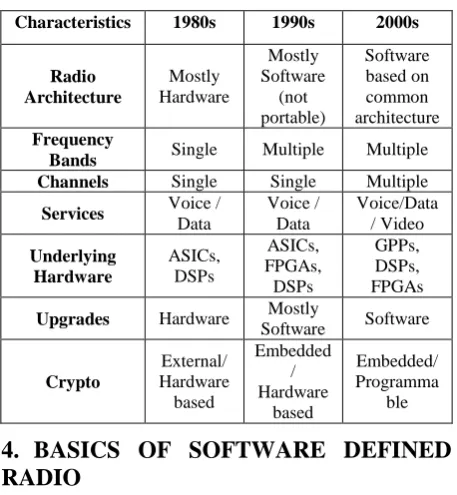
[image:2.595.315.544.320.563.2]DSP-based modem which is reprogrammable for different platforms and became the foundation for numerous other military radios. The first Programmable Digital Radio (PDR) is developed (GEC) in late 1980’s. A digital radio, which is similar to GEC’s PDR in terms of high level components was developed (ITT Corporation) in 1990’s. SPEAKeasy is a joint Department of Defense and industry program started to develop a software programmable radio which works in the range from 2 MHz to 2 GHz, uses waveforms selected from memory, or downloaded from disk, or reprogrammed over the air. It has a fully programmable waveform and COMSEC for voice, multimedia and networking purpose. FlexComm product family (Spectrum Signal Processing Inc.) comprises narrowband and wideband receiver subsystems, transceiver systems, baseband processing engines, and SDR development systems. It uses combination of PowerPC, DSP and FPGA signal processing devices. Vanu Inc. is another wireless company defined their own software radio architecture which comprises three hardware layers, one layer of operating system and two stacks of application level components. It also provides waveform software for waveforms such as, TDMA, GSM and AMPS. Table 1 gives the evolution of SDR.
Table 1: Evolution of Military Radios
Characteristics 1980s 1990s 2000s
Radio Architecture
Mostly Hardware
Mostly Software
(not portable)
Software based on common architecture
Frequency
Bands Single Multiple Multiple Channels Single Single Multiple
Services Voice /
Data
Voice / Data
Voice/Data / Video
Underlying Hardware
ASICs, DSPs
ASICs, FPGAs, DSPs
GPPs, DSPs, FPGAs
Upgrades Hardware Mostly
Software Software
Crypto
External/ Hardware based
Embedded / Hardware
based
Embedded/ Programma
ble
4.
BASICS OF SOFTWARE DEFINED
RADIO
[image:2.595.64.266.471.668.2]Front End
Processing
Engine
Application
RF
Digitized Complex
Baseband Data
[image:3.595.131.466.71.158.2]Data Frames
Figure 2. Fundamental architecture of SDR
SDR technology brings the flexibility, cost efficiency and power with wide-reaching benefits to service providers, product developers and to end users. Software Defied Radio (SDR) also called as Software Based Radio (SBR) or Software Radio (SR) is a revolution of technology in wireless communication. SDR/SBR/SR is defined as a “technology which receives baseband signal from RF antenna, digitizes the received signal in Front end, further converted into Data frames by Processing engine and then applied to required application, to satisfy communication networks generation changes by simply upgrading software without changing hardware” or “Radio equipment can be reprogrammed quickly to transceiver any frequency using any transmission format and set of standards virtually (Federal Communications Commission)” or “With the help of software, radio operating parameters including range of frequencies, type of modulation and output power limitations can be changed (International Telecommunication Union)” or “the combination of hardware and software making reconfigurable architectures of the system for wireless networks and user terminals (The SDR Forum)”. SDR has numerous definitions due to the broad and complex nature of technology itself, and the variety of implementation solutions for SDR systems.
In an ideal world, SDR is capable of transmitting and receiving signals of any frequency, power level, bandwidth, modulation techniques and to work with any communication system like an FM or AM radio, cellular phone, a pager, a WI-FI transceiver, and satellite communication terminal. Consumers like defense, police, rescue teams and others, who use radio for different purposes can buy single radio which withstands with multiple communication requirements and provides interoperability among the communication systems with an advantage of cost and time saving. This unique radio technology works like personal computing, where a single hardware platform is capable of carrying out numerous functions based on the software applications loaded. There is still a long way to achieve this ideal behavior for Current analog receiver and transmitter hardware sections.
5.
PRINCIPLE OF SDR
A. SDR Receiver Block Diagram
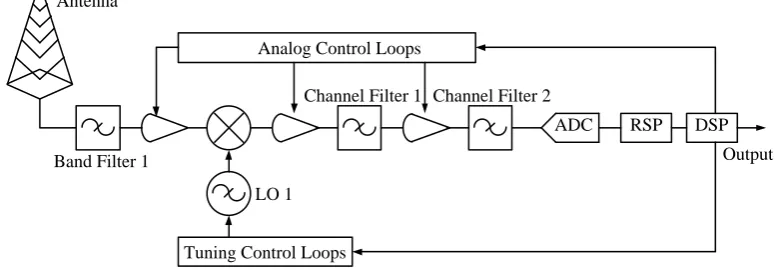
SDR receiver [10, 13, 17] block diagram is shown in Figure 3 for single carrier, it also valid for multicarrier. An SDR will have all signal elements that are reprogrammable. The
antenna becomes the weakest element in SDR. Since most of the antenna structures have bandwidth that is a small percentage of its center frequency, so in many applications there is no problem when single band of operation is used, but we get a problem when multiband operation is used. However, the antenna is tuned to track the operating frequency for maintaining operating efficiency. Next is the
Band select filter. To minimize the effect of intermodulation distortion, this filter will select the range of input frequencies and there is no problem when single band of operation is used, but we get a problem when multiband operation is used.
Mixers are used to convert RF spectrum to IF spectrum. Although only one mixer is shown in Figure 3, many receivers will have two or three mixer stages, each stage will generate a lower frequency and also take advantage of filtering undesired signals. A single carrier receiver will apply channel filtering with the use of mixer stages, but in multicarrier receiver analog channel filtering is not possible since channel bandwidth is not known in advance.
Local oscillator is used to generate carrier frequency which when mixed with incoming RF signal produces IF and the Local oscillator (LO) is easily programmable using software control. IF amplifier will be in the form of AGC. The goal of an AGC is to use the maximum gain without overloading the remaining signal elements. In multicarrier applications, use of an AGC will be difficult, since if insufficient dynamic range is available in the receiver, decrease in gain from a strong signal will cause loss of weak signal. ADC is used to convert IF signals into digital form [4, 6] for processing and the selection of ADC become important which determines the architecture of SDR. For ADC the parameters which can be
Antenna
Analog Control Loops
Band Filter 1
Channel Filter 1 Channel Filter 2
ADC RSP DSP
Tuning Control Loops LO 1
Output
[image:3.595.111.499.601.736.2]Input
Input
Input
Input Antenna
Band Filter
Driver & MCPA
Nyquist Filter
DAC
TSP
TSP TSP
TSP
DSP
DSP
DSP
DSP LO1
[image:4.595.116.477.71.233.2]Tuning Control Loops
Figure 4. SDR Transmitter with multi-channel Block Diagram
changed are: input range, sample rate and bandwidth. For very high sample rates and data rates, ADC is implemented as either on FPGA or ASIC. To reduce cost, ASICs are used to perform the functions. The final element in SDR is DSP
which can be programmed for any required processing task. It can process the functions like detection, receiver functions, equalization and even network interfacing.
B. SDR Transmitter Block Diagram
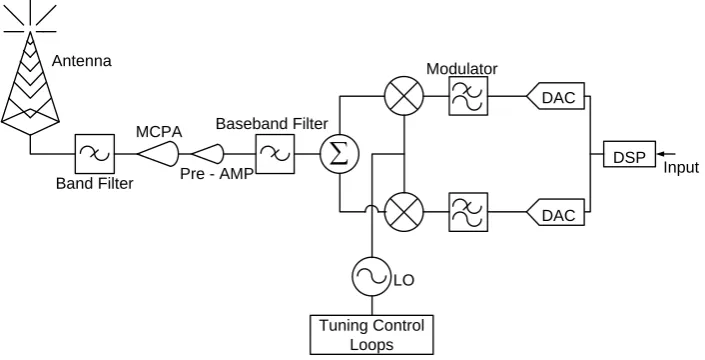
Transmitter functions for SDR are based on super-heterodyne or direct conversion. Figure 4 and 5 shows these two options. Super-heterodyne is suitable to single and multi-carrier applications, whereas direct conversion gives an excellent and low cost solution for single carrier applications. In both the applications, to generate modulated baseband data, DSP or ASIC/FPGA are used and the baseband data is applied either directly to digital to analog converters (DACs) for direct RF modulation or to a digital processor for converting into suitable IF. As with the receive function, the transmit function will select the bandwidth of the desired channel and then converted by digital means to IF. For this purpose a mixer or a modulator is used. If direct RF modulation is used, an RF modulator will be used. If IF is used, a mixer is used to convert frequency from one to another. As with the receive mixer/demodulator, to minimize distortion it is desirable to change the bias levels or the drive level of the data or local oscillator (LO) levels.
As with receive LO, to optimize the performance under various signal conditions, transmit LO is easily reprogrammable using software control. As with receive path, data converter or DAC is often more tedious, since dynamic range requirement for transmit signal path are lower (25 to 45 dB) than the receive path and component selection is also not difficult. Finally,Power gainis achieved from pre-amplifier and power amplifier (PA). These devices will operate across wide range of frequencies.
6. FEATURES
The key features of SDR technology [14] are:
A. Reconfigurability:
SDR implements different standards on the same system just by selecting appropriate software module dynamically which is possible both in infrastructure and handsets.
B. Interoperability:
SDR provides open architecture radio system implementation. End users can use third party applications on their handsets which improves the demand and usage of handsets.
C. Reliability:
In SDR the reliability can be improved by the use of software through a program which indicates software error prevention, fault detection and removal.
Antenna
Band Filter MCPA
Pre - AMP
Baseband Filter
Tuning Control Loops
LO
Modulator
DAC
DAC
DSP Input
[image:4.595.129.482.573.753.2]D. Redundancy:
In SDR redundancy or functionality of a radio within a system is exactly same due to the duplicative nature of software without change in hardware.
E. Scalability:
It indicates the system ability to adjust and develop with expanded requirements and users. Since in SDR defining the characteristics in software is generally very easy and changing the functionality of the system based on changes made in software.
F. Security:
It indicates end-to-end reliability of the transmission process to provide error free and uncompromised exchange of information and in SDR security measures can be taken very easily since secure devices [1] depends on software based algorithms.
7.
TECHNOLOGIES BASED ON SDR
SDR becomes a key enabling technology [2, 3, 8] for other reconfigurable radio equipment’s and provides the flexibility for them to achieve benefits like reduction of cost and increasing system efficiency.
A. Adaptive Radio:
It is a radio in which communication system will monitor their own performance and to improve it, operating parameters are modified. The use of SDR technology in adaptive radio system provides higher levels of performance and better quality of service.
B. Cognitive Radio:
Cognitive radio [1] is used for improving the usage of natural resource (radio electromagnetic spectrum). It is a radio in which communication systems knows their location and utilization and can make decisions about their radio operating parameters by mapping the information compared to predefined objectives. Intelligent Radio is a cognitive radio which is capable of changing performance and environment to serve the needs of the end user.
8.
APPLICATIONS
The needs of civil service sectors, agencies [16], organizations, and entities like police, coast guard, fire and other to have a common communication linkage gives the scope for SDR in present context.
SDR technology conceptualized to meet the end user requirement, where the handsets used by the user can be reconfigured using software providing solution for wireless telephony. Current market trend creates an environment of a buyer for wireless telephony and information services which mobilizes the wireless operators in offering various services to satisfy the user and keeping consistency from the customer.
9.
CONCLUSIONS
Software Defined Radio (SDR) is a leading technology in radio communication by providing upgradation facility which is flexible and withstands for long time while providing multi-standard terminals for end users with in financial feasibility.
learning radio units utilizes SDR as base technology. A tunable RF/IF filter simplifies reconfigurable radio design. Frequency selectivity of the receiver will be improved with tunable antennas which makes the linearity requirement of RF front-end. Current ADC technology is used to digitized the IF frequencies, though power consumption and sampling frequency of these devices are need to be reduced for mobile applications. Linearization of amplifier and mixer, interference rejection techniques are the areas where the research community and industry should focus on. A basic challenge for SDR design is to deliver required computational performance for the signal processing tasks within the size, weight and power requirements, specifically for handheld units. The progress in DSP and FPGA capabilities solve the computational requirements. The reconfigurability of SDR may have security challenges from loading unauthorized and/or malicious code which causes side effect.
10.
REFERENCES
[1] Gianmarco Baldini, Member, IEEE, Taj Sturman, Member, IEEE, Abdur Rahim Biswas, Member, IEEE, Ruediger Leschhorn, Member, IEEE, Gy¨oz¨o G´odor, Member, IEEE, and Michael Street, “Security Aspects in Software Defined Radio and Cognitive Radio Networks: A Survey and A Way Ahead,” IEEE Communications Surveys & Tutorials, Vol. 14, NO. 2, Second Quarter 2012.
[2] Tayfun Nesimoglu, A Review of Software Defined Radio Enabling Technologies, Microwave Symposium (MMS), 2010 Mediterranean, 2010, Page(s): 87 – 90.
[3] Kenington, P.B., “Linearized trans-mitters: an enabling technology for software defined radio”. Communications Magazine, IEEE, Vol: 40, Issue: 2, 2002, Page(s): 156 – 162.
[4] J. H. Reed, Software Radio: A Modern Approach to Radio Engineering, Prentice Hall, Upper Saddle River, NJ, 2002.
[5] B. Brannon, "Fast and Hot: Data Converters for Tomorrow's Software-Defi ned Radios," RF Design, 25 (July 2002): pp. 60"66.
[6] R. H. Walden, "Analog-to-Digital Converter Survey and Analysis," IEEE Communications Magazine, 17 (April 1999): pp. 539"550.
[7] G. Chen, D. Kotz, "A Survey of Context-Aware Mobile Computing Research", Technical Report TR2000-381, Dept. of Computer Science, Dartmouth College, Nov. 2000.
[8] W. Tuttlebee, Software Defined Radio: Enabling Technologies. Chichester: Wiley, 2002.
[9] European Defence Agency, “Back-ground on Software Defined Radio,” Nov. 2007.
[10]Abidi, “The path to the software-defined radio receiver,” Solid- State Circuits, IEEE J., vol. 42, no. 5, pp. 954– 966, 2007.
[11]E. Buracchini, “The software radio concept,” Commun. Mag., IEEE, vol. 38, no. 9, pp. 138–143, Sept. 2000.
[13]J. H. Reed, Software Radio: A Modern Approach to Radio Engineering. Prentice Hall, 2002.
[14]J. Mitola III, “Software radios - survey, critical evaluation and future directions,” in National Telesystems Conference, 1992. NTC-92, pp. 13/15– 13/23, May 1992.
[15]Software Defined Radio Forum. SDR Forum. (Oct. 2007). [Online]. Available: http://www.sdrforum.org
[16]S. Nagel, V. Blaschke, J. Elsner, F. K. Jondral, and D. Symeonidis, “Certification of SDRs in new public and governmental security systems,” in SDR’08 Technical Conference and Product Exposition, Oct. 2008.
[17]A. P. Vinod and E. M. K. Lai, “Low power and high-speed implementation of FIR filters for software defined radio receivers,” IEEE Transactions on Wireless Communications, vol. 5, no. 7, pp. 1669–1675, 2006.
[18]John L. Shanton III and H. Wang, “Design considerations for size, weight and power (SWAP) constrained radios,” in 2006 Software Defined Radio Technical Conference and Product Exposition, Nov. 2006.
[19]D. Efstathiou, L. Fridman, and Z. Zvonar, “Recent developments in enabling technologies for software defined radio,” IEEE Communications Magazine, vol. 37, no. 8, pp. 112–117, Aug. 1999.