E
3
-value to BPMO Model Transformation
Sara Jafarinasab
E-Learning FacultyShiraz University Shiraz, Iran
Omid Bushehrian
Department of Computer Engineering Shiraz University of Technology
Shiraz, Iran
ABSTRACT
The paper outlines an approach to link business models, based on e3-value ontology, with semantic business process models that are expressed with BPMO concepts and linked to WSMO concepts. The union of business modeling and business process modeling ensures that the requirements for a Business Process Management System are driven by business objectives. In the proposed approach interoperability problem in cross enterprise collaboration has also been considered.
In this paper, a mapping algorithm that gets an e3-value model as input and returns a BPMO diagram in output has been introduced.
General Terms
Business model to business process model transformation.
Keywords
Business Modeling; Business Process Modeling; Semantic Business Process Management; Cross Enterprise Collaboration.
1.
INTRODUCTION
Business-related specifications are divided into two categories, business models and business process models [1]. Business models illustrate the value exchanges between business partners on an abstract level with the overall goal of generating benefit for each participant [1]. Business process models on the next lower layer , concretize the relationships between the partners by making assertions about the flow of information and type of interaction [1]. From a generic viewpoint, a business model therefore describes the what while a business process model defines the how.
The union of these two layers assures that the requirements for a Business Process Management System are driven by business objectives [2].
Designing and implementing services in a flexible way requires a (semi-) automated path from business models down to business process models. So, these layers must be linked to derive artifacts at a lower layer from formal descriptions at a higher layer. [1].
There are a number of approaches, languages, and ontologies for business modeling, e.g. e3-value, REA and BMO. For the purpose of this paper ,one comprehensive and well established business model ontology, the e3value [3], which is widely used for business modeling in e-commerce is chosen.
In the next level , UML approaches, UMM and BPMN are common approaches for business process modeling.
In this paper BPMO [4] is chosen For Business Process Modeling which is a superset of Business Process Modeling Notation (BPMN) and Event-Driven Process Chain (EPC). BPMO is a product of The SUPER initiative (Semantic Business Process Management - SBPM), supported by the EU 6 Framework Program [5].
The exquisite effect of semantics on computational environment is mainly the fact that it allows for an unambiguous description of resources. Adding semantics means to semantically describe the data models, the services’ behavior and the business process model in terms of ontologies[6]. The actual benefits are the increase in the extent of automation and dynamism in the elementary operations on the available resources: discovery, composition, communication, etc [7].
In this paper the integration of business modeling based on e3-value and business process modeling represented by BPMO is proposed.
The research question addressed in this paper is: how can a process model based on BPMO be derived systematically from a value model by considering Interoperability problem? Previous research on this question has drawn attention to the aspects of communication model, process model and service design.
Fatemi [8], addresses the automation of business value model to coordination process model based on GROOVE, transformation method. The output model specifies the required messages for each value transfer , and it doesn’t define necessary services and processes for each transaction.
Transformation from value model to business process model is discussed by Weigand [9]. This analysis provides a basis for detemining the objects of concern in the process design.
Wigand also has proposed a service design method that starts from a value model and identifies core and enhancing services and also possible web services [10].
In another work Hoffman[11] focuses on interoperability requirements regarding data and process aspects. It has mentioned that defining a collaboration protocol can be a solution for interoperability problem in multi-actor service systems.
The paper is structured in the following way. In sect. 2 e3-value and BPMO are described respectively. In sect. 3 a mapping algorithm is introduced . In Section 4 there is the evaluation. In Section 5 a case study is discussed. Section 6 concludes the paper with a summary and directions for future work.
2.
VALUE MODELING AND PROCESS
MODELING
2.1
E3-value
The e3value ontology produces modeling constructs to represent and analyze a network of enterprises which are exchanging things of economic value with each other [2].
these values. Attention is on showing who is doing business with whom[3].
The feasibility of the model can be evaluated by means of profit sheets and sensitive analysis. A graphical e3value ontology editor as well as analysis tool is available for download (see http://www.e3value.com) [12].
2.2
Semantic Business Process Modeling
with BPMO
In the approach of this paper BPMO is used as the modeling notation to represent the business processes in a semantics-enriched manner. BPMO is based on WSMO which is a comprehensive framework for semantic business process modeling[3] .
BPMO is a product of The SUPER initiative (Semantic Business Process Management - SBPM).The SUPER methodology offers tools and methodologies for creating business process models and adding annotations based on ontological constructs to these models [4] .
Inof this paper BPMO (version 1.4) is considered as the standard language for detailed process models, just as e3-value is considered as a standard language for business models.
The BPMO concepts GoalTask and WebServiceTask are especially relevant to interaction, so they can be useful in cross-enterprise collaboration context. A GoalTask is an executable task which is used to request the achievement of a WSMO .A WebServiceTask specifies that for fulfilling a task which web service offers functionality. The goal is specified in the hasWSMOGoal property of GoalTask, and the composition algorithm uses it to match demanded and offered functionality. BPMO GoalTasks are symmetric to BPMO WebServiceTasks .It means that GoalTasks describe demanded functionality and WebServiceTasks present offered functionality[5].
The separation of demanded functionality and offered functionality is considered as a very powerful abstraction mechanism. This division enables a business user to create business process models in terms of desired functionality (goals) without worrying about the implementation[3].
3.
FROM VALUE MODEL TO PROCESS
MODEL
Fatemi [6] mentioned that value model does not imply order of messages , and a domain expert should define the ordering.
To put the message transfers in a correct order in the coordination model the domain expert has to ask the following two questions regarding each value exchange in the value model:
1. Which partner imitates the collaboration?
2. In which order the realization of the value transfers should occur?
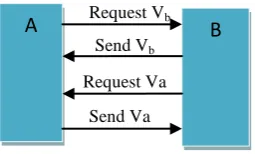
[image:2.595.355.483.72.149.2]According to these two answers, different ordering can be detected. In this paper it`s assumed that partner A starts the collaboration and, and partner B first realizes the A`s requested value and then requests it`s desired value. Figure 1 shows the assumed ordering.
Figure 1. Defined messages order
Fatemi[15] also has discussed that a direct value transfer between two partners in a value model does not necessarily imply that there will be a direct coordination object exchange between these partners in the corresponding coordination model. Sometimes a third party will be involved and the path for value object exchange becomes an indirect path for control object exchange.
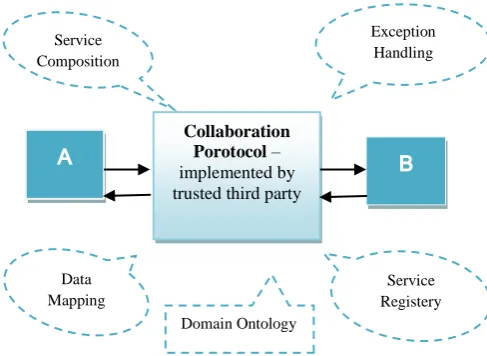
Here Here it`s assumed that all the informational data transfers which involve e web service are done through a third party which implements collaboration protocol and physical value transfers are done directly.
In the next section the collaboration protocol is discussed.
3.1
Collaboration Protocol
Based on Hoffman solution [7] on interoperability problem in multi-actor service systems a collaboration protocol is introduced, which offers below services:
Data mapping
Data mapping service is responsible for handling data mismatches. This service, after receiving requester`s message, maps it to the value needed by provider web services, in return after receiving the response from provider it maps this response to a understandable format for requester. BPMO mediation task can be used for this service
Domain ontology
In domain ontology core concepts of collaboration network are described .And also the request and response transferring messages format for each partner is defined .Data mapping works based on this defined format. We consider it as a common data structure for collaboration network.
Exception Handling
Collaboration protocol is responsible for unpredictable situation that occurs in collaboration and it handles exceptions during value transfer
Service Repository
Collaboration protocol contains a repository of services provided by each actor .by searching in this repository the requested service is invoked.
Service Composition
The service requested by a partner may be provided by the other party not just by one service. In this cases service composition is needed and collaboration protocol is responsible for it.
Collaboration protocol can be implemented by a trusted third party. Requirements and responsibilities of trusted third party has been discussed by Zeighami[8].
A
Request VbB
Request Va Send Vb
Figure 2.Collaboration protocol
3.2
Mapping Algorithm
In this section a mapping algorithm is proposed which gets an e3-value diagram as input and returns a BPMO diagram .The pseudo code of mapping algorithm is presented.
Figure 3. Pseduo Code of Mapping Algorithm
4.
EVALUATION
The approach introduced in this thesis is comprehensive as it considers business modeling, business process modeling and also implementation, the mapping is complete because it is based on all concepts of input model. proposed mapping algorithm is not two way mapping .By defining collaboration protocol that is implemented by a trusted third party ,trust in cross enterprise collaborations has been considered.
Proposed approach is compared to previous works [1, 6, 9].the result is seen in table 1.
Input e3valueDiagram {
FOR each actor in e3- value diagram
Define, the same actor in bpmoDiagram
FOR each value transfer and related value port in e3-value
Define one “send message event “in bpmoDiagram for requester and one “receive message event” for provider
FOR each value transaction in e3-value Diagram
Define one negotiation web service in provider and connect it to previous receive task in provider
FOR each value activity in e3-value Diagram
Define one sub-process with corresponding name in provider and Connect it to negotiation web service.
FOR each value transfer in e3-value Diagram
Define one “send message” in provider and one “receive message” in requester for delivering the value and Connect the send message to the previous sub-process
FOR each value transaction in e3-value Diagram
Define one collaboration protocol as a mediation process that handles message transfers between actors
Define send and receives for collaboration protocol corresponding to send and receive messages defined in sender and requester
Define goal tasks corresponding to value objects for invoking web services
Define mediation task for data mediation between requester and provider
Output bpmo diagram
Service Composition
Collaboration Porotocol – implemented by trusted third party
B
A
Exception Handling
Service Registery Data
Mapping
Table 1. Comparing collaboration protocol approach to previous works
Metrics [8] [10] [9] Mapping based on collaboration protocol
Complete [17]
×
Comprehe nsive
× ×
Two-way mapping [8]
× × ×
Trust[8] × ×
5.
CASE STUDY
For case study, Mizan credit card system is considered. In this scenario, in order to increase the purchasing power of workers and government employees. Bank issues Mizan card. Mizan credit card will be distributed among the clerks. It also sets up new purchase network and the amount of purchase is deducted from the salary of employees [8].
In this paper only collaboration between employer company, naming it Comptroller and bank has been taken into account.Comptroller sends credit card request for its employees to bank and in return bank issues credit card, after
a definite deadline comptroller company should pay money for employee's debts.
Fig shows the e3-value model for this scenario. This model shows the value transfers in the network
Figure 4. Value Model Of Mizan Case Study
Actors: Bank, company moon
Value objects: Mizan card, money
Value activities: issue Mizan card that is done by bank and paying debt that is done by comptroller.
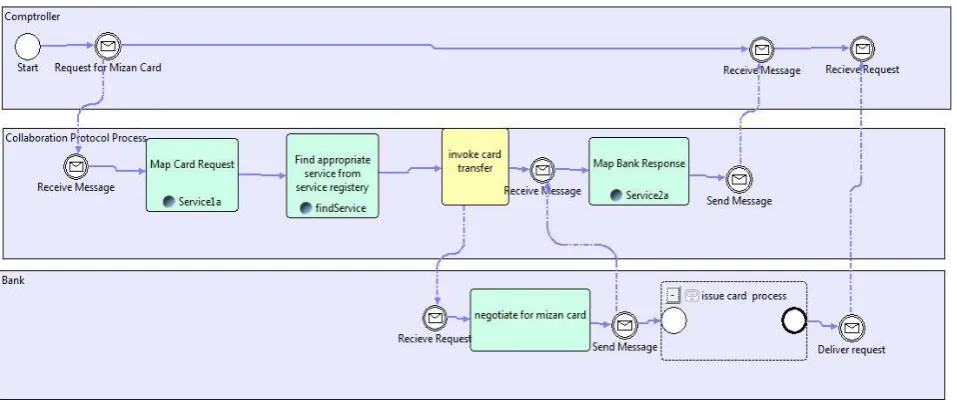
[image:4.595.317.532.127.226.2]According to mapping algorithm BPMO diagram is constructed. (We only consider Mizan card value transfer, because of space limitations. Transfers related to payment is not considered in process model)
[image:4.595.62.541.425.625.2]In collaboration protocol we have 2 mapping task: map card response that maps Comptroller request to value needed By bank negotiation web service and Map Bank Response that , maps bank response to a understandable format by Comptroller.
6.
CONCLUSIONS AND FUTURE
BRESEARCH
Requirements engineering should be driven by the business objectives for the system to be built, regardless of the implementation platform for the system. For the Business Process Management Systems platform, business process models are used during requirements engineering to specify the system.
In this paper we investigate how business modeling can be integrated with semantic business process modeling (following SUPER) such that business process modeling is driven by business objectives .The proposed integration is based mapping e3-value concepts with BPMO constructs.
This mapping is complete as it considers all concepts of the input model .Comparing to similar works it`s new as it has used BPMO semantic constructs for solving interoperability problem.
Implementing of proposed framework and mapping can be done in future.
7.
REFRENCES
[1] J. Dorn, C. Grun, H. Werthner, and M. Zapletal, "A survey of B2B methodologies and technologies: From business models towards deployment artifacts," in System Sciences, 2007. HICSS 2007. 40th Annual Hawaii International Conference on, 2007, pp. 143a-143a [2] K. Decreus and G. Poels, "Putting business into business
process models," in Computer Software and Applications, 2008. COMPSAC'08. 32nd Annual IEEE International, 2008, pp. 1005-1010.
[3] J. Gordjin, "Value based Requirements Engineering Exploring Innovative e_Comerce Ideas," Phd University of Vrije, 2002
[4] L. Cabral, B. Norton, and J. Domingue, "The business process modelling ontology," in Proceedings of the 4th International Workshop on Semantic Business Process Management, 2009, pp. 9-16.
[5] M. Born, C. Drumm, I. Markovic, and I. Weber, "SUPER-raising business process management back to the business level," ERCIM News, vol. 70, pp. 43-44, 2007
[6] H. H. Hoang, P.-C. T. Tran, and T. M. Le, "State of the art of semantic business process management: an
investigation on approaches for business-to-business integration," in Intelligent Information and Database Systems, ed: Springer, 2010, pp. 154-165.
[7] H. H. Hoang and T. M. Le, "Bizkb: a conceptual framework for dynamic cross-enterprise collaboration," in Computational Collective Intelligence. Semantic Web, Social Networks and Multiagent Systems, ed: Springer, 2009, pp. 401-412.
[8] H. Fatemi, M. van Sinderen, and R. Wieringa, "E3value to BPMN model transformation," in Adaptation and Value Creating Collaborative Networks, ed: Springer, 2011, pp. 333-340
[9] H. Weigand, P. Johannesson, B. Andersson, M. Bergholtz, A. Edirisuriya, and T. Ilayperuma, "Value object analysis and the transformation from value model to process model," in Enterprise Interoperability, ed: Springer, 2007, pp. 55-65
[10]H. Weigand, P. Johannesson, B. Andersson, M. Bergholtz, A. Edirisuriya, T. Ilayperuma, et al., "Value-based service design "Value-based on a general service architecture," Proc. BUSITAL, 2008
[11]W. H. Tan and Yaohua, "Requirements for modelling interoperability in knowledge intensive service systems based on BeerLL," International Journal of Services Technology and Management, vol. 16, pp. 191-207, 2011 [12]J. Gordijn and R. J. Wieringa, "A value-oriented approach to e-business process design," in Advanced Information Systems Engineering, 2003, pp. 390-403 [13]A. S. Marin Dimitrov "Deliverable 9.9," Super
Demontrator2008.
[14]K. Decreus, F. Gailly, and G. Poels, "A toolkit for business process owners to capture early system requirements," in 3rd International workshop on Semantic Business Process Management (SBPM 2008), 2008, pp. 87-92.
[15]H. Fatemi, "Risk-aware design of value and coordnination networks," Phd Thesis, University of Twente, 2012.
[16]N. Zeighami, M. Ali Seyyedi, and M. Mohsenzadeh, "Introducing a Domain Ontology based on the Role of Trusted Third Party (TTP) in inter-Organizational Collaboration," International Journal of Computer Applications, vol. 71, pp. 37-41, 2013.