http://dx.doi.org/10.4236/eng.2014.66030
An Enhanced Remote User Authentication
Scheme
Xiaohui Yang, Xinchun Cui, Zhenliang Cao, Ziqiang Hu
College of Information Technology and Communication, Qufu Normal University, Rizhao, China Email: [email protected]
Received 2 March 2014; revised 2 April 2014; accepted 9 April 2014
Copyright © 2014 by authors and Scientific Research Publishing Inc.
This work is licensed under the Creative Commons Attribution International License (CC BY).
http://creativecommons.org/licenses/by/4.0/
Abstract
Remote user authentication schemes are used to verify the legitimacy of remote users’ login re-quest. Recently, several dynamic user authentication schemes have been proposed. It can be seen that, these schemes have weaknesses because of using timestamps. The implement of strict and safe time synchronization is very difficult and increases network overhead. In this paper, we pro-pose a new dynamic user authentication based on nonce. Mutual authentication is performed us-ing a challenge-response handshake between user and server, and it avoids the problems of syn-chronism between smart card and the remote server. Besides, the scheme provides user’s ano-nymity and session key agreement. Finally, the security analysis and performance evaluation show that the scheme can resist several attacks, and our proposal is feasible in terms of computa-tion cost and communicacomputa-tion cost.
Keywords
Password, Dynamic ID, User Authentication, Smart Cards, Nonce
1. Introduction
One of the solutions to the problem is to employ dynamic ID in different login.
In 2004, Das et al. [5] proposed a dynamic ID-based remote user authentication scheme, which can resist rep-lay, masquerade, and insider attacks. However, Wang et al. in 2009 [6] pointed out that Das et al.’s scheme is susceptible to smart card attack and does not provide mutual authentication. Then, Wang et al. proposed a more efficient and secure dynamic ID-based remote user authentication scheme. Recently, Khan et al. in 2011 [7]
pointed out that Wang et al.’s scheme has insider attack and does not provide user’s anonymity and session key agreement. Then, they proposed a dynamic ID based remote user authentication scheme. We can see that these schemes have weaknesses because of using timestamps and lead to serious clock synchronization problems. In this paper, we proposed an enhanced dynamic ID-based remote user authentication scheme. In this scheme, mu-tual authentication is performed using a challenge-response handshake between user and server, and it avoids the problems of synchronism. Furthermore, the scheme provides user’s anonymity and session key agreement.
The remainder of this paper is organized as follows. In Section 2, we present an enhanced remote user authen-tication scheme. In Section 3, there is the analysis about this scheme. Finally, conclusions are presented in Sec-tion 4.
2. The Proposed Scheme
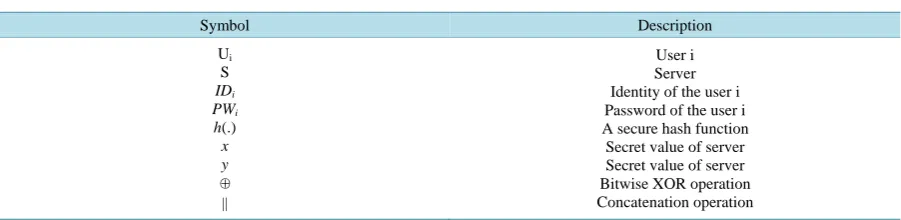
Although the implement of strict and safe time synchronization is very difficult and increases network overhead, most time synchronization schemes were not designed with security in mind. In addition, if the setting of the in-terval of transmission delay is too short, it will cause the failure of the legal users’ login. However, if the setting of the interval of transmission delay is too large, it will be suffered from the relay attacks. Therefore, authentica-tion protocols based on the timestamps not only introduces more safety risk, but also is unpractical. In this sec-tion, we propose an enhanced remote user authentication scheme. To avoid the clock synchronization problem, we replace the timestamp design with a novel nonce-based mechanism in our scheme. The improved scheme is divided into four phase: registration phase, login phase, authentication phase, and password change phase. De-tailed steps of these phases of the proposed scheme are described as follows. The notations used throughout this paper are in Table 1.
2.1. Registration Phase
A user Ui with identifier IDi should first carry out this phase once before he can use any of the services provided
by the server S. In this phase, Ui and S need to perform the following steps.
Step R1. User Ui keys his identity IDi and password PWi, and his smart card computes and submits
(
)
{
ID h IDi, iPWi}
to S, through a secure channel.Step R2. After receiving the request, S computes Ai=h h ID
(
( )
i ⊕x)
, Bi =h ID(
iPWi)
⊕Ai and( )
i i
C =h A , where x is the permanent secret key of S. Then, S sends
{
h( )
⋅ ,B Ci, i}
to Ui through a securechannel.
2.2. Login Phase
Whenever Ui wants to login a server S, he must perform the following steps:
Step L1. After inserting his smart card into the card reader, Ui inputs the identity IDi and password PWi. Then,
[image:2.595.88.539.610.720.2]the smart card computes Di=Bi⊕h ID
(
iPWi)
, and Ei =h D( )
i .Table 1. Notations.
Symbol Description
Step L2. The smart card checks whether or not Ei and Ci are equal. If yes, Ui passes the legitimate verification,
and performs the following steps; otherwise, Ui is rejected.
Step L3. The smart card randomly chooses a nonce R1and computes Fi=Di⊕R1.
Step L4. Ui sends the login request message
{
h ID( )
i ,Fi}
to the remote server S.2.3. Authentication Phase
A user performs the remote authentication phase based on the login message for authentication as long as it vis-its the server. Ui and S perform the following steps to achieve mutual authentication and to establish a session
key.
Step A1. After receiving the login message
{
h ID( )
i ,Fi}
, S computes Gi =h h ID(
( )
i ⊕x)
andR1′ = ⊕Fi Gi.Then, S chooses a nonce R2 and computes Hi=Gi⊕R2.
Step A2. The server S sends the mutual authentication message
{
H h Ri,( )
1′}
to the user Ui.Step A3. After receiving the mutual authentication message
{
H h Ri,( )
1′}
from the server S, the user Uichecks whether or not h R′
( )
1 and h(R1) are equal . If no, Ui rejects this message and terminates the operation;otherwise, Ui authenticates S successfully and computes R2′ =Hi⊕Di. Then, Ui sends
{
h R( )
2′}
to S.Step A4. When the server S receives h R′
( )
2 , checks whether or not h R′( )
2 and h(R2) are equal. If no, Ssends reject message to the Ui; otherwise, S authenticates Ui.
After finishing mutual authentication phase, the user Ui and the server S each can compute a common session
key SK=h R
(
1R2)
for the next data transmission.2.4. Password Change Phase
The user Ui can change his password without the help of the server S, and the details of the password change
procedures are as follows:
Ui inserts the smart card, and input his old password pwi and the identity IDi. Then, the smart card computes
(
)
i i i i
A′ =B ⊕h ID PW , Ci′=h A
( )
i′ , and checks whether or not Ci′ and Ci are equal. If the verificationprocess is correct, the smart card asks the cardholder to resubmit a new password new i
PW , and then smart card
computes Binew =h ID
(
iPWinew)
⊕Ai. At last, the smart card replaces the values of Bi stored in its memorywith new i
B to finish the password change phase.
3. Security Analysis
In this subsection, we present these security analyses of our scheme and show that proposed scheme can resist many kinds of attack. To analyze the security of our scheme, we assume that an attacker can obtain the secret values stored in the smart card by monitoring the power consumption [8] [9] and intercept the messages com-municating between the user and the server.
3.1. User Anonymity
The proposed scheme can protect user’s anonymity. In login phase, the user Ui will send the login request mes-
sage
{
h ID( )
i ,Fi}
to the server S. Thus, the attacker might incept and analyze the login message. It is infeasi-ble to derive the user identity IDi through h(IDi). Furthermore, the login message is dynamic in each login.
Among the parameters of login message, Fi is associated with nonce R1 and dynamically changed. Consequently,
the attacker cannot identify the person who is trying to login.
3.2. Relay Attack
request message
{
h ID( )
i ,Fi}
from Ui, the attacker can resend the same message to S, but he can’t continue,because he can’t compute Gi=h h ID
(
( )
i ⊕x)
without knowing x and can’t compute R1′. For the same reason,the attacker still cannot successfully impersonate the server S to cheat the users by replaying the server’s pre- vious mutual authentication message
{
H h Ri,( )
1′}
.3.3. Impersonation Attack
The proposed scheme can withstand impersonation attack. Assume the attacker intercepts h(IDi), Fi, Hi, but
these information has no meaning to an attacker. He can’t derive the secret parameter x and password PWi.
Without R1, R2, x and PWi, the attacker can’t compute Hi, so impersonation can’t continue. What’s more, the
at-tacker can’t impersonation of S, because he can’t compute R1′ without knowing the secret key x.
3.4. Denial-of-Service Attack
In our proposed scheme, the smart card of user Ui checks the validity of user identity IDi and password PWi
be-fore update procedure. The attacker has to insert the smart card of user Ui into the smart card reader and has to
guess the identity IDi and password PWi correctly. Since the smart card computes Ai′ =Bi⊕h ID
(
iPWi)
,( )
i i
C′=h A′ , and compares the computed value of Ci′ with the stored value of Ci in its memory to verify the le-
gitimacy of Ui before the smart card accepts the password update request. It is not possible to guess the identity
IDi and password PWi correctly at the same time in real polynomial time even after getting the smart card of user
Ui. Therefore, the proposed protocol is secure against DOS attacks.
3.5. Insider Attack
If an attacker obtains Biand Ci from Ui’s smart card, he can’t extract sensitive information, like IDi, PWi, x,
be-cause it is computationally infeasible to invert the one-way hash function h(). Moreover, he can’t extract Ai from
Bi without the knowledge of IDi and PWi. Furthermore, if the attacker is a legal user Ui, he can’t obtain x from
his smart card. Thus, the insider attack is resisted.
3.6. Password Guessing Attack
In our scheme, Ui’s password is only involved with h ID
(
iPWi)
instead of login request message{
h ID( )
i ,Fi}
or response message
{
H h Ri,( )
1′}
, it is more difficult for an attacker to compute a valid authentication requestmessage without knowing the server’s secret value x. Therefore, we believe that the on-line password guessing attacks can be prevented more efficiently.
On the other hand, in our scheme Ui’s login message, i.e.h(IDi), Fi, are well-protected and un-involved with
Ui’s password. This design eliminates the correlation between Ui’s password and the transmitted messages, i.e.
h(IDi), Fi, Hi, an attacker has no ability to examine his guessed password with previous legitimate request or
re-ply message in an off-line mode. Hence, our scheme is secure against the off-line password guessing attack.
3.7. Stolen Smart Card Attack
Our scheme can prevent stolen smart card attack. If the smart card is stolen or lost, the attacker can extract the secret information Biand Ci from the smart card. With the parameter, the attacker tries to impersonate the user to
login to the server S, however, he must produce a valid login request message
{
h ID( )
i ,Fi}
. It can be observedthat it is impossible to compute Ai and Fi from the given parameters without knowing x, IDi, and PWi, so the
at-tacker can’t generate a valid login message.
3.8. Parallel Session Attack
However, he can’t compute the agreed session key SK=h R
(
1R2)
between user Ui and server S because hedoes not know the values of x, R1, R2. Therefore, the proposed scheme is secure against parallel session attack.
3.9. Mutual Authentication
Our scheme provides mutual authentication of Ui and S. In our scheme, S sends mutual authentication message
( )
{
H h Ri, 1′}
to Ui validate its authenticity. The value of Hi is calculated by Gi which is only known to Ui and Sand this message is infeasible to forge by a fake server to impersonate the S.
3.10. Session Key Agreement
The proposed scheme provides session key agreement during the authentication phase. Suppose the attacker ob-tains the secret values in the legal user’s smart card and intercepts messages communicating between the user and the server, he may attempt to compute the session key SK. However, he can’t continue without knowing R1
and R2.
4. Performance Comparison
In this section, we summarize some performance issues of the proposed scheme. We compare the proposed scheme with related schemes in terms of cost and security requirements.
4.1. Cost Analysis
An efficient authentication scheme must take computation and communication cost into consideration during us- er’s authentication. The computation cost of each phase is defined as the total time of various operations ex-ecuted in that phase. The communication cost of authentication includes the cost of transmitting messages in-volved in the authentication scheme. We mainly focus on the computations of registration, login and authentica-tion phases since these phases are the main body of the proposed scheme.
In order to carry out the computation cost evaluation, we use the following notations: Th and Ts are defined as
the execution time of the one-way hash function and symmetric operations. Because exclusive-or operation and concatenation operation require very low execution time, it is usually neglected considering its computational cost. The time complexity associated with the different operations can be expressed as T⊕Th< Ts. The
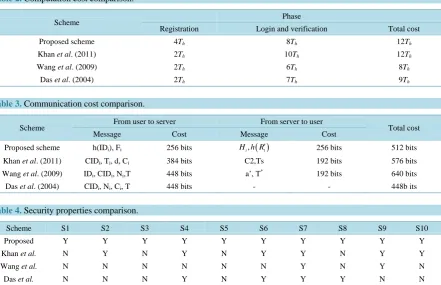
com-parative results are shown in Table 2.
From the table, it is noticed that our scheme requires nearly the same computation as other related schemes, but our scheme provides more security.
In addition, we have shown the comparison of communication cost between our scheme and related scheme. The comparative results are shown in Table 3, we assume that the output size of secure one-way hash function is 128 bits. For comparison, we also assume that, the lengths of IDi, PWi, x, y are 128 bits, and the sizes of
time-stamps and random number are 64 bits.
From the table, it is noticed that the communication cost of Das et al.’s scheme is the least with 448 bits, be-cause, it does not support mutual authentication. However, our scheme needs less bits than others.
4.2. Security Requirements Analysis
In this section, we summarize the security features of our proposed scheme and compare its security robustness with related schemes. The comparative results are shown in Table 4.
From the table, it is noticed that our scheme is more secure and robust than other schemes and achieves more security requirements, which were not considered in the their scheme and are essentially required in implement-ing a practical and universal remote user authentication scheme usimplement-ing smart cards.
5. Conclusions
Table 2. Computation cost comparison.
Scheme Phase
Registration Login and verification Total cost
Proposed scheme 4Th 8Th 12Th
Khan et al. (2011) 2Th 10Th 12Th
Wang et al. (2009) 2Th 6Th 8Th
Das et al. (2004) 2Th 7Th 9Th
Table 3. Communication cost comparison.
Scheme From user to server From server to user Total cost
Message Cost Message Cost
Proposed scheme h(IDi), Fi 256 bits H h Ri, ( )1′ 256 bits 512 bits
Khan et al. (2011) CIDi, Ti, d, Ci 384 bits C2,Ts 192 bits 576 bits
Wang et al. (2009) IDi, CIDi, Ni,T 448 bits a’, T* 192 bits 640 bits
Das et al. (2004) CIDi, Ni, Ci, T 448 bits - - 448b its
Table 4. Security properties comparison.
Scheme S1 S2 S3 S4 S5 S6 S7 S8 S9 S10
Proposed Y Y Y Y Y Y Y Y Y Y
Khan et al. N Y N Y N Y Y N Y Y
Wang et al. N N N N N N Y N Y N
Das et al. N N N Y N Y Y Y N N
S1: Resist impersonation attack; S2: Resist DOS attack; S3: Resist insider attack; S4: Resist replay attack; S5: Resist password guessing attack; S6: Resist stolen smart card attack S7: Resist Parallel session attack; S8: Provide user’s anonymity; S9: Provide mutual authentication; S10: Provide ses-sion key agreement.
nonce instead of timestamps. Mutual authentication is performed using a challenge-response handshake between user and remote server. Moreover, our scheme uses hashing functions to implement user’s anonymity and ses-sion key agreement. The other merits include: 1) our scheme provides a secure password change method to pre-vent the adversary from updating password freely; 2) our scheme can resist various attack, including forward se- crecy; 3) our scheme requires less computation and communication traffic; 4) it is a nonce-based scheme to avoid the time-synchronization problem.
Therefore, this scheme is well suited to the network-based application systems. In our future work, we would carry on experiments if the conditions are met.
Acknowledgements
Yang Xiaohui, Cui Xinchun, Cao Zhenliang and Hu Ziqiang thank the anonymous reviewers for their valuable comments and suggestions.
References
[1] Lamport, L. (1981) Password Authentication with Insecure Communication. Communications of the ACM, 24, 770- 772. http://dx.doi.org/10.1145/358790.358797
[2] Yoon, E.J., Ryu, E.K. and Yoo, K.Y. (2004) Further Improvement of an Efficient Password Based Remote User Au-thentication Scheme Using Smart Cards. IEEE Transactions on Consumer Electronics, 50, 612-614.
http://dx.doi.org/10.1109/TCE.2004.1309437
[3] Tina, X., Zhu, R.W. and Wong, D.S. (2007) Improved Efficient Remote User Authentication Schemes. International Jour- nal of Network Security, 4, 149-154.
[4] Yang, L. and Ma, J.F. (2011) Trusted Mutual Authentication Scheme with Smart Cards and Passwords. Journal of University of Electronic Science and Technology of China, 4, 128-133.
Trans-actions on Consumer Electronics, 50, 629-631. http://dx.doi.org/10.1109/TCE.2004.1309441
[6] Wang, Y.Y., Liu, J.Y., Xiao, F.X. and Dan, J. (2009) A More Efficient and Secure Dynamic Id-Based Remote User Authentication Scheme. Computer Communications, 32, 583-585. http://dx.doi.org/10.1016/j.comcom.2008.11.008
[7] Khan, M.K., Kim, S.K. and Alghathbar, K. (2011) Cryptanalysis and Security Enhancement of a More Efficient & Se-cure Dynamic ID-Based Remote User Authentication Scheme. Computer Communications, 34, 305-309.
http://dx.doi.org/10.1016/j.comcom.2010.02.011
[8] Kocher, P., Jaffe, J. and Jun, B. (1999) Differential Power Analysis. Lecture Notes in Computer Science, 1666, 388- 397.