Comparative Study of Various Next Generation Network-
Business Process Frameworks
Priya R. L
Computer Engineering Department, VESIT, Mumbai, India
Nupur Giri,
Ph.DComputer Engineering Department, VESIT, Mumbai, India
ABSTRACT
The paper discuss the impact of different process frameworks along the various key parameters that synthesizes views from areas such as information systems development, enterprise modeling and work flow management. The idea behind this comparison study of Next Generation Network (NGN) Business Process Framework is to help practitioners to identify different views one should consider whenever applying a Business Process Framework implementation project.
Keywords
NGN, eTOM
1.
INTRODUCTION
The growth in telecommunication industry in technology, forced the necessity to shape up the existing business models. A business process [7, 15] can be defined as a flow of business activities. Nowadays, the Business Process Framework (BPF) is a key survival factor for various companies such as telecommunication, information technology, and manufacturing companies since effective and efficient BPF can reduce operations cost and can achieve better Quality of Service(QoS).
2.
LITERATURE SURVEY
As defined in International Telecommunication Union(ITU) [1, 2, 11], Next Generation Network (NGN) allows for the creation and deployment of a new service and network architecture. This architecture defines the main business requirements in Information and Communication Technologies(ICT) area. The operational activities of an enterprise can be analyzed and integrated through its business processes. Here comes the relevance of Business Process Modeling (BPM).Business process framework are different within each process since different activities are needed to complete the process functions.
3.
COMPARISON OF (NGN) BUSINESS
PROCESS FRAMEWORKS (BPF)
eTOM, ITIL, Zachman, TOGAF and COBIT are widely used best practices in IT service operations and service managements. And here a comparison from different perspectives may help in explaining their purposes, exploitations, results and way of combining them in project executions.
3.1
eTOM (Enhanced Telecom Operations
Map )
The eTOM [4,5,6] framework can be viewed as covering three major business process areas such as Strategy, Infrastructure and Product (SIP), Operations and Enterprise Management (EM). SIP deals with planning and lifecycle management (associated with development and delivery of the product), Operations deals with core of operational management and EM focuses on corporate / business support management.
3.2
ITIL (Information Technology
Infrastructure Library)
In ITIL [9] , the first three phases such as Service Strategy, Service Design and Service Transition are primarily concerned with bringing new or improved services to the service catalog. Service Operation and Continual Service Improvement are concerned with service delivery and optimization of current services.
3.3
Zachman
Zachman framework [10] helps to define a logical structure for the descriptive representations of any complex object. It does not prescribed to any particular method, representation technique or automated tool.
3.4
TOGAF(The Open Group Architecture
Framework)
The TOGAF [3] explains four kinds of ”architecture” such as: Business, Data, Application and Technology architectures, that are commonly accepted as subsets of an overall Enterprise Architecture.
3.5
COBIT(The Control Objectives for
Information Technology)
COBIT [9] is an IT Governance and Control framework that focuses on all IT related processes to ensure good governance of an enterprise.
4.
NGN BPF COMPARISON
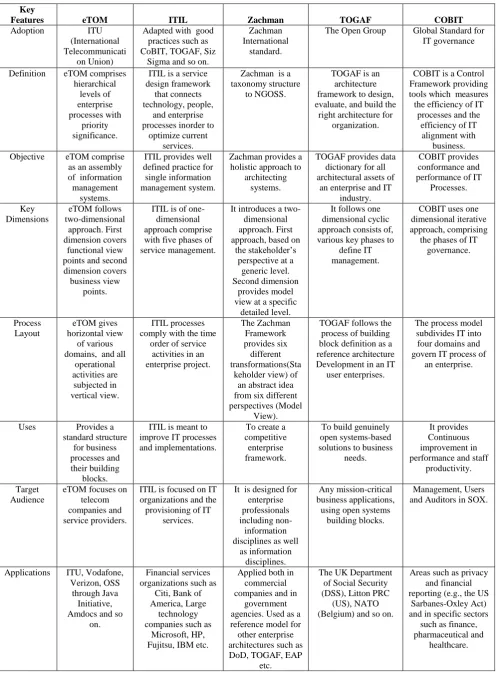
Table 1 : Comparison of NGN Business Process Frameworks
Key
Features eTOM ITIL Zachman TOGAF COBIT
Adoption ITU
(International Telecommunicati
on Union)
Adapted with good practices such as CoBIT, TOGAF, Siz
Sigma and so on.
Zachman International
standard.
The Open Group Global Standard for IT governance
Definition eTOM comprises hierarchical levels of enterprise processes with priority significance.
ITIL is a service design framework
that connects technology, people,
and enterprise processes inorder to
optimize current services.
Zachman is a taxonomy structure
to NGOSS.
TOGAF is an architecture framework to design, evaluate, and build the
right architecture for organization.
COBIT is a Control Framework providing tools which measures the efficiency of IT
processes and the efficiency of IT alignment with
business. Objective eTOM comprise
as an assembly of information management
systems.
ITIL provides well defined practice for single information management system.
Zachman provides a holistic approach to
architecting systems.
TOGAF provides data dictionary for all architectural assets of
an enterprise and IT industry.
COBIT provides conformance and performance of IT
Processes. Key Dimensions eTOM follows two-dimensional approach. First dimension covers functional view points and second dimension covers business view
points.
ITIL is of one-dimensional approach comprise with five phases of service management.
It introduces a two-dimensional approach. First approach, based on
the stakeholder’s perspective at a
generic level. Second dimension
provides model view at a specific
detailed level.
It follows one dimensional cyclic approach consists of, various key phases to
define IT management.
COBIT uses one dimensional iterative approach, comprising
the phases of IT governance. Process Layout eTOM gives horizontal view of various domains, and all
operational activities are
subjected in vertical view.
ITIL processes comply with the time
order of service activities in an enterprise project. The Zachman Framework provides six different transformations(Sta
keholder view) of an abstract idea from six different perspectives (Model
View).
TOGAF follows the process of building block definition as a reference architecture Development in an IT
user enterprises.
The process model subdivides IT into four domains and govern IT process of
an enterprise.
Uses Provides a standard structure
for business processes and their building
blocks.
ITIL is meant to improve IT processes and implementations.
To create a competitive enterprise framework.
To build genuinely open systems-based solutions to business
needs.
It provides Continuous improvement in performance and staff
productivity.
Target Audience
eTOM focuses on telecom companies and service providers.
ITIL is focused on IT organizations and the provisioning of IT
services.
It is designed for enterprise professionals including non-information disciplines as well
as information disciplines.
Any mission-critical business applications,
using open systems building blocks.
Management, Users and Auditors in SOX.
Applications ITU, Vodafone, Verizon, OSS
through Java Initiative,
Financial services organizations such as
Citi, Bank of America, Large
Applied both in commercial companies and in
government
The UK Department of Social Security (DSS), Litton PRC
(US), NATO
Areas such as privacy and financial reporting (e.g., the US
5.
CASE STUDY : ECORE DESIGN
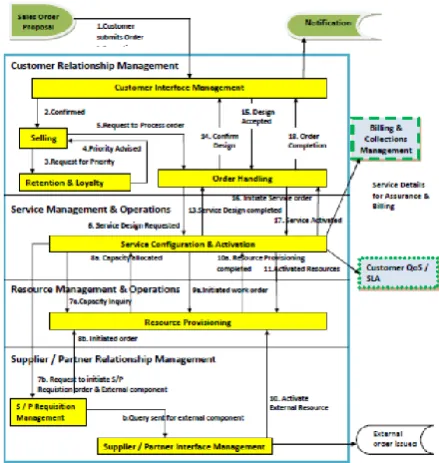
As defined in ITU-T Y.2012 eTOM business process areas such as Strategy, Infrastructure and Product (SIP), Operations and Enterprise Management (EM) are represented in a hierarchical fashion. Within the TM Forum Business Process Framework, eTOM Level 0 to 3 already defined as a standard in generic way. However, the figure 2 depicts Operation processes of eTOM in level 2 decomposition and explains end-to-end process flow for Order Fulfillment in a cellular domain. The operation process shows major business components and flow of Service Fulfillment, Assurance and Billing. Fulfillment, Assurance and Billing (FAB) or Vertical processes is the heart processes and describes business view points. Fulfillment processes are shown in solid rectangle boxes, Assurance processes are shown in dotted rectangle boxes and Billing processes are shown in dashed rectangle boxes. The triggers are conditions marked with arrows between processes and the large red arrows are external triggers from this flow. The four Swim Lanes (SL) or horizontal processes such as Customer Relationship Management (CRM), Service Management and Operations (SMO), Resource Management and Operations (RMO) and Supplier/ Partner Relationship Management (S/PRM) represent functional view points in eTOM framework.
5.1 Order Fulfillment Process in a Cellular
Network using eTOM:
Fig 2 : Order Fulfillment End-to-End Process Flow in a cellular network Level 2 decomposition
5.1.1
Case Scenario
The customer submits a request for New Order Processing in the system [17] (not depicted in figure) and is given Sales Order Proposal (SOP) by the system [17]. SOP contain order information like product information ( Requested cellular services granted to new customer), General information (bandwidth, access etc.) , Status information (cellular services activation time period) and other offer details (standardized or individual offers) provided by the Cellular service provider. This process flow deals with all activities through steps as shown in figure 2 [1 to 19] such as capturing customer order information, triggering the relevant services and its necessary resource provisioning process and finally handing over the order with confirm notification to the customer is explained as below :
The Process flow begins by capturing the customer order information routed through CIM to Selling process for the confirmation of order details (acquire customer data, authorize credit, determine order feasibility). Selling process send a request to Retention and Loyalty process to build customer insight for priority. Priority is then advised to Selling process and in turn it request Order Handling process to issue process order. Now, Order Handling process triggers the Service Configuration and Activation (SCA) process to provide service design solution (as per the product information) with specific service parameters (bandwidth, accessibility, connectivity) for all requested services.
Before SCA process activate the services, it check for internal resource availability through Resource Provisioning process and if supply is required it also initiates Supplier/ Partner Requisition Management process to verify the availability of services with other Cellular Service Provider (CSP) Network. However, there might be a reservation of some critical resources, depending on the CSP’s policies and procedures. Once the required resources are allocated, SCA process triggers the Resource Provisioning (RP) process to initiate internal work order. The required resources are configured, implemented, tested and activated by RP process. To get the design confirmation from the customer, SCA passes the design solution suggested by the cellular service provider through Order Handling process. After service design is
accepted, entire service portfolio will sent to Customer QoS / SLA Management and Billing Collections Management processes for Assurance and Billing vertical processes respectively. Finally, the customer order is completed and closed with notification message, sent to Customer. Then the Customer Satisfaction is validated.
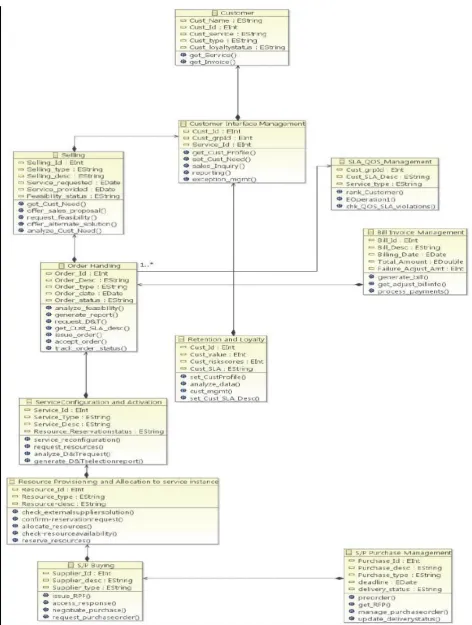
Ecore meta-meta model representation is a model-driven software design, which is the simplied representation of Ecore class hierarchy. It is designed by Eclipse Modeling Framework (EMF) to map eTOM order Fulfillment end-to end process flow with Ecore object instances as shown in figure 1.
6.
CONCLUSION AND FUTURE
WORKS
Next Generation OSS’s Structural view was studied with its eTOM Business Process Framework, defined by TMF. Also eTOM and its associated mapping with other standard framework bodies such as Zachman, COBIT, TOGAF and ITIL frameworks has been compared and discussed in an elaborate manner. The Case Study, designed for the cellular network of End-to-End Order Processing Flow illustrated the necessities of the Standard Business Process Frameworks. The comparison of eTOM with various business process frameworks shows that they are compatible, complementary and mutually supportive.
In future we are planning for the creation of Negotiation Service Component in service stratum of NGN architecture using different auction protocols, required among the NGN providers in order to achieve the better user Quality of Service.
7.
REFERENCES
[1] General principles and general reference model for next generation networks, ITU-T Y.2011
[2] Functional requirements and architecture of the NGN, ITU-T Y2012
[3] The Open Group Architecture Framework(TOGAF), Version 8 ”Enterprise Edition”, Document no: 1911, December 2002.
[4] B.Y. Chang, S. Ko, D. Hong, Introduction to NGOSS and Telecommunication Network Operations Management with eTOM (Published Conference Proceedings style), Proc.13th Annu. Conf. KIIE and KORMS, 2007.
[5] TM Forum: Enhanced Telecom Operations Map (eTOM), ITU-T Y, 2012Tavel, P. 2007 Modeling and Simulation Design. AK Peters Ltd.
[6] TM Forum: Enhanced Telecom Operations Map (eTOM). GB 921D, ETSI ES 282 001 version 1.1.1Forman, G. 2003.
[7] B. R. MohanRam, S. Balasubramanian, Automating Business Processes of Telecom Service Providers Using BPM and Web Services for NGOSS, White Paper InfoSys, 2003.
[8] B. Akhgar, M. G. Juan Munoz, A. L. Jose Lopez, J. Siddiqi, H. Nazaraf hah, Business Oriented OSS for NGN.
Asia International Conference on Modeling Simulation (AICMS 2008), pp. 749-753, May 2008.
[10]Stan Loche, The Zachman Enterprise Architecture, Metadata Systems Software, 2003.
[11]Service Creation and Provisioning in NGN, Recommendations / RFC.Rec.ITU-T-Y.2201 (09/2009)
[12]C. T. Betz, Ongoing confusion of process and function, October 2011.
[13]T. Pelvyak, V. Sahin, Next Generation telecom networks, services and management, Third — CA technologies, October 2010.
[14]R. E. Stroud, Using COBIT and ITIL , 2nd Asia International Conference on Modeling Simulation (AICMS 2008), pp. 749-753, May 2008.
[15]B. Y. Chang, Business Process Management of telecom companies: Fulfillment and Operations Support and readiness cases , International Journal of Future generation Communication and Networking, Volume 4, No: 3, September 2011.
[16]E. Ronco, The enhanced Telecom Operation Map (eTOM) Businees Process Framework , Information and Communication Service Provider(ICSP), Volume 2, No:4,June 2002