Generating the Best Fit Key in Cryptography
using Genetic Algorithm
Sania Jawaid
Department of Computer Science, Jamia Hamdard, New Delhi, India
Adeeba Jamal
Department of Computer Science, Jamia Hamdard, New Delhi, India
ABSTRACT
The goal of network security is to provide a secure, effective and private communication between the sender and the receiver. In order to achieve a high level of security, data is sent in the encrypted form to its intended recipient. But, tampering with the text and eavesdropping have assumed colossal proportions. This is generally done by decoding the key. Therefore, to make the key strong and almost unpredictable, a method based on the theory of natural selection has been proposed in the paper. This method finds the best fit element in the environment. as the paper uses Genetic Algorithm to accomplish the above task. The paper not only illustrates this innovative method of key generation but also demonstrates its implementation. To achieve even more high standards of security Data Encryption Standard cipher program has been used for verification and validation.
Keywords
Genetic Algorithm, Data Encryption Standard, Cryptography, Key Generation
1.
INTRODUCTION
Network security embraces some policies, adopted by the network administrator. Network security precludes the misuse and modification of the network resources. Authentication is also an important part of network security [1]. To authenticate, the username and the password is used.
‘Cryptography’ is a Greek word which means the style of secret writing [2] [13]. It is used for altering the messages to make them more secure. Cryptography is for the receiver, so that no intruder is ingenious enough to decode the text.
Network Security norms are necessary to protect the data during transmission. Network needs security from the hackers and the attackers spread everywhere [3]. Whenever data is transferred via the networks; it can be accessed by unguarded computers. To avoid data to be lost or get corrupted, network security is very essential and at the same time pivotal [2] [14]. The major role of network security lies in avoiding the tampering of data transmitted across the network.
The plain text is reformed into cipher text when the encryption algorithm is applied [1] [7]. At the receiver’s site cipher text is transformed into the plain text. Ciphering of the text is done so that Eve does not interrupt in between to hack the message.
The paper has been divided into the following section. Section 2 of the paper discusses cryptography, section 3 introduces genetic algorithms, section 4 discusses the proposed work, section 5 illustrates observations, section 6 discusses inference and the last section concludes.
2. TYPES OF CRYPTOGRAPHY
The systems based on cryptography are majorly divided into three independent categories [7] [2]:
a)The operations which are adequate for transformation of plain text to cipher text.
b)The number of keys which are used by the algorithm.
c)And lastly, how the plain text is processed [15].
Broadly there are two types of Cryptography:
2.1 Symmetric Key Cryptography
In this type, the sender and the receiver employ the equivalent key for encryption and decryption and hence the key is shared [1]. The sender uses this key and encryption algorithm to transform the plain text into cipher text [3]. The receiver uses the same key and decryption algorithm to convert the cipher text back into the plain text.
Some of the examples of symmetric cryptography are the block ciphers like AES and DES.
DES stands for Data Encryption Standard. This algorithm takes 64 bit key as the plain text and gives the output of 64 bit ciphered text [2] [14]. There are two P boxes which are used as initial and final permutations. Also there are 16 rounds and for each round a key is generated.
AES stands for Advanced Encryption Standard. This algorithm was introduced because length of the key in DES was small [1]. So, to increase the length of the key AES is implemented. It has three types of rounds with corresponding bits of text. The functioning is same but the difference lies in the order keys are used.
2.2 Asymmetric Key Cryptography
This type of cryptography is also called public key cryptography. In this, both the parties (sender and receiver) do not use the same key. The key is not shared. The sender uses the public key and encryption algorithm to encrypt the message [10]. The receiver uses the private key and decryption algorithm to convert the message back to plain text.
Some of the examples of asymmetric key cryptography are RSA and Diffie-Hellman Key Exchange [7] [12].
Diffie- Hellman Key Exchange is also a public key cryptography technique [3] [14]. Two numbers ‘x’ and ‘y’ are chosen. Then R1 and R2 are calculated for exchange between Alice and Bob. After the exchange has been done the session key (K) is generated. The session key is shared.
3.
GENETIC ALGORITHM
Genetic Algorithm (GA) is a function that imitates the process of natural selection in the field of Artificial Intelligence (AI) [11] [14]. GA involves some of the operators like crossover, mutation and selection.
3.1 Population Generation
The process of Genetic Algorithms (GA), usually, starts with a population which is randomly generated and is composed of several chromosomes [9]. The chromosomes are either binary or hex. A chromosome has cells which are 0/1 or a hex number, depending on the type of population. GA’s are iterative in nature and transform the population of chromosomes, generated into a new generation. Various operators are applied when the population is generated for selection of individuals. The individuals are selected based on their probability, various genetic operations and their fitness value [8] [15].
3.2
Crossover
After the population is generated the most important parameter of the GA is applied to the generated population. Crossover operator is applied on an individual and the resulting generation is much more fit, than the previous generation. Crossover is the process of taking more than one parent solutions. These parent solutions are chosen from the generation [4]. The offspring results from those solutions. A crossover operator takes more than one parent solutions and produces a child solution. Also there can be different types of crossover such as one point crossover or two point crossover.
3.3 Mutation
Mutation is another important genetic operator. It is used for maintaining genetic diversity among the different generations [4] [8]. Mutation alters each gene independently depending on the probability. This probability is called the mutation rate [10]. After the mutation operator is applied, the population remains same. But the less fit chromosomes are replaced by the more fit chromosomes. The main motive of the mutation process is to beget such chromosomes which have least similarities among themselves [6] [15].
3.4 Selection
Selection stage comes after the population has been generated, the crossover and mutation operators have been applied and the individual fitness of each chromosome is calculated. Selection procedure is used for selecting the better individuals. More fit chromosomes are selected out of the existing population. These individuals have a higher chance over the other individuals based on the proportion to fitness [9] [13]. To implement the selection technique, Dominance Testing is used.
4. PROPOSED WORK
In this paper, the use of GA is described in order to find the best fit key for the cryptographic algorithm. In the research paper an approach of a pseudo random number generator which is used to produce unique keys further used in the various ciphers has been proposed. Since in Genetic algorithm only the fittest one survives, hence there was a need to define a fitness function which helped us identify the best keys
among the rest. The key produced is shown to be non-repeating which makes the cipher text difficult to decode. The basic processes in Genetic Algorithm, such as Initial Population Generation, Crossover, Mutation, Fitness Function Calculation and Final Key Selection are used. In this paper a 48-bit key Data Encryption Standard (DES) Cipher is used in the end to show the implementation of the research.
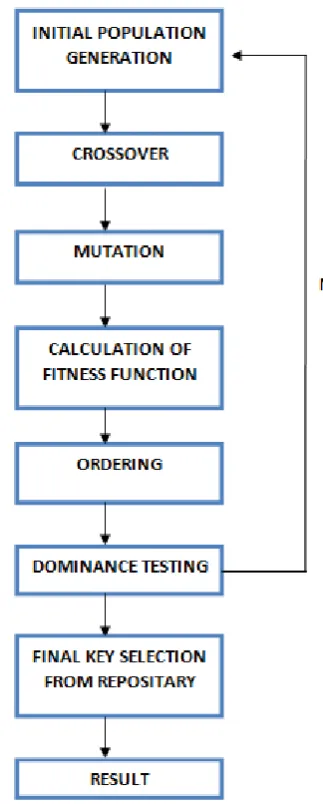
[image:2.595.330.492.180.583.2]The proposed solution involves the following steps as illustrated in Figure 1:
Figure 1. Steps involved in Generating the Best Fit Key in Cryptography using Genetic Algorithm.
4.1 Population Generation
4.2 Crossover
Crossover primarily simulates sexual genetic recombination. There are various ways by which it can be implemented in GAs. Sometimes crossover is applied with moderation so usually the crossover probability is defined to indicate a ratio of the number of couples selected for mating. Crossover is applied on two randomly chosen individuals.
A crossover rate is chosen and then number of crossovers is calculated with the formula:
noco = cor * m * n / 100,
Where noco = number of crossovers, cor = crossover rate,
m = key length, n = number of keys.
A random crossover point is then generated and the bits of the first individual from the starting till the crossover point and the bits of the second individual starting from the crossover point till the end are copied. The successor thus generated from crossover is very different from their initial parents.
4.3 Mutation
Mutation is a genetic operator used to maintain diversity from one generation of a population of chromosomes to the next. It is analogous to biological mutation. Mutation alters one or more gene values in a chromosome from its initial state. In mutation, the solution may change entirely from the previous solution. Mutation occurs during evolution according to a user-defined mutation probability. This probability should be set low. If it is set too high, the search will turn into a primitive random search. For example, if the mutation probability is set to 1, it means 1 out of every 100 bits will be manipulated. In the proposed solution, the bit inversion mutation operator is used. Here also number of mutations is calculated via the formula,
nom = mr * m * n / 100,
Where nom = number of mutations, mr = mutation rate, m = key length,
n = number of keys.
Mutation should allow the algorithm to avoid local minima by preventing the population of chromosomes from becoming too similar to each other, so that it cannot slow or stop evolution.
4.4 Calculating Fitness Function
Fitness evaluation involves defining an objective or fitness function which tests for suitability of the chromosome. As the algorithm proceeds, the individual fitness of the "best" chromosome is increased. Also the total fitness of the population is increased as a whole. In the proposed solution, all the keys which are in binary form are first converted into their respective decimal forms.
Gap test and Frequency Test are performed on them. The proposed fitness function is calculated by the formula,
F = 1 / (1 + e (- λ) )
Where λ = C1 λ1 + C2 λ2 λ1 = Frequency Test λ2= Gap Test
C1 = C2 = 1
4.4.1 Frequency Test
The frequency of each number is then calculated. This test is performed to check the number of times a chromosome is repeated [10]. The frequency test is used for testing randomization of the key.
4.4.2 Gap Test
This test is performed to calculate the gap between the two repeating numbers [11]. The gap test is used to determine the implication of the interval between recurrences of the same digit.
4.5 Ordering
The numbers are arranged in a sorted order according to their fitness values. The key with the highest fitness value is at the top of the list and the key with the lowest fitness value is at the bottom.
4.6 Dominance Testing
After ordering has been done, there will be set of random keys to choose from. On those keys dominance testing is performed. The key with highest fitness value will be paired with the rest of the keys and hamming distance between them will be calculated. Hamming distance is calculated by performing XOR of the two binary keys, then calculating the number of 1’s. Out of those keys, one key will be chosen randomly which will dominate over others. This key will be the Final key resulting from Dominance Testing.
4.7 Final Key Selection from Repository
The whole process is then repeated n times and all the keys generated from n iterations are stored in the repository. The final key is then selected on the basis of Dominance Testing.4.8 Result
The final key selected is then used for the encryption and decryption process in the DES cipher.
5. OBSERVATION
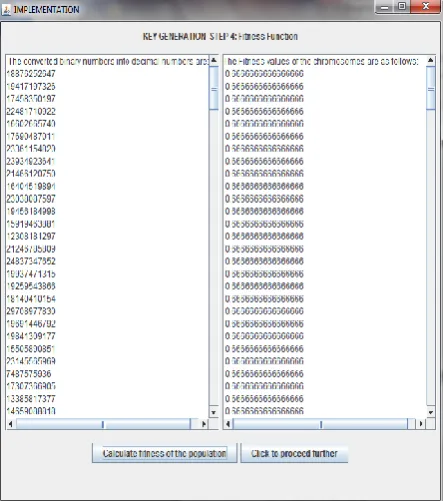
[image:3.595.316.538.489.740.2]The technique proposed in section 4 was implemented using Java Technology and observations were analyzed. These observations led to the conclusions presented in the next section. Figure 2 is shown as a screenshot from the working program of the proposed solution:
The observations from the implementation of the proposed algorithm are as follows:
5.1 Population Generation
In the implementation of the proposed algorithm, a random initial population of 100 chromosomes each having 48 genes is generated.
5.2 Crossover
The second step is to create a new child out of two randomly selected parents. Crossover Rate is taken as 2.5 which gives the number of crossovers as 120. For each iteration, a different crossover point is selected to perform single point crossover. Now the total population size becomes 220. The diagram shown in Figure 3 illustrates the single point crossover operation:
COP = 3
PARENT 1
PARENT 2
[image:4.595.311.557.63.643.2]
NEW CHILD
Figure 3. Single Point Crossover Operation
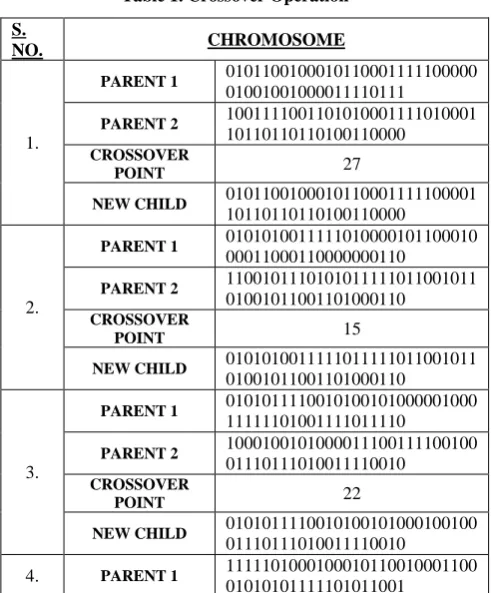
Table 1 shows 10% of the results generated from the crossover operation:
Table 1. Crossover Operation
S.
NO. CHROMOSOME
1.
PARENT 1 0101100100010110001111100000
01001001000011110111
PARENT 2 1001111001101010001111010001
10110110110100110000
CROSSOVER
POINT 27
NEW CHILD 0101100100010110001111100001
10110110110100110000
2.
PARENT 1 0101010011111010000101100010
00011000110000000110
PARENT 2 1100101110101011111011001011
01001011001101000110
CROSSOVER
POINT 15
NEW CHILD 0101010011111011111011001011
01001011001101000110
3.
PARENT 1 0101011110010100101000001000
11111101001111011110
PARENT 2 1000100101000011100111100100
01110111010011110010
CROSSOVER
POINT 22
NEW CHILD 0101011110010100101000100100
01110111010011110010
4. PARENT 1 1111101000100010110010001100
01010101111101011001
PARENT 2 1000100101000011100111100100
01110111010011110010
CROSSOVER
POINT 28
NEW CHILD 1111101000100010110010001100
01110111010011110010
5.
PARENT 1 1111100010100110111110000000
11000101001000000011
PARENT 2 1010110000100111010010100011
11011000101110001110
CROSSOVER
POINT 9
NEW CHILD 1111100010100111010010100011
11011000101110001110
6.
PARENT 1 1100011110111110001111011100
10001110010000001111
PARENT 2 0000000110101011110000101111
01010100011110101111
CROSSOVER
POINT 33
NEW CHILD 1100011110111110001111011100
10001100011110101111
7.
PARENT 1 0011010111111000000000100101
01010000111100000110
PARENT 2 0111101101000000101111000101
00010011111010010011
CROSSOVER
POINT 8
NEW CHILD 0011010101000000101111000101
00010011111010010011
8.
PARENT 1 0000010010010000100000001010
00001000011100111001
PARENT 2 0010010110101001000011001100
00001010100101111001
CROSSOVER
POINT 8
NEW CHILD 0000010010101001000011001100
00001010100101111001
9.
PARENT 1 0001111001000110111100110010
10110001011100101101
PARENT 2 0111110001101001110110011101
11110011111100100110
CROSSOVER
POINT 20
NEW CHILD 0001111001000110111110011101
11110011111100100110
10.
PARENT 1 0110010110000110111001101001
10101110111101111010
PARENT 2 0001111001000110111100110010
10110001011100101101
CROSSOVER
POINT 16
NEW CHILD 0110010110000110111100110010
10110001011100101101
5.3 Mutation
[image:4.595.62.279.248.391.2] [image:4.595.49.295.461.758.2]Table 2. Mutation Operation
S.
NO. CHROMOSOME
1.
ORIGINAL CHROMOSOME
1111100010100110111110000000 11000101001000000011
MUTATION POINT 33
MUTATED CHROMOSOME 1111100010100110111110000000 11001101001000000011 2. ORIGINAL CHROMOSOME 0000010101000111111101101110 00000111100001001111
MUTATION POINT 14
MUTATED CHROMOSOME 0000010101000011111101101110 00000111100001001111 3. ORIGINAL CHROMOSOME 1111010010011101011001011110 00101001101011010101
MUTATION POINT 17
MUTATED CHROMOSOME 1111010010011101111001011110 00101001101011010101 4. ORIGINAL CHROMOSOME 1100010011000011100010011000 11010110010011111011
MUTATION POINT 25
MUTATED CHROMOSOME 1100010011000011100010010000 11010110010011111011 5. ORIGINAL CHROMOSOME 0010010110010100100111110110 01101101000001101010
MUTATION POINT 48
MUTATED CHROMOSOME 0010010110010100100111110110 01101101000001101011 6. ORIGINAL CHROMOSOME 1111100010100110111110000000 11001101001000000011
MUTATION POINT 43
MUTATED CHROMOSOME 1111100010100110111110000000 11001101001000100011 7. ORIGINAL CHROMOSOME 0000110001001110010111011110 00101110011000101101
MUTATION POINT 21
MUTATED CHROMOSOME 0000110001001110010101011110 00101110011000101101 8. ORIGINAL CHROMOSOME 0111100001101000101100001000 01011110101100100001
MUTATION POINT 2
MUTATED CHROMOSOME 0011100001101000101100001000 01011110101100100001 9. ORIGINAL CHROMOSOME 1001001111000111110111011110 10000010111111001101
MUTATION POINT 30
MUTATED CHROMOSOME 1001001111000111110111011110 11000010111111001101 10. ORIGINAL CHROMOSOME 1010000111001100010100110010 01100010010011100011
MUTATION POINT 30
MUTATED CHROMOSOME
1010000111001100010100110010 00100010010011100011
5.4 Fitness Function Calculation
5.4.1 Conversion
The binary valued chromosomes from the population of size 220 were converted into the decimal number format.
5.4.2 Fitness Value
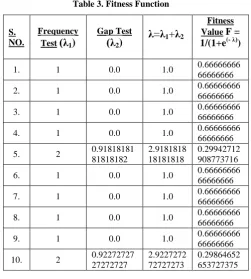
The Fitness values of the above chromosomes are shown in Table 3.
Table 3. Fitness Function
S. NO.
Frequency Test
(λ
1)
Gap Test
(λ
2)
λ=λ
1+λ
2Fitness Value F = 1/(1+e(- λ))
1. 1 0.0 1.0 0.66666666
66666666
2. 1 0.0 1.0 0.66666666
66666666
3. 1 0.0 1.0 0.66666666
66666666
4. 1 0.0 1.0 0.66666666
66666666
5. 2 0.91818181 81818182
2.9181818 18181818
0.29942712 908773716
6. 1 0.0 1.0 0.66666666
66666666
7. 1 0.0 1.0 0.66666666
66666666
8. 1 0.0 1.0 0.66666666
66666666
9. 1 0.0 1.0 0.66666666
66666666
10. 2 0.92272727 27272727 2.9227272 72727273 0.29864652 653727375
5.5 Ordering
The chromosomes are then sorted in the decreasing order according to their fitness values as shown in Table 4:
Table 4. Ordering
S.NO. ORDERED POPULATION
1. 00010110010010101011011010110101111101010 0101111
2. 11110100111011000100101111110100100110010 0111101
3. 01011001000101100011111100000100100100001 1110111
4. 11000001011100001000110110001010101000001 0101011
5. 10001011110011010010110110110110110011001 0001101
6. 10101101011111101110101000110101001111100 0110100
7. 01111111010000001011110001010001001111101 0010011
8. 00101000010100010010001010101011111101011 1010100
9. 11011001100001110100100111110110001100000 1111011
[image:5.595.309.546.455.694.2]5.6 Dominance Testing
The topmost key from the sorted population, i.e. the fittest value is selected and paired with the rest of the chromosomes one at a time. XOR function is applied to all these pairs and each pair's hamming distance is calculated. The pair with the maximum hamming distance is then chosen and through random selection one of the chromosomes is selected from that final pair. In the implementation, the most dominating key came out to be as:
011011101011010001100000010100100101100011100000
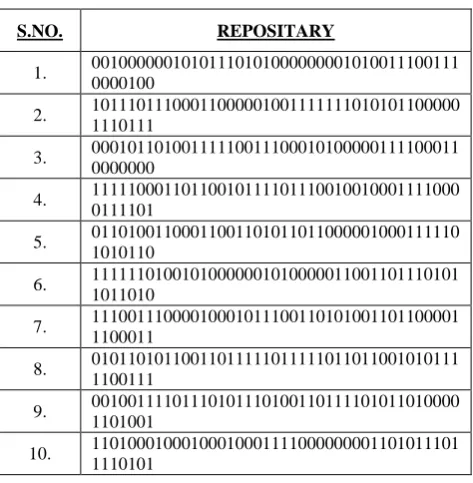
This key is then stored in the repository and the entire process starting from the first step is repeated 100 times.
[image:6.595.49.286.278.520.2]5.7 Final Key Selection from Repository
The following Table 5 shows the first 10 dominant keys generated which get stored in the repository:Table 5. Repository
S.NO. REPOSITARY
1. 00100000010101110101000000001010011100111 0000100
2. 10111011100011000001001111111010101100000 1110111
3. 00010110100111110011100010100000111100011 0000000
4. 11111000110110010111101110010010001111000 0111101
5. 01101001100011001101011011000001000111110 1010110
6. 11111101001010000001010000011001101110101 1011010
7. 11100111000010001011100110101001101100001 1100011
8. 01011010110011011111011111011011001010111 1100111
9. 00100111101110101110100110111101011010000 1101001
10. 11010001000100010001111000000001101011101 1110101
The Dominance Testing is again applied to all the 100 keys generated and then the final key is selected for the DES Cipher for further data encryption and decryption. This final key came out to be the 73rd key from repository which is as
follows:
001001111101110110010010000000011010110001011101
6.
RESULTS
The work has been implemented and analyzed. The implementation was done using Java Technology. Random samples were created by generating an initial random population of 100 chromosomes. Various tests were applied on the samples and the results were also satisfactory.
After generating 100 chromosomes, crossover function was applied taking the total population size to 220 chromosomes using the crossover rate as 2.5. Mutation rate was selected as 0.5. The fitness values of the keys were calculated and analyzed using the Frequency and Gap Tests. The maximum frequency which was observed in the sample was 2. This means the chromosomes were found to be repeated at most two times. This proves the randomness of the sample used.
Therefore, the final result generated came out to be as random and unique as possible.
7.
CONCLUSION
It can be observed from the above tables that the generated key is very random and almost difficult to decode. The Genetic Processes involved are very complex and when used together, they generate the most random and non-repeating key as possible. The implementation further involves the use of DES cipher for data encryption which is very complicated itself and it makes almost impossible for the cryptanalysts to attack the data. The proposed solution has a total of seven rounds and the whole process is again repeated 100 times. Despite this, the key gets generated in a very short duration of time. This proves to be a great advantage as the computational time of generating the key is lesser than encrypting the data using DES.
8. FUTURE SCOPE
This propounded idea can not only overcome the existing network security but also has an edge over the computational time. However, in this paper only a need for data encryption is created and its implementation is shown. Messages can be in the form of images or audio as well which are equally important to be protected against eavesdroppers and cryptanalysts [11] [15]. But implementing the same algorithm for image encryption could not be shown due to time constraints. Moreover, the proposed approach can be expanded further by using Neural Networks in Artificial Intelligence to calculate the mathematical coefficient for the Gap Test and the Frequency Test used in the fitness function. Both Neural Network and Genetic Algorithm provide with non-linear problem solving iteration [5]. So using both of the techniques together can solve a great deal of problems.
9. REFERENCES
[1] Behrouz A Forouzan, “Data Communication and Networking” Tata McGraw- Hill Publishing Company Limited, Special Indian Edition 2006.
[2] William Stallings, “Network Security Essentials,” Fourth edition.
[3] William Stallings, “Cryptography and Network security”, Fifth Edition.
[4] Harsh Bhasin and Nakul Arora, “Key Generation for Cryptography using Genetic Algorithm”.
[5] Sindhuja K and Pramela Devi S, "A Symmetric Key Encryption Technique Using Genetic Algorithm", Sindhuja K et al, / (IJCSIT) International Journal of Computer Science and Information Technologies, ISSN: 0975-9646 Vol. 5 (1), 2014, pg 414-416.
[6] Y.V. Srinivasa Murthy, Dr. S. C. Satapathy, P. Srinivasu and A.A.S. Saranya, "Key Generation for Text Encryption in Cellular Networks using Multi-point Crossover Function", International Journal of Computer Applications (0975-8887) Volume 32-No.9, October 2001.
[8] A. Tragha, F. Omary, A. Kriouile, “Genetic Algorithms Inspired Cryptography”, A.M.S.E Association for the Advancement of Modeling & Simulation Techniques in Enterprises, Series D: Computer Science and Statistics, November 2007.
[9] A Kumar, N Rajpal, Application of Genetic Algorithm in the Field of Steganography, in Journal of Information Technology, Vol. 2, No.1, Jul-Dec.2004, pg 12-15.
[10] Oded Goldreich, Foundations of Cryptography, Volume 1: Basic Tools, Cambridge University Press, 2001, ISBN 0-521-79172-3.
[11] A. J. Bagnall, “The Applications of Genetic Algorithms in Cryptanalysis”, School of Information Systems, University Of East Anglia, 1996.
[12] N. Koblitz, “A Course in Number Theory and Cryptography”, Springer-Verlag, New York, Inc., 1994. [13] Harsh Bhasin, “Test Data Generation Using Artificial
Life and Cellular Automata”, ACM SIGsoft Software Engineering Notes, January 2014.
[14] Harsh Bhasin, Neha Singla, “Cellular Genetic Test data Generation”: ACM Sigsoft Software Engineering Notes, September Edition, 2013.