http://dx.doi.org/10.4236/jpee.2014.24095
Leakage Currents of Zinc Oxide Surge
Arresters in 22 kV Distribution System
Using Thermal Image Camera
Wichet Thipprasert, Prakasit Sritakaew
Department of Electrical Engineering, Faculty of Engineering, Rajamangala University of Technology Lanna Chiang Rai, Chiang Rai, Thailand
Email: [email protected], [email protected]
Received December 2013
Abstract
Zinc Oxide (ZnO) surge arresters (SAs) experience thermal runaway when the temperature ex-ceeds the acceptable limit. This phenomenon is associated with the increase in resistive leakage current due to degradation. This paper presents the electrical performance of ZnO SAs in 22 kV distribution systems using thermal image camera under the power frequency AC operating vol-tages. When ZnO surge arresters are installation takes a long time in distribution system over more than 5 years. For the experimental study, as ZnO installation takes a long time over 6 years the leakage current is 63.9 mA, temperature differences were measured over a period of time over 14 degree Celsius. This data will be useful as a guideline for solving problems and reducing power loss from leakage current. Moreover, it will be useful in predicting lifetime of ZnO SAs.
Keywords
Electrical Performance; Surge Arrester; Thermal Image Camera
1. Introduction
High voltage systems are often subject to transient overvoltages of internal or external origin. The resultant surges travel along the transmission line and can cause damage to unprotected terminal equipment. Corona losses and the earth return path can attenuate and distort the surges, but the magnitude of the surge may still ex-ceed the insulation level of the equipment. SAs provide a limitation of the overvoltage to a chosen protective level. The superiority of the recently developed ZnO material over the earlier used silicon carbide (SiC) renewed interest and boosted the use of SA protection.
ab-sorbing surge energy, the phenomenon of thermal runaway occurs as a result of increased heat generation caused by subsequent ac voltage application. SA must not only be thermally stable at normal operating stress, but must also discharge various transient overvoltage energies and return to the former thermally stable condition from the temporary high temperature state. The latter is termed transient thermal stability. In the following text, tran-sient thermal stability is abbreviated to thermal stability. When the operating stress becomes higher, the ab-sorbed energy for transient overvoltages becomes larger because the current created by transient overvoltages is larger. Therefore, the discharge capability requirement and the transient thermal stability are more severe in the case of high operating stress [1-3].
ZnO SAs are fundamental elements of protecting systems of electric devices against overvoltages. They con-tain varistores, which have ZnO as the main constituent as well as small amounts of other metal oxides. SAs are exposed to transient effect of overvoltages generated as a result of lightning discharges, switching and damage states in electric power systems.
This thermal runaway phenomenon can be studied as a problem of balance between heat generation and heat dissipation. Conventionally, this problem has been discussed simply as static phenomenon on the basis that heat generation of ZnO elements was uniform along the ZnO columns, while their heat dissipation was equally uni-form [1,3]. Actual measurements were also conducted on single or several series-connected ZnO elements that possessed different heat dissipating conditions.
The electrical energy is then converted and stored in the metal oxide valve elements as thermal energy, thus resulting in a temperature rise above normal operating levels. An increase of valve element temperature can up-set the thermal balance in the arrester assembly, resulting in a thermal runaway. Since, the thermal capabilities of gapless metal oxide SAa depend on ambient temperature and solar radiation gain, both factors must be consi-dered in application studies. Such studies can now be carried out using a relatively simple and yet representative model of the thermal properties at the arrester valve element and housing [1].
In this research, in order to understand the thermal and electrical properties of a ZnO SAs 50 Hz AC voltage changes in leakage current were measured. The temperature distribution appearing on the ZnO SA was observed using a forward looking infrared camera. In particular, the correlation between the thermal and electrical proper-ties of a ZnO SA was analyzed experimentally. From this analysis, the thermal phenomena resulting from the heat generation and dissipation of the ZnO SA were interpreted.
2. Thermal Performance of ZnO Surge Arrester [1]
The thermal stability of ZnO SA is affected by ambient temperature and heat dissipation capability, impulse de-gradation and ageing. To obtain thermal stability, the electrical power dissipation in the element must be ba-lanced against heat output to the environment. Near the thermal equilibrium, it is possible to express the thermal dissipation capacity Q of a SA as:
(
a)
T T T
C
Q= − (1)
where T is the temperature of ZnO valve elements, Ta is the ambient temperature and CT the thermal dissipation
factor. The heat generation, P, which is voltage and material composition dependent, may be approximated by (Wc/kT)
T = Ae (2)
where Wc is the activation energy, k = 0.86 × 10 eV/K (Boltzmann constant), T is the temperature of the material
and A depends on the applied voltage level and the physical dimensions of the valve elements. The above curves are shown schematically in Figures 1 and 2. For an ambient temperature Ta and an applied voltage V, the two curves intersect at two points X and Y. The lower point X is at a stable operating temperature Tx and is referred to as the lower limit stability point. The upper point Y is also at a stable operating temperature Ty and is called the upper limit stability point. At these temperatures, the power input equals the power output.
3. Thermal Runaway Phenomenon of ZnO Surge Arrester [1,3]
Figure 1. Temperature dependence of ZnO voltage current characteristic.
Figure 2. Evaluation of ZnO surge arrester steady state stability using the heat loss-input characteristic.
Figure 3. Resistive leakage current flowing through surge arrester when AC voltage is supplied.
[image:3.595.206.390.409.528.2] [image:3.595.210.386.564.695.2]4. Test Specimens, Setups, and Procedures
4.1. Test Specimens
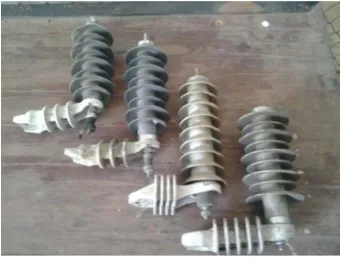
The specimens are ZnO surge arresters in 22 kV distribution systems as shown in Figure 5 consist ZnO SA No A 21 kV rated voltage installation takes a long time in distribution system over more than 6 - 7 years, No B 21 kV rated voltage installation takes a long time in distribution system over more than 5 year and No B 21 kV rated voltage installation takes a long time in distribution system over more than 5 - 6 years and Table 1 shows the parameters of the samples test.
4.2. Test Setup
[image:4.595.213.384.306.437.2]The test circuit of ZnO SA is provided schematically in Figure 6. The voltage elevation transformer is supplied by a Variac, thus resulting in a controlled gradual voltage increase. The transformer secondary coil is connected in series resistance R0 = 2 MΩ and parallel with a capacitive voltage divider comprised of capacitors C1 and C2 respectively. In parallel with the voltage divider is the series connected of the insulator. The voltage across C2 is measured by a scope meter (190B Scope Meter Series: Fluke) and connected to a computer where it is recorded and visually displayed with the use of appropriate software. The technical characteristics of the capacitors C1 and C2 were 224 pF, 100 kV/50 Hz and 2 µF, 1000 V/50 Hz, respectively.
[image:4.595.102.493.476.697.2]Figure 5. Test objects.
Table 1. Parameters of ZnO surge arrester.
No. Material Rated Voltage (kV) installation takes a long time
A Polymer coat 21 6 - 7 years
B Polymer coat 21 5 years
C Polymer coat 21 5 - 6 years
Figure 6. Schematic of testing.
C1
C2 R0
230/ 400 V. AC 50Hz
1 2
Scope meter
4.3. Test Procedures
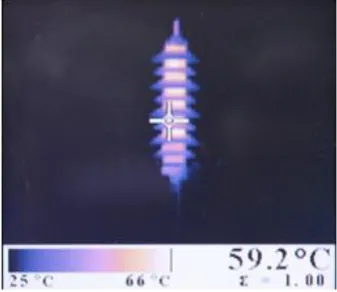
The research was carried out on three ZnO SAs of 22 kV distribution system of PEA. It is installation in distri-bution system over more than 5 years with parameter given in the Table 1. The experimental set-up is schemat-ically shown in Figure 6. Referring to the test standard [1-3], the test procedures in the paper were as follows. After the connected circuit in Figure 6 completely, ac voltage was applied to the specimens and increased at a constant rate till the voltage is 18 kV. Then ac voltage supplied to specimens is a long time 3 hours. The thermal image camera (Fluke Ti32) records the temperature profile and the leakage current, as shown in Figure 8 and Table 2.
5. Test Results of ZnO Surge Arrester
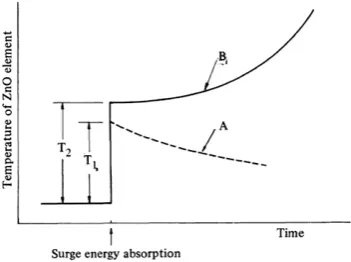
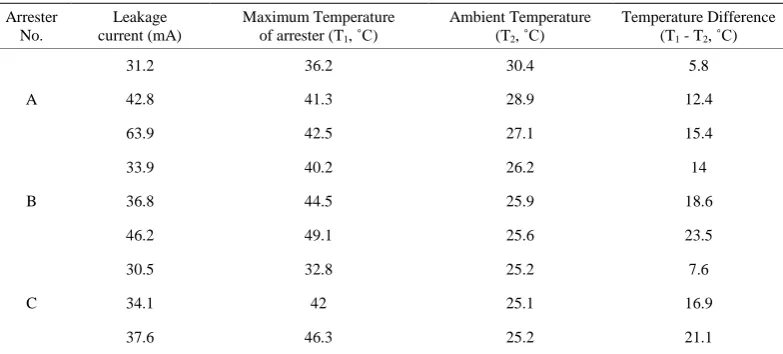
The results form experiments are shown in Table 2, Figures 7 and 8. From Figure 8 shows the temperature of the central ZnO element as a function of time during the IEC type test [4,5]. The result experiments arrester No A maximum temperature of arrester increasing to 42.5 degree Celsius as ambient temperature is 27.1 degree Celsius, leakage current increase to 63.9 mA. Arrester No B maximum temperature of arrester increasing to 49.1 degree Celsius as ambient temperature is 25.6 degree Celsius, leakage current increase to 46.2 mA.
[image:5.595.170.426.350.517.2]And arrester No C maximum temperature of arrester increasing to 46.3 degree Celsius as ambient temperature is 25.2 degree Celsius, leakage current increase to 37.6 mA. However, the temperature of ZnO surge arrester No C is over than all ZnO surge arrester but leakage current of less than No A and No B because installation takes a long time in distribution system is over than all ZnO surge arrester. Therefore the temperature of ZnO surge ar-rester can be used for estimation of leakage current.
Figure 7. Temperature and leakage current curve.
[image:5.595.214.383.548.694.2]Table 2. The leakage current and temperature of arresters; 18 kV ac voltage applied.
Arrester No.
Leakage current (mA)
Maximum Temperature of arrester (T1, ˚C)
Ambient Temperature (T2, ˚C)
Temperature Difference (T1 - T2, ˚C)
A
31.2 36.2 30.4 5.8
42.8 41.3 28.9 12.4
63.9 42.5 27.1 15.4
B
33.9 40.2 26.2 14
36.8 44.5 25.9 18.6
46.2 49.1 25.6 23.5
C
30.5 32.8 25.2 7.6
34.1 42 25.1 16.9
37.6 46.3 25.2 21.1
6. Conclusions
The thermal and electrical performances of ZnO SA were experimentally investigated. The results can be sum-marized as follows.
The total leakage current flowing through the Zno SA under power frequency is the sum of capacitive and re-sistive currents. The temperature profiles of Zno SAs are observed by thermal imager and the leakage current. Initially, the nominal voltage and leakage current is 63.9 mA. The temperature of Zno SAs is close to the am-bient temperature. Increase in the leakage current results in increase of the temperature profile.
Results from the experiment are used for ZnO surge arresters are installation takes a long time in distribution system over more than 5 years. These results can be guideline for solving problems and reducing power loss due to leakage current. Moreover, it will be useful to predict lifetime of ZnO SAs installed in distribution system.
References
[1] Haddad, A. and Warne, D. (2004) ZnO Surge Arresters. Advance in High Voltage Engineering, lET Power & Energy
Series, 40, 191-215.
[2] Lee, S.B., Lee, S.L. and Lee, B.K. (2009) Analysis of Thermal and Electrical Properties of ZnO Arrester Block.
Cur-rent Applied Physics, 10, 176-180.
[3] Nishiwaki, S., Kimura, H., Satoh, T., Mizoguchi, H. and Yanabu, S. (1984) Study of Thermal Runaway/Equivalent Prorated Model of a ZnO Surge Arrester. IEEE Transaction on Power Apparatus and Systems, PAS-103, 413-421.
http://dx.doi.org/10.1109/TPAS.1984.318260
[4] (1986) IEC Publ.815, First Edition. Guide for the Selection of Insulators in Respect of Polluted Conditions. Interna-tional Electrotechnical Committee.