http://dx.doi.org/10.4236/eng.2016.81001
Field Weakening Control of a Separately
Excited DC Motor Using Neural Network
Optemized by Social Spider Algorithm
Waleed I. Hameed
1, Ahmed S. Kadhim
1, Ali Abdullah K. Al-Thuwaynee
21Department of Communication Engineering, Iraqi University College, Basrah, Iraq 2Department of Electrical Engineering, University of Basrah, Basrah, Iraq
Received 1 December 2015; accepted 16 January 2016; published 19 January 2016
Copyright © 2016 by authors and Scientific Research Publishing Inc.
This work is licensed under the Creative Commons Attribution International License (CC BY).
http://creativecommons.org/licenses/by/4.0/
Abstract
This paper presents the speed control of a separately excited DC motor using Neural Network (NN) controller in field weakening region. In armature control, speed controller has been used in outer loop while current controller in inner loop is used. The function of NN is to predict the field cur-rent that realizes the field weakening to drive the motor over rated speed. The parameters of NN are optimized by the Social Spider Optimization (SSO) algorithm. The system has been implemented using MATLAB/SIMULINK software. The simulation results show that the proposed method gives a good performance and is feasible to be applied instead of others conventional combined control methods.
Keywords
DC Motor Drive, Field Weakening, Neural Network, Social Spider Optimization
1. Introduction
been proposed to operate the DC motor in the field weakening region. This controller has been used to reduce the field current and then increase the speed of motor over rated speed. This paper is organized as follows: a mathematical model of SEDC motor operating in both armature and field weakening regions is given in Section 2; combined control of SEDCM with proposed method has been presented in Section 3; a brief description of neural networks is given in Section 4; in Section 5, a Social Spider Optimization (SSO) algorithm has been de-veloped. Simulation results are given in Section 6, and finally, conclusions are given in Section 7.
2. Modeling of SEDCM
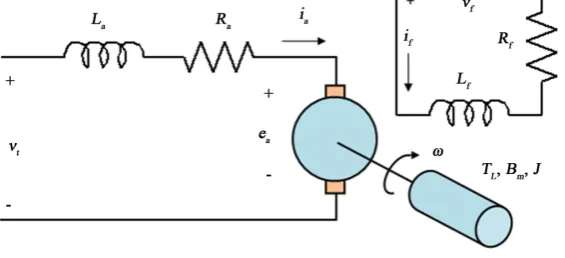
The quivalent circuit of a separately exited DC-Motor is shown in Figure 1 below. Dependent on the quivalent circuit, the mathmetical equations of the motor are obtained using electromechanical energy conversion and torque balance rules as follows [2] [3]:
d d
a
a a a a a
i
v R i L e
t
= + +
(1)
a m m
e =K ω (2)
m af f
K =L i (3)
e m a
T =K i (4)
d d
m
e L m m
J T T B
t
ω ω
= − −
(5)
d d
f
f f f f
i
v R i L
t
= +
(6)
where va and vf are the applied terminal voltage to the motor and field voltage, ea is the emf induced in the armature winding, The resistances Ra and Rf are the armature and field resistances, La and Lf are the ar-mature and field inductances, ia and if are the armature motor current and field current, Laf mutual induc-tance, Km is the motor constant, ωm is the motor speed, Te is the internal torque of the motor, J is the rota-tional inertia of motor, Bm is the viscous friction of motor and TL the load torque.
3. Combined Control of SEDCM
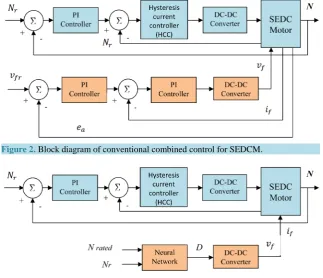
[image:2.595.171.454.575.704.2]The main advantage of DC motors is simple in the speed control. As the motor angular speed ωm, is directly proportional to armature voltage and inversely proportional to the magnetic flux produced by the field current, adjusting the armature voltage and/or the field current will change the rotor angular speed [4]. The separately excited DC motor (SEDM) is usually supplied by two controlled voltage sources, that can be controlled rectifi-ers or chopprectifi-ers. One source is supplying the motor armature winding with the armature voltage, va, and the other is supplying the motor field winding by the field voltage vf. The speed of the SEDM can be controlled by controlling either the armature voltage va or the field voltage vf, or both of them. Usually, the voltage speed
control method is used to control the speed of the SEDM below its rated speed. In this method, the field voltage
f
v is kept constant, while the armature voltage va is varied. A constant field voltage vf produces a constant field current If, which in turn, produces a constant magnetic flux in the motor air-gap. Hence, the torque pro-duced on the motor shaft remains constant, as the armature current remains constant.
The motor angular speed ωm and the power on the motor shaft are linearly proportional to the armature vol-tage va. To run the SEDM above its rated speed, the field weakening method is used. Here, the field current If
is reduced by reducing the field voltage vf. The magnetic flux in the motor air gap will be reduced, causing reduction of the back emf ea. The motor armature current will increase, resulting in increasing the motor speed. As a result of that, the back emf ea will increase and a new equilibrium will be established at a higher speed. In other words, with decreasing the field voltage vf, the motor angular speed ωm increases, while the motor torque decreases and the motor shaft power remains constant [5]. The block diagram of conventional combined control is shown in Figure 2 below.
In this paper we propose a new method to increase the speed of the motor above the rated value (N rated). The new method based on predict the duty ratio (D) that give the field voltage vf and thus give the require current field if . This can be realized by using the ability of neural networks (NNs) in prediction and control. Assume that this method don’t need to sensors for current field if and armature voltage ea. Also in this method, the predicted field current will keep the armature voltage of the motor under the rated value. Figure 3 below show the block diagram of the proposed method.
4. Neural Network
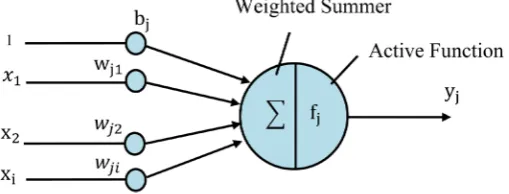
[image:3.595.152.476.429.707.2]The structure of an artificial neuron is inspired by the concept of a biological neuron. Neural Network (NN) basically performs input output mapping which can be static or dynamic. One important feature of NN is that it normally requires supervised training (or learning) by input-output example data sets unlike conventional pro-gramming of digital computer [6]. In learning process, neural network adjusts its structure such that it is able to output the same signals as the supervisor. The learning is repeated until the difference between network output and supervisor is enough [7]. The basic model of a single artificial neuron consists of a weighted summer and an activation (or transfer) function as shown in Figure 4.
Figure 2.Block diagram of conventional combined control for SEDCM.
Figure 4.Basic model of a single artificial neuron.
where:
1, , i
x x are inputs;
1, ,
j ji
w w are weights;
j
b is bias;
j
f is the activation function;
j
y is the output.
The weights sum sj is therefore
( )
1
. N
j ji i j
i
s w x t b
=
=
∑
+ (7)The sigmoid activation function is popular for neural network application. The equation for a sigmoid func-tion is:
( )
1. 1 e sj
f s = −
+ (8)
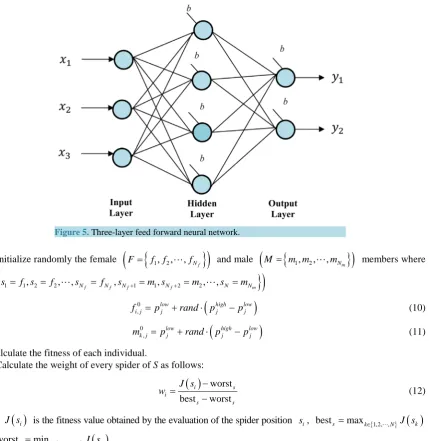
Feed forward network is a network of single neurons jointed together by synaptic connections. Figure 5 show a three-layer feed forward neural network [8].
5. The Social Spider Optimization (SSO) Algorithm
A new type of evolutionary technique, which is called Swarm intelligence has enticed much research interest [9]. The swarm expression is employed in a general manner to refer to any collection of interactive agents. Swarm intelligence is concerned with the methodology to model the attitude of social animals and insects for problem solving. Researchers invented optimization algorithms by simulating the behavior of ants, bees, bacteria, fire-flies and other organisms [10]. Self-organization and job division are the basic components of swarm intelli-gence. Self-organizing system means; each of the covered units responds to local exciter individually and may act together to achieve a global mission, via a job separation which averts a localized supervision. This will effi-ciently adapt the entire system to internal and external changes [11]. A swarm algorithms are built up on several methods. Such methods involve the social behavior of bird herding such as the Particle Swarm Optimization (PSO) algorithm [12], the cooperative demeanor of bee colonies such as the Artificial Bee Colony (ABC) tech-nique [13], the intermarriage demeanor of firefly insects such as the Firefly (FF) method [14] and imitation the cuckoo birds lifestyle such as the Cuckoo Optimization Algorithm (COA) [15].
The SSO supposes that entire search space is a sectarian web, where all the social-spiders react to each other. Each solution within the search space symbolizes a spider position in the communal web. Every spider receives a weight relating to the fitness value of the solution that is denoted by the social-spider. The algorithm supposes two different search agents (spiders): males and females. Depending on gender, each person is behaved by a set of different evolutionary operators which mimic different mutual behaviors that are commonly assumed within the colony. The computational steps for the SSO algorithm can be abstracted as follows [11]:
1) Considering N as the total number of n-dimensional colony members, define the number of male Nm and females Nf spiders in the entire population S.
(
0.9 0.25)
andf m f
Figure 5. Three-layer feed forward neural network.
2) Initialize randomly the female
(
{
1, 2, ,}
)
f N
F= f f f and male
(
M ={
m m1, 2,,mNm}
)
members where{
}
(
S= s1= f s1, 2= f2,,sNf = fNf,sNf+1=m s1, Nf+2=m2,,sN =mNm)
(
)
0 ,
low high low
i j j j j
f = p +rand⋅ p −p (10)
(
)
0 ,
low high low
k j j j j
m = p +rand⋅ p −p (11) and calculate the fitness of each individual.
3) Calculate the weight of every spider of S as follows:
( )
worst best worsti s
i
s s
J s
w = −
− (12)
where J s
( )
i is the fitness value obtained by the evaluation of the spider position si, bests=maxk∈{1,2,,N}J s( )
kand worsts=mink∈{1,2,,N}J s
( )
k .4) Move female spider according to the female cooperative operator
The sectarian web is used as technique to transmit information among the colony individuals, this information is encoded as small vibrations. Each vibration depends on the weight and distance of the spider which has gen-erated it.
There are two type of vibration:
a) Vibci which is understood by the member i as response of the information transmitted by the individual
c(sc), where c meant the nearest member to i and assigns higher weight in comparison to i 2
,
e di c
i c
Vibc =w ⋅ − (13) where di c, = si−sc .
b) Vibbi which is understood by the member i as response of the information transmitted by the individual
b(sb), where b meant the best fitness value such that wb=maxk∈{1,2, ,N}wk
2 ,
edi b
i b
where di b, = si−sb .
The movement of the female is depended on the attraction and repulsion, and they are depended on a uniform random number rm within range [0, 1]. If rm is smaller than a threshold PF an attraction is produced, oth-erwise a repulsion is generated.
The new position fik+1 of the female fik is calculated as follows:
(
)
(
)
(
)
(
)
1 1 with probability 2 1with probability 1 2
k k k
i i c i i b i
k i
k k k
i i c i i b i
f Vibc s f Vibb s f rand PF
f
f Vibc s f Vibb s f rand PF
α β δ
α β δ
+ + − + − + − = + − + − − − − (15)
where α β δ, , andrand are random value between [0, 1], while k represents the iteration number. 5) move the male according to the cooperative operator
We have now the third type of vibration Vibci (a vibration understood by the member i as a result of the in-formation transmitted by the member f(sb) where f is the nearest female to individual i.
2 ,
edi f
i f
Vibf =w ⋅ − (16) The male individuals are arranged in decreasing order according to their weight value, the individual whose weight
f N m
w + is located in the middle is considered the median male individual. The change of positions will be as follows:
(
)
1 1 1 1 if 2 if f f m f f f m f k ki i f i N i N m
k
N k i
h N h h
k k
i N i N i N m
N h h
m Vibf s m rand w w
m
m w
m m w w
w α δ α + + + + = + + + =
+ − + − >
=
+ − >
∑
∑
(17)where sf represents the nearest female to the male i.
6) mating is performed by predominant males and females members, when a dominant male m locates at a set of females within a specific range r, it mates forming a new brood.
r is calculated as follows:
(
high low)
1
. 2
n
j j
j p p
r
n
= −
=
∑
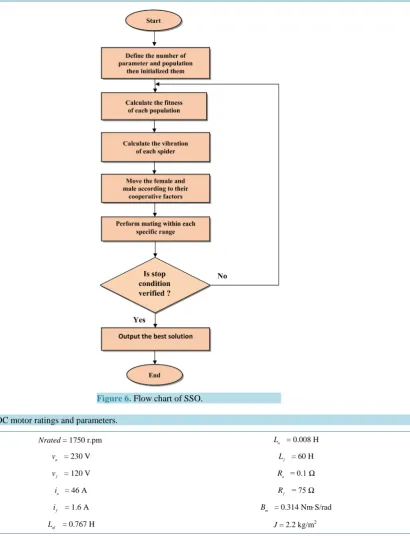
(18)7) it stop condition is verified the algorithm is finished otherwise go back to step 3. The flow chart of SSO is shown in Figure 6.
6. Simulation Results
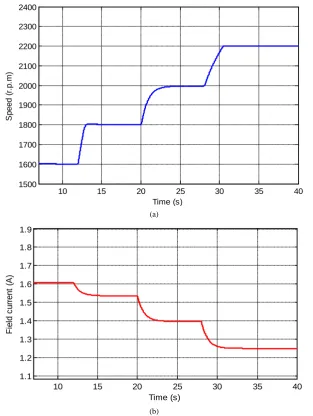
[image:6.595.183.448.353.418.2]The SIMULINK model of Field Weakening Control for separately excited DC motor have been implemented using MATLAB/SIMULINK software as shown in Figure 7. The ratings and parameters of DC motor are shown in Table 1. PI controller in outer loop have been used to control the speed of the motor in both armature and field modes. To control the current of the motor, Hysteresis current method have been used in inner loop. The maximum current (ia max) can the motor reach to it is twice the rated current. The voltage of field can be vraied by changing the duty ratio. For the speed equal or less than the rated speed the field current keep constant. For the speed higher than the rated speed the field current is varied to control the speed. Pre-data sets have been used as input and output to NN to training the weights and bais based on SSO. The training data are shown in
Figure 6. Flow chart of SSO.
Table 1. DC motor ratings and parameters.
Nrated = 1750 r.pm La = 0.008 H
a
v = 230 V Lf = 60 H
f
v = 120 V Ra = 0.1 Ω
a
i = 46 A Rf = 75 Ω
f
i = 1.6 A Bm = 0.314 Nm⋅S/rad
af
L = 0.767 H J = 2.2 kg/m2
Figure 7.SIMULINK model of field weakening control for SEDCM.
(a)
(b)
Figure 8. Speed and field current responses of the motor.
10 15 20 25 30 35 40 1500
1600 1700 1800 1900 2000 2100 2200 2300 2400
Time (s)
S
peed (
r.
p.
m
)
10 15 20 25 30 35 40 1.1
1.2 1.3 1.4 1.5 1.6 1.7 1.8 1.9
Time (s)
F
iel
d c
ur
rent
(
A
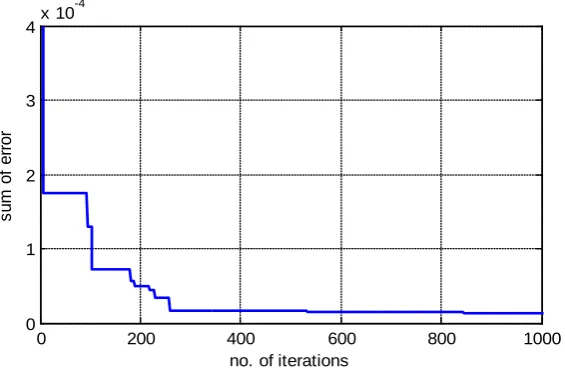
[image:8.595.158.472.286.703.2]Figure 9. The summation of the mean square error.
Figure 10. Armature voltage of the motor.
Table 2. Data sets for combined control.
Data No. Normlized input (Nr − Nb)/Nb Requirement field current (If) A
Duty
ratio (D) Data No.
Normlized input
(Nr − Nb)/Nb Requirement field current (If) A
Duty ratio (D)
1 −0.71 1.6 1 6 0.088 1.46 0.91
2 −0.428 1.6 1 7 0.137 1.4 0.87
3 −0.142 1.6 1 8 0.191 1.33 0.83
4 0 1.6 1 9 0.25 1.26 0.78
5 0.043 1.53 0.95 10 0.314 1.2 0.75
7. Conclusion
The armature and field circuits of SEDCM are providing from separate sources; this can give a flexible control and wide speed rang. Field weakening methods are dependent on the reverse relationship between the field cur-rent and the speed of the motor. To control the speed of the motor from zero up to rated speed, armature control method is used and thus the motor drives in the constant torque region. While controlling the speed over the
0 200 400 600 800 1000 0
1 2 3 4x 10
-4
no. of iterations
s
um
of
er
ror
15 20 25 30 35 40 150
200 250 300
Time (s)
ar
m
at
ur
e v
ol
tage (
v
) at 1800 r.p.m
step changes
rated speed (the motor operates in the constant power region), field weakening methods should be used. In this work, the requirement field current has been predicted by using NN to drive the motor in both torque and power regions without needing any sensor to the armature voltage or field current. The parameters of NN optimized using SSO. The simulation results show the effectiveness of the proposed method.
References
[1] Tipsuwanpom, V., Numsomran, A., Klinsmitth, N. and Gulphanich, S. (2007) Separately Excited DC Motor Drive with Fuzzy Self-Organizing. International Conference on Control, Automation and Systems, Seoul.
[2] Zribi, M. and Al-Zamel, A. (2007) Field-Weakening Nonlinear Control of a Separately Excited DC Motor Mathemati-cal Problems in Engineering. Hindawi Publishing Corporation.
[3] Liu, Z.Z., Luo, F.L. and Rashid, M.H. (2003) Speed Nonlinear Control of DC Motor Drive with Field Weakening.
IEEE Transactions on Industry Applications, 39, 417-423. http://dx.doi.org/10.1109/TIA.2003.808971
[4] Adday, A.M. and Othman, M.Z. (2012) Combined Armature and Field Fuzzy Speed Control of a DC Motor for Effi-ciency Enhancement. Al-Rafidain Engineering, 20.
[5] Alshehhi, K.M.A.T. (2014) Combined Armature and Field Voltage Control of DC Motor. The British University in Dubai, December.
[6] Bose, B.K. (2006) Power Electronics and Motor Drives. Elsevier, USA.
[7] George, M., Basu, K.P. and Chiat, A.T.W. (2010) Model Reference Controlled Separately Excited DC Motor. Neural Computing and Applications, 19, 343-351. http://dx.doi.org/10.1007/s00521-009-0271-1
[8] Burns, R.S. (2001) Advanced Control Engineering. Butterworth-Heinemann, UK.
[9] Parpinelli, R.S. and Lopes, H.S. (2011) New Inspirations in Swarm Intelligence: A Survey. International Journal of Bio-Inspired Computation, 3, 1-16. http://dx.doi.org/10.1504/IJBIC.2011.038700
[10] Yim, M., Zhang, Y. and Duff, D. (2002) Modular Robots. IEEE Spectrum, 39, 30-34. http://dx.doi.org/10.1109/6.981854
[11] Cienfuegos, E., Zaldívar, M., Zaldívar, D. and Pérez-Cisneros, M. (2013) A Swarm Optimization Algorithm Inspired in the Behavior of the Social-Spider. Expert Systems with Applications, 40, 6374-6384.
http://dx.doi.org/10.1016/j.eswa.2013.05.041
[12] Kennedy, J. and Eberhart, R. (1995) Particle Swarm Optimization. Proceedings of the 1995 IEEE International Confe-rence on Neural Networks, 4, 1942-1948. http://dx.doi.org/10.1109/icnn.1995.488968
[13] Karaboga, D. (2005) An Idea Based on Honey Bee Swarm for Numerical Optimization. Technical Report-TR06, En-gineering Faculty, Computer EnEn-gineering Department, Erciyes University.
[14] Yang, X.S. (2010) Engineering Optimization: An Introduction with Metaheuristic Applications. John Wiley & Sons. http://dx.doi.org/10.1002/9780470640425