Munich Personal RePEc Archive
Spurious Instrumental Variables
Ventosa-Santaulària, Daniel
Escuela de Economía, Universidad de Guanajuato
2008
S
PURIOUS
R
EGRESSION
Daniel Ventosa-Santaul`aria
∗Abstract
The spurious regression phenomenon in Least Squares occurs for a wide range of Data Generating Processes, such as driftless unit roots, unit roots with drift, long memory, trend and broken-trend stationarity. Indeed, spurious regressions have played a fundamental role in the building of modern time series econome-trics and have revolutionized many of the procedures used in applied macroecono-mics. Spin-offs from this research range from unit-root tests to cointegration and error-correction models. This paper provides an overview of results about spurious regression, pulled from disperse sources, and explains their implications. Keywords:Spurious Regression, Stationarity, Unit Root, Long Memory
JEL Classification:C10, C12, C13, C22.
Introduction
During the last 30 years econometric theory has undergone a revolution. In the late
seventies, economists and econometricians recognized that insufficient attention was
being paid to trending mechanisms and that, in fact, most macroeconomic variables
were probably nonstationary. Such an appraisal gave rise to an extraordinary
deve-lopment that substantially modified the way empirical studies in time-series
econo-metrics are carried out. Research in nonstationarity has advanced significantly since
the early important papers, such as Granger and Newbold (1974), Davidson, Hendry,
Srba, and Yeo (1978), Hendry and Mizon (1978), Plosser and Schwert (1978)
Bhatta-charya, Gupta, and Waymire (1983) and Phillips (1986). Nelson and Plosser (1982)
asserted that many relevant U.S. macroeconomic time series were governed by a unit
∗Departamento de Economia y Finanzas, Universidad de Guanajuato. Address: DCEA-Campus Marfil
root (a random trending mechanism), based on Dickey and Fuller’s (1979) Unit-root
test. Several years later, Perron (1989) argued that the trending mechanism in macro
variables was deterministic in nature (with some transcendent structural breaks). The
debate continues between ’unit rooters’ and ’deterministic trenders’, though there is
very general consensus as to the presence of a trending mechanism in the levels of
most macroeconomic series. In the words of Durlauf and Phillips (1988):
“Traditional Analyses of Economic time series frequently rely on the assumption that
the time series in question are stationary, ergodic processes[. . .]. However, the
assum-ptions of the traditional theory do not provide much solace to the empirical worker.
Even casual examination of such time series as GNP reveals that the series do not
possess constant means”.
Econometrics should work hand-in-hand with economic theory by providing it with the
tools it requires to understand economic activity. The modeling of such mechanisms
is thus a major goal of time series econometrics.1 Spurious regression can be
consi-dered as having played a fundamental role in this development. To understand it, we
paraphrase Granger, Hyung, and Jeon (2001), who provide an illuminating definition
[Phillips (1986) showed analytically that, when regressing two independent stochastic
trends, the estimates of the regression coefficient do not converge to their real value of
zero.2 Phillips’s (1986) results are detailed in a simple case in Appendix A]:
“A spurious regression occurs when a pair of independent series, but with strong
tem-poral properties, is found apparently to be related according to standard inference in
a Least Squares regression”.
Phillips (1998) presented a counterargument on the usefulness of spurious regression:
trend specifications are just coordinate systems for representing behavior over time.
Phillips argues that even if the series are statistically independent, when they include
a trending mechanism in their DGP, they admit a regression representation (even in
spu-rious regression. We usually conceive this phenomenon as the statistical
identifica-tion of a commonality of trending mechanisms. Phillips ventures that such results–the
’spurious’–constitute an adequate representation of the data. His main result applies for
regressions among stochastically trended series on time polynomials as well as
regres-sions among independent random walks. Phillips (1998) proves that Brownian motions
can be represented by deterministic functions of time with random coefficients. Given
that standardized discrete time series with a unit root (hereinafter UR) converge
wea-kly to Brownian motion processes, it is argued that deterministic time functions may
be used to model them. Such representations include polynomial trends, trend breaks
as well as sinusoidal trends; it is also proved that a stochastic process can represent an
arbitrary deterministic function on a particular interval, so a regression of a UR process
on an independent UR process is thus also a valid representation of the data. In both
ca-ses, the t-statistics diverge at rateT12, which is consistent since such parameterization
reflects a partial–though correct–specification of the DGP. One of the most significant
conclusions of Phillips concerns the long-standing debate of UR versus Trend
Statio-narity. To quote Phillips:
“[. . .]Our results show that such specifications [Trend stationary processes] are not,
in fact, really alternatives to a UR model at all. Since the UR processes have limiting
representations entirely in terms of these functions (deterministic), it is apparent that
we can mistakenly ’reject’ a UR model in favor of a trend ’alternative’ when in fact that
alternative model is nothing other than an alternate representation of the UR process
itself.’
This perspective has the virtue of allowing variables with different trending
mecha-nism (deterministic or stochastic) to be related without being limited to the somewhat
restrictive case of cointegration. Phillips advances this as an appropriate approach to
study stochastically unbalanced relationships such as the ones that may arise between
Phillips (2003)].
To the best of our knowledge, little has been done in the way of bringing the most
important works in this field together, treating them in any kind of standardized way,
making connections between them, and of any real study of the profound implications
for economics they might indicate. This article aims to rectify this situation.
1
Appraisal of the spurious phenomenon
Much progress has been made with Least Squares statistical inference since it was
first proposed more than two centuries ago as a means of estimating the course of
comets (Legendre 1805). Theoretical developments in econometrics address the
non-experimental nature of economic data sets. Least Squares (LS) offers a trade-off
bet-ween simplicity and powerful inference. Nevertheless, LS has certain limitations, such
as potential confusion between correlation and causality, and used unwisely may
pro-duce misleading evidence. Statisticians and econometricians had been aware of the
”spurious phenomenon” since Yule (1897) and Pearson (1897) [for excellent reviews
of these works, see Hendry and Morgan (1995) and Aldrich (1995)]. These results led
to the common expertise in the time-series field that indicated the need to differentiate
potentially nonstationary series when using these to run regressions or detrending these
by fitting trend lines estimated with LS. See Morgan (1990).
There are many examples of spurious regression. Some of these are commented on in
Phillips (1998), where we discover the implausible relationship between ‘the number
of ordained ministers and the rate of alcoholism in Great Britain in the nineteenth
century’; the equally ‘remarkable relationship’ presented in Yule (1926) concerning the
’proportion of Church of England marriages to all marriages and the mortality rate over
the period 1866-1911’; the ‘strange relationship’ between price level and cumulative
rainfall in the UK, which was advanced as a curious alternative version of quantitative
nonsense correlation when they proposed their quantity theory of sunspots. The main
argument is that the log of nominal income can be explained by way of the log of
accumulative sunspots. Not only did they find statistically significant estimates, but
the goodness of fit, measured with theR2, is quite high: 0.82.3
Granger and Newbold
(1974) computed a Monte Carlo Experiment where a number of regressions, specified
as equation (1), were run using simulated variables, each perfectly independent of the
others.
yt = α+βxt+ut (1)
wheret= 1, . . . , T, beingTthe sample size. The variablesxtandytare independent.
Under standard regularity conditions, LS delivers no evidence of a linear relationship
betweeny andx. In particular,βˆshould be statistically equal to zero. Nevertheless,
Granger and Newbold’s (1974) they were generated asI(1)processes,4usually referred to as random walks, that is, UR processes, but found estimated parameters statistically
different from zero, with its associated t-ratiotβˆ = ˆ
β
ˆ
σβˆ, unusually high.
5 Phillips
(1986) provided a theoretical framework that explained the causes of the phenomenon
of spurious regression. In short, it is fair to say that standard LS inference can only
be drawn when the variables are stationary. Even with stationary but highly persistent
variables, spurious regression can occur when the standard errors used in the t-ratio
are inconsistent. Ferson, Sarkissian, and Simin (2003) provide examples in financial
economics. One extremely important exception to this is the case of cointegration.
Even if the series are stochastically trending, when the trend is common to both series
the LS regression then works particularly well in the sense that estimates converge in
probability to their true value at a rate faster thanT, but have a nonstandard distribution
2
Data Generating Processes
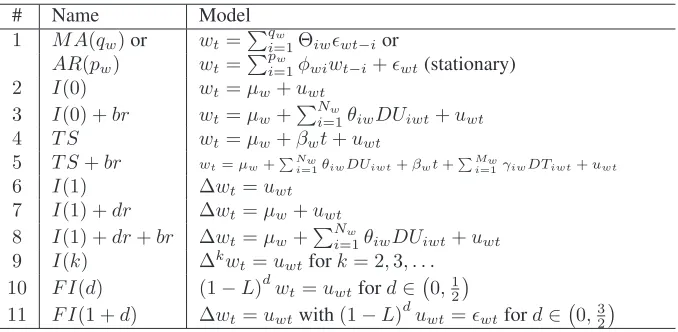
Research on spurious regression has been making use of increasingly complex Data
Generating Processes (DGPs). Table (1) provides a summary of those appearing in this
survey:
# Name Model
1 M A(qw)or wt=Pqw
i=1Θiwǫwt−ior AR(pw) wt=Ppw
i=1φwiwt−i+ǫwt(stationary)
2 I(0) wt=µw+uwt
3 I(0) +br wt=µw+PNw
i=1θiwDUiwt+uwt
4 T S wt=µw+βwt+uwt
5 T S+br wt=µw+PNwi=1θiwDUiwt+βwt+PMwi=1γiwDTiwt+uwt
6 I(1) ∆wt=uwt
7 I(1) +dr ∆wt=µw+uwt
8 I(1) +dr+br ∆wt=µw+PNw
i=1θiwDUiwt+uwt
9 I(k) ∆kwt=uwtfork= 2,3, . . .
10 F I(d) (1−L)dwt=uwtford∈ 0,12
[image:7.595.138.477.279.445.2]11 F I(1 +d) ∆wt=uwtwith(1−L)duwt=ǫwtford∈ 0,32
Table 1: The DGP’s for wt = xt, yt, zt. Note: T S, br and dr stand for trend-stationarity, breaks, and drift, respectively.
whereuwtare independent innovations obeying Assumption 1 in Phillips (1986),ǫwt
is an iid white noise with mean zero and varianceσ2
ǫ, andDUiwt,DTiwtare dummy
variables allowing changes in the trend’s level and slope respectively, that is,DUiwt=
1(t > Tbiw)andDTiwt= (t−Tbiw)1(t > Tbiw), where1(·)is the indicator function,
andTbiw is the unknown date of thei
thbreak inw. We denote the break fraction as
λiw = (Tbiw/T) ∈ (0,1),where T is the sample size;d ∈ −
1 2,
3 2
. Only DGPs1,
2and10(ford < 0.5) satisfy the weak stationarity definition. The remaining DGPs
generate nonstationary series.6F Iprocesses deserve further discussion; contrary to re-gularARM A(p, q)processes–made popular by Box and Jenkins in the 1970s–such as
DGP 1, whose autocorrelation function decays at an exponential rate (short memory),
memory).
There are a number of empirical examples in time series in which dependence falls
slowly across time. This phenomenon, known as Long Memory or Long-Range
de-pendence, was observed in geophysical data, such as river flow data (Hurst 1951) and
in climatological series (Hipel and McLeod 1978), as well as in economic time series
(Adelman 1965). In three important papers (Granger 1980, Granger and Joyeux 1980,
Hosking 1981), the authors extended these processes to provide more flexible
low-frequency or Long Memory behavior by consideringI(d)processes with non-integer
values ofd. As pointed out by Granger and Joyeux (1980),“It was standard procedure
to consider differencing time series to achieve stationarity”–thus obtaining a form of
the series that can be identified as anARM Amodel–however,“Some econometricians
were reluctant to this technique, believing that they may be losing information, by
zap-ping out the low frequency components.” But using infinite variance series without
differencing them was also a source of difficulties at that time. Fractional integration
encompassesARM Amodels ford= 0, andARIM Amodels ford= 1. The process
is stationary and ergodic whend∈ −1 2,
1 2
; nonstationary but mean-reverting7when
1
2 < d <1, and nonstationary and mean averting whend≥1.
Mean stationary processes (DGPs 2 and 3) have been used to model the behavior of real
exchange rates, unemployment rates, current account, and several great ratios, such as
the output-capital ratio and the consumption-income ratio. Unemployment has also
been conceived as a nonstationary fractionally integrated process (Arino and Marmol
2004). Some examples can be found in Perron and Vogelsang (1992), Wu (2000), Wu,
Chen, and Lee (2001) and D’Adda and Scorcu (2003). Trend Stationarity andI(2)
processes (DGPs 4 and 9, respectively) have been used to model growing variables,
real and nominal, such as output, consumption and prices; several macro variables
have been conceived as DGPs 5, 6, and 7 (Perron 1989, Perron 1997, Lumsdaine and
in Juselius (1996), Juselius (1999), Haldrup (1998), Muscatelli and Spinelli (2000),
Coenen and Vega (2001), and Nielsen (2002). In Table (11) of appendix B, a few
more examples are provided, in which the link between time-series econometrics and
important economic issues is acknowledged.
3
Spurious regression since the roaring twenties
We now begin our survey of the development of the theory of spurious regression. The
related literature is vast, for which reason we focus mainly on a limited selection of
articles which, in our view, are particularly representative.8 Unless otherwise
speci-fied, the regression specification for which all asymptotics are presented is hereinafter
expression (1). We focus mainly on on the rate of divergence of the relevant t-ratios
and let aside in most cases the asymptotic distributions that would be obtained had
the statistics being correctly normalized. This is so because such distributions do have
nuisance parameters that prevent one from making use of these to do correct inference;
moreover, practitioners cannot be awarea prioriof the adequate normalization.
Ho-wever, in some cases (Kim, Lee, and Newbold 2004, Sun 2004, Moon, Rubia, and
Valkanov 2006) the asymptotic distributions are important because of the relevance for
practitioners.9
3.1
Yule’s experiment
Spurious correlation was evidenced by Yule (1926) in a computerless Monte Carlo
experiment. Shuffling decks of playing cards, Yule obtained independent series of
ran-dom numbers. In fact, Yule generated independentI(0),I(1), and I(2)series and
computed correlation coefficients amongst them. Such correlation coefficients
provi-ded correct inference when usingI(0)series, but became nonsensical when the order of
integration of the variables was higher. With independentI(0)variables the correlation
variables no longer worked; many times it was close to unity, resulting in what we now
refer to as a spurious correlation. If variables wereI(2), the most probable outcome
was actually a correlation coefficient of close to1: the spurious phenomenon was even
stronger.
3.2
Reappraisal in the seventies: spurious Least Squares
Throughout most of the past century, it was commonly recommended to first-difference
the series if these seemed to have a trending mechanism. However, not every
econo-metrician was in agreement with such a method because, it was argued, differencing
causes losses in the information contained in the original series. A profound
reapprai-sal of this issue began with Granger and Newbold’s (1974) article, which allowed the
spurious regression in Least squares estimators to be identified. The Monte Carlo
ex-periment described above revealed, among other things, that highR2and low
Durbin-Watson statistics (hereinafterDW) should be considered as a sign of misspecification.
They also pointed out, comparing the outcome of simulation with many results in
ap-plied econometrics, that problems of misspecification seemed to be widespread. It was
proposed that first-differenced series be used, although the authors warned about the
risks of catch-all solutions; their results may be considered as the seed of many fruitful
extensions in time series econometrics.
3.3
Theory at last: asymptotics in nonsensical regressions
Phillips (1986) proposed the theoretical framework necessary to allow an
understan-ding of Granger and Newbold’s earlier results and provided a first insight into the
phe-nomenon of spurious regression. His development set the groundwork for the spurious
regression literature in econometrics. Whilst Granger and Newbold used ani.i.d.noise
in their simulations , Phillips allowed a flexible autocorrelation structure, as well as
the following asymptotics are obtained:
ˆ
β=Op(1) αˆ=OpT12
R2=Op(1)
tβˆ=Op
T12
tαˆ=Op
T12
DW→p 0
Table 2: Orders in Probability: variablesytandxtboth independently generated by DGP6
whereOp(m)denotes the order of magnitude and→p means convergence in probability.
The most relevant results are that theR2does not collapse, and, the t-statistic associated
toβˆ diverges at a rateT12. This means that the t-statistic will exceed the classical
5%−level critical values (−1.96 and1.96) as the sample size grows and, with a
sufficiently large sample, the null hypothesis of the t-statistic (H0 : β = 0) will be
rejected with certainty.
Park and Phillips (1989) demonstrated the presence of spurious regression when the
independent variables areI(2). Marmol (1995) proved that the phenomenon of
spu-rious regression occurs in a more general nonstationary framework; he demonstrated
that spurious regression occurs when independent seriesxt, ytare integrated of orderd
ford∈ N ={1,2, . . .}(see DGP 9). Empirically relevant DGPs, such as theI(2)
pro-cess (identified, as mentioned earlier, with uncontrolled inflation) can produce spurious
regression. The asymptotic results are somewhat similar to those of Phillips:
ˆ
β=Op(1) αˆ =OpT12−d
R2=Op(1)
tβˆ=Op
T12
tαˆ=Op
T12
DW=Op T−2
Table 3: Orders in Probability: variablesytandxtboth independently generated by DGP9. Both variables are integrated of the same order.
Although the parameter estimate of the constant term,αˆ, diverges at a different rate,
work, i.e.OpT12
.
One limitation of Marmol’s (1995) results is that both the dependent and the
indepen-dent variables share the same order of integration. Banerjee, Dolado, Galbraith, and
Hendry (1993), provided Monte Carlo evidence of spurious regression when the order
of integration of each variable is different. Marmol (1996), later allowed the relevant
DGPs for bothyandxto be integrated of different orders;yt∼I(d1)andxt∼I(d2)
where d1 and d2 ∈ N = {1,2, . . .}. Marmol’s (1996) results are twofold; either
d1> d2or vice versa:
• Whend1> d2:
ˆ
β=Op Td1−d2 αˆ=Op
Td1− 1 2
tβˆ=Op
T12
tαˆ=Op
T12
DW=Op T−1ifd
2= 1 DW=Op T−2ifd2= 2,3, . . .
Table 4: Orders in Probability: variablesytandxtboth independently generated by DGP9. Variables are integrated of different orders.d1> d2
• Whend1< d2:
ˆ
β=Op Td1−d2 αˆ=Op
Td1−12
tβˆ=Op
T12
tαˆ=Op
T12
DW=Op T−1ifd
1= 1 DW=Op T−2
ifd1= 2,3, . . .
Table 5: Orders in Probability: variablesytandxtboth independently generated by DGP9. Variables are integrated of different orders.d1< d2
• In both casesR2=Op(1)
Indeed, spurious regression persists in the presence of the so-called unbalanced
regres-sions. The rate of divergence oftβˆremainsT
1
2. de Jong (2003) extended the study of
spurious regression using independent driftless unit root processes; he used DGP (6) to
transformation of both variables–a direction which has proved extremely relevant for
empirical purposes:10
ln (yt) = α+βln (xt) +ut
de Jong discovered similar results to previous works, i.e. βˆ = Op(1) and tβˆ =
OpT12
.
Entorf (1997) made a slight-and yet, fundamental-modification to the Phillips’ DGPs
by adding a drift (DGP 7).11 Amongst the most relevant consequences of such drift is
the fact that there is not only a stochastic trend but also a deterministic one. In the long
run, the deterministic trend dominates the stochastic (see Appendix C). The asymptotic
results of estimating equation (1) using independent variables generated by DGP 7 are:
tβˆ=Op(T) tαˆ=Op
T12
1−R2=Op T−1 DW=Op T−1
Table 6: Orders in Probability: variablesytandxtboth independently generated by DGP7.
Note thattβˆgrows at rateTinstead ofT
1
2, contrary to the results presented so far, due
to the presence of a deterministic trend.
3.4
Spurious regression and long memory: an unforgettable
exten-sion
Among the first papers to deal with spurious regression in econometrics12 using long memory processes are those of Cappuccio and Lubian (1997) and Marmol (1998). The
authors use the nonstationary fractionally-integrated processes specified in DGP 11.
Under these conditions, the asymptotics of an LS regression as specified in expression
ˆ
β=Op(1) tβˆ=Op
T12
R2=Op(1) DW=Op T−(1+2d)
Table 7: Orders in Probability: variablesytandxtboth independently generated by DGP11. The variables are integrated of the same order.
Note that as most of the previous cases the t-statistic ofβˆdiverges at rateT12. The
main difference lies in theDW, the rate of divergence of which varies according to the
degree of long memory, measured byd. These results can be understood as an
argu-ment against the usefulness of the ‘rule-of-thumb’; a regression was usually considered
spurious whenR2 >DW. However, when long memory is present in the variables,
the regression may well be spurious even ifR2<DW. It is worth mentioning that the
fractional integration parameter,d, is the same in both variables. This ‘shortcoming’
is fixed by Tsay and Chung (2000), who used a manifold approach. They used two
DGPs (No 10 and 11) and then combined these in a simple regression. Thus, there
are four fractionally-integrated processes, two stationary,[F I(d1) andF I(d2) with
di∈ 0,1 2
, and two nonstationary,[F I(di+ 1) for di ∈ 1 2,
3 2
. The authors then
studied several specifications using six DGPs. The first four are used in the estimation
of specification (1) whilst the remaining two estimateyt=α+δt+ut:
1. yt∼F I(1 +d1)andxt∼F I(1 +d2),14
2. yt∼F I(d1)andxt∼F I(d2)whered1+d2>12,
3. yt∼F I(1 +d1)andxt∼F I(d2)whered2>12,
4. yt∼F I(d1)andxt∼F I(1 +d2)whered1>12,
5. yt∼F I(1 +d1)whered1>0,
6. yt∼F I(d1)whered1>0.
We can summarize the results by stating thattβˆ =Op(Tr)where0 < r < 1which
means that the t-ratio always diverges; the divergence rate,r, is,T12,Td1+d2−12,Td2
,
Td1
,T12, andTd1
Special attention should be given to the Durbin-Watson statistic, which collapses to
zero (as usual) except in the second case, whereDW = Op(1)and hence does not
converge to zero as it does elsewhere. This also could be interpreted as an important
indication of the need for caution when using the rule-of-thumb, which states that when
R2 > DW there may be spurious regression. As in Cappuccio and Lubian (1997),
there is evidence that the rule-of-thumb may be a dangerous tool. Another important
result appears when we compare model 1 and model 2. The reader may notice that
the variables used in the second model are merely the first differences of those used in
the first. What is surprising is that the spurious regression persists after the variables
have been differenced.15 This goes against fifty years of tradition (differencing is used
to deal with spurious regression16). Tsay and Chung (2000) actually go further by suggesting that the spurious phenomenon is due to the long memory properties of the
series and not to the presence of unit roots.17 Sun (2006) shows that spurious regression can occur between two stationary generalized fractional processes, as long as their
generalized fractional differencing parameters sum up to a value greater than 12 and
their spectral densities have poles at the same location.
3.5
Spurious regression with stationary series: size-matters
Granger, Hyung, and Jeon (2001) show, both through Monte Carlo experiments and
theoretically that the spurious regression phenomenon may occur amongst independent
stationary series.18 Two independentAR(1)series (see DGP 2 withPw= 1) were run together to estimate regression (1), resulting in a rejection rate of the t-statistic greater
than the expected 5%. Granger, Hyung, and Jeon (2001) provide a theoretical proof of
why this happens (although the variance of the estimates does not diverge, it may not
be unity, depending on the values of the DGP’s parameters).19
These results are extended to long-spanM Aprocesses (see DGP 1). Curiously, the
parameter,qw. What is interesting about this result is the fact that it better explains
the spurious regression phenomenon in small-sized samples. This would complete the
theoretical framework necessary to allow an understanding of the Monte Carlo results
of Granger and Newbold (1974) and Ferson, Sarkissian, and Simin (2003)
Granger, Hyung, and Jeon’s (2001) results differ from all others, the effect being
dis-cussed is not not an asymptotic phenomenon but rather a size distortion. Size
distor-tions arise because standardizing a test statistic is difficult unless the exact form of the
spectral density of the residuals is known. The intuition behind the spurious regression
phenomenon is thus, different from the one that underlies all other results.
Mikosch and de Vries (2006) provide an alternative theory to explain spurious-type
behavior akin to the financial risk measurement literature.20 In the words of Mikosch and de Vries (2006):
“Estimators of the coefficients in equations of regression type which involve financial
data are often found to vary considerably across different samples. This observation
pertains to finance models like the CAPM beta regression, the forward premium
equa-tion and the yield curve regression. In economics, macro models like the monetary
model of the foreign exchange rate often yield regression coefficients which
signifi-cantly deviate from the unitary coefficient on money which is based on the theoretical
assumption that money is neutral.”.
Mikosch and de Vries (2006) prove that, when the distribution of the innovations is
heavy tailed, that is, when there is a departure from the normality assumption usually
made, using standard statistical tools (such as LS, for example) can be misleading.21
3.6
The last newcomer: Trend Stationarity
Hassler (2000) studied the spurious regression phenomenon from a different
perspec-tive. He considered the possibility of spurious regression when the variables do have a
4]). Thus, there are two independent nonstationary variables. Hassler’s (2000) results,
as with those of Kim, Lee, and Newbold (2004), who worked with the same DGPs, are
as follows:
tβˆ=Op
T32
β=Op(1) T2 1−R2→p 0
Table 8: Orders in Probability: variablesytandxtboth independently generated by DGP4.
In addition, Kim, Lee, and Newbold (2004) proved that when one of the deterministic
trend components is taken out (that is, eitherβy = 0andβx6= 0or vice versa), the
t-ratios converge to centered normal distribution, although its variance is not unity, which
may provoke spurious rejection of the null hypothesis that the parameter is zero. That
means that running a trend stationary variable (DGP 4) on a mean stationary variable
(DGP 2) or vice versa lessens the ”spuriosity” in the regression. The authors also
generated independent series with the DGP (4), as did Entorf (1997), although they ran
a different specification:
yt = α+βxt+δt+ut (2)
The asymptotics provided in Kim, Lee, and Newbold (2003) only concernβˆandtβˆ. We
computed the orders in probability of the other two parameters, given their relevance.
We included in Appendix D a guide on how to obtain these asymptotics:
ˆ
α=Op(1) tαˆ =Op
T12
ˆ
β =OpT−12
tβˆ=Op(1)
ˆ
δ=Op(1) tδˆ=Op
T12
It should be noted that the t-ratio converges to a normal distribution. However, since
the variance is not unity, spurious regression may well be still present.
A relevant extension of Hassler (2000) and Kim, Lee, and Newbold (2004) was
provi-ded by Noriega and Ventosa-Santaul`aria (2006b) where (possibly multiple) structural
breaks are added to the Trend Stationary DGP, i.e. DGP 5. Adding breaks to the
speci-fication of the DGPs makes the divergence rate of the t-statistic associated withβˆreturn
to the usualT12 ‘norm’. They also proved that adding a deterministic trend into the
re-gression specification (see equation 2) does not prevent the phenomenon of spurious
regression;tˆδ remainsOp
T12
. In an effort to unify the related literature, Noriega
and Ventosa-Santaul`aria (2007) filled a number of gaps until then unaddressed. They
studied several previously overlooked combinations of DGPs and summarized most of
the others’ results. DGPs 2-9 may indistinctly generatexand/ory.22 In fact, amongst the new possible combinations, the divergence rate oftβˆ usually remainsT
1 2. The
combination of a Trend Stationary and anI(1) plus drift stands out since the
diver-gence rate of the t-ratio isT rather thanT12 as in Kim, Lee, and Newbold (2004),
although this result should have been anticipated given the asymptotic dominance of
the deterministic trend over the stochastic. This combination is thus clearly linked to
Entorf’s (1997) results.
Granger, Hyung, and Jeon (2001) showed that the use of an Heteroskedasticity and
Autocovariance covariance matrix diminishes size distortions in some cases but their
Monte Carlo evidence also showed that this is true only when the sample size is large
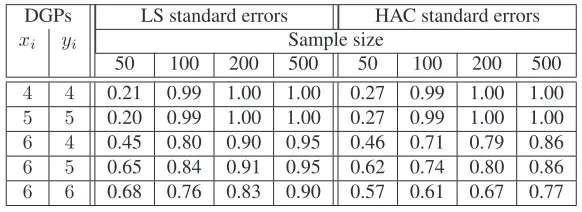
(greater than500). The use of HAC standard errors23 when the DGPs are stationary or have a deterministic trend is not so obvious. We performed a simple simulation to
support this view (see table 10). The variablesxandy are independently generated
either by DGP (4), (5), or (6). Lag selection was done as in Granger, Hyung, and Jeon
(2001), that is, using the formula: l = integerh4 (T /100)1/4i. Simulation results
high (perhaps results would improve further if the data could follow a pre-whitening
procedure).
DGPs LS standard errors HAC standard errors
xi yi Sample size
50 100 200 500 50 100 200 500
4 4 0.21 0.99 1.00 1.00 0.27 0.99 1.00 1.00
5 5 0.20 0.99 1.00 1.00 0.27 0.99 1.00 1.00
6 4 0.45 0.80 0.90 0.95 0.46 0.71 0.79 0.86
6 5 0.65 0.84 0.91 0.95 0.62 0.74 0.80 0.86
[image:19.595.160.451.215.321.2]6 6 0.68 0.76 0.83 0.90 0.57 0.61 0.67 0.77
Table 10: t-ratio rejection rates using a1.96critical value (5%level) for a standard normal distribution: spurious regression using LS and HAC standard errors.
3.7
Next of kin: statistical tests, Long Horizon, and Instrumental
Variables
Not all work on the spurious phenomenon has been monopolized by the LS simple
estimator. Stochastic trending mechanisms have been used in most of the studies,
alt-hough some exceptions are presented at the end of this section. Equally relevant are
the Instrumental Variables (IV) estimates, which have also been analyzed
(Ventosa-Santaul`aria 2009).
Giles (2007) studied two important residual tests: the Jarque-Bera test [hereinafterJ B;
see Jarque and Bera (1980)] and the Breusch-Pagan-Godfrey test (Breusch and Pagan
1980, Godfrey 1988), used to test for normality and autocorrelation/heteroskedasticity
evidence in the residuals of an LS regression, respectively; he used independent driftless
random walks (DGP 6) and proved that both statistics diverge at rateT, that is:
• Jarque-Bera test:J B=Op(T)
• Breusch-Pagan-Godfrey test: T·R2=Op(T)
The null hypothesis of normality or serial independence/homoskedasticity will be
Ventosa-Santaul`aria and Vera-Vald´es (2008) studied the behavior of the classical
Gran-ger-Causality test [see Granger (1969)], hereinafter GC. It is proved that the classical
GC test fails to accept the null hypothesis of no GC between independent broken-trend
(DGP 5) or broken-mean (DGP 3) processes whether the former series are differenced
or not.
Kim, Lee, and Newbold (2005) study several important nonlinearity tests: the RESET
test (Ramsey 1969), the McLeod and Li test (McLeod and Li 1983), the Keenan test
(Keenan 1985), the Neural Network test (White 1989), White’s Information test (White
1992), and the Hamilton test (Hamilton 2000). All these tests were studied by way of
finite-sample experiments using independent driftless random walks (see DGP 6). They
also presented the asymptotics of the RESET and Keenan tests; both test-statistics are
Op(T), so the null of linearity is eventually rejected as the sample size grows. In the
same vein, Noriega and Ventosa-Santaul`aria (2006a) proved that, when the variables
are generated independently by any combination of DGPs (3), (5), (7), and (8), the
Engle and Granger cointegration-test spuriously rejects the null of no cointegration25
in an indeterminate number of cases since the relevant t-statistic isOpT12
.26
Spurious regression has also been identified in the context of Long-Horizon (henceforth
LH) regressions, which are used in situations where previous “short-term”27 studies
have failed. In fact, Valkanov’s (2003) insight is that rolling summations ofI(0)
varia-bles, that is LH variavaria-bles, behave asymptotically asI(1)series. Hence, the theory of
spurious regression between independentI(1)variables, discussed earlier, should give
readers the intuition. Late eighties’ studies provided interesting results in economics
and finance. As asserted by Valkanov (2003):
“The results[. . .]are based on long-horizon variables, where a long-horizon variable
is obtained as a rolling sum of the original series. It is heuristically argued that
long-run regressions produce more accurate results by strengthening the signal coming from
More precisely, if the specification to be estimated is equation (1), a Long-Horizon
“reinterpretation” is carried out with the building of partially aggregated variables. As
usual, let,w = x, y, thenwk t =
Pk−1
j=0wt+j. The LH regression specification can
usually be one of the following:
yk
t = α+βxkt +ut (3)
ykt = α+βxkt−k+ut ykt = α+βxt+ut
Such specifications are used mostly in the estimation of the equity/dividend
relations-hip and to test both the neutrality of money or the Fisher effect. Based upon the
pre-vious specifications, Valkanov (2003) and Moon, Rubia, and Valkanov (2006) proved
that this regression strategy also presents the spurious regression phenomenon. To do
this, they let time overlap in the summations as a fixed fraction of the sample size,
k= [λ·T]whereλ∈[0,1]. Valkanov (2003) then defines the following DGP:
yt = βxt+uyt (4)
where (1−L)φ(L)xt = uxt. The variable xt follows an autoregressive process
whose highest root is unity whilst the rest, represented in the polynomialφ(L), is
invertible. Letω = (uyt, uxt)′ be defined as a martingale difference sequence with
E(ωtω′
t|ωt−1. . .) = σ211σ12;σ21σ222
and finite fourth moment. We could argue
that, whenβ = 0, the t-ratio associated with its estimate should be small enough
for the null hypothesis to be accepted. As in previous results, that does not happen;
tβˆ=Op
T12
. Valkanov (2003) and Moon, Rubia, and Valkanov (2006) suggest the
use of a rescaled t-ratio, tβˆ
T12. Although the limiting distribution of such t-statistic’s
is neither normal nor pivotal, it can be easily simulated and hence used. Lee (2006)
asso-ciated withβˆin equation (3) diverges:tβˆ=Op
T12
.
Ventosa-Santaul`aria (2009) studies the asymptotics of Instrumental Variables (IV) using
DGPs (5) and (7), not only forxandy, but also for a spurious and independent
ins-trument. It is shown that the t-ratio still diverges at rateT12 which confirms the Monte
Carlo simulations carried out by Leybourne and Newbold (2003). This result can be
also seen as a complement to those presented by Phillips and Hansen (1990) and
Han-sen and Phillips (1990), in which the use of spurious instruments is proposed to
im-prove the estimates whenever strong endogeneity is present betweenxand the residual
term in cointegrated relationships.
Sun (2004) developed a convergent t-statistic for correcting the phenomenon of
spu-rious regression. The new t-ratio is based on an estimate of the parameter variance
made in the same manner as HAC standard errors. This t-statistic converges to a
non-degenerate limiting distribution for many cases of spurious regression. He considered
the regression between two independent nonstationaryI(d)processes withd > 12 as
well as the regression between an independent nonstationaryI(d)process and a linear
trend [see equation (5)]:
yt=α+δt+ut (5)
In previous studies, the presence of unit roots in the series generally produced aT12
divergent t-ratio. To avoid such divergence, Sun proposes a rescaling of the parameter
estimate using a new standard error. The new Standard Error is computed in the same
way HAC is. The main difference is that HAC estimates usually require a bandwidth
or truncation lag. Sun suggests using the entire sample length:
ˆ
σ2βˆ =
T
X
t=1
(xt−x¯)2
!−1
·TΩˆ ·
T
X
t=1
(xt−x¯)2
where
ˆ
Ω =
T−1
X
j=−T+1
κ
j T
ˆ Γ(j)
ˆ Γ(j) =
1
T
PT−j
t=1 (xt+j−x¯) ˆut+jutˆ (xt−x¯) f or j≥0
1
T
PT
t=−j+1(xt+j−x¯) ˆut+jutˆ (xt−x¯) f or j <0
whereκis a kernel function that belongs to a class that ensures positive definitiveness.
Whetherxt∼I(d)orxt=t, well-defined asymptotic distributions for the t-ratio are
provided.
4
What to do if one fears spurious regression
The spurious regression phenomenon pervades many subfields in time series analysis.
It might be controlled by using correctly scaled t-ratios, as suggested earlier, but
ha-ving a clear idea of what DGP best emulates the properties of the series (this could
be labeled asDGPi-fication) would therefore be necessary (examples of this can be:
(i) evidence of UR must be obtained before a cointegration analysis is undertaken; (ii)
the nature of the trending mechanism should be identified prior to the application of a
transformation intended to render stationary the series, and; (iii) a test such as
Robin-son’s (1994) could be undertaken in order to identify long-memory behavior). This can
be achieved by means of applying a battery of tests to our series. Such an approach is
not exempted of failures. Many statistical tests are known to yield spurious evidence
under specific circumstances (see the previous subsection). Nevertheless, pretesting the
series remains an adequate strategy and allows the practitioner to be aware of the
poten-cial difficulties he could face. In this section we include a short—and incomplete—list
of tests that are employed in theDGPi-ficationof the series:
means of Dickey-Fuller-type (DF) tests [see Dickey and Fuller (1979) and
Di-ckey and Fuller (1981)]. The original DF test distinguishes between the null
hypotheses of UR (DGPs 6 and 7) and the alternatives of stationarity (DGPs 1, 2
and 4). Other well-known UR tests are: (i) the KPSS test (Kwiatkowski, Phillips,
Schmidt, and Shin 1992); (ii) the GLS-detrended DF test (Elliott, Rothenberg,
and Stock 1996); (iii) the Phillips-Perron test (Phillips and Perron 1988), and;
(iv) the Ng and Perron test (Ng and Perron 2001, Perron and Ng 1996).
2. The UR tests previously mentioned provide severely biased results under the
hypothesis of trend-stationarity in the presence of structural breaks;28 several
alternatives are available. Perron (1989) suggested the use of a DF-type test with
(point,level and trend) breaks specified in the auxiliary regression (see DGP 5);
the break dates must be decided by the practitioner. Zivot and Andrews (1992)
also proposed to modify the DF test in the same direction than Perron, only they
allowed the break date to be endogenously specified; their test allows for a single
break [see Lumsdaine and Papell (1997) for an extension that allows for two
breaks] under the alternative hypothesis (DGP 5) and rules out the possibility
of a break under the null hypothesis of UR (DGP 8); Carrion–i–Silvestre and
Sans´o (2006) proposed a test where a break under the null hypothesis is taken
into account.
3. Bai and Perron (1998) proposed a test to distinguish between DGPs 2 and 4 and
DGPs 3 and 5. The test presupposes that the trending mechanism is exclusively
deterministic.
4. Long-range dependence: many testing procedures are also available. R/S-type
test [see Hurst (1951), Mandelbrot and Taqqu (1979) and Lo (1991)] are
com-monly used to identify Long Memory (LM) against stationarity. However,
Bhat-tacharya, Gupta, and Waymire (1983) proved that the classical R/S test may
a trending mechanism. Moreover, Mikosch and St˘aric˘a (2000) and Mikosch and
St˘aric˘a (2004) proved that the sample autocorrelation function (sample ACF) can
also be a misleading statistical tool when used to identify LM; stationary series
that include a non-linear component might yield a sample ACF usually attributed
to LM processes [see also Teverovsky and Taqqu (1997)]. Several Short memory
processes may thus seem to behave as LM processes. This phenomenon can be
labeled as spurious long memory (Mikosch and St˘aric˘a 2004).
5. Many other tests have been proposed to identify LM while they control for
pos-sible non-linearities (structural breaks in the mean or the variance of the series).
See Liu, Pan, and Hsueh (1993), Robinson (1994), Lobato and Robinson (1996),
Giraitis, Kokoszka, and Leipus (2001), Giraitis, Kokoszka, Leipus, and
Teys-siere (2003), Berkes, Horv´ath, Kokoszka, and Shao (2006), Zhang, Gabrys, and
Kokoszka (2007), Aue, Horv´ath, Huˇskov´a, and Kokoszka (2008), and Jach and
Kokoszka (2008).
Concluding remarks
Spurious regression can arise wherever a trending mechanism is present in the data.
Even some stationary-autocorrelated processes cause spurious results.
Applied macroeconomists and financial experts have been steadily incorporating
tech-nical advances in the analysis of the spurious regression, a phenomenon identified for
many empirically-relevant Data Generating Processes. These include stationary
pro-cesses withAR(or longM A) structure and/or level breaks; random walks (with or
without drifts), trend stationarity (with possible level and trend breaks), long-memory
processes (whether stationary or not) and so on. These processes have been associated
with unemployment rates, price levels, real exchange rates, monetary aggregates, gross
variables entails a high risk of obtaining a spurious relationship.
Differencing the series may not always prevent spurious estimates; nor should the
R2>DWrule-of-thumb be seen as an adequate rule to identify a spurious regression.
Cointegration analysis appears to better prevent non-sensical statistical relationships
although, one should bear in mind Phillips’s (2003) and further study the statistical
relationship at hand. Out-of-sample forecasting evaluation could be an option. Most
macroeconomic variables are either nonstationary or very persistent. Pre-testing the
variables in order to identify the nature of the trending mechanism arises as the
gol-den rule to avoid non-sense regression. Once the DGP is correctly igol-dentified, spurious
regression is “easier” to deal with.
Attaining a clear understanding of any problem is the first step toward finding its
solu-tion.
References
ADELMAN, I. (1965): “Long Cycles: Fact or Artifact,”American Economic Review, 55, 444–463.
AGHION, P., ANDS. N. DURLAUF(2005): Handbook of Economic Growth, Volume
1A. North-Holland.
ALDRICH, J. (1995): “Correlations genuine and spurious in Pearson and Yule,” Statis-tical Science, 10(4), 364–376.
ALOGOSKOUFIS, G., ANDR. SMITH(1991): “The Phillips Curve, The Persistence
of Inflation, and the Lucas Critique: Evidence from Exchange-Rate Regimes,”The American Economic Review, 81(5), 1254–1275.
ARINO, M., AND F. MARMOL (2004): “A permanent-transitory decomposition for
ARFIMA processes,”Journal of Statistical Planning and Inference, 124, 87–97.
AUE, A., L. HORVATH, M. HU´ SKOVˇ A,´ AND P. KOKOSZKA (2008): “Testing for changes in polynomial regression,”Bernoulli, 14(3), 637–660.
BAI, J.,ANDP. PERRON(1998): “Estimating and Testing Linear Models with Multiple
Structural Changes,”Econometrica, 66, 47–78.
BANERJEE, A., J. DOLADO, J. GALBRAITH, AND D. HENDRY (1993):
BARDSEN, G., E. JANSEN,ANDR. NYMOEN(2004): “Econometric Evaluation of the
New Keynesian Phillips Curve,”Oxford Bulletin of Economics and Statistics, 66(s 1), 671–686.
BERKES, I., L. HORVATH, P. KOKOSZKA,´ ANDQ. SHAO(2006): “On discriminating between long-range dependence and changes in mean,”Annals of Statistics, 34(3), 1140–1165.
BERNARD, A., AND S. DURLAUF (1995): “Convergence in International Output,”
Journal of Applied Econometrics, 10(2), 97–108.
BERNARD, A.,ANDS. DURLAUF(1996): “Interpreting tests of the Convergence
Hy-pothesis,”Journal of Econometrics, 71, 161–173.
BHATTACHARYA, R., V. GUPTA,ANDE. WAYMIRE(1983): “The Hurst effect under
trends,”Journal of Applied Probability, pp. 649–662.
BREIDT, F., N. CRATO, ANDP. DELIMA(1998): “The detection and estimation of
long memory in stochastic volatility,”Journal of Econometrics, 83(1-2), 325–348.
BREUSCH, T., ANDA. PAGAN(1980): “The Lagrange Multiplier Test and its
Appli-cations to Model Specification in Econometrics,”Review of Economic Studies, 47, 239–254.
CAMPELL, J.,ANDP. PERRON(1991): “What Macroeconomist Should Know about
Unit Roots,” inNBER Macroeconomics Annual, ed. by O. Blanchard,andS. Fisher, pp. 141–201. MIT Press.
CAPPUCCIO, N.,ANDD. LUBIAN(1997): “Spurious Regressions Between I(1)
Pro-cesses with Long Memory Errors,”Journal of Time Series Analysis, 18, 341–354.
CARRION–I–SILVESTRE, J.,ANDA. SANSO´ (2006): “Joint hypothesis specification for unit root tests with a structural break*,”Econometrics Journal, 9(2), 196–224.
CATI, R., M. GARCIA,ANDP. PERRON(1999): “Unit roots in the presence of abrupt
governmental interventions with an application to Brazilian data,” Journal of Ap-plied Econometrics, 14(1), 27–56.
CAVALIERE, G.,ANDR. TAYLOR(2006): “Testing for a Change in Persistence in the Presence of a Volatility Shift,”Oxford Bulletin of Economics and Statistics, 68(s1), 761–781.
CHEUNG, Y. (1993): “Long memory in foreign-exchange rates,”Journal of Business & Economic Statistics, pp. 93–101.
COCHRANE, J. (1994): “Permanent and Transitory Components of GNP and Stock Prices,”The Quarterly Journal of Economics, 109(1), 241–265.
COE, P., AND J. NASON (2004): “Long-run monetary neutrality and long-horizon
COENEN, G.,ANDJ. VEGA(2001): “The Demand for M3 in the Euro Area,”Journal
of Applied Econometrics, 16(6), 727–748.
CORBAE, D.,ANDS. OULIARIS(1988): “Cointegration and Tests of Purchasing
Po-wer Parity,”The Review of Economics and Statistics, 70(3), 508–511.
CRATO, N., AND P. DE LIMA (1994): “Long-range dependence in the conditional variance of stock returns,”Economics Letters, 45(3), 281–285.
CROWDER, W. (1997): “The Long-Run Fisher Relation in Canada,” The Canadian Journal of Economics, 30(4b), 1124–1142.
CUDDINGTON, J., ANDH. LIANG(2000): “Purchasing power parity over two
centu-ries,”Journal of International Money and Finance, 19(5), 753–757.
CULVER, S., ANDD. PAPELL(1997): “Is there a unit root in the inflation rate?
Evi-dence from sequential break and panel data models,”Journal of Applied Econome-trics, 12(4), 435–444.
D’ADDA, C.,AND A. SCORCU (2003): “On the time stability of the output-capital
ratio,”Economic Modelling, 20(6), 1175–1189.
DAVIDSON, J., D. HENDRY, F. SRBA,ANDS. YEO(1978): “Econometric Modelling of The Aggregate Time Series Relationship betwen the consumers: Expenditure and Income in the United Kindom,”Economic Journal, 88, 661–92.
DEJONG, R. (2003): “Logarithmic Spurious Regressions,”Economics Letters, 81(1), 13–21.
DELOACH, S. (2001): “More Evidence in Favor of the Balassa-Samuelson Hypothe-sis,”Review of International Economics, 9(2), 336–342.
DIBA, B.,ANDH. GROSSMAN(1988): “Explosive Rational Bubbles in Stock Prices?,”
The American Economic Review, 78(3), 520–530.
DICKEY, D.,ANDW. FULLER(1979): “Distribution of the Estimators for
Autoregres-sive Time Series with a Unit Root,”Journal of the American Statistical Association, 74, 427–31.
(1981): “Likelihood ratio statistics for autoregressive time series with a unit root,”Econometrica, pp. 1057–1072.
DICKEY, D., AND S. PANTULA (1987): “Determining the Order of Differencing in
Autoregressive Processes,”Journal of Business & Economic Statistics, 5(4), 455– 461.
DRINE, I., ANDC. RAULT(2003): “Do panel data permit the rescue of the
DURLAUF, S. (1996): “On The Convergence and Divergence of Growth Rates,”The Economic Journal, 106(437), 1016–1018.
(2001): “Manifesto for a Growth Econometrics,”Journal of Econometrics, 100(1), 65–69.
DURLAUF, S.,ANDP. PHILLIPS(1988): “Trends versus Random Walks in Time Series Analysis,”Econometrica, 56(6), 1333–1354.
DURLAUF, S.,ANDD. QUAH(1998):The New Empirics of Economic Growth.
Natio-nal Bureau of Economic Research Cambridge, Mass., USA.
ELLIOTT, G., T. ROTHENBERG,ANDJ. STOCK(1996): “Efficient tests for an
autore-gressive unit root,”Econometrica: Journal of the Econometric Society, pp. 813–836.
ENDERS, W., ANDS. HURN(1994): “Theory and Tests of Generalized
Purchasing-Power Parity: Common Trends and Real Exchange Rates in the Pacific Rim,” Re-view of International Economics, 2(2), 179–190.
ENGLE, R.,ANDC. GRANGER(1987): “Co-integration and Error Correction:
Repre-sentation, Estimation, and Testing,”Econometrica, 55, 251–276.
ENTORF, H. (1997): “Random Walks Wiht Drifts: Nonsense Regression and Spurious Fixed-Effect Estimation,”Journal of Econometrics, 80, 287–296.
EVANS, M.,ANDK. LEWIS(1995): “Do Expected Shifts in Inflation Affect Estimates
of the Long-Run Fisher Relation?,”The Journal of Finance, 50(1), 225–253.
FAMA, E. (1965): “The behavior of stock-market prices,”Journal of business, 38(1), 34.
FARIA, J.,ANDM. LEON-LEDESMA´ (2003): “Testing the Balassa-Samuelson Effect:
Implications for Growth and the PPP,”Journal of Macroeconomics, 25(2), 241–253.
FAUST, J.,ANDE. LEEPER(1997): “When Do Long-Run Identifying Restrictions Give
Reliable Results?,”Journal of Business & Economic Statistics, 15(3), 345–353.
FERSON, W., S. SARKISSIAN,ANDT. SIMIN(2003): “Is Stock Return Predictability
Spurious?,”Journal of Investment Management, 1(3), 1–10.
FUHRER, J.,ANDG. MOORE(1995): “Inflation Persistence,”The Quarterly Journal of Economics, 110(1), 127–159.
FURMAN, E.,ANDR. ZITIKIS(2008): “Weighted risk capital allocations,”Insurance
Mathematics and Economics, 43(2), 263–269.
(2009b): “Weighted Pricing Functionals,” Actuarial Research Clearing House (ARCH). pp. 31. Proceedings of the 43rd Actuarial Research Conference, University of Regina, Saskatchewan, Canada.
GAL´I, J., M. GERTLER,ANDJ. L ´OPEZ-SALIDO(2005):Robustness of the Estimates
of the Hybrid New Keynesian Phillips Curve. Banco de Espa˜na.
GARCIA, R., ANDP. PERRON(1996): “An Analysis of the Real Interest Rate Under
Regime Shifts,”The Review of Economics and Statistics, 78(1), 111–125.
GILES, D. E. (2007): “Spurious Regressions with Time-Series Data: Further Asym-ptotic Results,”Communications in Statistics-Theory and Methods, 36(5), 967–979.
GIRAITIS, L., P. KOKOSZKA,ANDR. LEIPUS(2001): “Testing for long memory in
the presence of a general trend,”Journal of Applied Probability, pp. 1033–1054.
GIRAITIS, L., P. KOKOSZKA, R. LEIPUS, AND G. TEYSSIERE(2003): “Rescaled
variance and related tests for long memory in volatility and levels,”Journal of Eco-nometrics, 112(2), 265–294.
GODFREY, L. (1988): Misspecification Tests in Econometrics: The Lagrange Multi-plier Principle and Other Methods. Cambridge University Press.
GRANGER, C. (1969): “Investigating Causal Relations by Econometric Models and Cross-spectral Methods,”Econometrica, 37(3), 424–438.
(1980): “Long Memory Relationships and the Aggregation of Dynamic Mo-dels,”Journal of Econometrics, 14, 227–38.
(1981): “Some Properties of Time Series Data and their Use in Econometric Model Specification,”Journal of Econometrics, 16, 121–130.
GRANGER, C., N. HYUNG,ANDY. JEON(2001): “Spurious regressions with
statio-nary series,”Applied Economics, 33(7), 899–904.
GRANGER, C., AND R. JOYEUX (1980): “An Introduction to Long-Memory Time Series Models and Fractional Differencing,”Journal of Time Series Analysis, 1, 15– 29.
GRANGER, C., ANDP. NEWBOLD(1974): “Spurious Regressions in Econometrics,”
Journal of Econometrics, 2, 11–20.
GRANGER, C.,ANDA. WEISS(1983):Time Series Analysis of Error-Correction
Mo-dels. Academic Press.
HALDRUP, N. (1998): “An Econometric Analysis of I (2) Variables,”Journal of Eco-nomic Surveys, 12(5), 595–650.
HAMILTON, J. (1994):Time Series Analisys. Princeton.
HAMORI, S.,ANDA. TOKIHISA(1997): “Testing for a unit root in the presence of a
variance shift,”Economics Letters, 57(3), 245–253.
HANSEN, B.,ANDP. PHILLIPS(1990): “Estimation and Inference in Models of
Coin-tegration: A Simulation Study,”Advances in Econometrics, 8, 225–248.
HASSLER, U. (1996): “Spurious regressions when stationary regressors are included,”
Economics Letters, 50(1), 25–31.
HASSLER, U. (2000): “Simple Regressions with Linear Time Trends,”Journal of Time Series Analysis, 21, 27–32.
HASSLER, U. (2003): “Nonsense Regressions Due to Neglected Time Varying Means,”Statistical Papers, 44, 169–182.
HENDRY, D. (1980): “Econometrics-Alchemy or Science?,” Economica, 47(188), 387–406.
HENDRY, D., ANDG. ANDERSON(1977): “Testing Dynamic Specification in Small
Simultaneous Systems: An Application to a Model of Building Society Behaviour in the United Kingdom,”Frontiers in Quantitative Economics, 3, 361–383.
HENDRY, D., ANDG. MIZON(1978): “Serial Correlation as Convenience Simplifi-cation, Not a Nuissance: A comment on a Study of the Demand for Money by the Bank of England,”Economic Journal, 88, 549–63.
HENDRY, D., ANDM. MORGAN (1995): The Foundations of Econometric Analysis.
Cambridge University Press.
HENDRY, D., A. PAGAN,ANDJ. SARGAN(1984): “Dynamic Specification,”
Hand-book of Econometrics, 2, 1023–1100.
HIPEL,ANDMCLEOD(1978): “Preservation of the Rescaled Adjusted Range Parts 1,
2 and 3,”Water Resources Research, 14, 491–518.
HOSKING, J. (1981): “Fractional Differencing,”Biometrika, 68, 165–76.
HURST, H. (1951): “Long Term Storage Capacity Reservoirs,” Transcations of The American Society of Civil Engineers, 116, 770–799.
JACH, A., AND P. KOKOSZKA (2008): “Wavelet-domain test for long-range
depen-dence in the presence of a trend,”Statistics, 42(2), 101–113.
JARQUE, C.,ANDA. BERA(1980): “Efficient Tests for Normality, Homoskedasticity
and Serial Independence of Regression Residuals,”Economics Letters, 6, 255–259.
JEVONS, W. (1884): “Commercial Crises and Sunspots,”Investigations in Currencies and Finance (MacMillan, London), pp. 221–243.
(1999): “Price Convergence in the Medium and Long Run: An I (2) Analysis of Six Price Indices,” Cointegration, Causality and Forecasting: A Festschrift to Clive Granger, Oxford University Press, Oxford.
KAO, C. (1999): “Spurious regression and residual-based tests for cointegration in panel data,”Journal of Econometrics, 90(1), 1–44.
KEENAN, K. (1985): “A Tukey nonadditivity type test for time series nonlinearity,”
Biometrika, 72, 39–44.
KIM, T., S. LEE,ANDP. NEWBOLD(2003): “Spurious Regressions With Processes Around Linear Trends or Drifts,” Discussion Papers in Economics.
KIM, T., S. LEE,ANDP. NEWBOLD(2004): “Spurious Regressions With Stationary
Processes Around Linear Trends,”Economics Letters, 83, 257–262.
KIM, T., S. LEE, AND P. NEWBOLD (2005): “Spurious Nonlinear Regressions in
Econometrics,”Economics Letters, 87, 301–306.
KIM, T., S. LEYBOURNE,ANDP. NEWBOLD(2002): “Unit root tests with a break in
innovation variance,”Journal of Econometrics, 109(2), 365–387.
(2004): “Behaviour of Dickey-Fuller Unit-Root Tests Under Trend Misspeci-fication,”Journal of Time Series Analysis, 25(5), 755–764.
KING, R., C. PLOSSER, J. STOCK,ANDM. WATSON(1991): “Stochastic Trends and
Economic Fluctuations,”The American Economic Review, 81(4), 819–840.
KOUSTAS, Z. (1996): “Unemployment hysteresis in Canada: an approach based on long-memory time series models,”Applied Economics, 28(7), 823–831.
KWIATKOWSKI, D., P. PHILLIPS, P. SCHMIDT, ANDY. SHIN(1992): “Testing the
null hypothesis of stationarity against the alternative of a unit root,”Journal of eco-nometrics, 54(1-3), 159–178.
LEE, J. (2006): “Fractionally integrated long horizon regressions,”Studies in Nonli-near Dynamics & Econometrics.
LEGENDRE, A. (1805): Nouvelles m´ethodes pour la d´etermination des orbites des com`etes. F. Didot.
LEYBOURNE, S., T. C. MILLS,AND P. NEWBOLD(1998): “Spurious rejections by
Dickey–Fuller tests in the presence of a break under the null,”Journal of Econome-trics, 87(1), 191–203.
LEYBOURNE, S.,ANDP. NEWBOLD(2000): “Behavior of Dickey-Fuller t-tests when
there is a break under the alternative hypothesis,”Econometric Theory, 16(05), 779– 789.
LEYBOURNE, S.,ANDP. NEWBOLD(2003): “Spurious Rejections by Cointegration
LI, Q., ANDD. PAPELL (1999): “Convergence of International Output Time Series
Evidence for 16 OECD Countries,”International Review of Economics and Finance, 8, 267–280.
LIU, Y., M. PAN, AND L. HSUEH (1993): “A modified R/S analysis of long-term dependence in currency futures prices,”Journal of International Financial Markets, Institutions & Money, 3(2), 97–113.
LO, A. (1991): “Long-term memory in stock market prices,”Econometrica, pp. 1279– 1313.
LOBATO, I., ANDP. ROBINSON(1996): “Averaged periodogram estimation of long
memory,”Journal of Econometrics, 73(1), 303–324.
LOBATO, I., ANDN. SAVIN(1998): “Real and spurious long-memory properties of
stock-market data,”Journal of Business & Economic Statistics, pp. 261–268.
LUMSDAINE, R.,ANDD. PAPELL(1997): “Multiple Trend Breaks and the Unit-Root
Hypothesis,”The Review of Economics and Statistics, 79(2), 212–218.
MANDELBROT, B., ANDM. TAQQU(1979): “Robust R/S analysis of long run serial
correlation,” inProc. 42nd Session ISI, pp. 69–99.
MARMOL, F. (1995): “Spurious Regressions Between I(d) Processes,”Journal of Time Series Analysis, 16, 313–321.
MARMOL, F. (1996): “Nonsense Regressions between Integrated Processes of Diffe-rent Orders.,”Oxford Bulletin of Economics & Statistics, 58(3), 525–36.
MARMOL, F. (1998): “Spurious Regression Theory with Nonstationary Fractionally Integrated Processes,”Journal of Econometrics, 84, 233–250.
MCLEOD, A., ANDW. LI(1983): “Diagnosting checking ARMA time series models
using squared residual autocorrelation,”Journal of Time Series Analysis, 4, 169– 176.
MEHL, A. (2000): “Unit Root Tests with Double Trend Breaks and the 1990s Reces-sion in Japan,”Japan and the World Economy, 12(4), 363–379.
MIKOSCH, T. (2003): Modeling dependence and tails of financial time series. Chap-man & Hall/CRC, Extreme Values in Finance, Telecommunications, and the Envi-ronment.
MIKOSCH, T., ANDC.DEVRIES(2006): “Tail Probabilities for Regression Estima-tors,” Laboratory of Actuarial Mathematics, University of Copenhagen.
MIKOSCH, T.,ANDC. STARIC˘ A˘(2000): “Is it really long memory we see in financial returns,”Extremes and integrated risk management, 12, 149–168.
MONTAN˜ES, A.,´ ANDM. REYES(1998): “Effect of a Shift in the Trend Function on
Dickey-Fuller Unit Root Tests,”Econometric Theory, 14, 355–363.
MONTAN˜ES, A.,´ ANDM. REYES(1999): “The asymptotic behaviour of the
Dickey-Fuller tests under the crash hypothesis,” Statistics and Probability Letters, 42(1), 81–89.
MOON, R., A. RUBIA,ANDR. VALKANOV(2006): “Long-Horizon Regressions when
the Predictor is Slowly Varying,”Journal of Business and Economic Statistics.
MORGAN, M. (1990):The History of Econometric Ideas. Cambridge University Press.
MUSCATELLI, V.,ANDF. SPINELLI(2000): “The long-run stability of the demand for
money: Italy 1861–1996,”Journal of Monetary Economics, 45(3), 717–39.
NELSON, C.,ANDH. KANG(1981): “Spurious Periodicity in Inappropriately
Detren-ded Time Series,”Econometrica, 49(3), 741–751.
NELSON, C.,ANDC. PLOSSER(1982): “Trends and Random Walks in
Macroecono-mic Time Series: some evidence and Implications,” Journal of Monetary Econo-mics, 10, 139–169.
NEWEY, W.,ANDK. WEST(1987): “A simple, positive semi-definite, heteroskedas-ticity and autocorrelation consistent covariance matrix,”Econometrica: Journal of the Econometric Society, pp. 703–708.
NG, S., AND P. PERRON(2001): “Lag length selection and the construction of unit
root tests with good size and power,”Econometrica, pp. 1519–1554.
NIELSEN, H. (2002): “An I (2) Cointegration Analysis of Price and Quantity Forma-tion in Danish Manufactured Exports,”Oxford Bulletin of Economics and Statistics, 64(5), 449–472.
NORIEGA, A.,ANDD. VENTOSA-SANTAULARIA` (2006a): “Spurious Cointegration: the Engle-Granger test in the presence of Structural Breaks,” Banco de M´exico Wor-king Paper No 2006-12.
(2006b): “Spurious Regression Under Broken Trend Stationarity,”Journal of Time Series Analysis, 27, 671–684.
(2007): “Spurious Regression And Trending Variables,” Oxford Bulletin of Economics and Statistics, 7, 4–7.
PARK, J.,ANDP. PHILLIPS(1989): “Statistical Inference in Regressions with
Integra-ted Processes: Part 2,”Econometric Theory, 5(1), 95–131.
PEDRONI, P. (2004): “Panel Cointegration; Asymptotic and Finite Sample Properties of Pooled Time Series Tests with an Application to the Purchasing Power Parity Hypothesis,”Econometric Theory, 20(3), 597–625.
PERRON, P. (1989): “The Great Crash, The Oil Price Shock and the Unit Root Hypot-hesis,”Econometrica, 57, 1361–1401.
(1990): “Testing for a unit root in a time series with a changing mean,”Journal of Business & Economic Statistics, pp. 153–162.
(1997): “Further evidence on breaking trend functions in macroeconomic variables,”Journal of Econometrics, 80(2), 355–385.
PERRON, P., ANDS. NG(1996): “Useful modifications to some unit root tests with
dependent errors and their local asymptotic properties,” The Review of Economic Studies, pp. 435–463.
PERRON, P.,ANDT. VOGELSANG(1992): “Nonstationarity and Level Shifts with an
Application to Purchasing Power Parity,”Journal of Business and Economic Statis-tics, 10(3), 301–320.
PHILLIPS, P. (1986): “Understanding Spurious Regressions in Econometrics,”Journal of Econometrics, 33, 311–340.
(1998): “New Tools for Understanding Spurious Regressions,”Econometrica, 66, 1299–1325.
(2001): “Trending Time Series and Macroeconomic Activity: some present and future challenges,”Journal of Econometrics, 100, 21–27.
(2003): “Laws and Limits of Econometrics*,” The Economic Journal, 113(486), 26–52.
(2005): “Econometric Analysis of Fisher’s Equation,”The American Journal of Economics and Sociology, 64(1), 125–68.
PHILLIPS, P.,ANDB. HANSEN(1990): “Statistical Inference in Instrumental Variables
Regression with I (1) Processes,”The Review of Economic Studies, 57(1), 99–125.
PHILLIPS, P.,ANDH. MOON(1999): “Linear Regression Limit Theory for Nonstatio-nary Panel Data,”Econometrica, 67(5), 1057–1111.
PHILLIPS, P., ANDP. PERRON(1988): “Testing for a Unit Root in Time Series
Re-gression,”Biometrika, 75, 335–346.
PLOSSER, C.,ANDG. SCHWERT(1978): “Money, Income and Sunspots: measuring
economic relationships and the effects of differencing,”Journal of Monetary Eco-nomics, 4, 637–660.