PROGRAMMING THE SMART HOME
Urs Bischoff, Vasughi Sundramoorthy, Gerd Kortuem
Lancaster University, Computing Department, UK
Keywords: Smart home, intelligent environment, pro-grammable space, software engineering.
Abstract
A smart home is a house that is responsive to its inhabitants and their actions by being aware of their context. Potential applications for smart homes address economic and com-fort aspects of living, or could provide unobtrusive support for the elderly or disabled to promote independent living. The basic building blocks of such a smart home is a com-puting system consisting of distributed sensors and actua-tors. Programming and maintaining such an infrastructure is challenging because suitable programming abstractions are currently missing. In this paper we introduce the no-tion of programmable space that lets the applicano-tion devel-oper perceive the smart home as an integrated runtime envi-ronment. This approach is implemented in a system called RuleCaster. Applications are developed in a high-level rule-based language. Our approach shows a notable simplifica-tion of applicasimplifica-tion development and maintenance. To verify the utility of RuleCaster we use a scenario-based evaluation method.
1 Introduction
Smart homes are an important area of research for build-ing ambient intelligence and intelligent environments. A smart home is a domestic environment in which we are sur-rounded by interconnected technologies that are, more or less, responsive to our presence and actions [8]. With the advent of better sensors, tiny low-powered computers and wireless communication, we are moving closer to realising this vision of an unobtrusive pervasive computer assistant. This area is interesting because we tend to spend more time in our homes than in other environments.
Smart home applications can be divided into two broad classes [2]. The first class is related to economic and com-fort aspects of living. For example, window blinds auto-matically adjust to satisfy the light and temperature require-ments depending on the location and activities of the in-habitants. The second class addresses independent living. Assistive technology for supporting the daily lives of the elderly is one example.
Regardless of the application the basic building block of a smart home is a network consisting of a large number of heterogeneous sensor and actuator nodes. These nodes are small low-powered computers populated with sensors and/or actuators that allow the computing system to inter-act with the surrounding environment. As the technology
makes the creation of these smart environments feasible, we must also consider the way we program and maintain the underlying infrastructure.
A problem pointed out in [10] is that our experience in building integrated environments is limited by the set of concepts we know at the time of development; we are con-stantly faced with better technology becoming available. Unlike a mobile phone it is not possible to replace the smart home every few months. As emphasised by Rodden and Benford [16], living and work environments are also sub-ject to continuous transformation; they are modified by the people who inhabit them in a variety of ways, for a variety of purposes and with different frequencies. This observa-tion also has an effect on the requirements of a computing infrastructure and its applications. As such, they are sub-ject to similar changes as the rest of our living and work environments. As users we want to change or extend the application logic from time to time. With better technol-ogy becoming available, the network or parts of it should be exchanged without greatly affecting the running appli-cations. Or by adding nodes and replicating tasks we want to make the application more reliable. Upgrading and mod-ifying embedded software is difficult because of the gener-ally tight coupling between hardware and software. Having to deal with distributed applications makes changes to the application even harder.
In this paper we present RuleCaster, a programming sys-tem for the smart home. This syssys-tem supports evolutionary changes in the life-cycle of an application in a unified way by separating the concerns of implementation, distribution and execution of an application. Furthermore, this high-level approach relieves the programmer of dealing with low-level details such as sending data between nodes, and issues related to distributed programming. The application developer defines applications in a high-level language for the smart home as a whole. A compiler then splits the appli-cation into a set of distributed tasks that form the executable application code. The novelty of our approach is that the programmer perceives the smart home as an integrated run-time environment. Space is a fundamental concept of the physical environment of a smart home. The kitchen, for example, is a space that has different characteristics to the bedroom. RuleCaster directly reflects the notion of physi-cal space in software in terms of aspacedata type. The programmer is presented with high-level software abstrac-tions of spaces that allows him to program the smart home as if it was a single computing platform.
and several application scenarios that are used to illustrate our approach in the remainder of this paper. In Section 4 we present a solution outline. Then we focus on one spe-cific part, namely a high-level application language, of the overall approach. Section 5 presents a software abstraction that builds the basis for the application language introduced in Section 6. In Section 7 we show the utility of our ap-proach with a scenario-based evaluation. Finally, Section 8 concludes this paper.
2 Background on Smart Homes
The development of small low-powered computers, sensors and wireless radios has made impressive progress in recent years. This is only partly the consequence of Moore’s law and better materials being developed in research labs. The potential economic impact of this technology (not just for the smart home, but in general) shows great potential be-yond research labs (e.g. [9]). Several companies produce ready to use hardware platforms (e.g. Crossbow, Ember, Freescale or Texas Instruments) and industry-driven com-munication standards have been published (e.g. Zigbee [1]).
This technological development and the trend of moving away from a single PC per household has cleared the way to the development of smart environments. Several research groups have developed first-generation prototypes of the smart home to study the computing needs in our everyday lives ([15, 12, 11]).
Currently, the main technological focusses are on integrat-ing suitable hardware into the home, and on developintegrat-ing ser-vices that analyse sensory data in order to identify high-level contexts. One existing problem is that these systems are generally purpose-built. This makes the development or maintenance of applications a challenging task because expert knowledge is required.
In order to ease the development of applications for these systems, people have developed middleware solutions and programming abstractions. The context toolkit [7] provides the application developer withcontext widgetsthat give ac-cess to context information while hiding the details of con-text sensing. These widgets can be used in a programming language to implement context-aware applications. Similarly Helal et al. propose a service-based middleware to simplify application development [11]. Basic services hide low-level details of a specific sensor platform by pro-viding a standardised interface to the application developer. These services can be composed into other services or be directly used in a development environment to build smart home applications. The underlying middleware takes care of the management of the distributed infrastructure. Still, the application programmer is faced with the problem of having to decompose the global application logic into a set of distributed tasks. Furthermore, such a static distribu-tion is not flexible for accommodating future changes. In contrast to these bottom-up approaches that allow the ap-plication developer to build higher level abstractions from low-level services, we propose a top-down approach. Our approach provides abstractions for the smart home as one
logical entity instead of individual devices. Hence, the pro-grammer is not forced to decompose the application logic into distributed tasks and implement them by composing device-centric services. Instead, applications can be di-rectly written for the smart home as a whole.
3 The Off-the-shelf Smart Home
In order to simplify the discussion in the remainder of this paper we introduce concrete application scenarios. First, we show the smart home infrastructure in Section 3.1. Then, we describe the scenarios in Section 3.2.
3.1 Infrastructure
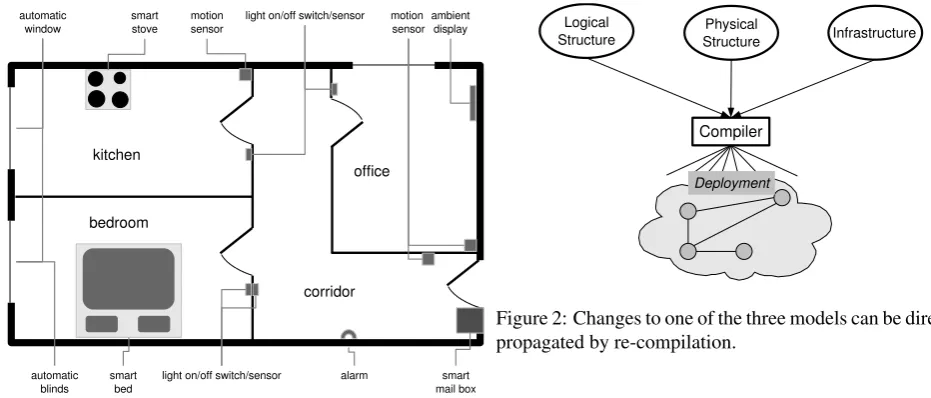
The smart home is equipped with a variety of sensors and actuators. Just like electric wiring or central heating, these devices are part of our infrastructure. Figure 1 shows a smart home that is equipped with off-the-shelf hardware. The home is subdivided into four rooms: kitchen, bedroom, office and corridor. Each room contains a number of sen-sors and actuator that build the interface between the com-puting system and the physical world:
Kitchen. Themotion sensordetects the presence of mov-ing objects. Thesmart stovesenses if it is turned on or off. And theautomatic windowcan open and close itself.
Bedroom. It contains an automatic window. The auto-matic blindsallow to be automatically adjusted. The
smart bedhas integrated pressure sensors to detect the presence of a person on the bed.
Office. Themotion sensordetects the presence of moving objects. Theambient displayis an unobtrusive screen that can display arbitrary RGB colours.
Corridor. Thealarmcan alert inhabitants with sound and light effects. Thesmart mail box detects mail. The
motion sensordetects the presence of moving objects. Furthermore, every room contains a switch/sensor that is used to turnon/offthe light and to detect if the correspond-ing lamp is turned on or off.
3.2 Application Scenarios
kitchen
bedroom
corridor
automatic blinds
smart bed
light on/off switch/sensor smart mail box motion
sensor smart stove
ambient display
alarm motion sensor
office light on/off switch/sensor automatic
window
Figure 1: The programmable smart home.
4 Solution Outline
In the following we outline our solution that addresses the two main problems mentioned earlier: (1) defining the global application in terms of local actions, and (2) ac-commodating changes. By dealing with space not only as a physical entity but also as a software data structure we realised the concept of a programmable physical environ-ment. The advantage of this approach is that the application developer can implement applications for the smart home as one logical entity;the smart home is the computer. Rule-Caster provides the application developer with a high-level language for application development.
As mentioned earlier, dealing with evolutionary changes to the application requirements and the infrastructure is a complex job for application developers, which touches upon several life-cycle phases. We can identify three major classes of changes that a smart home application undergoes throughout its lifecycle. These are changes to the
• logical structure,
• physical structure and
• computing infrastructure.
The logical structure describes how functional elements and application states are connected for describing the applica-tion logic. Changes to the logical structure refer to changes in the observable behaviour of an application. For example, while an application might initially be defined to open the window when the room is too hot, a new application logic might turn on the air conditioning instead.
The physical structure describes where computational ele-ments are executed and where application states are stored in the network infrastructure. Changes to the physical struc-ture of an application refer to changes in the distribution of computing tasks to individual nodes. For example, a task initially performed by a central node is distributed over sev-eral nodes in order to improve reliability and decrease en-ergy consumption.
Infrastructure Physical
Structure Logical
Structure
Compiler
[image:3.595.55.521.64.263.2]Deployment
Figure 2: Changes to one of the three models can be directly propagated by re-compilation.
The infrastructure is the actual smart home that stores and computes the application states. It is the distributed runtime environment. Changes to the infrastructure refer to changes in the underlying hardware and runtime system (e.g. net-work system). For example, a system might need to be up-dated when a new generation of hardware devices becomes available with different processor, memory or radio. An-other example is modifying a system by adding or removing nodes.
RuleCaster supports these classes of changes by separating them into three separate models (cf. Figure 2). The core of RuleCaster is a high-level compiler system that takes these three models as input to generate a distributed soft-ware system. Changes to any of these three models can be directly propagated to the running application by recompi-lation and re-deployment. This separation allows the pro-grammer to change any model individually and therefore simplifies maintenance of applications.
The infrastructure is described in terms of a network model which provides the compiler with a list of properties (e.g. location, hardware specification etc.) and available node-level services. The infrastructure consists of the actual sensor-actuator node hardware running a middleware that executes the application. This middleware is based around a service-based architecture. Services give access to the interface between the network and the physical world (i.e. sensors and actuators). Nodes are statically assigned to a space or several spaces (e.g. a node in the kitchen is as-signed to the spacekitchen).
Application Definition (in RCAL)
Compiler
Task for node 1
Task
for node 2 for node nTask
Distribution Strategy Network
Model
Middleware
lo
gic
al
str
uc
tu
re
ph
ys
ica
l
str
uc
tu
re
in
fra
str
uc
tu
[image:4.595.77.271.63.243.2]re
Figure 3: The architecture of the RuleCaster system.
distribution strategy — a compiler plug-in that influences the generation of the physical structure of an application based on some quality model such as energy consumption or robustness.
5 The
Space
Programming Approach
The smart home is an integrated runtime environment that can execute user-defined applications. We propose a high-level language for implementing applications. The basic data type of this language isspace. Aspaceis an ab-stract representation of a distributed computer consisting of a collection of nodes with some relationship to one another such as “all nodes in the same room” or “all nodes within a circle of radius r around position X”. A node can belong to one or several spaces. Even though thespacetype could be used to define an arbitrary collection of nodes, we solely use it to describe a network partition contained within a confined spatial area.
Thespacedata type hides low-level details of the under-lying network such as the number of nodes or specific com-munication protocols and encapsulates the manipulation of state information. Figure 4 illustrates thespacedata type. This data type has four distinct communication interfaces. It uses sensors to observe and actuators to influence the surrounding physical world. Furthermore, it communicates with other spaces through the exchange ofspacestate in-formation.
The smart home is represented as a set of programmable spaces. Each spaceencapsulates the state of the corre-sponding network partition. The application developer im-plements applications in terms of these states and condi-tions for state transicondi-tions. These condicondi-tions can depend on sensor observations, the activation of actuators or on the state of other spaces (i.e. it requires state information; cf. Figure 4). By providing state information to other spaces or requiring state information from other spaces, the spaces create an implicit coordination network between each other.
Input: Sensors
Output: Actuator
P
ro
vi
de
s
S
ta
te
R
eq
uir
es
S
ta
te
Computing System Physical World
Space S
Figure 4: The data typespace provides the application developer with a high-level abstraction of programmable space.
PRE_STATE(<state1>) [ <rule>.
] POST_STATES(<state2>,...,<staten>).
Figure 5: The basic structure of a state transition rule.
5.1 A Rule-based Language
As mentioned above the space data type encapsulate the application logic that corresponds to the respective physi-cal space. The rule-based language RuleCaster Application Language (RCAL) is used to describe states and the condi-tions for state transicondi-tions. Figure 5 shows the basic struc-ture of a state transition rule. The programmer specifies the conditions for the transition from one current state (la-belled withPRE STATE) to a set of next states (labelled withPOST STATES) in a rule. This rule is a boolean func-tion consisting of disjuncfunc-tions and conjuncfunc-tions of boolean terms. Boolean terms are defined in terms of built-in func-tions (e.g. comparison funcfunc-tions), user-defined funcfunc-tions, actuator activation functions or filter functions of sensor ob-servations. For example, a system which is in a statecold
can switch into states hotandhumidwhen the sensors are observing high temperature and high humidity.
The advantage of this high-level language approach is that rules can be easily understood by both humans and com-puters; Dey et al. even argue that people are naturally in-clined to use rules when asked to describe the behaviour of a smart space [6]. Furthermore, the declarative nature of RCAL does not force the programmer to express where and how the application is executed. He only has to specify what should be executed by the smart home.
6 The RuleCaster Application Language
We illustrate the syntax and expressiveness of RCAL with the example scenarios introduced in Section 3.2. We use the following two expressions in the description of the lan-guage syntax:Definition 6.1. Atermis a boolean function that is either
TRUEor FALSE at any point in time. It has an ID and
[image:4.595.322.518.65.196.2]NULL stoveOnHazard
stoveOn(), motion(X), X=0
[image:5.595.81.270.65.152.2]stoveOff() OR motion(X), X>=4
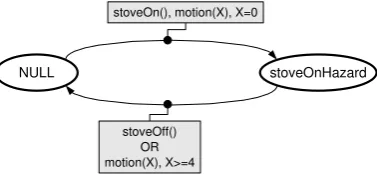
Figure 6: The kitchen states and the conditions for the state transitions.Nullrepresents the empty default state.
is provided to the function or one that is returned from the function.
Definition 6.2. Thesignatureof a term is defined as a tuple A/x, where A is the ID of the term and x is the number of arguments.
In the following we show how these scenarios are expressed in RCAL in terms of spaces, states and state transitions. The four rooms (kitchen, bedroom, corridor and office) are the four spaces we program. The user-specified rules are written in bold italics followed by the explanation of the implementation in RCAL.
Turn on the alarm if the stove is switched on and nobody is in the kitchen.This scenario includes the spaceskitchen
andcorridor. Figure 7 illustrates the RCAL program that implements the application logic. Line 1 introduces the declaration of the spacekitchen. Lines 2-6 declare the communication interface of this space (cf. Figure 4). It has three sensors1to observe the environment.
The sensor is declared with the signature of a term that can be used in a transition rule to access the sensor. Line 3, for example, defines the term with IDstoveOnthat requires
0arguments. In the following the termstoveOn()can be used in transition rules; this term isTRUEif the stove is de-tected to be on andFALSEotherwise. The spacekitchen
provides information about the statestoveOnHazardto other spaces (declared in line 6).
Figure 6 depicts the two kitchen states and the transition conditions used to implement the application logic for the spacekitchen. The first state transition is defined in lines 8-10. The transition is to the state calledstoveOnHazard; this state describes the situation when the stove is turned on and nobody is in the kitchen. BecausePRE STATEis empty, the transition generates a new state. The actual con-dition for the state transition is defined in line 9. It is de-fined as the conjunction of the three terms stoveOn(),
motion(X)andX=0. It is important to notice that both terms stoveOn()andmotion(X)have the same sig-nature as the corresponding sensors in the interface decla-ration; this allows the use of sensor observations in a rule. The argument in motion(X)is term specific; this term is true if the current sensor specific motion value can be assigned toX. The last term compares the value that is as-signed toXwith0. If the conjunction of these three terms 1Such a sensor is an abstract concept of programmable space
and does not directly correspond to a specific physical network sensor.
1 SPACE(kitchen) {
2 INTERFACE:
3 SENSOR(stoveOn/0),
4 SENSOR(stoveOff/0),
5 SENSOR(motion/1),
6 STATE(stoveOnHazard).
7
8 PRE_STATE() : time(2) [
9 STATE :- stoveOn(), motion(X), X=0.
10 ] POST_STATES(stoveOnHazard). 11
12 PRE_STATE(stoveOnHazard) [
13 STATE :- stoveOff().
14 STATE :- motion(X), X>=4.
15 ] POST_STATES().
16 }
17
18 SPACE(corridor) {
19 INTERFACE:
20 SENSOR(mail/0),
21 ACTUATOR(alarm/1).
22
23 PRE_STATE() : STATE(kitchen:stoveOnHazard) [
24 STATE :- alarm(10).
25 ] POST_STATES(alarmOn). 26
27 PRE_STATE(alarmOn) : STATE(NOT kitchen:stoveOnHazard) [
28 STATE :- alarm(0).
29 ] POST_STATES().
30 }
Figure 7: RCAL program for the programmable smart home.
isTRUE, the condition for a state transition is satisfied (i.e. the stove is on and nobody is in the kitchen because the measured motion is zero). There is an additional temporal constraint for the successful evaluation of this condition. Line 8 definestime(2); this means that all terms have to beTRUEat arbitrary points within a common interval of 2 seconds.
Lines 12-15 specify the transition from the state
stoveOnHazardto the empty state. The transition con-dition is satisfied if either the concon-dition in line 13 or the one in line 14 is satisfied. In other words, the state
stoveOnHazardis removed if the stove is turned off (i.e.
stoveOff() is TRUE) or if someone is in the kitchen (motion(X), X!4 is TRUE; the higher the value as-signed toXthe more probable is the presence of a person in the kitchen). The order of the two rules is of no significance with respect to the evaluation order of these rules.
Lines 18-30 define the spacecorridor. This space is re-sponsible for triggering the alarm in case of a hazardous situation in the kitchen. This space has two communica-tion channels in its interface declaracommunica-tion; it is the actua-tor with ID alarmand the sensor with IDmail. Lines 23-25 define the transition from the empty state to the state alarmOn (i.e. the valid state when the alarm is turned on). If the evaluation of the termalarm(10)in line 24 is TRUE, the condition for this transition is sat-isfied. Similar to the temporal constraint line 8 there is a state constraint for this transition defined in line 23 as
STATE(kitchen:stoveOnHazard). This means that the space kitchen has to be in the statestoveOnHazard
1 SPACE(bedroom) {
2 INTERFACE:
3 SENSOR(bed/1),
4 SENSOR(isLightOn/0),
5 SENSOR(isLightOff/0),
6 ACTUATOR(blinds/1).
7
8 PRE_STATE() [
9 STATE :- bed(X), X>20.
10 ] POST_STATES(personInBed).
11
12 PRE_STATE(personInBed) [
13 STATE :- isLightOff(), blinds(0).
14 ] POST_STATES(personInBed, blindsDown).
15 }
16
17 SPACE(office) {
18 INTERFACE:
19 SENSOR(floor/1),
20 ACTUATOR(display/3).
21
22 PRE_STATE() : STATE(corridor:newMail) [
23 STATE :- officeOccupied(), display(255,0,0).
24 officeOccupied() :- motion(X), X>=4.
25 ] POST_STATES(mailAlert).
26 }
Figure 8: Definitions of the spaces office and corridor.
in line 27 requires the kitchen not to be in the state
stoveOnHazard. The transition condition is satisfied if the termalarm(0)isTRUE(i.e. the alarm can be turned off by the corresponding actuator).
Shut the blinds if someone is in bed and the light is turned off. Figure 8 shows the definition of the space
bedroom. For simplicity reasons we only show the most important transitions. In line 9 the weight of the object on the bed is assigned toX. If this value is more than20, the transition condition is satisfied and the bedroom goes into a statepersonInBed(i.e. it is assumed that a per-son is in bed). Lines 12-14 show the concept of a tran-sition from one state to several states. This allows us to keep the statepersonInBedand add the additional state
blindsDownto the current states of the spacebedroom.
Notify the person in the office as soon as mail arrives. Lines 17-26 in Figure 8 define the spaceoffice. In or-der for the transition rule defined in lines 22-25 to work we have to extend the definition of spacecorridorshown in Figure 7. The space office requires access to in-formation about the state newMail (i.e. the state that is valid if mail is in the mail box) in spacecorridor. Access from outside is granted by adding the statement
STATE(newMail) to the interface declaration of the spacecorridor. The transition rule to statenewMail
in spacecorridoris shown in Figure 9.
Lines 23 and 24 in Figure 8 show another important con-cept of RCAL. The term officeOccupied() in line 23 is defined with the rule in line 24. This rule is sat-isfied if the conjunction of both its terms (motion(X)
andX!4) evaluates to TRUE. It is also important to no-tice that a lazy evaluation semantic is applied. This is a powerful concept that can be used to influence the output of information through actuators. For example, the actua-tor termdisplay(255,0,0), that causes the display to show the colour red, in line 23 is not evaluated if the term
officeOccupied()evaluates toFALSE.
PRE_STATE() [ STATE :- mail(). ] POST_STATES(newMail).
Figure 9: Transition rule to the statenewMailin space cor-ridor.
7 Scenario-based Evaluation
One main challenge of developing smart home applications are changing application requirements (cf. Section 1). A problem faced is the fact that our experience in building in-tegrated environments is limited by the set of concepts we know at the time of development. Once built for a spe-cific goal (such as to assist the elderly or avoiding haz-ardous situations), the smart home will likely to be used for decades to come [10]. Still, we cannot assume that the application requirements or the physical environment will be static. RuleCaster addresses these changes by separat-ing the development of applications into different models (cf. Section 4). Each model addresses different kinds of changes.
We evaluate the utility of our approach by showing how a number of change scenarios are supported by the Rule-Caster system and the underlying programming model. This method is inspired by work on scenario-based analy-sis of software architectures [14, 13]. Scenarios allow us to express particular instances of a quality attribute important to specific life-cycles of an application.
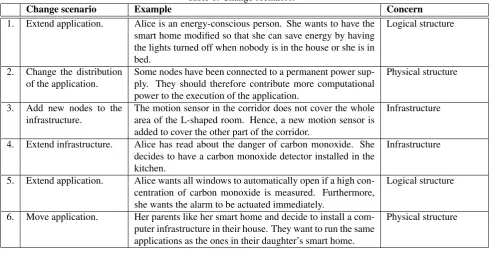
The change scenarios are based on the scenario introduced in Section 3.2. We can assume that the infrastructure is installed and the initial application deployed. This allows us to focus on the more interesting change scenarios. Table 1 shows six probable changes that will occur during the life-time of our smart home example and its applications. In the following we discuss how the concept of pro-grammable space and RuleCaster support each individual scenario. We address each scenario from the perspective of the application developer who has to make the changes:
Table 1: Change scenarios.
Change scenario Example Concern
1. Extend application. Alice is an energy-conscious person. She wants to have the smart home modified so that she can save energy by having the lights turned off when nobody is in the house or she is in bed.
Logical structure
2. Change the distribution
of the application. Some nodes have been connected to a permanent power sup-ply. They should therefore contribute more computational power to the execution of the application.
Physical structure
3. Add new nodes to the
infrastructure. The motion sensor in the corridor does not cover the wholearea of the L-shaped room. Hence, a new motion sensor is added to cover the other part of the corridor.
Infrastructure
4. Extend infrastructure. Alice has read about the danger of carbon monoxide. She decides to have a carbon monoxide detector installed in the kitchen.
Infrastructure
5. Extend application. Alice wants all windows to automatically open if a high con-centration of carbon monoxide is measured. Furthermore, she wants the alarm to be actuated immediately.
Logical structure
6. Move application. Her parents like her smart home and decide to install a com-puter infrastructure in their house. They want to run the same applications as the ones in their daughter’s smart home.
Physical structure
1 SPACE(house) { 2 INTERFACE: 3 SENSOR(motion/1), 4 ACTUATOR(light/1). 5
6 PRE_STATE() [
7 STATE :- motion(X), X=0, light(0). 8 STATE :- bed(X), X>20, light(0). 9 ] POST_STATES(lightsOff). 10
11 ...
12 ...
13 }
Figure 10: Definition of the spacehouse.
Scenario 2. We do not have to change the application code. The network model reflects the infrastructure changes to the compiler, which can find a better task assignment to the nodes. In the changed application the nodes connected to a permanent power supply take over some tasks previ-ously executed by other nodes. This can have a positive effect on the energy consumption of the battery-powered nodes. The application is recompiled and automatically re-deployed. The changes only affect the physical structure of the application.
Scenario 3. After having added the new node configured with the RuleCaster middleware and assigned to the spaces
corridorandhouse, we recompile the application and re-deploy it. We do not have to change the application logic because the changes do not affect the logical structure of the application. The new motion sensor is used in the same way as the existing sensor in the corridor.
Scenario 4. The carbon monoxide detector is installed in the kitchen and configured with the RuleCaster middleware, which includes the assignment to the relevant spaces (i.e.
kitchenandhouse). Because the current smart home application does not require this sensor, it does not have a direct effect on the running application. The application logic is extended to use this sensor in the next scenario.
Scenario 5. This scenario only affects the applica-tion code of the space house. We add a new state
highCOConcentrationthat describes the situation of high carbon monoxide concentration. We also add the re-quired conditions for a transition into this state (i.e. ob-served high carbon monoxide concentration). This state can then be used to define the condition for opening the windows. This change scenario only affects the application code. After recompilation the application is automatically re-deployed and then executed.
Scenario 6. Her parents’ computer infrastructure is set up differently. Due to their bigger house, they have installed more motion sensors. Because the application logic stays the same, the application developer only has to recompile it to generate the adapted physical structure of the application before it is re-deployed.
These scenarios show that specific changes can be at-tributed to separate models. This separation reduces the complexity of changes. Changes to any of these models can be directly propagated to the running application by re-compilation and re-deployment. Hence, RuleCaster does not only address the implementation of smart home applica-tions but also supports evolutionary changes after the initial deployment in a unified way.
8 Conclusion
Our language-based approach provides support for pro-gramming and maintaining the smart home through a num-ber of measures:
pro-grammer has to deal with many issues related to dis-tributed programming which make application devel-opment difficult, time-consuming and error-prone. In-stead, the application developer can program the smart home as one logical entity.
• The high-level language eases the implementation ef-forts for the application developer. People are inclined to use rules for describing the required behaviour of a smart space. By providing a rule-based language we can decrease the mental gap between the user-based application description and the actual implementation.
• By separating application development into different
high-level models we can simplify application mainte-nance due to changing user requirements or changes in the living environment. We show that different change scenarios in the life-cycle of an application address distinct models.
To successfully realise the vision of a smart home outside research labs, we have to address issues related to pro-grammability and maintenance of the related computing in-frastructure. We believe that the proposed system is a step into the right direction.
References
[1] Zigbee Alliance. Zigbee specification. http://www.zigbee.org, December 2006.
[2] Juan C. Augusto and Chris D. Nugent. Smart homes can be smarter. InDesigning Smart Homes - The Role of Artificial Intelligence, 2006.
[3] Urs Bischoff and Gerd Kortuem. Programming the ubiquitous network: A top-down approach. In Pro-ceedings of the System Support for Ubiquitous Com-puting Workshop (UbiSys’06), 2006.
[4] Urs Bischoff and Gerd Kortuem. Rulecaster: A macroprogramming system for sensor networks. OOPSLA Workshop on Building Software for Sensor Networks, 2006.
[5] Urs Bischoff and Gerd Kortuem. Rulecaster: A pro-gramming system for wireless sensor networks. In
Proceedings of the First European Conference on Smart Sensing and Context (EuroSSC’06), 2006.
[6] Anind D. Dey, Timothy Sohn, Sara Streng, and Justin Kodama. iCAP: Interactive prototyping of context-aware applications. InProceedings of the 4th Interna-tional Conference on Pervasive Computing (PERVA-SIVE 2006), 2006.
[7] Anind K. Dey, Gregory D. Abowd, and Daniel Salber. A conceptual framework and a toolkit for supporting the rapid prototyping of context-aware applications.
Human-Computer Interaction, 16(2):97–166, 2001.
[8] W. Keith Edwards and Rebecca E. Grinter. At home with ubiquitous computing: Seven challenges. In Ubi-Comp ’01: Proceedings of the 3rd international con-ference on Ubiquitous Computing, pages 256–272, London, UK, 2001. Springer-Verlag.
[9] Mareca Hatler and Chalie Chi. Wireless sensor net-works: Growing markets, accelerating demand. On-World, July 2005.
[10] Sumi Helal. Programming pervasive spaces. IEEE Pervasive Computing, 4(1):84–87, 2005.
[11] Sumi Helal, William Mann, Hicham El-Zabadani, Jef-frey King, Youssef Kaddoura, and Erwin Jansen. The gator tech smart house: A programmable pervasive space. Computer, 38(3):50–60, 2005.
[12] Stephen S. Intille. Designing a home of the future.
IEEE Pervasive Computing, 1(2):76–82, 2002.
[13] Rick Kazman, Gregory Abowd, Len Bass, and Paul Clements. Scenario-based analysis of software ar-chitecture. IEEE Software, 13(6):47–55, November 1996.
[14] Rick Kazman, Leonard J. Bass, Mike Webb, and Gre-gory D. Abowd. SAAM: A method for analyzing the properties of software architectures. InInternational Conference on Software Engineering, pages 81–90, 1994.
[15] Cory D Kidd, Robert Orr, Gregory D. Abowd, Christopher G. Atkeson, Irfan A. Essa, Blair MacIn-tyere, Elizabeth Mynatt, Thad E. Starner, and Wendy Newstetter. The aware home: A living laboratory for ubiquitous computing research. InProceedings of the International Workshop on Cooperative Buildings (CoBuild 1999), pages 191–198, 1999.