ISSN 2250-3153
Trees as Credit Collateral: Potential of Developing
Educational Loan for Forests Cover Improvement in
Uasin Gishu County, Kenya.
*1
Andrew Rutto Kiptum, 2 Paul Okello Odwori, 1 Joel Sumukwo
1. Department of Applied Environmental Social Science (Environmental Economics), School of Environmental Studies, University of Eldoret, Eldoret, Kenya.
2. Department of Applied Economics, School of Economics, University of Eldoret, Eldoret, Kenya.
DOI: 10.29322/IJSRP.9.10.2019.p9434 http://dx.doi.org/10.29322/IJSRP.9.10.2019.p9434
Abstract: The quest being sought by policy makers and resource managers for rural household to engage into forestry-based livelihood for optimal ecological functions is by developing economic incentives. This study sought to use trees in woodlot as households collateral asset as a strategy for lengthening tree harvesting period. Two sets of questionnaires were developed; that’s for rural homes and for credit financing institution. Multi-stage and systematic random sampling of 224 rural homes was sampled, while 76 questionnaires in 19 identified financial institutions within study area, where respondents from identified sections in the banking service namely; Customer services, Branch business, Retail and Consumer services and Management were randomly selected to evaluate credit worthiness of trees in woodlot. Hypothetical market questions were formulated in questionnaires for respective target which asked employees at credit financing institution to evaluate credit worthiness of specific species of trees in woodlot per acre, while households’ heads at rural home were asked to express the size of land that they were willing to allocate for bequeathed trees. Other socio economic variables data were also collected. Descriptive statistics was the main data analysis used. All rural households expressed their willingness to forego income of $234.19 from land utilities for bequeathed woodlot as conservation stewardship. Evaluated credit worthiness by financial institutions from the most preferred tree species by households were; Eucalyptus ($15962.12), Cypress ($13242.42), Pines ($9896.97) and Wattle tree ($6333.33), while aggregate mean of credit worthiness irrespective of tree species was $10206.67, respectively. Difficulty in quantifying trees in woodlot and absence of supporting policy that allows the use of trees as collateral asset was the popular reasons cited for low ranking of woodlot. In conclusion, woodlot can possibly be used as collateral asset to achieve lengthening tree harvesting period for forests conservation if supportive policy and legislative frame work is formulated.
Keywords: Woodlot, Credit Worthiness, Community Welfare, Collateral
1.0 Introduction
Forests provisions, regulative and supportive services are vital components for social and economic wellbeing to adjacent rural homes and far beyond (Sumukwo et al., 2013 and Huang et al., 2015). According to Huang et al., (2015), forests are important in regulating quality water flow, acting as water reservoirs, soil erosion reduction and creation of micro climate that are beneficial in agricultural production. Again, forests are known to have the most effective regulative services such as sequestering harmful greenhouse gases believed to be causing climatic episodes such as flood and prolonged drought; hence, an important mitigating component for climatic change (Kerr et al., 2014). Apart from ecological services, it too provides economic goods which include fuel wood, poles, herbs and edible products such as wild fruits. Forests creates habitat for beneficial organisms that aid agricultural production process such as bees; hence, act as supportive components in food production. Therefore, forests are an important landscape resource that supports societies as livelihood source, which calls for the protection and conservation for sustained provision of its goods and stock flow services for inter-generational equity.
ISSN 2250-3153
results into untimely planting which affects agricultural output if prolonged climatic variability occurs beyond expected period (Romijn et al., 2015 and Kelemen, 2016). Social consequences could result into food scarcity, shift in nutrition value, while economic effect could be price inflation on food and raw materials for industrial purposes which negatively affect human livelihoods (Pastakia, 2011).
Nevertheless, global awareness on the declining forests lands arising from unsustainable utilization and degrading human activities is driving innovative ways among resources managers and policy makers with the aim of restoring forests functions. Given that smallholders at rural areas engage in forestry-based livelihood, trading trees planted in woodlot form at micro scale could result into forests conservation by cushioning over dependency on public forests (Pagiola, 2009). Evidence of forest cover improvement in Nordic countries is attributed to effective use of economic incentives tools in trading conservation stewardship in form of carbon credits on trees planted at micro unit (Pagiola, 2009; Kerr et al., 2014 and Romijn et al., 2015).
Tree venture among rural households could act as natural insurance or immediate safe nets when faced with vices of climatic change (Sumukwo et al., 2013). Premature harvesting of trees to cushion idiosyncratic and covariate financial shocks by rural homes reduces its optimal regulative ecosystem functionality such as carbon sequestration services. These creates paradoxical question among policy makers and resource managers on ways that could motivates resource producer at private lands to lengthen trees harvesting period for optimal ecological functions. Studies by Bianchi et al. (2013) and RCOFTC (2015) have suggested the use of trees in stands as collateral, to decelerate deforestation by lengthening harvesting period of trees for maximum ecosystem functions such as sustained supply of stock flow services for societal livelihood improvement; however, the use of trees as collateral is still rudimentary.
To conceptualise trees in woodlot, if used as collateral in lengthening tree harvest period for maximum forests ecosystem functions, benefits flows over time can be expressed in a functional form as;
(1)
Where; represents benefits flow, while and are the specific benefits from forests stock flow such as water or carbon sequestrations process and utilities in form of income, respectively.
Using Booker and Young (1994) resources maximisation framework, benefit flow functions can be expressed as;
(2)
Where; are the aggregate welfare benefits flow of forests, while are specific forests stock flow services such as water, carbon sequestration processes and are consumptive products in monetary scale when trees in woodlot are used as collateral to lengthen harvesting period for maximum benefits flow over specified time period .
However, welfare benefits of either forests stock flow or income stream converted into credit form over a specified period of time can be expressed using Hicksian equation functions as;
(3)
Where; Utility function represents a marginal welfare change of increased forests cover and income
when trees are used as collateral to access educational loans.
Expressed welfare change in Hicksian function in equation 3, describes compensating variation measure, whereby superscript sign (+) on income (y) depicts willingness to accept compensation for lengthening time period of harvesting trees or conservation stewardship. In a way, the accessed credit when trees are used as collateral could describe mitigation value or safe-nets that are associated with effects to climatic variability which causes financial risks.
Hence, the conditional effect in regards to welfare changes as expressed in Hicksian relationship function in equation (3) is;
(4)
Therefore, the paradigm shifts in this study was to examine the potential of using trees in woodlot as collateral in accessing educational loan, with view to motivate rural homes in contributing conservation for optimal and sustainable ecological functions form forests cover in the study area. This is in view of the fact that Kenya is a low forests cover of 7.4% which is way far below 10% of the recommended national and international forests cover standards. Again, Kenya’s agenda under vision 2030 and global strategy in poverty alleviation and wealthy creation under SDGs recognizes environmental protection and conservation as a driver where sustainable stock flow such as water assists in agricultural productivity, industrial use and sanitation improvement.
2.0 Materials and Methods 2.1 Description of the Study Area.
ISSN 2250-3153
Source: Author
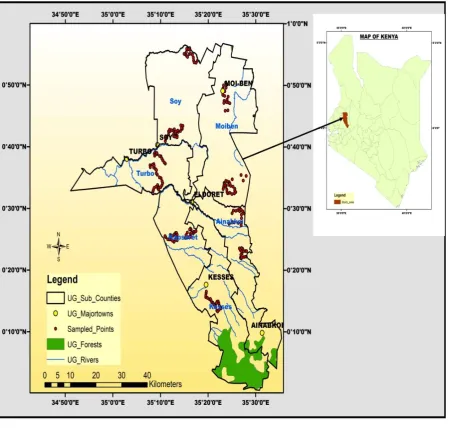
Figure 1: A Map Showing a Study Area and Sampled Units characterized by quasi undulating topography with altitude lies
between 2,700m and 1,500m above sea level to the southern and northern part, respectively. The mean annual rainfall is 945mm with a pattern showing bimodal type of rainfall between March and June for long rains, and September to November for short rains. Agricultural ventures of crop farming and livestock rearing are dominant economic activities. Popularly crops grown are maize, wheat, beans, fruits and vegetables such as kales and cabbages, while livestock reared are chicken, cattle, goats and sheep.
2.2 Sampling, Information Sought and Data Analysis
Two types of questionnaire were developed; one, for collecting rural households data and second, for estimated credit worthiness of trees and repayment period from credit financing institution in the study area. Sampling for rural households employed multi-stage approach from Sub-county to location level in selecting sample units while systematic random sampling was used in administering questionnaires at household level. That's after selecting sample units by
excluding locations with urban areas, a starting household from a reference point such as junction of the road was identified with the immediate household at reference point was selected as first responded. Thereafter, subsequent respondents were selected by following the right hand rule method where every fifth household was selected. The sample size required for rural households was achieved by using the following formula;
(5)
Where; n represent sample size, N is population size, C is coefficient of variation of (30%), while e is the margin of standard error of 2% (Kothari, 2004).
[image:3.595.67.517.333.761.2]ISSN 2250-3153
was 61.3%. Therefore, using KNBS (2010) survey data in projecting rural household, 90,687 rural household was used as target population (N) in determining sample size using sample size determination formula in equation 5 as follow;
Therefore, a total of 224 household heads were randomly sampled and interviewed. However, to compensate non respond household, unclear or erroneously entered data and missing data which could invalidate the findings, another 10 household questionnaires were added which represent 5% of the required sample size for this study. Therefore, the total rural households sampled were 234 in this study.
While administering questionnaires to credit financing institutions in the study area, a total of 19 financial institutions were selected. Four common sections in the banking services were identified which includes; Customer Service, Branch Business, Retail and Consumer Banking and Management, which formed the basis of selecting respondents randomly in regard to credit worthiness for some specific tree species of woodlot in one acre of land. The maximum numbers of questionnaire given to each financial institution were four based on the identified sections, which totalled to 76 questionnaires given to 19 credit financing institution found in urban areas of the study area.
To understand rural households aspirations regarding allocation of land for bequeathed woodlot as expressed conservation stewardship, hypothetical market questions was developed that ask household to state land size in acres for bequeathed woodlot and the type of tree species they were willing to plant on the stated land. Apart from households demographic and socio economic characteristics, information on agro-ecological condition such as wetland, rockiness and soil fertility of the land and intended beneficiaries of bequeathed trees was also sought. While information sought from credit financing institutions was credit worthiness of specific trees species preferred by rural farmers in the study area and payment period in months. Other data sought were households’ properties that often used as collateral by credit financing institutions in order to compare with trees in woodlot.
To establish households’ foregone income, agricultural outputs
from the foregone crop or compensating costs such as animals feeds equivalent with forgone grazing land was used. While the real or relative market price of the forgone land utilities; that's, the crop output from foregone farmland
was multiplied with respective market price to give economic value for foregone income from crop land which is expressed in equation function as follows;
(6)
Where; represent foregone income from specific
farm venture (1, 2, 3...n) such as wheat, maize, beans, millet, potatoes, vegetables, animal feeds, passion fruits and grazing land. Information sought from rural households and credit financing institutions was mainly analysed using descriptive statistics.
3.0 Results and Discussion
3.1 Rural Households Demographics and Socio Economics Characteristics
Out of 234 targeted rural households in Table 1, there was high number of females interviewed at 57.7% (135) than male 42.3% (99), with all the respondents 100% (234) revealing to have the right of land ownership. Findings by African Women Studies Center, (2014), Kariuki (2014) and Naburi et al., (2018) found more female respondents than male and entitlement of land ownership among rural households than in urban areas, which is in tandem with the findings from this study. Therefore, the construct of land ownership from the results forms a critical construct in development of ecosystem conservation strategy at private lands and sustainable resource utilisation (Naburi et al., 2018).The phenomenon of women presences in homes than men in this study could explains the norm in African set up where females act as functionaries of domestic and house chores making them to be occasionally found at their rural homes, while males who are regarded as household providers are often away tending other external household’s activities for their families.
ISSN 2250-3153
Table 1: Household Demographic and Social-Economic Characteristics
Variables Unit Frequency Mean Proportion Std Deviation Std Error
Age Years 234 54.96 100% 10.44 0.68
Gender 0.50 0.03
Male Persons 99 - 42.3%
Female Persons 135 - 57.7%
Household size Persons 234 8.44 100% 2.2 0.14
Education 0.74 0.05
No Education Persons 9 - 3.8%
Primary level Persons 73 - 31.2%
Secondary level Persons 127 - 54.3%
Tertiary Level Persons 22 - 9.4%
University Level Persons 3 - 1.3%
Occupation 0.82 0.05
Farmer Persons 196 - 83.8%
Trader Persons 9 - 3.8%
Civil Servant Persons 17 - 7.3%
Informal Sector Persons 12 - 5.1%
Land Tenure Persons 234 - 100% 0.00 0.00
Land Size Acres 234 22.15 100% 15.27 1.00
Source: Author; n=234
Using formal education to assess literacy level among rural households, the study results (Table 1) showed that majority of households heads at 54.3% (127) had attained secondary school level, 31.2% (73) had primary education level, 9.4% (22) posses tertiary education level and pantry proportion of 1.3% (3) had advanced education level to university. The respondents with no formal education were 3.8% (9) with majority found to be elderly persons. Access to formal education is a critical variable that enhances scientific knowledge on sustainable utilisation of resource among economic units (Lemba, 2009), while the variable of age allows elderly people to predicts effects of idiosyncratic and covariates climatic pattern on income streams based on experiences accumulated over years and on their socio economic practices, thus influences conservation venture through trees planting for future generation (Madisson, 2007).
3.2 Households Aspirations for Bequeathed Woodlot.
Respondents at rural households were asked to express land size that they were willing to allocate for bequeathed trees in woodlot, the preferred tree species and to describe agro-ecological condition of land site as fertile, infertile, rocky and/or wetland. From the results the expressed cumulative land area that households wished to allocate for specific tree species were Eucalyptus 101.3 acres, Cypress 80.2 acres, Wattle tree 8.7 acres, Pines 8 acres, and Gravellier 3.4 acres, while total cumulative land area for all tree species would be 201.6 acres. Further, the results revealed that majority of the respondents at 64.5% (151) preferred to allocate bequeathed trees in woodlot form in fertile area, while proportions of respondents at 17.1% (40), 12.8% (30) and 5.6% (13) preferred rocky, infertile and wetland, respectively. Five species of trees were identified as the most preferred tree
species; namely Eucalyptus species 50% (117), Cypress species 38% (89), Wattle tree 5.6% (13), Pines 3% (7), respectively. The choice of the four identified tree species of Eucalyptus, cypress, Pines and Wattle tree were informed by pre-test result, of which this study only focused on such trees species preference for woodlot. When households heads were asked to state expected beneficiaries of bequeathed woodlot, majority wished to bequeathed woodlot to their own children 61.5% (144), grand children 38.5% (90), while no respondent bothered to bequeath woodlot to great grandchildren.
Major forms in which respondents wished their beneficiaries to utilize bequeathed woodlot were for fees and construction 78.2% (183), while 21.8% (51) preferred woodlot to be used purely for education matters (Table 2). Influencing factors for the choice of tree species for woodlot was the maturity 13.2% (31), higher economic values 60.7% (142) and adaption of tree to soil condition 26.1 (61). It could be seen from the study results that, most households were motivated to allocate land for multi-purpose use of tree species depicting high economic benefits for their future generation.
ISSN 2250-3153
Table 2: Percentage of Household Allocation for Woodlot and preferred Tree species
Variables Frequency
Respondents Proportion
Total land size (in
acres) Std. Deviation
Expressed land for woodlot 234 100% 201.60 0.55
Land characteristics that will be under woodlot
Fertile land 151 64.5% 130.30 0.55
Infertile Land 30 12.8% 19.6 0.41
Wetland or Swampy 40 17.1% 41.00 0.63
Rocky 13 5.6% 10.70 0.51
Preferred Tree Species
Cypress 89 38.0% 80.20 0.56
Pines 7 3.0% 8.00 0.48
Gravellier 8 3.4% 3.40 0.12
Eucalyptus 117 50% 101.30 0.58
Wattle Tree 13 5.6% 8.70 0.27
Reason of Tree Species Choice
Mature Easily 31 13.2% - -
High Income 142 60.7% - -
Adaptive to climate & soil 61 26.1% - -
To Whom to Bequeath the woodlot
Children 144 61.5% - -
Grand children 90 38.5% - -
Great grand children 0 0.0% - -
Intended use on bequeathed woodlot
Fees 51 21.8% - -
Construction 0 0.0% - -
Fees and Construction 183 78.2% - -
Own use 0 0.0% - -
Source: Author; n=234
Study by Ndayambaje et al. (2012) found Eucalyptus and Cypress trees to be of high economic importance because of its varied use both in industries and for domestic purposes especially as wood fuel. Hence, expressed willingness by household to allocate land for bequeathed woodlot could increase forest land and forest cover. Merits of increased forest land at private lands could results into increased forest products, thus cushioning over dependency of public forest for timber and wood fuel (Ndayambaje et al., 2012 and Keenam et al., 2015). Again, improved forest cover at private lands could increases sequestration capabilities of greenhouse gases that often cause climatic variability (Cao et al., 2013).
3.3 Correlations of Influence among Covariates on Tree Species Preference
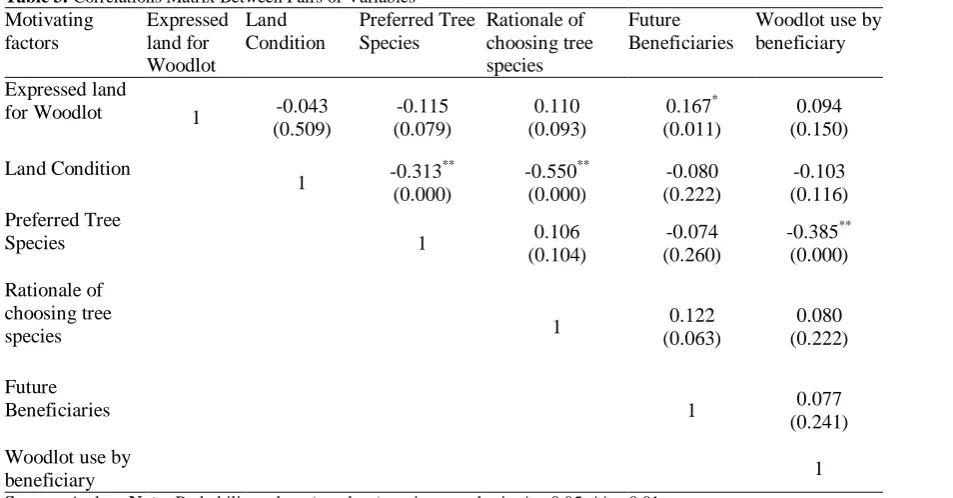
Further, relationship tests in Table 3 between pairs of motivating factors that influenced household heads to allocate land for bequeathed woodlot as predictor variables was done. The existence of the small statistical correlation coefficient values from correlation matrix results suggests minimal collinearity among variables, which imply that these variables could be measuring different things. Of all the predictors that showed to be significantly correlated, results in Table 3 revealed mixed associations of either positive or negative in motivating households to allocate land for bequeathed woodlot.
The stated land size for bequeathed woodlot by household from correlation matrix (Table 3) showed to be positively associated with future beneficiaries of bequeathed woodlot, suggesting a household that allocates large land size for bequeathed woodlot could translate tree planting venture into better households’ livelihood for their future offspring. While, the significant inverse correlation of variables between land characteristic and preferred tree species, imply that household’s choice of tree species was not motivated by productiveness of land rather by unproductiveness such as infertile over fertile land characteristics, reflecting theoretical concepts of rational resource maximization.
ISSN 2250-3153
Table 3: Correlations Matrix Between Pairs of Variables Motivating
factors
Expressed land for Woodlot
Land Condition
Preferred Tree Species
Rationale of choosing tree species
Future Beneficiaries
Woodlot use by beneficiary
Expressed land
for Woodlot 1 -0.043
(0.509)
-0.115 (0.079)
0.110 (0.093)
0.167* (0.011)
0.094 (0.150)
Land Condition
1 -0.313
**
(0.000)
-0.550** (0.000)
-0.080 (0.222)
-0.103 (0.116) Preferred Tree
Species 1 0.106
(0.104)
-0.074 (0.260)
-0.385** (0.000)
Rationale of choosing tree
species 1
0.122 (0.063)
0.080 (0.222)
Future
Beneficiaries 1 0.077
(0.241)
Woodlot use by
beneficiary 1
Source: Author; Note: Probability values (p-values) are in parenthesis; *p<0.05; **p<0.01.
Table 4: Determined Credit Worthiness of Specific Tree Species per Acre
Tree species
Credit Worthiness Repayment Period
Means ($) Std Deviation Means (Months) Std Deviation
Cypress 15962.12 3532.61 35.06 3.31
Eucalyptus 13242.42 2578.38 35.15 3.07
Pines 9896.97 1927.69 28.45 4.97
Gravellier 5598.48 1092.70 19.09 2.96
Wattle Tree 6333.33 1203.63 18.63 2.14
Aggregate 10206.67 1738.06 27.28 2.07
Source: Author; Note: Sampled respondents were 66 from 19 financial institutions in the study area.
3.4. Trees in Woodlot as Collateral for Sustainable Forest Cover
Results in Table 4 showed that Cypress tree species had highest credit worthiness of $15962.12, while credit worthiness of Eucalyptus ($13242.42), Pines ($9896.97), Wattle tree ($6333.33) and Gravellier ($5598.48) followed in that order. While the mean credit worthiness irrespective of tree species was $10206.67. Notably, these findings could be seen to collaborate with households’ rational choice on Eucalyptus and Cypress tree species for which high economic benefits which was cited as the main motivating factors, depicting resources maximization theory (Booker and Young, 1994). Further, the study results on the mean repayment period of loans in months if used as collateral for each species of trees from the results for Cypress, Eucalyptus, Pines,
Gravellier and Wattle tree species were 35.06, 35.15, 28.45, 19.09 and 18.63, respectively.
[image:7.595.52.524.626.737.2]ISSN 2250-3153
1.26 4.97
5.68
4.27
0.52 3.42
5.5
2.38
0 1 2 3 4 5 6
R
anki
ng
s
S
ca
le
Ranking of household's properties for credit Access
[image:8.595.38.279.192.462.2]Source: Author
Figure 2: Ranked Households Assets as Collateral by Credit Financing Institution
3.5 Comparison of Households Assets and Bequeathed Woodlot as Collateral
Information on other household’s properties often used as credit or collateral by credit financial institutions in this study necessitated the comparison with bequeathed woodlot. Figure 2 shows identified households’ properties often used by credit financing institution as collateral. Collateral identified includes; Land with Buildings, Salary payslip, Land title deeds, Vehicle and Farm machinery.
Results in figure 2 showed that trees in woodlot was lowly ranked as collateral assets, posing difficulties in design and implementation of policy that could use woodlot as credit security for households offspring to access educations for lengthening forests cover for maximum forests services functions such as forests stock flow services and/or optimal carbon sequestration. Major reasons cited that made woodlot to be ranked lowly as collateral by respondents from credit financing institution was that the use of woodlot was a new idea which have never been used, hence, no policy and legislative support that guide and permit the use of trees as collateral. Another reason cited was difficulty in quantifying trees into economic terms at different stages of growth before trees matures. Despite difficulties, however, most respondents pointed out the viability of using woodlot as collateral provided policy, supportive legislation and standard scientific measurements of trees are provided.
4.0 Conclusion and Public Policy Recommendation
The effect of unpredictable climatic variability exposes rural household to engage in unsustainable consumption of resources such as harvesting trees before maturity, which raises concerns on conservation strategies on forests cover improvement. However, based on evidence from empirical findings in this study, the potential of using trees in woodlot as collateral for sustainable forests cover reveals to be a viable conservation strategy. That's, aspiration of rural households to bequeath woodlot to future generation preferably their own children, with majority wished to see bequeathed woodlot used for education purposes informs the need of using bequeathed woodlot as collateral for education loans. Further, households’ choice and preference on tree species were influenced by household demographics factors and agro-ecological condition of the land, reflecting rational resource maximization framework by rural households; that’s households had high propensity to allocate land with lower opportunity costs on farm ventures for bequeathed woodlot.
Therefore, when sound policies and regulatory systems are implemented with care combined with extension of credit in regards to household consumptive demands such as access to education can incentivizes rural households to adopt tree planting as business venture. In addition, lengthening woodlot harvesting period could result into maximum forests service provision such as stock flow services to the society and carbon sequestration which reduces green house gases blamed for climatic variability; reflecting Kaldors-Hicks compensation tests in rewards distribution in resources conservations realms. It can also build the foundation for enterprise initiatives were income savings from credit access for education could form capital for household’s entrepreneurial activities for income stability. However, the cited difficulties in evaluating credit worthiness of trees in woodlot by respondents from financial institution and conflicting results that were difficult to interpret depicted by correlation matrix of influencing variables factors on household decision making, was part of the limitation of this study which formed the basis for future research. However, volumetric analysis such as the use of stumpage measurement of trees (RCOFTC, 2015) could form the basis that allows woodlot pricing using standard quantifiable volume of trees in stands.
Acknowledgement
ISSN 2250-3153
Reference
African Women’s Studies Center, (2014). Status Report on the Kenya National Food Security. Nairobi. University of Nairobi Press.
Appiah M. and A. Pappinen (2010). Farm Forestry Prospects Among Some Local Community in Rachuonyo District, Kenya. Small-Scale Forestry, 9(3): 297-316. Bianchi, S., Mohns, B. and F. Noeske (2013). Assessing
Harvesting Costs Improves the Quality of Valuation of Smallholder Teak Plantation in Lao PDR: In World Teak Conference. Bangkok, Thailand, 25-30 March 2014. Bangkok: RECOFTC
Booker,J. and R.A. Young (1994). Modelling intrastate and interstate Markets for Colorado River Water Resources.
Journal of Environmental Economics and
Management, 26(1):66-87.
http://www.sciencedirect.com/science/aerticle/pii/s009 5-0696(84)71005-9
Cao, G.; Zheng, C.; Scanlon, B. R.; Liu, J.; Li, W. (2013). Use of Flow Modelling to Assess Sustainability of Groundwater Resources in the North China Plain.
Water Resource Research, 49, 159–175.
https://doi.org/10.1029/2012WR011899
Huang, J.-C., Shaw, D., Chien, Y.-L., Zhao, M.Q., (2015). Valuing Environmental Resources through Demand for Related Commodities. American Journal of Agricultural Economics, aav053.
Kariuki, M., (2014). Food Security and Environmental Sustainability in Kenya. University of Nairobi. Centre for Advanced Studies in Environmental Law & Policy (CASELAP)
Kelemen E., Garcia-Llorente M., Pataki G., Martin-Lopez B. and E. Gomez-Baggethun (2016). Non-Monetary Technique for the Valuation of Ecosystem Services. In: Potschin M and K. Jax (eds): OpenNess Ecosystem Services Reference Book. EC FP7 Grant Agreement
no. 308428.
www.openness-project.eu/library/reference-book
Kerr, M. J., Vardhan, M., & Jindal, R. (2014). Incentives, Conditionality and Collective Action in Payment for Environmental Services. International Journal of the Commons, 595-616.
KNBS. (2010). The 2009 Kenya Population and Housing Census. Nairobi: Government of Kenya.
Kothari, C. R. (2004). Research Methodology, Methods and Techniques (2nd ed.). New Age International (p) Ltd. Publishers, New Delhi [online], [cited 16 December
2018], Available at:
https://www.modares.ac.ir/uploads/Agr.Oth.Lib.17.pdf Lemba, J.K. (2009). Intervention Model for Sustainable
Household Food Security in the Dry Lands of Kenya: Case Study of Makueni district. Thesis Submitted in Fulfilment of the Requirement for the degree of Doctor (PhD) in Applied Biological Science: (Agriculture), Ghent University.
Madisson, D., (2007). The Perception of and Adaptation to Climate Change in Africa. Policy Research Working Paper 4305. World Bank. Washington DC.
Mugabo J.R. (2003). Farm-Level Incentives for Fertilizer Use in Rwanda Rural Province: a financial analysis. Msc Thesis. Michigan State University, Michigan.
Naburi, N.D., Mugalavai, E.M. and J.F. Obiri, (2018). Determinants of Watershed Governance and Food Security among Household in the Lower Sio River Watershed, Busia County Kenya. International Journal of Agriculture, Environment and Bioresearch. Vol. 3 (5)
Ndayambaje, J.D.; Heijman, W.J.M.; G.M.J. Mohren (2012). Household Determinats of Tree Framing on Farms in Rural Rwanda. Small-Scale Forestry, 11:477-508 Pagiola, S. (2009). Payment for Environmental Services: An
Introduction. Presentation at Environment Department. World Bank. Washington.
Pastakia, O (2011). Livelihood Augmentation in Rainfed Areas. Gujarat, India: Development Support Centre (DSC).
RECOFTC (2015). Trees as loan collateral: Valuation methodology for smallholder teak plantations. RECOFTC working paper-the centre for people and forests. Bangkok, Thailand.
Romijn E., C.B. Lantican, M. Herold, E. Lindquist, R. Ochieng, A. Wijaya, D. Murdiyarso and L. Verchot (2015). Assessing change in national forest monitoring capacities of 99 tropical countries. Forest Ecology and Management 352 (2015) 109-123