VIBRATION PERFORMANCE OF LIGHTWEIGHT CONCRETE COATED
BIOPOLYMER BASED ON USED COOKING OIL
Noraini Marsi1,5, Anika Zafiah Mohd Rus2,4 and Nurulsaidatulsyida Sulong3
1Department of Mechanical Engineering Technology, Faculty of Engineering Technology, Universiti Tun Hussein Onn Malaysia, Parit Raja, Batu Pahat, Johor, Malaysia
2Faculty of Mechanical and Manufacturing Engineering, Universiti Tun Hussein Onn Malaysia , Parit Raja, Batu Pahat, Johor, Malaysia 3Faculty of Mechanical Engineering, Universiti Teknologi MARA, Kampus Pasir Gudang, Pasir Gudang, Malaysia
4Sustainable Polymer Engineering, Advanced Manufacturing and Materials Center, Universiti Tun Hussein Onn Malaysia, Parit Raja, Batu Pahat, Johor, Malaysia
5Advanced Technology Center, Faculty of Engineering Technology, Universiti Tun Hussein Onn Malaysia, Parit Raja, Batu Pahat, Johor, Malaysia
E-Mail: [email protected]
ABSTRACT
In this paper, we present the vibration performance of lightweight concrete coated biopolymer based on used cooking oil. The composition of material preparation was involved in two categories: (a) fabrication of lightweight concrete by different percentages of rubber aggregate with a ratio from 55%, 60%, 65% and 70% weight by weight, (b) the different proportion of titanium dioxide as additive for biopolymer used cooking oil coating in the ratio of 0.5, 1.0, 1.5, 2.0 and 2.5 by weight with the thicknesses of coating is about 0.30 ± 0.05 mm. The composition of lightweight concrete and surface coating was observed by scanning electron microscope (SEM) image to inspect the effect undercut edge and adhesion on layer coated on lightweight concrete. The results obtained by higher ratio particles sizes of rubber aggregate, which is 70% can reduced more mechanical vibration of lightweight concrete. It was observed that the proportion up to 2.0 by weight titanium dioxide of biopolymer used cooking oil offer some possibility to reduce the characterization of vibration on lightweight concrete in phase with a high frequency of 100 Hz operate at amplitudes is about 0.000174 Grms for input (A1) while 0.000111 Grms for output (A2). In comparison of an uncoated lightweight concrete, the vibration amplitude is higher exceeding 0.002130 Grms for input (A1) and 0.000468 Grms for output (A2).
Keywords: vibration, biopolymer, lightweight concrete, used cooking oil, rubber aggregate.
INTRODUCTION
Vibration is the oscillating motion of an object relative to fixed point of reference. A vibration-prone object will vibrate freely (free vibration) if it is displaced from its equilibrium position and released. An object may also vibrate in response to an externally applied source vibration as forced vibration (Parnell et al. 2010). Two
basic quantities for describing vibration are frequency in cycles per second of Hertz (Hz) and amplitude which can expresses as a displacement, velocity or acceleration. Vibration be able the result of strong impact which can describe as shock vibration. Shock vibration can induce large deformation and strain in objects or parts. Shock vibration can induce large deformation and strain in objects or parts. Shock intensity is measured in g unit of acceleration where g represents the acceleration due to the Earth’s gravity. Shock can cause substantial damage to most objects (Carrilo and Alcocer 2013).
Mechanical shock vibration is an energy response of an object; it is characterized by substantial displacement and strain. Four outcomes are possible (JinGon et al.
2014): (a) Low levels of shock may be absorbed and dissipated in the object without damage. A bell provides an example striking it with the right object and the amount of force makes it ring without any damage to the bell’s surface; (b) Impact may cause an object or parts to move, resulting in collision between objects, object parts and their surroundings; (c) High shock levels may cause movement and induce strains in excess of critical thresholds resulting in fatigue damage; (d) If the shock magnitude is high enough, damage occurs in a single event (stress fracture) (Moron et al. 2015).
Table-1. Vibration effects and approximate relationship between intensity and magnitudes for construction vibration (Moron et al. 2015).
Intensity
Scale Effect on human Effect on buildings
Maximum acceleration
(Grms)
Richter magnitude
I Imperceptible No effect on buildings 0.01 and below M2 - M2.5 II-III Imperceptible No effect on buildings 0.01 to 0.03 M2.5 - M3.1 IV-VII Barely perceptible Felt indoors, hanging objects 0.03 to 0.08 M3.1 - M3.7
VI-VII vibrations begin to annoy in Level at which continuous buildings
Minimal potential for damage to
weak or sensitive structures 0.08 to 0.25 M3.7 - M4.3
VII-IX
Vibration considerate unacceptable for people exposed
to continuous vibration
Threshold at which there is a risk of architectural damage to buildings with plastered ceilings
and walls.
0.25 to 0.60 M4.3 - M5.5
VII or
higher Vibration considered unpleased by most people
Potential for architectural damage and possible minor structural
damage. 0.60 and above M5.5 - M7.3
Figure-1. Sample for vibration test with different portion of rubber aggregate; 0.55, 0.60. 0.65 and 0.70 weight to weight (wt/wt).
Figure-2. Specimen for vibration test for coated lightweight concrete with different percentages of biopolymer doped with titanium dioxide (0.5, 1.0, 1.5, 2.0 and 2.5 %).
METHODOLOGY
The frequency of vibration most perceptible to humans range from 1 to 100 Hz. The vibration for building surfaces can also radiate noise, which typically heard as a low-frequency. At very high levels of amplitude, low frequency vibration can damage lightweight component buildings (Hong et al. 2015).The
vibration test was performed to determine the frequency and absorb amplitude for coated lightweight concrete design. The vibration may be form of a single pulse of acoustical energy, a series of pulses, or continuous oscillating motion. The vibration test is necessary to control the vibration generated in order to avoid upon
different ratio of rubber aggregate in lightweight concrete applications.
broad flat iron cantilevered I-beam. There are four holes with 15 mm in diameter. The specimens for vibration test were cleaned until the surface is free from unwanted materials with uniform surface.
In this study, the vibration test was measured by using Dynamic Portable Data Logger, Dewetron/DEWE-201 as shown in Figure-4. This testing was performed according to ASTM C 4728 Standard Test Method for Random Vibration Testing. Accelerometers are used to measure the motion and vibration of a structure that is exposed to dynamic loads. Accelerometer was joined at analyst data as to obtain the frequency value of the specimen. The stored data in analyze tool data was transferred into DEWESoft-2010 software on the screen computer.
Figure-3. The dimension of vibration specimen.
Figure-4. Vibration test set-up equipment.
The specimen was fixed at the input (A1) and output (A2) beam to get their vibration results as shown in Figure-3. Two accelerometers is connected at the beam to get input (A1) and output (A2) joint with analyzer to compute the data from wave analysis. Shaker was set at first mode vibrate at about 450 rev/min and its dynamic load was transferred from the beam to input (A1)
detected the transferred or resultant vibration. After the sample absorbs the vibration from the input (A1) beam, the resultant was stored in wave form. The signal was translated into computer by using DEWEsoft software to produce amplitude versus frequency graph and saved in word pad. From the data recorded in wordpad, Microsoft Window Excel software was used to plot the graph. The analysis was made based on the vibration absorption rate.
RESULTS AND DISCUSSIONS
The effects of vibration test for input (A1) and output (A2) at different percentage rubber aggregate for uncoated lightweight concrete
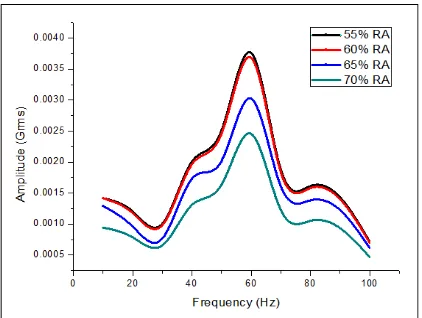
Figure-5 and Figure-6 show vibration test result for input (A1) and output (A2) of different percentage rubber aggregate of 55%, 60%, 65% and 70% weight by weight. The graphs show the highest amplitude for lightweight concrete at frequency 60 Hz. A systematic decrement was observed started form low to highest loading of rubber aggregate for the vibration amplitude response. There is a significant improvement of reducing vibration by increase the proportion of rubber aggregate. Carol, C. (2004) stated by adding rubber aggregate to concrete can improve its vibration absorption characteristics (Carol 2004). A potential application for this rubber aggregate in lightweight concrete for structures can absorb and minimize the shock vibration such as heavy rain, wind and others random vibration.
Figure-5. Graph of vibration test input (A1) for uncoated lightweight concrete with different percentage rubber
Figure-6. Graph of vibration test output (A2) for uncoated lightweight concrete with different percentage rubber
aggregate of 55%, 60%, 65% and 70%.
[image:4.612.80.291.88.247.2]Figure-7 shows the vibration results between input (A1) and output (A2) at frequency 60 Hz for four different rubber aggregate loading lightweight concrete specimens. The input (A1) shows higher amplitude while the output (A2) shows the lowest amplitude. The lowest reduction in amplitude is lightweight concrete with 70% rubber aggregate from 0.0181333 Grms to 0.003763 Grms followed by 65% rubber aggregate from 0.017628 Grms, 60% rubber aggregate from 0.015483 Grms to 0.003025 Grms while 55% rubber aggregate from 0.011180 Grms to 0.002455 Grms. From the experiment analysis, it was revealed that as the percentages of rubber aggregate loading were increased up to 70%, a systematic decrement of amplitude responses were obtained and the vibration is highly been absorb up to 79.2% compared to commercial standard 45.9% only. This is due to the material properties of rubber aggregates absorbing the transmission of vibrations and able to store and easily transfer energy to the rubber aggregate (Karacasu 2015).
Figure-7. Graph of vibration test input (A1) and output (A2) for lightweight concrete with different percentage
rubber aggregate of 55%, 60%, 65% and 70%.
The effects of vibration test for input (A1) and output (A2) at different ratio of titanium dioxide for coated lightweight concrete
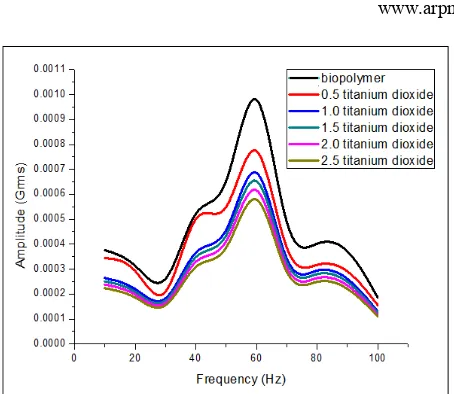
[image:4.612.317.540.404.566.2]Six specimen of coated lightweight concrete with percentage of 55% rubber aggregate coated with different ratio titanium dioxide with biopolymer used cooking oil have been prepared to investigate the vibration characteristic and the effect of vibration test for input (A1) and output (A2). The results was summarized and discussed in amplitude vs. frequencies as referred to Figure 8 and Figure 9. From the Figure 8 and Figure 9 show the vibration test results for input (A1) and output (A2) for coated lightweight concrete with different ratio of titanium dioxide to biopolymer as surface coating. The highest amplitude for all coated lightweight concrete is focuses at frequency 60 Hz. The lightweight concrete with ratio of 2.5 shows lowest amplitude vibration followed with 2.0, 1.5, 1.0, 0.5 and finally biopolymer only. From the result, it was revealed that as the higher loading titanium dioxide was increased up to 2.5, a systematic decrease of amplitude responses were obtained. This is due to biopolymer doped with higher ratio of titanium dioxide up to 2.5 performed a higher capacity to absorb more energy. The coated lightweight concrete also possess in reduction of vibration and damping characteristic. It is benefits in situations where vibration compaction is hazardous to the surroundings and it is easily compacted and consolidated (Aiello and Leuzzi 2010).
Figure-8. Graph of vibration test input (A1) for coated lightweight concrete with different ratio titanium dioxide
[image:4.612.73.301.517.664.2]Figure-9. Graph of vibration test output (A2) for coated lightweight concrete with different ratio titanium dioxide
of 0.5, 1.0, 1.5, 2.0 and 2.5 weight by weight.
Figure-10 shows the vibration result between input (A1) and output (A2) for uncoated and coated lightweight concrete with different ratio of titanium dioxide to biopolymer at frequency of 60 Hz. From the result, the input (A1) shows higher amplitude while the output (A2) shows the lowest amplitude. There is reduction in amplitude by loading with 2.5 ratio of titanium dioxide from 0.00091 Grms to 0.000579 Grms followed by 2.0 ratio from 0.01324 Grms to 0.000616 Grms, 1.5 ratio from 0.01472 Grms to 0.000653 Grms, 1.0 ratio from 0.001636 Grms to 0.000686 Grms, 0.5 ratio from 0.001708 Grms to 0.000773 Grms, then biopolymer from 0.00233 Grms to 0.000979 Grms while uncoated shows the highest amplitude with 0.018133 Grms to 0.003763 Grms. From the data, coated lightweight concrete shows the lowest amplitude compared to uncoated revealed that the vibration is highly been absorb about 96.8 % compared to uncoated 79.2 % only.
From all the results, it is show the highest peak of frequency possess structural resonance vibrations excited by the energy cantilever I-beam reaching the surface of lightweight concrete samples that can be detected by accelerometers. This means that the peak represent the total energy of the vibration in both results of input (A1) and output (A2). If vibration energy increases, the peak value will be increase (Pacheco et al. 2015). Based on
vibration effects and approximate relationship between intensity and magnitudes for construction vibration in Table 1, intensity scale (I) was referred. It is stated that there is no effect on building when the maximum acceleration below 0.01 Grms. Based on the experimental analysis, it was a remarkable, in the coated biopolymer exhibiting lowest amplitude response compare to uncoated lightweight concrete at frequency of 60 Hz.
Figure-10. Graph of vibration test for input (A1) and output (A2) for uncoated and coated lightweight
concrete.
SEM image for uncoated lightweight concrete at different percentage of rubber aggregate
[image:5.612.313.544.80.237.2]55% rubber aggregate 60% rubber aggregate
65% rubber aggregate 70% rubber aggregate Figure-11. SEM Image for uncoated lightweight concrete
at different percentage rubber aggregate.
SEM image for coated lightweight concrete
Figure-12 shows the cross sectional SEM image of coated lightweight concrete as a function enhancing the vibration performance of lightweight concrete other than to protect the surface from the environment. In term of vibration performance, the different percentages of titanium dioxide able to absorb most of the shock and attenuate some vibration, thus the lightweight concrete impact noise reduction coefficient (Zheng et al. 2008).The
formulation of surface coating from used cooking oil is an ecological method reducing environment pollution. The observation on the physical properties, it is evidence that the different percentages loading of titanium dioxide can affect the surface coating, which can helped to protect the changes of color from deterioration upon environmental exposure especially with harsh equatorial conditions. Hence, improvement of the quality property for surface finishing for outdoor application can be applied for longer period of exposure time, which has been evidence of previous studies (Cheng and Shi 2014).
Figure-12. Cross sectional SEM Image of coated lightweight concrete based on used cooking oil.
Applications
In this study, the production process of lightweight concrete from rubber aggregate was carried out to be applied used as roof tiles and surface coating based on used cooking oil used as coated roof tiles as shown in Figure-13. The use of lightweight concrete in roof tiles applications is benefits of a more economic analysis factor and the formulation of surface coating based on used cooking oil has been exploring alternatives solutions in the issues of environmental protection and sustainable.
Figure-13. Application of lightweight concrete and coating used as roof tiles.
CONCLUSIONS
lightweight concrete compared to commercial standard. This is due to rubber-concrete as a shock absorber, in sound barriers and sound boaster which controls the vibration or sound effectively and in buildings as an earthquake shock-wave absorber. Meanwhile, different ratio loading of titanium dioxide to biopolymer can be used to improve the vibration performance in practical use for outdoor application especially to enhance the stability of surface coating.
ACKNOWLEDGEMENT
The authors would like to thanks Universiti Tun Hussein Onn Malaysia (UTHM), Johor and Malaysian Government for supporting this research.
REFERENCES
R. Parnell, B. Davis, L. Xu., “Vibration Performance of Lightweight Cold-Formed Steel Floors”, Journal of Construction Engineering. 2010, 645-653.
J. Carrilo, S. M. Alcocer., "Simplified equation for estimating periods of vibration of concrete wall haousing", Engineering Structures. 2013, pp. 446-454.
K. Jin-Gon, L. Jae-Kon, and Y. Hyun., "On the Effect of Shear Coefficient in Free Vibration Analysis of Curved Beams", Journal of Mechanical Science & Technology, 2014, vol.28 (8):3181.
C. Moron, A. Garcia, D. Ferrandez and V. Blanco., "Transmission of Impact Vibration on Concrete and Mortar Sheets", Shock and Vibration. 2015, pp. 1-6.
K. Tawfiq, P. Mtenga, and J. Sabanjo., "Effect of Constructuion Induced Vibrations on Green Concrete in Drilled Shafts", Journal of Materials Civil Engineering. 2010, 637-642.
S. U. Hong, J. H. Na, S. H. Kim and Y. T. Lee. "Evaluation of the Floor Vibration of Concrete Structures", Materials Research Innovations. 2015, 19(5), 799-804.
C. Carol, "Transportation Noise Measures and Countermeasures", 2004, Retrieved from http://onlinepubs.trb.org.
M. Karacasu, V. Okur and A. Er., "A Study of the Rheological Properties of Recycled Rubber-Modified Asphalt Mixtures", The Scientific World Journal. 2015, ID 258586, 1-9.
M. A. Aiello and F. Leuzzi., "Waste Tyre rubberized Concrete: Properties at Fresh and Hardened State", Waste Management. 2010, 30 (8-9) pp. 1696-1704.
J. Pacheco, J. de Brito, J. Ferreira, D. Soares., "Dynamic Characterization of Full-Scale Structures Made with
Recycled Coarse Aggregates", Journal of Cleaner Production. 2015.
L. Zheng, X. Sharon Huo, and Y. Yuan., "Experimental Investigation on Dynamic Properties of Rubberized Concrete", Construction and Buildings Materials. 2008, 22(5): 939-947.