TWO STAGE SIMULATION TO OPTIMIZE RISK SHARING IN
PERFORMANCE-BASED CONTRACT ON NATIONAL ROAD
A SYSTEM DYNAMIC AND GAME THEORY APPROACH
Hanie Teki Tjendani, Nadjadji Anwar and I Putu Artama Wiguna
Civil Engineering, Institut Teknologi Sepuluh Nopember Surabaya, Indonesia E-Mail:[email protected]
ABSTRACT
The Performance-based contracts (PBC) have been implemented in Indonesia starting in 2011. Risk analysis and risk management need to be performed on PBC implementation for road maintenance. The research on risk identification has been done, but the pattern of risk sharing between government and private sector (contractor) is still under study. Because "risk sharing" must be controlled in this contract. If too much risk is allocated to the contractor, the price will be high and if too little risk is transferred then the goal of obtaining efficiency and effectiveness of the contract is not achieved. In performance-based contracts, a traditional contractual risk is transferred to contractors and contractors must ensure that network performance complies with the specifications in return for agreed lump sum payments. The result of this paper is the duration of performance-based contracts that outcome in the most optimizes payoffs for both parties using dynamic system approach and game theory. No one of them (government and contractor) gets more profit or benefit while another disadvantaged. To get a positive payoff for both parties the duration of PBC can be set with contract duration of at least 7 years and above.
Keywords: game theory, performance-based contract, risk management, system dynamic.
INTRODUCTION
Background
National road as part of a national transportation system that has a strategic role in supporting national development and integration is part of efforts to promote general welfare as mandated by the Constitution of State the Republic of Indonesia. The potential and role of road infrastructure must be developed to realize fluency of traffic, secure, safe, and continuity road transport in order to support economic development and regional development. Road infrastructure in Indonesia based on the classification of government administration is grouped into national roads, provincial roads, district roads and village roads. It is intended to realize the legal assurance of road operation in accordance with the authority of central government and local government. Increased access to roads is an important role in improving the human quality of life (Hartwig et al., 2005).
Compared with surrounding developing countries, Indonesia is still far behind in the field of quality and service level of the highway in the period 2010-2011 (Mahmudi et al., 2012). Under such conditions, Indonesia is still lagging behind in an effort to improve the quality of life of the community. The high percentage of road damage is mainly caused by (1) the quality of low construction work; (2) overloading in several main corridors in certain areas such as in Java, Bali, and Sumatra; (3) irregular maintenance due to limited funds and resources, and poor coordination among authorized agencies. (Tamin et al., 2011).
So far, there are still differences in perceptions about the causes of road deterioration that need to be understood and mutually agreed, especially by relevant stakeholders, each stakeholder considers that road
deterioration is not caused by mismanagement. The ministry of transportation considers that road damage is caused by underground drainage condition and road drainage while the department of public works assumes that road damage is caused by overloaded vehicle loads. Both factors can be used as an important factor causing road deterioration, so it is necessary to find a way out that is able to answer both the root problem of road damage. Every year the government has budgeted the large number expenses for road construction and maintenance but has not been able to keep all road assets in a steady state. Another fact, the use of freight transportation mode in Indonesia is currently unbalanced, 90% of the movement of freight transport is dominated by land transportation mode through the highway (Mahmudi et al., 2012).
The various problems that occur in national roads become a challenge to improve the accountability of road operators by increasing open-minded, responding quickly to problems in the field, handling effective and efficient problems. (Tjendani et al., 2017)
Research object
The goal of this research is to get the duration of performance-based contracts that outcome in the most optimizes payoffs for both parties namely the government (service users) and the private sector as service providers (contractors). No one of them gets more profit or benefit while another severely disadvantaged.
Research question
LITERATURE REVIEW
Risk management approach
The risk management approach can be applied because each road segment has different degrees of priority and risk profile. All these risks that have resulted in poor road services are borne by the government should the risk be borne by the party causing the risk to occur. The long-term road damage has not been able to encourage the improvement of structured construction services; this is because the delivery system used still creates a gap between the users and service providers so that an innovative contract and procurement form may be required. User goals and service providers with fair and proportional risk sharing schemes (Rahadian Hedy et al., 2008).
This condition may be caused by improper selection of the delivery system. So far, contracts for highways still use traditional contracts, this will be very difficult for road authority in case of road deterioration prematurely because this contract separates the planning, construction, maintenance, and operational. In the fragmented construction industry forward to efforts towards an integrated and innovative contract model. The separation of design and maintenance in long-term maintenance contracts has been recognized as a restrict factor in adapting to life-cycle costs. Thus the widespread view that integration further enhances the success of a project becomes a driver for using integrated and innovative contracting practices (Pakalla et al., 2007).
A risk sharing and transfer mechanism are much preferred and used in large civil construction projects. For example, contractual relationships and integrated project organizations are two commonly used methods to reduce risk across all stakeholders, forming an alliance structure in the construction sector to balance control and confidence in the face of risk, exploring the effects of procuring cooperation on risk management in construction projects, encouraging academics and practitioners to reflect further on how to combine different management systems to achieve successful cooperative risk management (Guo et al., 2014).
Performance-based contract
So far, highway agencies in the developed countries around the world have lead major changes in road maintenance practices, have completed switching to performance-based contracts or Performance-Based Contracts are an option on collaborative efforts with the private sector (contractor).(Anastasopoulos et al., 2010 ).
Risk transferring to contractors on performance based contracts aims to reduce total maintenance costs over the life-cycle of the pavement by utilizing the efficiency of private sector management (Kim et al., 2010). Road authority makes payments when the contractor successfully meets or exceeds a clearly defined and specifically defined minimum performance indicator (Stankevich et al., 2005), enables sustainable road management, maintenance over the life-cycle, resulting in
long-term cost reduction or reduced government spending (Liautaud et al., 2004).
In addition, the government must monitor the performance of implementation PBC to be more comprehensive and accurate in five key areas: service level effectiveness, cost efficiency, timeliness of response, safety procedures and service quality to ensure completeness and reliability of the evaluation process (Pinero JC and de la Garza JM, 2003).
In a subsequent study Anastasopoulos, et al (2010) present a methodology for estimating the possibility and amount of cost savings associated with the application of performance-based contracts for maintenance operations Highway. Using data on maintenance contracts from around the world, models were developed that could be used to compare several contract methods including variables such as contract duration, activity type, and contract size.
Regardless of the nature of the contract, construction projects involve multiple stakeholders, long periods, open production systems, involving interactions between internal and external environments, have unique issues, organizational and technological complexity that can lead to a number of risks. Project Management Book of Knowledge (2008) defines risk as an uncertain event or condition which, if it occurs, has a positive or negative impact on at least one project objective. The risk is also defined as the effect of uncertainty on purpose (Rafindadi et al., 2014). Even before introducing sustainability goals in the construction industry, it is claimed that the construction industry is exposed to more risk and uncertainty than other industrial sectors (Flanagan and Norman, 1993).
Performance-based contracts i.e. design (D) - Build (B) - Operate (O) - Maintain (M), are worth considering in order to improve the quality of Indonesia's national road service. Also analyzed the opportunities and challenges of implementing performance-based contracts in accordance with Indonesia's national road management system. This suggests that the benefits of the contract will be obtained if the contractor is allowed to develop creativity and innovation during the design and construction period, improve productivity and efficiency during operations, and accurately identify risks transferred from service users to service providers. Experience is needed to improve the system on continuing basis and to find the best practices that are in line with national conditions (Tamin et al., 2011).
The performance-based contract applies a fix lump sum payment system to the contractor. Payments on a monthly basis will be made if the contractor meets the performance specified in the contract. Performance measurements include the level of service quality defined according to the user's point of view. Measures are the average travel speeds, rider comfort, and safety features (Wirahadikusumah and Abduh, 2003)
period if the contractor does not meet the specified service level (Wijaya et al., 2014).
Except for the opportunities, implementation of performance-based contracts encountered constraints that fall into the category of moderate constraints, implying that performance-based contract designs can be implemented in road maintenance, but management innovation is necessary for this method to be implemented. Risk analyzes and risk management needs to be performed on performance-based contract implementation for road maintenance. The regulation that supports this contract application needs to be introduced to road managers and stakeholders involved in road use from road users, road construction service providers and agencies/ministries related to the lifetime of the road after the pilot project can be tested validation for a constraint indicators variable model assessment of the implementation of PBC from the point of view of managers and implementers. (Wahyudi Set al., 2009).
Weaknesses in integrated contracts related to regulation and the imperfect of legal framework and lack of experience in the implementation of integrated contracts so as to provide definitive model and regulatory frameworks, both technical and non-technical as well as human resource enhancement (Dewi et al. 2012), coordination among ministerial, multi-year fund certainty from the Ministry of Finance, coordination of road users with the Ministry of Transportation and coordination with the Police, as well as internal factors i.e. lack of understanding concept of performance-based contracts of all human resources involved in contracts and incomplete existing data of a road. (Faizal, N. et al., 2014)
Therefore, risk identification in the implementation of performance-based contracts is essential. Because "risk" must be controlled in this contract. If too much risk is allocated to the contractor, the price will be high and if too little risk is transferred then the goal of obtaining efficiency and effectiveness of the contract is not achieved (Pakkala et al., 2011). In performance-based contracts, traditional contractual risk is transferred to contractors and contractors must ensure that network performance complies with the specifications in return for agreed lump sum payments (Henning et al., 2011).
System dynamic
The dynamic system is a computer simulation model that can assist us to overcome complex dynamics in the effective decision process (Sterman, 2000). Modeling dynamic systems is a powerful approach to addressing complex problems; this explains the causal relationships between stocks, currents and loop feedback. And is an object-oriented approach that has been used in various fields including construction project management experience, procurement engineering, improvement of construction organization performance relationship of construction contractor, safety systems, contractor competition, and so on. (Xu et al, 2012).The risk analysis in performance-based contract implementation uses the system dynamic simulation model by the reason of the
model is not intended to forecast projection longer than the time available to achieve acceptable validity by many parties.
System dynamic has the power to show the interrelationships between variables, appropriately used at high levels of aggregation (country or world), when the past affects the future and time-based movements are important.
The systems dynamic approach also fits into the challenge of developing performance-based contracts that have high complexity features ranging from multi-actor, multi-sector and long-term involvement. The complexity of PBC is categorized as dynamic complexity because it has many possible events. Many criteria must be met by contractors such as risk transferred to the contractor as the party deemed most able to bear the risk, long duration, fixed lump sum price payment system, delivery system that must be fast due to delays lead to penalties, contractor skills in innovation, stakeholders, financial management and lack of understanding of the parties involved in implementing performance-based contracts. In modeling, the system is very commonly built from existing basic models.
With the process of adaptation in the scenario can have a significant difference from the basic model. Due to the dynamic system, each action of each change is set in the feedback loops, meaning that the situation when the output of the current event or the past event will affect the current or future events.
Game theory
None of the construction projects is risk-free. Risk must be shared among the parties involved, in such a way that no party is harmed. Research on the allocation of risk among parties involved in construction contracts has been carried out as well as being in a state of sustainability. The results of the statistical analysis show that most are done by scientists from such countries as China, the United States, Australia and the UK. The researchers found that many findings wherein making decisions only benefit one party in the construction contract agreement that is, the owner and not profitable for others. This raises many legal disputes, the implementation of irrational construction projects in general. The allocation of risk between the parties to the construction contract agreement should be put into place cooperative game theory in which the decision is made by taking into account the needs of all concerned parties (Tjendani et al., 2015) The application of cooperative game theory to the allocation of risk between parties to construction contract agreement is the object of further research from the author.
Every strategy is made to deal with strategies from other players. (4) The results of each strategy used by each player will be displayed in the form of a payoff matrix. The units of numbers appearing from the matrix can be either quantitatively (percentage, the value of money, and quantity of goods) depending on the purpose of the game. (Mustaqim, K. et al., 2013).
METHODOLOGY
Two stage simulation model
The system framework determines performance-based contract variables into controlled inputs (decision variables), uncontrolled inputs and goal outputs (result). A dynamic system simulation is a tool for getting results in the game theory matrix. Then, the strategy was chosen for all players using a game theory approach. Controlled input is the player's strategy in the game, uncontrolled input by is the behavior of the system that cannot be controlled by each player and the output goal is the result of each player based on the controlled and uncontrolled input. The strategic shape in game theory is in the form of payoff diagram results.
In this case 2 player result diagram. The players involved and the strategies they have are as follows: 1. Government: determines CESAL (cumulative equivalent single axle load) value: low, medium, high. 2. Contractor: determines the speed of construction work: low, medium, high. At the time of the project there are uncontrollable things that are the amount of rain: low, medium, high and the increase of vehicle volume (10% increase, 20% increase). The payoff for each combination of strategies is in rupiah, for the government is an advantage with the PBC project whereas the contractor is the profit received during the project with a performance-based contract. The scheme of two stage simulation model as seen on Figure-1.
Figure-1.Two stage simulation model.
RESULT AND DISCUSSIONS
In general, system dynamic model for PBC contract on Semarang - Bawen project can be seen in the stock-flow diagram in Figure-2. The simulation model is made based on causal loop diagram. In detail will not be discussed in this paper, it has been discussed in other papers. Then do the verification on this base model.
Verification is a process to check whether the simulation model is in accordance with the conceptual model. verification consists of equations and dimensional consistency tests.The verification test equation is performed using the model diagnostic feature provided by the Stella software and a dimensional consistency test performed using the unit check command in the Stella software.
After the basic model passes the verification equation by using model diagnostics features check & dimensional consistency test using unit check, then continuing to model validation test.
Figure-2. Stock flow diagram.
Furthermore, game theory is used as an approach to finding sustainability of performance-based contract implementation for all stakeholders. In this simulation, there are two players that is government and contractor. Therefore the simulation is set on the respective duration for the duration of the contract 4 years, 7 years and 10 years. In this section will analyze and interpret the results of all selected scenarios using game theory, the best choice scenarios will be recommended for decision makers.
Interface to get a payoff
Each player in the game theory simulation gets rewarded by changing the input (strategy). The simulation interface (part of system dynamic tool's) to get the results can be seen in Figure-3, where each player has its own decision variable indicated by the input variable box and the result itself (the result) is indicated by the response variable box. In addition, the system behavior in each selected scenario is indicated by the system performance graph.
Figure-3. PBC simulator.
Formulation of payoff diagram
Based on the performance-based contract (PBC) simulator, the resulting diagram can be formulated. The schematic diagram involves 2 players namely (1).government (red color) with three strategy that is in determining the CESAL value (low, medium, high). the second player (2).contractor (blue color) with speed in the construction work (low, medium, high) plus the conditions at the job site where there are rainfall and traffic conditions (traffic) which is input uncontrolled. Each simulation was performed on the PBC simulator for 4 years duration, 7 years duration, 10 years duration and 15 years duration. Payoff generated from each player can be inputted in the tree diagram from Gambit software to then simulated.
Schema PBC simulator
Figure-4. Simulation to get payoff PBC simulator (Duration: 4 years).
As an initial step start with a performance-based contract scheme simulator for a 4-year duration. In each simulator, the simulation will be done as much as 54 times in accordance with the Gambit tree diagram. The first simulation is carried out under conditions: Government with the low CESAL value strategy, low-speed contractor while uncontrolled environmental conditions in rainfall position -10% and traffic condition + 10%. As illustrated in the following simulator:
Figure-5. Schema PBC simulator, duration 4 years.
After the simulation, the payoff generated for the government is 2.765.570.000.000,-IDR and the payoff generated for the contractor is (13.133.600.000),-IDR as can be seen in the following figure which is part of figure 5.17 above:
Figur 6. Output / payoff.
So the output of payoff generated can be input in Gambit software, after payoff filled all then can be simulated to get the final value of the simulation.
Figure-7. Payoff result of system dynamic as input for game theory simulation.
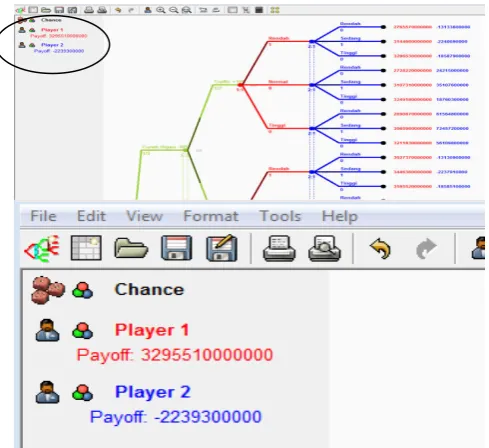
The final value of the simulator with a duration of 4 years is as follows: the simulator with a duration of 4 years after the simulation as a whole obtained government payoff Rp.3,295,510,000,000,-andcontractor payoff Rp. (2,239,300,000),-. Thus a performance-based contract scheme with a duration of 4 years can not be executed
Schema PBC simulator, duration 4 years
Medium
High Low
Low
Contractor
Government
because the payoff earned by the contractor is negative even though the contractor payoff is positive.
Figure-8.Results of payoff simulator with 15 years duration.
Thus the simulation is done in 7 years duration, 10 years duration and 15 years duration in the same way. From simulation game theory with Gambit got the payoff from each player that is government and contractor. So the results of all the simulations can be seen in the following table.
Table-1. Recapitulation "payoff" on PBC.
In Table-1sighted the result of PBC simulation by the duration of 4 years. Under such conditions the benefit by the government is 3,295,510,000,000,-IDR and contractor profit is (2,239,300,000,-)IDR during a 4-year project period. This cannot be applied because the contractor's payoff is negative. So performance-based contracts are not eligible for a 4-year duration.
On the 7-year duration. The condition of the duration of 7-year contract PBC, payoff /benefit generated by the government is 6,448,730,000,000,-IDR and contractor payoff /profit of 12,683,250,000,-IDR over a 7 year project period. Thusa Performance Based Contract with a duration of 7 years can be applied because the resulting payoff is positive for each government and contractor.
CONCLUSIONS
In this study finding a performance-based contract simulator model to determine the best practice of PBC duration with the best payoff for service users (government) and private sector (contractors). In another word, both parties get the best benefits/profits without harming the other. This model can be simulated for projects in all locations by providing rainfall data, traffic and CESAL values and vehicle operating costs. Then the service users and service providers can choose the benefits (payoff) that want to get by controlling the work in the field.
At the performance-based contract by 7 years duration, 10 years duration and 15 years duration, payoffs the government and contractor are rises according to the project duration increases. This can happen if the contractor performs construction work in accordance with the plan in the specified CESAL value. So that the increase in traffic and the increase of rainfall have no effect during the maintenance service period with IRI ≤ 4 value still can preserve. In Indonesia, rainfall can affect road damage if rainwater soaks the body of the road more than 48 hours (based on contract document). This will not happen if the contractor does the construction work in accordance with the minimum indicator contained in the contract.
ACKNOWLEDGEMENT
Our gratefulness goes to Ministry of Research and Higher Education of Indonesia as a contribution and financial support for the research.
REFERENCES
AnastasopoulosP.,McCullouchB.,GkritzaK.,ManneringF.a nd SinhaK. 2010.Cost Savings Analysis of Performance Based Contracts for Highway Maintenance Operations. J. Infrastruct. Syst.16(4): 251-163.
DewiP, TooE and TrigunarsyahB. 2012. Implementing Design Build Project Delivery System in Indonesia Road Infrastructure Projects.
Faizal N. 2013. Dukungan Puslitbang Jalan dan Jembatan terhadap Kontrak Berbasis Kinerja (KBK)/Performance Base Contract (PBC) untuk mendukung Keselamatan dan Lingkungan Jalan. Konferensi Regional Teknik Jalan ke-12, Bandung. 21-23 Oktober 2014. Himpunan Pengembangan Jalan Indonesia.
FaizalN.2014. Pemilihan Project Delivery System (Sistim Pengadaan) yang sesuai dengan kondisi Indonesia untuk Pekerjaan Jalan. Seminar Nasional Kontrak Konstruksi, 25 September 2014, HPJI Jabar-Pusjatan-Unpar.
Flanagan. R,Norman. G. 1993. Risk management and construction. Blackwell Science Pty Ltd, Victoria, Australia.
Risks in Major Infrastructure Projects: A Comparative Analysis. Science Direct International Journal of Project Management. 32: 815-826.
Hartwig T, Mumssen Y, Schliessler A. 2005. Output-based Aid in Chad, Using performance-Output-based contracts to improve roads. OBA Approach, No. 06.
Henning T& Miller G. 2011. Kontrak berbasis kinerja untuk mengelola pemeliharaan jalan raya di Indonesia. Prakarsa, Hal 7-11.
Juan C Pinero,and Jesus M de la Garza, A.M.A.S.C.E. 2003. Issues Related to the Assessment of Performance Based Road Maintenance Contracts.
Kuo Lu. 2013. Using fuzzy multiple criteria decision making approach to enhance risk assessment for metropolitan construction projects. SciVerse Science Direct International Journal of Project Management. 31: 602-614.
Mahmudi. 2012. Performance Based Contract: Solusi Pekerjaan Perawatan Jalan. Warta Anggaran, 6- 10 Edisi 24.
Mustakim K. 2013. Aplikasi konsep teori permainan dalam pengambilan keputusan politik. Universitas Pendidikan Indonesia/repository.upi.edu.
Pakkala P.,de JongM.and AijoJ.2007. International Overview of Innovative Contracting Practices for Roads, Finnish Road Administration and Next Generation Infrastructure, Helsinki, Finland.
Pakkala P, Talvitie A. 2010. International lesson learned from Performance Based Service Agreements. Slovenski Kongres o Cestah in Prometu.
PakkalaP.2011. Improving Productivity Using Procurement Methods Pakkala, P. 2011,an International comparison, Sweden Productivity Committee, Stockholm, Sweden.
Pakkala P. 2013. Recent Developments in World Class Road Maintenance Contracts. The XXVIII International Baltic Road Confrence.
Project Management Institute, A Guide to the Project Management Body of Knowledge (PMBOK Guide) Fifth Edition, An American National Standard, 2013
Liautaud G. 2004. Maintaining Roads: Experience with Output-based Contracts in Argentina. Washington, D.C: The World Bank.
Rafindadi et al. 2014. Global Perception of Sustainable Construction Project Risks. ScienceDirect Procedia - Social and Behavioral Sciences. 119: 456-465.
Rahadian Hedy. 2008. Langkah Awal Menuju performance based contract melalui extended warranty
periode.
www.pu.go.id/assosiasi/hpji/majalah/mjt_0401.pdf.
Soelaiman W. 2009. Penerapan Kontrak Berbasis Kinerja (Performance-based contract) untuk meningkatkan efektifitas penanganan Pemeliharaan Jalan, Thesis, Universitas Indonesia.
Stankevich N, Qureshi N, Queiroz C. 2005. Performance Based Contracting for Preservation an Improvement of Road Assets. Transport Note TN 27, The World Bank, Washington DC.
Sterman J. 2000. Business Dynamics: System Thinking and Modelling for a Complex World. Chicago, IL: Irwin-McGraw-Hill.
Tamin RZ, Tamin AZ dan Marzuki PF. 2011. Performance Based Contract Application Opportunity and Challenges in Indonesian National Roads Management. ScienceDirect Procedia Engineering. 14: 851-858.
Tjendani H.T, Anwar N, Wiguna A. 2015. Risk Sharing Among Stakeholder to Implement Performance Based Contract on Highway Project. International Symposium on Civil and Environmental Engineering, the 14th International Conference on QIR (Quality in Research), ISSN 1411-1284.
Tjendani Anwar, Wiguna. Sustainability of Performance-Based Contract in Indonesia National Road, Eng. Journal.com.
(2017)DOI: 10.21817/ijet/2017/v9i5/170905088.
WijayaNurmalita,WibowoAdi. 2014. Analisis kontrak berbasis kinerja (KBK) dan kontrak konvensional. Studi Kasus: Proyek Proyek pembangunan jalan KBK Semarang-Bawen dan Proyek pembangunan Jalan Tol Semarang - Solo. Jurnal Karya Teknik Sipil. Vol.3,No.4, tahun 2014, Halaman, 909-921.
Wirahadikusumah R, Abduh M. 2003. Metoda Kontrak Inovatif untuk Peningkatan Kualitas Jalan: Peluang dan Tantangan. Lokakarya Pola Manajemen Proyek untuk Kondisi Berjalan dan Masa Depan, KNTJ-7 Jakarta.
Wirahadikusumah. R, Susanti. B, Coffey. B, Adighibe. C. 2015. Performance-based contracting for roads-experiences of Australia and Indonesia. The 5th International Conference of Euro Asia Civil Engineering Forum (EACEF-5).