
http://www.scirp.org/journal/iim ISSN Online: 2160-5920
ISSN Print: 2160-5912
Common Management Process Model of New TQM
Based on the Situation Analysis
Kazuhiro Esaki
Faculty of Science and Engineering, HOSEI University, Tokyo, Japan
Abstract
In the previous study, we suggested the concept of new TQM based on the consider-ation of basic concept of Quality Control. Also, in the previous study, we suggested the target domains and entities of product and process based on the TQM Matrix and view point of Three Dimensional Unification Value Models for managing quality of organization systems. Furthermore, in the previous study, we suggest the Common Management Process of organizations. Based on the above suggestion, in this paper, we would like to propose the Common Management Process Model of Total Quality Management based on the consideration of situation analysis and more precise defi-nition of TQM Matrix and Three Dimensional Unification Value Model of “Product and Process”. Improvement of quality and efficiency of organization management can be expected by the integration of conventional different management such as quality assurance, quality improvement, risk management, investment individually from the view point of common management process.
Keywords
Common Management Process Model, TQM Matrix, Three Dimensional Unification Value Model, Quality Assurance, Quality Improvement, Static Risk Management, Dynamic Risk Management, Investment Management, Project Management
1. Introduction
Recently, strictness of social environment of organization management is changed day by day, and company should solve many “Problems” and “Issues”.
Therefore, an application of the good management process to solve these “Problems” and “Issues” are demanded from organizations. If we choose the wrong management process, it may cause a risk to produce a considerable damage in the management of organization.
How to cite this paper: Esaki, K. (2016) Common Management Process Model of New TQM Based on the Situation Analysis. Intelligent Information Management, 8, 181-193.
http://dx.doi.org/10.4236/iim.2016.86013
Received: September 5, 2016 Accepted: November 20, 2016 Published: November 23, 2016
Copyright © 2016 by author and Scientific Research Publishing Inc. This work is licensed under the Creative Commons Attribution International License (CC BY 4.0).
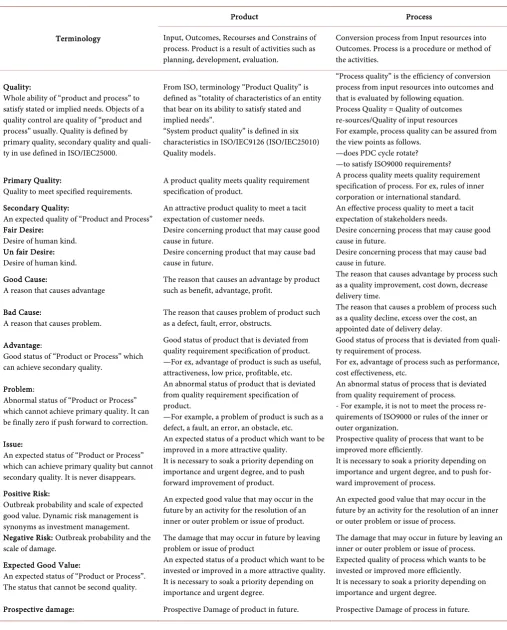
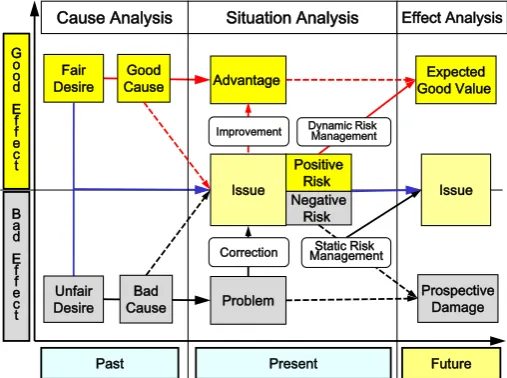
On the other hand, for a high quality evaluation of the organizational management, TQM (Total Quality Management) [1] is used all over the world and is recognized. However, it is very difficult to establish all management scope of the TQM. Further-more, the aim of TQM must cover both “Product and Process” based on the considera-tion of the basic concept of Quality Control. On the other hand, we have been working on the development of ISO/IEC25000 (SQuaRE) series of standards for quality re-quirements and evaluation of the system and software product [2] [3] [4] [5] for a long time in ISO/IEC JTC1 (Joint Technical Committee 1 of the International Organization for Standardization and the International Electro technical Commission) SC7WG 6 (software and systems engineering). As part of this project, we have worked on the de-velopments of ISO/IEC25030 [3], 25040 [4], 25041 [5], which are the standards to pro-vide supporting technique of method for quantitative quality requirement definitions and evaluation of software and system product. And, quantitative quality require-ment and evaluation of system are executed from the view point of system and soft-ware product quality models defined in ISO/IEC9126-1 [2] (ISO/IEC9126-1 has revised by ISO/IEC25010:2011). On the other hand, the definition of system is a combination of interacting elements organized to achieve one or more stated purposes defined in ISO/IEC15288:2008 Systems and software engineering-System life cycle processes [6]. Therefore, an organization with specific purpose is regarded as a kind of system based on the definition of system of ISO/IEC15288. Based on the above assumptions, previous study [7], we suggested the General framework of “new TQM” based on the concept of “system quality requirement and evaluation process” of ISO/IEC 25040 [4] and the original concept of “TQM Matrix” [7]. On the other hand, previous study [8], we sug-gested the “Three Dimensional Unification Value Model for Product evaluation based on the consideration of enlarging system product quality model in ISO/IEC9126-1 [2]. Therefore, previous study [9], we suggested the “Target Entities of Total Quality Man-agement” for organization based on the “new TQM” and “Three Dimensional Unifica-tion Value Models”. Furthermore, previous study [10], we suggested the “Common Management Process Model” based on the consideration of “TQM Matrix” and “Three Dimensional Unification Value Models”. Therefore, in this article, we suggest the “Common Management Process Model” of organization based on the consideration of situation analysis as shown in Figure 5 and more precise definition of new TQM for “Product and Process [9]” as shown in Table 1. Furthermore, we report the result of confirmation of the application possibility of the “Common Management Process Model” for the four domains of “new TQM”. In this paper, background of this research in clause 1, concept of new TQM in clause 2, concept of the Common Management Process Models in clause 3, verification result of the application possibility of common management process in clause 4, conclusion described in clause 5.
2. Concept of New TQM
2.1. Basic Concept of Quality Control
Table 1. Explanation of terminology for situation analysis.
Terminology
Product Process
Input, Outcomes, Recourses and Constrains of process. Product is a result of activities such as planning, development, evaluation.
Conversion process from Input resources into Outcomes. Process is a procedure or method of the activities.
Quality:
Whole ability of “product and process” to satisfy stated or implied needs. Objects of a quality control are quality of “product and process” usually. Quality is defined by primary quality, secondary quality and quali-ty in use defined in ISO/IEC25000.
From ISO, terminology “Product Quality” is defined as “totality of characteristics of an entity that bear on its ability to satisfy stated and implied needs”.
“System product quality” is defined in six characteristics in ISO/IEC9126 (ISO/IEC25010) Quality models.
“Process quality” is the efficiency of conversion process from input resources into outcomes and that is evaluated by following equation. Process Quality = Quality of outcomes re-sources/Quality of input resources
For example, process quality can be assured from the view points as follows.
—does PDC cycle rotate? —to satisfy ISO9000 requirements? Primary Quality:
Quality to meet specified requirements.
A product quality meets quality requirement specification of product.
A process quality meets quality requirement specification of process. For ex, rules of inner corporation or international standard. Secondary Quality:
An expected quality of “Product and Process” An attractive product quality to meet a tacit expectation of customer needs. An effective process quality to meet a tacit expectation of stakeholders needs. Fair Desire:
Desire of human kind. Desire concerning product that may cause good cause in future. Desire concerning process that may cause good cause in future. Un fair Desire:
Desire of human kind. Desire concerning product that may cause bad cause in future. Desire concerning process that may cause bad cause in future. Good Cause:
A reason that causes advantage The reason that causessuch as benefit, advantage, profit. anadvantage by product
The reason that causes advantage by process such as a quality improvement, cost down, decrease delivery time.
Bad Cause:
A reason that causes problem.
The reason that causes problem of product such as a defect, fault, error, obstructs.
The reason that causes a problem of process such as a quality decline, excess over the cost, an appointed date of delivery delay.
Advantage:
Good status of “Product or Process” which can achieve secondary quality.
Good status of product that is deviated from quality requirement specification of product. —For ex, advantage of product is such as useful, attractiveness, low price, profitable, etc.
Good status of process that is deviated from quali-ty requirement of process.
For ex, advantage of process such as performance, cost effectiveness, etc.
Problem:
Abnormal status of “Product or Process” which cannot achieve primary quality. It can be finally zero if push forward to correction.
An abnormal status of product that is deviated from quality requirement specification of product.
—For example, a problem of product is such as a defect, a fault, an error, an obstacle, etc.
An abnormal status of process that is deviated from quality requirement of process. - For example, it is not to meet the process re-quirements of ISO9000 or rules of the inner or outer organization.
Issue:
An expected status of “Product or Process” which can achieve primary quality but cannot secondary quality. It is never disappears.
An expected status of a product which want to be improved in a more attractive quality. It is necessary to soak a priority depending on importance and urgent degree, and to push forward improvement of product.
Prospective quality of process that want to be improved more efficiently.
It is necessary to soak a priority depending on importance and urgent degree, and to push for-ward improvement of process.
Positive Risk:
Outbreak probability and scale of expected good value. Dynamic risk management is synonyms as investment management.
An expected good value that may occur in the future by an activity for the resolution of an inner or outer problem or issue of product.
An expected good value that may occur in the future by an activity for the resolution of an inner or outer problem or issue of process.
Negative Risk: Outbreak probability and the
scale of damage. The damage that may occur in future by leaving problem or issue of product The damage that may occur in future by leaving an inner or outer problem or issue of process. Expected Good Value:
An expected status of “Product or Process”. The status that cannot be second quality.
An expected status of a product which want to be invested or improved in a more attractive quality. It is necessary to soak a priority depending on importance and urgent degree.
Expected quality of process which wants to be invested or improved more efficiently. It is necessary to soak a priority depending on importance and urgent degree.
Figure 1. Basic concept of quality control [7].
situa-tion of “Issue” before planning for the purpose of improvement acsitua-tion. Above assump-tions, we cannot evaluate the quality of process even if we measure the characteristic of process own. It is necessary to evaluate both quality of “Product and Process” based on the consideration of quality management. Every kind of activity is a process to convert from an Input product into an Outcomes product. Therefore, it is thought that the process quality can be evaluated by the quality of both Outcomes and Input. In order to improve “Outcomes”, we should improve both quality of “Input Resources and Process”. Table 1 is the definition and explanation of the quality-related terminologies which we showed in this paper.
[image:5.595.213.533.453.691.2]2.2. TQM Matrix
Figure 2 shows the “TQM Matrix” which has proposed by our previous paper [7] and four target domains of “new TQM” has suggested.
From Figure 2, it is recognized that the both conventional “Quality Assurance” and “Quality Improvement” is included in the management domains of “TQM Matrix”. Also, it is recognized that the additional management domains such as the “Dynamic Risk Management” and “Static risk management” are included as shown in Figure 2. The “Dynamic Risk” is defined as the scale of the “Expected Good Value” and probabil-ity that “Expected Good Value” will achieve in future when occurred. “Dynamic Risk management” should be performed based on the consideration of the view point of ef-fectiveness, priority and limited Input Resources. On the other hand, “Static Risk” is defined as the scale of the prospected damage and probability that damage will produce in future when occurred. “Static Risk management” such as “reception, imputation, reduction and evasion” should be performed corresponding to the result of risk analysis of “TQM Matrix”.
2.3 Framework of New TQM
In the previous study [7], we have proposed the framework of “new TQM” that is nec-essary to lead an organization for success of improvement of management quality as shown in Figure 3.
The framework of “new TQM” has defined based on the consideration of quality re-quirement and evaluation process of system product quality defined in ISO/IEC25040, 25041 [4] [5] and proposed concept of “TQM Matrix” as shown in Figure 2.
2.3.1 Five Target Domain of Product
From Figure 3, five kinds of target domains of product assessment such as Top man-agement, Input, Outcomes, Constrain and Resources are defined in the framework of “new TQM”. And, target entities of product assessment should correspond to the each target domains of product assessment.
1) Top management
This domain is located in the centre of Figure 3. Good sense of values, Public spirit, Intelligence, Decision making, Strategic planning and control, good sense of responsi-bility, Ability for self-act, Leadership, Communication, Fairness, Outlook on ethic, Ac-countability, etc.
2) Input
Necessary Resources should be taken from outside of organization or project in order to achieve purpose of activities. For example, human Resources, facilities, materials, engineering, technique, etc.
3) Outcomes
Primary results of organization activities such as “products, service and ment”. Secondary result of organization activities such as “result of various improve-ments or “Bad Effect” such as environmental load”.
4) Constrains
[image:6.595.247.497.501.687.2]It is the limitation of activities such as the “purpose, requirement, budgets and time
Figure 3. Framework of new TQM [7].
② Input
③
Outcomes
④Constrain
⑤Resource (Infrastructure) Process Management
Facility
Product service Improve -ment
②Quality Assurance
law
③Quality Improvement
④Static Risk Management ⑤Dynamic Risk
Management
Technology
Profit
Environment
IT system Human
resource Technology Asset
Time Needs
Resource ①Leadershipof Top
from the agreement with outside or inside stakeholders. Also, include the limitation of activities such as “law, rule, standard, corporate strategy of the organization, financial Resources, human Resources, facilities environment and technologies, etc.
5) Resources
It is the Resources or infrastructures which is the organization helping practice of the organization activity holds. For example, infrastructure for supporting organization ac-tivities such as top management, various human Resources, core technologies, informa-tion system, financial Resources, facilities, materials, etc.
2.3.2. Four Target Domain of Process
From Figure 3, four target domains of process assessment such as the Quality Assurance, Quality Improvement, Static Risk Management and Dynamic Risk Management (For ex, investment project management) are defined in the framework of “new TQM”.
1) Quality Assurance
Activities of assurance to realize a “Primary Quality” of “Product or Process” those are specified and promised according to the contract of customers.
2) Quality Improvement
Activities of improvement for realize a “Secondary Quality” of “Product or Process”. A domain of activity of improvement of “Advantage” and “Issue” of “Product or Process”, and raise it to attractive quality. An “Issue” and “Advantage” does not pro-duce the “Bad Effect” at present, but may cause “Expected Good Value” if we can im-prove it. It is necessary to consider a priority based on significance.
3) Static Risk Management
This domain is called “Risk Management” conventionally, however, in this paper; it is called “Static Risk Management”. The “Negative Risk” may cause future “Prospective Damage” by the influenced from “Problems” or “Issues” of “Product or Process” at present in future. “Negative Risk” may cause outbreak of “Prospective Damage” in fu-ture if we ignore a “Problem” without hitting any solutions. We investigate the “Nega-tive Risk” of “Product and Process” based on a result of risk analysis and perform “re-ception, imputation, reduction and evasion” as shown in Figure 2.
4) Dynamic Risk Management (Investment)
“Dynamic Risk Management” is performed in order to take “Expected Good Value” in future. Therefore, this domain is synonyms as investment management or Project risk management [11]. The “Positive Risk” may cause “Expected Good Value” by an in-fluenced from improvement of “Advantage” and “Issue” of “Product or Process” at the present. “Positive Risk” is defined by the “probability and scale” of “Expected Good Value” or “Prospective Damage” when performing “Dynamic Risk Management”.
2.4. Three Dimensional Unification Value Model
Figure 4. Concept of three dimensional unification value model for process [9].
In this model, three kinds of target entities of management process such as “Planning, Doing and Checking” are defined for the process quality assessment of organizations. These three axes are corresponds to the process of “CPD” cycle shown in Figure 1. Al-so, these three kinds of viewpoint correspond to the three axes of process as shown in Figure 4 and are correspond to the three characteristics of system product such as the “Value, Performance and Adaptability” for the assessment of product quality manage-ment of organizations as shown in previous paper [9].
1) Planning axis
Planning process is that defining suitable targeted values. Planning axis is the quality of planning process in order to make suitable plan that can achieve ultimate goral such as purpose, target, schedule and budget.
2) Doing axis (Execution)
Execution process is that achieve defined plan.
Doing axis is the quality of execution process to achieve targets of defined plan. 3) Checking axis (Evaluation)
Checking axis is the quality of evaluation process to take suitable result from evalua-tion based on the defined plan. From Figure 4, total quality of management process of organization can be unified by volume of the cuboids or vector by using “Planning, Doing and Checking axes”.
3. Common Management Process
3.1. Concept of Situation Analysis
Figure 5 shows the concept of “situation analysis of quality is suggested by this paper. The horizontal axis shows the present and the future in time axis, and vertical axis show the volume of “Good Effect” or “Bad Effect”.
Figure 5. Concept of situation analysis.
stakeholders and should confirm the requirement of “Secondary Quality” from the needs. The “Positive Risk” is the “Issue” that the “Good Value” can be expected in future if we solve the “Issues”. In order to identify a “Positive Risk”, we should confirm the possibility of future “Expected Good Value” based on the situation of “Product or Process”. On the other hand, the “Bad Cause” may be caused by the “Unfair Desire” of past, and may cause a “Problem” or “Negative Risk”. The “Problem” may cause more serious “Prospective Damage” in future. In order to identify the “Problem”, we should confirm the requirement of “Primary Quality” from the needs of “Product or Process”. The “Negative Risk” is the “Issue” that the “Prospective Damage” can be predicted in future if we don't solve them. In order to identify the “Negative Risk”, we should con-firm the possibility of “prospective damage” based on the situation of “Product or Process”. From Figure 5, we should make measures to remove the “Bad cause” of “Problem or Negative Risk” or to strengthen the “Good Cause” of “Advantage, Issue or Positive Risk” causing situation. If we carry out the solution and correct, “Problem” can be finally zero because the “Problems” are limited. On the other hand, “Issue and Risk” cannot be zero forever because the desire of interested stakeholders exists forever.
3.2. Common Management Process Model
Table 2 shows the target entities of total quality management processes based on the “Three Dimensional Unification Value Model for Process” as shown in Figure 4. Fig-ure 6 shows the suggested “Common Management Process Model” based on the con-sideration of concept of situation analysis shown in Figure 5. Following are the detail explanation of each processes defined in “Common Management Process Model” as shown in Figure 6.
1) Information Gathering
For the purpose, at first, we should collect the concerning information about purpose. 2) Situation Analysis
B a d E f f e c t G o o d E f f e c t
Present Future
Situation Analysis
Problem Advantage Fair
Desire CauseGood
Negative Risk Positive
Risk
Bad Cause Unfair
Desire
Issue
Prospective Damage Expected Good Value
Issue
Past
Effect Analysis
Cause Analysis
Improvement
Correction ManagementStatic Risk
Table 2. Target entities of total management for process [9].
Target Domain of Process Management
3DUVM Target entities of Quality Assessment for Domain of Process Management
P D C P: Planning D: Doing C: Checking
Quality Assurance Quality Improvement, Static or Dynamic
Risk
● ① Quality of Planning process for management of organization
● ② Quality of Execution process for management of organization
● ③ Quality of Evaluation process for management of organization
Figure 6. Common management process model [10].
In order to confirm the situation, we should investigate the interested party and the situation of “Product or Process” such as “Advantage”, “Issue”, “Problem”, “Positive Risk” and “Negative Risk” as shown in Figure 5.
The “Issue” and “Positive Risk” is the phenomenon that leads to the outbreak of “Expected Good Value” in the future when you perform the improvement or invest-ment. On the other hand, “Problem” and “Negative Risk” is the phenomenon that leads to the outbreak of “Prospective Damage” when you remain the “Problem” or “Negative Risk” instead of correction. If you misunderstand the “Problem” instead of “Issue”, you may waste valuable financial Resources and time on the theme of small priority and may cause a loss of opportunity.
An important thing is that the later solutions and measures are different among the each domain of process management of TQM Matrix as shown in Figure 2.
Therefore, it is extremely important to identify the “Advantage”, “Issue”, “Problem”, “Positive Risk” and “Negative Risk” accurately.
3) Identify Process Domain
After situation analysis, we should identify the four target domain of process such as “Quality Assurance”, “Quality Improvement”, “Static Risk Management” and “Dynam-ic Risk Management”.
4) Cause analysis
If you could identify the situation such as the “Problem”, “Advantage”, “Issue”, “Pos-itive Risk” and “Negative Risk”, you should confirm the “Cause” next.
5) Identify the Cause
If you could confirm the “Cause”, you must identify the “Main Cause” of causing. Measure is the activity which to remove or strengthen the identified “Main Cause” of situation. If you identified the wrong “Main Cause”, measures to remove the “Cause” become invalid and may not be connected for the solution of identified process.
6) Making Measures
After identify the “Main Cause”, you must make the measures to remove the “Main Cause”. The measures should be performed by the priority based on the consideration of “Urgent degree” and “Cost-effectiveness”.
Usually, “Problems” should correct it immediately because they are producing a damage by the deviation from a normal state. It is necessary to carry out the measures correspond to the priority based on the consideration of emergency, importance, cost-effectiveness in the condition of limited management Resources.
7) Estimation of effect
After making Measures, you should estimate the feasibility and effect of measures. 8) Requirement Specification
After confirmation of feasibility of measures, we should define the targets of re-quirements.
9) Making Summary Plan
After confirmation of targets of requirements, we should make the summary plan for the purpose of audit.
10) Making Execution Plan
After audit of Summary Plan, we should make the Execution Plan which include the element such as the targets, schedule, human Resources and budget, etc.
11) Execution-Evaluation-Assessment
After audit of Execution Plan, we can execute and evaluate based on the Execution Plan shown in Figure 6.
4. Verification of Common Process
Table 3, the common activities except target entities of process such as the “Identify Process Domain, Making Measures and Making Execution Plan” for four domain of management process are recognized. On the other hand, the differences of process in column for each four target domain are recognized. Difference between the processes is differences of the time in horizontal axis and effect of vertical axis defined in TQM Ma-trix as shown in Figure 2. Also, difference between concrete activities in the column for four target domains are only differences of the content of purpose and an aim. There-fore, it is thought that the “Common Management Process Model” can be applied to each domain of management process if you distinguish the target domain of process appropriately.
Table 3. Application of Common Management Process Model of New TQM based on the Situation Analysis[10].
Target entities of process
domain Target Domain of management Process based on the TQM Matrix
3D Common Process Assurance Quality Improvement Quality Management Static Risk Dynamic Risk Management
Check
①Information
Gathering Collect to necessary information for a purpose ②Situation Analysis Analysis of current situation based on an Organization
③Identify Process
Domain Problem Advantage & Issue Negative Risk Positive Risk
④Cause Analysis Cause Analysis and Assessment of current Organization
⑤Identify the Cause Identify the most important Cause concerning the issue of Organization
Plan
⑥Making Measures Correction Improvement Risk Measures Investment
⑦Estimation of
Effect Fusibility study and Effort Analysis of Measures
⑧Requirement
Specification Define Purpose and Targets of Measures for current Situation
⑨Making Summary
Plan Define Targets, Schedule and Budget for Measures
Do
⑩Making Execution
Plan Correction Improvement Risk measures Investment
⑪Execution Perform activities based on the execution plan
⑫Evaluation Evaluation of result of activities based on the execution plan
⑬Quality Assurance Verify and Confirm the result of execution
Check
⑭Adaptation of
Outcomes Adapt a outcomes to specific context of use
⑮Total Assessment
of Effect Assessment the effect of activity
⑯Documentation Make a report of result of activity
5. Conclusions
From the result of verification of Table 3, it is thought that the “Common Management Process Model” suggested it is applicable to each process management domain of “new TQM” instead of the conventional individual management processes such as “Quality Assurance”, “Quality Improvement”, “Risk Management” and “Investment Manage-ment”. Furthermore, it is thought that the “PDCA” cycle of process has the “Negative Risk” for the essential solution to “Problem” and “Issue” till now.
Therefore, it is thought that it is necessary to start from Check for all management processes and should call “CPD” instead of conventional “PDCA”. Improvement of quality and efficiency of organization management can be expected by the integration of conventional different management by the installation of “Common Management Process Model” suggested. In the future study, we would like to try the development of an example of application to make use of “Common Management Process Model” sug-gested as a future “Problem” in the unification management of the organization or system.
References
[1] American Malcolm Baldridge Prize, Criteria for Performance Excellence, 2014.
http://www.nist.gov/baldrige/publications/business_nonprofit_criteria.cfm/
[2] ISO/IEC9126-1: Software Engineering-Product Quality—Part1: Quality Model, 2001. [3] ISO/IEC25030: Software Engineering-Software Product Quality Requirements and
Evalua-tion (SQuaRE)-Quality Requirement, Int’l OrganizaEvalua-tion for StandardizaEvalua-tion, 2007.
[4] ISO/IEC25040: Software Engineering-System and Software Quality Requirements and Evaluation (SQuaRE)—Evaluation Process, 2011.
[5] ISO/IEC25041: Software Engineering-System and Software Quality Requirements and Evaluation (SQuaRE)—Evaluation Guide for Developers, Acquirers and Independent Eva-luators, 2012.
[6] ISO/IEC15288: Systems and Software Engineering—System Life Cycle Processes—System Life Cycle Processes, Int’l Organization for Standardization, 2008.
[7] Esaki, K. (2013) General Frame Work of New TQM Based on the ISO/IEC25000 Series of Standard. Intelligent Information Management, 5, 126-135.
http://dx.doi.org/10.4236/iim.2013.54013
[8] Esaki, K. (2013) Three Dimensional Integrated Value Models Based on ISO/IEC9126 Sys-tem Quality Model. American Journal of Operations Research, 3, 342-349.
http://dx.doi.org/10.4236/ajor.2013.33031
[9] Esaki, K. (2015) Target Entities of Total Quality Management Based on the New TQM and Three-Dimensional Unification Value Models. Intelligent Information Management, 7, 70-
79.http://dx.doi.org/10.4236/iim.2015.72007
[10] Esaki, K. (2015) Common Management Process Based on the TQM Matrix and Three Di-mensional Unification Value Models. Handbook on Economics, Finance and Management Outlooks. 3rd International Conference on Economic, Finance and Management Outlooks, Vol. 3, 54-59.
![Figure 1. Basic concept of quality control [7].](https://thumb-us.123doks.com/thumbv2/123dok_us/7815217.730814/4.595.213.535.72.304/figure-basic-concept-quality-control.webp)
![Figure 2. Concept of TQM matrix [7].](https://thumb-us.123doks.com/thumbv2/123dok_us/7815217.730814/5.595.213.533.453.691/figure-concept-of-tqm-matrix.webp)
![Figure 3. Framework of new TQM [7].](https://thumb-us.123doks.com/thumbv2/123dok_us/7815217.730814/6.595.247.497.501.687/figure-framework-of-new-tqm.webp)
![Figure 4. Concept of three dimensional unification value model for process [9].](https://thumb-us.123doks.com/thumbv2/123dok_us/7815217.730814/8.595.260.489.64.227/figure-concept-dimensional-unification-value-model-process.webp)
![Table 2. Target entities of total management for process [9].](https://thumb-us.123doks.com/thumbv2/123dok_us/7815217.730814/10.595.191.551.92.412/table-target-entities-total-management-process.webp)
![Table 3. Application of Common Management Process Model of New TQM based on the Situation Analysis [10]](https://thumb-us.123doks.com/thumbv2/123dok_us/7815217.730814/12.595.192.548.264.710/table-application-common-management-process-model-situation-analysis.webp)
