Effects of mammography positioning on the
autonomic nervous function
Mieko Uchiyama*, Yongbum Lee, Mieko Sadakata, Du-Yih Tsai, Mitsuko Sayama
Graduate School of Health Sciences, Niigata University, Niigata, Japan; *Corresponding Author: [email protected]
Received 1 June 2013; revised 1 July 2013; accepted 30 July 2013
Copyright © 2013 Mieko Uchiyama et al. This is an open access article distributed under the Creative Commons Attribution License, which permits unrestricted use, distribution, and reproduction in any medium, provided the original work is properly cited.
ABSTRACT
The physical and psychological burden on pa- tients during mammography was analyzed using the autonomic function index in 34 adult females. The indices included heart rate (HR), high fre- quency (HF) of the R-R interval on an electro- cardiogram, and the ratio of HF to LF (low fre- quency) (LF/HF). HR is an indicator of the degree of mental and physical activity, HF indicates the parasympathetic index and LF/HF indicates the sympathetic index. For the mediolateral oblique (MLO) view in mammography, autonomic func- tion indices were measured before and during mammography. Statistical analysis was per- formed by the Mann-Whitney U test and the sig- nificance level was set at 5%. The autonomic function indices were compared before and dur- ing mammography and all showed no significant differences. The average value before imaging and the reference value at rest were compared. The results showed that HR increased 1.3-fold, HF increased 0.4-fold, and LF/HF increased 3.2- fold over reference values. Chronological changes during mammography showed that HF increas- ed and LF/HF decreased from 120 seconds after the start of imaging. From these observations, it is evident that the state before mammography is not the same as the resting state and that the sympathetic index is dominant before imaging. They also suggest that some aspects of the psychological burden experienced during mam- mography are not due to the pain of breast com- pression alone.
Keywords:Mammography; Physical and
Psychological Burden; Autonomic Nervous Function
1. INTRODUCTION
Mammography is performed by pressing and stretch-
ing the breast using a thin radiolucent compression plate [1]. During mammography, the patient experiences a physical burden due to the positioning required, such as twisting the neck and raising the arm in addition to the breast compression. As a result, examinees are forced to endure pain caused by breast compression and immobi- lization. Additionally, in order to obtain the most suitable image for diagnosis, the radiological technologist may directly touch the breast and press it further to spread it if necessary. Breasts are closely related to sexuality for women. Such procedures weigh heavily on examinees in some cases, causing psychological pain in addition to the physical pain [2,3].
As for the physical and psychological burden experi- enced by the examinees at the time of mammography positioning, we have previously demonstrated empiri- cally the relationship between muscle activity and pain based on the imaging method and the process of imaging [4-6]. Based on these results, we report that patients ex- perience more than moderate pain from the start of posi- tioning through the entire course of breast compression and immobilization and that pain also occurs at sites other than the breast.
We believe it is necessary to clarify empirically the psychological burden experienced by patients during mammography and thus to gain a valuable insight into the experience of pain and tension which will help with the development of a positioning technique that provides a “relaxed state”.
However, previous studies only focused on pain caus- ed by breast compression. The psychological burden be- ginning at the time of mammography positioning through the process leading to imaging has not been addressed adequately to date. Although it is difficult to objectively measure the psychological burden, we consider that as- sessing the autonomic nervous function using variations in the R-R interval of an electrocardiogram, which is an indicator of sympathetic and parasympathetic nerve ac-tivity, could lead to improved understanding of the crea-tion of tension in the human body.
In this study, in order to clarify empirically the physi- cal and psychological burden experienced by patients during mammography positioning, basic data from the parasympathetic and sympathetic nerves were collected and variation in the R-R interval of an electrocardiogram (ECG), which was one of the cardiovascular autonomic function tests and was analyzed using as a means of evaluating autonomic nervous function.
2. METHODS
2.1. Subjects
The subjects were 34 women without heart disease, hypertension or skin disease. Their age was 28.5 ± 9.2 years (mean ± standard deviation, SD), height was 160 ± 0.1 cm, body weight was 54.6 ± 6.3 kg and body mass index (BMI) was 20.2 ± 6.3. The compression pressure was 122.3 ± 10.5 N. The number of mammography ex- periences was 0 for 12 women, 1 for 16 women, and 2 or more for 6 women.
2.2. Measurement Methods
2.2.1. Measurement of Autonomic Function Indices
The autonomic function indices measured in this study were heart rate, high-frequency component of the ECG R-R interval and low-frequency (LF) component/high- frequency (HF) component ratio. Each index is described below.
The heart beat is regulated by two nodes within the heart itself (the sinoatrial node and the atrioventricular node). The initial electrical excitation occurs in the si- noatrial node, and is conducted to the atrioventricular node, then via the bundle of His to the Purkinje fibers (impulse conducting system) to generate a regular rhythm. By this mechanism, contraction is regulated and con- ducted from the atria to the ventricles. In addition, the heart rate is affected by nerves outside of the heart. The heart rate is increased by the center of the sympathetic nervous system of the medulla, while the parasympa- thetic nerve (vagus nerve) reduces the heart rate [13,14].
180 beats/min the instant before bungee jumping, dem- onstrating that it can be influenced by mental stress. Be- cause of this, the heart rate has previously been used as basic data to gauge the activity of the mind and body and to evaluate the living and working environment [15].
Even though the heart rate appears to be a regular si- nus rhythm, it is influenced by autonomic nervous activ- ity related to respiration and circulation and it fluctuates periodically. This fluctuation is known as heart rate variability (HRV) [16]. HRV is the coefficient of varia- tion of the interval between R wave peaks on an electro- cardiogram. Since the 1980s, HRV has been divided into the frequency components of the cardiac sympathetic and parasympathetic functions by spectral analysis. There have been many reports in which this was measured in a clinical setting as time-series data over a long duration (usually 24 hours). For example, the relationship be- tween the onset of myocardial infarction and autonomic nervous activity has been studied by analyzing data re- corded over a 24-hour period. On the other hand, when autonomic nervous activity is to be assessed before and after drug administration, a short-term analysis may also be used for comparison. The Japan Society of Neurove- getative Research has specified the use of short-term analysis and long-term analysis as separate methods of testing cardiovascular autonomic function [17].
It is said that cardiac vagal activity, which is para- sympathetic, is dominant at rest or a state close to it and that cardiac activity is suppressed due to excitement of the vagus nerve. Additionally, frequency analysis of HRV has shown that a power spectrum HF component of 0.16 - 0.42 Hz in the high-frequency range reflects vagus nerve activity. Based on these concepts, the HF compo- nent has been reported in many studies to represent an index of parasympathetic activity. On the other hand, the ratio of the power spectrum LF component of 0.04 - 0.15 Hz of the low-frequency range to the high-frequency component power or the ratio of LF to the power of the total frequency range has been reported to be associated with sympathetic activity [16].
2.2.2. Measurement Equipment and Methods
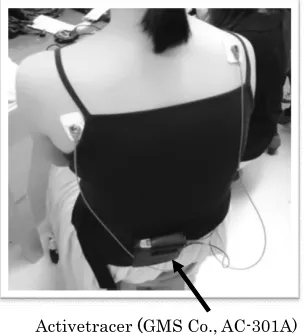
Activetracer (GMS Co., AC-301A)
Figure 1. Actvivetracer for HRV meas- urement.
In this study, measurements were performed under conditions of mammography positioning. Therefore, the electrodes were attached to sites which would not inter- fere with breast compression during mammography but which allowed the ECG to be measured.
2.2.3. Analysis Methods
In this study, the R-R interval, which is the interval between R wave peaks on an ECG, was measured every 2 seconds and the HR, the HF component of HRV and the LF/HF ratio were analyzed. Data obtained were ana- lyzed using the MemCalc/Tarawa heart rate variability real-time analysis program [GMS, Co., Tokyo].
LF and HF were calculated by determining the area under the power spectrum in the frequency range of in- terest. In other words, it was calculated by multiplying the sum of the power of the frequency range by the fre- quency division width. The standard unit of the ECG R-R interval is msec, which represent 1/1000 of 1 second. Therefore, the unit of both HF and LF is msec2.
Measurements were performed as described below. The Active tracer was attached and data were collected from the beginning of right mediolateral oblique (MLO) imaging to the end following a 10 minute seated rest period. Considering the stability of the data, for the data collected during resting, the 5 minutes beginning half way through the 10 minute rest period and ending just before imaging (“before imaging”) and between the start and end of right MLO imaging (“during imaging”) were analyzed. Experimental procedure is shown in Figure 2.
HR, HF and LF/HF values were obtained for each in- dividual, all data were divided into “before imaging” and “during imaging” and the mean and standard deviation were calculated. The effects at rest and during imaging were analyzed.
As a reference value for each index, the standard value of HR at rest is 60 beats/min in adults [18]. As for HF
Physical check
During imaging Seated rest period
10min
Mammography positioning
[MLO view]
Start Finish
Before imaging
Mammography imaging
[No exposure]
With in 5min
[image:3.595.311.531.87.219.2]Entire mammography
Figure 2. Experimental procedure for HRV measurement.
and LF/HF, the report on HRV standardization by the joint research group (task force) of the North American Society of Pacing and Electrophysiology and the Euro- pean Society of Cardiology was adopted values for the short-term analysis of HRV at the Japan Society of Neurovegetative Research (HF: 975 (±203) msec2, LF/HF: 1.5 - 2.0) [19]. These were used as the reference values in this study.
Analysis was performed using the Mann-Whitney U test and the difference between values before and during imaging was compared. Statistical analyses were per- formed using SPSS 19J for Windows and the signifi- cance level was set at less than 0.05.
In order to observe the chronological changes during the course of mammography, HR, HF and LF/HF of the subjects were expressed by averaging the data over 30- second intervals.
2.3. Ethical Considerations
Prior to conducting this study, the research plan was submitted to and approved by the research ethics com- mittee at Graduate school of Health Sciences, Niigata University (approval number 82).
3. RESULTS
3.1. Abbreviations and Acronyms
Table 1 summarizes the average values (±SD) of HR, HF and LF/HF of 34 subjects during the entire mam- mography procedure (including before and during imag- ing), as well as before imaging and during imaging.
HR was 81.12 (±12.03) beats/min. for the entire mam- mography procedure, 80.35 (±12.72) beats/min before imaging and 81.75 (±11.84) beats/min. during imaging.
HF was 407.31 (±520.11) msec2 for the entire
mammog-raphy procedure, 429.6 (±601.66) msec2 before imaging
and 391.41 (±444.92) msec2 during imaging. LF/HF was
HR, HF and LF/HF between Measurements before and during Imaging
The average values of HR, HF and LF/HF for the en- tire mammography procedure, before imaging and during
[image:4.595.309.534.86.258.2]imaging are shown in the figures (HR: Figure 3, HF:
Figure 4, LF/HF: Figure 5). Comparison of average values before and during imaging showed no significant differences in HR, HF or LF/HF (HR: P = 0.640, HF: P = 0.767, LF/HF: P = 0.386).
Next, the “before imaging” data from this study were compared to reference values of HR, HF and LF/HF. The average value of HR before imaging was 1.3-fold higher than the reference value. The average value of HF, which is a parasympathetic index, before imaging was reduced to 0.4 times the reference value, while the average value of LF/HF, a sympathetic index, was increased 3.2-fold before imaging compared to the reference value.
3.3. Chronological Changes in HR, HF and LF/HF during Imaging
[image:4.595.312.534.320.494.2]The average (±SD) duration of mammography imag- ing in this study was 170 (±35.0) seconds. With the start of imaging set at 0 seconds, measurements of HR, HF
Table 1. Average values of HR, HF and LF/HF during mam- mography. N = 34 (Mean ± SD).
Entire mammography
Before imaging
During imaging HR
(beats/min ) 81.12 ± 13.03 80.35 ± 12.72 81.75 ± 11.84 HF (msec2) 407.31 ± 520.11 429.6 ± 601.66 391.41 ± 444.92
LF/HF
(msec2/msec2) 6.19 ± 4.23 6.48 ± 4.91 5.54 ± 3.88
(HF: High frequency (0.16 - 0.42 Hz) component, LF/HF: Ratio of high frequency to low frequency (0.04 - 0.15 Hz) components, HR: Heart rate).
n.s.
0 10 20 30 40 50 60 70 80 90 100
Before imaging During imaging
Be
at
s /
m
[image:4.595.59.285.435.513.2]in
Figure 3. Average value of HR during mammography. (The line indicates the resting reference value at 60 beats/min [18] Mann-Whitney U test: n.s.).
0 200 400 600 800 1000 1200
msec²
Before imaging During imaging
Figure 4. Average value of HF during mammography. (The line indicates the reported HRV standardization of the reference value of 975 msec2 (Task force) at rest in the supine position [19].).
0 1 2 3 4 5 6 7 8 9 10 11 12
m
sec²
/
m
sec²
n.s.
Before imaging During imaging
Figure 5. Average value of LF/HF during mammography. (The line indicates the reported HRV standardization of the reference value of 2.0 msec2/msec2 (Task force) at rest in the supine posi- tion [19].).
and LF/HF were obtained every 30 seconds up to 180 seconds.
The average (±SD) of HR was 88.66 (±4.58) beats/min between 0 - 30 seconds, 82.41 (±2.85) beats/min between 31 - 60 seconds, 82.21 (±3.47) beats/min between 61 - 90 seconds, 82.67 (±4.31) beats/min between 91 - 120 sec- onds, 78.49 (±3.13) beats/min between 121 - 150 sec- onds and 70.84 (±1.68) beats/min between 151 - 180 seconds. As shown in Figure 6, the chronological values of HR were consistently more than 80 beats/min up to 120 seconds, showing a tendency to decrease slightly at the end of the mammography imaging.
[image:4.595.62.284.547.699.2]0 20 40 60 80 100
0~30s 31~60s 61~90s 91~120s 121~150s 151~180s
beat
s/
m
in
[image:5.595.60.280.83.242.2]Time (seconds)
Figure 6. Chronological changes in HR during mammography. (SD values are shown in the vertical direction around the mean. 0 ~ 30 s indicates 0 ~ 30 seconds, 31 ~ 60 indicates 31 ~ 60 seconds, 61 ~ 90 s indicates 61 ~ 90 seconds, 91 ~ 120 s indi-cates 91 ~ 120 seconds, 121 ~ 150 s indiindi-cates 121 ~ 150 sec-onds, 151 ~ 180 s indicates 151 ~ 180 seconds.).
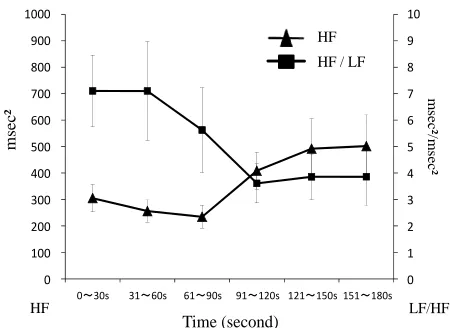
msec2 between 91 - 120 seconds, 492.15 (±113.58) msec2
between 121 - 150 seconds and 501.78 (±118.53) msec2
between 151 - 180 seconds. LF/HF was 7.10 (±1.35)
msec2/msec2 between 0 - 30 seconds, 7.10 (±1.87)
msec2/msec2 between 31 - 60 seconds, 5.62 (±1.68)
msec2/msec2 between 61 - 90 seconds, 3.61 (±0.74)
msec2/msec2 between 91 - 120 seconds, 3.85 (±0.86)
msec2/msec2 between 121 - 150 seconds and 3.86 (±1.08)
[image:5.595.311.536.85.249.2]msec2/msec2 between 151 - 180 seconds. As shown in
Figure 7, chronological changes of HF tended to in- crease and LF/HF tended to decrease from 91 - 120 se- cafter the start of imaging. Usually, most of the time re- quired for mammography is the time required for posi- tioning. Therefore, 91 - 120 seconds after the start of imaging is in the middle of positioning and a situation in which the breast is compressed. In that situation, we show that the parasympathetic index increases and the sympathetic index decreases.
4. DISCUSSION
The comparison of values obtained before and during imaging showed no significant differences in HR, HF or LF/HF in this study. However, when our data were compared with the generally used reference values, val- ues of HR, HF and LF/HF before imaging were all found to be significantly different from the reference values at rest. In other words, even at rest before imaging, HF, which reflected parasympathetic activity, was lower than the reference value and LF/HF, which reflected sympa- thetic activity, was higher than the reference value. Re- garding the autonomic nervous function in the body, it has been said that “when mental or physical stimulation (stressor) is applied to where homeostasis of the body is maintained, a warp (strain) is caused to the body and the
HF
msec
²
LF/HF
0 1 2 3 4 5 6 7 8 9 10
0 100 200 300 400 500 600 700 800 900 1000
0~30s 31~60s 61~90s 91~120s 121~150s 151~180s
m
sec²/
m
sec²
Time (second)
HF HF / LF
Figure 7. Chronological changes of HF and LF/HF during mammography.
body exhibits coping (stress) to correct the warp. The autonomic nervous system is involved in doing this, adaptive hormone is secreted and required energy is sup- plied to return to its original state” [20]. There is a possi- bility that psychological reaction, such as undergoing unfamiliar mammography and the expectation that it may be painful, may result in a situation in which sympathetic activity dominates.
From the results of the chronological changes, it was apparent that LF/HF, which reflected sympathetic activ-ity, was increased before imaging compared to during imaging. HF, which reflected parasympathetic activity, showed the opposite trend. The autonomic nervous re-sponse to stress has been understood to involve stimula-tion of sympathetic activity and regression of parasym-pathetic activity. During mammography, since it is ac- companied by pain and tension due to breast compres- sion and immobilization, the state of tension is expected to increase with the physical burden. However, the data obtained in this study showed that HF, which reflected parasympathetic activity, showed a tendency to increase gradually starting before imaging.
for an increase in HF and decrease in LF/HF. The fol- lowing point may be considered. Even in a situation in which there is a physical and psychological burden, there may be other associated psychological reactions, such as a sense of relief that the imaging is nearing an end.
These observations suggest that sympathetic nervous activity, which reflects tension, does not necessarily be- come dominant at the time-point associated with peak pain during mammography. In addition, it suggests that sympathetic nervous activity, which reflects tension, dominates when the examinee does not understand the situation and the reality of mammography. Therefore, we suggest that there is a need for data analysis on the physical and psychological burden during mammography to be carried out from the stage of preparation before positioning.
5. ACKNOWLEDGEMENTS
This work was supported by JSPS KAKENHI Grant Number 23593285.
REFERENCES
[1] Henrich, R.E., Baett, L., Botsco, M.A., Deibei, D., Feig, S. and Gray, J. (1999) Mammography quality control ma- nual: Patient positioning and compression. American Co- llege of Radiology, 30-75.
[2] Montgomery, M. and McCrone, S.H. (2010) Psychologi- cal distress associated with the diagnostic phase for sus- pected breast cancer: Systematic review. Journal of Ad- vanced Nursing, 9, 2372-2390.
doi:10.1111/j.1365-2648.2010.05439.x
[3] Whelehan, P., Evans, A., Wells, M. and Macgillivray, S. (2013) The effect of mammography pain on repeat par- ticipation in breast cancer screening: A systematic review.
The Breast, 28, 1-6.
[4] Uchiyama, M., Lee, Y., Kazama, K., Minagawa, Y., Tsai, D.Y., Sadakata, M. and Sayama, M. (2011) A preliminary study on measurement of muscle activity during mam- mography positioning. Japanese Journal of Radiological Technology, 67, 679-682. doi:10.6009/jjrt.67.679
[5] Uchiyama, M., Lee, Y., Sadakata, M., Sayama, M. and Tsai, D.Y. (2012) Measurement of muscle activities for evaluating physical burden and pain during mammo- graphy positioning. The Tohoku Journal of Experimental Medicine, 228, 53-58. doi:10.1620/tjem.228.53
[6] Uchiyama, M., Lee, Y., Kazama, K., Minagawa, Y., Tsai, D.Y., Sadakata, M. and Sayama, M. (2012) Quantitative assessment of muscle activity in mammography position- ing. Proceedings of the XX IMEKO World Congress, Bu- san, 9-14 September 2012, 1-4.
[7] Shiro, Y., Arai, Y.C.P., Matsubara, T., Isogai, S. and Ushi- da, T. (2012) Effect of muscle load tasks with maximal isometric contractions on oxygenation of the trapezius muscle and sympathetic nervous activity in females with
Musculoskeletal Disorders, 13, 1-7.
[8] Mostoufi, S.M., Afari, N., Ahumada, S.M., Reis, V. and Wetherell, J.L. (2012) Health and distress predictors of heart rate variability in fibromyalgia and other forms of chronic pain. Journal of Psychosomatic Research, 72, 39- 44. doi: 10.1016/j.jpsychores.
[9] Hallman, D.M. and Lyskov, E. (2012) Autonomic regu- lation, physical activity and perceived stress in subjects with musculoskeletal pain: 24-hour ambulatory monitor- ing. International Journal of Psychophysiology, 86, 276- 282. doi:10.1016/j.ijpsycho.
[10] Chang, L.H., Ma, T.C., Tsay, S.L. and Jong, G.P. (2012) Relationships between pain intensity and heart rate vari- ability in patients after abdominal surgery: A pilot study.
Chinese Medical Journal, 125, 1964-1969.
[11] Streeter, C.C., Gerbarg, P.L., Saper, R.B., Ciraulo, D.A. and Brown, R.P. (2012) Effects of yoga on the autonomic nervous system, gamma-aminobutyric-acid, and allostasis in epilepsy, depression, and post-traumatic stress disorder.
Medical Hypotheses, 78, 571-579.doi: 10.1016/j.mehy.
[12] Hatayama, T., Kitamura, S., Tamura, C., Nagano, M. and Ohnuki, K. (2008) The facial massage reduced anxiety and negative mood status, and increased sympathetic ner- vous activity. Biomedical Research, 29, 317-320.
doi:10.2220/biomedres.29.317
[13] Berger, R.D., Saul, J.P. and Cohen, R.J. (1989) Transfer function analysis of autonomic regulation. I. Canine atrial rate response. The American Journal of Physiology, 256, 142-152.
[14] Berntson, G.G., Cacioppo, J.T. and Quigley, K.S. (1993) Respiratory sinus arrhythmia: Autonomic origins, physio- logical mechanisms, and psychophysiological implica- tions. Psychophysiology, 30, 183-196.
doi:10.1111/j.1469-8986.1993.tb01731.x
[15] Ajioka, M., Sugiyama, S., Ogawa, K., Satake, T. and Ozawa, T. (1986) Mechanism of cardiac arrhythmias in- duced by epinephrine in dogs with hypokalemia. Ameri- can College of Cardiology Foundation, 8, 1373-1379.
doi:10.1016/S0735-1097(86)80310-2
[16] Pomeranz, B., Macaulay, R.J., Caudill, M.A., Kutz, I., Adam, D., Gordon, D., Kilborn, K.M., Barger, A.C., Shannon, D.C., Cohen, R.J. and Benson, H. (2012) As- sessment of autonomic function in humans by heart rate spectral analysis. American Journal of Physiology, 248, 151-158.
[17] Hayano, J., Taylor, J.A., Yamada, A., Mukai, S., Hori, R., Asakawa, T., Yokoyama, K., Watanabe, Y., Takata, K. and Fujinami, T. (1993) Continuous assessment of hemody- namic control by complex demodulation of cardiovascu- lar variability. American Journal of Physiology, 264, 1229- 1238.
[18] Mason, J.W., Ramseth, D.J., Chanter, D.O., Moon, T.E., Goodman, D.B. and Mendzelevski, B. (2007) Electrocar- diographic reference ranges derived from 79,743 ambu- latory subjects. Journal of Electrocardiology, 40, 228-234.
doi:10.1016/j.jelectrocard.2006.09.003
ology (1996) Heart rate variability: Standards of meas- urement, physiologic interpretation and clinical use. Cir-culation, 93, 1043-1065.
doi:10.1161/01.CIR.93.5.1043
[20] Gregg, D.J. (2001) The physiology of mind-body interac-tions: The stress response and the relaxation response.
The Journal of Alternative and Complementary Medicine,
![Figure 4. Average value of HF during mammography. (The [19].). line indicates the reported HRV standardization of the reference value of 975 msec2 (Task force) at rest in the supine position](https://thumb-us.123doks.com/thumbv2/123dok_us/7815012.730787/4.595.309.534.86.258/figure-average-mammography-indicates-reported-standardization-reference-position.webp)