Does Economic Integration Affect Spatial
Concentration of Industries? Theory and
a Case Study for India
Saikia, Dilip
Darrang College, Tezpur, Assam, India
June 2011
Online at
https://mpra.ub.uni-muenchen.de/64199/
1
Does Economic Integration Affect Spatial Concentration
of Industries? Theory and a Case Study for India
Dilip Saikia
Assistant Professor, Department of Commerce, Darrang College, Tezpur, Assam-784001, India, E-mail: [email protected]
ABSTRACT
Notwithstanding there has been voluminous concern among the researchers and policymakers, the theoretical predictions and empirical evidences regarding the impact of economic integration on spatial concentration of industries are ambiguous. The paper critically reviews the theoretical and empirical literature on the issue, and presents a case study for India. The findings suggest that following economic reforms in the early 1990s spatial concentration of manufacturing industries has declined in the early years (during 1993-94 to 1999-2000), but it has significantly increased in the last decade.
Key words: economic geography, economic integration, Indian manufacturing industry, industry location, role of state
JEL Classification: F15, L5, R3
1. Introduction
The issue of location of industry has been a major concern among the academics and regional policymakers over the years. Location of industry is very important to understand the development potential of the sub-national regions, especially in developing countries, since industrialisation is considered as sine qua non for economic growth (Hirschman, 1958; Kaldor, 1967) and in modern view, economic growth is a story dynamic cities that are highly industrialised (World Bank, 1999). Many cross-country and country-specific studies have shown that, in recent years, spatial disparity in industrialisation is one of the major causes of spatial (income) inequality (Kim, 2008).
2
growth of industrial cities and gradually, after some point, spread to other regions. However, the success or failure of a region in industrialisation is not determined entirely by the location specific factors, but it is the result of a set of complex factors comprising of some market forces and some political economy forces (Chakravorty and Lall, 2007). Though in a liberalised economy market forces become stronger and role of the state has curtailed, the state has to play active role in mediating the market forces. Therefore, the regional industrialisation processes have to be examined in terms of the interaction of market forces and the State. Further, in view of the globalisation process, the regional industrialisation is not entirely depend on domestic forces; but international forces, policies and players play key role in shaping the economic geography of a region. However, the theoretical predictions about location of industries from macro models of liberalisation and deregulation are ambiguous. Different theories and empirical analysis often reach contrasting results about the regional impact of globalisation. Adding to this, they are not available in a single place. Therefore, in this paper we try to provide a critical review of the theoretical and empirical literature on the impact of economic integration on industrial location. We also investigate the Indian experience of spatial concentration of industries following the economic reforms and WTO-led trade liberalisation undertaken in the economy since the mid 1990s.
2. Perspectives of Industrial Location
There has been a long-standing concern among the economists, geographers, and regional scientists with location choices. Marshall (1920) highlighted knowledge spillovers, locally-traded intermediate inputs, and the pooling of specialised skills as three potential mechanisms for the agglomeration of economic activity. In the early location theories firm’s location decision is exogenously determined by given the spatial distribution of natural resource endowments, technological differences, transport costs, and factors endowments, what Krugman (1993) termed as “first nature geography”. However, these ideas have been consigned with the successive technological innovation and shifting of interest towards inter-regional trade, inter-industry and intra-industry linkages, and agglomeration economies.
3
transport cost. In these models, known as the new economic geography (NEG), inter-industry and intra-industry specialisation takes the dominating location pattern. The location decision
becomes entirely endogenous and is determined by the relative strength of the “centripetal” and “centrifugal” forces. The agglomeration forces arise from pecuniary externalities (labor market pooling, input-output linkages, and migration induced demand linkages, etc.) due to a combination of variety preferences, increasing returns to scale, and transport costs. On the other hand, the dispersion forces arise in the form of high wages driven by competition among firms for skilled labour, high rent due to increased demand for housing and commercial land, and various negative externalities such as congestion, pollution, etc. Thus, the location decision of an industry in a particular place depends on the relative strength of these two opposite forces, which in turn depends on transport costs, so that changes in transport costs result in endogenous changes in the distribution of economic activity across space.
The insights from these models suggest that apart from the first nature geography the role of second nature geography, i.e. intra-industry and inter-industry specialisation, increasing returns to scale, transport costs, enhance market access, economic diversity, and
historical path dependence, etc. are more important in firm’s location decisions. All these factors, however, are not usually available in any location and they all are not equally important for each and every industry. Also the influence of these factors varies from place to place and within the same place from time to time. Hence, the net impact of the favourable factors over the unfavourable factors in a specific location compared to the same in other competing location becomes important for industrial location in a region. Yet, the disadvantage of a region in some of these factors (for example, lack of infrastructure, financial institutions, etc.) can be overcome with suitable government policies. Here, the political economy plays the most crucial role in determining industrial location.
3. Role of the State
4
from establishment of heavy industries and creation of socio-economic infrastructure in the backward regions to adopting regulatory policies and providing incentives to divert private sector investment towards the backward regions.
Nevertheless, in a liberalised economy the role and nature of the State has been changed. The state involvement in the ownership of industry and the regulatory structure affecting new investments are significantly weakened, entry barriers to multinational capital are lowered, export orientation is favoured over import substitution, and steps are taken toward some decentralisation of power and policy instruments in favour of sub-national States (Chakravorty, 2000). From a theoretical point of view, the role of the State in a liberalised economy is much debated. While in the neoclassical models the role of government involvement is relatively limited to infrastructure investments, the potential role for government intervention is significantly higher in the NEG models (Kim, 2008).1 In practice, there is coexistence of both liberalising and protectionist policies in a liberalised State, which leads to inaction of the State in some areas, whereas simultaneously there are more concerted actions in some other areas (Leinbach, 1996). For instance, in a liberalised economy the role of the nation State is reduced as far as the promotion of regional balance is concerned, whereas its role is enlarged in terms of promoting selected metropolitan regions for receiving investments, especially foreign investments (Chakravorty, 2000). So after reforms the most critical question arises: What role the combined forces of the state and market have played in shaping the economic landscape of a country after economic reforms?
4. On the Impact of Economic Integration
4.1 Theoretical Conjuncture
The theoretical predictions about the impact of globalisation on industry location are ambiguous. Different theories often reach contrasting results about the regional impact of economic globalisation. The “cumulative causation” approach suggested that regional imbalances in industrial development are likely to widen in the absence of State intervention (Myrdal, 1957 and Hirschman, 1958). In this view industrialisation follows the classic virtuous cycle principles, where new firms tend to locate where other firms already exist,
1 According to Kim (2005), this is due three reasons: first, the potential for “cumulative causation” forces, small
5
because the early-industrialised cities capture much of the new physical, human, and financial capital at the cost of the peripheral regions.
In the neoclassical approach the regional development models are equilibrium and convergence seeking, rest on export-driven growth and the economies of agglomeration in dynamic nodal region (Chakravorty, 2000). This neoclassical “divergence followed by
convergence” principle suggests that regional inequality increases during the early years of industrial development, being concentrated in metropolitan areas, and begins to decline at some later indeterminate point.
Nevertheless, these models are based on the assumptions of policy continuity; that is, the regulatory conditions under which location decisions are taken do not change, and therefore, the key of urban and regional change is not political action, but the rise and fall of agglomeration advantages (Chakravorty, 2000). The fact that the assumption of policy continuity no longer holds, since the role and nature of the State as industrial owner and industrial location regulator has been reduced in a liberalised economy. Further, these models assume that regions have similar comparative advantage and technology. Unless regions and their cities have similar comparative advantage and identical exposure to trade, liberalisation is likely to increase spatial inequality, because the regions that have natural resources for exports and natural advantages such as near to coasts, market hubs, and transportation networks, etc. are likely to be benefited more from external trade, whereas those in remote areas are not (Kim, 2008).
Contrary to these models the NEG models argued for an inverted U-shaped relationship between trade reforms and spatial concentration of industries, where regional inequality first rises and then falls in the presence of increasing returns to scale and transport costs.2 Elizondo and Krugman (1992) suggested that post-reform regional development is likely to be more evenly balanced. They argued that the magnitude of internal trade is much larger than foreign trade in inward-looking trade regimes, which leads to concentration of production and trading activities in large metropolis. When trade is liberalised, it breaks the monopoly power of these highly concentrated production and trading centres and weaken the traditional forward and backward linkages. The centripetal forces such as proximity to local markets, inter-firm spillovers, etc. become weaker because producers can now depend on
2
6
external demand, whereas higher wages, land-rent, high transport cost due to congestion in the established markets act as centrifugal forces compelling them to relocate to less established regions. Similarly, Krugman and Venables (1995) showed how a gradual process of growing world trade due to falling transport costs can first cause the world to divide spontaneously and arbitrarily into a high-wage, industrialised “North” and a low-wage, primary-producing “South”, and then at a later date, cause the South to rise again at the
North’s expense. Puga and Venables (1999) have suggested that, under certain circumstances, trade liberalisation reduces spatial inequality over time in sequential regional waves. They have argued that initially industries concentrate in one region given the agglomeration economies. When the wage gap widens between this region and the poor regions, industry will migrate toward one of the poor regions. Over time, as the process continues, more poor regions will join the group resulting spread of industries across the regions, and thereby, spatial inequality will decline. However, though the increased openness to external trade leads to spatial de-concentration of manufacturing activities as a whole, but it may lead to clustering of particular industry in few locations (Fujita et al., 1999).
4.2. Empirical Evidence
Likewise the theoretical predictions, the empirical evidences are also inconsistence and inconclusive. Studies from various developed and developing countries have provided evidence for the possibility of both increasing and decreasing spatial concentration following economic integration. For instance, Hanson (1997) and Elizondo and Krugman (1992) have shown that following trade reforms in Mexico in the late 1980s there has been a shift of manufacturing activity away from Mexico City, especially towards the states bordering the United States such as Ciudad Juarez, Monterrey, and Tijuana, and thus, bringing down the regional disparity. Hanson (2005) observed that between 1980 and 1993 the share of the border states in manufacturing employment has increased from 21 percent to 30 percent,
while the Mexico City’s share has declined from 44.4 percent to 28.7 percent.
low-7
tech industries such as textiles, apparel, and tobacco, etc. were much more localised than the medium- to high-tech industries such as electricity, transportation, and so forth. Consequently, the gradual shift in manufacturing from low-tech to high-tech industries contributed to the general dispersal of manufacturing over time. Similarly, Brulhart and Torstensson (1998) have observed a similar inverted U-pattern of spatial concentration of manufacturing industries for the European Union. They found that activities with larger scale economies were more concentrated in regions close to the geographical core of the European Union during the early stages of European integration, while concentration in the core has fallen slightly in the 1980s. Tomiura (2003) also found that increasing import penetration weakened industrial concentration in Japan.
Turning to the other side of the coin, studies have also shown that the benefits of globalisation for many countries sharply increased their spatial inequality. Kanbur and Venables (2005) based on their survey of over 50 developing nations argued that the uneven spatial impact of trade and globalisation played a major role in widening the regional and urban spatial inequalities in most of the developing countries in recent years. Fujita and Hu (2001) have provided evidences for increasing regional disparities in China following the trade liberalisation. Similarly, Kanbur and Zhang (2005) observed that inequality in China has risen substantially with decentralisation and the sharp rise in international trade during 1984-2000. In the similar way, Sala-i-Martin (1996) and Paluzie (2001) observed considerable evidences for increasing regional inequalities following Spain’s entry in the European Union in 1986. They found income convergence between Spanish regions during 1955-1990, but that the process came to a halt in the 1980s and afterwards, when Spain was integrated with the European Union.
Amidst of such theoretical debate and empirical confusion on the impact of economic integration on regional economy, researchers have been discussing on whether the policy changes actually affect regional variation of development (Holmes, 1998; Morgenroth, 2003; Redding and Venables, 2004). These studies argued that it is not the policy variables, but the geographic location of the region and economic geography variables that have considerable impact on regional development. Redding and Venables (2004) have argued that the increasing integration of world goods and financial markets has not caused the cross-country differences in income per capita and manufacturing wages, rather it is caused by each
8
country’s distance from all of its trade partners yields an increase of over 70 percent. Similarly, Chakravorty (2000) pointed out that the most important factor for a developing country (like India) is the availability of infrastructure, which is in its highest standard in the metropolitan regions compared to the other regions. The private industries (which got the permit to participate in all industrial arenas after reforms), and the foreign investments (which become important key to spur economic growth with the increase in economic integration) prefer the metropolises because of the concentration of infrastructure. Therefore, the government also invests in infrastructure in the leading metropolises in order to make them the most likely destinations of new private investments and encourages competition. Thus, the concentration of infrastructure leads to agglomeration of manufacturing activities in these metropolises.
However, some others argued that the point is not whether economic integration affects spatial concentration or not; the important point to be considered is the way through which it affects industrial location. Puga (1999) and Fujita and Mori (2005) pointed out that the way in which agglomeration occurs and evolution of industrial location when the economy is liberalised depends largely on whether workers are mobile across regions or not. For Paluzie (2001) this is the force that generates the unequal geography within a country through industrial agglomeration, and trade liberalisation reinforces this effect. The agglomeration of industry tends to raise local wages in locations with relatively many firms. If higher wages lead workers to relocate towards more industrialised regions, this intensifies agglomeration while eliminating wage differentials. If instead workers do not move across regions, interregional wage differentials persist. In this case, the reduction in trade costs as a result of integration makes the firms sensitive to wage differentials and will lead industry to spread across the regions. Topalova (2005) observed that mobility of workers across the states is extremely limited in India and that the spatial inequalities are largely explained by the lack of inter-regional and inter-sectoral mobility of workers. Therefore, it is reasonable to argue that removal of trade restrictions and economic integration would benefit the states where labour market laws and institutions are more business-friendly, and possibly harm the states where there are biased in favour of workers.
5. The Indian Experience
9
capital, modern technology, access to international market, and competitiveness of industries, etc. (Das and Barua, 1996; Chakravorty, 2000; Ahluwalia, 2002). Following the changes in the policy regime there has been a growing concern among the researchers and policymakers about the impact of economic reforms on regional industrialisation. The skeptics of market reform claimed that the economic reforms process and the WTO-led trade liberalisation policies since mid 1990s will lead to increase in spatial concentration of industries, since the new policy regime curtailed the role of the State as industrial owner and industrial location regulator, and hence, the State could not directly influence balanced regional industrial development. The findings of the existing studies about the trends in spatial concentration of industries after reforms are ambiguous, though majority of studies have provided evidences for increasing spatial concentration in the post-reform period (Chakravorty, 2000, 2003; Lall et al., 2001; Soo, 2002; Lall et al., 2003; and Lall and Chakravorty, 2005). Chakravorty (2003) and Lall and Chakravorty (2005) found that spatial concentration of organised manufacturing industries (measured in terms of Moran’s-I) across Indian districts has increased (from 0.093 to 0.161) during 1994-94 to 1997-98. Using the same data set Chakravorty (2000) also observed increase in the Moran’s-I for the post-reform period. Most of the findings of these studies have also tested and vindicated in Chakravorty and Lall (2007). Soo (2002) have examined the concentration of organised manufacturing industries across 16 major states for the period 1980-1997 using spatial Gini index and found that the mean value of Gini index has declined between 1980 and 1991 (from 0.565 to 0.519) and then increased to 0.551 in 1997. In a recent study Barua and Chakraborty (2010), found that regional inequality in the distribution of manufacturing value added across 26 states has significantly increased during (1981-2000).
These findings have become outdated (though they have their own importance) since they are related to very old data and there is hardly any evince for a recent period, especially after 2003-04, the period which has witnessed higher economic openness and also achieved fabulous economic growth. Therefore, in the rest of the paper we examine the long run trend of spatial concentration of manufacturing industries in India during 1980-81 to 2007-08.
We have employed the entropy index to measure spatial concentration. Following Aiginger and Davies (2004) we measure the entropy index of an industry as the summation of the products of the shares and log shares of each state to the country’s total employment (or output) for that industry. Symbolically,
Eik Ei Eik Ei
10
where, 𝐸𝑖𝑘 is the employment (or output) of the kth region in the ith industry and 𝐸𝑖 is the employment (or output) of all the regions in the ith industry as a whole. The index takes values between ln 𝑘 and zero. If the industry is equally distributed across all the regions, then 𝐸𝑖𝑘/𝐸𝑖 = 1/𝑘for all k and𝐸 = 𝑙𝑛(𝑘). Alternatively, if the industry is completely concentrated in one region, 𝐸 = 𝑙 𝑛 1 = 0. More generally, the index increases when the industry spreads more evenly across the regions. It is thus an inverse measure of concentration, and hence, an increase in the index will imply decline in spatial concentration.
We estimate the entropy index (E) using employment and value added data of organised manufacturing industries for 18 major Indian states for the period 1980-81 to 2007-08.3 Data on manufacturing employment and value added have been collected from the Annual Survey of Industries, published by the Central Statistical Organisation.4
Figure 1 reports the long run trends in the entropy measures in terms of manufacturing employment and net value added. Since entropy is an inverse measure of concentration, the upward movement of the curve implies decline in spatial concentration. From the figure it is obvious that the spatial concentration level is high in terms of value added compared to employment, but the changes in concentration is more obvious in terms of value added.
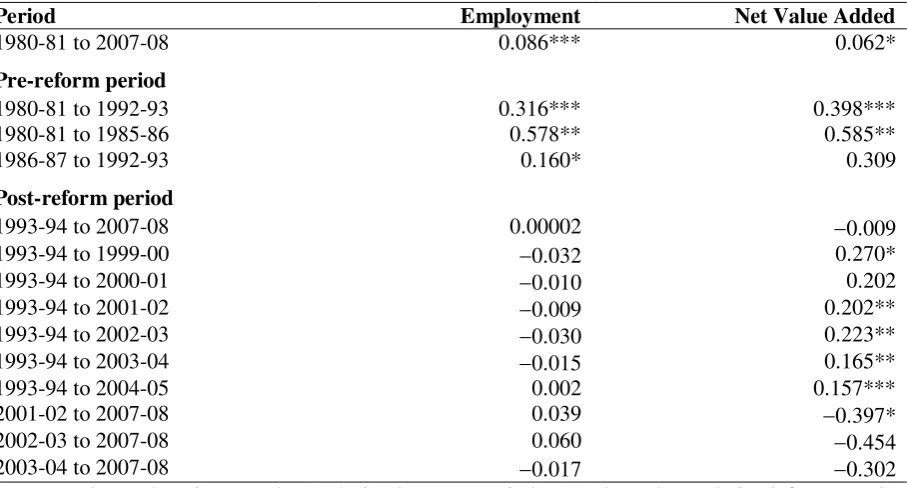
The entropy concentration measures have been further analysed in Table 1 in order to test the statistical significance of trend concentration during the pre-reform and post-reform periods. For the overall three decades period (1980-81 to 2007-08) the trend growth in entropy index is positive and statistically significant in terms of both employment (0.086%) and value added (0.062%). The positive trend growth of the entropy index implies that concentration has declined. For the pre-reform period (1980-81 to 1991-92) spatial concentration is found to be significantly declined, as the trend entropy index is significantly positive for both employment (0.316%) and value added (0.398%). We have further divided the pre-reform period into two sub-periods: 1980-81 to 1985-86 and 1986-87 to 1991-92, and found that the decline in concentration is more obvious in the first sub-period compared to the second sub-period. Indeed, the decline in spatial concentration in terms of value added is
3
The 18 states considered for analysis are Andhra Pradesh, Assam, Bihar, Delhi, Gujarat, Haryana, Himachal Pradesh, Jammu & Kashmir, Karnataka, Kerala, Madhya Pradesh, Maharashtra, Orissa, Punjab, Rajasthan, Tamil Nadu, Uttar Pradesh, and West Bengal. These states together accounted for around 94.5 percent of total geographical area in 2005-06 and 98.4 percent of India’s population as per the 2011 Census.
4
11
not significant in the second sub-period and in terms of employment also the level of statistical significance has declined.
The trend spatial concentration is not statistically significant for the post-reform period (1993-94 to 2007-08) for both manufacturing employment and value added. In fact, for any of post-reform sub-period we have not found statistically significant trends in terms of employment. In terms of value added, however, we have two sub-periods with statistically significant trends. The first sub-period is 1993-94 to 1999-00 during which spatial concentration has significantly declined. Extending the period up to 2004-05, actually, increases the statistical significance level. So, for the overall period 1993-94 to 2004-05 spatial concentration of manufacturing value added has significantly declined. The second sub-period is 2001-02 to 2007-08, and during this period spatial concentration has increased. However, if we consider the period after 2003-04 during which the Indian economy has achieved fabulous growth (Figure 2), the trend concentration is not significant though the sign of trend growth rate is negative, implying increased spatial concentration.
12
Figure 1: Entropy Index for Manufacturing Employment and Value Added
Note: The value of entropy index, in our case, lies between ln(18)=2.89 and zero, where a higher value implies lower spatial concentration.
Source: Computed based on data from Annual Survey of Industries, various years
Table 1: Trends in Entropy Index
Period Employment Net Value Added
1980-81 to 2007-08 0.086*** 0.062*
Pre-reform period
1980-81 to 1992-93 0.316*** 0.398***
1980-81 to 1985-86 0.578** 0.585**
1986-87 to 1992-93 0.160* 0.309
Post-reform period
1993-94 to 2007-08 0.00002 0.009
1993-94 to 1999-00 0.032 0.270*
1993-94 to 2000-01 0.010 0.202
1993-94 to 2001-02 0.009 0.202**
1993-94 to 2002-03 0.030 0.223**
1993-94 to 2003-04 0.015 0.165**
1993-94 to 2004-05 0.002 0.157***
2001-02 to 2007-08 0.039 0.397*
2002-03 to 2007-08 0.060 0.454
2003-04 to 2007-08 0.017 0.302
Notes: Unless otherwise stated, trends in the entropy index (g) have been derived from yearly estimates of entropy index (y) using the equation ln(y) = a + g(time)
*** Significant at 1% level; ** significant at 5% level; * significant at 10% level.
2.350 2.400 2.450 2.500 2.550 2.600 1980-81 1981-82 1982-83 1983-84 1984-85 1985 -86 1986-87 1987-88 1988-89 1989-90 1990-91 1991-92 1992-93 1993-94 1994 -95 1995-96 1996 -97 1997-98 1998 -99 1999-00 2000-01 2001-02 2002-03 2003-04 2004-05 2005 -06 2006-07 2007-08
[image:13.595.75.529.453.697.2]13
Figure 2: Annual Growth Rate of GDP and Industrial GDP (at 1999-2000 prices)
Source: Economic Survey 2011, Government of India
Figure 3: Gini Coefficient of Per Capita Gross State Domestic Product
Note: The Gini coefficients have been are computed based on real per capita GSDP of all states excepting Mizoram, Nagaland and A & N Islands for 2003-04 and 2004-05 in the 1993-94 series. In the 1999-00 series, the coefficient for 2005-06 is based on 29 States/UTs.
Source: EPWRF, District Product of States of India: 1960-16 to 2006-07
The findings of the paper are consistent with the existing studies in the Indian context (Chakravorty, 2003; Lall and Chakravorty, 2005; Chakravorty and Lall, 2007). However, our findings are up to date, as we have extended our analysis up to a very recent period (2007-08), the latest period for which manufacturing data is available at the regional level. This is
0 2 4 6 8 10 12 14 1980 -81 1981 -82 1982 -83 1983 -84 1984 -85 1985 -86 1986 -87 1987 -88 1988 -89 1989 -90 1990 -91 1991 -92 1992-93 1993 -94 1994 -95 1995 -96 1996 -97 1997 -98 1998 -99 1999 -00 2000-01 2001-02 2002-03 2003-04 2004-05 2005-06 2006-07 2007-08 2008-09 2009-10
GDP GDP from Industry
0.2 0.22 0.24 0.26 0.28 0.3 1993 -94 1994 -95 1995 -96 1996 -97 1997 -98 1998 -99 1999 -00 2000 -01 2001 -02 2002 -03 2003 -04 2004 -05 2005 -06
1993-94 Price Series
[image:14.595.74.523.399.594.2]14
the first attempt, as per our knowledge, that has looked at the long run trend in spatial concentration of manufacturing (or any other economic activity) in India. The earlier studies either looked at the cross sectional pattern of spatial concentration of manufacturing industries across different industry groups or the temporal pattern of spatial concentration at discrete time points. Even there is no evidence for the period after 2003-04. Thus, the present study contributes to the literature by providing the temporal pattern of manufacturing concentration in India for a long time series covering nearly three decades.
6. Conclusion
The paper reviews the theoretical and empirical literature on the impact of economic integration on spatial concentration of industries. The review unveils that while there has been voluminous concern about the impact of economic integration on spatial concentration/inequality, the theoretical predictions and empirical evidences from many cross-country and country-specific studies are ambiguous. While there has not been any common argument about such contradiction, some authors have argued that it is not the policy variables but the geographical location of the regions and economic geography that have considerable impact on industrial location. Yet, some others opined that the important point to be considered is the way through which economic integration affects industrial location, and it depends largely on whether workers are mobile across regions or not. It is likely that economic integration would benefit the regions where labour market laws and institutions are more business-friendly.
15
References
Ahluwalia, M. S. (2002), “Economic Reforms in India since 1991: Has Gradualism Worked?”,Journal of Economic Perspectives, 16(3): 67-88.
Barua, A. and Chakraborty, A. (2010), “Does Openness Affect Regional Inequality? A Case Study for India”, Review of Development Economics, 14(3): 447–465.
Brulhart, M. and Torstensson, J. (1998), “Regional Integration, Scale Economies and Industry Location in the European Union”, CEPR Discussion Paper No. 1435.
Chakravorty, S. (2000), “How Does Structural Reform Affect Regional Development? Resolving Contradictory Theory with Evidence from India”, Economic Geography, 76(4): 367-394.
Chakravorty, S. (2003), “Industrial Location in Post-reform India: Patterns of Inter-regional Divergence and Intra-regional Convergence”, Journal of Development Studies, 40(2): 120-52.
Chakravorty, S. and Lall, S. V. (2007), “Made in India: The Economic Geography and Political Economy of Industrialization”, Oxford University Press, New Delhi.
Das, S. K. and Barua, A. (1996), “Regional Inequalities, Economic Growth and Liberalisation: A study of the Indian Economy”, Journal of Development Studies, 32: 364-90.
Dixit, A. K. and Stiglitz, J. E. (1977), “Monopolistic Competition and Optimum Product Diversity”,American Economic Review, 67(3): 297-308.
Elizondo, L. R. and Krugman, P. R. (1992), “Trade Policy and the Third World Metropolises”, NBER Working Paper No. 4238, Cambridge, MA.
Fujita, M. and Hu, D. (2001), “Regional Disparity in China 1985-94: The Effects of Globalisation and Economic Liberalisation”, Annals of Regional Science, 35(1): 3-37. Fujita, M. and Mori, T. (2005), “Frontiers of the New Economic Geography”, Discussion
Paper No. 069, Institute of Economic Research, Kyoto University, Japan.
Fujita, M., Krugman, P. R. and Venables, A. J. (1999), “The Spatial Economy: Cities, Regions and International Trade”, MIT Press, Cambridge, MA.
Hanson, G. H. (1997), “Increasing Returns, Trade and the Regional Structure of Wages”,
Economic Journal, 107: 113–33.
Hanson, G. H. (2005), “Globalization, Labour Income and Poverty in Mexico”, NBER Working Paper No. 11027, Cambridge, MA.
Hirschman, A. O. (1958), “A Strategy for Economic Development”, Yale University Press, New Haven.
Holmes, T. J. (1998), “The Effect of State Policies on the Location of Industry: Evidence from State Borders”,The Journal of Political Economy, 106: 667-76.
Kaldor, N. (1967), “Strategic Factors in Economic Development”, Ithaca: New York State School of Industrial and Labour Relations, Cornell University.
16
Kanbur, R. and Zhang, X. (2005), “Fifty Years of Regional Inequality in China: A Journey through Central Planning, Reform and Openness”, Review of Development
Economics, 9(1): 87-106.
Kar, S. and Sakthivel, S. (2007), “Reforms and Regional Inequality in India”, Economic and
Political Weekly, 42(47): 69-77.
Khomiakova, T. (2008), “Spatial Analysis of Regional Divergence in India: Income and Economic Structure Perspectives”, The International Journal of Economic Policy
Studies, 3: 138- 61.
Kim, S. (1995), “Expansion of Markets and the Geographic Distribution of Economic Activities: The Trends in U. S. Regional Manufacturing Structure, 1860-1987”, The
Quarterly Journal of Economics, 110(4): 881-908.
Kim, S. (2008), “Spatial Inequality and Economic Development: Theories, Facts, and Policies”, Commission on Growth and Development Working Paper No. 16
Krugman, P. R. (1991a), “Increasing Returns and Economic Geography”, The Journal of
Political Economy, 99(3): 483-99.
Krugman, P. R. (1991b), “Geography and Trade”, MIT Press, Cambridge.
Krugman, P. R. (1993), “First Nature, Second Nature and Metropolitan Location”,Journal of
Regional Science, 33: 129-44.
Krugman, P. R. and Venables, A. J. (1995), “Globalization and the Inequality of Nations”,
The Quarterly Journal of Economics, 110(4): 857-80.
Lall, S. V. and Chakravorty, S. (2005), “Industrial Location and Spatial Inequality: Theory and Evidence from India”, Review of Development Economics, 9(1): 47–68.
Lall, S. V., Shalizi, Z. and Deichmann, U. (2001), “Agglomeration Economies and Productivity in Indian Industry”, Policy Research Working Paper No. 2663, World Bank, Washington DC.
Lall, S. V., Koo, J. and Chakravorty, S. (2003), “Diversity Matters: The Economic Geography of Industry Location in India”, Policy Research Working Paper No. 3072, World Bank, Washington DC.
Leinbach, T. R. (1996), “Regional Science and the Third World: Why Should We be Interested? What Should We Do?”, International Regional Science Review, 18: 201-09.
Marshall, A. (1920), “Principles of Economics”, Macmillan, London.
Morgenroth, E. “2003”, “What Should Policy Makers Learn From Recent Advances in Growth Theory and New Economic Geography”, Economic and Social Research Institute.
Myrdal, G. (1957), “Economic Theory and Underdeveloped Regions”, London.
Paluzie, E. (2001), “Trade policy and regional inequalities”, Papers in Regional Science, 80: 67–85.
Puga, D. (1999), “The Rise and Fall of Regional Inequalities”, European Economic Review, 43: 303-34.
Puga, D. and Venables, A. J. (1999), “Agglomeration and Economic Development: Import Substitution vs. Trade Liberalisation”,Economic Journal, 109: 292-311.
17
Sala-i-Martin, X. (1996), “Regional Cohesion: Evidence and Theories of Regional Growth and Convergence”, European Economic Review, 40: 1325-52.
Soo, K. T. (2002), “Factor Endowments and the Location of Industry in India”, Centre for Economic Performance, London School of Economics, London.
Tomiura, E. (2003), “Changing Economic Geography and Vertical Linkages in Japan”,
Journal of the Japanese and International Economics, 17: 561-89.
Topalova, P. (2005), “Trade Liberalization, Poverty and Inequality: Evidence from Indian Districts”, NBER Working Paper No. 11614, Cambridge, MA.
Venables, A. J. (1996), “Equilibrium Locations of Vertically Linked Industries”,
International Economic Review, 37: 341-359.
Venables, A. J. (2005), “Spatial Disparities in Developing Countries: Cities, Regions and the International Trade”, Journal of Economic Geography, 5(1): 3-22.