Munich Personal RePEc Archive
Coordination structures
Rosa-García, Alfonso and Kiss, Hubert Janos
Universidad de Murcia, Universidad Autónoma de Madrid
23 April 2011
Coordination structures
Alfonso Rosa-García
yUniversidad de Murcia
Hubert Janos Kiss
zUniversidad Autónoma de Madrid
April 23, 2011
Abstract
We study a coordination problem where agents act sequentially. Agents are embedded in an
obser-vation network that allows them to observe the actions of their neighbors. We …nd that coordination
failures do not occur if there exists a su¢ciently large clique. Its existence is necessary and su¢cient when
agents are homogenous and su¢cient when agents di¤er and their types are private. Other structures
guarantee coordination when agents decide in some particular sequences or for particular payo¤s. The
coordination problem embodied in our game is applied to the problems of revolts and bank runs.
Keywords: social networks, coordination failures, multiple equilibria, revolts, bank runs
JEL Classi…cation: C72, D82, D85, G21, Z13
1
Introduction
Coordination failures occur when agents fail to coordinate on an equilibrium in which they are better-o¤
than in an alternative equilibrium in which they end up. There are many socioeconomic situations in which
it may occur (as in many Keynesian models (Cooper and John, 1988), bank runs (Diamond and Dybvig,
We would like to thank Coralio Ballester, Ismael Rodríguez-Lara and Jaromir Kovarik for helpful comments. This paper has bene…tted from suggestions provided by participants of the XXV Congress of the EEA in Glasgow, ASSET 2010 in Alicante, 2nd UECE Meeting in Lisboa, XXXV Simposio Asociación Economía Española (SAEe), MECA seminar in Murcia and IUDESP seminar in Alicante. The authors kindly acknowledge …nancial support from the Spanish Ministry of Science and Innovation under the project number ECO 2008-00510 (Hubert Janos Kiss) and ECO2010-19830 (Alfonso Rosa-García).
yCorresponding author. email: [email protected]. Address: Dpto. de Fundamentos del Análisis Económico- Facultad de
Economía y Empresa - Universidad de Murcia - Campus Espinardo - 30100 Murcia, Spain
zemail: [email protected]. Address: Dpto. Análisis Económico: Teoría Económica e Historia Económica - Facultad de
1983) or revolts (Chwe, 2000), among others). The idea was presented by Jean-Jacques Rousseau as an
illustration of a problem which has become known as the stag-hunt game. In this game, hunting the stag is
risky. This is the case because the payo¤ it yields depends on whether the hunters manage to coordinate. If
they do so, then their payo¤ is higher than the one related to the safe choice of going for the hare. However,
if they fail, the payo¤ is lower.
We study coordination problems that are characterized by a risky action, which is the optimal choice only
if it is taken by the su¢cient amount of agents. They decide in sequence, according to an order of decision
exogenously given. We show how the coordination problems disappear if certain information structures exist
that allow the observability of actions among the agents. We study the case with heterogenous agents: there
may exist agents who di¤er with respect to their di¤erent preferred risky action and/or threshold. The main
objective in our paper is to characterize the structures that guarantee that coordination emerges. In this
sense, our aim is very closed to Chwe (1999, 2000), as explained later.
The agents that we study are embedded in a social network that allows to observe actions.1 If two agents
are linked, then the one who acts later in the order of play observes the other agent’s decision who is aware
that her action will be observed. The e¤ect of a link, in this case, is to change the interaction among agents,
from simultaneous to sequential. The link allows to observe the action, but neither the type, nor the threshold
nor the position in the order of decision are observed. We say that a network allowing the observation of
actions is anobservation network. We look for observation networks that imply that the coordination game
played has a unique equilibrium in which all agents take their preferred risky action, independently of the
order of decision. If this occurs for any possible payo¤s that allow for the type of coordination failures that
we study, we say that these observation networks arecoordination structures.
We …nd that, when agents are homogenous, the existence of a clique of given size is necessary and
su¢cient in guaranteeing coordination: coordination failures can be sustained in equilibrium if such a clique
does not exist, while in any observation network where the clique exists the unique equilibrium is the e¢cient
one. This is the case for any payo¤s of the type that we study and for any sequence of decision. We extend
our model to di¤erent agents with private types, and we …nd a su¢cient condition on the size of a clique
that guarantees that, for any payo¤s and sequence of decision, only the e¢cient outcome can be sustained
in equilibrium. For this case, however, it is not a necessary condition, and we …nd other structures that
also guarantee the coordination. However, these structures are formed by a higher number of nodes forming
several cliques.
1Typically, social networks are used to model the interactions among agents. As far as we know, Choi et al (2011) and Kiss
When agents are heterogenous and type is private information, we discuss also the case of observation
networks that can be su¢cient for guaranteeing coordination for certain sequences of decision or certain
payo¤s, and we name these networks quasi-coordination structures. In this context, we show with an example
that more connections may generate coordination failures, a fact that is absent of coordination structures2.
As an illustration of the type of situations we study, imagine a group of people (e.g. professors in a
department) who decide which operating system are going to use3. They prefer one system or another
depending on how many partners choose it (for instance, because of the possibility of sharing software or
knowledge about the operating system). For simplicity, consider that if su¢cient agents are choosing Linux,
then everyone prefers to use it; if there are not su¢cient agents who use Linux, people would prefer Windows.
Such a situation is characterized by a threshold, which makes pro…table the risky action of using Linux. As
a concrete case, suppose that there are four individuals and that they prefer to use Linux over Windows if
at least 3 of them use it. Suppose that the network structure is common knowledge and consider the social
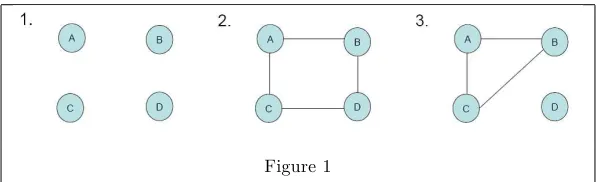
[image:4.612.157.457.403.494.2]structures represented in Figure 1.
Figure 1
In network 1 individuals are not connected. It means that they are not able to observe each other. If they
are su¢ciently optimistic and believe that the other individuals will adopt Linux, then all of them adopt
it. But in case of pessimism the opposite happens. Therefore, picture 1 represents an observation network
that does not lead with certainty to the socially e¢cient outcome, so this network is not a coordination
structure. Individuals are more connected in network 2, but still this structure does not enable coordination
always. If any of the individuals observes two others who use Linux, then she adopts it as well. But if only
one other Linux’s user is observed, then it is not clear what is the optimal choice: B may …nd optimal not
to adopt Linux even if she observes that A has adopted it. It is the case, because even if she adopts Linux
and this is observed by D, B does not know with certainty if C will adopt and upon observing only one
2Any observation network that contains a coordination structure is also a coordination structure.
3The literature on adoption studies how the market ends coordinating in one or another product. See Farrell and Klemperer,
other agent adopting, D may choose not to adopt. In other words, there is no pro…table deviation from the
strategy that has "do not adopt Linux when observing zero or one other agent adopting it, and adopt it
otherwise". Thus, nobody starts to adopt and everyone may end up using Windows. The network 3 - even
though it has less links than the network 2 - enables coordination, because A,B and C will adopt Linux in
any equilibrium. Beliefs for them do not play any role, independently of the order in which they act. This
is the case because upon observing that two other individuals have adopted Linux, the optimal response for
the third is to adopt it as well. By backward induction, the best response when observing that somebody
has already adopted Linux is to adopt as well. As a consequence, if any of the three individuals does not
observe any action (so she knows to be the …rst to act), then her best choice is to adopt and induces the
other two individuals to follow suit. Since the network structure is common knowledge, individual D knows
that the other three individuals will coordinate, so she adopts as well, even although she does not observe
anyone and her action is not observed by the others. In Proposition 1, we show in general that in case of one
type and a homogeneous threshold t a group of completely connected agents (a clique) of size t is necessary
and su¢cient to achieve uniquely the Pareto-superior equilibrium.
We also study a more general setup in which there are di¤erent types (di¤erent preferred operating
systems in our example) as well as situations in which the threshold changes from individual to individual
(personalized thresholds)4. For instance, some people may want to use Linux if they are sure that a few
other people use it, while others adopt Linux only if many others use it. Theorem 1 indicates that for every
agent there exists a minimal size of the clique that ensures that she takes her risky action. As a consequence,
every individual takes her risky action in any order of play, in any sequential equilibrium, if there exists in
the society a clique of size as the largest of these minimally required cliques.
Our setup extends naturally to various examples. We study three of them. Revolts succeed if enough
individuals join them and they can be modelled as coordination problems. Several papers (e.g. Granovetter,
1978 and Chwe, 1999 and 2000, among others) study what are the necessary condition for a revolt to succeed.
Bank runs also may be viewed as coordination failures (Diamond and Dybvig, 1983). When a liquidity shock
occurs, some depositors have urgent liquidity need (impatient depositors) and they want to withdraw their
money immediately. Other depositors without immediate liquidity needs (patient depositors) prefer to wait
if other patient depositors wait as well. If many patient depositors try to withdraw, the bank su¤ers a bank
run and it becomes optimal for the patient depositors to withdraw. In this situation, patient depositors play
among them a multiagent stag-hunt game. This example has two types, both of them with a homogeneous
threshold. We show that even though types are unobservable a su¢ciently large clique allowing extensive
mutual observation of actions entails that no bank run should occur in equilibrium. The di¢culty of the
formation of a large clique may explain why bank runs happen.
Our paper is related mainly with Chwe (1999, 2000) and Granovetter (1978), who studied the emergence
of revolts, and Choi et al (2011), which study how di¤erent observation networks facilitate coordination
among agents. Chwe (1999, 2000) analyzes how must be the structure of a communication network in order
to enable the revolts. In the model, he analyzed the minimal requirement on the structure in order to ensure
that the revolution may occur, for the case in which agents know only the willingness to participate of their
neighbors. The condition for coordination requires that agents know through the network that su¢cient
other agents are also willing to revolt. Chwe shows the key relevance of cliques in the formation of the local
common knowledge that enables the revolts. Our aim is similar in the sense that we characterize also a family
of networks under which coordination emerges. Moreover, the type of coordination problem that we study
is similar to the one studied by Chwe. However, our models di¤er in several basic aspects. Chwe studies a
case in which agents have information only about her neighbors, and this information is precisely what the
network transmits. The information of our agents is completely di¤erent, since it allows them to know the
actions of their predecessors who are also neighbors, although they may ignore the type of her neighbors.
However, we assume certain knowledge over these types, since we analyze the case where agents know that
there exist enough people for coordination. Therefore in the model by Chwe there exists local knowledge
of types but complete uncertainty about the global distribution, while in our model we assume knowledge
about the global distribution of types but uncertainty about its local con…guration. Chwe characterizes how
must be the structure for generating a su¢cient information to the agents (there are su¢cient people for the
coordination) that in our model we assume that exists. So the structures in Chwe guarantees the existence
of enough information such that the equilibrium of coordination exists. We show that the coordination
in the risky action is in fact the unique equilibrium under certain structures when the network allows the
observation of previous actions of the neighbors.
With respect to Granovetter (1978), the environment that we study is very similar, although our objective
di¤ers signi…cantly from his. He assumes that each previous action can be observed and analyzes how the
distribution of thresholds must be so that a revolution occurs. Agents may have personalized thresholds and
they revolt after observing that su¢cient other agents do so. The agents studied by Granovetter are rational
in the sense that they participate only if they consider it is bene…cial for them, and respond to the actions
they observe. He characterizes how must be the individual distribution of thresholds in order to generate
the collective action, and how it determines the amount of people that take part on it. In our model, we
participating for willing to take part on it. However, our agents are called to participate just once, and they
decide strategically: they take into account what they observe and also the strategies of the other players.
Moreover, in the model of Granovetter the agents observe all past actions, while our aim is precisely to
characterize the minimal requirements on observation of actions in order to ensure the coordination in the
risky action.
The potential multiple interactions generate that multiplicity of equilibria emerge in many contexts
related with networks. For instance, it was the case in one of the …rst approaches to the formation of
networks (Aumann and Myerson, 1988). This leaded to the use of several equilibrium re…nements to study
the process of formation (Jackson and Wolinsky, 1996; Bala and Goyal, 2000). Problems of coordination
emerge also in the study of games that are played by agents embedded in given networks (Ellison, 1993;
Bramoullé and Kranton, 2005; Galeotti et al, 2010), or when agents decide at the same time about the
formation of the network (Jackson and Watts, 2002; Goyal and Vega-Redondo, 2005). Our approach di¤ers
since we study the problem of coordination among all the agents with a …xed network that allows them to
mutually observe their actions.
Choi et al. (2011) show the impact of di¤erent observation networks in the coordination of agents in an
experiment. Agents had to decide simultaneously during three rounds wether to contribute or not to a public
good. They were embedded in a network that allowed them to observe the actions of their neighbors only if
they were linked. They …nd that di¤erent structures have di¤erent impact in the possibilities of coordination.
In their environment, they show that the agents, depending on their network position, decide to delay or
commit. By contrast, we study a di¤erent game where agents are called once to decide and therefore these
e¤ects are absent. In Kiss et al. (2009), the e¤ect of having links in an observation network is analyzed in a
bank run experiment. It is shown that links may promote coordination but also failures, depending on the
particular action observed.
The observation of other agents’ actions has an e¤ect on coordination that has been studied in several
strands of the economic literature. In herding models (e.g. Banerjee ,1992, or Bikhchandani, Hirshleifer and
Welch, 1992) agents face a binary decision and receive a private signal about the quality of the alternatives
before deciding. They also observe the actions of their predecessors. They use the information conveyed by
these sources in order to choose the alternative that is expected to give the higher utility. In our setup, there
is no uncertainty about the utility the alternatives yield, but the issue is to …nd the information structure
that ensures that su¢cient agents take their risky action and enjoy the highest possible utility. However, a
similarity with herding arises when an agent takes into account that many other agents with low threshold
is su¢cient, she will also choose the risky action, so a herd of risky action forms. However, notice that the
reasons and mechanisms in herding papers are very di¤erent from ours. Costain (2007) shows in a model
that nests global games and herding models that if most agents may observe a few previous actions instead
of playing a simultaneous-move game, then in the face of fundamental uncertainty multiplicity of outcomes is
prevailing. Our paper - without considering fundamental uncertainty - asks how the social structure enabling
observability of previous actions should be so that agents choose optimally.
The rest of the paper is organized as follows. In the following section we de…ne formally our model.
Section 3 states our main results and in section 4 we discuss some particular cases. Section 5 applies the
model to riots, revolts and bank runs and section 6 concludes. Most of the proofs are relegated to the
Appendix.
2
The model
Let be N = f1;2; :::; ng the set of agents. These agents are embedded in an observation network that
connects them. An observation network is a collection of pairsijsuch that ifij belongs to ,then agents
iandj are linked and are able to observe each other’s actions (one of them plays after observing the action
of the other), with i; j 2 N. For convenience, we assume that an agent is always neighbor of itself, i.e.
ii 2 ,8i 2 N. We assume that the network is undirected, ij 2 () ji 2 and common knowledge5.
Agents that are linked are called neighbors. We de…ne the set of neighbors ofiasNi N :8j2Ni!ij2 .
A key network concept throughout the paper is the concept of clique. Given a network a clique is a subset
of agentsq N such that they are completely connected, i.e. ij 2 ;8i; j2q.
2.1
The game
Payo¤s of agents depend on their actions and actions of others and are given by a utility functionu. We
study generalizations of the stag-hunt game, where there is a coordination equilibrium that dominates the
rest of payo¤s. Each of our players is characterized by a thresholdt, such that if at leasttagents choose the action preferred by the player, she obtains a payo¤ higher than with any other option. We label this action
as the risky action, since it generates the highest payo¤ but only if the agents are able to coordinate among
themselves.
5The requirement of common knowledge about the network structure is strong. Results similar to those in the paper can be
2.1.1 Homogeneous case
We name homogeneous case to the one where all the agents share the same risky action and threshold t.
Importantly in this case, every agent knows that the rest of players share her threshold. The threshold t
represents the amount of agents that are required taking the risky action in order to make it the optimal
decision. In this version of the problem, agents face a binary decision. LetA=f ; gbe the pure action set.
We name the risky and the safe action, meaning that agents highest payo¤ is obtained when choosing
if su¢cient other agents choose it also. The preferences that we study are represented as follows:
ui
0
@ai= ;
X
j2N
Iaj= t 1
A> ui(ai= )> ui
0
@ai = ;
X
j2N
Iaj= < t 1
A; (1)
where Iaj= is the indicator function and ai is the action taken by agenti. Action is the safe action, yielding a …xed utility independently of the other agents’ choices. Note that the utility does not depend on
the position in the network or the order of decision, it is only a function of the actions taken by the agents.
One can imagine this setup as the generalized version of the example in the Introduction. In a large
Department, everybody may prefer Linux (the risky action), but only if enough other agents adopt it as
well. Otherwise, they prefer the safe option and use Windows.
2.1.2 General set up
In general, agents di¤er in their preferred action and in their threshold. Returning to our example about the
operating systems, some individuals may prefer Linux, while others prefer Mac OS. There may be individuals
that would adopt Linux whatever the others do while other people would need to observe that some have
adopted an operating system before choosing it as well. And others would adopt upon observing a high
number of earlier adopters. The type of an agent consists of the preferred operating system and the number
of individuals adopting it that prompts her to adopt as well.
In this general environment, the set of actions if formed by a set of possible risky actionsA=f 0; 00; :::g
and the safe action . We name A= A; =f ; 0; 00; :::; gthe set of pure actions. For simplicity, we
are assuming that the safe action is the same for everybody6. Let de…ne a
i 2 A as the action chosen by
agentianda=fai:8i2Ng as an action pro…le, which contains an action for every agent.
At the beginning of the game, nature reveals privately to each agent her preferred action and threshold,
which we name the type of the agent, i =f i; tig 2A N. We assume that the amount of agents of each
6If agents would have di¤erent safe actions, they could be perfectly identi…ed if they are observed choosing it. In this way,
type is …xed, commonly known and given byk
k : (A N)!N
k( ; t) = #fi: i= ( ; t)g:
and therefore type is randomly assigned to each agent as in a sampling without replacement.
This is a strong assumption, since it means that the agents know exactly the amount of agents of each
type that exist, although they ignore the exact type of each agent (except the own type). A more standard
assumption would be one where types are randomly drawn from a given distribution. However, we use our
assumption because it allows us to focus in pure coordination problems, as explained later. We assume
that nature assigns types unconditionally, so that ex-ante all agents can be of a given type with the same
probability, given byk.
Consistency requires
X
( ;t)2A N
k( ; t) =n: (2)
Let denote by
K( ; t) =X
t0 t
k( ; t0)
the number of agents whose risky action is 2Aand who have a threshold that istat most.
We say that 2Ais the risky action of agentiif that agent’s highest payo¤ is obtained when she chooses
and su¢cient other agents do the same. If not enough agents choose it, then the safe action is preferred:
ui(a0) > ui(a00)> ui(a000) (3)
with 8 < :a 0 : 0
@a0
i= ;
X
j2N
Ia0
j= ti
1
A 9 =
;;fa
00:a00
i = g; a000 2= fa0; a00g (4)
Note that in this de…nition of the problem, the thresholdtmay vary across agents. Action is the safe
action, yielding a …xed utility independently of the other agents’ choices. If there is only one preferred action
and all the agents share the same threshold, this utility is the one of the homogenous case.
We restrict our attention to situations in which coordination is possible, i.e.
maxK( ; t) maxft0 :k( ; t0)>0g;8 2A
This condition implies that coordination is a rational outcome: the highest threshold of each risky action is
smaller than the amount of agents who prefer that action. This implies speci…cally that if all agents who
of agents of each type allow us to study pure coordination problems. Since the amount of agents of each
type is known, we are restricting our attention to environments where coordination is always an equilibrium
outcome: every agent would best respond choosing her own risky action if everyone else were choosing also
it, and it is known that it is possible. Therefore any equilibria di¤erent from the e¢cient one is always the
result of a pure coordination failure. Our aim is to characterize the conditions over the observation network
such that the e¢cient equilibrium is the only one possible.
2.1.3 The coordination game
Agents act in a consecutive manner according to the order of decision (N), which assigns a position to each
agent. Let (N) = f i:8i2Ng such that i 2 f1;2; ::ng and i 6= j,8i; j 2 N: Then, i = 5 indicates
that agent i is the …fth to take the decision. Let (N) denote the set of all possible orders of decision,
which is equivalent to the set of possible permutations on f1;2; ::ng. This order is randomly assigned by
the nature according to some probability P( (N)), which is assumed to be common knowledge: agents
ignore the precise order of decision7, but they know actions of neighbors who have already decided8. The
order of decision and the observation network de…ne the information set of each individual. For instance,
an empty network corresponds to a simultaneous game, since nobody observes no other action: in this case,
information sets only contain the private type of each individual. Links allow observation, transforming the
game into a sequential one. In the other extreme case, the complete network, all the previous actions belong
to the information set of the agent and she is able to infer perfectly her exact position in the sequence of
decisions Notice that the connections in the network and the position in the order of decision make agents
heterogeneous.
A coordination game starts with the nature selecting the order of decision with the probabilityP( (N)).
We assume that this distribution is common knowledge (but not the precise order). The network and the
order of decision determine the information set of each agent, i. It includes the type of the agent and the
actions played by those neighbors who have decided before the agent:
i=f i;faj :ij2 ; j< i; j; i2 (N)gg: (5)
Thus, agent i observes the actions of her preceding neighbors in the order of decision selected by the
Nature. The knowledge of the network enters the information set by allowing the observation of neighbor’s
actions. The set of all possible information sets in which agenticould be is denoted by i.
7Except ifP( (N))is degenerated.
A strategy is a mapping from all possible information sets into actions. We allow for mixed strategies, so
si: i! 4 fAg:
The history of the game up to agent icontains the order of decision, the actions up to agent i and the
type of each agent, and is de…ned as follows:
Hi=
n
(N) ;faj;8j : j < i; j; i2 (N)gj2N;f j0;8j0 2Ng
o
(6)
The belief of agentiis the probability that she assigns to each history that may occurred before she takes
her decision, given her information set. Hence, the belief is de…ned as
i= Pr (Hij i) 0 :
X
Hi
Pr (Hij i) = 1: (7)
Now we are ready to de…ne the coordination game.
De…nition 1 A coordination game is de…ned by N; ; A; k; P( (N))andu(:) that satis…es condition (3).
A coordination game is de…ned by the observation network , that connects the agents, the probability
distribution over the di¤erent orders of play as well as the utility function that depends on the actions, which
satis…es condition (3).
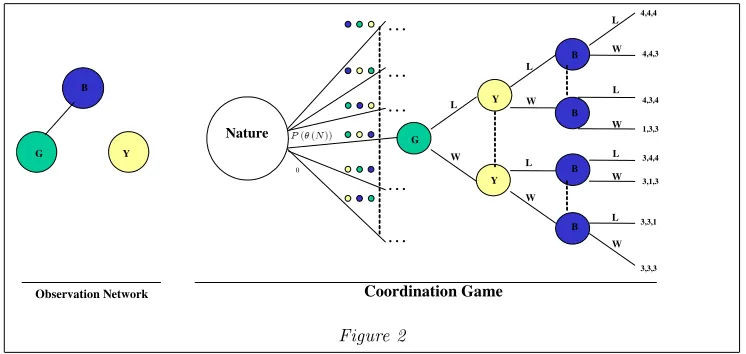
The following example clari…es each of the elements in a coordination game.
Example 1 There are three agents, N = fB; G; Yg. All of them prefer Linux if at least two of them adopt it. Otherwise they would rather use Windows than being the only person using Linux. They are set
in an observation network that links agents B and G, so = fBGg. The action set for all of them is
A=4 fL; Wg,Ldenoting the choice of Linux (W denoting Windows). The utilities are given by:
ui(L;
X
j2N
Iaj=L 2) = 4;
ui(W) = 3;
ui(L;
X
j2N
The extensive form of the coordination game is as follows: G Y B L 4,4,4 4,4,3 4,3,4 1,3,3 3,4,4 3,1,3 3,3,1 3,3,3 0 Nature L L L L L L W W W W W W W B B B Y G B Y Coordination Game Observation Network … … … … … Figure 2
The coordination game associated with the network starts with the Nature selecting one order of decision
with probabilityP( (N)), we illustrate the order GYB. This is the case in which (N) =f3;1;2g(remember
that we have de…ned N =fB; G; Yg). Figure 2 shows that B is the third one who decides, and observes the
action taken by G but not the action taken by Y, who is the second to decide. This is a homogenous case,
with
k=
8 <
:
3for (a; t) = (L;2)
0 otherwise
We use sequential equilibrium as the solution concept. A sequential equilibrium is de…ned by a pro…le
of behavioral strategies in each information set and beliefs such that the strategies are best responses to the
strategies of the other agents conditional on beliefs, and the beliefs are consistent with Bayes rule for some
sequence of completely mixed strategies that converges to the equilibrium ones.
De…nition 2 Let ( 0; 0) be an assessment, a pro…le of behavioral strategies and beliefs for each player in
each of her information sets. The assessment( ; )is a sequential equilibrium (Kreps and Wilson, 1983)
if
1. ( ; )is consistent:
( ; ) = lim
n!1( n; n);f( n; n)g
0;
0 =
8 <
:
( ; ) : is completely mixed and
(x) = PP(((xx)))
9 =
where xis a decision node included in the information set (x), and P (x)and P ( (x)) are the
probability assigned to xand to (x)respectively,by the system of beliefs .
2. ( ; )is sequentially rational:
E uij i; i i ; ; i E uij i; i i ; ; i ;8i2N;8 i2 i
Our aim is to …nd the observation networks that lead to the Pareto-superior equilibrium in the
coordi-nation game de…ned byN; ; Aandk, for any (N); P( (N))andu(:).
De…nition 3 An observation network is a coordination structure for N, A andk, if for all sequence of decision and utilities,8P( (N))and8u(:), all agents take the risky action over the equilibrium path in any
sequential equilibrium of the associated coordination game.
For a set of agents in which it is known how many of them prefer each option, if is a coordination
structure, the unique equilibrium implies the e¢cient coordination. The observation network allows that
some individuals in the game play sequentially instead of simultaneously, which generates that some Nash
equilibria of the simultaneous version can not be sustained as sequential equilibria. We can understand
the concept of coordination structure as the social network such that, if it is known to exist, an agent not
belonging to it would choose the risky action, since she can infer that the unique option is that the structure
promote the coordination in the e¢cient outcome.
3
Coordination structures
3.1
Homogenous case
First we present the result for the homogenous case:
Proposition 1 In the homogenous case with thresholdt, an observation network is a coordination struc-ture if and only if there exists a subset of agentsfq2N : #q=tg that forms a clique.
Proof. See Appendix.
A clique is su¢cient by an argument of backward induction. If there exists a clique of sizet, in any order
the last agent in the clique chooses the risky action if in her information set observes t 1 risky actions.
Agent in position t 1 in the clique best responds to a strategy of this type by choosing the risky action
that also belong to the clique, chooses the risky action when observingr 1risky actions. So the …rst agent
in the clique chooses it, and any agent out of the clique best responds to these strategies by choosing the
risky action, since there aret agents who choose it. Everyone chooses the risky action over the equilibrium
path. We prove that the clique is necessary by constructing an equilibrium assessment in which, over the
equilibrium path, everyone chooses the safe action when the clique does not exist. If everyone believes
that everyone else is going to choose the safe action, everyone choosing the safe action can be sustained
in equilibrium, if the clique does not exist. This is the case because an initial agent cannot know if her
action will be observed by su¢cient people who are also mutually observing their actions in order to be sure
that the …rst best is obtained. Note also that any structure that contains the clique is also a coordination
structure. In this sense, a clique of sizetcan be said to be minimal and su¢cient.
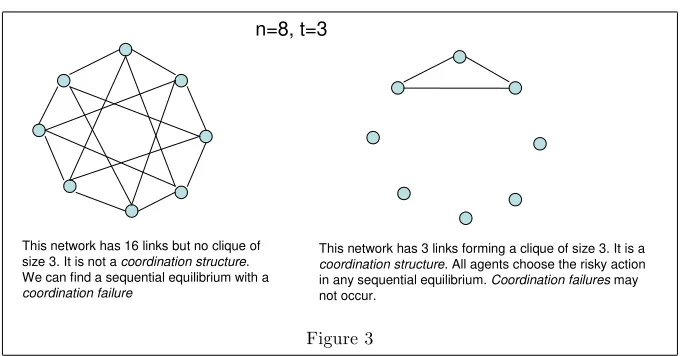
Figure 3 illustrates the importance of the clique. In this example, there are two di¤erent network
structures of n = 8, and it is required that at least 3 agents take the risky action so that it becomes
pro…table.
This network has 16 links but no clique of size 3. It is not acoordination structure. We can find a sequential equilibrium with a
coordination failure
n=8, t=3
This network has 3 links forming a clique of size 3. It is a
[image:15.612.146.486.394.572.2]coordination structure. All agents choose the risky action in any sequential equilibrium.Coordination failuresmay not occur.
Figure 3
The network structure on the left has 16 connections but no clique of size 3. Given our result, in
any sequential equilibrium in the structure on the right, the Pareto-dominant equilibrium emerges. In the
structure on the left, coordination failures are a likely outcome.
3.1.1 Relevance of cliques: consistency
This result supports the importance of cliques in the emergence of coordination from a new point of view.
to signal their decision in those structures. Importantly for our result, it holds for any utility function: it
does not depend onu: it is possible to …nd a coordination failure equilibrium if the clique does not exist, and
it is not possible if the clique exist, for all possible functions that satisfy 1. This has relevant implications.
Imagine the case of a society deciding wether to revolt against a dictatorship. Our homogenous case would
describe a society where everyone wants to revolt, it is known, but it is required a certain amount of people
revolting in order to support these revolts. In this situation, in a simultaneous set up (i.e., an empty network
in our model), both situations are equilibria, everyone or nobody revolting. In principle, which equilibrium
emerges would depend on the relative payo¤s9. For instance, if the penalty if the revolt do not success is
very strong, we would expect that people do not revolt.
However, once the clique exists, relative payo¤s do not matter, and everyone would choose the risky
action even if the penalty for failure is very strong. This intuition make clear that a dictatorship has an
interest in destroying such type of cliques, since penalties for failure would not matter. This also suggests
that we should observe this kind of e¢cient coordination when there exist these large cliques that allow the
observation of actions. This point of view gives an additional explanation for the cities as the usual starting
points of revolts, since in the cities there are large amounts of individuals able to observe each other actions,
i.e. embedded in large observational cliques.
How important are the assumptions that we use for this result? Is it consistent? We argue that it is the
case and that the existence of a clique really plays a crucial role because of several reasons. With respect to
the previous literature, in a closed but di¤erent environment, Chwe (2000) obtained a result that is connected
with ours (we detail this connection in a later section). Importantly he showed that the existence of cliques
has a key role in generating the common knowledge that allows coordination (among other results). We
assume the existence of that common knowledge and show that cliques play also a crucial role for obtaining
coordination as theunique expected outcome.
One of the main points is the independence of the result with respect to utilities: if the clique exists and
the bene…t of coordination is arbitrarily small, the unique equilibrium implies that coordination emerges;
if the clique does not exists, even if many agents are able to observe among themselves and to others, and
even if the bene…t of coordination is arbitrarily large with respect to the failure, it is possible to construct
the coordination failure equilibrium.
The clique is su¢cient for coordination for any possible sequence of decision, but it is also necessary. In
this homogenous case, no matter how the structure or the payo¤s are, no matter who starts to play, the
9This kind of simultaneous situations have been succesfully analyzed withglobal games (Carlsson and Van Damme, 1993).
existence of the clique guarantees the e¢cient coordination, and the non existence of the clique guarantees
the existence of a coordination failure. In fact, the existence of the clique is necessary and su¢cient for any
sequence of decision: there exists no structure in which the coordination failure may not be sustained, even
if the …rst agent who decides is observed by many other people (but not forming a clique of sizet).
Another aspect that reinforces the consistency of the result is the type of equilibrium that we use. Along
the paper, for consistency, we use the concept of sequential equilibrium, which is a relatively strong concept
that requires the existence of very rational beliefs out of equilibrium. Even using this concept, we …nd
that the coordination failure can be sustained when the clique does not exist. When proving uniqueness
of the equilibrium when the clique exist, we in fact prove that it is the case for arbitrary beliefs out of
equilibrium. That is, we prove that coordination is the unique equilibrium outcome for any weak perfect
Bayesian equilibrium. Under our point of view, the fact of obtaining uniqueness of equilibrium with a
very few demanding equilibrium concept as WPBE, and of obtaining multiplicity even under sequential
equilibrium, reinforces the consistency of the result, supporting the real relevance of cliques in the emergence
of coordination.
3.2
General case
The general version of the model allows to study the case when the agents ignore if they are observing people
who share their preferences or not. In this general case, we assume that preferences (i.e., the utility function
of each individual) are private information but that the amount of agents of each type is …xed and common
knowledge10. We start our analysis with some illustrating examples of the simplest case. Imagine a society
formed by n agents, where n 1 are willing to take the action and the other agent has a degenerated
decision, choosing always . We name her the "unwilling" agent. If types are private information, how must
1 0Note that common knowledge about the type distribution implies knowledge about private type in the homogenous case,
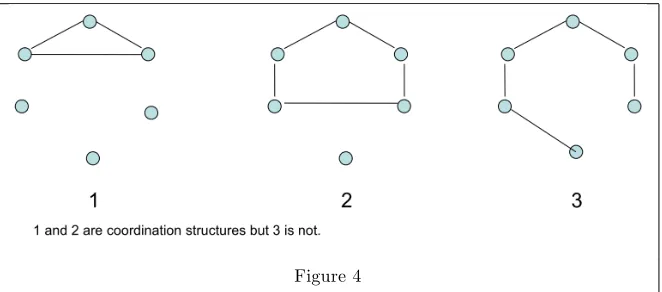
be the coordination structures if agents that prefer have thresholdt= 2? Figure 4 shows some examples.
Figure 4
If there is in the society an observation network as 1 or 2, in any sequential equilibrium, for any payo¤s, and
for any order selected by the nature, agents willing to take choose it on the equilibrium path. Let explain
why. Since the agents have thresholdt= 2;any of them would best respond by choosing if observes that a
predecessor has chosen also . In the network 1, the …rst agent in the clique who has to choose, knows that
her action is observed by at least one agent willing to take the action (she is observed by 2 agents, and only
1 in the society does not want to choose ). Therefore, she best responds by choosing , since then the …rst
best is obtained. The second agent in the clique, when choosing, if she observes that the …rst one has not
chosen must believe with probability 1 that she was the unwilling agent, and assigns probability1 to be
observed by a willing agent. Therefore, in any equilibrium path, the willing agents in the clique choose ,
and agents who does not belong to the clique best respond to these strategies by also choosing . A similar
argument can be applied in the network 2. However, in 3 a di¤erent equilibrium can be sustained. Imagine
that everyone is playing after observing and that penalization of choosing if nobody else chooses it is
extremely high. If the …rst agent who decides is not in the extremes, she will choose since she knows that
is observed by, at least, one willing agent. But if the …rst agent is in one of the extremes, if she plays , with
positive probability she is observed by the unwilling agent, who would choose also . Given the prescribed
strategy, if the order of play is according to the sequence, nobody else would choose , and the initial agent
prefers . Therefore it is possible to sustain an equilibrium failure. The existence of the structure 3 does
not guarantee the non existence of coordination failures.
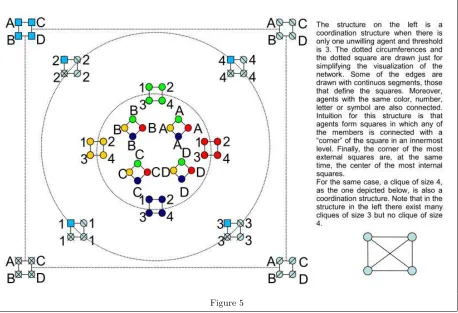
Figure 5 shows other coordination structures when threshold ist= 3and there exists only one unwilling
Figure 5
In this situation of thresholdt = 3, a clique of size 4 as the one in the right corner, formed by 4 nodes
and 6 links, is a coordination structure. The argument is related with the one used for the clique of size 3
when threshold was t = 2. The …gure in the left, with 64 agents and 320 connections is "minimal" since,
if just one link is deleted, a coordination failure may occur in equilibrium (for certain payo¤s and order of
play). It is a coordination structure with cliques of size 3. The …gure is formed by squares where all agents
are connected to a "center" of the square, who is at the corner of another square. In a square connected to a
center, it can be proved that, if the …rst agent who decides is the center and she is of the willing type, then
every willing agent chooses the action . In the structure in the left, every agent is the center of a square,
and her neighbors in the square are at the same time the center of a di¤erent square. Therefore, the …rst
agent who decides chooses the action if she is of the willing type. If she is not of the willing type, the
following agent who decides is in the center of some square and is of the willing type, and so on. In any
order of decision, for any payo¤s, every willing agent chooses in that structure. Therefore, if the structure
equilibrium path.
3.2.1 General results
The previous examples show some coordination structures for a very particular case: one where all the
society shares the same risky action and threshold except for one individual. We have found some simple
structures, as cliques, and some other complex structures. Here we explore if we can obtain more general
results. We …nd that the existence of one clique su¢ciently large guarantees the coordination.
Let focus in the case of agents who share the same risky action but with di¤erent thresholdst. Given our
environment, an agent knows that there are su¢cient people if the clique is of a size at leastn K( ; t) +t.
This is the case sinceK( ; t)are the amount of people in the society who wants with a threshold smaller
or equal thant,n K( ; t)are all individuals in the society who would not take optimally although there
weret agents choosing it. The following lemma comprises this insight:
Lemma 1 An agent of type f ; t0g; t0 t takes the risky action on any equilibrium path if there exists a
clique of sizen K( ; t) +t
Proof. See Appendix
If there exists a clique of size n K( ; t) +t, it is sure the existence of t agents willing to choose
. Note that the clique of size 3 in Figure 4 and the clique of size 4 in Figure 5 can be shown to be
coordination structures according to this Lemma. There are signi…cant di¤erences with the homogenous
case. In particular, in the equilibrium of coordination, it is likely that an agent observes actions di¤erent
from her risky action. What Lemma 1 adds to our knowledge is that, in any sequential equilibrium and
given the existence of the clique, any equilibrium beliefs of the agent must incorporate probability 0 to the
event of those non-risky action being taken by agents like the individual (other agents who share her own
risky action). In the Appendix we prove that this is the case.
When having di¤erent thresholds, however, a second e¤ect must be incorporated, related with a "cascade
e¤ect". Because of Lemma 1, an agent of type( ; t)takes the risky action if there exists a clique of size at
leastn K( ; t) +t. But note that an agent of type ( ; t) takes the risky action also if there aret agents
with a threshold smaller thant (sayt < t). In such a case, the clique required by agents with thresholdtis
also su¢cient for the agents with thresholdt. All these insights are summarized in the following theorem:
q N of size #q=q(t)where
q(t) = q (r (t)); (8)
wherer (x) = minfN K( ; t) +t:8t xg
q (x) =
8 <
:
r (x) if r (y)< x
r (y) if r (y) x ; y= maxft:y < xg
whereq (x)is constructed iteratively from the lowest threshold xfor the action .
Proof. See Appendix.
Theorem 1 shows that if a clique of certain size exists, then the agent takes the risky action in any
sequential equilibrium. This is the case for an agent of given type, independently of how many di¤erent
preferences exist (in risky actions or threshold). So this result can be applied for environments where people
di¤er in their objectives of coordination. The result of Lemma 1 is incorporated in r (x), which includes
that an agent takes the risky action when the condition of the Lemma 1 is met by the agents with some
threshold equal or larger than her threshold. The possibility of existing more than t agents choosing the
risky action with a threshold smaller thant is incorporated in q (x), which is constructed recursively and
says that, if there are more thantagents with a threshold smaller thant0 < t, the size of the clique required
by agents with thresholdt is the same than the one required by the agents with thresholdt0. The following
example of a society of 25 agents who share the same risky action but di¤er in their thresholds, and 1
agent who prefers 0, illustrates the result.
Example 2 Let suppose a set of agents N =f1;2; :::;26g which play a game of coordination. The type of agents is given by
k(:; :) =
8 > > > > > > > > > > > > > > > < > > > > > > > > > > > > > > > :
5 for ( ;2)
5 for ( ;6)
8 for ( ;10)
2 for ( ;14)
5 for ( ;21)
1 for ( 0;1)
0otherwise
risky action in any equilibrium:
t k( ; t) N K( ; t) N K( ; t) +t r (t) q (r (t))
2 5 21 23 18 18
6 5 16 22 18 18
10 8 8 18 18 18
14 2 6 20 20 18
21 5 1 22 22 22
Table 1
If there is a clique of size23, agents with thresholdt= 2know that there are at least 2 people with threshold
2 in the clique, and therefore, they are going to take the risky action. Agents with threshold at most ten
(t 10) know that if there is a clique of size18, it includes with certainty at least 10 agents with a threshold
equal or smaller than 10. Therefore, those agents with threshold at most 10 in the clique coordinate on their
e¢cient action in any equilibrium, and - since the network is common knowledge - also any other agent with
the same threshold in the society will do so. This is the direct e¤ect of a clique of size18.
Finally, the "amplifying" e¤ect generates that agents with threshold 14 take the risky action also when
there is a clique of size18. This occurs because this clique generates that all agents with a threshold smaller
or equal than 10 take the risky action in any equilibrium path; and since they are 18 agents, the e¤ect of the
clique a¤ects also to those agents with threshold at most 18 (in this case, the 2 agents with threshold 14).
However, the agents with threshold 21 will not necessarily follow suit. They require the existence of a clique
su¢ciently large to know that 21 agents will coordinate: in this case, a clique of size22.
Note that, in the example, if there exists a clique of size 22, any agent chooses the risky action. This
means that an observation network including a clique of size 22 is, in fact, a coordination structure.
Nevertheless, if the highest threshold was 18 instead of 21, then a clique of size 18 would be a coordination
structure. Therefore we can obtain a su¢cient condition for the existence of a coordination structure, that
follows directly from the Theorem 1:
Corollary 1 A network is a coordination structure in the incomplete information case if there exists a subset of agentsns N : #s= maxfq (r (t))g8 2A;8tothat forms a clique.
Proof. If there exists a clique of size ns N : #s= maxfq (r (t))g8 2A;8t
o
, given Theorem 8, for any
agent in N there exists a clique su¢ciently high such that she takes the risky action over any equilibrium
Agents of each type require a clique of a given size for choosing the risky action for sure. Corollary 1
says that if the largest of the required cliques exists, everyone chooses her risky action. And therefore
is a coordination structure. This can be applied when in the society there are groups of agents who di¤er
in their risky action . In these conditions, Corollary 1 shows that if a su¢ciently large clique exists, the
unique equilibrium outcome is the Pareto-e¢cient one.11
This result provides us with a su¢cient condition to obtain coordination in the case of heterogenous
agents with private types. It is required the existence of a clique larger than in the homogenous case. The
reason is that now, initial agents who would potentially coordinate require that their action is observed by
much more people than before in order to be sure that they are coordinating with su¢cient people of the
same type. At the same time, people who plays lately in the sequence of decision requires also to have enough
observations over the past in order to identify correctly those agents who are not choosing the risky action
as agents of a type di¤erent from their own type. When an agent has information of the types of the agents
she is observing to act (the homogenous case), we have shown that still a clique of size t is necessary. So
that, this represents a lower bound on the requirements for coordination. We can imagine that in the case
of private information, the existence of a clique of size t is necessary. Figures 5 and 6 show some of these
structures, formed by small cliques of the size that would be required in the case of known types. In the
Discussion in the following section, we argue how can be constructed this family of coordination structures
and show them for the simplest cases.
It is interesting to note that the …rst individuals to decide are not always those whose threshold is the
lowest. However, this does not impede coordination, because agents’ choices are strategic and consequently
even an agent with a high threshold takes the risky action if the observation network enables coordination.
The ability to observe other actions works as mechanisms of coordination. When people know that there
is a su¢cient amount of other agents, and that they are mutually observing their respective actions, they
are able to signal their type to the rest of members of the group by choosing their preferred action. This
happens only if the group is su¢ciently large to ensure that enough people with the same type will observe
the action: coordination failures are less likely when there are larger groups of people able to observe each
1 1The result relies on the fact that coordination in the risky action generates the highest possible payo¤. It is worthy to note
other (even if they do not communicate).
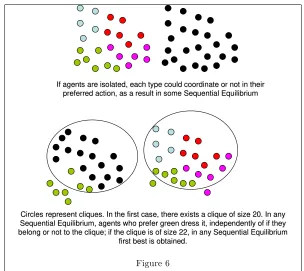
Figure 6 illustrates the case of a coordination structure when there are di¤erent risky actions (although
for simplicity, we assume that all thresholds are the same). Let suppose a society of 24 individuals who have
to dress for a party. We assume that each one has a preferred color to dress, preferring 7 of them to dress in
green, 6 in red, 6 in pink and 5 in blue. However, they prefer it only if at least 2 people more are dressing
their preferred color. If not, they prefer to dress in black. Formally, this is a case whereN =f1;2; :::;24g,
A=fgreen; red; pink; blue; blackg and
k( ; t) =
8 > > > > > > > > > < > > > > > > > > > :
7 if ( ; t) = (green;7) 6if ( ; t) = (red;6)
6if ( ; t) = (pink;6)
5if ( ; t) = (blue;5)
0otherwise
In this situation, what observation networks are coordination structures?
If
Ifagentsagentsareareisolatedisolated,,eacheachtypetypecouldcouldcoordinatecoordinateorornotnotinintheirtheir preferred
preferredactionaction, as a, as aresultresultininsomesomeSequentialSequentialEquilibriumEquilibrium
Circles
Circlesrepresentrepresentcliquescliques. In. Inthethefirstfirstcase,case,therethereexistsexistsaacliquecliqueofofsizesize20. In20. Inanyany Sequential
SequentialEquilibriumEquilibrium,,agentsagentswhowhopreferprefergreengreendressdressitit,,independentlyindependentlyofofififtheythey belong
belongorornotnottotothethecliqueclique;;ififthethecliquecliqueisisofofsizesize22, in22, inanyanySequentialSequentialEquilibriumEquilibrium
first
firstbestbestisisobtainedobtained..
Figure 6
Theorem 1 shows that, if there exists a clique of size 20, every agent whose preferred action is green
a coordination structure, since the agents who prefer blue are those who require the highest clique, and it is
of size 22. If such an observation structure exists, in any order of play, for any payo¤s, every agent chooses
her risky action over the equilibrium path and the …rst best is obtained: all agents will dress in their favorite
colors. It is important to remember that we are analyzing a situation where agents do not communicate.
Our conditions are su¢cient only if the individuals in the clique are able to observe how each other …nally
dresses.
The clique required by Theorem 1 and Corollary 1 may be very large, which is typically not likely.
However, the kind of social interaction that we are studying is mild: a link between two subjects only
implies that they are able to observe their actions. This can be simply the case of living in the same
neighborhood. Imagine once more the case of revolts against dictatorships. People may prefer go to the
streets if enough other people are going to revolt. We require that these actions are observable. One can
imagine that a city would be in fact a clique that connects all its citizens, since in a city, each agent would
observe if other agents go to the streets. Our result implies that if there exist a clique su¢ciently large,
coordination emerges. In the revolt environment, we would say that if there exists a city su¢ciently large,
where people are able to mutually observe their actions, we expect that revolt occurs. We argue that this
mechanisms can give some insights on the cities being places where revolts generate. In fact, we are saying
that if people know that there exist a city su¢ciently large, where there are for sure su¢cient people willing
to revolt, everyone would decide to revolt, even people who is not in the city, and even people who require
high thresholds for participating. The di¤erence with respect to the homogenous case is that now when the
agents take the decision they do not know who of their neighbors are willing to take it, but we show that
also in this situation the unique outcome is the e¢cient one when a su¢ciently large clique exists. The key
point is to know that there exist su¢cient people willing to revolt.
4
Discussion
The existence of a su¢ciently high clique guarantees the coordination of agents for any payo¤s and for any
sequence of decision. Now we discuss some other possibilities, the case of coordination structures formed
by more complex structures with many smaller cliques, as the one depicted in Figure 5, or structures that
guarantee the coordination for particular payo¤s or sequence of decisions, a case that we name
4.1
Coordination structures with smaller cliques
An agent that has to coordinate with a part of the society in order to obtain her …rst best takes her risky
action if she knows that there exists a su¢ciently large clique, as determined by Theorem 1. However, in
contrast with the homogenous case, it is not a necessary condition: it is possible to …nd structures with
cliques of smaller sizes that also guarantee the coordination in the risky action for any payo¤s and sequence
of decision. Figures 4 and 5 illustrate the case when there is 1 agent in the society who will play always the
safe action and the required threshold ist= 2ort= 3respectively. Here we discuss how can be constructed
these structures. We focus in the simplest case, when there is a group of agents with the same risky action ,
the same thresholdtand the rest of the society chooses always the safe action . We namen the cardinal of
agents who prefer if at leasttagents choose it andn the cardinal of agents who always choose . Abusing
the notation we say that an agent is of type or of type respectively. In this kind of situations, following
Corollary1, a clique of sizen +tis a coordination structure. In fact, any larger structure including a clique
of sizen +tis a coordination structure. But what about structures formed by smaller cliques?
What can be known about any sequential equilibrium, for any order and payo¤s? Any equilibrium
strategy pro…le must include that an agent of type chooses the action in all those information sets where
she observes t 1actions . For the simplest case, when t= 2, an agent of type chooses it if she knows
that is followed by another agent of her type. If in the society there is only one agent of type ,n = 1, an
agent of type who has two neighbors who have not played yet will choose action in equilibrium. The
simple structure where we can know that there will be a initial player with two neighbors is a triangle, the
clique of size3. For this case, one clique of size 3 is su¢cient, in fact, because of Lemma 1.
Can we found other coordination structures for this case? Yes, as depicted in Figure 7, an square is also
a coordination structure: an agent of type has two neighbors and will choose ; consistent beliefs imply
that, if she does not play , must be the type agent with probability 1. The square is an example of
coordination structure formed by cliques of size2for the caset= 2,n = 1.
For the case of t= 2, n = 2each agent requires to have3 successors in order to play the risky action
if is of type . In a clique of size #q =t+n = 4, every agent has 3 followers, and therefore if the …rst
one plays consistent beliefs imply that she is a type agent. In order to obtain a coordination structure,
we require agents who have 3 successors. In this way, an agent of type will choose in any sequential
equilibrium, because having 3 successors she knows that at least1 is of type . It can be got with a clique
of size4 or with other structures with more nodes and connections but cliques of smaller size. In Figure 7
we have drawn di¤erent coordination structures whent= 2 and the amount of agents of type is between
n + 1 neighbors.
Figure 7
When coordination is more di¢cult, that is, when it is required more agents for obtaining coordination,
coordination structures become more complex. In Figure8we have drawn the required coordination
struc-tures formed by cliques of size 3 for the case whent= 3 and n = 1and n = 2. In this cases, cliques of
size 4 and 5 would be su¢cient, following Corollary 1. But structures become much more complex when
using smaller cliques. In the simplest case, whent = 3 andn = 1, a square with all corners linked with
a "center"12 generates that, if the center is the …rst who plays, she will choose if is of such type. For
obtaining a coordination structure, we must ensure that each of the agents is the center of a square. Figure
8 shows how looks a network where it occurs. When n = 2, the center of an hexagon whose opposite
corners are connected would also choose if she is of such type and is the …rst who play. Therefore, we can
construct a coordination structure if we guarantee that each node is the center of an hexagon of that type.
Note that in such an hexagon, the highest clique is of size2, and therefore, if agents connect to some center,
[image:28.612.100.532.211.577.2]the highest clique remains of size3.
Figure 8
Figure 8 illustrates the complexity that can require an observation network in order to be a coordination
structure when size of the cliques is limited. Corollary 1 guarantees the existence of a coordination structure
with a relatively low requirements in terms of amount of nodes and connections. Moreover, it guarantees the
existence of some coordination structure when there are su¢cient agents for the coordination: ift Fa(t),
that is, if there are enough agents for coordination, a complete network always contains a clique of size
4.2
Quasi-coordination structures
Up to now, we have analyzed how are the structures in which coordination problems do not occur for any
payo¤s and for any sequence of decision. However, in particular situations, it is possible also that the unique
equilibrium is the one where everybody plays her risky action with other structures, for particular payo¤s
and/or sequences of decisions. In this subsection, we study this situation. We focus, as previously, in the
simplest coordination problem in a heterogenous society: a society formed byn agents that are playing the
coordination game among them. These agents prefer over the safe action if at leasttagents are choosing
. There are alson agents who always choose action .
The agents who face the coordination problem are homogenous with respect to their threshold, so that
the utility of agents of type can be reduced to the payo¤su ; t > u > u ;<t, that represent the utility
they get if choose or , depending on wether …nally there are less thant people choosing or not. Since
we deal now with speci…c payo¤s, we assume that agents are expected utility maximizers.
4.2.1 Quasi-coordination structures for certain payo¤s
We say that a network is a Quasi-coordination structure for certain payo¤s if, for any possible sequence
of decision, any agent chooses always her risky action over the equilibrium path, under certain restrictions
over the payo¤s. The following proposition shows that an isolated clique of size#q=tcan be su¢cient. An
isolated cliqueq N is a set of individuals such that8i2q; ij2 ()j2q. It occurs when the bene…t of
the risky action is su¢ciently high.
Proposition 2 In any sequential equilibrium, any agent of type chooses over the equilibrium path, for
any sequence of decision, if there exists an isolated cliqueq N of size #q=t when
u ; t u ;<t
u u ;<t
> (n +n 1)! (n t 1)! (n +n t 1)! (n 1)! =
1 ~
p andn > t
Proof. See Appendix.
This proposition reveals that, even when types are uncertain, a clique of size t may be su¢cient for
coordination. This is true ifu ; t andu ;<t are su¢ciently large with respect tou . In this circumstances,
an agent who is not connected to the clique assigns a probability su¢ciently high to the event of existing
t agents of type in the clique such that they are going to coordinate among them (in the Appendix we
prove that it is the case). In fact, p~is the probability of having tagents of size in the clique conditional
on having one agent of type out of the clique:Therefore, any agent who is not connected to the clique best
there are higher cliques, the probability of having su¢cient agents of type 0 in the clique increases, and
there are a higher set of utilities under which coordination would emerge for any sequence of decision. This
reasoning connects with Lemma 1: when there exists a clique of size n K( ; t) +t, it includes for sure a
set oftagents with threshold t. Since it occurs with probability 1, every agent chooses the risky action for
general coordination payo¤su ; t > u > u ;<t.
Non-isolated: more connections may destroy coordination Interestingly, in this case we have that more connections could potentially generate the existence of coordination failures. Our general results of
coordination structures show some kind of networks such that, if the structure exists, coordination emerges
always, independently on wether there are more connections or not. It is not the case with quasi-coordination
structures for certain payo¤s. Note that Proposition 2 requires the existence of an isolated clique. When
it exists, nobody knows what is occurring in the clique and agents believe that coordination occurs with
su¢cient probability, and they take the risky action. But if agents are observing what occurs in the clique,
with positive probability we have in it agents who are not of type , and agents observing actions in the
clique would play simultaneously with the rest of agents of type . In this case, under some sequences of
decision, agents of type would choose the safe action over some equilibrium path (speci…cally, when they
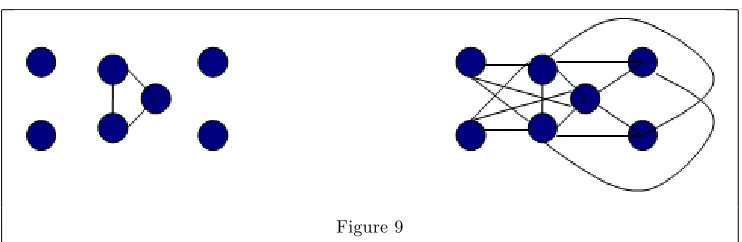
play after agents in the clique, and agents in the clique are not of type ). In the Figure 8 we present two
di¤erent networks. For the case in whichn = 4, n = 3, we have that a clique of size 3includes 3 agents
of type with probabilityp= 4
35. An agent of type who does not belong to the clique believes that it is
formed by agents of type with probability13 p~= 1
20. If utilities are given byu ; t= 21; u = 1; u ;<t = 0,
the agents of type who are not connected to the clique in the network in the left choose the risky action
in any equilibrium, and agents in the clique best respond to it by also choosing , even if they observe that
some agent in the clique does not choose .
1 3It is the probability of the 3 agents in the clique being of type conditional on one agent out of the clique being of type
. Note that in such circumstances, there are 3agents of type and3 agents of type that can be in the clique, and the probability of everyone being of type is given byp~=3
6 2 5
1 4 =
Figure 9
However, in the …gure in the right all the agents are connected to the clique. If the sequence is such that
the agents in the clique are the …rst to decide and they are of type , all agents out of the clique know that
they are playing simultaneously with the rest of agents of type and the failure of coordination may occur
in equilibrium, just by assuming that in such information set anyone of them chooses . In this sense, more
connections, more information, may be detrimental for coordination14.
4.2.2 Quasi-coordination structures for certain sequences of decision
We have shown that smaller networks may be quasi-coordination structures for certain payo¤s. Another
interesting issue is if we can …nd quasi-coordination structures that guarantee the e¢cient equilibrium for
certain sequences of decision but general payo¤s. The answer is positive and we show now some examples,
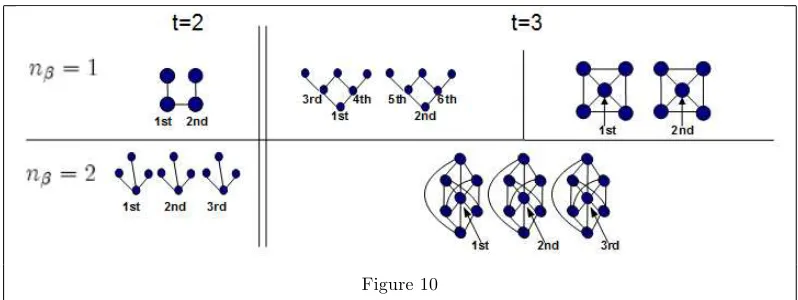
using the same framework that in the rest of this subsection. Suppose that there are n and n = 1
individuals, and that threshold is t = 2. The central agent in a segment of three nodes chooses the risky
action in this context. Therefore, if in the order of decision the central individuals play the …rst and there are
two segments of three individuals, the risky action is played by everyone. Figure 9 illustrates some examples
for the cases in which t = 2 or t = 3 and n = 1 or n = 2. We have written a part of the sequence of
decision with the ordinal position of the di¤erent nodes. This networks are quasi-coordination structures for
any possible payo¤s if the nodes with a assigned position play in that position, and for any order of decision
of the nodes for those we have not written a position. If the sequence of decision is known, since at least t
agents will choose , any agent of type in the society who is not included in those structures chooses it as
well.