Munich Personal RePEc Archive
Perceived effectiveness of training and
development: a case study in stc
technologies pvt ltd., chennai
Swaminathan, j and Gowri shankar, u
A.V.C.College of Engineering, India
1 March 2011
Online at
https://mpra.ub.uni-muenchen.de/39641/
PERCEIVED EFFECTIVENESS OF TRAINING AND DEVELOPMENT
A CASE STUDY IN STC TECHNOLOGIES PVT LTD, CHENNAI.
J.SWAMINATHAN M.A., B.L., M.B.A, M.Phil., U. GOWRI SHANKARM.B.A, M.Phil.
Department of Management Studies, A.V.C.College of Engineering, Mannampandal, Mayiladuthurai 609 305 Tamil Nadu
Mobile : 9488923659 Mobile : 9788065789
Email- < [email protected]> Email- [email protected]
ABSTRACT
Training is the act of increasing the knowledge and skill of an employee for doing particular job .The training is to acquire new skill, technical knowledge, problem- solving, etc. Training improves the performance of employees on present jobs and prepares them for taking up new assignments in the future. Training also helps in the development of the employees.
The main objective of the study is to measure the effectiveness of the training in the organization and its impact on employee job performance in the organisation.
INTRODUCTION
TRAINING AND DEVELOPMENT
Training and development is the field concerned with organizational activity aimed at bettering the performance of individuals and groups in organizational settings. It has been known by several names, including employee development, human resource development, and learning and development.
An organisation which aspires to grow must be in tune with the changing needs of the society. Training becomes relevant in the context since it is only through training that the gap between performance of the organisation and the felt need of a changing society can be neutralised. Training reduces the gap by increasing employees’ knowledge, skill, ability and attitude. Employees are motivated to attend the training programmes by the management for self development as well as organization development Employees realize the importance of training needs of training to achieve the organizational goals.(5)
Training and Development are terms which are sometimes used interchangeably. Development was seen as an activity associated with managers. In contrast training has a more immediate concern and has been associated with improving the knowledge and skill of non-managerial employees in the present job. In management education system, training system is a set of interdependent parts which together form a unitary whole that performs a well defined function. It essentially has an input, a processing or transforming unit, an output and a feedback.(4)
Every organisation needs the services of trained persons for performing the activities in a systematic way. The fast changing technological development makes the knowledge of employees obsolete. They require constant training to cope with the needs of jobs. After selecting the employees, the next task of management is to give them proper training.
Training makes a very important contribution to the development of the organisation human resource and hence to the achievement of its aims and objectives. To achieve its purpose training needs to be effectively managed so that right training is given to the right people in the right form at the right time and at the right cost.
Training is different from college education since management is relating experience to learning going from experience and concept. Training is purely vocational in contrast to
The term training indicates the process involed in improving the apptitude, skills, and abilities of the employees to perform specific jobs.(6)
Training is a vital phase of management control .It helps in reducing accidents, eliminating wastages and increases the quality of work. The training programmes must focus on are soft skill ,such as interpersonal communication , team work , innovation and leadership .most importantly the training has to be comprehensive ,systematic and strategy with which the company is planning to fight the competition . In the future it is training that will act as between people, between strategy and between customers and the organisation. The development of individual and teams through training is important for the achievement of long term goals of the organization.(3)
The existing favourable conditions and the rate at which it is expected to grow the BPO sector requires large number of trained and well groomed employees. Any attempt which undermine the importance of training could adversely affect the quality of service provided and in turn becomes detrimental to the outsourcing business itself. Hence it is significant not only to identify the training needs of this sector but also the appropriate mode of training(1).
Importance of Training(6)
The benefits of training like Better performance, Employee Development, Personal Growth, Less Supervision and High morale clearly shows its importance.
NEED OF THE STUDY
Training is very important for employees in doing the job and it improves the performance or skills. Training strongly influence the productivity, efficiency, innovative ideas and complete knowledge about the job.
Therefore, it is necessary to know the training given to the employees in the organization provide them level of acceptance, care and confidence after the training programme and their satisfaction about the training programme.
SCOPE OF THE STUDY
In earlier researches while gender, educational background experience and salary did not influence the opinion on the impact of training on individual such as enhancement of self-confidence, improvement of individual, competence, decision making ability, problem solving significant differences were noticed among the different positions and age groups.(2)
PROFILE OF THE COMPANY
STC Technologies Pvt. Ltd.
STC Technologies is an independent software testing service company providing enterprise-wide critical quality solutions to software development organizations. With a unique, effective and efficient approach to quality, STC helps clients align IT to their business strategy and implement projects that provide a measurable return on investment.
STC is among the fastest growing and most innovative Software and Human Resource Consulting firm based at Chennai, India. The company provides comprehensive services in the areas of IT Staff Recruiting, Temporary Staffing, Executive Staffing, and Job Placements for leading technology companies both in India and outside.
STC Technologies is the country's leading provider of Outsourced Independent Testing Services to the IT organizations of the most admired corporations in the Banking, Finance, Insurance and Technology sector.
Training
STC Technology provides a formalized set of training courses on Manual and Automated regression and load testing tools, as well as a more generalized training class on quality assurance methodology for managers.
The On site training courses is provided at their premises for larger groups and teams. This flexible and cost effective method of training allows them to schedule training around your project schedule allowing all members of your team and project to be involved.
OBJECTIVES OF THE STUDY
1. To analysis the perceived effectiveness of training and development provided by STC Technologies.
2. To evaluate the impact of the training programme on employee job performance.
Research Design:
ended and multiple choice questions is used. The primary data is collected from the 60 employees selected by Simple Random Sampling Method. Chi- Square, ANOVA and Correlation Analysis were used to analyse the data.
Limitation of the study
The effectiveness of training and development programme is measured only on the basis of the perceived satisfaction level regarding the programmes.
ANALYSIS AND INTERPRETATION OF DATA
Table.1
Perceived Effectiveness Score
Effectiveness Elements Total Score Average(Totalscore/60)
1.Competent Faculty 250 4.17
2.Resourse used 207 3.45
3.Information gained 221 3.68 4.Evaluated after training 239 3.98 5.Comfortable training environment 209 3.48
6.Interval between 183 3.05
7.Well planned 212 3.53
8.Overall training 213 3.55
9.Importance to the personal 239 3.98 10.Develop my career 263 4.38 11.Organisation development 252 4.2
12.New skill 264 4.4
13.Self development 247 4.12
14.Techincal skill 259 4.31
15.Work better with job satisfaction 242 4.03 16.Improves job performance 263 4.38 17.Offerd minimize accident 220 3.66 18.Improve working condition 266 4.43 19.Work development 248 4.13
Total 74.91
Source : Primary Data
Effectiveness score= 74.91/19=3.94/5*100=78.8 %
Table 2
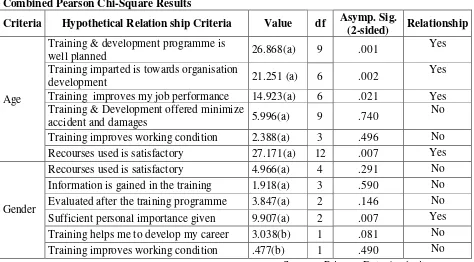
Combined Pearson Chi-Square Results
Criteria Hypothetical Relation ship Criteria Value df Asymp. Sig.
(2-sided) Relationship
Age
Training & development programme is
well planned 26.868(a) 9 .001
Yes
Training imparted is towards organisation
development 21.251 (a) 6 .002
Yes
Training improves my job performance 14.923(a) 6 .021 Yes Training & Development offered minimize
accident and damages 5.996(a) 9 .740
No
Training improves working condition 2.388(a) 3 .496 No Recourses used is satisfactory 27.171(a) 12 .007 Yes
Gender
Recourses used is satisfactory 4.966(a) 4 .291 No Information is gained in the training 1.918(a) 3 .590 No Evaluated after the training programme 3.847(a) 2 .146 No Sufficient personal importance given 9.907(a) 2 .007 Yes Training helps me to develop my career 3.038(b) 1 .081 No Training improves working condition .477(b) 1 .490 No
Source : Primary Data Analysis
Hypotheses:
Ho: There is no significant relation ship between Age/Gender and the measured criteria. H1: There is significant relation ship between Age/Gender and the measured criteria.
When the significant value is less than 0.05 the null hypothesis is rejected and if it is more than 0.05 the null hypothesis is accepted. The relationship between various opinions and age/gender is clearly seen in the table.
Table.3 Correlation
Assumptions Correlation Relationship
Training conducted by competent faculty and
comfortable with training environment. .503 Positive correlation Evaluated after the training and no.of the training
programs attended .340 Positive correlation Sufficient personal importance given in the training
and training is well planned .239 Positive correlation Overall training in my organization is satisfactory and
no .of training programs -.341
Negative correlation
Training is towards organization development and
personal importance is given .298 Positive correlation Age and training programme improve working
condition.
.031 Positive correlation
Inferences:
1) This implies when the competency of the faculty increases, the comfortability of participants also increases.
2) This implies the increase in no.of.training programs increase the opinion about evaluation after training.
3) This implies the training is well planned and the participants feel that personal importance is given.
4) The negative correlation implies, if the no.of.training programs increase the overall satisfaction decreases to some extent.
5).The training is towards organisation development and is also giving importance to the personal.
6).The age has a small influence in the opinion of working condition improvements.
Table.4
ANOVA
Criteria Relationship Mean
Square F Sig.
Gender
Training conduted by competent
faculty .193 .424 .517
Recourses used in the training is
satisfactory 5.630 4.858 .031 Information is gained in the training
programme .000 .000 .996
Satisfied with time interval between
various training programs .534 .363 .549 Training imparted is towards
organisation development .250 .409 .525
Age
Recourses used in the training is
satisfactory 3.706 3.361 .025 Evaluated after the training programme. 1.391 2.704 .054 Sufficient personal importance given in
the training .944 1.754 .166 Training develops new skill .149 .667 .576 Training improves working condition .195 .774 .514 Overall training in my organisation is
Hypotheses :
Ho : Both male and female employees have equal chances of giving opinion about training.
H1 : Both male and female employees have no equal chances of giving opinion about
training.
Inferences:
When the significant value is greater than 0.05 the null hypothesis is accepted and when it is less than 0.05 null hypotheses is rejected.
1) There is no gender bias on the opinion about competent faculty.
2) There is no gender bias on the opinion about satisfactory resources used.
3) This implies there is no gender bias on the opinion about the information gained. 4) There is no gender bias on the opinion about the satisfaction with intervals between various training programs.
5) There is no gender bias on the opinion about training given towards organisation development.
6) This implies age did not affect the opinion about satisfactory resources used. 7) This implies age did not affect the opinion about evaluation after training.
8) This implies age did not affect the opinion about giving importance to the personal.
9) This implies age did not affect the opinion about new skill developed by training. 10) This implies age did not affect the opinion about the working condition improvements by training.
11) This implies training did not affect opinion about overall satisfaction.
Findings
Majority of the employees are found to be 30-40 years of age and have attended
mostly internal training programs. They also opined that the training and development programs offered by STC are more satisfactory to the employees.
In the chi-square analysis, it is found that there is relationship between Age and
Through the correlation it was found that the comfortability increases with the
number of training programs, opinion on evaluation improves, organisation development training, personal importance and improves opinion on working condition. But the overall satisfaction of training programme decreases with the increase in number of training programme attended.
In the Anova analysis it is found that the age and gender did not affect the
opinion about organisation development and satisfactory resources used. Similarly they did not affect overall satisfaction about training.
The average score as found to be 74.91.This implies that the perceived
effectiveness is up to 78.8 %. The training provided by the company is more effective because the employee’s satisfaction level is more.
Suggestions
While planning the training programme age is to be considered. Since the increase in the number of training programs decrease the overall satisfaction to some extent the required training programme only to be given to the employees. Based on the opinion current need identified is career development and organization development. Similarly the opinion as need for developing new skill identified is related to self development by the training programme. The opinion about training helps to work better and improves job satisfaction and working condition. This points are to be considered to improve the effectiveness of training and development programme.
Conclusion
Refrerences
1. Employment structure and Training need in the emerging Business process outsourcing (BPO) Industry, Sujatha Sony, Indian Journal of Training and Development xxxv No.1 (January – March 2005)
2. Training as an effective HRD Technique in Banking sector - An opinion survey
Dr.T.Raju, Indian Journal of Training and Developnment xxxv2 (April – June 2005)
3. Manager’s Training Parameters, Dr. Udai Pareek, Indian Journal of Training and Developnment xxxv3 (September 2005)
4. New concept in management Education & Training System (feed back oriented Rationalized Management Education Training System),Dr. S.K. Shrivastav, Indian Journal of Training and Development xxxv2 (April – June 2005)
5. S. Sundarajan, Indian Journal of Training and Development xxxvii No.3 (July – September 2007)
6. Dr. Manju Gupta, Indian Journal of Training and Development xxxvii No.3 (July – September 2007)
ANNEXURE I
PERCEIVED EFFECTIVENESS OF TRAINING AND DEVELOPMENT IN STC TECHNOLOGIES PVT LTD – CHENNAI.
Questionnaire
1) Gender
Male Female 2) Age
Below 30 30-40 40-50 50&above 3) The attend any training programme in your organization. Yes No
External Internal
5) Number of training programme attended by me so for. 2 4 6 morethan 8
6) Training programme Conducted by competent faculty.
Strongly agree Agree Neutral Disagree Strongly disagree 7) The resourse used the training programme is satisfactory.
Strongly agree Agree Neutral Disagree Strongly disagree 8) The information gained from the training programme is.
Strongly agree Agree Neutral Disagree Strongly disagree 9) I was evaluated after the training programme.
Strongly agree Agree Neutral Disagree Strongly disagree 10) The type of training conducted in my organization is.
Skill Training Refresher Training Appretiship training Team Training 11) I feel comfortable with the training environment.
Strongly agree Agree Neutral Disagree Strongly disagree 12) I am satisfied with time interval between various training programmes.
Strongly agree Agree Neutral Disagree Strongly disagree 13) The training and Development programme is well planned.
Strongly agree Agree Neutral Disagree Strongly disagree 14) The overall training programme in my organization is satisfactory.
Strongly agree Agree Neutral Disagree Strongly disagree
15) Sufficient personnal importance is given the training programme.
Strongly agree Agree Neutral Disagree Strongly disagree 16) Training helps me to develop my career.
Strongly agree Agree Neutral Disagree Strongly disagree 17) The training imparted is towards organization development.
Strongly agree Agree Neutral Disagree Strongly disagree 18) Training develop new skill.
Strongly agree Agree Neutral Disagree Strongly disagree 19) The training programme is related to self development.
Strongly agree Agree Neutral Disagree Strongly disagree 20) I need training to enhance my technical skill.
21)Training makes me to work better with job satisfaction.
Strongly agree Agree Neutral Disagree Strongly disagree 22) The training programme provided by the company improve my job performance.
Strongly agree Agree Neutral Disagree Strongly disagree 23) The training &development offerd to me minimize the accident and damages to
equipment.
Strongly agree Agree Neutral Disagree Strongly disagree 24) My purpose of training programme is to improve working condition.
Strongly agree Agree Neutral Disagree Strongly disagree 25) The training programme is related to work development.
Strongly agree Agree Neutral Disagree Strongly disagree
Your valuable suggestion regarding training & development in the organization.