lllfiP
"lai!
1971
WÚmm
j§P|iliÌPP'
niBUìfiùt '*^':3 ÍSKÍ
Joint Nuclear Research Centre Geel Establishment - Belgium
Central Bureau for Nuclear Measurements - CBNM
ff
LEGAL NOTICE
document was prepared under the sponsorship of the Commission e European Communities.
Neither the Commission of the European Communities, its contractors nor any person acting on their behalf :
L a u A L N O T I C E
WãMmmlmmi
■'■"■'■
mmm
im l> ίιΠτ^ιζ v . ^ ^ ^ , ν,χ na,, uic use ui any ì n r o r m a n o n , apparatus, m e t h o d
or process disclosed in this document may not infringe privately owned rights; or >>S [BW,M
assume any Hability with respect to the use of, or for damages resulting
from the use of anv infnrrrmHnr. cmr,,,™«-,^ « „ f U J : _i_ ,j 'PsffiH : «-ι ' ï
make any warranty or representation, express or implied, with respect to the accuracy, completeness or usefulness of the information contained m this document, or that the use of any information, apparatus, method
E U R 4714 e
T H E PRECISE COMPLEXIMETRIC D E T E R M I N A T I O N OF T H O R I U M by A. BRÜCK and K.F. LAUER
Commission of the European Communities
Joint Niicleat Research Centre — Geel Establishment (Belgium) Central Bureau for Nuclear Measurements — CBNM
Luxembourg, October 1971 — 14 Pages —■ 1 Figure — FB 40
Thorium has been determined by compleximetric titration using xylenol orange as an indicator. Quantities above 5 mg thorium per determination are analyzed, using visual endpoint detection. The precision and accuracy is better than 0.1 % . For quantities less than 5 mg thorium per determination a photometric endpoint detection is used.
E U R 4714 e
T H E PRECISE COMPLEXIMETRIC D E T E R M I N A T I O N O F T H O R I U M by A. BRÜCK and K.F. LAUER
Commission of the European Communities
Joint Nuclear Research Centre — Geel Establishment (Belgium) Central Bureau for Nuclear Measurements — CBNM
Luxembourg, October 1971 — 14 Pages — 1 Figure — FB 40
EUR 4 7 1 4
e
COMMISSION OF THE EUROPEAN COMMUNITIES
THE PRECISE COMPLEXIMETRIC DETERMINATION
OF THORIUM
by
A. BRÜCK and K.F. LAUER
1971
Joint Nuclear Research Centre Geel Establishment - Belgium
The precise compieximetric determination of thorium *)
Introduction
As the thorium ion exists only in the valency state + IV in aqueous solution, no reaction involving oxydation or reduction is known. Therefore thorium can only be determined by gravimetric, volumetric or spectrophotometric methods. The usual photometric methods are generally applied to small quantities of thorium and are not very precise unless a differential spectrophotometric method is used (1). If a pure
solution of thorium has to be analyzed with great precision only the gravimetric.or complexLmetric
method can be applied. Of these two last methods only the compleximetric one can be used if the
concen-tration of the thorium in the solution is low. The determination of thorium with chelating agents such as. the disodium (ethylenedinitrilo)-tetraacetate
dihydrate (EDTA) has been described by several authors.
y
Thorium forms a 1:1 complex with EDTA and the value of the log of the stability constant at 20· at an ionic strength of 0.1 as determined by polarography is 23.2 + 0.1. (2). Cabell described the formation of the thorium - EDTA complex in 1952 (3)· Since then numerous indicators have been proposed for the direct
or indirect determination of thorium. Fritz and Ford (4) determined thorium with Red Alizarin S and
several other indicators have been described such as Arsenazo, pyrocatechol violet, SPADNS, thorin and
Xylenol orange (5) (6) (12). As the determination is
carried out in an acidic medium (pH 2,3 - 3-^) few
metals form complexes with EDTA which renders the method rather selective.
To improve specificity the use of T.C.A.
(Dithio-carbaminoacetic acid) as a masking agent in the titration
6
-of thorium has been investigated (7)· This material has been shown to mask In (III), Bi (III), Cr (III), Ni (II), Cu (II), Pb (II) and Al (III). Fe (III),
Sc (III), Zr (IV) and Ti (IV) are not masked and interfere quantitatively.
Of all the described indicators the best endpoint
indication is obtained with xylenol orange prepared by Pribl et al. (8).
In an acidic medium this indicator has remarkable properties Compleximetric determinations of Bi (III), Th (IV),
Sc (III), Pb (II), Zn (II) and Cd (II) has been described (8). In the case of the thorium titration, even in
solutions which are not buffered, the endpoint indication from red to lempfon yellow, is surely one of the best ever seen in compleximetric titrations. The composition and the stability of the thorium-xylenol orange complex have been studied by Budesinsky (9). We have already described the technique of the titration in the case of the
compleximetric determination of uranium (11). The end-point is detected visually for large quantities of
thorium, whereas for small quantities, down to 5 nig
metal per determination, we have applied the photometric endpoint detection.
2. Determination of thorium
For measurements and adjustment of the pH a Knick pH meter (type 350) fitted with a combined glass-calomel
electrode was used. The addition of the EDTA solution was done partially with a weight burette and partially with the calibrated Metrohm burette E374 of 1 ml
-
7-quality, the water was twice-distilled from quartz and the thorium metal provided by Metal Hydrides Inc. had been prepared by the iodide process.
2.1 .1 . Standard_EDTA_solution
The preparation and the standardization of the EDTA solutions have been described in detail (11). The
molarity of the EDTA solutions varried from 0.05 M for the greatest quantities of thorium to 0.0004 M for the quantities of 0.1 mg thorium per determination.
2.1.2. Standard_thorium_solution
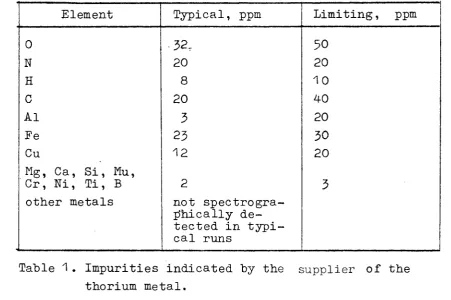
The analysis report of the thorium metal provided by Metal Hydrides Inc. indicated the following impurities,
Element
0
N
H
C
Al Fe CuMg, Ca, Si, Mu, Cr, Ni, Ti, Β other metals Typical, ppm •32r 20
8
203
23 122
not spectrogra-p'hically de [image:9.595.67.519.343.643.2]tected in typi cal runs Limiting, 50 20 10 40 20 30 20
3
ppmTable 1 . Impurities indicated by the supplier of the thorium metal.
- 8
te which 3 drops of a very diluted hydrofluoric acid had been added. After dissolution the excess of
acid ivas removed by heating gently to near dryness, the thorium salt was taken up in water and the
solution made up to a known weight. The acidity of the solution was about 0.1 N. More dilute solutions were made by gravimetric dilution.
2.1.3· ï^-i^â^^1.
For the visual titrations the indicator was prepared by mixing 1 g xylenol orange with 99 g of suprapur KCl For the titrations with a spectrophotometric endpoint detection a 0.1 % aqueous"solution of xylenol orange was used.
2.2. Titration of the thorium
.2.1. Procedure using &_visual endpoint_detection_technique 20 g of a thorium solution containing about 250 to 1 mg to 1 mg thorium are introduced with a weight burette into a 250 ml beaker. The EDTA solution is added gravimetrically in such a quantity that the endpoint is nearly reached. The solution is diluted with water to a volume of approximatively 150 ml. The pH of the solution is adjusted with a diluted ammonia solution to a value of 3-0 + 0.1. The indicator
is added and the titration is completed with the same EDTA solution using the calibrated microburette of 1 ml. The quantity of titrant added volumetrically is
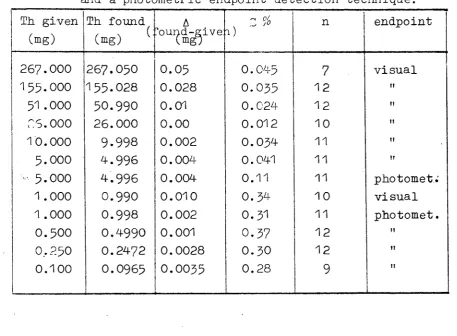
less than 0.1 ml. The endpoint is easily detected by the sharp change of the indicator from red to lemmon yellow. The results are .reported in table 2. A look at this table shows that S (coefficient of -variation)
increases rapidly at quantities below 5 mg. The systematic error appeared also to increase with smaller quantities.. Therefore we have adopted in this range another procedure,
Table 2.Results of the compleximetric determinations using a visual and a photometric endpoint detection technique.
Th g i v e n
(mg)
2 6 7 . 0 0 0
I55.OOO
5 1 . 0 0 0 Γ. S. 0 0 0
1 0 . 0 0 0
5 . 0 0 0
·-■- 5.OOO
1 . 0 0 0
1 . 0 0 0
0 . 5 0 0
0 . 2 5 0
0 . 1 0 0
Th f o u n d
(mg) ( :
2 6 7 . 0 5 0 1 5 5 . 0 2 8 5O.99O 2 6 . 0 0 0 9 . 9 9 8 4 . 9 9 6 4 . 9 9 6 O.990 0 . 9 9 8 O.4990 O.2472 0 . 0 9 6 5
Δ round-give:
0 . 0 5 0 . 0 2 8 0.01 0 . 0 0 0 . 0 0 2 0 . 0 0 4 0 . 0 0 4 0 . 0 1 0 0 . 0 0 2 0.001 0 . 0 0 2 8 0 . 0 0 3 5
Ζ %
ι )
0 . 0 4 5 0 . 0 3 5 0 . 0 2 4 0 . 0 1 2 0 . 0 3 4 0.041 0.11 0 . 3 4 0.31 0.37 0 . 3 0 0 . 2 8
η
7
1 2 1 2 1 0 11 11 11 1 0 11 1 2 1 29
e n d p o i n t
v i s u a l
photomet.' v i s u a i p h o t o m e t .
M II II
A glance at table 2 shows that there are no problems to reach
a precision and an accuracy better than 0.1 % for quantities greater than 5 mg thorium per determination. Quantities from 5 m
down to O.5 mg per determination should by determined by
photometric endpoint detection giving a good precision and
accuracy. The method shows a very slight and constant negative
systematic error of about 3 ug thorium. For the determinations
of quantities of Th above 5 mg Th per determination this
systematic error is negligible and disappears within the limits
of the reproducibility of the method. For quantities below 5 mg
a correction for this systematic deviation will have to be
applied to the factor of the strength of the titrant. It is
evident that the above method allows the titration of smaller
quantities of thorium with reproducibilities of several per
- 10
2.2.2. Proc edur e_using_a_p_ho tometric_endp_oint _de te c tion technique
We shall give a detail example for a quantity of 0.5 mg thorium per determination. 10 g of a thorium solution containing 0,2644 mg Th/g are introduced with a weight burette into a beaker. 50 ml of water are added and the pH is adjusted in such a way that if the solution is transferred to a 100 ml volumetric flask and 0.5 ml of the indicator solution is added, the pH of the solution will be 3·0 + 0.1. The solution is homogenized and after a short time the volumetric flask is weighed 20 ml of this solution are introduced in the cylindrical cell provided with the cell
attachment for photometric titrations (10). One
introduces approximatively 96 % of the EDTA solution
(O.OOO5 M) gravime.trically and the following titration is done volumetrically by adding portions of 0.02 ml of the same titrant with the microburette of 1 ml capacity. After each addition the optical density is measured at a wavelength of 570 nm. Fig. 1 shows
such a titration curve in the vicinity of the endpoint. The same technique is used for quantities of 5 mg and 1 mg thorium per determination, whilst for 0,25 mg and 0,1 mg thorium the addition of the titrant is done volumetrically. The results obtained are shown in table 2.
3· Results and discussion
- 11
4. Use of thorium metal as a standard
From the above measurements it can be concluded that the metal that is at our disposal would probably be suitable as starting material for the preparation of a thorium reference sample. The values found agree
very well (< O.O5 %) with the nominal weight of
thorium taken for the analysis. The homogeneity should be checked on greater batches of such a metal. The metal has a bright appearance and does not seem to have
tarnished since we have obtained it (2 years). The Central Bureau for Nuclear Measurements is pre-paring a programme for the preparation and definition of a chemical thorium standard.
5. Ac kno wle dgment
12-6. Literature
(1 ) M.W. Lerner
EANDC - 42 "S" 0965)
(2)
G. Schnarzenbach, E. Gut and G. Anderegg
Helv. Chim. Acta ¿ Ζ 0*954) 937
(3) M.J. Cabell
Analyst
21
0952) 859
(4) J.J. Fritz and J.J. Ford
Anal. Chem. 2¿ 0953) 1640
(5) F.J. Welcher
The Analytical Uses of Ethylenediaminetetraacètic Acid
D. Van Norstand Company Inc. (1958)
(6)
D.I. Eyalchikov and E.K. Gol'braikh
The Analytical Chemistry of Thorium
Pergamon Press (1963)
(7)
G.C. Good
Private Communication, October 1966
(8)
J. Körbl, R. Pribl and A. Emr
Collect. Czech. Chem. Comm. 22 (1957) 961
(9) B. Budesinsky
Collect. Czech. Chem. Comm. 2£ (1962) 226
(10) Y. Le Duigou and A. Brück
Anal. Chim. Acta 31 (1964) 394
(11) A. Brück and K.F. Lauer
Anal. Chim. Acta (in press)
(12) L.H. Andersson
13
-0.6'
0.5
0.4
0.3
0.2
0.1
Q02 0.06 0.10 0.14 0.18 0.22 0.26 0.30 0.34 0.3 f ml EDTA 0.0005 M
,.im
kW·.**· .J
RS
ili
NOTICE TO THE READER
All scientific and technical reports published by the Commission of the European Communities are announced in the monthly periodical " e u r o - a b s t r a c t s " .
»I
ψ
bm
or
JÄR^fc*
-ι;:;::
I To disseminate knowledge is to disseminate prosperity — I mean
I general prosperity and not individual riches — and with prosperity
J disappears the greater part of the evil which is our heritage from
\>'i
\ darker times.
reports published by the Commission of the European Communities ate on sale at the offices listed below, at the prices given on the back of the front cover. When ordering, specify clearly the EUR number and the title of the report which are shown on the front cover.
m
OFFICE FOR OFFICIAL PUBLICATIONS OF THE EUROPEAN COMMUNITIES P.O. Box 1003 - Luxembourg 1
(Compte chèque postal N° 191-90)
ï BELGIQUE - BELGIË
må
må
MONITEUR BELGE
Rue de Louvain, 40-42-B-1000 Bruxelles BELGISCH STAATSBLAD
Leuvenseweg 40-42 - B-1000 Brussel
DEUTSCHLAND
VERLAG BUNDESANZEIGER Postfach 108 006-D-5 Köln 1
«PäS
FRANCE
SERVICE DE VENTE EN FRANCE DES PUBLICATIONS DES
COMMUNAUTÉS EUROPÉENNES rue Desaix, 26-F-75 Paris 15°
ITALIA
LIBRERIA DELLO STATO Piazza G. Verdi, 10-1-00198 Roma
ÏMBOURG
OFFICE DES
PUBLICATIONS OFFICIELLES DES COMMUNAUTÉS EUROPÉENNES Case Postale 1003 - Luxembourg 1
NEDERLAND
STAATSDRUKKERIJ en UITGEVERSBEDRIJF
Christoffel Plantijnstraat - Den Haag
UNITED KINGDOM
H. M. STATIONERY OFFICE P.O. Box 569 - London S.E.I
WE
ÉÉÉ1
U Î B Î j i
m
m
méWÈ
CDNA04714ENC |
mmm
Commission of the European Communities