Munich Personal RePEc Archive
Impact of Human Development Index
and Rule of Law to Attract Foreign
Direct Investment in Selected Developing
Countries
mollaesmaeili dehshiri, hassan and sameti, Morteza and
sameti, Majid
Isfahan branch, Islamic Azad University, IRAN, Isfahan branch,
Islamic Azad University, IRAN, Isfahan branch, Islamic Azad
University, IRAN
4 September 2012
Online at
https://mpra.ub.uni-muenchen.de/81479/
1
Impact of human development index and rule of law to attract foreign
direct investment in selected developing countries
hassan mollaesmaeili-dehshiri
phd of Economic
Isfahan branch, Islamic Azad University [email protected]
Morteza sameti
professor of economics
Isfahan branch, Islamic Azad University [email protected]
Majid sameti
Associate professor of economics Isfahan branch, Islamic Azad University
Abstract
Capital is the driving force of economic growth and development and the optimal utilizations of resources and capital are the most important factors in achieving economic growth and development. Foreign direct investment is one of the best methods in industrial projects’ financing and investing. Therefore, in line with the economic growth and development it is necessary to identify those factors which affect the FDI and to determine the influence degree of each to make a proper policy in this area. Human development index and rule of law are the effective factors which influence the absorption of FDI and this varies according to different economic governments. The main purpose of this paper is to investigate effects of human development index and rule of law on attracting FDI. In order to assess each of these factors’ influence, we consider the FDI as a function of GPD, exchange rate, inflation, human development index and rule of law, the data is collected in
23 developing countries between 2001-2010 and a model is provided by using regression of panel data. The results of model estimation confirm the study hypothesis which is on the basis of positive and significant impacts of human development index and rule of law on the attraction of FDI.
Keywords: Foreign direct investment, human development index, rule of law,panel data Regression
2
1
.Introduction
Foreign direct investment (FDI) is the process whereby residents of one country (the source country) acquire ownership of assets for the purpose of controlling the production, distribution and other activities of a firm in another country (the host country). The International Monetary Fund's Balance of Payments Manual defines FDI as an investment that is made to acquire a lasting interest in an enterprise operating in an economy other than that of the investor, the investor's purpose being to have an effective voice in the management of the enterprise. The United Nations
1999 World Investment Report (UNCTAD, 1999) defines FDI as an investment involving a long- term relationship and reflecting a lasting interest and control of a resident entity in one economy (foreign direct investor or parent enterprise) in an enterprise resident in an economy other than that of the foreign direct investor (FDI enterprise, affiliate enterprise or foreign affiliate). The term
“long-term” is used in the last definition in order to distinguish FDI from portfolio investment, the latter characterized by being short-term in nature and involving a high turnover of securities
(moosa,2002). FDI became an increasingly important element in global economic development and integration during the 1990s (UNCTAD, 2003). This development occurred contemporaneously with the process of transition from socialism to capitalism and the integration of the Central and Eastern European countries (CEEC) into the world economy through trade and capital flows, as Di
Mauro (1999) and Buch et al. (2003) discuss. FDI into transition economies may facilitate growth,
promote technical innovation, and accelerate enterprise restructuring in addition to providing capital account relief (EBRD
1 , 2002).
The economic development of emerging markets and developing countries depends to a large extent on the possibility to make profitable investments and accumulate capital. Having access to foreign capital and investments allows a country to exploit opportunities that otherwise could not be used. Recent experiences with opening capital accounts in emerging and developing economies, however, have proved to be a mixed blessing, as it is becoming increasingly clear that not all types of capital imports are equally desirable. Short-term credits and portfolio investments run the risk of sudden reversal if the economic environment or just the perception of investors change, giving rise to financial and economic crises. It is therefore frequently advised that those countries should primarily try to attract foreign direct investment and be very careful about accepting other sources of finance (Prasad et al., 2003). Nathan m.Jensen (2003) in an article titled “Democrary, gavernance and muitinationo is Wrporations: political regimes and the flow of foreign direct inveatment ” examined the effect of factors including economic conditions, political decisions and democracy in
114 eveloping countries to attract FDI during the Period of 1970 to 1997 using panel data. Variably of his research model including market sice, level of development, commerce, natural resources, democracy and human capital, all have positive effect on FDI and other Variables such as growth. Government expenses and budget deficit have negative effect on attracting FDI. In the other model in this study, positive effect of the rule of law and negative effect of the corrnption is confirmed.
Peter and kord( 2001 ) examined factors affenting the flow of FDI, and in addition to Variables of wage, exchange rate and interest rate, they added Variables of degree of economic freedom and tax
structure in to model. Pexasad and jeenvey( 2005 ) examined factors. Affecting the flow of FDI in
china; results of the in study indicate Significant effect of productive etenance of china in to the
global finocial market, performing related clarifications and risk management. Alvarez ( 2003 )
States low risk from factors affecting the outflow of FDI from the catalan region of spain. Oniew(
2002 ) in his Study inrestgated the flow of FDI to less developed conties. This study examination the role of economic and structural factors on the flow of FDI with data from 51 developing contries and the mena region during the period of 1975 to 1999. The results of this study show that both free trade, corruption and encrypted line of bureaucracy have the main role in attracting FDI.
3
Bengoa and sanchez – robles ( 2003 ) in this study titled “FDI, economic freedom and growth: case study of latin America” analyzed the relationship between economic freedom, ewnomic growth and
FDI in 18 selected countries in latin America during the period of 1970 to 999 with panel data, they concluded that FDI leads to economic growth in Selected countries and also economic freedom and Stability in long team increase the capital into the desired countries. Ferri and Snyder ( 1985 ) in an experimental study have shown that the volume of foreign investment is linked to political and economic factors. The result of previous worked that the political and economic factors as security are effective in attracting FDI.
In this study an attempt is made to determine the effects of HDI and Rule of Law on the absorption of FDI so that steps can be taken for absorbing more capital and hence achieve economic growth by presenting effective and purposeful policies. This study also seeks to answer the following question: Does the improvement of HDI and Rule of Law lead to further absorption of FDI in developing countries1 ? In the following parts, first the theoretical principals will be elaborated. Then, based on the theoretical principals and experimental studies carried out in the past a model will be proposed. Next the variables will be defined and the results obtained from the estimation will be investigated, finally a conclusion and policy solution for the improvement of FDI absorption will be presented.
2
.Review of literature
John Dunning’s ownership, location, and internalization (OLI) framework is generally considered the paradigmatic theory of the multinational firm’s investment decisions, where multinational enterprises (MNEs) invest internationally for reasons of ownership, location, and internalization Firms have ownership advantages when they have access to some asset or process that provides some advantage over existing firms in the foreign market These can be physical, for example patented products or production processes, or more intangible, such as global brand name recognition Multinational firms invest abroad to exploit these firm-specific advantages in foreign markets and secure higher returns Firms may also be motivated to invest abroad because of locational advantages Firms often invest in production facilities in foreign markets because transportation costs are too high to serve these markets through exports This could either be directly related to the physical nature of the good, as with a high bulk item or a service that needs to be provided on site, or because of policy factors such as tariff rates, import restrictions, or issues of market access that make physical investment advantageous over serving the market through exports The locational advantage could also be related to the actual endowments of the host location either the richness of its natural resources or the high quality and low cost of its labor force The third and most complex factor is that of internalization advantages Althoughthe other two OLI factors highlight reasons why firms would move production to a foreign location, they do not give any reason as to why a firm would simply not license a foreign producer to make the item for the parent firm A multinational could simply provide the technology needed for the production process and the blueprints for the product to a local firm This concept of internalization advantages captures the firm-specific motivations for a firm choosing to produce the product within the organization itself in a foreign location (Jensen,2003). Obviously, location advantages are relevant in determining where the firm chooses to manufacture its products. These include factor prices, access to customers, government regulations with respect to trade, exchange rates, capital flows, and institutional and political stability (Bevan and Estrin,2004). One of pioneers in this field who elaborated FDI in the context of imperfect market was Hymer. To separate direct and indirect foreign investments, he
1 The present study has been carried out on developing countries which include Algeria, Angola, Argentina, Bahrain, Bolivia, Colombia, Ecuador,
4
emphasized on controlling the investment by the investor and questioned the previous theories on the ground of having simplistic assumptions. He believed that FDI appears in incomplete markets. Thus, using an industrial organizational approach, he elaborated on the activities of the multi-national companies (Berclay, 2000).
Hymer’s theory entitled “Industrial Organization” was later developed by Caves (1982). According to this theory, if each institution establishes another branch in another country, it will have disadvantages compared to other institutions in the host country. The advantages are rooted in the language, culture, judicial system and other differences between the two countries. In the face of these disadvantages, the company should have some advantages called intangible assets which include good reputation, good management, high technology and other characteristics of the institution. These advantages should be transferrable to the home branch, so that they can neutralize the lack of the advantages, compared to other domestic institutions. One of the shortcomings of this approach is that it cannot justify the reason why these institutions do not use the advantages in their own countries and do not export and although, this theory mentions the reason why these institutions perform foreign investment, it cannot tell which country will be accepted as destination. Thus, the internalization theory was proposed by some researchers, such as Casson (1979), Buckly
and Casson (1967), Buckly ( 1978), Rugman (1980, 1981, 1985) (Berclay, 2000). According to this theory, FDI is formed by the efforts of the institutions for replacing market exchanges with internal exchanges (Krugman, 2000). As Caves states, the main advantage of this theory is that some of the marketing prices can be decreased by establishing a new institution. This happens because of imperfect information in intermediate goods market such as human capital, knowledge, marketing and management skills. In general, the advantages of internalization, avoidance of time breaks and lack of trust. Internalization of markets in international limitations will create FDI till the ultimate benefit equals ultimate cost. One of the strengths of the internalization theory is its explanation of the reason why institutions prefer direct foreign investment to export (Berclay, 2000).
In the following part the human development index and the law dominance and the theoretical foundation of their effects on FDI will be explained separately.
2
-
1
.
Human development index
The human development index (HDI) developed by the United Nations Development
Programme (e.g., UNDP 2003) is computed as the average of three equally weighted outcome measures or indices of human development: life expectancy (LI), educational attainment (EI) and income (WI). The methodological underpinnings of the HDI are straightforward and appear as a technical note to the various Human Development Reports (e.g., UNDP 2003). For each country, the LI is measured by the life expectancy at birth. EI is based upon the weighted average of the
adult literacy rate (2/3 weight) and the combined gross enrolment in primary, secondary and tertiary
education (1/3weight). WI uses the adjusted, per capita GDP (PPP, US$). All three are deprivations indexes. As such, LIn and the two components of EI are computed as the ratio of the difference
5
that human capital is a completely economical concept in economic studies. In fact, human qualitative features are considered as assets. For these features can lead to productivityand increase in production and income and welfare.
Schultz, the father of human capital theory, (1961) believes that investment in human capital leads to the improvement of the quality of workforce which can be considered as a decisive factor for growth in traditional analyses. The quality of workforce which is reflected in hygiene, nutrition, skills and education is of paramount importance for economic growth (Amini and Hejaziazad,
2008). Kuznets, the winner of the noble prize in economics in 1971, believed that the concept of capital which only includes physical and commodity capital is an incomplete concept. Thus human capital should also be taken into account. According to him: the human capital of a country is not its high technology, industrial instruments, but its knowledge accumulated from carrying out different experiments and the experience of the people of that country for utilizing this knowledge (Sobhani,
1992). Education, considered as a reflection of the skills of workforce, is an important factor in absorbing FDI. The educated population is able to carry out highly complex tasks and easily adapt itself to new conditions. Moreover, education increases a country’s ability to absorb new technology. Education, as an influential factor in FDI structural change in international companies change FDI from labor-intensive production to technology-intensive production. In other words, the presence of educated and skilled labor force in modern commercial companies is an important factor influencing direct foreign investment (Rivlin, 2001). Thus, improvement of human development leads to an increase in the quality of life and educational level of labor force and elimination of economic concerns and, on the whole, it will increase the productivity of labor force and absorption of more capital.
2
-
2
.Rule of law
Rule of law is one of the important legal and political matters which human beings have long pursued. This principle is sometimes referred to as equality before the law or dominance of law. According to this principal, the rulers and politicians are considered the protectors of law. They are themselves subject to it and the legitimacy of their rule depends on their loyalty to law. Thus, the sensible decision-making and ruling according to law can be considered as the essence of rule of law ( Markazmalmiri, 2006). World Bank defines Rule of Law as limitation of the power of the
government and protection of the civil rights against the government’s arbitrary use or abuse of
power. Rule of Law affects the absorption of FDI in different ways.
2-2-1.Channels of the Influence of Rule of Law On FDI 2-2-1-1. Protection of Property Rights
The more advanced the property rights, the more certain the access to the profit of investment, thus the motivation for investment increases.
2-2-1-2. Increase in the Market Volume
Development of markets is basically a legal challenge. Markets do not take place in a vacuum. Thus, they are protected by a complex network of institutional infrastructures (Grief, 2005). which protect market law and its good institutions. For every exchange in the market requires a legal structure which is to recognize the property rights of the buyers and sellers. This leads to the development and expansion of markets and finally improves the absorption of FDI.
2-2-1-3. Providing a Suitable Atmosphere for Business
6
entrepreneurs to turn an illegal situation into a well-organized business. Most of the entrepreneurs are active in non-governmental parts (Stopler, Walker and Mark, 2006). Rule of law can attract investors through development of business and paving the way for entrepreneurship.
2-2-1-4. Appropriate Conformation and Loyalty to Contracts
Exact conformation and complete supervision over contracts leads to more trust in foreign investment. When there is a possibility that the business partners may not follow the contracts, the probability of the risk increases and the development of manufacturing will be limited. Thus, in commercial development trend a strong executive mechanism to guarantee the security and right of people is of paramount importance (Haggard et al, 2008). Rule of law, which is one of the indices of good governance, is annually calculated for every country by World Bank. The criterions for it are: cost of crime, corruption in banking systems, the prevalence of the black market, the independence of the judicial system, trust in the judicial system, efficiency of the security forces, etc. In the following parts of this article the effect of Rule of law on FDI absorption will be estimated through fixed effect method and then it will be analyzed.
2
-
3
.Inflation
The ever-increasing prices lead to the decrease in the value of internal assets. Therefore, citizens and capitalists prefer to change the optimal combination to their own advantage in order to keep the real value of their capital (the capital exit). On the other hand, the increase in the prices will lead to the decrease in the net profit of investment and the value of assets and the import of the capital into the country. Inflation increases the risk of investment and decreases the average commercial loan maturity and disorder in the transferred data by prices. Inflation is a sign of instability and lack of control over macro policies and has a negative correlation with foreign direct investment
(Shahabadi and Mahmudi, 2006).
2
-
4
. Exchange rate
7
3
.Methodology
The estimation of a panel under the hypothesis of fixed effects assumes that the differences among countries are captured by allowing a different intercept αi for each of them. αi may be
estimated, so the specification with k regressors becomes:
yit = αi+β Xit + eit , i = 1, . . . , n, t = 1, . . . , T (1)
where i indexes countries and k indexes regressors. y is the dependent variable, X is an nT by k
matrix of regressors, b is a k by 1 vector of parameters and ei,t are the disturbances. Intuitively, the
main assumption is that the economic model underlying the estimation is the same for all countries. The variation among countries is captured by the intercept ai. The estimation is by OLS, which in this case is called Least Square Dummy Variables (LSDV) or within-groups estimation. Instead, random effects consider idiosyncratic features of the units as nonobservable and randomly distributed. They are captured by the error terms that, in turn, have a constant (over time) part and a second component that varies over time. The specification in this case becomes:
yit = α + βXit + ui + vit (2)
where ui is the random disturbance associated to the ith country, constant over time by assumption.
The economic intuition associated with random effects is that the economic model underlying the estimation may change over time. The estimation in this case is performed by Generalized Least Squares. In the present study, in order to assess the effect of HDI and Rule of law on FDI absorption in the selected developing countries two different patterns of combined data are utilized. With regard to the theoretical discussions and experimental studies pertaining to FDI, the experimental design of this study is as follows:
The first pattern (includes RL index): FDIGDPit= F (ERit , INit , GDPit , RLit )
FDIGDPit= β0 + β1ERit + β2 INit + β3LNGDPit + β4RLit++ Ԑit (3)
Second pattern (includes HDI index): FDIit= F (HDIit , ERit , INit , GDPit )
LNFDIit= β0 + β1HDIit + β2 ERit + β3INit + β4LNGDPit+ Ԑit (4)
In which ER and IN denote exchange rate (U.S. dollar) and inflation rate, respectively. Moreover, GDP denotes gross domestic product (million dollars) which is considered in a logarithmic fashion. HDI and RL represent Human Development Index and Rule of Law, respectively. The dependent variable in the first pattern is the contribution of FDI to gross domestic product and in the second pattern is the input rate of FDI in million dollars which operates in a logarithmic fashion. Ԑit denotes error, i denotes sections or countries and t denotes time. It is
expected that the effect of the variables be like this:
0 , 0 , 0 , 0 , 0 HDI FDI RL FDI GDP FDI IN FDI ER FDI
(5)
3
-
1. S
tatistical sources and intelligence
In order to estimate the first pattern, data was collected from the selected developing countries
(23 countries) during 10 years from 2001 to 2010 and for the second pattern, data was collected
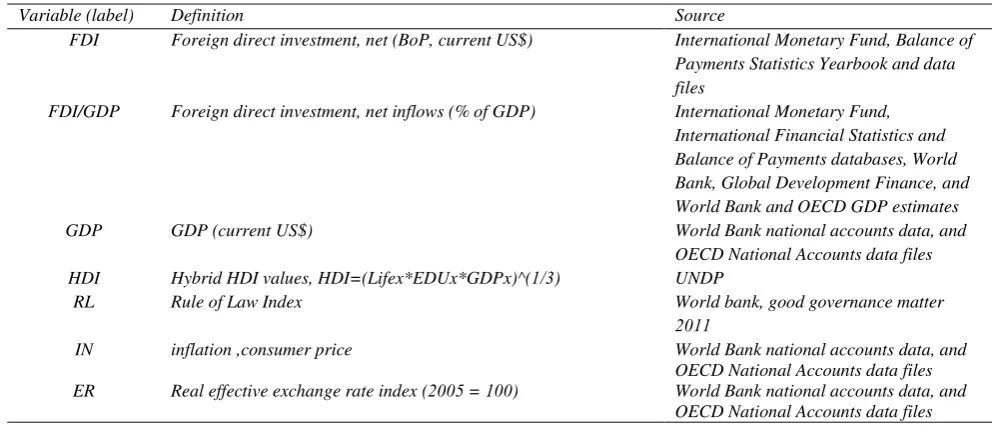
from 12 selected developing countries during the same ten years. The sources and measurement of
8
Table 1. Variables, definitions, and data sources
4
. The Result of the Estimation and The Analysis of the Data
4
-
1.
Unit Root Test
Prior to the estimation of the effect of the variables on FDI, it is necessary to test the stasis of all variables used in the estimations. For the stasis of the variables, either in time series or for panel data will lead to false regression. But contrary to what is common for time series data, for panel data Dicke-Fuller test and augmented Dicke-Fuller (ADF) tests cannot be utilized. Instead, the total stasis of the variables must be calculated. For this purpose, Levin, Lin and Chu test is especially used for panel data. The result of these test for all the variables of the first pattern and the second
[image:9.595.53.551.100.315.2]pattern are shown in Tables 2 and 3, respectively.
Table 2. The Results of The Unit Root Test Developed by Levin, Lin And Chu (LLC) for the First Pattern
variable LN FDI LN GDP IN ER RL
statistic -2.30 -10.05 -8.98 -81.63 -8.067
[image:9.595.48.533.487.531.2]probability 0.000 0.000 0.000 0.000 0.000
Table 3. The Results of the Unit Root Test Developed by Levin, Lin And Chu (LLC) for the Second Pattern
variable LN FDI LN GDP IN ER HDI
statistic -3.92 -2.62 -1.76 -7.48 -1.57
probability 0.000 0.004 0.038 0.000 0.057
The above tables show the results of total unit root test of the variables used in the estimation. The null hypothesis of the test is that LLC denotes non-stasis of the variables. Thus, is the estimated value is greater than p level. The null hypotheses will be rejected. The results show that the null hypothesis is rejected. It can be concluded that all variables are static. When all variables are static, the regression will not be false and the model can be analyzed.
4
-
2.
Estimation of Coefficients
4-2-1. Estimation of the First Pattern and Data Analysis
Before the estimation of the coefficients, Limer F test was utilized for choosing between panel data and combined data. The null hypothesis of the test denoted the selection of the method for
Source Definition
Variable (label)
International Monetary Fund, Balance of Payments Statistics Yearbook and data files
Foreign direct investment, net (BoP, current US$) FDI
International Monetary Fund, International Financial Statistics and Balance of Payments databases, World Bank, Global Development Finance, and World Bank and OECD GDP estimates Foreign direct investment, net inflows (% of GDP)
FDI/GDP
World Bank national accounts data, and OECD National Accounts data files GDP (current US$)
GDP
UNDP
Hybrid HDI values, HDI=(Lifex*EDUx*GDPx)^(1/3)
HDI
World bank, good governance matter
2011
Rule of Law Index RL
World Bank national accounts data, and OECD National Accounts data files inflation ,consumer price
IN
World Bank national accounts data, and OECD National Accounts data files
Real effective exchange rate index (2005 = 100)
9
combined data and their priority with regard to panel data. Considering the reported F value at p<
0.05 level the null hypothesis is rejected. Then Husman test was used to choose the estimation method. Its null hypothesis confirms the existence of random effect in the model. The p level was
less than 0.05 (0.08). Therefore, the estimation method was fixed effect. The results of the
[image:10.595.106.489.187.332.2]estimation of the first pattern are shown in Table 4.
Table 4. The Results of the Estimation of the First Pattern through Fixed Effect Method
As it is manifest in the results of the estimation, the variable EX is not statistically significant. The IN variable with a coefficient of 0.1935 had a positive and significant effect on FDI absorption. Gross domestic product also had a positive and significant effect on FDI absorption with a
coefficient of 0.9349. The rule of law with a coefficient of 0.0933 at the p≤0.005 had a positive and significant effect on FDI absorption. The results of the study conform to the theoretical principals. Thus, with the improvement of RL index which leads to the improvement of business atmosphere and entrepreneurship, market development, maintenance of investment security and prevention of corruption, there will be more FDI absorption.
4-2-2. Estimation of the Second Pattern and Data Analysis
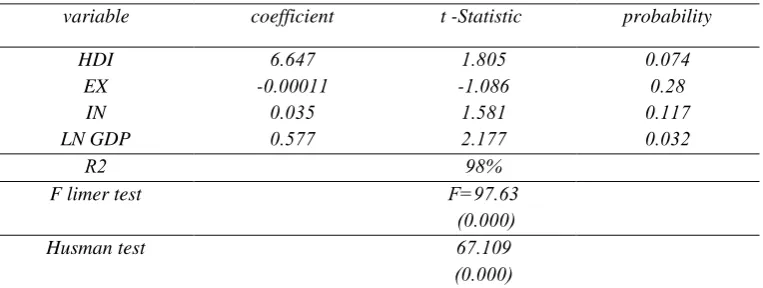
The value of Limer F reported in Table 4 denotes the rejection of the null hypothesis and use of panel data for pattern estimation. The results of Husman test also indicate that pattern estimation should be carried out through fixed effect method. The results of the estimation of the second
pattern are shown in Table 5.
Table 5.The Result of the Estimation of the Second Pattern through Fixed Effect Method
The results of the second pattern through the fixed effect method carried out for 12 selected developing countries, indicate that the variables of exchange rate and inflation with coefficients
-variable coefficient t -Statistic probability
EX -2.77 -0.0807 0.935
IN 0.1935 12.574 0.000
LN GDP 0.9349 2.363 0.010
RL 0.0933 2.804 0.005
R2 59.5%
F limer test F=5.255
(0.000)
Husman test 13.61
(0.008)
variable coefficient t -Statistic probability
HDI 6.647 1.805 0.074
EX -0.00011 -1.086 0.28
IN 0.035 1.581 0.117
LN GDP 0.577 2.177 0.032
R2 98%
F limer test F=97.63
(0.000)
Husman test 67.109
[image:10.595.108.490.575.719.2]10
0.00011 and 0.035, respectively, are not statistically significant and do not affect FDI absorption.
Human development index (HDI) with a coefficient of 6.647and the probability of 0.074 had a
positive and statistically significant effect on FDI absorption in selected countries. Due to the lack of skilled and efficient labor force in many countries, investment in them is not possible. With the improvement of human development investment in many areas becomes possible and this encourages foreign investors.
5
. Conclusion and Policy Suggestions
FDI is one of the best methods in industrial projects’ financing and investing In addition to financing the investment projects, attracting the FDI includes other goals such as: transferring and promoting advanced technology, transferring knowledge management skills, knowledge and promoting workforce, provoking competition between domestic firms, developing export markets, and increasing the domestic production standards. FDI will be an effective strategy for improvement, growth and economic development, if suitable infrastructures exist. The absorption of foreign investment requires suitable conditions, too. Among them are: legal structure, rule of law and human development. In this study the effects of HDI and Rule of law as two important and influential factors on FDI were investigated. The results of the estimation about the selected developing countries were indicative of the positive, statistical significant effect of the two variables on FDI absorption. And that the improvement of HDI and Rule of law leads to more FDI absorption. Rule of law can develop manufacture and foreign investment absorption by creating economic security for investment and can contribute to human development by creating human capital. Therefore, in order to improve FDI absorption, it is necessary to adopt appropriate policies in Human development and Rule of law. In the end some policy suggestions are presented for improving the two variables under study and increasing FDI absorption:
- Establishing an independent, effective legal system to control corruption and rent-seeking - Improving the laws and regulations, revising the awkward rules and exercising complete
supervision on execution of laws to achieve a law-abiding official system
- Revising, improving and focusing on policies like: tariff and non-tariff barriers, import and export rules for cost and fee control
- Providing free public education in the countries under study and eradicating illiteracy to improve the quality of labor force and human capital
11
References
Amini, A & Hejaziazad, Z. (2008)The role of human capital and research and development in improving total factor productivity (TFP) in the Iranian economy, Iran economic research journal, No.35, pp.1-3.
Arcelus, F., Sharma, B. & Srinivasan, G. (2005) The Human Development Index Adjusted for Efficient Resource Utilization, world institute for development economic research, research paper No.2005/08.
Bercaly, L. A. (2000) Foreign Direct Investment in Emerging Economies: Corporate Strategy and Investment Behavior in the Caribbean, Routledge, London and New York.
Bevan, A & Estrin, (2004) The determinants of foreign direct investmentinto European transition economies,Journal
of Comparative Economics, No. 32. Pp. 775–787.
Buch, Claudia, Kokta, Robert, Piazolo & Daniel, (2003): Does the East get what would otherwise flow to the South? FDI diversion in Europe, Journal of Comparative Economics, No. 31. pp. 94–109.
Caves, R. E. (1974) Multinational Firms, Competition and Productivity in Host Country Market, Economica, No. 41.
PP. 176 -193.
Dargahi, H. (2006)Factors affecting the development of foreign direct investment: lessons for Iranian economy, sharif journal, No.36. pp. 57-73.
Di Mauro, F. (1999) The effects of economic integration on FDI flows: an empirical analysis and comparison with trade, Document paper No. 134, Center for European Policy Studies, Brussels.
European Bank for Reconstruction and Development (EBRD), 1994–2002. Transition Report. EBRD, London. Hejazi,
Walid, Safarian, Edward, 1999. Trade, foreign direct investment, and R & D spillovers. Journal of International
Business Studies 30, 491–511.
Froot, K.A. & Stien J.C. (1989) Exchange Rate and Foreign Direct Investment , NBER Working Paper (2914).
Haggard, S., MacIntyre, A. & Tiede, L. (2007) The Rule of Law and Economic Development, by University of California - SanDiego.
Jensen, N. (2003) Democratic Governance and Multinational Corporations: Political Regimes and Inflows of
ForeignDirect Investment, International Organization, No. 57. pp.587–616.
Markaz Malmiri, A. (2006) Rule of Law, The Office of Law Studies, Majlis Research Center (First Edition).
Moosa, I. (2002) Foreign Direct Investment, Theory, Evidence and Practice, London, Palgrave.
Rivlin P. (2001) Economic Policy and Performance in the Arab World, London: Lynne Renner.
Shahabadi, A & mahmoudi, A. (2006) Determinants of foreign direct investment in Iran, Threads economic journal, No. 5. pp. 89-125.
Sobhani, H. (1992) Efficiency of educational investment, economic research journal, No. 45. pp. 76.