ISSN Online: 2327-6053 ISSN Print: 2327-6045
The Strength Characters of C/C Composite
Material with Opening Hole and Typical
Application
Zhiyong Tan, Changwan Min, Xuyun Zhan, Weili Dong
Science and Tehnology on Space Physics Laboratory, Beijing, China
Abstract
Research on the opening hole and connecting problem of C/C composite ma-terial was conducted. The strength characteristics of plate with opening hole were tested and the applicability of strength criteria focused on particular point was analyzed. Conclusion is obtained that obviously conservative to evaluate open hole and joint strength by hole-edge stress. Based on these, high and normal temperature strength test of typical circular shaft was completed, proving that comprehensive joint performance can be significantly improved by appropriately optimized design.
Keywords
Composite Material, Opening’s Characteristics, Joint Strength
1. Introduction
As a new type of ultra-high temperature composite material, C/C is one of the important alternatives to primary load bearing thermal protection structure in newly aircraft. In order to meet the requirement of disassembly of parts, in con-sideration of the limitation of using adhesives in high temperature environment, mechanical joint is an irreplaceable choice.
The basis of mechanical joint is the thorough understanding of the mechani-cal properties of structure with structural opening and reinforcement. In the system of advanced composite materials, numerous studies have been done on the opening and joint properties of resin matrix composite material. Xie Mingjiu [1] used industrial method to carry out systematic discussion and draw conclu-sion. Wang Fusheng [2] did research into the effect of the shape of opening and fit clearance on properties. Song Zuoyu [3] studied the joint characteristics of
How to cite this paper: Tan, Z.Y., Min, C.W., Zhan, X.Y. and Dong, W.L. (2017) The Strength Characters of C/C Composite Material with Opening Hole and Typical Application. Journal of Materials Science and Chemical Engineering, 5, 61-68.
http://dx.doi.org/10.4236/msce.2017.51009
different opening forms of resin matrix material. These studies indicate that re-sin matrix composite material has been maturely applied to primary load bear-ing structure in aviation field. However, C/C composite material is very much different from resin matrix material in mechanical properties and representation. The basic mechanical properties and performance of C/C material were com-prehensively introduced. However, in-depth researches on the C/C material's opening and joint are rare in research reports. Relevant experiment shows [4] 4that the complicated three-dimensional stress and strain distribution at the opening, influential factors on mechanical joint (type of joint, environmental temperature, material’s thermal suitability, geometrical dimension of joint, type and dimension of fasteners, influence of pretension force, dimension error be-tween fastener and connecting hole, etc.) can’t copy the laws and conclusions of resin matrix material.
To explore problems of C/C thermal protection structure’s need for mechani-cal joint, structural design and loading features, this thesis carried out research on typical experimental sample’s mechanical properties and joint problems, in-cluding the regularity of C/C material’s opening hole strength and extruding strength characteristics. After testing plate with opening holes about its charac-teristics at normal temperature, the experiment drew the conclusion that materi-al’s tensile strength is not sensitive to opening hole, and analyzed the applicabil-ity of strength criteria focused on particular point based on the results of expe-riment. On the basis of theoretical analysis, typical circular shaft’s way of joint in high-temperature environment was analyzed and improved, validated by strength experiment in high and normal temperature. So it indicates that rea-sonably optimized design can improve the performance of composite joint.
2. Test the Strength Characteristics of C/C Plate with
Opening Holes and Analyze the Applicability
of Point Strength Criteria
The experimental sample for tension and extrusion of C/C open hole uses stack-switched carbon cloth. The carbon cloth is T300-3K double damask; stacking sequence is 0˚/90˚/45˚/0˚/90˚/-45˚; sutures are (T300 − 3K + T300 − 1K) × 2; suture spacing is 4 mm; fiber content of the plate is about 45% - 48%. The experimental sample’s width is 20 mm.
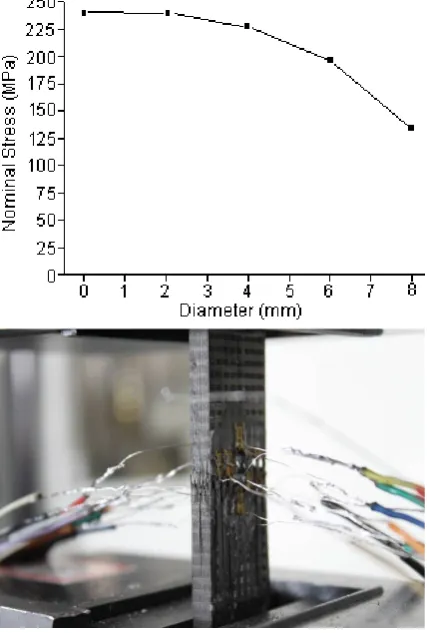
Strength characteristics were obtained after doing tension experiment toward plate with opening holes. Diameters of opening holes are 2 mm, 4 mm, 6 mm and 8mm respectively. In experiment, strain gages were pasted in parallel on each side of opening hole. The material’s tensile strength with opening hole ob-tained from the experiment was implemented nominal strength formula, that is:
max 0 bnom
P A
σ = (1)
In the formula, σbnom is sample’s nominal tensile strength, Pmax is the
maximum failure load, A0 is nominal sectional area (including sectional area
typical failure were displayed in Figure 1. The nominal strength when opening hole diameter is 0, is the average strength value of standard tensile sample. It’s obvious that when the diameter of opening is smaller than 4 mm, the sample’s strength wasn’t decreased evidently, which indicted that tensile strength is not sensitive to round opening hole.
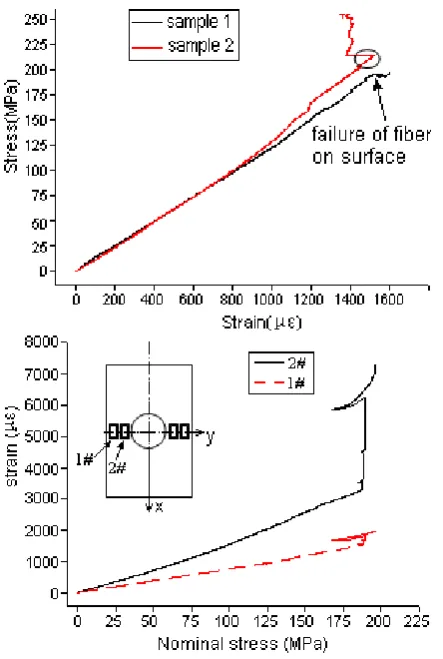
Figure 2 presents the stress-strain test results of 2 samples without opening, and a single sample with a 6 mm opening at different locations of the surface with opening. Through analysis, the conclusion can be drawn that samples without opening are consistent. Since C/C’s tensile properties are primarily con-trolled by fiber, so it demonstrates obvious linear and brittle characteristics, and failure strain is about 1600 με. As to the sample with opening, strain of the loca-tion far away from opening is somewhat lower than failure strain of the sample without opening. There is stress and strain concentration around opening, which is also the location where failure first occurs. Comparing Figure 1 with Figure 2, it’s obviously conservative to evaluate open hole and joint strength by hole-edge stress. The conservative quantity of the sample with 6 mm opening is 1.9 times.
[image:3.595.267.481.389.706.2]Point strength criteria can be adopted to evaluate the strength in condition of stress concentration, that is, using special stress in some local area to evaluate the failure load of sample with opening under tensile/compressive load. It is a
Figure 2. Typical stress-strain curves of samples without opening and sample with 6mm opening.
simple method based on two parameters which are σb0, the strength of plate
without opening hole, and d0, the characteristic dimension of the hole. Kogo Y
[5] used this method to forecast well the composite laminated plate specimen with two-dimensional C/C notch.
K. Sabeel Ahmed [6] gave the theoretical calculation formula of strength crite-ria focused on particular point, wherein d0, the characteristic dimension, is
de-fined as the distance between the point at which the stress on the plate reaches the tensile/compressive strength without opening hole and the hole edge when the opening hole failure occurs, so:
(
0, 0)
0b R d b
σ + =σ (2)
When formula (2) is met, failure occurs on the plate with opening hole. Stress analysis is conducted under linear condition for the semi-infinite plate with opening hole, obtaining the ratio of the strength of plate with opening hole to that of plate without opening hole:
2 4 6 8
0
2
2 3 ( 3)(5 7 )
b
b KT
σ
σ = +β + β − ∞− β − β
(3)
where: β =R/ (R+d0), R is the radius of the central opening hole, KT
[image:4.595.265.487.74.404.2]the stress concentration factor, which can be calculated by the formula below:
(
)
1 2 / / (2 )
T x y xy x xy
K∞ = + E E −µ +E G (4)
where: Ex, Ey are Young’s modulus in two directions, Gxy is in-plane
shearing modulus, and µxy is Poisson’s ratio.
As a geometric parameter relevant to the failure region, a specific physical in-terpretation has not yet been given for d0, which generally can be obtained by
finite element calculation and test. Considering the stress distribution obtained by finite element method has some human assumption factors, in this paper, the characteristic dimension is obtained from the measured strain data of a test spe-cimen with 6 mm opening hole under tensile failure load, which is 4.0 mm. Ac-cording to tensile and in-plane shear test specimen without opening hole, obtain that Ex=Ey =85GPa, µxy =0.035, Gxy =20GPa, substitute these data into the above formulas, obtain the ratio of the strength of plate with opening hole to that of plate without opening hole, which is 0.88; while the ratio measured through the test is 0.84. Thus, this shows that the point strength criterion, as a simple but effective forecasting method, has a good applicability in the test. The reason why the theoretical result is slightly higher is that the directly used cha-racteristic dimension measured from the test is slightly larger, which should in-clude the influence of test error, dispersion of subsample and distinguishing method of singular data near the failure load. Correct the theoretical result, then a relatively identical and safe result can be obtained when d0 ≈R. The
charac-teristic dimension is relevant to several factors such as material, opening hole size, edge condition, etc., so generally, the conclusion is only applicable to speci-fied conditions. To different practical situations, it should be determined through a large number of tests.
3. Optimized Application of Joint Performance of C/C
Typical Circular Shaft
The bearing capacity of circular shaft is the key of thermal structure such as rud-der and flaperon, etc., and the weak link of the strength of circular shaft is gener-ally relevant to the position of opening hole and the bolted joint. The stress state near the position of opening hole is complicated, which needs to consider many factors. To ensure enough loading transfer capacity, the circular shaft is usually adapted as bolted joint with double-column and even multi-column opening hole. So, it is necessary to analyze the effect of extruding and tensile load to each hole, and to ensure the bearing rationality of the hole in each column. Establish the re-lationship of ratio between the extruding and tensile stress of the loaded hole of shear bolted joint sample, which can reflect the combined action effect of the two. The formula is determined through below:
0 jy jy tc b b
K σ +K σ =σ (5)
where: σb0 is the tensile strength of material without opening hole, σjy is the
by-pass load. Kjy is the extrusion stress concentration reduction factor of hole
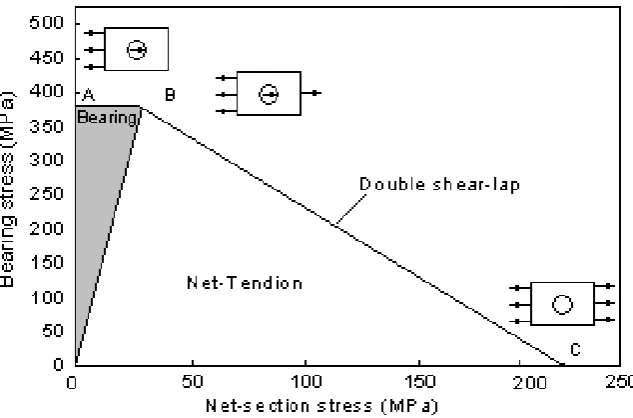
loaded, and Ktc is the tensile stress concentration reduction factor of opening hole. According to the formula in related article [7] [8] and using the test speci-men with 8mm opening hole in this paper, the sketch map of failure envelope for a single opening hole under the combined action of tension and extrusion is shown in the figure below. Extrusion failure occurs on the joint structure in the grey OAB area, and tensile failure occurs on the joint structure in the white OBC area. This is used as the foundation of optimized application of C/C typical circu-lar shaft, which is under flexural-torsional combined load.
By Figure 3, tensile failure should be more attention for this sort of opening hole. For the actual circular shaft, factors need to be considered when structural design include shape of opening hole, size dimension, interval and stiffness of connecting bolt, moment of pre-tension and interval, etc. It is necessary not only to achieve the optimization under normal temperature, but also to consider the possible influence of high-temperature thermal expansion and additional heat stress. Under normal conditions, the need for large diameter of opening hole of circular shaft and for proper stiffness of bolt is somewhat contradictory. By notching or hollowing, the stiffness of metal bolt with large diameter can be re-duced, so as to achieve the stiffness matching of multi-column bolt. Changing the shape of opening hole moderately can reduce stress concentration for special load condition, which can be achieved through bolt bushing in the structural design.
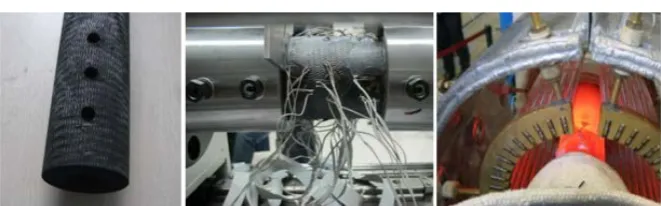
[image:6.595.215.532.507.716.2]Figure 4 gives the situations of opening hole joint and high and normal tem-perature test of a C/C typical circular shaft. 3 columns of through holes are opened at each end of the circular shaft, which are connected by metal bolts. Choose the above factors as the variables to make numerical analysis and opti-mized design. Under initial design condition, the ratio of load bearing of column 1, 2 and 3 bolt (i.e. the extrusion load of opening hole) is about 65:25:10, while, after optimization, hole diameter:hole interval ≈ 4, and the ratio of load bearing
Figure 4. Opening hole joint and high and normal temperature bearing test of typical cir-cular shaft.
of these three columns of bolt is 45:35:20. Each opening hole tends to bear a uni-form load. Additionally, the distribution of the extrusion load and the bypass load is more reasonable, and it also considers the influence of high-temperature heat-ing. The test result verifies the effect of the optimized design, and that the circular shaft failure does not occur at the position of the opening hole.
4. Conclusions
By summarizing the typical opening hole test of C/C composite material, we can know that the rule of strength of opening hole obtained from the study is an im-portant basis of connection design and analysis of bolt-like machinery. And the specific stress concentration sensitivity coefficient and the characteristic length by strength criteria focused on particular point are obtained in this paper. However, there are a lot of factors involved in connection of opening hole of the actual structure, so it is necessary to make a reasonable optimization. Thus, the typical circular shaft is applied in this paper.
With respect to the relevant follow-up work, study on mechanical properties of opening hole of a typical test specimen under high temperature will be con-ducted, to discuss the coupling property and heat matching characteristic of heat stress and external load stress. Moreover, the testing technique and the oxidation resistance technique under high temperature are both difficulties that need to be solved.
Acknowledgements
The research work is supported by the National Science Foundation of China (11572086).
References
[1] Xie, M.J. (2011) Connection of Composite Materials. Shanghai Jiaotong University Press, Shanghai.
[2] Wang, F.S., Liu, Y. and Yue, Z.F. (2010) Analysis of the Influence Factors on Me-chanical Properties of Single-Bolted Composite Laminates. Journal of Materials Science and Engineering, 28, 58-61
[4] Wang, P.Y., Zhu, Z.T., Wang, F.S. and Yue, Z.F. (2008) Dispersibility and Reliability Analysis of Composite Laminates Bolted Joint. Chinese Quarterly of Mechanics, 29, 573-577.
[5] Kogo, Y. and Hatta, H. (1998) Effect of Stress Concentration on Tensile Fracture Behavior of C-C Composites. Journal of Composite Materials, 32, 1273-1294.
https://doi.org/10.1177/002199839803201302
[6] Sabeel Ahmed, K., Vijayarangan, S. and Naidu, A.C.B. (2007) Elastic Properties, Notched Strength and Fracture Criterion in Untreated Woven Jute-Glass Fabric Reinforced Polyester Hybrid Composites. Materials and Design, 28, 2287-2294.
https://doi.org/10.1016/j.matdes.2006.08.002
[7] Hart-Smith, L.J. (2003) Adhesively Bonded Joints for Fibrous Composite Structures. In: Tong, L.Y. and Soutis, C., Eds., Recent Advances in Structural Joints and Repair for Composite Materials,Kluwer Academic Publishers, 173-210.
https://doi.org/10.1007/978-94-017-0329-1_6
[8] Hart-Smith, L.J. (1977) Bolted Joints in Graphite/Epoxy Composites. Technical Re-port NASA CR-144899, National Aeronautics and Space Administration, USA.
Submit or recommend next manuscript to SCIRP and we will provide best service for you:
Accepting pre-submission inquiries through Email, Facebook, LinkedIn, Twitter, etc. A wide selection of journals (inclusive of 9 subjects, more than 200 journals)
Providing 24-hour high-quality service User-friendly online submission system Fair and swift peer-review system
Efficient typesetting and proofreading procedure
Display of the result of downloads and visits, as well as the number of cited articles Maximum dissemination of your research work
Submit your manuscript at: http://papersubmission.scirp.org/