© 2017, IRJET | Impact Factor value: 5.181 | ISO 9001:2008 Certified Journal
| Page 270
Parametric Optimization of Solar Parabolic Collectors Using
AHP-TOPSIS
J Ravi Kumar
1, K Dharma reddy
2, P Venkataramaiah
31
PG Scholar, Dept. of Mechanical Engineering, Sri Venkateswara University, Tirupati, A.P., India.
2Assistant Professor, Dept. of Mechanical Engineering, Sri Venkateswara University, Tirupati, A.P., India.
3
Professor, Dept. of Mechanical Engineering, Sri Venkateswara University, Tirupati, A.P., India.
---***---Abstract - In the present work the behavior of linear solar
parabolic Collector is studied. An experimental design is prepared based on the considered parabolic collector parameters such as Temperature, Discharge and Period of Sun Incidence (POI). The copper alloy c101 tube and aluminum alloy 1199 are used in experimental setup as absorbers. Copper alloy c101 tube has composition of Copper(99.998%), Antimony (0.1ppm), Arsenic(0.1ppm), Bisumasu (0.1ppm), Cadmium (<0.1ppm), Iron (1ppm), Lead (1ppm), Manganese (<=0.1ppm), Nickel (0.5ppm) and Aluminium alloy1199 has aluminium (99.98%), copper (0.006%), gallium (0.005%), iron (0.005%), titanium(0.002%), magnesium (0.006%) and the reflective surfaces are considered at two levels, one is Glass mirror and other is polished aluminum. Present work is focused on improvement of temperature of working fluid (water) and discharge of fluid, which influenced by parameters such as absorber tube materials, reflective sheet materials, time duration. The experiments are conducted according to the Taguchi design on the solar parabolic collector. This data is analyzed using AHP-TOPSIS and optimal parameter combination has been identified.
Key Words
: 1)Parabolic Shaped Structure, 2)
Supporting legs, 3) Reflective Surfaces, 4) Heat
collecting element(Absorber), 5) Auto Tracking
System, 6) Piping system and Storage tank.
1. INTRODUCTION
The powerful presence of the sun is hard to ignore in one’s everyday life: indeed, the majority of life on Earth could not exist without its vast output of radiant energy. At any given moment, the Earth’s upper atmosphere receives solar radiation amounting to 174 PW (Peta Watts) of power. As shown in Figure 1.2, about 55% of this reaches the Earth’s surface and is either absorbed or reflected by land and oceans. With such a vast amount of solar energy available, humanity could meet its demands by harnessing just a small fraction of this. Indeed, the total annual solar radiation falling on the Earth is more than 7500 times greater than the world’s total annual primary energy consumption (WEC 2007). Furthermore, unlike fossil fuels, solar energy will continue to be available for billions of years.
1.1 Introduction of Solar Thermal systems
Concentrating solar technologies, such as the parabolic dish, compound parabolic collector and parabolic trough can operate at high temperatures and are used to supply industrial process heat, off-grid electricity and bulk electrical power. In a parabolic trough solar collector, or PTSC, the reflective profile focuses sunlight on a linear heat collecting element (HCE) through which a heat transfer fluid is pumped. The fluid captures solar energy in the form of heat that can then be used in a variety of applications.
1.2 Experimental Setup
(a) The experimental setup consists of the following components:
1)Parabolic Shaped Structure, 2) Supporting legs, 3) Reflective Surfaces, 4) Heat collecting element(Absorber), 5) Auto Tracking System, 6) Piping system and Storage tank.
The whole experimental setup is placed on the top of the buildings. All the components are assembled to form the entire setup. The entire set is placed in the N_S direction to face the axis of the parabolic trough towards east.
(b) Plan of investigation: It is planned that the experiments are conducted according to the L36 array with respect of factors and levels of problem.
Table2.: Process parameters and their levels
S.No
Process Parameters
Level 1 Level 1 Level 1
1 Reflectivity Polished Aluminum (AP)
Glass Mirror (GM)
-
2 Absorptivity Copper Alloy C101 tube
Aluminum Alloy 1199 tube
-
3 Period of sun
incidence (POI)
10.00AM-12.00PM
12.00PM-2.00PM
© 2017, IRJET | Impact Factor value: 5.181 | ISO 9001:2008 Certified Journal
| Page 271
Fig-1.Experimental Setup
2.
EXPERIMENTAL WORK
The experiments were conducted for several days on the solar parabolic trough by changing the reflective and absorber materials. After absorbing sufficient radiation, the water in the absorber tube gets heated and its density decreases. Due to the differential, and the end of the absorber tube is closed the natural convection in counter flow direction has occurred .at each experiment the temperature is noted at the surface of the absorber and bottom of the water tank ,the water in storage tank is heated by the natural convection.
Table2.1: Experimental results and response data
POI Absor
-ber Tube
Refle
-ctor Output Temp (°C)
Dischar -ge (lit/hr)
Thermal efficiency (%)
10
a.m-12p.m Cu alloy GM 60.6 19 89.37
12a.m-2p.m Cu alloy GM 75.3 16 135
2p.m-4p.m Cu alloy GM 68.1 18.5 112.5
10a.m-12p.m Cu alloy GM 61.3 18.3 91.6
12p.m-2p.m Cu alloy GM 78.5 15 145
2p.m-4p.m Cu alloy GM 65.5 17 104.68
10a.m-12p.m Cu alloy GM 59 19.1 84.37
12p.m-2p.m Cu alloy GM 77 15.5 140.6
2p.m-4p.m Cu alloy GM 65.2 18 103.7
10a.m-12p.m Cu alloy Al Sheet 51 19.4 59.37
12p.m-2p.m Cu alloy Al Sheet 65.3 18.7 104.06
2p.m-4p.m Cu alloy Al Sheet 58.1 19.1 81.56
10a.m-12p.m Cu alloy Al Sheet 50.4 19 57.5
12p.m-2p.m Cu alloy Al Sheet 62.2 18.8 94.37
2p.m-4p.m Cu alloy Al Sheet 56.1 17.2 75.31
10a.m-12p.m Cu alloy Al Sheet 49.3 19.2 54.06
12p.m-2p.m Cu alloy Al Sheet 66 18.4 106.25
2p.m-4p.m Cu alloy Al Sheet 59.2 18.6 85
10a.m-12p.m Al alloy GM 50 19.3 56.25
12p.m-2p.m Al alloy GM 68.2 18.5 113.12
2p.m-4p.m Al alloy GM 59.2 19 85
10a.m-12p.m Al alloy GM 49.2 19.1 54.06
12p.m-2p.m Al alloy GM 67.5 18.7 110.09
2p.m-4p.m Al alloy GM 58.2 19 81.8
10a.m-12p.m Al alloy GM 51.2 19.2 60
12p.m-2p.m Al alloy GM 69.3 18 116.56
2p.m-4p.m Al alloy GM 59.4 18.7 85
10a.m-12p.m Al alloy Al Sheet 46.2 19.6 44.37
12p.m-2p.m Al alloy Al Sheet 58.1 19.1 81.56
2p.m-4p.m Al alloy Al Sheet 49.2 19.4 53.7
10a.m-12p.m Al alloy Al Sheet 45.4 19.7 41.87
12p.m-2p.m Al alloy Al Sheet 57.6 19 80
2p.m-4p.m Al alloy Al Sheet 48.2 19.6 56
10a.m-12p.m Al alloy Al Sheet 43.3 19.8 35.31
12p.m-2p.m Al alloy Al Sheet 55.2 19.2 72.5
2p.m-4p.m Al alloy Al Sheet 46.5 19.4 45.31
3. EVALUATION OF WEIGHTAGE FOR RESPONSES
USING IN AHP
© 2017, IRJET | Impact Factor value: 5.181 | ISO 9001:2008 Certified Journal
| Page 272
Step ISpecify the set of criteria for evaluating the weights and tabulated in Table3.1
Temperature Efficiency Discharge
Temperature EP Not
BEtMP
Not MP
Efficiency BEtMP EP Not
BEtMP
Discharge MP BEtMP EP
Step II
The criterion is compared with each other in order to determine the relative importance of each factor to accomplish the overall objective. The importance of each factor is represented on the left (row) relative to the importance of the factor on top (column) of the matrix. Thereby, consider the higher value which means the factors on the left is relatively more important than the factor on the top and compute the priorities or weights of the criteria based on this information and is tabulated as in Table
Table3.2: Pair wise comparison matrix Tem
p Therma-l Efficien
cy
Discha
r-ge ValueEigen s (EV)
Weighta g-es (EV/3.36
7)
Temp 1 1/2 1/3 0.550
2 0.1633 Efficien
cy 2 1 1/2 1 0.2969
Dischar
ge 3 2 1 1.8171 0.5396
Total 6 3.5 1.83 3.367
3
λmax 3.007
Step III
Compute Eigen vectors for each matrix by approximation of priorities using geometric mean method. This is done by multiplying the elements in each row and taking their nth root and these values are shown below. Where n is number of criteria.
Eigen vector or value for Temperature
EVtemp=
For Efficiency
EV Effi= For Discharge
EV Dis= Step IV
Sum of each column is then multiplied with corresponding Priority vector. Sum of column one with Priority vector of component one and so on and sum of product is called Principal Eigen vector.
λ max = *Pvi λ max = 3.006
Step V
Consistency index is calculated using the equation C. I = (λmax - n)/n – 1
C.I= (λmax-n)/(n-1) = (3.006-3)/3-1 = 0.0032 Then calculation of consistency ratio (CR)
In this case R.I is 0.58 as the size of matrix is three (Table 4.2). The value of CR should be around 10% to be acceptable.
C.R = (C.I/R.I) = (0.0032 /0.58) = 0.055
Hence the C.R is less than 10%; therefore the pair wise comparison matrix is acceptable and the weightage obtained for output responses as follows.
Weightages:
Temperature =0.1633
Thermal Efficiency =0.2969 Discharge =0.5396
4. SELECTION OF OPTIMAL PROCESS PARAMETERS COMBINATION USING TOPSIS METHOD
TOPSIS method is used to determine the optimum parameter combination by analyzing the experimental data.
Step1: The first step is to formulate decision matrix with ‘m’ alternatives and ‘n’ attributes are shown in table 3.1.
© 2017, IRJET | Impact Factor value: 5.181 | ISO 9001:2008 Certified Journal
| Page 273
rij= ……….(1)
𝑉𝑖𝑗 = 𝑊𝑖 × 𝑟𝑖𝑗……….…….(2)
Si+ = ……… (3)
Si- = ………..… (4) Table4.1: Normalization Matrix
Step 4: After obtaining weighted normalized matrix, Positive separation ideal solution (PIS) and negative separation ideal solution (NIS) are determined. Using Equations 3 and 4. These ideal solutions are as follows.
From weighted normalized decision-making matrix, the positive separation ideal solution V+ obtained as
V+= {0.036, 0.052, 0.143}
From weighted normalized decision-making matrix, the negative separation ideal solution V-obtained as
V-= {0.019, 0.039, 0.036}
Step 5: The separation of each alternative from positives separation ideal solution (PSIS) and negative separation NORMALISATION MATRIX
s.no Output
Temp Discharge Efficiency
1 0.1702 0.1701 0.1695
2 0.2116 0.1432 0.2561
3 0.1913 0.1655 0.2134
4 0.1722 0.1638 0.1738
5 0.2205 0.1342 0.2751
6 0.1840 0.1521 0.1986
7 0.1658 0.1709 0.1601
8 0.2163 0.1387 0.2657
9 0.1832 0.1611 0.1967
10 0.1433 0.1736 0.1126
11 0.1835 0.1673 0.1974
12 0.1632 0.1709 0.1547
13 0.1416 0.17007 0.1091
14 0.1747 0.1682 0.1791
15 0.1576 0.1539 0.1429
16 0.1385 0.1718 0.1025
17 0.1854 0.1647 0.2016
18 0.1663 0.1664 0.1612
19 0.1405 0.1727 0.1067
20 0.1916 0.1655 0.2146
21 0.1663 0.17007 0.1612
22 0.1382 0.1709 0.1025
23 0.1896 0.1673 0.2088
24 0.1635 0.17007 0.1552
25 0.1438 0.1718 0.1138
26 0.1947 0.1611 0.2211
27 0.1669 0.1673 0.1612
28 0.1298 0.1754 0.0841
29 0.1632 0.1709 0.1547
30 0.1382 0.1736 0.1018
31 0.1275 0.1763 0.0794
32 0.1618 0.17007 0.1518
33 0.1354 0.1754 0.1062
34 0.1216 0.1772 0.0670
35 0.1551 0.1718 0.1375
36 0.1306 0.1736 0.0859
WEIGHTED NORMALSED MATRIX
s.no
Output
Temp
Discharg
e
Efficienc
y
1
0.027
0.051
0.091
2
0.034
0.042
0.138
3
0.031
0.049
0.115
4
0.028
0.048
0.093
5
0.036
0.039
0.148
6
0.031
0.045
0.107
7
0.027
0.051
0.086
8
0.035
0.041
0.143
9
0.029
0.047
0.106
10
0.023
0.051
0.061
11
0.029
0.049
0.106
12
0.026
0.051
0.083
13
0.023
0.051
0.058
14
0.028
0.049
0.096
15
0.025
0.045
0.077
16
0.022
0.051
0.055
17
0.031
0.048
0.108
18
0.027
0.049
0.087
19
0.022
0.051
0.057
20
0.031
0.049
0.115
21
0.027
0.051
0.087
22
0.022
0.051
0.055
23
0.030
0.049
0.112
24
0.026
0.051
0.083
25
0.023
0.051
0.061
26
0.031
0.047
0.119
27
0.027
0.049
0.087
28
0.021
0.052
0.045
29
0.026
0.050
0.083
30
0.022
0.051
0.054
31
0.020
0.052
0.042
32
0.026
0.050
0.081
33
0.022
0.052
0.057
34
0.019
0.052
0.036
35
0.025
0.051
0.074
© 2017, IRJET | Impact Factor value: 5.181 | ISO 9001:2008 Certified Journal
| Page 274
ideal solution (NSIS) are calculated using the equation as in [image:5.595.54.217.141.598.2]the Table 4.3
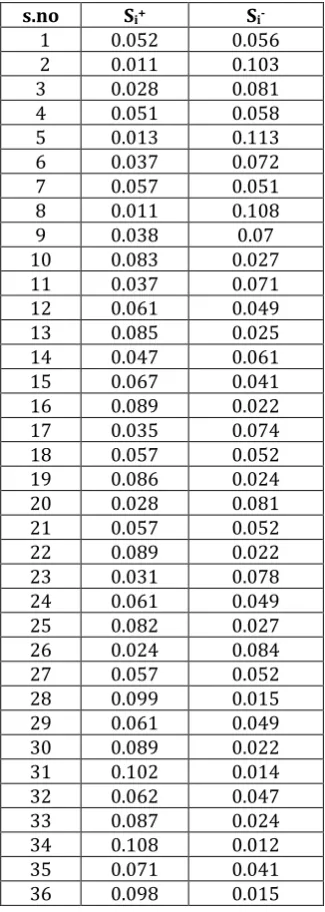
Table 4.3: Positive and Negative Separation ideal solution
Step 6: The closeness co-efficient (Table 4.4) of each
alternative is CCi =
Table 4.4: Closeness coefficient
Step 7: Rank the preference order based on their largest relative closeness co-efficient. It is observed from the Table 4.4, for the higher closeness coefficient is obtained for 8th experimental run. Hence the best parameter combinations of experimental 8th run are in the following. Best combination of parameter
Period of incidence : 12.00 p.m. – 2.00 p.m. Absorber Tube : Copper alloy c101 Reflector : Glass Mirror Best Output Responses for best combination of reflector and absorber tube
Temperature : 77°C Discharge : 15.5 lit/hr. Thermal Efficiency : 140.6%
s.no Si+ S
1 0.052 0.056 2 0.011 0.103
3 0.028 0.081
4 0.051 0.058
5 0.013 0.113
6 0.037 0.072
7 0.057 0.051
8 0.011 0.108
9 0.038 0.07
10 0.083 0.027
11 0.037 0.071
12 0.061 0.049
13 0.085 0.025
14 0.047 0.061
15 0.067 0.041
16 0.089 0.022
17 0.035 0.074
18 0.057 0.052
19 0.086 0.024
20 0.028 0.081
21 0.057 0.052
22 0.089 0.022
23 0.031 0.078
24 0.061 0.049
25 0.082 0.027
26 0.024 0.084
27 0.057 0.052
28 0.099 0.015
29 0.061 0.049
30 0.089 0.022
31 0.102 0.014
32 0.062 0.047
33 0.087 0.024
34 0.108 0.012
35 0.071 0.041
36 0.098 0.015
s.no CCI RANK
1 0.521 14
2 0.901 2
3 0.736 6
4 0.539 13
5 0.892 3
6 0.657 9
7 0.473 18
8 0.904 1
9 0.652 11
10 0.248 26
11 0.657 10
12 0.447 20
13 0.228 27
14 0.566 12
15 0.382 23
16 0.201 30
17 0.677 8
18 0.478 17
19 0.221 28
20 0.742 5
21 0.479 15
22 0.201 31
23 0.714 7
24 0.449 19
25 0.252 25
26 0.772 4
27 0.478 16
28 0.135 34
29 0.447 21
30 0.201 32
31 0.123 35
32 0.432 22
33 0.221 29
34 0.105 36
35 0.364 24
© 2017, IRJET | Impact Factor value: 5.181 | ISO 9001:2008 Certified Journal
| Page 275
ConclusionsThe following conclusions are drawn from the results. In the present work, the behaviour of linear solar
parabolic Collector for cooking system is studied and analysed using Mathematical models. Finally experimental response data is analysed
using AHP-TOPSIS and optimum parameters levels have been identified.
Among the combination of different reflector and absorber, glass mirror and copper alloy c101 tube combination is given best results for obtaining maximum temperature and discharge, thermal efficiency.
References
[1] A. Kahrobaian and H. Malekmohammadi (2008): Energy optimization Applied to Linear Parabolic Solar collectors. Journal of faculty of engineering, Vol.42.No.1 2008 PP-131-144
[2] Aneirson Francisco and da silva (2013): Multi-choice mixed integer goal programming optimization for real problems in a sugar and ethanol milling company, Applied Mathematical Modeling, 37(2013) 6146-6162. [3] Delfin Silio Salcines, Carlos Renedo Estebanez (2009):
Simulation of solar domestic water heating system, with different collector efficiencies and different volume storage tanks.
[4] Fernandez-Garcia, E.Zarza (2010) “Parabolic solar through collectors and their applications” Elsevier journal of Renewable energy, Vol.14, pp.1695–1721 [5] Sairam, P. Mohan Reddy and P. Venkataramaiah