http://dx.doi.org/10.4236/ojpm.2015.53012
The Study on the Process and Impact of
External-Care-Seeking Behavior in Shanghai
Chunlin Jin, Fen Li, Linan Wang, Shanlian Hu, Changying Wang
Shanghai Health Development Research Center, Shanghai Medical Information Center, Shanghai, China Email: [email protected]
Received 20 January 2015; accepted 15 March 2015; published 18 March 2015
Copyright © 2015 by authors and Scientific Research Publishing Inc.
This work is licensed under the Creative Commons Attribution International License (CC BY).
http://creativecommons.org/licenses/by/4.0/
Abstract
Objectives: To evaluate the impact of external-care-seeking, explore the framework to regulate patients’ seeking doctor behavior and to promote better medical resources allocation. Methods: Obtaining data from regular reports from public medical institutions in Shanghai, comparing pa-tients who seek doctors from out-of-Shanghai residence and local papa-tients with insurance in terms of the quantity of service, types of diseases, medical expenses, etc. Results: External-care-seeking has a large quantity, especially in hospitalization. In 2012, the number of discharged population from out-of-Shanghai accounted for 22.74% of the total discharged number, the proportion even higher than 30% in tertiary hospitals. Tertiary hospitals have a significant attraction effect, con-centrating 59.42% of the outpatient and emergency visits and 71.82% of the amount of hospitali-zation, with corresponding cost of 75.86% and 82.56%. The top three divisions in tertiary hospit-als for external-care-seeking were surgical, obstetrics and gynecology, internal medicine. Based on the interview, admitting out-of-shanghai patients is conducive to the improvement of the tech-nical level of hospitals, and to the enhancement of the utilization efficiency of health resource. However, the local residents may have less accessibility of high quality of medical service. The av-erage expense of external-care-seeking is higher than that of local patients happened in the same level of hospitals. Conclusions: External-care-seeking will have a more far-reaching impact on the health care system in Shanghai; some interventions might be necessary, such as rationally allo-cating medical resources based on the estimates of external-care-seeking and establishing a med-ical service supervision mechanism.
Keywords
External-Care-Seeking, Medical Tourism, Medical Resources Allocation
1. Background and Rationale
background, distance, transportation and medical services accessibility, price and quality of services as well as ethics; namely, patients tend to choose places with similar culture (especially immigrants from foreign countries or provinces), high accessibility and short waiting time, and good service with low expenses [1]. The phenome-na that individuals travel long distances to see doctors has gained momentum over the past years among other countries and regions [2] [3]. For example, in India, the number of patients from across the globe for medical treatment is expected to increase by 15% each year [4]. In other leading medical tourism destinations such as Thailand and Singapore, medical tourism has become one of the pillar industries [5].
The inherent driving factors of cross-provincial movement of patients are linked with social and economic development. With health needs of residents increasing, the demand of medical services gradually emerges with diverse forms. While in China medical resources of high quality are mainly concentrated in metropolitans, part of patients start to seek care in other cities to meet their health needs. Moreover, the basic medical insurance coverage has gradually expanded and improved [5], which increases the economic accessibility. Meanwhile, the development of transportation has accelerated migration, and urbanization has contributed to the opening and sharing of medical and health resources. Shanghai is the central city in Yangtze River Delta region and has a growth format with many highways and railways, which makes it fast and convenient for patients from other provinces to seek for medical care [6]. In addition, the gradual improvement of medical insurance reimburse-ment policies in different regions has further released residents’ needs for quality healthcare services [7]. For the hospitals, with the intention of pursuing high technology and economic incentives, patients from other regions are very welcomed. As a regional medical center in Asia, Shanghai is confronted with an escalating number of patients from other provinces and cities [8].
External care seekers have brought positive effects for promoting the development of health care in Shanghai, increasing efficiency of medical services and improving the utilization of medical high technology. However, it was also an upsetting issue for some reasons: local residents may have less access to local medical services, es-pecially to tertiary hospitals and special medical services; external patients may have unreasonable high costs due to the absence of effective supervision and management in cross-region health insurance systems, which poses an impact on local medical resource allocation, service supervision and health insurance management.
2. Methods
Quantitative investigation: Shanghai Health Resource and Medical Services Survey Regulation (hereinafter re-ferred to as “the Regulation”) divides patients into 2 categories, namely, local patients with health care insurance, and patients from out-of-Shanghai residence, which refers to patients from other cities and provinces to Shang-hai for medical services. Medical institutions in ShangShang-hai are responsible to make regular reports (monthly and annual) of services utilization and expenses for patients from out-of-Shanghai residence, and these data are de-rived from Shanghai Health and Family Planning Commission (which was known as Shanghai Health Bureau) Information Center. The officers from inpatient and outpatient department of sample hospitals mentioned that it is relatively accurate to identification patients’ sources, since, in addition to their medical insurance card identi-fication, they will also be asked for a payment of Shanghai medical insurance and their residences. Double check of information is carried out in hospitalization, which has guaranteed a relatively high accuracy of data. For outpatient, due to a massive number of patients, the identification basically relies on the presence of the Shanghai medical insurance card. As Shanghai’s medical insurance system has basically covered all the perma-nent residents, which was 97% in 2012, and the coverage ratio of permaperma-nent residents population was 93% (Shanghai Medical Insurance Bureau, 2012). Therefore, the estimate of external-care-seeking was mainly in line with the actual situation in Shanghai, with possible overestimation though.
Qualitative interviews: According to the results of the quantitative data, interview were carried out in tertiary hospitals and maternal care hospitals (which have higher percentage of external-care-seeking patients), mainly with hospital administrators, medical staff and patients both from Shanghai and other provinces or cities. In par-ticular, the interviews were carried out with health administration and social security management staff in some cities in Jiangsu Province with the largest proportion of non-local patients, so as to have a better understanding of external-care-seeking.
3. Status of External-Care-Seeking
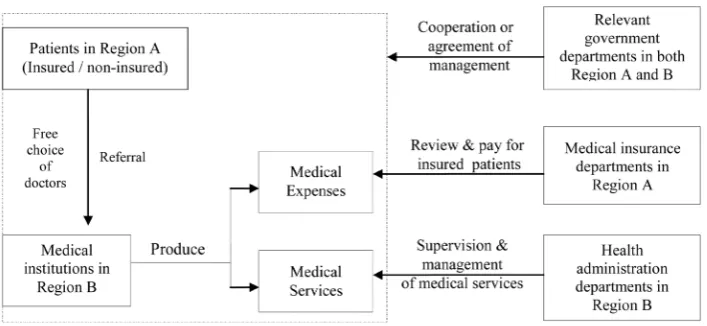
institutions of both source and destination regions, which has a reciprocal influence on regional medical and health services development plannings, medical insurance management, and medical services supervision and regulation. Stakeholders are shown in Figure 1.
3.1. The Proportion of External-Care-Seeking
3.1.1. Quantity of Service and Its ProportionExternal-care-seeking has a large quantity, especially in hospitalization. In 2012, the amount of outpatient and emergency visits of external-care-seeking was 9.48 million, accounting for 4.5% of the total outpatient and emergency visits. The number of discharged population was 661,400, accounting for 22.74% of the total number of discharged patients. From the perspective of the proportion of external-care-seeking to the total services amount, the largest number is found in tertiary hospitals and maternal care hospitals, and the outpatient and emergency visits and discharged population of tertiary hospitals accounted for 8.41% and 30.93%, respectively, while that of maternal care hospitals was 8.13% and 28.38% (Table 1). It is worth noting that there is a big dif-ference among different tertiary hospitals. For example, in some well-known large tertiary hospitals with high technology, the discharged population of external-care-seeking accounted for 70% or more of the total, while some other has a proportion of less than 10%.
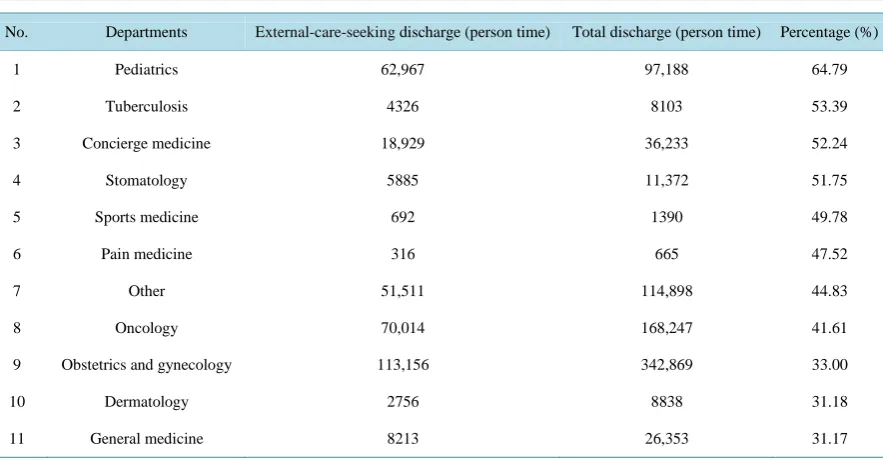
Also, there is a very obvious difference among different departments. In 2012, the data showed that sections with a 50% or more hospitalization proportion of external-care-seeking included pediatrics, tuberculosis, con-cierge medicine and stomatology (Table 2). There were 11 divisions whose hospitalization proportion of exter-nal-care-seeking exceeded 30%, and the proportion in the features sections with specialties of some tertiary hos-pitals is even higher, some may hitting 70% or more.
3.1.2. Medical Expenses and Proportion
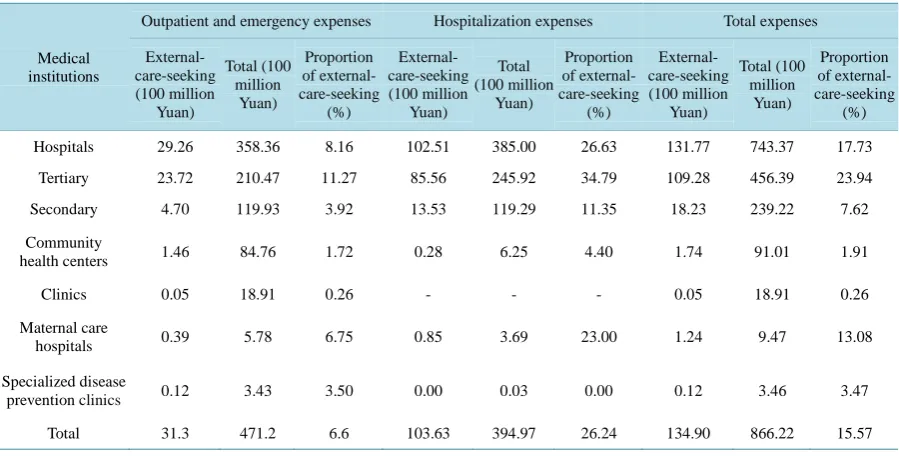
In 2012, the total expenses of external-care-seeking were 13.49 billion Yuan (2.24 billion US Dollar), account-ing for 15.57% of the city’s total medical expenses, includaccount-ing 3.13 billion Yuan (0.52 billion US Dollar) of out-patient and emergency expenses, which was 6.6% of the total outout-patient and emergency expenses, and 10.36 bil-lion Yuan (1.72 bilbil-lion US Dollar) of hospitalization expenses, which was 26.24% of total hospitalization ex-penses. And for the proportion to total medical cost, tertiary hospitals ranked the top, which was 23.94%, espe-cially the hospitalization costs, accounted for up to 34.79% (Table 3).
3.2. The Flow of External-Care-Seeking
[image:3.595.138.492.536.699.2]The majority of external-care-seeking occurred in hospitals, whose outpatient and emergency visits accounted for 82.17% of total external-care-seeking outpatient and emergency visits in Shanghai, with the expenses pro-portion of 93.57% of total. The discharged population from hospital accounted for 94.78% of the total external-
Table 1. Service quantity and proportion of external-care-seeking in Shanghai, 2012.
Medical institutions
Outpatient and emergency person time Discharged patients number
External-care-seeking (10,000 person time)
Total (10,000 person time)
Proportion of external-care-seeking
(%)
External-care-seeking (10,000 person time)
Total (10,000 person time)
Proportion of external-care-seeking
(%)
Hospitals 778.72 12882.47 6.04 62.69 272.15 23.04
Tertiary 563.12 6696.93 8.41 47.50 153.57 30.93
Secondary 200.46 5394.05 3.72 13.70 107.06 12.80
Community
health centers 142.95 7331.92 1.95 1.08 10.20 10.59
Clinics 1.36 457.77 0.30 - - -
Maternal care
hospitals 19.74 242.68 8.13 2.37 8.35 28.38
Specialized disease
prevention clinics 4.97 153.44 3.24 0.00 0.15 0.00
Total 947.7 21068.3 4.5 66.14 290.85 22.74
Note: The classification is in line with the Health Statistics report of Shanghai, and municipal tertiary hospitals, such as Shanghai Oral hospital and International Peace MCH are included in tertiary hospitals.
Table 2. Divisions for hospitalization in external-care-seeking in Shanghai, 2012.
No. Departments External-care-seeking discharge (person time) Total discharge (person time) Percentage (%)
1 Pediatrics 62,967 97,188 64.79
2 Tuberculosis 4326 8103 53.39
3 Concierge medicine 18,929 36,233 52.24
4 Stomatology 5885 11,372 51.75
5 Sports medicine 692 1390 49.78
6 Pain medicine 316 665 47.52
7 Other 51,511 114,898 44.83
8 Oncology 70,014 168,247 41.61
9 Obstetrics and gynecology 113,156 342,869 33.00
10 Dermatology 2756 8838 31.18
11 General medicine 8213 26,353 31.17
care-seeking discharged population, with the expenses proportion of 98.92% of total, and within the total exter-nal-care-seeking medical expenses, 97.68% was occurred in hospitals. Tertiary hospitals have a significant at-traction effect, concentrating 59.42% of the outpatient and emergency visits and 71.82% of the amount of hos-pitalization, with corresponding cost of 75.86% and 82.56%, respectively. 81.01% of the total medical expenses for patients from out-of-Shanghai residence were incurred in tertiary hospitals (Table 4).
Table 3. Expenses and proportion of external-care-seeking in Shanghai, 2012.
Medical institutions
Outpatient and emergency expenses Hospitalization expenses Total expenses
External- care-seeking (100 million Yuan) Total (100 million Yuan) Proportion of external- care-seeking (%) External- care-seeking (100 million Yuan) Total (100 million Yuan) Proportion of external- care-seeking (%) External- care-seeking (100 million Yuan) Total (100 million Yuan) Proportion of external- care-seeking (%)
Hospitals 29.26 358.36 8.16 102.51 385.00 26.63 131.77 743.37 17.73
Tertiary 23.72 210.47 11.27 85.56 245.92 34.79 109.28 456.39 23.94
Secondary 4.70 119.93 3.92 13.53 119.29 11.35 18.23 239.22 7.62
Community
health centers 1.46 84.76 1.72 0.28 6.25 4.40 1.74 91.01 1.91
Clinics 0.05 18.91 0.26 - - - 0.05 18.91 0.26
Maternal care
hospitals 0.39 5.78 6.75 0.85 3.69 23.00 1.24 9.47 13.08
Specialized disease
prevention clinics 0.12 3.43 3.50 0.00 0.03 0.00 0.12 3.46 3.47
Total 31.3 471.2 6.6 103.63 394.97 26.24 134.90 866.22 15.57
Table 4. Medical institutions visits and expenses flow in external-care-seeking in Shanghai, 2012.
Medical institutions
Medical visit flow Expenses flow
Outpatient and
emergency (%) Inpatient (%)
Outpatient and emergency cost (%)
Inpatient cost (%)
Total medical expenses (%)
Hospitals 82.17 94.78 93.57 98.92 97.68
Tertiary 59.42 71.82 75.86 82.56 81.01
Secondary 21.15 20.71 15.03 13.06 13.52
Community health centers 15.08 1.63 4.67 0.27 1.29
Clinics 0.14 - 0.16 - 0.04
Maternal care hospitals 2.08 3.58 1.25 0.82 0.92
Specialized disease prevention clinics 0.52 0.00 0.38 0.00 0.09
[image:5.595.90.534.546.719.2]Total 100.00 100.00 100.00 100.00 100.00
Table 5. Division flow of hospitalization in external-care-seeking in Shanghai, 2012.
Division External-care-seeking discharge (person time) Division percentage (%) Accumulating percentage (%)
Surgical 196,221 27.41 27.41
Obstetrics and gynecology 113,156 15.81 43.21
Internal medicine 95,177 13.29 56.51
Oncology 70,014 9.78 66.29
Pediatrics 62,967 8.80 75.08
Other 51,511 7.20 82.28
Traditional Chinese medicine 27,158 3.79 86.07
Ophthalmology 22,688 3.17 89.24
Concierge medicine 18,929 2.64 91.89
3.3. Average Expenses for External-Care-Seeking
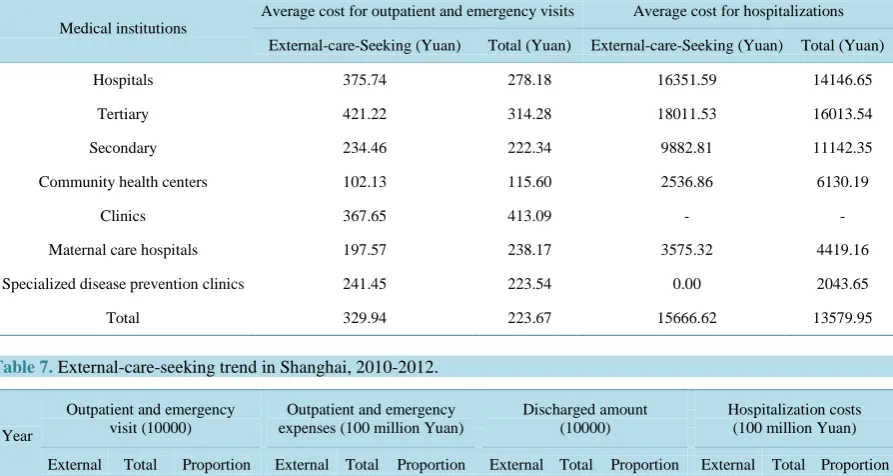
The overall average cost for external-care-seeking was higher than the average in Shanghai. The average cost of outpatient and emergency visits for external-care-seeking was 329.94 Yuan (54.51 US Dollar), which was 47.51% higher than the average in Shanghai, and that of hospitalizations was 15666.62 Yuan (2588.13 US Dol-lar), which was 15.37% higher than the average (Table 6). Most expenses of patients from out-of-Shanghai res-idence was relatively higher comparing to the average in Shanghai, except for community health centers, clinics, and maternity care hospitals, There are two main explanations for such differences: on the one hand, patients from out-of-Shanghai residence often go to higher level medical institutions, resulting in an overall higher aver-age cost. On the other hand, expenses are related to disease type and severity (Table 6).
3.4. Demography Characteristics of External-Care-Seeking
According to the current residence of patients from the home page of their medical record, the major source provinces were Jiangsu, Zhejiang and Anhui in 2012, which account for 64%, followed by Henan, Sichuan, Fu-jian, Shandong, Hubei, Jiangxi and Hunan, which account for 28.9%, while the remaining 21 provinces (cities or regions) only accounted for 11%. This has shown a close relation between external-care-seeking and location and traffic conditions. An inter-regional cooperation and joint supervision shall be higher cost-effectiveness.
4. Changes in the Total Amount of External-Care-Seeking
Since 2010, external-care-seeking have presented the feature of large inpatient. The percentage of external-care- seeking stabilizes over 20%, with the expenses over 22% (Table 7). Compared with 2010 and 2011, the amount of service and medical expenses of external-care-seeking in 2012 had increased, which was featured with a fast-er increase of inpatient than outpatient and emfast-ergency visits. In 2012, the numbfast-er of outpatient and emfast-ergency visits, and discharged patients were increased by 845,000 and 158,000 person times comparing to 2010, respec-tively, with a growth rate of 9.79% and 31.41%, while the expenses of outpatient and emergency visits and hos-pitalization were increased by 620 million Yuan (100 million US Dollar) and 3.6 billion Yuan (0.59 million US Dollar), with a growth rate of 24.7% and 54.1%.
5. The Impact on Stakeholders
China’s medical institutions follow the principle of jurisdiction, and patients are able to freely travel among dif-ferent regions. However, with no unified policies and management system, it poses a certain challenge on regu-lation and supervision of medical services.
5.1. Healthcare Institutions and Staff
The medical care costs of patients from out of Shanghai is an important source of income for medical institu-tions in Shanghai, which can also promote the development of related industries, such as pharmaceuticals, med-ical devices retail, dining and accommodation. The interviews with management and medmed-ical staff in medmed-ical institutions in Shanghai show that it is good for the development of Shanghai medical institutions and improve-ment of medical personnel skills. Firstly, the severe and complicated diseases have greatly enriched the types of cases in Shanghai, and are conducive to improvement of medical skills. Secondly, with more severe diseases, there is a greater probability of the use of advanced medical instruments, which can improve the efficiency in the use of medical resources and marginal benefit. Thirdly, medical institutions in source regions are also influ-enced. If the patient has been referred to other medical institutions outside their source regions, it can alleviate the shortage of medical resources or insufficient skills.
5.2. Patients
Table 6. Comparison of average cost for external-care-seeking with the average in Shanghai, 2012.
Medical institutions
Average cost for outpatient and emergency visits Average cost for hospitalizations
External-care-Seeking (Yuan) Total (Yuan) External-care-Seeking (Yuan) Total (Yuan)
Hospitals 375.74 278.18 16351.59 14146.65
Tertiary 421.22 314.28 18011.53 16013.54
Secondary 234.46 222.34 9882.81 11142.35
Community health centers 102.13 115.60 2536.86 6130.19
Clinics 367.65 413.09 - -
Maternal care hospitals 197.57 238.17 3575.32 4419.16
Specialized disease prevention clinics 241.45 223.54 0.00 2043.65
Total 329.94 223.67 15666.62 13579.95
Table 7. External-care-seeking trend in Shanghai, 2010-2012.
Year
Outpatient and emergency visit (10000)
Outpatient and emergency expenses (100 million Yuan)
Discharged amount (10000)
Hospitalization costs (100 million Yuan)
External Total Proportion External Total Proportion External Total Proportion External Total Proportion
2010 863.2 18858.5 4.6 25.1 378.0 6.6 50.3 251.6 20.0 67.2 296.0 22.7
2011 866.7 19964.9 4.3 28.0 423.2 6.6 60.4 268 22.5 91.2 340.1 26.8
2012 947.7 21068.3 4.5 31.3 471.2 6.6 66.1 290.9 22.7 103.6 395.0 26.2
For external-care-seeking patients, their diverse medical needs are fully met. They are free to choose medical institutions for treatment based on the needs, and the gradually improving medical insurance reimbursement policies have further reduced their economic concerns and greatly improved economic accessibility of the med-ical services, in particular, the average expenses of external-care-seeking is higher than that of local patients happened in the same level of hospitals, which may be associated with the types and severity of diseases, but also be caused by lack of supervision in cross-regional medical services [9].
5.3. Health Management
The behavior of external-caseeking may release the pressure of medical resources development in source re-gions, and expanded the purchase options for health insurance sectors. The interviews conducted in neighboring province showed that external-care-seeking patients tend to go to regional medical center, such as Shanghai, for treatment once they have major diseases. On the other hand, since the development of medical institutions is not the economic growth points in source regions. This has brought some tips for health administrative departments in Shanghai, namely, to adjust the total amount and structure of resources in Shanghai health resources planning [10].
The service should target in both local patients and a large number of non-local patients. In the estimate of the amount allocation of local medical resources, the number of the latter should be taken into consideration. In ad-dition, the allocation shall take full account of the diseases and flow characteristics of external-care-seeking pa-tients and a hierarchical classification is needed during making plan of resource allocation. They tend to go to medical institutions with high concentrated and comprehensive services (mainly top tertiary hospitals), espe-cially famous specialist divisions.
5.4. Healthcare Sector
Shang-hai has established a collaborative relationship with some provinces and cities in cross-regional medical insur-ance and reimbursement, and a reimbursement standard provides great convenience for non-local patients [11] [12] [13] [14]. However, most patients get reimbursement afterwards, which is inconvenient.
6. Limitations and the Direction of Research Improvement
The major identification criterion for outpatient and emergency patients is with/without basic medical insurance; therefore, a slight number of local patients who do not have the insurance would be mistaken as external-care seeking patients. In the field investigation at the hospital, doctors said that in rural areas, a lot of migrant work-ers in informal employment, such as waitwork-ers, are not covered by basic medical insurance, and they are possibly mistaken for external-care seeking patients as well. In the future, small-scale surveys can be carried out for the data correction.
References
[1] Yip, W.C.-M., Hsiao, W.C., Chen, W., et al. (2012) Early Appraisal of China’s Huge and Complex Health-Care Re-forms. Lancet, 379, 833-842. http://dx.doi.org/10.1016/S0140-6736(11)61880-1
[2] Weisz, G. (2011) Historical Reflections on Medical Travel. Anthropology & Medicine, 18, 137-144. http://dx.doi.org/10.1080/13648470.2010.525880
[3] Horton, S. and Cole, S. (2011) Medical Returns: Seeking Health Care in Mexico. Social Science & Medicine, 72, 1846- 1852. http://dx.doi.org/10.1016/j.socscimed.2011.03.035
[4] Hazarika, I. (2010) Medical Tourism: Its Potential Impact on the Health Workforce and Health Systems in India.
Health Policy and Planning, 25, 248-251. http://dx.doi.org/10.1093/heapol/czp050
[5] Wu, T. and Heng, D.Q. (2010) The Initial Emergence of “One Core and Nine Lines” Layout in Yangtze River Delta.
Shanghai Securities News.
[6] Li, S.C. (2010) Joint Efforts Are Called for in the Whole Management and Service System for Cross-Region Health-care. China Health Insurance, 12-14.
[7] Li, F., Jin, C.L. and Wang, L.N. (2012) The Study on External-Care-Seeking Status in Shanghai and its Impact on Health Care System. Chinese Health Economics, 42-45.
[8] Shanghai Municipal Development and Reform Committee.
http://www.shdrc.gov.cn/main?main_colid=522&top_id=398&main_artid=19043
[9] Jiang, X. (2009) Cross-Region Medical Treatment: Cost Control Is the Key. Chinese Social Security, 73.
[10] Zhang, M. and Liu, Q. (2008) Cross-Region Medical Treatment: From Regional Cooperation to National Co-Ordi- nating Collaboration. China Social Insurance, 74-75.
[11] Hu, S.L., Ding, H.S. and Wang, X.J. (2011) Investigation on Shanghai Health Insurance and Health Joint Problems.
Special Report on Advances in Health Policy Research, 1-8.
[12] Meng, Q.M. (2011) Cross-Region Medical Treatment Collaboration in Pan Northwest Region. Chinese Medical In-surance, 70.
[13] Cao, A.H., Bai, Z.Q. and Han, Y.W. (2009) An Assumption on the Establishment of Cross-Region Settlement of Med-ical Treatment with Pan-Pearl River Delta. Chinese Health Economics, 56-57.