
© 2018, IRJET | Impact Factor value: 6.171 | ISO 9001:2008 Certified Journal | Page 51
Image Segmentation Techniques: A Survey
Rahul Basak
1, Surya Chakraborty
2, Aditya Kumar Mondal
3, Satarupa Bagchi Biswas
412,3
Dept of Information Technology, Heritage Institute of Technology, Kolkata, West Bengal, India
4Asst. Professor Dept of Information Technology, Heritage Institute of Technology, Kolkata, West Bengal, India
---***---
Abstract -
Technology is always been a factor whichaccelerate the time. Among the several hands of it, Image Processing or better to say Digital Image processing is most important portion to study. And Image Segmentation is one of the hotspot of Digital Image Processing. There is no any general solution available for this. Several general-purpose techniques have been developed for Image Segmentation process. This paper addresses some of the most important techniques from the brunch and represents a survey on them.
Key Words: Image segmentation, Image Segmentation
Techniques, Image Processing, Histogram Technique, K-means, Fuzzy C-means, Watershed Technique, Clustering techniques.
1. INTRODUCTION
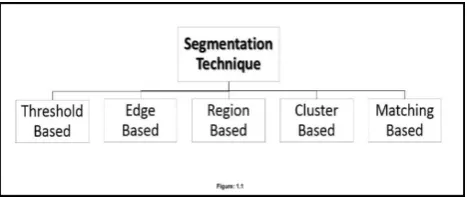
In Image Processing it’s been a always important part to segment an image into multiple section, to study or evaluate them properly. A image can be segment depends upon so many factors like colours, Textures, grey scale value [21] etc. and also there is no any general rule available for this. So, naturally there is so many general-purposed approaches are available for the segmentation process, which leads to a separate study on Image Segmentation. In Image Segmentation, it means divides a image into multiple parts [21] which are definable, actionable, profitable and accessible. And those parts can also be evaluated separately without interfere into each other. And as mentioned there are so many techniques are available [20] in the world. But according to their behaviours of segmentation process they are divided into five methods as described in figure: 1.
Fig-1: Classification of Segmentation Technique
Here is some example of techniques for each method. For Threshold Based: histogram based techniques, iterative thresholding, otsu method, etc. For Edge Based: the Hough transformation, watershed segmentation, snakes, etc. For Region Based: region growing, region merging, split and merge method etc. pyramid tree and scale method, texture
method, Fourier technique, co-occurrence matrices, etc. For Cluster Based: agglomerative clustering, K-means, Fuzzy C- means, etc. For Matching Based: template matching, etc. This paper address four techniques from above which are belongs to different method. They are Histogram Based, K-means, Fuzzy C-means (Both K-means and Fuzzy C-means belongs to the same method.), Watershed.
If you look around into the world from your right next mobile phone to any big industry, or any hospital you can find Image Segmentation is a big deal over there. And some of the cases it’s really need to be more accurate as it can be cause security for a system for example your mobile phone or personal computer can be open with finger print scan or by face detection which is developed by image segmentation process. And if you go in to medical science field you can find it also very useful like locate a tumor, details study on anatomical structure, measuring tissue volume those things are done by Image Segmentation. In other fields like machine view in Industry, object locating from Satellite, content based image retrieval. Keeping in the mind the importance of Image Segmentation the developers always invented new approaches sometime by merging the best from different techniques or algorithms to make the required result as accurate as possible.
2. SEGMENTATION TECHNIQUES
Now we are going to discuss those four particular techniques by some research paper available from recent study.
2.1. Histogram Based
It is one of the simplest way to receive segmented parts of an image from the histogram of it. In the classic approach first, the histogram of the image is made according to the color and intensity value, the cluster can be define. Based on the clusters got from the image, segmentation is done but the drawback over here is we cannot get much required level of details in the segmented pictures.
More technically, The histogram based techniques is dependent on the success of the estimating the threshold value that separates the two homogonous region [23] of the object and background of an image. Histogram based thresholding is applied to obtain all possible uniform regions in the image.
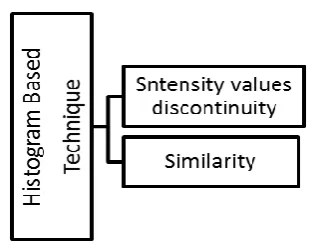
[image:1.595.40.274.572.672.2]© 2018, IRJET | Impact Factor value: 6.171 | ISO 9001:2008 Certified Journal | Page 52 Fig -2: Techniques classification of Histogram Technique
First category is an image should be partitioned with respect to some of its features like image intensity, edges etc. Second category is to partition an image into several regions that can clearly segregate an image into several regions that may be with respect to intensity or colour value.
Histogram Threshold approach belongs to intensity, regions of an image; i.e., with respect to colour intensity or with respect to colour regions, a corresponding Histogram is placed for that image which denotes; the amount every no. of pixels that are presented in that image. Threshold segmentation techniques can be classified into three different classes:
Taking in account the local properties of an image like its pixel value, neighbourhood pixel details etc.
Global techniques segment an image on the basis of information obtain globally (By using image histogram; global texture properties).
Splitting, merging and growing techniques for an image( use both the notions of homogeneity and geometrical proximity) to obtain good segmentation results for an image.
They shown [1] the comparative studies applied by using five techniques of threshold segmentation techniques. And among them HDT become one of best process. In this paper, the researchers have worked on a particular domain of input data. But there may be a chance that the result will change, with other input data. The approach in [2] they have used the thresholding by choosing the mean or median value of a pixel which is the key parameter in thresholding .If any object pixel is brighter than the background, that should also posses higher value than the average. In a noiseless image having uniform background and object values, the mean or median will work well as the threshold as there the segregation of object from background is easier, however, this will generally not be the case. A more complicated approach is to create a histogram of the image by calculating the intensity values of pixels and calculate the threshold value by taking the valley point of the placed histogram. The histogram approach like that there exists some average value for the background pixels and object pixels, although the actual pixel values have some variation around these average values. They have also
enlightened on Adaptive Thresholding: different thresholding is applied on spatial variation of pixel's intensity for a given image. In [3] they have applied Histogram technique along with Fuzzy C Means technique. A clustering based approach is the segregation of objects into similar groups, or more precisely, the partitioning of a data set into subsets (clusters), so the data in the set can share common clusters. . Many clustering schemes are categorized based on their special characteristic, like the hard clustering scheme and the fuzzy clustering scheme. One of the most popular clustering methods used in image segmentation is Fuzzy C-means (FCM) algorithm because it can detect the degree of participation for an pixel and can hold much more information about pixel details. Although conventional FCM is not associated with spatial context information and it is sensitive to noise and imaging artefacts. The fuzzy clustering algorithm FCM is then employed in the proposed approach to achieve proper segmentation. To prevent & detect noise, the spatial probability of neighbouring pixels is combined with the conventional FCM. By using an efficient algorithm which can effectively remove noise, the input noisy medical image firstly the noise is removed so that it can improve its robustness further. When the spatial information combines with traditional FCM it is clear that it will take longer time to converge and also there exists lots of possibilities to converge in the local minima. Thus, in the presented approach, for avoiding local minima, the parameters of the FCM algorithm are initialized using histogram. Generally, clustering is to segregate an image into different clusters with the intensity values(& colour values too) of pixels but it does not bother about the spatial information of the respective pixel. Hence the histogram based FCM converges very quickly in comparison with conventional FCM. In this way [4] they have discussed about two more recent and fruitful segmentation process which is termed as class driven segmentation; where object class models liable to propose object localizations that is efficient in image segmentation. Another method is interactive segmentation; in which user gives approximate segmentations and then refines and gather the auto created image based segmentations into groups. Here it is discussed to show that if an appropriate distance measure is used; equal or superior recognition results can be obtained by a single class model, and also to explain why this result comes about. Moreover this paper enlighten on to show that pixel-wise segmentations can be obtained from sliding windows using class models. In addition, an object category is represented by a single histogram of dense visual words, and then look for the effectiveness of this representation for segmentation. Actually the advantage of a single class histogram it can be represented efficiently in terms of computation.
2.2. Clustering Method
© 2018, IRJET | Impact Factor value: 6.171 | ISO 9001:2008 Certified Journal | Page 53 A good clustering method will produce [23] high superiority
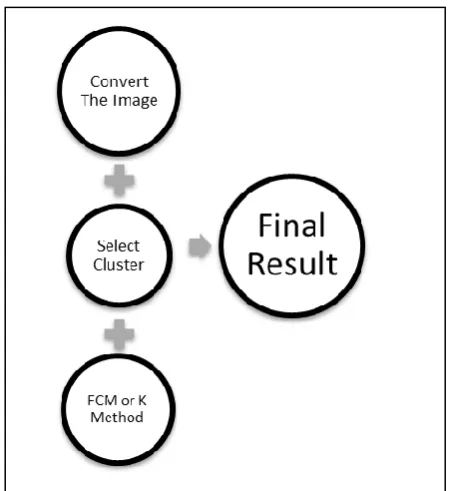
clusters with high intra-class similarity and low inter-class similarity. Clustering algorithms can be categorized into partition-based algorithms, hierarchical-based algorithms, density-based algorithms and grid-based algorithms. Partitioning clustering algorithm splits the data points into k partition, where each partition represents a cluster.
Fig -3: Clustering process with FCM and K Methods
We are discussing two of the most important Clustering Techniques here. They are:
2.2.1. K-Means Clustering
The K-means technique is used to partition an image into K clusters. Every pixel only belongs to a particular cluster. The clustering is done based on either pixel colour intensity of the image or texture, location, or a combination of these factors. The K value can be selected manually, randomly, or by a heuristic approach. Although this algorithm is guaranteed to converge, but it is hard to say about the optimality of solution. The quality of the result depends on the initial set of clusters and the selection of K value. Also, K-means clustering is not suitable for the images that have fuzziness. More technically It is a partition method technique which finds mutual exclusive clusters of spherical shape. It generates a specific number of disjoint, flat(non-hierarchical) [24] clusters. Stastical method can be used to cluster to assign rank values to the cluster categorical data.
In this paper [5] they have discussed about Subtractive clustering method which is an efficient technique that can find the optimal data point, which serves as cluster centroid; based on the density of neighbourhood data points. It estimates the number and initial location of the cluster
centres. It distributes the data space into gridding point and then calculates the distance of every data point from actual data point. So the grid point with many data point nearby possess high potential value; so this grid point with highest potential value will be choose as first cluster centre. After selecting the first cluster centre the second cluster centre to be found by calculating the highest potential value in the remaining grid points. This method of acquiring new cluster centre and reducing the potential of surrounding grid point. This process will be circulated till the convergence of every grid point; that their potential falls under pre determined threshold value. One problem is that, as the data dimension is increased; corresponding computation complexity is also increased exponentially.
Sadia Basar et al. [6] they has proposed system which will create the temporary and individual clusters that helps to find the optimal threshold value. The optimal cluster value can be calculated by applying K-Means clustering algorithm. They have also used Histogram for each individual colour domain In RGB domain to find the individual peak, the relative distance of each are also considered to calculate the mean value of each cluster for final segmentation. As per their work, an image is firstly loaded, then it will be created the temporary and individual clusters that will find the optimal threshold value. K-means clustering algorithm is used to find the optimal cluster value calculation and feature has been extracted i.e. pixel colour value, pixel intensity level and regions. After the feature extraction, for RGB domain, three histograms will be generated corresponding to Red, Green, and Blue. Then peaks are identified for Red, Blue and Green and then relative distance from peak to every data point is calculated. After calculating the relative distance , the mean value should be calculated for each cluster; the image is segmented by using the mean cluster value, finally.
[image:3.595.50.276.168.414.2]© 2018, IRJET | Impact Factor value: 6.171 | ISO 9001:2008 Certified Journal | Page 54 and counteract the intrusive efforts and intrusive efforts can
be effected by insiders (like any system failure) or outsiders (any malicious attack) in the system. The pre-processed datasets are further normalized (to remove any redundancy) by applying various data pre-processing techniques, and then applied as input to the models. Ramaraj.M et al. In their study [9] a new approach has been discussing of brain tumour the image, by applying K-means algorithm along with Fuzzy c-means technique.. The statistical parameters for a tumour are calculated by applying K-means & Fuzzy C method. They have incorporated K-Means algorithm with FCM in association with Hierarchical clustering; which proper way to find the distance that is applied in traditional clustering method. That method also generates a tree structure (or a dendrograms) and it’s distance matrix. Bottom-up & Top-down approaches are available for Hierarchical clustering.
2.2.2. Fuzzy-C means Clustering
Fuzzy clustering (or Soft Clustering) is a technique for image segmentation in which each data point can belong to more than one cluster or partition. Membership grades are assigned to each of the data points. These membership grades indicate the degree of participation that indicates which data point belongs to which cluster. Thus, points on the edge of a cluster, with lower membership value, indicate that the cluster to a lesser degree of participation than central cluster point. Technically The use of fuzzy set provides imprecise class membership function. of the key constituents of soft computing in handling challenges posed by massive collections of natural data. The central idea [25] in fuzzy clustering is the non-unique partitioning of the data into a collection of clusters. The data points are assigned membership values for each of the clusters and fuzzy clustering algorithm allow the clusters to grow into their natural shapes. In this case [10] they classify image using statistical features (mean and standard deviation of pixel colour values) which is a simple but powerful method for text as well as image segmentation. A systematic structure is followed by these features which leads that segregation one from another.They identified this segregation in the form of class clustering; Fuzzy C-Means method which is used to determine each cluster location; using this technique, maximum membership defuzzification and neighbourhood smoothing is achieved. The steps that they have used are demonstrated below:
[image:4.595.323.535.82.373.2]
Fig- 4: Process described [10] for FCM method
© 2018, IRJET | Impact Factor value: 6.171 | ISO 9001:2008 Certified Journal | Page 55 over the image. Long Chen et al. [13] introduced a
generalized multiple-kernel fuzzy C-means (FCM) (MKFCM) methodology ;as a framework for image-segmentation. In the framework, the composite kernels are used in the kernel FCM (KFCM), is just a integrating form of multiple kernels. The proposed MKFCM algorithm provides flexibility to fuse different pixel information in image-segmentation problems. The kernel FCM (KFCM) algorithm is an extension of FCM, which connects the original with Hilbert space by some transform function. When this mapping is done, the data are more easily to be separated or clustered. It can be defined different kernel functions purposely for the intensity information, the texture information and the combination of these kernel functions are applied the composite kernel in MKFCM (including LMKFCM) to obtain better image-segmentation results.
Yannis A. Tolias[14] has incorporated spatial constraints into the results of conventional Fuzzy clustering technique for solving image segmentation problems. They proposed of imposing spatial constraints is based on a voting scheme over a neighbourhood that is evaluated on a cluster basis. The basic criterion for imposing spatial constraints over a neighbourhood is ; when we deal with a homogeneous region, either of low or high membership to a cluster, the fuzzy partition matrix should be updated in such a way that describes the membership of the majority of the pixel neighbours to the cluster.
2.3. Watershed Transformation
The idea of watershed transform [26] is straightforward by the intuition from geography. The main goal of watershed segmentation algorithm is to find the “watershed lines” in an image in order to separate the distinct regions. To imagine the pixel values of an image is a 3D topographic chart, where x and y denote the coordinate of plane, and z denotes the pixel value. The algorithm starts to pour water in the topographic chart from the lowest basin to the highest peak. In the process, we may detect some peaks disjoined the catchment basins, called as “dam”. The watershed algorithm is one of the most powerful morphological tools for image segmentation.
Fig-5: Catchment basin and Watershed line. [26]
They have fold the paper [15] in two. In first they have present a critical review of several definition of Watershed Transformation and associated sequential algorithm. And in the second main current approaches towards parallel implementation of Watershed model, Depends upon strategies, distinguishing between distributed memory and shared memory architecture. They have also divided there paper [16] in to two section. First, they define basic tools, the watershed transform. And then they show that this transformation can be built by implementing a flooding process on a grey-tone image. Using elementary morphological operations like a geodesic skeleton and reconstruction; this flooding process can be performed. By applying this methodology, image segmentation operations is discussed over here. Due to the application of Watershed algorithm on a particular image to transform in gradient image; causes a over segmentation. This leads, in the to the part, to the introduction of a general methodology for segmentation. They have enlightened on a transformation viz. Homotopy modification. This complex tool is defined in detail and various types of implementation are shown there. They add a new approach in there paper [17] approach of Watershed Algorithm using Distance Transform is applied to Image Segmentation. It is very common that with watershed transformation segmentation outcome image (segmented) comes with a max level of noise; here to reduce that, they have used Laplacian of Gaussian (LoG) edge detector technique with the classic approach of watershed transformation. By the help of this approach, as shown in the paper the result comes with the lesser value of noises. Which means subject visibility becomes clearer after segmentation. Lamia J aafar et al.[18] they have also works with the same issue that is to reduce over segmentation problem with a new approach which is based on mathematical morphology. More preciously they propose to adapt the topological gradient method with the classical approach of Watershed transformation technique. They have also illustrated the numerical tests obtained from the result to show the efficiency. In this paper [19] they have mainly concentrate on the medical images issues. And based on this they have developed the approach. Magnetic resonance image basically comes with a much level of noise. Here they have targeted to reduce those by the help of some marker techniques. They propose to introduce the use of a previous probability calculation in the watershed technique. Furthermore, they introduce a method through the use of markers to combine; the watershed transform and atlas registration,. And as the result the images comes with less drawback of segmentation like over-segmentation, sensitivity to noise or low signal to noise ratio structures.
3. CONCLUSION
[image:5.595.39.285.590.742.2]© 2018, IRJET | Impact Factor value: 6.171 | ISO 9001:2008 Certified Journal | Page 56 best approach to solve the problem of image segmentation.
And that is what actually done by the most of the review papers, In addition some of the authors also introduce some mathematical approaches and edge detection techniques to get the desired output. As there is no any universally accepted method for image segmentation technique and there is so many factors which create affect on the result. Like: homogeneity of images, spatial characteristics of the image, continuity, texture. Considering all above factors, image segmentation remains a challenging problem in image processing and computer vision.
ACKNOWLEDGEMENT
We would love to thank Professor Joydev Hazra for his expert advice and encouragement throughout this project.
REFERENCES
[1] Salem Saleh Al-mria, N.V. Kalyankar and Khamitkar,
“Image Segmentation by Using Threshold Technique”, JOURNAL OF COMPUTING, VOLUME 2, ISSUE 5, MAY 2010, ISSN 2151-9617,pp.83-86
[2] P.DanielRatnaRaju, G.Neelima, “Image Segmentation by
using Histogram Thresholding”, IJCSET |January 2012| Vol 2, Issue 1, pp. 776-779
[3] Meenakshi M. Devikar and Mahesh Kumar
Jha,”SEGMENTATION OF IMAGES USING HISTOGRAM BASED FCM CLUSTERING ALGORITHM AND SPATIAL PROBABILITY”, International Journal of Advances in Engineering & Technology, Mar. 2013,pp.-225-231
[4] F. Schroff, A. Criminisi, A. Zisserman, ”Single-Histogram
class models for Image Segmentation”, Indian Conference on Computer Vision, Graphics and Image Processing, 2006
[5] Nameirakpam Dhanachandra, Khumanthem Manglem
and Yambem Jina Chanu, “Image Segmentation using K-means Clustering Algorithm and Subtractive Clustering Algorithm”, Eleventh International Multi-Conference on Information Processing-2015 (IMCIP-2015) pp. 764-771
[6] Sadia Basar, Awais Adnan, Nalia Habib Khan, Shahab
Haider, “COLOR IMAGE SEGMENTATION USING K-MEANS CLASSIFICATION ON RGB HISTOGRAM”, Recent Advances In Telecommunications, Informatics And Educational Technologies, ISBN: 978-1-61804-262-0, pp. -257-262
[7] Hong Liu, and Xiaohong Yu, “Application Research of
k-means Clustering Algorithm in Image Retrieval System” Proceeding of the Second Symposium International Computer Science and Computational Technology(ISCSCT ‘09), China, 26-28,Dec. 2009 ,pp.274-277
[8] Santosh Kumar Sahu and Sanjay Kumar Jena, “A Study of
K-Means and C-Means Clustering Algorithms for Intrusion Detection Product Development”, International Journal of Innovation, Management and Technology, Vol. 5, No. 3, June 14,pp. 207-213
[9] Ramaraj.M Dr. Antony Selvadoss Thanamani, ”IMAGE
SEGMENTATION BY USING K-MEANS CLUSTERING ALGORITHM “, “Detection of Brain Tumor by Mining MRI Images”IJARCCE,vol 2,issue 4,January 2013.
[10] SompornChuai-aree, ChidchanokLursinsap, Peraphon
Sophatsathit, and SuchadaSiripant,” Fuzzy C-Mean: A Statistical Feature Classification of Text and Image Segmentation Method”, Advanced Virtual and Intelligent Computing Center (AVIC) Department of Mathematics Chulalongkorn University Bangkok, 10330, Thailand,Page 1-6
[11] Deliang Xiang, Student Member, IEEE, Tao Tang, Canbin
Hu, Yu Li, and Yi Su, Senior Member, IEEE,“A Kernel Clustering Algorithm With Fuzzy Factor: Application to SAR Image Segmentation” IEEE GEOSCIENCE AND REMOTE SENSING LETTERS, VOL. 11, NO. 7, JULY 2014,Page 1290-1294
[12] Hongbao Cao, Hong-Wen Deng, and Yu-Ping Wang,
Senior Member, IEEE,” Segmentation of M-FISH Images for Improved Classification of Chromosomes With an Adaptive Fuzzy C-means Clustering Algorithm”, EEE TRANSACTIONS ON FUZZY SYSTEMS, VOL. 20, NO. 1, FEBRUARY 2012,Page 1-7
[13] Long Chen, C. L. Philip Chen, “A Multiple-Kernel Fuzzy
C-Means Algorithm for Image Segmentation”, Fellow, IEEE, and Mingzhu Lu, Student Member, IEEE,Page 1-12
[14] Yannis A. Tolias, Student Member, IEEE, and Stavros M.
Panas, Member, IEEE,” On Applying Spatial Constraints in Fuzzy Image Clustering Using a Fuzzy Rule-Based System”, IEEE SIGNAL PROCESSING LETTERS, VOL. 5, NO. 10, OCTOBER 1998,Page 359-369
[15] Jos B.T.M. Roerdink and Arnold Meijster, “The
Watershed Transformation: Definatioin, Algorithms and Parallelization “, FundamentaInformaticae 41 (2001) 187–228, Page No: 1-40
[16] S.Beucher, ”The Watershed Transformation Applied to
Image Segmentation” Centre de
MorphologieMathématiqueEcole des Mines de Paris 35, rue Saint-Honoré 77305 FONTAINEBLEAU CEDEX (France). Page No: 1-26
[17] P.P. Acharjya, A.sinha, S. Sarker, S. Dey, S. Ghosh, “A New
© 2018, IRJET | Impact Factor value: 6.171 | ISO 9001:2008 Certified Journal | Page 57
[18] Lamia J aafar Belaid and WalidMourou, “Image
Segmentation: A Watershed Transformation Algorithm”, Image Anal Stereol 2009;28:93-102, Page No: 93-102
[19] V. Grau, A. U. J. Mewes, M. Alcaniz, R. Kikinis, and S. K.
Warfield, “Improved Watershed Transform for Medical Image Segmentation Using Prior Information.” IEEE TRANSACTIONS ON MEDICAL IMAGING, VOL. 23, NO. 4, APRIL 2004 Page No: 447-458
[20] Nida M. Zaitouna, Musbah J. Aqelb, “Survey on Image
Segmentation Techniques” International Conference on Communication, Management and Information Technology (ICCMIT 2015), Procedia Computer Science 65 ( 2015 ) 797 – 806
[21] Waseem Khan, “Image Segmentation Techniques: A
Survey”, Journal of Image and Graphics Vol. 1, No. 4, December 2013
[22] Amandeep Kaur Mann & Navneet Kaur, “Review Paper
on Clustering Techniques”, Global Journal of Computer Science and Technology Software & Data Engineering” Volume 13 Issue 5 Version 1.0 Year2013
[23] K.K.Rahini, S.S.Sudha, “Review of Image Segmentation
Techniques: A Survey” , International Journal of Advanced Research in Computer Science and Software Engineering , Volume 4, Issue 7,July 2014, Page: 842-845
[24] Aastha Joshi, Rajneet Kaur, “A Review: Comparative
Study of Various Clusterering Techniques in Data Mining”, International Journal of Advanced Research in Computer Science and Software Engineering, Volume 3, Issue 3, March 2013, Page 55-57
[25] R.Suganya, R.Shanthi, “Algorithm-A Review Fuzzy
C-Means” International Journal of Scientific and Research Publications, Volume 2, Issue 11 , November 2012 ISSN 2250-3153, Page: 1-3
[26] Farheen K. Siddiqui Prof. Vineet Richhariya, “An Efficient
![Fig- 4: Process described [10] for FCM method](https://thumb-us.123doks.com/thumbv2/123dok_us/8132777.797369/4.595.323.535.82.373/fig-process-described-for-fcm-method.webp)
![Fig-5: Catchment basin and Watershed line. [26]](https://thumb-us.123doks.com/thumbv2/123dok_us/8132777.797369/5.595.39.285.590.742/fig-catchment-basin-watershed-line.webp)
