© 2018, IRJET | Impact Factor value: 6.171 | ISO 9001:2008 Certified Journal | Page 3589
EFFECT OF RELATIVE STIFFNESS OF BEAM-COLUMN ON JOINT
RIGIDITY
Nagaraj Ganachari
1, Prof. Dr. Vinod Hosur
21
Mtech Student, Dept. of civil Engineering, KLS Gogte Institute of technology, Belagavi, Karnataka, India
2
Senior Associate Professor, Dept. of civil Engineering, KLS Gogte Institute of technology, Belagavi,
Karnataka, India
---***---Abstract
-
The behaviour of connection is very crucial for any type of structure as it is always desirable for the structural member to fail first instead of the connection. The design of steel structures rely on assuming the restraints as either rigid(fixed) or perfectly pinned. However in practical considerations, the connections are neither pinned nor fully rigid but behave somewhere in between the two assumed extremities as semi-rigid/partially restrained. This has a great affect on behavior of steel frames. Therefore, an ideal semi-rigid joint is considered for structural design having large rotational capacity and flexural strength. Many studies have shown that connection stiffness has considerable impact on the load displacement behavior of structure. This approach is not only advantages in terms of material savings but also providing lateral stiffness for sway frames. IS: 800:2000 code incorporates a separate provision for the analysis of the frame with semi rigid connection. The classification proposed by Bjorhovde with the Frey-Morris model is used to model the semi-rigid connection in the codal provision. In Beam-Column connection, the connection constants proposed by Frye-Morris model accounts only for stiffness parameters of beam and joint. However there is no particular emphasization on the stiffness parameter of column.This work is concerned with the study on the influence of column stiffness on the partially restrained connection in beam-column joint using Indian standards and implementing of this behavior in STAAD Pro software.
Key Words: Partially restrained connection, Frey-Morris model, Beam-column connection, Stiffness, STAAD Pro software.
1. INTRODUCTION
Steel sections are fabricated and delivered to some standard lengths, as represented by moving, transportation and dealing with confinements. Nonetheless, the vast majority of the steel auxiliary individuals utilized as a part of structures need to traverse extraordinary lengths and encase huge three-dimensional spaces. Subsequently associations are important to integrate such spatial structures from one-and two-dimensional components and furthermore to achieve strength of structures under various burdens. In this manner, associations are basic to make a necessary steel structure utilizing discrete direct and two-dimensional (plate) components. A structure is just as solid as its weakest connection. Unless legitimately planned, the associations
joining the individuals might be weaker than the individuals being joined. Nonetheless, it is attractive to keep away from association disappointment before part disappointment for the accompanying reasons:
• To accomplish a prudent plan, for the most part it is essential that the associations build up the full quality of the individuals.
• Usually association disappointment isn't as bendable as that of steel part disappointment. Consequently it is alluring to dodge association disappointment before the part disappointment.
Thusly, plan of associations is an essential and imperative piece of outline of steel structures. They are additionally basic segments of steel structures, since
• They have the potential for more prominent inconstancy in conduct and quality,
• They are more mind boggling to plan than individuals, and
• They are typically the most helpless segments, disappointment of which may prompt the disappointment of the entire structure.
The purposes behind the high vulnerability and multifaceted nature of the association are:
• Complexity of association geometry
• Geometric flaws
• Residual stresses and strains
1.2 COMPLEXITY OF CONNECTION GEOMETRY
© 2018, IRJET | Impact Factor value: 6.171 | ISO 9001:2008 Certified Journal | Page 3590 Fig.1.1 Complex Beam to column connection
1.3 TYPES OF CONNECTIONS
• Simple connections
Simple connections are assumed to transfer solely shear at some nominal eccentricity and generally utilized in frames up to concerning five stories tall, wherever strength instead of stiffness govern the planning. In such frames separate lateral load resisting system is to be provided within the sort of bracings or shear walls.
• Rigid Connections
In high-rise and slender structures, stiffness necessities could warrant the employment of rigid connections. Rigid connections transfer important moments to the columns and are assumed to endure negligible deformations at the joint. These are necessary in sway frames for stability and additionally contribute in resisting lateral loads.
• Semi-rigid Connections
Semi-rigid connections fall between the two sorts mentioned on top of the actual fact is that simple connections do have some extent of rotational rigidity as within the semi-rigid connections. equally rigid connections do expertise some extent of joint deformation and this will be used to reduce the joint design moments. The moment-rotation relationship of the connections got to be determined supported experiments conducted for the precise design or supported the connection derived from tests, given in specialist literature. The only methodology of study is going to be to idealize the association as a similar rotational spring with either a additive or non-linear moment- rotation characteristics.
1.4 BEHAVIOR OF STRUCTURAL CONNECTIONS
[image:2.595.80.270.76.189.2] [image:2.595.335.530.278.412.2]The role of the beam-to-column connections in overall frame behavior is additionally of interest. These connections could also be created using bolting or fastening relying upon the sort of jointing technique and parts wont to build the joint, the flexibleness of the joint might vary from hinged to rigid joint condition. The moment at the joint, M might vary between rigid joint moment, Mr [Fig 1.2(a)], and zero value [Fig 1.2(b)] and also the relative rotation between members at the joint, Ɵ, might vary between zero [Fig 1.2(a)] and hinged joint rotation, Ɵh [Fig 1.2(b)].
Fig.1.2 Types of beam to column joints
The moment versus relative joint rotation of various forms of connections is shown in Fig.1.3. Any joint developing more than 90% you look after the perfect rigid joint moment is classed as rigid and equally any joint exhibiting but 10% you look after the perfect rigid joint moment is classed as hinged joint; and therefore the joint developing moments and rotations in between are referred as semi-rigid.
Fig.1.3 Graph of Moment v/s joint rotation
1.5 POLYNOMIAL MODEL
The principal scientific model is proposed by Frye and Morris (1975), which depends on an odd power polynomial factor to assess the occasion revolution conduct of a few sorts of association. The Frye-Morris show was created based on a methodology defined by Sommer (1969). This model is represented by:
Ɵ= C1 (KM) + C2 (KM)3 + C3 (KM)5
where M is a moment in the joint in kNm , K is a parameter relying upon the geometrical and mechanical properties of the basic detail, and C1, C2 and C3 are curve fitting constants. The connection used and curve fitting constants(C1, C2 and C3) and standardization constants(K) and their respective initial stiffness is given in Table 1.1
Table 1- Connection Constants [IS 800:2007]
Sl.
No Connection Types Curve-Fitting constants Standardization constants
1 Top and Seat angle connection
C1 = 1630 C2 = 7.25 x 10¹⁴ C3 = 3.31 x 10²³
K = d-1.5 ta-0.5 la-0.7 db-1.1
2 Flange and Web angle connection :
C1 = 0.224 C2 = 1.86 x 10⁴ C3 = 3.23 x 10⁸
K = d-1.287 ta-1.128tc-0.415la-0.694
© 2018, IRJET | Impact Factor value: 6.171 | ISO 9001:2008 Certified Journal | Page 3591 3 T-Stub
Connection
C1 = 405 C2 = 4.45 x 10¹³ C3 = -2.03 x 10²³
K = d-1.5 tf-0.5 le-0.7db-1.1
4 End plate connection
C1 = 260 C2 = 5.37 x 10¹¹ C3 = 1.31 x 10²²
Single line spacing
1.6 OBJECIVE OF THESIS
The behavior of connection is very crucial for any type of structure as it is always desirable for the structural member to fail first instead of the connection. The design of steel structures rely on assuming the restraints as either rigid (fixed) or perfectly pinned. However in practical considerations, the connections are neither pinned nor fully rigid but behave somewhere in between the two assumed extremities as semi-rigid/partially restrained. This has a great affect on behavior of steel frames. Therefore, an ideal semi-rigid joint is considered for structural design having large rotational capacity and flexural strength. Many studies have shown that connection stiffness has considerable impact on the load displacement behavior of structure. This approach is not only advantages in terms of material savings but also providing lateral stiffness for sway frames. IS: 800:2000 code incorporates a separate provision for the analysis of the frame with semi rigid connection. The classification proposed by Bjorhovde with the Frey-Morris model is used to model the semi-rigid connection in the codal provision. In Beam-Column connection, the connection constants proposed by Frye-Morris model accounts only for stiffness parameters of beam and joint. However there is no particular emphasis on the stiffness parameters of column.
This work is concerned with the study on the influence of column stiffness on the partially restrained connection in beam-column joint using Indian standards and implementing of this behavior in STAAD software.
1.7 LITERATURE REVIEW
Wangg Yan,Liu Xiuli, Li Jianfen (2004) computed the initial stiffness of semi-rigid connections beneath linear assumption. The fixed-end moments of semi-rigid beams beneath targeted, uniform and linearly varied loads are obtained. The influence of semi-rigid connections on the interior forces of steel frame is mentioned. it's shown that the initial stiffness of semi-rigid connections is principally associated with the bending stiffness of the joints, thickness and placement of bolts. The flexibleness of the connections affects the behavior of the frame. It will decrease the negative end moment of beams and increase the positive moment at the mid-span of beams. Thus, it's unreasonable to design beneath rigid connection assumption. It’s ended that the semi-rigid connections ought to be taken into consideration within the analysis and design of steel frames
Over the past few years, an excellent deal of efforts has been gone at intervals within the analysis arm of the structural engineering profession addressing the subject of semi-rigid
connections and their impact on structural response. A review of the recent literature shows that the interest is being maintained and even dilated. The AISC LRFD specification, in an endeavor to extend the look of semi-rigid form of construction, altered the antecedent outlined sorts of construction by combining the previous kind a pair of any kind three into one class PR, partly restrained. Though the ninth edition of the ASD Specification maintained the antecedent outlined 3 varieties, there seems to be a heightened recognition that some attention should incline to moment-rotation characteristics of connections, even once it's anticipated that they very behaving as pins.
Wahid Ferdous(2014) in his paper of “Effect of beam-column joint stiffness on the design of beams” explains about the importance of beam-column joint stiffness on the design of beams. The framework ought to be plan such that guarantees sheltered, serviceable, tough and monetary development. For the beam outline, the joints amongst beam and column are customarily viewed as a rigid connection which really not completely rigid and subsequently accounted an additional moment prompting basic over-outline and therefore higher cost of beam construction. This paper proposed a hypothetical model for moment and deflection considering the genuine stiffness of beam-column joint as opposed to conventional idea of rigid connection. A focused moving load is connected on the beam with three diverse help conditions, for example, fixed both end, simply supported and propped cantilever. This proposed show is then checked hypothetically considering known limit conditions. Results demonstrated that the proposed hypothetical model for moment and deflection of beam impeccably caught the current beam conditions with that particular help conditions and the cost of the beam construction can be lessened because of considering the real beam-column joint stiffness.
This investigation gives a hypothetical model to moment and deflection joining the rotational support stiffness from which the accompanying conclusions are drawn:
1. The hypothetical model for moment and deflection can clarify the halfway conduct of pinned and rigid joint condition and can without much of a stretch present in regular outline hone.
2. The semi rigid joint amongst beam and column gives a lower moment toward the finish of the beam when it is contrasted and completely rigid joint. This lower outline moment can lessen the required segment modulus of the beam and along these lines a potential cost investment funds may accomplish.
© 2018, IRJET | Impact Factor value: 6.171 | ISO 9001:2008 Certified Journal | Page 3592
2. ANALYSIS AND RESULTS
2.1 FRYE AND MORRIS MODEL
The Frye and Morris model is based on an odd-power polynomial representation of the moment–rotation curve:
Ɵ= C1(KM) + C2(KM)3 + C3(KM)5
where K is a parameter depending on the geometrical and mechanical properties of the structural detail, and C1, C2 and C3 are curve-fitting constants.
The main drawback of this formulation is that, in some cases, the slope of the moment–rotation curve can become negative for some values of M. This is physically unrealistic and can cause numerical difficulties in the analysis of semi-rigid frames using the tangent stiffness formulation.
The STAAD Pro model of the steel frame is analysed foe a uniform distributed load. The design is carried out using STAAD Pro software in accordance with IS 800 design code. Four different types of connection are assigned for beam-column joint and respective initial stiffness has been calculated.
2.2 ANALYSIS IN STAAD PRO
Initial Stiffness is applied to the connection models in STAAD Pro software and rotation (Ɵr) is calculated by using Frye-Morris equation. The iterative process is continued until rotation (Ɵr) is converged. Uniformly distributed load of 30 kN/m is applied on beam. Length of the beam is taken as 6m and the height of the column is also taken as 6m. The STAAD Pro model of loading and span is shown in Fig.3.1.
[image:4.595.308.542.80.209.2]Chart -1: STAAD Pro Model 2.3 RIGID CONNECTIONS
Table 2- Properties of Beam and Column
Beam ISMB 500
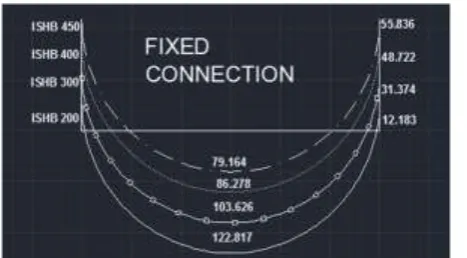
Column ISHB 200
ISHB 300 ISHB 400 ISHB 450
Chart -2: Bending moments of Fixed connection(From STAAD Pro)
The bending moment for the different sections of column keeping beam section constant is been found through STAAD Pro software(Chart 2).
As the column section is increased the mid-span moment is decreased.
As the beam section is kept constant and column section is increased there is increase in the end moment i.e. there is more moment transfer at the ends of the beam.
As there is more moment transfer in the end moment of the beam, hence there will be increase in the base moment also.
[image:4.595.33.282.489.608.2]2.4 PINNED CONNECTIONS
Table 3- Connection Constants [IS 800:2007]
Moments (kNm) ISHB 200 ISHB 300 ISHB 400 ISHB 450
Mid-Span 135 135 135 135
End moment 0 0 0 0
Base 0 0 0 0
The bending moment for the different sections of column keeping beam section constant is been found through STAAD Pro software.
As it is a Pinned connection there will be no transfer of end moments and the base and moments will be zero.
The value of bending moment for all the sections is constant i.e 135 kNm.
Manual calculation : wl2/8 = 135 kNm
2.5 TOP AND SEAT ANGLE CONNECTION
© 2018, IRJET | Impact Factor value: 6.171 | ISO 9001:2008 Certified Journal | Page 3593 Rki = 98.65 kNm/deg
Chart -
3
: Secant StiffnessChart -4: Bending moments of Top and seat angle connection(From STAAD Pro)
2.6 FLANGE AND WEB ANGLE CONNECTION
INITIAL STIFFNESS:
Rki = 6727.256 kNm/deg
Chart -5: Bending moments of Flange and web angle connection(From STAAD Pro)
2.7 T-STUB CONNECTION
INITIAL STIFFNESS
Rki = 15476.16 kNm/deg
Chart -6: Bending moments of T-Stub connection(From STAAD Pro)
2.8 END PLATE CONNECTION
INITIAL STIFFNESS
Rki = 7452.52 kNm/deg
© 2018, IRJET | Impact Factor value: 6.171 | ISO 9001:2008 Certified Journal | Page 3594 2.9 GRAPHICAL REPRESENTATION
1) For Beam section of ISMB 500 and Column section of ISHB 200
Chart -8: Moment v/s Rotation graph
2) For Beam section of ISMB 500 and Column section of ISHB 300
Chart -9: Moment v/s Rotation graph 3) For Beam section of ISMB 500 and Column
section of ISHB 400
Chart -10: Moment v/s Rotation graph
4) For Beam section of ISMB 500 and Column section of ISHB 450
Chart -11: Moment v/s Rotation graph
3. CONCLUSIONS
1) From the graphs obtained we can observe that T-Stub connection, End plate connection and Flange and web angle connection nearly behave as Fixed type connection where as Top and Seat angle connection behave as Semi-rigid type of connection.
2) From the results obtained from STAAD Pro we can say that design of Beam-column connection not only depends on the stiffness of the beam and joint but also depends on the relative stiffness of column and the beam.
3) As the section of column is increased there is change in the bending moments hence Frye-Morris equation has to consider the relative stiffness of column and the beam.
4) As the section of the column is increased there is decrease in the mid span moment and increase in the end moment and base moment.
5) As the section of column is increased there will be more moment transfer at the ends of the beam.
6) Secant stiffness obtained for Top and Seat angle connection is minimum compared to other type of connection. Hence it behaves as a Semi-rigid type of connection.
REFERENCES
[1] Arne Aalborg – “Classification boundaries for stiffness of beam- o column joints and column bases”, Department of Structural Engineering, NTNU, Rich. Birkelandsveila, NO-7491 Trondheim, Norway, Nordic Steel Construction Conference, 2012.
© 2018, IRJET | Impact Factor value: 6.171 | ISO 9001:2008 Certified Journal | Page 3595 [3] Clinton O. Rex et al. - “Design and behaviour of a real pr
building”, Stanley D. Lindsey and Associates Ltd. 2300 Windy Ridge Pkwy; Suite 200 South Atlanta, Georgia 30339, U.S.A.
[4] H.B. Basaga et al - “Effects of Semi-Rigid Connection on Structural Responses”, Karadeniz Technical University, Turkey M. Muvafık Yüzüncü Yıl University, Turkey,
[5] IS: 800-2007, “Code of Practice for General Construction in Steel Bureau of Indian standards.” New Delhi
[6] Joseph P. Migliozzi - “Feasibility study of partially restrained connections”, BLACK SBURG, VIRGINIA 24061,1997
[7] Kurt H. Gerstle et al. - “Behaviour and Design of Flexibly-Connected Building Frames,” Engineering journal/American institute of steel construction, 1990
[8] Lito Louis et al. - “Numerical Analysis of Strength Behaviour of Bolted Steel Beam Column Connection Based on Type and Position of Stiffeners”, M.Tech Student, Dept. of Civil Engineering, Sree Narayana Gurukulam College of Engineering, Ernakulam, Kerala, India, IRJET, 2017
[9] Nurettin murat azap - “Modeling of nonlinear behavior of steel beam to column semi-rigid connections with 3-d solid finite elements,” M.S., Department of Civil Engineering Middle East Technical University July 2013.
[10] S. O. Degertekin et al.-“Design of non-linear semi-rigid steel frame with semi-rigid column bases”, Civil Engineering Department, Dicle University, Muhendislik-Mimarlik Fakultesi 21280 Diyarbakir, Turkey, eJSE, 2004
[11] S.P.Tak – “3 D Finite Element Analysis of Partially Restrained Beam to Column Connections in Steel Frames”, International Journal on Recent and Innovation Trends in Computing and Communication, Volume: 3 Issue: 2, Applied Mechanics Department, GCOE,Amravati, India
[12] S. Taufik et al. -“Finite Element Model for the Behaviour of Partially Restrained High Strength Web Angle Connections”, Department of Civil and Structural Engineering, Lambung Mangkurat University, Banjarmasin, 70123 Indonesia, 2012
[13] U. V. Dave et al.- “Analysis and design of semi-rigid steel frames”, Department of Civil Engineering, Institute of Technology, Nirma University, Ahmedabad-382481, Gujarat, ASCE, 2010
[14] Wahid Ferdous - “Effect of beam-column joint stiffness on the design of beams”, 23rd Australasian Conference on the Mechanics of Structures and Materials
(ACMSM23), vol. II, Byron Bay, NSW, 9-12 December, Southern Cross University, Lismore,2014