Journal of Chemical and Pharmaceutical Research, 2014, 6(5):258-265
Research Article
CODEN(USA) : JCPRC5
ISSN : 0975-7384
The application of intelligence tourism mobile client based on ontology
Zhou Fa-Guo
1, Zhao Mei-Jiao
1, Sun Zhen
2, Zhao Jie
2and Gong Zheng
21
School of Mechanical Electronic & Information Engineering, China University of Mining & Technology, Beijing, China
2National Administration for Code Allocation to Organizations, Beijing, China
_____________________________________________________________________________________________
ABSTRACT
Mobile Internet era makes the position of traditional internet appliance replaced by mobile internet. And with the increase of users’ requirements for real-time and intelligence to tourism services, tourism industry ushered in a new challenge. This paper counts the mainstream mobile application client related intelligence tourism, identifies their problems, analyses the main cause of the current small coverage and poor functions of intelligence tourism application client and proposes the application of ontology theory in the research of intelligence tourism mobile application client. Also, many advantages of ontology in solving these practical problems are summarized. It has significant value for the development of intelligence tourism in mobile internet.
Key words: Terms-Ontology; mobile internet; intelligence tourism; mobile application; client
_____________________________________________________________________________________________
INTRODUCTION
Since 1978, the rapid development of the tourism industry around makes it become the pillar industry, competitive industry or leading industry in promoting economic development [1]. The Smarter Planet raised by IBM makes the concept of smart city to set off a boom in the scale of world. And as the extremely important content in the Smart City, the intelligent tourism rises along with it. But with the mobile Internet era, Traditional Internet travel service can’t meet users' requirement about real-time, diversity and convenience in current. Ontology is a philosophical concept, which examines the philosophical question about the nature of existence. But in recent decades, ontology has been widely used in the computer industry and played more and more important role in the aspect of information system, natural language processing and Knowledge-based Systems.
In the computer theories, ontology is one kind of pristine intellectual theory. It also an important tool for Knowledge reusing, sharing and modeling and could help computers to solve many problems of knowledge expression.
In this paper, many handheld clients about intelligent tourism were analyzed in the application market and some problems in it were found, and then the advantages of ontology in solving related problems were proposed. Finally, conclusions and outlook on the future of applying ontology into the handheld client about intelligent tourism were made.
1. LITERATURE REVIEW 1.1 THE BACKGROUND
As the sustained development of global economy, industrial restructuring continues to accelerate. That the tertiary industry led the national economic has become a global economic trend and the speeded-up on the development of tertiary industry is more compelling. As part of tertiary industry in China, the tourism industry has grown to become one of the most dynamic and promising emerging industries.
increase of 12%, and domestic tourism revenue 1.93 trillion yuan(RMB), an increase of 21%. This makes China become the financial market with highest potential and largest number in the world. Mainland China received a total of 135 million international tourists. International inbound tourists in size from twelfth place in 1990 jumped to third in the world, becoming the third largest tourist destination country after France and United States. Chinese outbound scale has reached 70.25 million passengers in 2011; International tourism outbound tourism consumption expenditure totaling $ 72.6 billion, ranking third in the world. In the first three quarters of 2012, the domestic tourist arrivals 2.25 billion passengers, an increase of 13.7% and the domestic tourism revenue 1.7 trillion yuan(RMB), an increase of 18.6%. The tourism revenue totaled 22.8 billion yuan(RMB) over the country. Whereas the touring rate and tourism spending per capita at this stage are lower than the international average. Consequently the tourism industry will have greater long-term development as a new consumption pattern. The prosperity of China’s domestic tourism industry has laid a stable groundwork for China’s tourism industry being a growth point in China’s economy. As well as, the sustaining and stable growth of China’s economy can provide a large amount of capital for tourism infrastructure construction in favor of the development of China’s domestic tourism. With the continuous, rapid and stable development of China’s economy, income of resident rising steadily, leisure time of resident increasing step by step, popular and diversifying demand for tourism products provide a favorable opportunity to the development of China’s domestic tourism industry. The sustaining and healthy development of China’s economy will keep on driving the development of China’s domestic tourism industry [2].
The rapid development of Android and iOS operating system makes intelligent systems worldwide popularity. Smart-phones' retail prices getting lower and lower, the operation is more simplistic. The Internet revolution following has been making mobile Internet become the protagonist of the Internet age. 2012 is the first year to popularize mobile Internet in China. Diffusion rate of mobile subscriber is about 3 times desktop Internet [3]. How to spurt and exert force in the starting phase of the mobile Internet has become a hot topic of IT industry.
1.2 CURRENT STATUS OF INTELLIGENCE TOURISM DEVELOPMENT
Along with people living standard enhancement and strong support from our country for the tourist trade, tourism has become many people's first choice for leisure and therefore tourism is also favored by the major investors.
Qunar, Ctrip and other Chinese online travel sites’ successes in China make the Internet-based tourism increasingly
mature. Whereas according to the latest research provided by China Tourism Academy, with the touring market matures, travelers’ have increasingly expanded their self-awareness and their consumption attitudes are changing gradually [4]. The observation of Research on the demand trend of Chinese leisure travel customer from China Tourism Academy shows that Foreign Independent Tourist (FIT) Visit has entered an important stage in the development of explosive with significantly improved degree of market popularity. Tourism authorities at various levels, tour enterprises and tourism destination cities are generally starting to focus on the FIT market and provide more tourism products and services. Compared with traditional mode of tourist groups, new dining style can meet consumer demand for personalized greater.
However, although most traditional online touring service providers have already realized the inevitable trend of mobile Internet in the future and the development of mobile Internet has been a great few years, tourism in the field of mobile Internet has not marched into flood tide and maturity in the mobile internet area as quickly as it did in the traditional internet, but has been tepid being carried out without a representative of the success story.
1.3 RELATED RESEARCH
Application ontology is a hot issue in the current information field. Many scholars have done a great deal of researches based on ontology in various aspects.
In the Journal of Software and Journal of Computers, many related researches are delivered such as the uniform knowledge representation [5], knowledge extraction [6], the knowledge matching and retrieval [7] with ontology technology and so on. Besides, in the Journal of Knowledge Management, information processing based on ontology in the construction process of the knowledge management system is explored [8]. Moreover, introducing ontology into the knowledge management system, Liao Liangcai [9] realized the enterprise knowledge management through the semantic expansion, reasoning and retrieval finally. All these researches show the important role of ontology in the realization of knowledge sharing, reuse and matching.
2. ONTOLOGY AND INTELLIGENCE TOURISM
individuals becomes extremely important. These communications include the sharing, interoperability, etc. However, ontology just can provide a clear consensus for the communication between different individuals [10].
2.1 THE CONCEPT OF INTELLIGENCE TOURISM
In 2008, Obama and U.S. business leader shield around table after being elected U.S. president. Samuel Palmisano, the CEO of IBM, proposed the Smarter Planet concept. The target of this concept is to make the world toward a more intelligent direction. It involves the governments, enterprises, individuals, organizations, natural and social interaction. And the interaction will effectively improve performance, efficiency and productivity. Therefore, the kernel of the “Smarter Planet” is aiming to improve the clarity, efficiency, flexibility and the response speed in the interaction, transforming the interactions among the state, enterprises and individuals with the oncoming generation information technology and being characterized by more thorough perception, more comprehensive interoperability, more in-depth intelligence.
Intelligence tourism is developed on the basis of cutting-edge technologies such as cloud computing and Internet of things. It can sense tourism resources, information about economy, activities and tourists and release them in time on portable terminals that connect with internet or mobile internet, enabling the tourists to get the information, and to arrange or adjust their working and traveling schedule. Intelligence tourism provides superior service with its intelligence and convenient use of all kinds of tourism information.
2.2 THE CONCEPT OF ONTOLOGY
The earliest ontology definition in artificial intelligence (AI for short) is Neches and the others. They consider that ontology defines the basic terminologies and their relationship of glossary which formed the thematic areas and that it defines rules combining these terminologies with these relationships to define the vocabulary extension.
Afterwards as more and more people conduct research on ontology, many researchers have also given many different definitions. The most famous in them is widely recognized theory proposed by Gruber that ontology is a specifically conceptual specification and it is used to describe the essence of things. Borst improved it further to be the formal specification of shared conceptual model. The unified view of the concept of ontology at present comes from the in-depth exploration of the two previous concepts from Studer, namely the theory that ontology is the formal specification of shared conceptual model. Ontology in science has no uniform concept and specific application, but from the view of connotation, different researchers have a uniform understanding of ontology.
The concept of ontology has four implications:
1) The concept model: Refers to the abstract model of the relevant concept in the phenomenon as described in the objective world;The concepts in it are defined into: C=<D, W, R>, where D is an area, W is the set of states of affairs in this area, and R is a collection of conceptual relations in domain space<D, W>.
2) The definition: Refers to clearly defining types of used concept and constraints of the usage of concept.
3) The formalization: Refers to that this ontology should be machine-readable or machine-traceable;
4) The sharing: Refers to that the knowledge described in ontology is not individual but collective communal.
2.3 ONTOLOGY CLASSIFICATION AND REPRESENTATION
Ontology can be classified into Domain Ontology, Generic Ontology, Application Ontology and Representational Ontology [11]. Domain Ontology contains the knowledge over some professional fields (such as electronics, machinery, medicine, etc.); Generic Ontology, as its name implies, covering most areas, is called Core Ontology [12]; Application Ontology covers all the knowledge and methods needed in the modeling of certain area of expertise. Representational Ontology is not limited to a certain professional field and it provides the entity used to describe things, such as Framework Ontology, defining the concept about framework and groove [13]. Task Ontology and Method Ontology are essentially depicts the view in domain knowledge from the point of view of problem solving and inference. They can help to solve a lot of interaction problems, namely domain knowledge is not represented in the form unconnected with its using way. Task Ontology and Method Ontology explicitly denote the interactions between domain knowledge and problem solving methods by “assumption”, acting as “adhesive” among systematic layers. Thus, those key problems in that knowledge base system is reused in component-based development could be solved.
Ontology representation makes people to consider problems from different angles. If it is possible that we can connect and unify information from different field by reusability, it will effectively promote the role of knowledge base in the application domain.
2.4 THE CHARACTERISTICS OF ONTOLOGY
Ontology is a new conception, demonstrating its superior characteristics in the field of Philosophy, Natural Language Processing, Knowledge Representation and Acquisition, Process Management and other fields in different ways. This is an important guarantee to obtain systematic and sustainable domain concepts. Ontology has the following advantages:
1) The Common vocabularies in describing the target world; 2) Providing appropriate date structure for describing and exchanging information; 3) Representing underlying and abstract knowledge in human society; 4) Interpreting and converting metadata to ensure semantic interoperation among metadata; 5) Helping to make the needed hypothesis and underlying precondition solving the problems and a more conceptualized reaction of assumptive target object; 6) It is helpful to describe phenomenon, theories, target object and others for providing the support of systematic knowledge; 7) Providing modules with their needed concepts and relations for the model.
3.ONTOLOGY-BASED INTELLIGENCE TOURISM MOBILE CLIENT 3.1 STATUS ANALYSIS
Real-time, portable nature and positioning is striking features that mobile internet distinguishes from traditional internet. On the one hand, users need to get relevant information rapidly at any time and make consumption decisions quickly, on the other hand, as portable intelligent terminal becomes increasingly popular today, the change of user's habit and operation mode influence the original industry chain greatly.
Tourism is the earliest area which concreted with internet in the traditional industry in China, whereas traditional online tourism tends to saturation in the increasingly competitive word. The wave of mobile Internet struck on this momentum [14] which is just meet people’s higher demands for more efficient and convenient service on touring.
Assortment of application software in the application market fully demonstrates the explosive development of mobile Internet. Tourism and transportation software occupies a substantial part in it. The author analyses 17 mainstream mobile tourism applications in domestic and 21 mainstream mobile tourism applications at abroad in detail. The rules to select these mobile tourism applications are followed as follows.
1) Only those mobile tourism applications which provide more than one service element in six service elements were selected.
2) Only the most representative one in the mobile tourism applications from the same enterprise were selected. 3) This analysis was conducted by separating domestic mobile tourism applications from foreign mobile tourism applications.
[image:4.595.170.437.543.743.2]The analysis charts and results are as below.
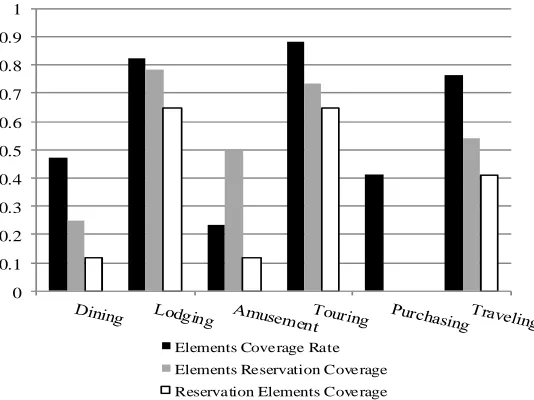
Fig. 1: Elements coverage of intelligence tourism mobile application in domestic 0
0.1 0.2 0.3 0.4 0.5 0.6 0.7 0.8 0.9 1
In the Fig. 1, Elements Coverage Rate refers to the percentage of tourism applications that has certain service elements against all the mainstream mobile tourism applications in domestic. Elements Reservation Coverage Rate refers to tourism applications that have reservation service of certain elements against tourism applications that provides the same service in domestic. Reservation Elements Coverage refers to tourism APP that has reservation service of certain elements against all the mainstream mobile tourism applications in domestic.
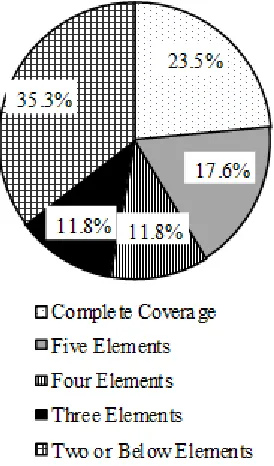
Fig. 2: The amount of coverage elements analysis of intelligence tourism mobile application in domestic
[image:5.595.204.405.491.684.2]In the Fig. 2, Complete Coverage refers to the percentage of software that covers all the six tourism elements. Five Elements refers to the percentage of software that covers five of the six tourism elements. Four Elements refers to the percentage of software that covers four of the six tourism elements. Three Elements refers to the percentage of software that covers three of the six tourism elements. Two or Below Elements refers to the percentage of software that covers two or one of the six tourism elements.
Fig. 3: Elements coverage of intelligence tourism mobile applications at abroad
In the Fig.3, Elements Coverage Rate refers to the percentage of tourism applications that has certain service elements against all the mainstream mobile tourism applications at abroad. Elements Reservation Coverage Rate refers to tourism applications that have reservation service of certain elements against tourism applications that provides the same service at abroad. Reservation Elements Coverage refers to tourism applications that has
0 0.1 0.2 0.3 0.4 0.5 0.6 0.7 0.8 0.9 1
reservation service of certain elements against all the mainstream mobile tourism applications at abroad.
Fig.4: The amount of coverage elements analysis of intelligence tourism mobile applications at abroad
In the Fig. 4, Complete Coverage refers to the percentage of software at abroad that covers all the six tourism elements. Five Elements refers to the percentage of software at abroad that covers five of the six tourism elements. Four Elements refers to the percentage of software at abroad that covers four of the six tourism elements. Three Elements refers to the percentage of software at abroad that covers three of the six tourism elements. Two or Below Elements refers to the percentage of software at abroad that covers two or one of the six tourism elements.
By analyzing Fig.1 and Fig.3, we can find that in the mobile tourism applications in domestic, Elements Coverage Rate of the services about lodging, touring and traveling is lager, whereas Elements Coverage Rate of services about dining, amusement and purchasing are just the reverse of the former, and the lowest proportion one is the entertaining service. In the mobile tourism applications at abroad, Elements Coverage Rate of lodging and traveling is larger and dining medium. Whereas touring, purchasing and amusement services are low. Elements Coverage Rate of services about purchasing is the lowest one. The higher the Element Coverage, the higher their reservation elements coverage and elements reservation coverage. Both reservation elements coverage and element reservation coverage of shopping service are zero. The element reservation coverage of food service is low too.
From Fig. 2 and Fig. 4, we can conclude that first two statistics with largest proportion in domestic are Complete Coverage and Two or Below Elements. At abroad, they are Three Elements and Two or Below. The lowest one is Complete Coverage. The following is Five Elements.
Across most of famous traditional online touring service agents like Qunar, Ctrip, Tongcheng, Mango, Elong and others, their pocket tourism clients are very much the same, and majority of them copy their original traditional patterns in the Internet to the mobile Internet. However, the traditional pattern of Internet marketing cannot fully meet travelers’ demands for real-time and abruptness. This is the principal reason that mobile application for intelligence tourism has not developed striding swiftly.
Since tourism is a process of moving, in this process, six elements dining, lodging, amusement, touring, purchasing and traveling are all irreplaceable and their connections are inextricable. Travelers have made realistic and practical requirements to pocket application for their high standards with real-time, effectiveness and convenience.
1) Covering food, lodging, entertainment, travel, shopping and transportation six elements in its entirely; 2) Achieving direct or indirect pair wise correlation among six elements; 3) Achieving relations of between keywords from the six elements in semantic level; 4) Achieving personalized recommendation for various users.
3.2 THE ADVANTAGE OF ONTOLOGY APPLICATION
To achieve that four demands mentioned in 2.1, the modeling method based on ontology shows more advantages than other traditional methods [15].
Ontology provides semantic route chart for the relation between single field and multi-field, which serves azimuth and reference tool: Correlating the concept to the term and providing the definition; using the concept in the context of ontology to make it precise; linking the concept to term or icon [16]. By comparison with object-oriented mode, the description to the declaration from ontology schema is more definitive and clearly. In contrast with database, ontology can offer distinct and formal semantic information and descript the relationship among the concept of a field, properties of the concept and its concepts naturally, thus it can be shared and reused (this is the important features) conveniently. Ontology development is becoming a distributed process. Its knowledge expression is more natural. It contains more abundant amount of information. Therefore, ontology could describe more complex module in more expressive language. By comparison with standard definition[17],the language defining ontology has more
abundant syntax and semantics than ordinary database method; The information described by ontology includes demi-structured natural language texts rather than tabular information; Ontology is mainly used in information sharing and exchange, therefore it is terminology for sharing and consensus; Ontology provides domain theory, not structure of data container.
Due to the integrity, clarity and consistency of ontology, tourism ontology must conclude key concepts and relationship between concepts in the field of tourism completely. There is no redundancy and ambiguity between concept and the relationship between concepts of the tourism ontology is able to support the inference in semantic logic.
Therefore, introducing ontology, the mobile tourism application system can cover these six tourist area easily, and the accordance in semantic level of relations between keywords from various areas can be achieved. When searching for touring related contents, the quality of the results also will be greatly improved. In addition, it helps to extract the common recognition vocabulary to form a recognized concept by introducing ontology to the personalized recommendation mode of mobile tourism application system. Furthermore, these concepts and their relations can be externalized formally. It takes into account the relationship between words sufficiently. Thus, the system will not merely make keywords matching while offering the customers information, which improves the information quality.
CONCLUSION
Acknowledgments
This paper is partly supported by “the Fundamental Research Funds for the Central Universities”, National Key Technology Research and Development Program of the Ministry of Science and Technology of China with no. 2013BAK07B02, National High-tech R&D Program of China (863 Program) with no. 2013AA064303.
REFERENCES
[1]D. Liang,ShangHai Securities News, v. ED-75, n.7, July. 2007.
[2]L. Wangu; H. Zhang and W. Li,Journal of Computers, v.7, n.9, pp.2152-2159, September, 2012. [3]R. Hu,Knowledge Economy, China Direct, n.4, pp. 49-51, 2012.
[4]R. Zheng,China Business & Trade, n.14, pp. 187-188, 2011.
[5]J. Zhu; Y. Jiang and B. Li,Journal of Software, v.5, n.12, pp.1402-1408, December, 2010. [6]B. Jiang; M. Zhu and J. Wang, Journal of Computers, v.8, n.1, pp.85-90, January, 2013. [7]X. Wang and Y. Wang,Journal of Software, v.7, n.12, pp.2849-2856, December, 2012.
[8]C. J. Anumba; R. R. A. Issa; J. Pan and I. Mutis,Construction Innovation: Information, Process, Management, v.8, n.3, pp.218-239, March, 2008.
[9]L. Liao; W. Qin and Y. Shu,Computer Engineering, v.35, n.16, pp.256-261, August, 2009. [10]H. Gong; Y. Zhang; Z. Xue and Y. Zhang,Science Mosaic, n.8, pp. 17-20, August, 2008. [11]T. Gruber, Knowledge Acquisition, v.5, n.2, pp. 199-220, June, 1993.
[12]M. Uschold,AI Technical reports, University of Edinburgh, pp. 31-33, 1997.
[13]D. Skuce,Proceedings of the 9th Knowledge Acquisition for Knowledge based Systems Workshop, pp. 6-9, 1997. [14]Z. Li,Hangzhou Daily, n.11, 3 July, 2013.
[15]W. Li,Ontology-based distributed knowledge base system, Ph.D. dissertation, Dept. Computer. Eng., Tianjin
University, Tianjin, China, 2004.
[16]D. Soergel.Journal of the American Society for Information Science, v.50, n.12, pp. 1119~1120, December,
1999.
[17]D. Fensel,Ontologies: Silver Bullet for Knowledge Management and Electronic Commerce, Berlin: