Design Study of Single and Three-Phase Synchronous
Generator Using J-MAG Designer
M.Jenal, E. Sulaiman, M. Z. Ahmad, S.N. U Zakaria, W. M. Utomo, S. A. Zulkifli, A. A. Bakar
,
Department of Electrical Power Engineering, Faculty of Electrical & Electronic Engineering,Universiti Tun Hussein Onn Malaysia, 86400 Parit Raja, Batu Pahat, Johor
Abstract- Synchronous Generator (SG) can be either using permanent magnet (PM) or field-excitation (FE) coil as their main flux sources are located in rotor part. However, synchronous generator using FE has advantages of variable flux control capabilities when compared to fix permanent magnet flux. In this research SG with various FEC configurations is investigated. Several slot-pole SG configurations such as 12S-4P, 12S-6P, 36S-12P, and 36S-18P are analyzed. The speed, maximum turns for the rotor and maximum turns for the stator are set to 1200 rpm, 28 turns and 8 turns respectively. JMAG version 12.0 is used for the geometry editor and analysis based on 2D-FEA to defined appropriate combination of stator and rotor pole number. Initially, each phase configuration is determined using flux linkage generated from coil test analysis and induced voltages are calculated. Furthermore, various winding configuration of concentrated and distributed are also considered during the design. In conclusion, the three-phase synchronous generators are obtained from 36S-12Pand 12S-4Pdesigns, while the single-phase are obtained from36S-18P and 12S-6P
Index Terms—Synchronous generator, FEA, J-MAG Designer
I. INTRODUCTION
Synchronous machines are AC machines that have a field circuit supplied by external DC source and include two constructions which are Synchronous Generator (SG) and Synchronous Motor (SM) [1]. In power station, 3-phase AC generator is used to produce 3-phase voltage with low magnitude. However, the power transformer used to increase the low magnitude. Then, the machine generates 3-phase power from mechanical energy (usually provided by steam as a prime mover) convert to electrical energy called as SG. It works on the principle of Faraday’s Law of Electromagnetic Induction which also called as Alternator [2].In practical applications, a shaft is coupled with mechanical turbine such as steam, gases, coal and hydro for various voltage level [3]. The low voltage SG with DC excitation may have in cylindrical or salient-pole rotor. In this project, SG is designed in JMAG to explore the operating principle of Field Excitation Synchronous Generator (FESG) and analyzing the characteristics and performance of 1-phase and 3-phase SG by using two methods which are geometry editor and JMAG designer. There are consists of a stationary armature winding (stator) which connected in concentrated and distributed winding to achieve desired voltages induced. The SG with concentrated windings become increasingly competitive regarding to those distributed windings. Concentrated
windings became more attractive for several reasons [4]-[5] which is the winding length is reduced this means the quantity of used copper, then the copper loses are reduced. In comparison with distributed windings has a large harmonic content. The armature winding is sets into slotted laminated steel core. The stator carries the three separate (3-phase) producing an AC voltages output. It carries the three separates (3-phase) and electrically displace from each other by 120 degrees [6].The field winding is placed on a rotating shaft which is turning within the armature conductor. The FE coil used to rotate the rotor and magnetic flux is produced in armature coil. Various combinations of stator slot and rotor pole for FESG have been developed for phase of magnetic flux by coil test. For example, designed of 36S-12P and 12S-4P FESG has been obtained the 3-phase for magnetic flux. However, 36S-18P and 12S-6P designed are obtained for the 1-phase magnetic flux. Generally, the relation between the mechanical rotation frequency and the electrical frequency for this machine can be expressed as;
m r
e
f
N
f
.
2
(1)where fe is the electrical frequency, fm is the mechanical
rotation frequency and Nr is the number of rotor poles
respectively. The design parameter and procedure for the target FESG applications are discussed clearly in Section II. Initially, the performance of the proposed machine is calculated using 2D- finite element analysis (FEA). Therefore, designs of SG studies are conducted to get the operating principle of FE coil and performance of 1-phase and 3-phase of generator. Besides that, it is also used for the purpose of design and investigating the characteristic of 1-phase and 3-phase SG. The method of design SG model is explained in Section III. Moreover, the phase of induced voltage in SG are analyzed and given in section IV. At last some conclusions are discussed in Section V.
II. DESIGN PARAMETERS AND PROCEDURES OF THE PROPOSED FESG
TABLE I. SYNCHRONOUS GENERATOR DESIGN SPECIFICATIONS FOR FIELD EXCITATION (FE) COIL
Parameters Unit 36-18 36-12 Slot-Pole (S-P) 12- 6 12- 4
No of phase - 3 3 1 1
Stator slots - 36 36 12 12
Rotor poles - 18 12 6 4
Stator outer radius mm 66.5 66.5 66.5 66.5 Stator inner radius mm 44.5 44.5 44.5 44.5 Rotor outer radius mm 43.5 43.5 43.5 43.5 Rotor inner radius mm 11.0 11.0 11.0 11.0
Air gap mm 1.0 1.0 1.0 1.0
Stator coil turns - 8 8 8 8
Rotor coil turns - 28 28 28 28
Rotation speed rpm 1200 1200 1200 1200 proposed FESG are listed in Table I for all designs. The electrical specification in term of maximum current density of FE coil is set to 10A/mm2 all over the design. According to
conventional synchronous speed equation, the frequency of the proposed FESG is determined at maximum speed of 1,200r/min at the specific pole numbers in Table 1.
m r
e
f
N
f
.
2
(2)where f is the frequency of induced voltage, p is number of rotor poles, and n is rotor speed in rpm.
The stator outer radius, stator inner radius, rotor outer radius, rotor inner radius and air gap of the main part of the generator design are 66.5mm, 44.5mm, 43.5mm, 11.0mm and 1.0mm, respectively, which identical with the Lucas Nuelle FESG. The maximum operating speed is set to 1,200r/min for all design.
The main objective of this research is to obtain various configurations of three-phase and single-phase magnetic field flux generated by FEC of 36S-18P, 36S-12P, 6P and 12S-4P FESG. Commercial 2D-FEA Finite Element Analysis (FEA) package, JMAG-Designer ver.12.1, released by Japanese Research Institute (JRI) is used to design and analyze the SEFG. The conventional electrical steel of 35H210 is used for rotor and stator body.
Initially, performance of the proposed FESG is calculated using 2D-FEA and the parameter defined from the SG in Laboratory UTHM. Basically, the design parameters are divided into four groups such as those related to stator core, rotor core, rotor coil or FEC slot shape and armature coil slot shape by geometry part using the formula, where Je is FEC current density (set to 10 A/mm2), Ae is input current of FEC
(set to maximum of 50A), Ne is no of turn of FEC, αe is FEC filling factor (set to 0.5) and Se is FEC slot area (estimate the slot area from drawing). Thus the number of turns of FEC is 28 turns and 8 turns of stator set into the circuit. The analysis is generated from the flux of FEM coil test result and the flux characteristic is plotted for each FEM coil of armature.
e e e e e
N
S
J
A
(3)
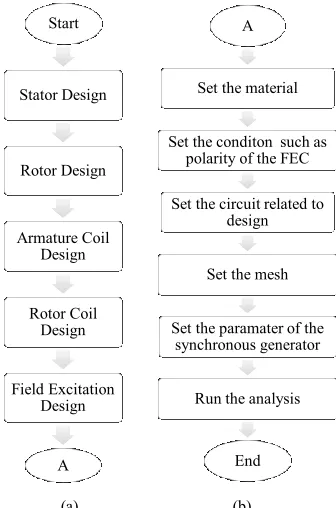
where, Ae is FEC inpur current, Je is current density, is the filling factor, Se is slot of area in rotor and Ne is number of turns. The JMAG designer is used to set the materials, conditons, circuit and run the analysis. The JMAG consists of two parts which are Geometry Editor as shown in Figure 1(a) which is used for setting materials, conditions, circuits and analysis while JMAG Designer in Figure 1(b) is used in designing parts of machine.
III. DESIGN OF FIELD EXCITATION SYNCHRONOUS GENERATOR(FESG)
The initial design of FESG with 12S-4P, 12S-6P, 36S-12P, and 36S-18P configurations are illustrated in Figure. 2. It is obvious that all FESGs are having field excitation in the rotor and armature coil in the stator.
IV. DESIGN RESULTS AND PERFORMANCES BASED ON 2D-FINITE ELEMENT ANALYSIS (FEA)
A. FESG Coil Test Analysis
[image:2.612.354.522.416.670.2]Each FESG designed is analyzed with various stator-rotors and concentrated-distributed winding conditions as listed in Table II. The armature coil tests are used to analyze the phase of magnetic flux for single-phase and three-phase conditions.
(a) (b)
Figure 1: (a) Flowchart of Geometry Editor (b) Flowchart of JMAG Designer
Start
Stator Design
Rotor Design
Armature Coil Design
Rotor Coil Design
Field Excitation Design
A
A
Set the material
Set the conditon such as polarity of the FEC
Set the circuit related to design
Set the mesh
Set the paramater of the synchronous generator
Run the analysis
[image:2.612.39.301.578.707.2]A. Case study 12S-4P
Through coil test analysis, the design of 12S-4P FESG has been examined as 3phase generator. Since there are 2 type of rotor winding configurations namely distributed and concentrated winding, only the distributed winding type has achieved the 3-phase coil test while the concentrated winding part failed. The results are shown in Figure 3(a) and the comparison of U-phase is illustrated in Figure 3(b).
B. Case study 12S-6P
In case of distributed winding, 2-phase FESG are achieved namely U and V phase. However, this 2-phase is also known as 1-phase. This is shown in Figure 4(b) while for the concentrated winding 1-phase magnetic flux is obtained. See Figure 4(a).
C. Case study 36S-12P
In this case, 3-phase magnetic flux has been achieved similar to the case of 12Slots 4poles. This is based on the formula, where s is slot, m is phase and p is pole.
S = mp (4)
These are shown in Figure 5(a). The U-phase of the distributed winding is higher in voltage than the concentrated winding at the rotor. Figure 5(b) shows the result.
D. Case study 36S-18P
This result is approximately similar to the case of 12Slots 6Poles. It depends on the formula (4). The parameter is measured by real SG in UTHM laboratory where the U-phase and (UV)-phase are achieved in this case. Figure 6 (a) and Figure 6 (b) show the comparison of U-phase.
B. Induced Voltage Generated by FESG.
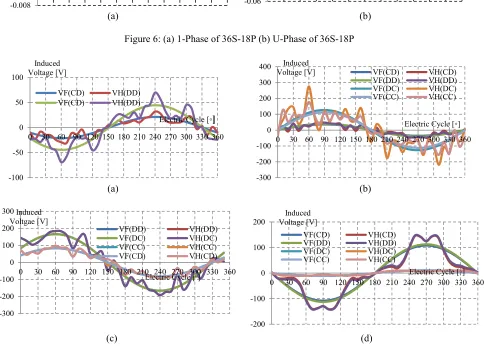
The flux in air gap at no load is significantly important for the machine design, modeling and operation because it capability to generate the induced voltage [8]-[9]. The result of induced voltage obtained for various winding configuration of armature coil and field excitation coil on various slot-pole combinations are listed in Table III and plotted in Figure 7. Figure 7(a) demonstrates for 4S-12P, Figure 7(b) for 12S-6P, Figure 7(c) for 36S-12P and Figure 7(d) for 36S-18P.
Rotation angle [deg]
(a) (b)
[image:3.612.49.547.56.411.2](c) (d)
Figure 2: Initial design of FESG (a) 12S-4P (b) 12S-6P (c) 36S-12P (d) 36S-18P
(a) Dshaft=22m
m
Dsi=89mm
Field Excitation
Dso=133mm
Dro=87mm Armature Coil
Shaft Rotor
Dshaft=22m m
Dsi=89mm
Field Excitation
Dso=133mm
Dro=87mm Armature Coil
Shaft Rotor
Dshaft=22mm
Dsi=89mm
Field Excitation
Dso=133mm
Dro=87mm Armature Coil
Shaft Rotor
Dshaft=22m m
Dsi=89mm
Field Excitation
Dso=133mm
Dro=87mm Armature Coil
(a) (b)
Figure 3: (a) 3 Phase of 12S-4P (b) U-Phase of 12S-4P
(a) (b) Figure 4: (a) 1-Phase of 12S-6 P (b) U-Phase of 12S-6P
(a) (b) Figure 5: (a) 3-Phase of 36S-12P (b): U-Phase of 36S- 12P -0.06
-0.04 -0.02 0 0.02 0.04 0.06
0 30 60 90 120 150 180 210 240 270 300 330 360 Flux [Ø]
Electric Cycle [◦]
U V W
-0.06 -0.04 -0.02 0 0.02 0.04 0.06
0 30 60 90 120 150 180 210 240 270 300 330 360 Flux [Ø]
Electric Cycle [◦]
C-D D-D
-0.2 -0.15 -0.1 -0.05 0 0.05 0.1 0.15 0.2
0 30 60 90 120 150 180 210 240 270 300 330 360 Flux [Ø]
Electric Cycle [◦] U
-0.25 -0.2 -0.15 -0.1 -0.05 0 0.05 0.1 0.15 0.2
0 30 60 90 120 150 180 210 240 270 300 330 360 Flux [Ø]
Electric Cycle [◦]
C-D D-D D-C C-C
-0.08 -0.06 -0.04 -0.02 0 0.02 0.04 0.06 0.08
0 30 60 90 120 150 180 210 240 270 300 330 360 Flux [Ø]
Electric Cycle [◦]
U V W
-0.08 -0.06 -0.04 -0.02 0 0.02 0.04 0.06 0.08
0 30 60 90 120 150 180 210 240 270 300 330 360 Flux [Ø]
Electric Cycle [◦]
[image:4.612.63.555.59.661.2]It is obvious that the highest induced voltage is generated by three-phase 36S-12P combination with the magnitude of 166.6577 V. Meanwhile, combination of single-phase 12S-6P produces the utmost harmonics content with the magnitude of approximately 280 V. Otherwise, the lowest induced voltage and harmonics content is obtained for three-phase 36S-18P combination.
V. CONCLUSIONS
In this paper, a single-phase 12S-4P, single-phase 12S-6P, three-phase 36S-12P and three-phase 36S-18P FESG with FE coil and armature windings located in the rotor and stator, respectively are analyzed based on FESG topology. The investigations are made based on two windings configurations namely distributed and concentrated windings. The single-phase and three-single-phase magnetic flux are achieved with various voltage generated. Even though the target phase of the generator is successfully achieved, but the induced voltages generate much harmonic distortion that should be refined in future.
(a) (b)
Figure 6: (a) 1-Phase of 36S-18P (b) U-Phase of 36S-18P
(a) (b)
[image:5.612.86.534.59.198.2](c) (d)
Figure 7: The fundamental wave and the harmonic of air gap flux. -0.008
-0.006 -0.004 -0.002 0 0.002 0.004 0.006
0 30 60 90 120 150 180 210 240 270 300 330 360 Flux [Ø]
Electric Cycle [◦] U
-0.06 -0.04 -0.02 0 0.02 0.04 0.06
0 30 60 90 120 150 180 210 240 270 300 330 360 Flux [Ø]
Electric Cycle [◦]
C-D D-D D-C C-C
-100 -50 0 50 100
0 30 60 90 120 150 180 210 240 270 300 330 360 Induced
Voltage [V]
Electric Cycle [◦]
VF(CD) VH(DD) VF(CD) VH(DD)
-300 -200 -100 0 100 200 300 400
0 30 60 90 120 150 180 210 240 270 300 330 360 Induced
Voltage [V]
Electric Cycle [◦] VF(CD) VH(CD) VF(DD) VH(DD) VF(DC) VH(DC) VF(CC) VH(CC)
-300 -200 -100 0 100 200 300
0 30 60 90 120 150 180 210 240 270 300 330 360 Induced
Voltgae [V]
Electric Cycle [◦]
VF(DD) VH(DD)
VF(DC) VH(DC)
VF(CC) VH(CC)
VF(CD) VH(CD)
-200 -100 0 100 200
0 30 60 90 120 150 180 210 240 270 300 330 360 Induced
Voltage [V]
Electric Cycle [◦]
VF(CD) VH(CD)
VF(DD) VH(DD)
VF(DC) VH(DC)
[image:5.612.66.552.175.521.2]REFERENCES
[1] B. C. Kok, S. Saiman, A. Ponniran, R. Hamdan and S. A. Jumaat,
“Electric Machine and Drive”, Part of Module in UTHM, (2008).
[2] C. Hubret, “Theory Operation Maintanance of Electrical Machine”.Printice-Hall, Inc. (1991).
[3] W. Hossli,(ed). “Large steam turbines”. Brown boveri Rev. 63: 84-147 (1976).
[4] F. Meier, “Permanent-Magnet Synchronous Machines with Non-overlapping Concentrated Windings for Low-Speed Direct-Drive
Application” Master Thesis, Royal Institute of Technology School of
Engineering Electrical Machines and Power Electronics, Stockholm (2008).
[5] A. M. EL-Refaie, “Fractional-slot concentrated Windinggs Synchronous
permanent Magnet Machines: Opportunities and Challenges”, IEEE
Transactions on industrial Electronics, vol. 57 No. l. (January 2010). [6] K.Yamazaki, Y. Fukushima, and M. Sato, “ Loss Analysis of
Permanent-Magnet Motors With Concentrated Windings- Variation of Magnet Eddy-Current Loss Due to Stator and Rotor Shapes”, IEEE
Trans. On Industry Application, Vol.45, No. 4, pp. 1334-1342 July/ Aug. (2009).
[7] Lucas-NulleGmbH,”SpecialMachines,EEM 6 Exercise Descriptions”,
Kerpen, Siemensstr.2, 2nd edition, 1998.
[8] T. Wildi, “Electrical Machines, Drives, and Power Systems”, Pearson
Prectice Hill, Sixth Edition(2006)
[9] NEMA,”Motor and Generators”, Washington: National Electrical
Manufactures Association (ANSI-NEMA No. MGI 1993)
[10] Longnian Li, Baoling Wang, Nvhuang Zhou, “Machine Design”,
Tsinghua University press (in Chinese), 1992.
[11] L. A. Pereira, V. M. Canalli, “ Five-phase permanent magnet synchronous machine operating as generator design, parameter
determination by FEM and performance”, Electric Machines and
Control, Vol. 14, No. 8, pp. 8-1, August 2010.
[12] H. Hooshyar, M. Savaghebi, and A. Vahedi, “Synchronous Generator:
Past, Present and Future
[13] Qiu-ling Deng, Xiao Peng, WeicaiXie, “Design of Axial Flux Permanent Magnet Synchronous Generators with Soft Magnetic Compound (SMC)
Stator Core”, International Conference on Energy and Environment
Technology (2009)
TABLE II. WINDINGOFFESG
12SLOT 4POLE
CASE STATOR ROTOR
1 Concentrated Distributed 2 Distributed Distributed 3 Distributed Concentrated 4 Concentrated Concentrated
12SLOT 6POLE
CASE STATOR ROTOR
1 Concentrated Distributed 2 Distributed Distributed 3 Distributed Concentrated 4 Concentrated Concentrated
36SLOT 12POLE
CASE STATOR ROTOR
1 Distributed Distributed 2 Distributed Concentrated 3 Concentrated Concentrated 4 Concentrated Distributed
36SLOT 12POLE
CASE STATOR ROTOR
[image:6.612.338.541.83.354.2]1 Concentrated Distributed 2 Distributed Distributed 3 Distributed Concentrated 4 Concentrated Concentrated
TABLE III. INDUCEDVOLTAGEOFFESG
CASE INDUCED VOLTAGED SLOT-POLE (V)
12-4 12-6 36-12 36-18
D-D 44.9702 40.3085 166.6574 112.8075 C-D 21.2776 35.8959 83.3292 107.7746
D-C 0 126.8371 166.6577 10.9016