88
T
EACHINGS
UGGESTIONSTeaching Suggestion 7.1:Draw Constraints for a Graphical LP Solution.
Explain constraints of the three types (, , ) carefully the first time you present an example. Show how to find the X1, X2 inter-cepts so a straight line can be drawn. Then provide some practice in determining which way the constraints point. This can be done by picking a few X1, X2 coordinates at random and indicating which direction fulfills the constraints.
Teaching Suggestion 7.2:Feasible Region Is a Convex Polygon. Explain Dantzing’s discovery that all feasible regions are convex (bulge outward) polygons (many-sided figures) and that the opti-mal solution must lie at one of the corner points. Draw both con-vex and concave figures to show the difference.
Teaching Suggestion 7.3:Using the Iso-Profit Line Method. This method can be much more confusing than the corner point ap-proach, but it is faster once students feel comfortable drawing the profit line. Start your first line at a profit figure you know is lower than optimal. Then draw a series of parallel lines, or run a ruler paral-lel, until the furthest corner point is reached. See Figures 7.6 and 7.7. Teaching Suggestion 7.4:QA in Action Boxes in the LP Chapters. There are a wealth of motivating tales of real-world LP applica-tions in Chapters 7–9. The airline industry in particular is a major LP user.
Teaching Suggestion 7.5:Feasible Region for the Minimization Problem.
Students often question the open area to the right of the constraints in a minimization problem such as that in Figure 7.10. You need to explain that the solution is not unbounded in a minimization problem as it is in a maximization problem.
Teaching Suggestion 7.6:Infeasibility.
This problem is especially common in large LP formulations since many people will be providing input constraints to the problem. This is a real-world problem that should be expected.
Teaching Suggestion 7.7:Alternative Optimal Solutions. This issue is an important one that can be explained in a positive way. Managers appreciate having choices of decisions that can be made with no penalty. Students can be made aware that alternative optimal solutions will arise again in the transportation model, as-signment model, integer programming, and the chapter on net-work models.
Teaching Suggestion 7.8:Importance of Sensitivity Analysis. Sensitivity analysis should be stressed as one of the most important LP issues. (Actually, the issue should arise for discussion with every
model). Here, the issue is the source of data. When accountants tell you a profit contribution is $8.50 per unit, is that figure accurate within 10% or within 10¢? The solution to an LP problem can change dramatically if the input parameters are not exact. Mention that sensitivity analysis also has other names, such as right-hand-side ranging, post-optimality analysis, and parametric programming.
A
LTERNATIVEE
XAMPLESAlternative Example 7.1: Hal has enough clay to make 24 small vases or 6 large vases. He only has enough of a special glaz-ing compound to glaze 16 of the small vases or 8 of the large vases. Let X1the number of small vases and X2the number of large vases. The smaller vases sell for $3 each, while the larger vases would bring $9 each.
(a) Formulate the problem. (b) Solve graphically. SOLUTION:
(a) Formulation OBJECTIVEFUNCTION:
Maximize $3X1$9X2
Subject to : Clay constraint: 1X14X224 Glaze constraint: 1X12X216
(b) Graphical solution
7
C H A P T E R
Linear Programming Models: Graphical
and Computer Methods
0 5 10 15 20 25
0 5 10 15
X1 = Number of Small Vases
X2
= Number of Large Vases
Feasible Region A
(0, 0)
Glaze Constraint
Clay Constraint (0, 8)
(0, 6)
(24, 0) (16, 0)
D C
Point X1 X2 Income
A 0 0 $ 0
B 0 6 54
C 8 4 60*
D 16 0 48
*Optimum income of $60 will occur by making and sell-ing 8 small vases and 4 large vases.
Draw an isoprofit line on the graph from (20, 0) to (0, 6X\c) as the
$60 isoprofit line.
Alternative Example 7.2: A fabric firm has received an order for cloth specified to contain at least 45 pounds of cotton and 25 pounds of silk. The cloth can be woven out on any suitable mix of two yarns, Aand B.Material Acosts $3 per pound, and Bcosts $2 per pound. They contain the following proportions of cotton and silk (by weight):
Yarn Cotton (%) Silk (%)
A 30 50
B 60 10
What quantities (pounds) of Aand Byarns should be used to mini-mize the cost of this order?
Objective function: min. C3A2B Constrains: 0.30A0.60B45 lb (cotton)
0.50A0.10B25 lb (silk)
Simultaneous solution of the two constraint equations reveals that A39 lb, B55 lb.
The minimum cost is C$3A$2B3(39) (2)(55) $227.
applied to minimization problems. Conceptually, isoprofit and iso-cost are the same.
The major differences between minimization and maximiza-tion problems deal with the shape of the feasible region and the di-rection of optimality. In minimization problems, the region must be bounded on the lower left, and the best isocost line is the one closest to the zero origin. The region may be unbounded on the top and right and yet be correctly formulated. A maximization prob-lem must be bounded on the top and to the right. The isoprofit line yielding maximum profit is the one farthest from the zero origin.
7-2. The requirements for an LP problem are listed in Section 7.2. It is also assumed that conditions of certainty exist; that is, co-efficients in the objective function and constraints are known with certainty and do not change during the period being studied. An-other basic assumption that mathematically sophisticated students should be made aware of is proportionalityin the objective func-tion and constraints. For example, if one product uses 5 hours of a machine resource, then making 10 of that product uses 50 hours of machine time.
LP also assumes additivity.This means that the total of all ac-tivities equals the sum of each individual activity. For example, if the objective function is to maximize P6X14X2, and if X1 X21, the profit contributions of 6 and 4 must add up to produce a sum of 10.
7-3. Each LP problem that has a feasible solution doeshave an infinite number of solutions. Only one of the points in the feasible region usually yields the optimal solution, but all of the points yield a feasible solution. If we consider the region to be continu-ous and accept noninteger solutions as valid, there will be an infi-nite number of feasible combinations of X1and X2.
7-4. If a maximization problem has many constraints, then it can be very time consuming to use the corner point method to solve it. Such an approach would involve using simultaneous equations to solve for each of the feasible region’s intersection points. The iso-profit line is much more effective if the problem has numerous constraints.
7-5. A problem can have alternative optimal solutions if the isoprofit or isocost line runs parallel to one of the problem’s con-straint lines (refer to Section 7.7 in the chapter).
7-6. This question involves the student using a little originality to develop his or her own LP constraints that fit the three condi-tions of (1) unboundedness, (2) infeasibility, and (3) redundancy. These conditions are discussed in Section 7.7, but each student’s graphical displays should be different.
7-7. The manager’s statement indeed had merit if the manager understood the deterministic nature of linear programming input data. LP assumes that data pertaining to demand, supply, materi-als, costs, and resources are known with certainty and are constant during the time period being analyzed. If this production manager operates in a very unstable environment (for example, prices and availability of raw materials change daily, or even hourly), the model’s results may be too sensitive and volatile to be trusted. The application of sensitivity analysis might be trusted. The applica-tion of sensitivity analysis might be useful to determine whether LP would still be a good approximating tool in decision making.
7-8. The objective function is not linear because it contains the product of X1and X2, making it a second-degree term. The first, second, fourth, and sixth constraints are okay as is. The third and 50 100 150
Pounds of Yarn A
200 250 50
100 150 200 250 300
Pounds of Yarn B
min C
S
OLUTIONS TOD
ISCUSSIONQ
UESTIONS ANDP
ROBLEMSfifth constraints are nonlinear because they contain terms to the second degree and one-half degree, respectively.
7-9. For a discussion of the role and importance of sensitivity analysis in linear programming, refer to Section 7.8. It is needed especially when values of the technological coefficients and con-tribution rates are estimated—a common situation. When all model values are deterministic, that is, known with certainty, sen-sitivity analysis from the perspective of evaluating parameter ac-curacy may not be needed. This may be the case in a portfolio se-lection model in which we select from among a series of bonds whose returns and cash-in values are set for long periods.
7-10. If the profit on Xis increased from $12 to $15 (which is less than the upper bound), the same corner point will remain opti-mal. This means that the values for all variables will not change from their original values. However, total profit will increase by $3 per unit for every unit of Xin the original solution. If the profit is increased to $25 (which is above the upper bound), a new corner point will be optimal. Thus, the values for Xand Ymay change, and the total profit will increase by at least $13 (the amount of the increase) times the number of units of X in the original solution. The increase should normally be even more than this because the original optimal corner point is no longer optimal. Another corner point is optimal and will result in an even greater profit.
7-11. If the right-hand side of the constraint is increased from 80 to 81, the maximum total profit will increase by $3, the amount of the dual price. If the right-hand side is increased by 10 units (to 90), the maximum possible profit will increase by 10(3) $30 and will be $600 $30 $630. This $3 increase in profit will re-sult for each unit we increase the righthand side of the constraint until we reach 100, the upper bound. The dual price is not relevant beyond 100. Similarly, the maximum possible total profit will de-crease by $3 per unit that the right-hand side is dede-creased until this value goes below 75.
7-12. The student is to create his or her own data and LP formula-tion. (a) The meaning of the right-hand-side numbers (resources) is to be explained. (b) The meaning of the constraint coefficient (in terms of how many units of each resource that each product re-quires) is also to be explained. (c) The problem is to be solved graphically. (d) A simple sensitivity analysis is to be conducted by changing the contribution rate (Cjvalue) of the X1variable. For ex-ample, if C1was $10 as the problem was originally formulated, the student should resolve with a $15 value and compare solutions. 7-13. A change in a technological coefficient changes the feasi-ble solution region. An increase means that each unit produced re-quires more of a scarce resource (and may lower the optimal profit). A decrease means that because of a technological advance-ment or other reason, less of a resource is needed to produce 1 unit. Changes in resource availability also change the feasible re-gion shape and can increase or decrease profit.
7-14.
020 40 60
Number of Air Conditioners, X1
Number of Fans,
X2
80 100 120 0
20 40 60 80 100 120 140
b
c
d a
Feasible Region
(X1 = 40, X2 = 60)
Drilling Constraint
Wiring Constraint Optimal Solution
Let: X1number of air conditioners to be produced X2number of fans to be produced
Maximize profit 25X115X2 subject to 3X12X2240 (wiring)
2X11X2140 (drilling) X1, X20
Profit at point a(X10, X20) $0 Profit at point b(X10, X2120)
25(0) (15)(120) $1,800 Profit at point c(X140, X260)
25(40) (15)(60) $1,900 Profit at point d(X170, X20)
Optimal corner point R175, T10,
Audience 3,000(175) 7,000(10) 595,000 people 7-17. X1number of benches produced
X2number of tables produced Maximize profit $9X1$20X2 subject to 4X16X21,200 hours
10X135X23,500 pounds X1, X20
Profit at point a(X10, X2100) $2,000 Profit at point b(X1262.5, X225) $2,862.50 Profit at point c(X1300, X20) $2,700
050
Feasible Region
100 150 200 250 300 350 400 0
50 100 150 200 250 300
X1
b X2
Optimal Solution, $2862.50 Profit
c a
(57.14, 57.14)
175.,10 80
T
10
10 200
R
Constraints
Isoprofit Line 7-15.
Maximize profit 25X115X2 subject to 3X12X2240
2X11X2140
X1 20
X2 80
X1, X20
Profit at point a(X120, X20)
25(20) (15)(0) $500 Profit at point b(X120, X280)
25(20) (15)(80) $1,700 Profit at point c(X140, X260)
25(40) (15)(60) $1,900 Profit at point d(X170, X20)
25(70) (15)(0) $1,750 Profit at point e(X126.67, X280)
25(26.67) (15)(80) $1,867 Hence, even though the shape of the feasible region changed from Problem 7-14, the optimal solution remains the same.
7-16. Let Rnumber of radio ads; Tnumber of TV ads. Maximize exposure 3,000R7,000T
Subject to: 200R500T40,000 (budget) R10
T10 RT R, T0
020 40 60
X1
X2
80 100 120 0
20 40 60 80 100 120 140
b
c
d a
Feasible Region
Optimal Solution (26.67, 80)
0 10 20304050 60 0
10 20 30 40 50 60
X1
b X2
a X2 = 20
X1 + X2 = 60
X1 = 30
Feasible Region
Optimal Solution
U 75,000
50,000
20000,30000
33,333.33 50,000
Constraints
Isoprofit line
P 7-18.
X1number of undergraduate courses X2number of graduate courses Minimize cost $2,500X1$3,000X2 subject to X1 30
X2 20 X1X260
Total cost at point a(X140, X220) 2,500(40) (3,000)(20) $160,000
Total cost at point b(X130, X230) 2,500(30) (3,000)(30) $165,000
Point ais optimal. 7-19.
0 1020 3040
0 10 20 30 40
X1
b X2
a
Optimal Solution
Feasible Region is Heavily Shaded Line
X1number of Alpha 4 computers X2number of Beta 5 computers Maximize profit $1,200X1$1,800X2 subject to 20X125X2800 hours
(total hours 5 workers
160 hours each) X110
X215
Corner points: a(X110, X224), profit $55,200 b(X1211f, X215), profit $52,500
Point ais optimal.
7-20. Let Pdollars invested in petrochemical; Udollars invested in utility
Maximize return 0.12P0.06U Subject to:
PU50,000 total investment is $50,000 9P4U6(50,000) average risk must be less 6 [or
total less than 6(50,000)] P, U0
Corner points
Return
P U 0.12P0.06U
0 50,000 3,000
20,000 30,000 4,200
The maximum return is $4,200.
The total risk is 9(20,000) 4(30,000) 300,000, so average risk 300,000/(50,000) 6
7-21. Let Pdollars invested in petrochemical; Udollars invested in utility
Minimize risk 9P4U Subject to:
PU50,000 total investment is $50,000 U
66,666.67
50,000
33,333.34 50,000
50000,0
P
Constraints
Note that this problem has one constraint with a negative sign. This may cause the beginning student some confusion in plotting the line.
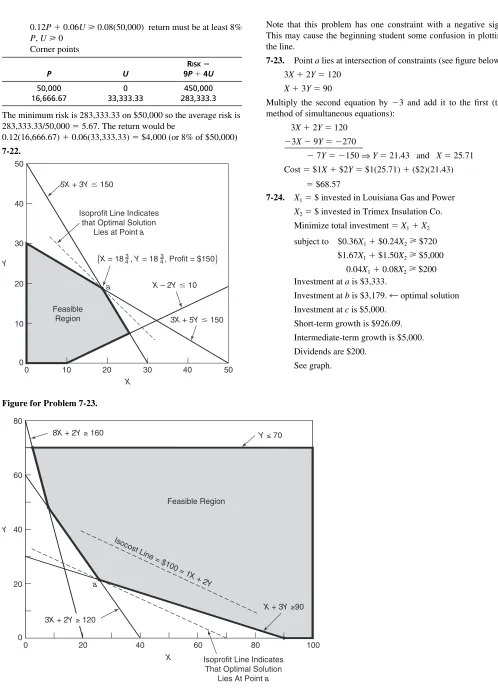
7-23. Point alies at intersection of constraints (see figure below): 3X2Y120
X3Y90
Multiply the second equation by 3 and add it to the first (the method of simultaneous equations):
3X2Y120
3X9Y 270
7Y 150 ⇒Y21.43 and X25.71 Cost $1X$2Y$1(25.71) ($2)(21.43)
$68.57
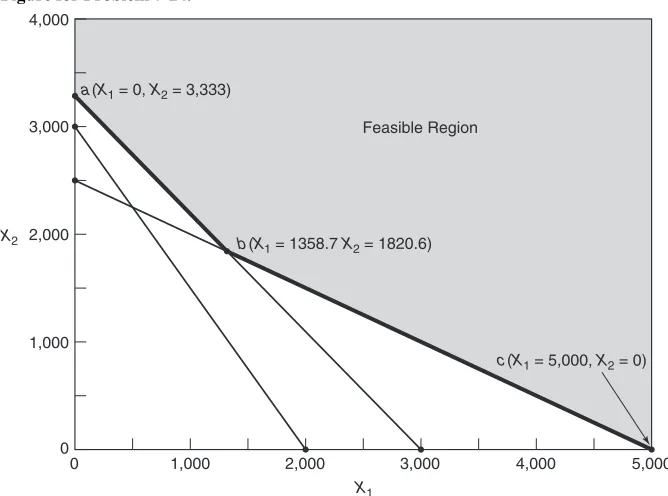
7-24. X1$ invested in Louisiana Gas and Power X2$ invested in Trimex Insulation Co. Minimize total investment X1X2 subject to $0.36X1$0.24X2$720
$1.67X1$1.50X2$5,000 0.04X10.08X2$200 Investment at ais $3,333.
Investment at bis $3,179. koptimal solution Investment at cis $5,000.
Short-term growth is $926.09. Intermediate-term growth is $5,000. Dividends are $200.
See graph. a
X Y
010 20 30 40 50
0 10 20 30 40 50
5X + 3Y 150
Isoprofit Line Indicates that Optimal Solution
Lies at Point a
X – 2Y 10
3X + 5Y 150 Feasible
Region
(
X = 18 , Y = 18 , Profit = $15043
43
)
a
X Y
0 20 40 60 80 100
0 20 40 60 80
8X + 2Y ≥ 160 Y ≤ 70
Isoprofit Line Indicates That Optimal Solution
Lies At Point a Isocost Line = $100 = 1
X + 2 Y
X + 3Y ≥90 Feasible Region
3X + 2Y ≥ 120 Figure for Problem 7-23.
0.12P0.06U0.08(50,000) return must be at least 8% P, U0
Corner points
RISK
P U 9P4U
50,000 0 450,000
16,666.67 33,333.33 283,333.3
The minimum risk is 283,333.33 on $50,000 so the average risk is 283,333.33/50,000 5.67. The return would be
1.1111 1
B G
0.8330.9 0.75, 0.25
1.5 Constraints
Isoprofit line X1
X2
0 1,000 2,000 3,000 4,000 5,000
0 1,000 2,000 3,000 4,000
Feasible Region a(X1 = 0, X2 = 3,333)
c(X1 = 5,000, X2 = 0)
b(X1 = 1358.7 X2 = 1820.6)
Figure for Problem 7-24.
7-25. Let Bpounds of beef in each pound of dog food Gpounds of grain in each pound of dog food Minimize cost 0.90B0.60G
Subject to:
BG1 the total weight should be 1 pound 10B6G9 at least 9 units of Vitamin 1 12B9G10 at least 10 units of Vitamin 2 B, G0
The feasible corner points are (0.75, 0.25) and (1,0). The mini-mum cost solution
B 0.75 pounds of beef, G 0.25 pounds of grain, cost $0.825,
Vitamin 1 content 10(0.75) 6(0.25) 9 Vitamin 2 content 12(0.75) 9(0.25) 11.25 7-26. Let X1number of barrels of pruned olives
X2number of barrels of regular olives Maximize profit $20X1$30X2 subject to 5X12X2250 (labor hours)
1X12X2150 (acres) X1 40 (barrels)
X1, X2 0
a. Corner point a(X10, X20), profit 0 Corner point b (X10, X275), profit $2,250 Corner point c(X125, X262Z\x), profit
$2,375 koptimal profit
Corner point d(X140, X225), profit $1,550 Corner point e(X140, X20), profit $800 b. Produce 25 barrels of pruned olives and 62Z\xbarrels
of regular olives.
c. Devote 25 acres to pruning process and 125 acres to regular process.
X1
a X2
0 25 50 75 100 125 150
0 25 50 75 100 125
Feasible Region b
c
d
e
7-27.
Formulation 1:
X1
X2
0 1 2 3 456
0 1 2 3 4 5
Unbounded Region
X1
X2
01 2 3 4 6 8 10 12
0 1 2 4 6 8
Feasible Region
X1
X2
02 4 6 8 10 12
0 2 4 6 8
Infeasible Solution
Region
X1
X2
01 2 3
0 1 2
Feasible Region
Line For X1 + 2X2
Formulation 2:
While formulation 2 is correct, it is a special case. X12X22 line—this is also the same slope as the isoprofit line X12X2and hence there will be more than one optimal solution. As a matter of fact, every point along the heavy line will provide an “alternate optimum.”
Formulation 3:
Formulation 4:
Formulation 4 appears to be proper as is. Note that the constraint 4X16X248 is redundant.
7-28. Using the isoprofit line or corner point method, we see that point b (where X 37.5 and Y 75) is optimal if the profit
$3X$2Y. If the profit changes to $4.50 per unit of X, the opti-mal solution shifts to point c.If the objective function becomes P
$3X$3Y, the corner point bremains optimal.
X2
X1
Profit Line for 3X1 + 3X2
Profit Line for 4.50X1 + 2X2
Profit Line for 3X1 + 2X2
0 50 100 150
0 50 100 150
a
b
Using the corner point method, we determine that the optimal so-lution mix under the new constraint yields a $29 profit, or an in-crease of $3 over the $26 profit calculated. Thus, the firm should not add the hours because the cost is more than $3.
7-31. a. The corner points and profits are X0, Y0, profit 0
X60, Y0, profit 300
X30, Y60, profit 510 kOptimal solution X0, Y80, profit 480
b. If profit 8X 6Y, the optimal solution is at the same corner point but profit increases.
X0, Y0, profit 0 X60, Y0, profit 480
X30, Y60, profit 600 kOptimal solution X0, Y80, profit 480
Y
X
024 6 8 10 12
0 2 4 6 8 10 12
X = 5, Y = 1 ; Profit = $29 6X + 4Y = 36
1X + 2Y = 8 /2
1 )
(
Y
X 120
80
60
30 60 120
7-30.
X Y
02 46 8
0 2 4 6 8
Profit = 4X + 6Y = $26
7-29. The optimal solution of $26 profit lies at the point X2, Y3.
If the first constraint is altered to 1X3Y8, the feasible region and optimal solution shift considerably, as shown in the next column.
X Y
02 46 8
0 2 4 6 8
Profit = 4X + 6Y = $21.71
1X + 3Y = 8 Optimal solution at
a. The feasible corner points and their profits are:
Feasible corner points Profit 8X1 5X2
(0,0) 0
(6,0) 48
(6,4) 68
(0,10) 50
The optimal solution is X1 6, X2 4, profit $68. b. The feasible corner points and their profits are:
Feasible corner points Profit 8X1 5X2
(0,0) 0
(6,0) 48
(6,5) 73
(0,11) 55
The new optimal solution is X1 6, X2 5, profit $73. Profit increased $5, so this is the dual price for constraint 1.
c. The feasible corner points and their profits are:
Feasible corner points Profit 8X1 5X2
(0,0) 0
(6,0) 48
(0,6) 30
As a result of this change, the feasible region got smaller. Profit decreased by $20. The right-hand side decreased by 4 units, and the profit decreased by 4 x dual price.
d. The feasible corner points and their profits are:
Feasible corner points Profit 8X1 5X2
(0,0) 0
(5,0) 40
(0,5) 25
As a result of this change, the feasible region got smaller. Profit decreased by $28. Although there was a 5-unit change in the right-hand side of constraint 1, the dual price found in part b is not valid when the right-hand side of this constraint goes below 6 (which is a 4-unit decrease).
e. The computer output indicates that the dual price for constraint 1 is $5, but this is valid up to a lower bound of 6. Once the right-hand side goes lower than this, the dual price is no longer relevant. g. When the right-hand side goes beyond the limits, a new corner point becomes optimal so the dual price is no longer relevant. X2
10
6,4
610 X1
Constraints
Isoprofit line c. If profit 3X6Y, a new corner point is optimal. X0, Y0, profit 0
X60, Y0, profit 180 X30, Y60, profit 450
X0, Y80, profit 480 kOptimal solution
7-32. The corner points change and the new optimal solution is X 40, Y40, and profit 440. The corner points are
X 0, Y 0, profit 0 X 60, Y 0, profit 300
X 40, Y 40, profit 440 kOptimal solution X 0, Y 60, profit 360
7-33. a. It could increase by 7 (for an upper limit of 12) or de-crease by 1 (for a lower limit of 4).
b. Profit would increase by the dual value of 0.75. c. Profit would increase by 10 times the dual price or 10(0.75) $7.50.
7-34. a. 25 units of product 1 and 0 units of product 2. b. All of resource 3 is being used (there is no slack for constraint 3). A total of 25 units of resource 1 is being used since there were 45 units available and there are 20 units of slack. A total of 75 units of product 2 being used since there were 87 units available and there are 12 units of slack.
c. The dual price for constraint 1 is 0, for constraint 2 is 0, and for constraint 3 is 25.
d. You should try to obtain resource 3 because the dual price is 25. This means profit will increase by 25 for each unit of resource 3 that we obtain. Therefore, we should pay up to $25 for this.
e. If management decided to produce one more unit of product 2 (currently 0 units are being produced), the total profit would decrease by 5 (the amount of the reduced cost).
0 30 60 90 120 0
5 10 15 20
a
b
c Feasible
Region
Optimal Solution
Number of Coconuts, X1
Number of Lion Skins,
X2
7-36. Let: X1number of coconuts carried X2number of skins carried
Maximize profit 60X1300X2(in rupees) subject to 5X115X2300 pounds
X11X215 cubic feet X1, X20
At point a:(X10, X215), P4,500 rupees At point b:(X124, X212), P1,440 3,600
5,040 rupees At point c:(X160, X20), P3,600 rupees The three princes should carry 24 coconuts and 12 lions’ skins. This will produce a wealth of 5,040 rupees.
1 8
7-39. a. Let: X1number of pounds of stock Xpurchased per cow each month
X2number of pounds of stock Ypurchased per cow each month
X3number of pounds of stock Zpurchased per cow each month
Four pounds of ingredient Zper cow can be transformed to: 4 pounds (16 oz/lb) 64 oz per cow
5 pounds 80 oz 1 pound 16 oz 8 pounds 128 oz
3X12X24X3 64 (ingredient A requirement) 2X13X21X3 80 (ingredient B requirement) 1X10X22X3 16 (ingredient C requirement) 6X18X24X3 128 (ingredient D requirement)
X35 (stock Zlimitation) Minimize cost $2X1$4X2$2.50X3
b. Cost $80 X1 40 lbs. of X X2 0 lbs. of Y X3 0 lbs. of Z
7-40. Let: X1number units of XJ201 produced X2number units of XM897 produced X3number units of TR29 produced X4number units of BR788 produced Maximize profit 9X112X215X311X4 subject to
0.5X11.5X21.5X30.1X415,000 (hours of wiring time available)
0.3X10.1X20.2X30.3X417,000 (hours of drilling time available)
0.2X10.4X20.1X30.2X426,000 (hours of assembly time available)
0.5X10.1X20.5X30.5X412,000 (hours of inspection time) X1 150 (units of XJ201)
X2 100 (units of XM897) X3 300 (units of TR29) X4 400 (units of BR788) 7-41. Let
SN1number of standard racquets produced in current month on normal time
SO1number of standard racquets produced in current month on overtime
SN2 number of standard racquets produced in next month on normal time
SO2number of standard racquets produced in next month on overtime
PN1number of professional racquets produced in current month on normal time
7-37. a. $120,000 in money market fund; $80,000 in stock fund; total risk 1,560,000
b. Total return $14,000. Rate of return 14,000/200,000 0.07
c. The investments would not change since 14 is less than the upper bound for this coefficient. The total risk would increase.
d. The total risk would worsen by 2 (the dual value) per additional dollar.
e. No. The amount invested in the money market fund is greater than $50,000 for the original solution.
7-38. a. $40,000 in money market fund; $160,000 in stock fund; total return 18,000
b. Total risk 12(160,000) 5(40,000) 2,120,000. Average risk 2,120,000/200,000 10.6.
c. No. The change is above the lower bound. d. Dual value 0.10 10%
c. The optimal solution suggests making all MCA regular modems. Students should discuss the implications of shipping no MCA intelligent modems.
7-43. Minimize cost 12X19X211X34X4 subject to X1X2X3X450
X1X2X3X47.5 X1X2X3X422.5
X1X2X3X415.0
Solution:
X1 7.5 pounds of C-30 X2 15 pounds of C-92 X3 0 pounds of D-21 X4 27.5 pounds of E-11 Cost $3.35.
Table for Problem 7-42(a)
MCA REGULARMODEM MCA INTELLIGENTMODEM
Total Per Unit Total Per Unit
Net sales $424,000 $47.11 $613,000 $58.94
Variable costsa
Direct labor 60,000 6.67 76,800 7.38
Indirect labor 9,000 1.00 11,520 1.11
Materials 90,000 10.00 128,000 12.31
General expenses 30,000 3.33 35,000 3.37
Sales commissions $231,000 $23.44 $360,000 $25.76
Total variable costs $220,000 $24.44 $311,320 $29.93
Contribution margin $204,000 $22.67 $301,680 $29.01
aDepreciation, fixed general expense, and advertising are excluded from the calculations. X2
X1
27,750 15,400
8,000
Optimal
P = $629,000
b
P = $534,339
c PO1number of professional racquets produced in current month
on overtime
PN2number of professional racquets produced in next month on normal time
PO2number of professional racquets produced in next month on overtime
ISnumber of standard racquets left in inventory at end of cur-rent month
IPnumber of professional racquets left in inventory at end of current month
Minimize cost 40SN1 50SO1 44SN2 55SO2 60PN1 70PO166PN277 PO22IS2IP
Subject to:
ISSN1SO1–180 Standard racquets remaining is number produced less demand
IP PN1PO1– 90 Professional racquets remaining is number produced less demand SN2SO2IS200 Demand for standard racquets next
month
PN2PO2IP 120 Demand for professional racquets next month
SN1PN1230 Capacity in current month on normal time
SO1PO180 Capacity in current month on overtime SN2PN2230 Capacity next month on normal time SO2PO280 Capacity next month on overtime All variables 0
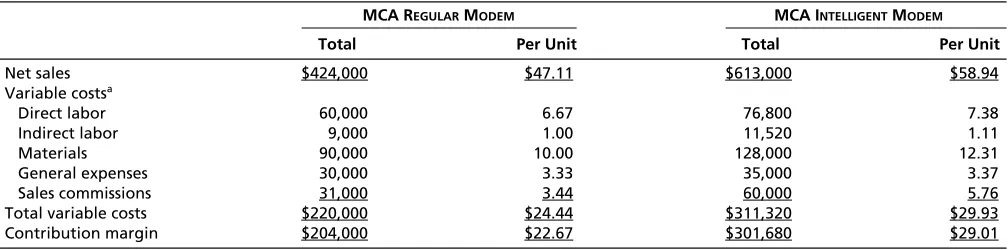
7-42. a. Let: X1number of MCA regular modems made and sold in November
X2number of MCA intelligent modems made and sold in November
Data needed for variable costs and contribution margin (refer to the table on the bottom of this page):
Hours needed to produce each modem: MCA regular
MCA intelligent
Maximize profit $22.67X1$29.01X2
subject to 0.555X11.0X215,400 (direct labor hours) X28,000 (intelligent modems)
= 10,400 hours
10,400 modems=1.0 hour/modem
= 5,000 hours
9,000 modems=0.555 hour/modem
7-44. Let A1gallons of crude A used in Regular A2gallons of crude A used in Premium A3gallons of crude A used in Super B1gallons of crude B used in Regular B2gallons of crude B used in Premium B3gallons of crude B used in Super
Minimize cost 0.42A10.42A20.42A30.47B1 0.47B20.47B3
Subject to
subject to X1X260 (pounds per bag) X1 30 (pounds compost per bag)
X240 (pounds sewage per bag) Corner point a:
(X130, X240) ⇒cost 5(30) (4)(40) $3.10 Corner point b:
(X130, X230) ⇒cost 5(30) (4)(30) $2.70 Corner point c:
(X160, X20) ⇒cost 5(60) (4)(0) $3.00
020 40 60
0 20 40 60
a
b
c
X1
X2 Feasible
Region Optimal
Solution
0 50,000 100,000 150,000 200,000 250,000
0 50,000 100,000 150,000 200,000 250,000
a
b
X1
X2 X2 = 100,000
X1 + X2 = 100,000
X1 = 125,000
Feasible Region is this Line X1number of model Atubs produced
X2number of model Btubs produced Maximize profit 90X170X2
subject to 125X1100X225,000 (steel) 20X130X26,000 (zinc)
X1, X20
Profit at point a(X10, X2200)$14,000 Profit at point b(X185.71, X2142.86)$17,714.10
Profit at point c(X1200, X20)$18,000 optimal solution 7-46. Let: X1number of pounds of compost in each bag
X2number of pounds of sewage waste in each bag Minimize cost 5X14X2(in cents)
a
0.40A20.52B2 0.44(A2+ B2) 0.40A30.52B3 0.48(A3+ B3) A1B1 20,000
A2B2 15,000 A3B310,000 A1, A2, A3, B1, B2, B30 The solution is
A118,333.33 gallons of crude A used in Regular; A2 10,000 gallons of crude A used in Premium; A3 3,333.33 gallons of crude A used in Super; B11.666.67 gallons of crude B used in Regular, B25,000 gallons of crude B used in Premium ; B36,666.67 gallons of crude B used in Super; total cost $19,566.67.
S
OLUTIONS TOI
NTERNETH
OMEWORKP
ROBLEMS7-45.
0 50 100 150 200 250 300 350
0 50 100 150 200 250 300
X1
b
c X2
a
Feasible Region
7-49. Maximize Z[220 (0.45)(220) 44 20]X1
[175 (0.40)(175) 30 20]X2
57X155X2 Constraints:
X1X2390 production limit 2.5X12.4X2960 labor hours Corner points:
X1384, X20, profit $21,888 X10, X2390, profit $21,450 X1240, X2150, profit $21,930
Students should point out that those three options are so close in profit that production desires and sensitivity of the RHS and cost coefficient are important issues. This is a good lead-in to the dis-cussion of sensitivity analysis. As a matter of reference, the right-hand side ranging for the first constraint is a production limit from 384 to 400 units. For the second constraint, the hours may range only from 936 to 975 without affecting the solution.
The objective function coefficients, similarly, are very sensi-tive. The $57 for X1may increase by 29 cents or decrease by $2. The $55 for X2may increase by $2 or decrease by 28 cents.
S
OLUTION TOM
EXICANAW
IREW
ORKSC
ASE1. Maximize P34 W75C 30 W33C 60 W5X 25 W7X subject to:
1 W75C 1,400 1 W33C 250 1 W5XC1,510 1 W7XC1,116
1 W75C 2 W33C 0 W5X 1 W7X 4,000 1 W75C 1 W33C 4 W5X 1 W7X 4,200 1 W75C 3 W33C 0 W5X 0 W7X 2,000 1 W75C 0 W33C 3 W5X 2 W7X 2,300
1 W75C 150
1 W7X 600 Solution:Produce:
1,100 units of W75C—backorder 300 units 250 units of W33C—backorder 0 units
0 units of W5X—backorder 1,510 units 600 units of W7X—backorder 516 units
Maximized profit will be $59,900. By addressing quality problems listed earlier, we could increase our capacity by up to 3% reducing our backorder level.
2. Bringing in temporary workers in the Drawing Department would not help. Drawing is not a binding constraint. However, if these former employees could do rework, we could reduce our re-work inventory and fill some of our backorders thereby increasing profits. We have about a third of a month’s output in rework inven-tory. Expediting the rework process would also free up valuable cash.
a d
c b
X1
X2
0 5 10 15 20 25 30 35
0 20 40 60 80
X1≥ 5
X2≥ 10
X1≤ 25
3,000X1 + 1,250X2≤ 100,000
Feasible Region Optimal Exposure
Rating
a
X1$ invested in Treasury notes X2$ invested in bonds
Maximize ROI 0.08X10.09X2 X1 $125,000
X2$100,000 X1X2$250,000
X1, X20
Point a(X1150,000, X2100,000), ROI $21,000 optimal solution Point b(X1250,000, X20), ROI $20,000 7-48.
Let: X1number of TV spots X2number of newspaper ads
Maximize exposures 35,000X120,000X2 subject to 3000X11,250X2$100,000
X1 5
X1 25
X2 10
Point a(X15, X210), exposure 375,000 Point b(X15, X268), exposure 175,000
1,360,000 1,535,000 (optimal) Point c(X125, X220), exposure 875,000
400,000 1,275,000 Point d(X125, X210), exposure 875,000
3. The plant layout is not optimum. When we install the new equip-ment, an opportunity for improving the layout could arise. Exchang-ing the locations for packagExchang-ing and extrusion would create a better flow of our main product. Also, as we improve our quality and re-duce our rework inventory, we could capture some of the space now used for rework storage and processing and put it to productive use.
Our machine utilization of 63% is quite low. Most manufac-turers strive for at least an 85% machine utilization. If we could determine the cause(s) of this poor utilization, we might find a key to a dramatic increase in capacity.
I
NTERNETC
ASES
TUDY:
A
GRI-C
HEMC
ORPORATIONThis case demonstrates an interesting use of linear programming in a production setting.
Let X1ammonia
X2ammonium phosphate X3ammonium nitrate X4urea
X5hydrofluoric acid X6chlorine X7caustic soda
X8vinyl chloride monomer Objective function:
Maximize Profit 80X1120X2140X3140X490X5
70X660X790X8 Subject to the following constraints:
X11,200 X5560 X2540 X61,200
X3490 X71,280 X4160 X8840
Current natural gas usage 85,680 cu. ft. 103/day 20 percent curtailment 68,554 cu. ft. 103/day Hence, the ninth constraint is:
8X110X212X312X47X518X620X714X8 68,544 The following is the production schedule (tons/day); X11,200 X5560
X2540 X61,200 X3490 X7423.2 X4160 X8840 Objective function value $487,192
Because of the natural gas curtailment, the caustic soda pro-duction is reduced from 1280 tons/day to 425 tons/day.
For a 40 percent natural gas curtailment, the ninth constraint is: 8X110X212X312X47X518X620X714X8
51,408 The optimal solution results in the following production schedule:
X11200 X5560 X2 540 X6718,2 X3 490 X70 X4 160 X8840 Objective function value: $428,075.6