PowerPoint® Lectures for
Current, Resistance, and
Electromotive Force
Learning Goals for Chapter 25
Looking forward at …
• the meaning of electric current, and how charges move in a conductor.
• how to calculate the resistance of a conductor from its dimensions and its resistivity or conductivity.
• how an electromotive force (emf) makes it possible for current to flow in a circuit.
Introduction
• Electric circuits contain charges in motion.
• In a flashlight, the amount of current that flows out of the bulb is the same as the amount that flows into the bulb.
• It is the energy of the charges that decreases as the current flows through light bulbs.
Current
Direction of current flow
• A current can be produced by positive or negative charge flow.
• Conventional current is treated as a flow of positive charges.
Signs of charge carriers
• In general, a conductor maycontain several different kinds of moving charged particles.
• An example is current flow in an ionic solution.
• In the sodium chloride solution shown, current can be carried
by both positive sodium ions and negative chlorine ions
Current density
• We can define a vector current density that includes the direction of the drift velocity:
• The vector current density is always in the same direction as the electric field, no matter what the signs of the charge
Resistivity
• The resistivity of a material is the ratio of the electric field in the material to the current density it causes:
• The conductivity is the reciprocal of the resistivity.
Resistivities at room temperature (20°C)
Substance
ρ (Ω ∙ m)
Copper
1.72 ×10
−8Gold
2.44 ×10
−8Lead
22 ×10
−8Pure carbon (graphite)
3.5 ×10
−5Glass
10
10– 10
14Teflon
>10
13Wood
10
8– 10
11Conductors
Circuit boards and resistivity
• The copper “wires,” or traces, on this circuit board are printed directly onto the surface of the dark-colored insulating board.
• Even though the traces are very close to each other, the board has such a high
Resistivity and temperature
• The resistivity of a metallicconductor nearly always increases with increasing temperature.
Temperature coefficients of resistivity
Material
α
[(°C)
−1]
Aluminum
0.00039
Carbon (graphite)
−0.0005
Copper
0.00393
Iron
0.0050
Lead
0.0043
Resistivity and temperature
• The resistivity of graphite (a semiconductor) decreases with increasing temperature, since at higher temperatures, more electrons “shake loose” from the atoms and become mobile.
• Measuring the resistivity of a small semiconductor crystal is a sensitive measure of temperature; this is the principle of a
Superconductivity
• Some materials show aphenomenon called
superconductivity.
• As the temperature decreases, the resistivity at first decreases smoothly, like that of any metal.
• Below a certain critical temperature Tc a phase
transition occurs and the resistivity suddenly drops to zero.
Resistance and Ohm’s law
• The resistance of a conductor is• The potential across a conductor is given by Ohm’s law:
Resistors are color-coded for easy
identification
Ohmic resistors
Nonohmic resistors
Electromotive force and circuits
Electromotive force and circuits
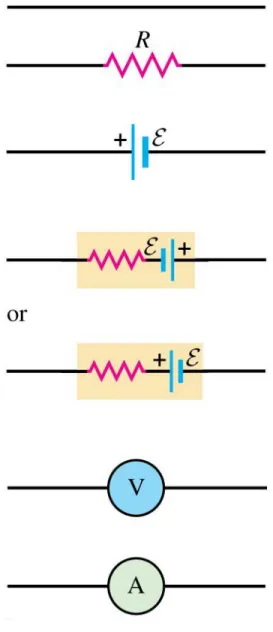
• The influence that makes current flow from lower to higher potential is called electromotive force (abbreviated emf and
pronounced “ee-em-eff”), and a circuit device that provides emf is called a source of emf.
• Note that “electromotive force” is a poor term because emf is not a
force but an energy-per-unit-charge quantity, like potential.
• The SI unit of emf is the same as that for potential, the volt (1 V = 1 J/C).
• A typical flashlight battery has an emf of 1.5 V; this means that
Internal resistance
• Real sources of emf actually contain some internal
resistance r.
Potential changes
• The figure shows how thepotential varies as we go around a complete circuit.
• The potential rises when the current goes through a
battery, and drops when it goes through a resistor.
• Going all the way around the loop brings the potential
Energy and power in electric circuits
• The box represents a circuitelement with potential difference Vab = Va − Vb
between its terminals and
current I passing through it in the direction from a toward b.
• If the potential at a is lower than at b, then there is a net transfer of energy out of the circuit element.
Power
• The upper rectangle
represents a source with emf and internal resistance r, connected by ideal wires to an external circuit represented by the lower box.
• Point a is at higher potential than point b, so Va > Vb and
Vab is positive.
Metallic conduction
• Electrons in a conductor are free to move through the crystal, colliding at intervals with the stationary
positive ions.
• The motion of the electrons is