Open Access
R E S E A R C H
© 2010 Ming et al; licensee BioMed Central Ltd. This is an Open Access article distributed under the terms of the Creative Commons Attribution License (http://creativecommons.org/licenses/by/2.0), which permits unrestricted use, distribution, and reproduction in any medium, provided the original work is properly cited.
Research
Development of a
Bacillus subtilis
expression
system using the improved P
glv
promoter
Yang M Ming*
†, Zhang W Wei
†, Chen Y Lin and Gong Y Sheng
Abstract
Background: B. subtilis is an important organism in the biotechnological application. The efficient expression system is desirable in production of recombinant gene products in B. subtilis. Recently, we developed a new inducible expression system in B. subtilis, which directed by B. subtilis maltose utilization operon promoter Pglv. The system demonstrated high-level expression for target proteins in B. subtilis when induced by maltose. However, the system was markedly repressed by glucose. This limited the application of the system as a high-expression tool in biotechnology field. The aim of this study was to further improve the Pglv promoter system and enhance its expression strength.
Results: Here, site-directed mutagenesis was facilitated to enhance the expression strength of Pglv. The transcription level from four mutants was increased. Production of β-Gal from the mutants reached the maximum 1.8 times as high as that of wildtype promoter. When induced by 5% maltose, the production of β-Gal from two mutants reached 14.3 U/ml and 13.8 U/ml, 63.5% and 57.5% higher than wildtype promoter (8.8 U/ml) respectively. Thus, site-directed mutagenesis alleviated the repression of glucose and improved the expression activity. To further improve the promoter system, the B. subtilis expression host was reconstructed, in which B. subtilis well-characterized constitutive promoter P43 replaced the promoter of the glv operon in B. subtilis chromosome through a double crossover event. The β-galactosidase production from the improved system (21.1 U/mL) increased compared to that from origin system. Meanwhile, the repression caused by glucose was further alleviated.
Conclusions: In this study, we obtained a mutated promoter Pglv-M1 through site-directed mutagenesis, which demonstrated high expression strength and alleviated the repression caused by glucose. Moreover, we alleviated the repression and enhanced the expression activity of the Pglv-M1 promoter system via reconstruction of the B. subtilis
host. Thus, we provided a valuable expression system in B. subtilis.
Background
B. subtilis is an important organism in the biotechnologi-cal application, regarding its non-pathogenic and well-characterized biochemical and physiological property [1,2]. The genetic engineering of B. subtilis played a sig-nificant role in biotechnological application and industry [3,4]. A controllable expression system is desirable in effi-cient production of recombinant gene products in B. sub-tilis [5-7]. The most prominently and widely used induction systems in B. subtilis are mediated by promot-ers Pspac and Pxyl. The disadvantage of these systems is that the inducer is costly for industrial application [8-10].
Recently, we developed a new inducible expression sys-tem in B. subtilis [11], which directed by B. subtilis malt-ose utilization operon promoter Pglv [12,13]. The system demonstrated high-level expression for target proteins in
B. subtilis when induced by maltose. Moreover, cheap and safe inducer makes the system a potential promoter sys-tem in industrial application. However, the syssys-tem was markedly repressed by glucose, in which the glucose repressed the Pglv promoter via a catabolism repression
element (cre) located downstream of the transcription origin site of the Pglv promoter [11-13]. This limited the application of the system as a high-expression tool in bio-technology field. To improve the Pglv promoter system, site-directed mutagenesis of several nucleotides down-stream the transcription origin site of Pglv was facilitated via overlap polymerase chain reaction (PCR) in vitro in
* Correspondence: [email protected]
1 College of Animal Science and Technology, Northwest A&F University,
Yangling 712100, China
† Contributed equally
this study. To further alleviate the repression and enhance the expression strength of the Pglv promoter, the B. subtilis
expression host was reconstructed, in which the constitu-tive promoter P43 replaced the promoter of the glv
operon in the B. subtilis chromosome through a double crossover event.
Results and discussion
Site-direct mutagenesis of Pglv promoter and examination of the expression strength
In the mutant Pglv-M1, two bases located at the conserva-tion sequence of catabolism repression element were mutated (GCTAT). According to the 3' sequence of 16 s RNA, the ribosome binding site was optimized in the mutants Pglv-M2 and Pglv-M3, based on Pglv-M1, Addi-tionally, based on Pglv-M3, the two bases downstream Shine-Dalgarno sequence (SD sequence) of the Pglv
pro-moter was mutated, resulting in Pglv-M4.
There is a typical conservation sequence of catabolism repression element (cre), overlapping with the ribosome binding site, downstream of the transcription origin site of the Pglv promoter [11,13]. In order to alleviate the repression of glucose and improve the expression strength of the Pglv promoter, the site-directed mutagene-sis of cre sequence is performed. To further enhance the expression of gene downstream the promoter, we try to improve the ribosome-binding site sequence. According to the sequence of hydroxyl end of 16 S rRNA, the nucle-otides downstream the SD sequence were select to mod-ify in pJRINM4.
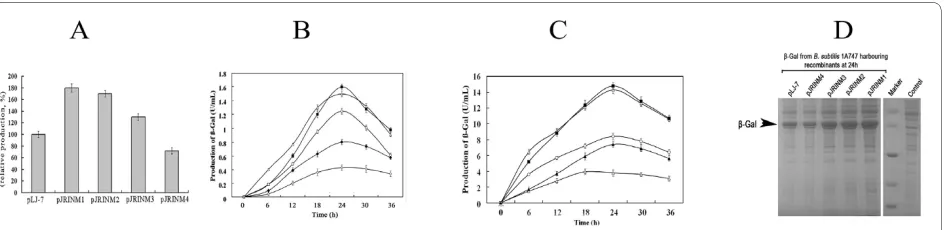
To examine the expression efficiency of the obtained four mutants, they were sub-cloned and engineered with synthetic ribosome binding site. The resultant recombi-nants pJRINM1, pJRINM2, pJRINM3 and pJRINM4, in which the bgaB was under the control of four mutants respectively, were transformed into B. subtilis 1A747 to investigate the expression of β-Gal. Real-time PCR assay (Figure 1A) showed that compared with the pLJ-7, the transcription amount from the pJRINM1, pJRINM2 and pJRINM3 were increased in different degrees, in which the mutant pJRINM1 is obviously prior to the pLJ-7. This suggested the site-directed mutagenesis of the Pglv pro-moter is efficient in these three mutants.
To further verify the efficiency of mutated promoters, the β-Gal driven by these promoters was determined. The production of β-Gal from pJRINM1, pJRINM2 and pJRINM3 increased compared with that from pLJ-7. Amongst the production of β-Gal from pJRINM1, pJRINM2 was 1.8 fold (1.6 U/mL) and 1.7 fold (1.5 U/mL) of that from wildtype promoter (0.9 U/mL) after 24 h cul-ture, respectively. Whereas, the production of β-Gal from pJRINM4 was obviously decreased, about 58.2% of that from wildtype promoter after 24 h culture (Figure 1B).
This showed that site-directed mutagenesis in pJRINM4 has negative effect on the Pglv promoter. We speculated that the three mutated sites including the SD sequnence may change the space structure of the promoter, and the result reduced the transcript level.
While, the growth trend of B. subtilis 1A747 harbour-ing pJRINM1, pJRINM2, pJRINM3, pJRINM4 or pLJ-7 was approximately same (Additional file 1). It confirmed that the difference of β-Gal production was not caused by the cell amount.
To further assay these promoters, we tested the growth curves (Additional file 2) and the β-Gal activity (Figure 1C) under the induction conditions. When induced with 5% maltose, the production of β-Gal from pJRINM1 and pJRINM2 reached 14.3 U/mL and 13.8 U/ml, up by 63.5% and 57.5% compared with wildtype promoter (8.77U/mL) at 24 h, respectively. Meanwhile, the β-Gal production from pJRINM4 was 4.3 U/mL, only 48.8% of that from wildtype promoter.
SDS-PAGE assay (Figure 1D) demonstrated the β-Gal production from pJRINM1 and pJRINM2 was obviously higher than that from pLJ-7, further confirming that the two mutants enhanced the expression strength of Pglv promoter.
Effect of site-directed mutagenesis on the repression caused by glucose
To examine the effect of mutant on alleviating repression caused by glucose, the four recombinants were cultured in LB medium supplemented with 5% maltose and 5% glucose, and the growth curves (Additional file 3) and β-Gal production (Figure 2A) was measured, respectively. The β-Gal production from wildtype promoter was only 1/17 and 1/5 of that in medium without glucose supple-ment at 24 h and 30 h, respectively. Whereas the β-Gal production from pJRINM1 was 1/4 and 1/3 of that in medium without glucose supplement at 24 h and 30 h, respectively. While, the β-Gal production from pJRINM2, pJRINM3 and pJRINM4 was 1/6, 1/6 and 1/4 of that in medium without glucose supplement at 24 h, respec-tively. Thus, these mutants alleviated the repression caused by glucose, especially pJRINM1.
trend that with the decrease of the glucose concentration during cultivation, the β-Gal production from the recom-binant sharply increased in the medium supplemented with 5% maltose plus 5% glucose.
Reconstruction of the B. subtilis strain to further improve the expression system
The abovementioned results suggested that the promoter Pglv-M1 alleviated the repression caused by glucose; however, the glucose still exerted repression on the sys-tem. We speculated that one of the possible causes of the residual repression was that the maltose utilization operon located in the chromosome of the B. subtilis was nevertheless negatively regulated by glucose, in which GlvR as a positive regulator of the Pglv-M1 promoter sys-tem was driven by the operon native promoter Pglv. To further improve the Pglv-M1 promoter system, we replaced maltose utilization operon promoter Pglv with
B. subtilis constitutive promoter P43. Southern blot
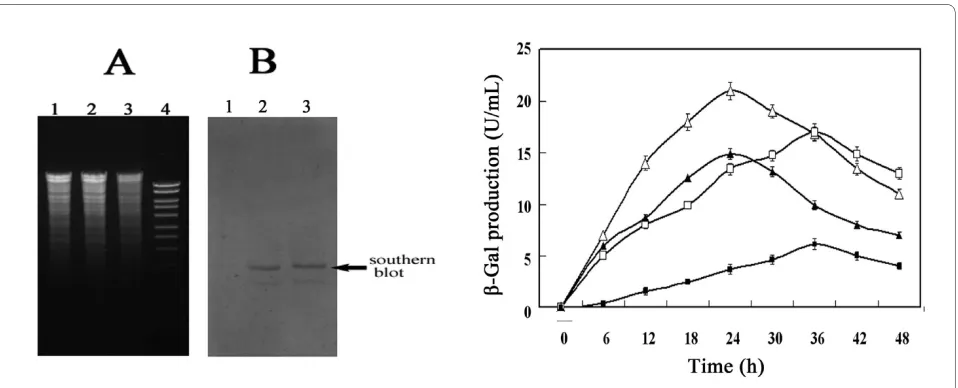
anal-ysis (Figure 3A) and PCR detection indicated that the double crossover event occurred in the resultant strain B. subtilis BCYL as expected.
To probe the efficiency of the improved expression sys-tem, the mutant pJRINM1 was transformed into BCYL and expression experiments were carried out. Figure 3B indicates that, with 5% maltose induction, β-Gal produc-tion reached a maximum (21.1 U/mL) at 24 h from B. subtilis BCYL harboring pJRINM1, and this was 50.3% higher than that from B. subtilis 1A747 harboring pJRINM1. For investigating the repression caused by glu-cose on the improved expression system, BCYL harbor-ing pJRINM1 was cultivated in LB supplemented with 5% maltose plus 5% glucose, yielded about 4-fold higher pro-duction of β-Gal than that of B. subtilis 1A747 harboring pJRINM1 at 24 h (Figure 3B). Therefore, the reporter gene production driven by the improved expression sys-tem increased obviously when supplemented with 5% glucose or not.
Figure 1 RT-PCR analysis of the mutated promoters (A) and the production of β-Gal driven by these promoters (B, C and D). (A) Real-time PCR analysis of the transcription amount from pLJ-7, pJRINM1, pJRINM2, pJRINM3 and pJRINM4, respectively (16 s rDNA used as the control). (B) The production of β-Gal when cultured in LB. The black square, white triangle, white circle, black diamond and white diamond represents the production
of β-Gal from B. subtilis 1A747 harboring pJRINM1, pJRINM2, pJRINM3, pLJ-7 and pJRINM4, respectively. (C) The production of β-Gal when cultured in
LB supplemented with 5% maltose. The black square, white triangle, white circle, black diamond and white diamond represents the production of
β-Gal from B. subtilis 1A747 harboring pJRINM1, pJRINM2, pJRINM3, pLJ-7 and pJRINM4; (D) SDS-PAGE analysis of β-Gal from the recombinants in B.
sub-tilis 1A747 after 24 h cultured on a 12% SDS-polyacrylamide gel. β-Gal is indicated by the arrow. Molecular mass marker indicates (top to bottom): 116, 66, 45, 35 and 25 kDa.
Figure 2 Characterization of the mutated promoters. The production of β-Gal from B. subtilis 1A747 harboring mutants supplemented with 5% maltose plus 5% glucose. The black square, white triangle, white circle, black diamond and white diamond represents the production of β-Gal from
B. subtilis 1A747 harboring pJRINM1, pJRINM2, pJRINM3, pLJ-7 and pJRINM4, respectively; (B) Reduced sugar concentration of culture of B. subtilis
1A747 harboring pJRINM1 in LB supplemented with 5% maltose; (C) Glucose actual concentration and β-Gal activity detection from B. subtilis 1A747
Controllable and strong promoter is the essential ele-ment to achieve high-level expression of target gene in the B. subtilis genetic engineering. B. subtilis maltose uti-lization promoter is a potential control element in the biotechnological application; however, glucose as a repressor influenced the strength of Pglv. In the maltose-inducible system, maltose plays two roles as an inductor: on one hand, it positively regulates the transcription of the Pglv promoter; on the other hand, as a fermentation carbon source, its metabolism production-glucose repressed the activity of promoter. There is a dynamic balance between the two carbon sources during the fer-mentation. Maltose was a positive regulation factor and, meanwhile degraded as one of carbon sources during this process; in the later stage of fermentation, both the total carbon sources and glucose are at relatively low level. When induced by 5% maltose, the production of β-Gal reached the maximum at 24 h and then decreased. In the glucose repression experiment, expression strength of both the mutated and wildtype promoter had a drastic increase after cultured for 24 h. This may be the utiliza-tion of glucose, as an easy ferment carbon source, was prior to maltose and the amount of glucose in total car-bon source declines to a relatively low level in the later stage of fermentation. As a result, the repression caused by glucose was relatively alleviated after 24 h.
Conclusions
In this study, we obtained a mutated promoter Pglv-M1 through site-directed mutagenesis, which demonstrated high expression strength and alleviated the repression
caused by glucose. Moreover, we further alleviate the repression and enhance the expression activity of the Pglv-M1 promoter system via reconstruction of the B. subtilis host. Thus, we improved the promoter system and provided a valuable expression system in B. subtilis.
Methods
Bacterial strains, plasmids and growth conditions
B. subtilis 1A747 was a generous gift from the Bacillus Genetic Stock Center (BGSC). Escherichia coli DH5α was purchased from Novagen (Darmstadt, Germany). The bacterial strains were cultured in Luria-Bertani (LB) medium at 37°C. Maltose and glucose were added as required. The following concentrations of antibiotics were used for selection: 100 μg/mL ampicillin (Amp), 5 μg/mL chloramphenicol (Cm) and 50 μg/mL spectinomy-cin (Spec). The plasmids used in this study were listed in Additional file 4.
Primers and oligonucleotides
Polymerase chain reaction (PCR) primers and oligonucle-otides used in this study were listed in Additional file 5.
General manipulation
General recombinant DNA technique was carried out using standard techniques [14]. The transformation of B. subtilis was performed by electroporation [15,16].
Site-directed mutagenesis of Pglv promoter via overlap PCR
The bases downstream the transcription original sites were site-directed mutated by using of overlap PCR. The
Figure 3 Reconstruction of B. subtilis host. (A) Agarose-gel-electrophoresis of chromosome DNA digested with ApaI and EcoRI. Lane1, treated
chro-mosome DNA from B. subtilis 1A747 [this served as the negative control]; lanes 2 and 3, treated chromosome DNA from B. subtilis BCYL; lane 4,
molec-ular weigh marker. (B) Southern blot analysis of recombinant B. subtilis BCYL chromosome DNA. The lanes 1, 2 and 3 are that the same as in (A). (C)
β-Gal production by the improved expression system. White triangle and white square represents the β-β-Gal production by B. subtilis BCYL harboring
pJRINM1 cultures in LB with 5% maltose and LB with 5% maltose plus 5% glucose, respectively; black triangle and black square represents the β-Gal
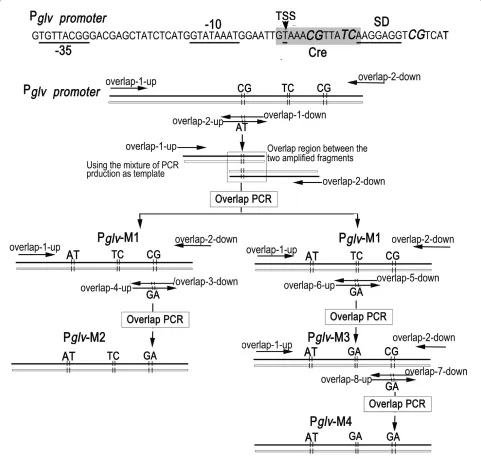
sequences of primers that were used in this experiment are shown in Additional file 5, and the mechanism of the mutagenesis method and the positions of the primers are depicted in Figure 4.
A 360 bp fragment upstream of the maltose promoter and a 300 bp fragment downstream of the maltose pro-moter waiting for site-directed mutagenesis were
ampli-fied from Bacillus subtilis 1A747 genome DNA as a template respectively, using primer pairs overlap-1-up/ overlap-1-down and overlap-2-up/overlap-2-down, in which there are 30 bp overlap in the two amplified frag-ments and the two mutant sites were introduced by prim-ers overlap-1-down and overlap-2-up. With overlap-1-up and overlap-2-down as primers, and the mixture of two
Figure 4 Schematic diagram of the overlap PCR. -10, -35, TSS, SD, and Cre represent the -10 box, -35 box, transcription origin, SD box and catabolite repression element, respectively. Italic indicates the mutated nucleotides. Approximate positions of the primers are shown with arrows. Using primer pairs overlap-1-up/overlap-1-down and overlap-2-up/overlap-2-down, a 360 bp fragment upstream of the maltose promoter and a 300 bp fragment
downstream of the maltose promoter were amplified from Bacillus subtilis 1A747 genome DNA, in which there are 30 bp overlap in the two amplified
fragments and the two mutant sites were introduced by primers overlap-1-down and overlap-2-up. With overlap-1-up and overlap-2-down as
prim-ers, and the mixture of two obtained fragments as template, a 630 bp Pglv-M1 was overlap PCR amplified. Same mechanism was used to generate the
fragments as template, a 630 bp Pglv-M1 was overlap PCR amplified.
According to the abovementioned protocol, using Pglv -M1 as template, the second mutant Pglv-M2 and third mutant Pglv-M3 were amplified via overlap PCR by using of primer pairs overlap-1-up/overlap-3-down and over-lap-4-up/overlap-2-down, and overlap-1-up/overlap-5-down and overlap-6-up/overlap-2-overlap-1-up/overlap-5-down, respectively. The mutant was introduced by overlap section of over-lap-3-down and overlap-4-up for Pglv-M2 and,
overlap-5-down and overlap-6-up for Pglv-M3. Then, the fourth mutant Pglv-M4 was generated from Pglv-M3 using primer pairs overlap-1-up/overlap-7-down and overlap-8-up/ 2-down, in which the overlap section of overlap-7-down and overlap-8-up introduced the mutant.
Construction of plasmid vectors
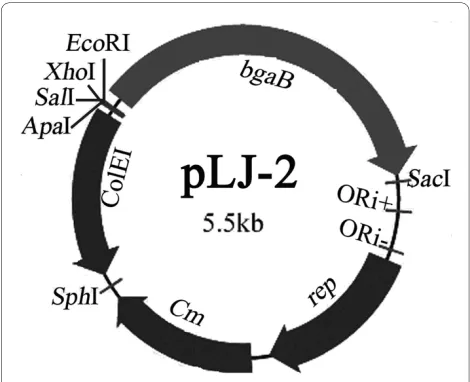
Using primer pair bga-up/bga-down, the bgaB coding for thermostable β-Gal was polymerase chain reaction (PCR) amplified from plasmid pDL. The obtained 2.0 kb frag-ment was digested with EcoRI and SacI, and cloned into pGJ103 digested with the same enzymes, resulting in pLJ-2 (Figure 5).
Using Pglv-1-up and Pglv-5-down as primers, PglvMa, PglvMb, PglvMc and PglvMd were PCR amplified from Pglv -M1, Pglv-M2, Pglv-M3 and Pglv-M4 (As shown in Figure 4), respectively. After digested with ApaI and BamHI, these amplified fragments were cloned into the corresponding sites of pBluskm, resulting in pJR1, pJR2, pJR3 and pJR4. A ribosome binding site (RBS) fragment INSD generated
by annealing two artificially synthesized oligonucleotides INSID-1 and INSID-2, was cloned into the pJR1-4 digested by BamHI and SacI, respectively. Then, the four mutant promoters with engineered RBS were excised from the obtained four recombinants with ApaI and
EcoRI, and cloned into the corresponding sites of pLJ-2, in which the bgaB was used as reporter, yielding pJRINM1, pJRINM2, pJRINM3 and pJRINM4, respec-tively.
Reconstruction of B. subtilis strain
With B. subtilis 1A747 chromosomal DNA as template, the two homogeneous arms GAf (using GlvA-fro-up and GlvA-fro-down as primers) and GAb (using GlvA-bac-up and GlvA-bac-down as primers) were amplified. A selec-tion marker (spectinomycin resistance gene) was gener-ated through PCR amplified from plasmid pDG1728, using primers Spec-I-up and Spec-I-down. And Bam
HI-SalI treated selection marker and KpnI-ApaI treated GAf was cloned into pBluskm, resulting in pYG34.
The expression cassette directed by P43 promoter was constructed as follows. First, the P43 promoter [3,17] was amplified from B. subtilis 1A747 chromosomal DNA, using primers P43-1-up and P43-1-down. After digestion with ApaI and EcoRI, the P43 promoter was cloned into the corresponding sites in pBluskm, yielding pB43. Then the GAb fragment, digested with EcoRI and SacI, was cloned into the corresponding sites in pB43, resulting in pCYL17. Finally, with primers P43-2-up and GlvA-bac-down, the P43 promoter and the GAb were amplified as a single product from pCYL17 and ligated with pYG34 after digestion with BamHI and SacI, resulting in pCYL25. The B. subtilis 1A747 was transformed with the linear fragment of pCYL25 obtained with ScaI to replace promoter Pglv with P43 via a double crossover event between the linearized pCYL25 and B. subtilis 1A747 chromosome. The spectinomycin resistance (SpecR)
colo-nies were selected. And the resultant strain was named as BCYL.
Isolation of total RNA and Real-time PCR
The cultures was harvested at 24 h. Total RNA of bacteria was isolated by using SV total RNA isolation kit (Cat. Z3100, Promega). The cDNA chain was synthesized by using Reverse Transcription System (Cat. A3500, Pro-mega).
And Real-time PCR was performed by using Real time PCR Kit (Cat. DRR041 S, TaKaRa). The bagB gene was amplified using bga-up and bga-down as primers B1-up/ B1-down. With the primers 16s-up/16s-down, Bacillus subtilis 16 s rDNA was amplified as control, The PCR protocol was as follows: 2 min at 50°C, 10 min at 95°C, and then 35 cycles consisting of 45 s at 95°C, 1 min at
Figure 5 Map of the promoter probe vector pLJ-2. ORI+, ORI- and rep represent the single-strand replication origin, the double strand
or-igin and replication protein in B. subtilis, respectively. ColEI, bgaB and
Cm represent E. coli ColEI replicon, chloramphenicol-resistance marker
52°C, and 30 s at 72°C. Reactions were carried out in real-time PCR detection system (IQ5, Bio-RAD).
SDS-PAGE assay
Sodium dodecylsulfate polyacrylamide gel electrophore-sis (SDS-PAGE) was performed as described previously [14].
β-Gal activity assay
Method has been described previously [[11,18] and [19]]. In brief, the culture was pelleted by centrifuge and resus-pended in an equivalent volume of buffer Z [18,19]. Using buffer Z, 0.01 or 0.1 mL sample aliquots was diluted to 0.8 mL, and then added 0.01 mL of lysozyme stock (10 mg/ ml). The mixture was incubated at 37°C for 30 min, and then, added 0.2 ml of 4 mg/ml o-nitrophenyl-b-Dgalacto-pyranoside (ONPG). After incubated at 55°C for 15 min, the reaction was stopped by adding 0.5 ml of 1 M Na2CO3. Absorbance was recorded at 420 nm with a spectrophotometer (HITACHI, U-3010). One unit of β-galactosidase activity was defined as the amount of enzyme necessary to release 1 μmol 2-nitrophenol from o-nitrophenylgalactopyranoside per minute at 55°C. β-galactosidase activity is expressed as units per mL sam-ple.
Southern blot analysis
Southern blot analysis of chromosomal DNA digested with ApaI and EcoRI was carried out as described previ-ously [14]. Probe labeling was performed with a DIG DNA labeling kit (Roche, Cat.No.1093657) according to the instructions, using the spectinomycin resistance gene as template.
Reducing sugar assay
Reducing sugar was measured by the dinitrosalicylic method (DNS) [20] using glucose as a standard.
Assay of glucose concentration
The concentration of glucose was determinate as previ-ously described [21]
Additional material
Competing interests
The authors declare that they have no competing interests.
Authors' contributions
MMY initiated and coordinated the project. WWZ and MMY were responsible for site-directed mutagenesis and its analysis. WWZ and YLC performed the batch cultivation. MMY and Y-S Gong performed construction of expression system. All authors wrote the paper and approved the final version of the man-uscript.
Acknowledgements
This work was supported by grants from Chinese National Natural Science Foundation (30871813). And we thank the Bacillus Genetic Stock Centre of Ohio State University for generously providing the study materials.
Author Details
College of Animal Science and Technology, Northwest A&F University, Yangling 712100, China
References
1. Kunst F, Ogasawara N, Moszer I, Albertini AM, Alloni G, Azevedo V, Bertero
MG, Bessieres P, Bolotin A, Borchert S: The complete genome sequence
of the gram-positive bacterium Bacillus subtilis. Nature 1997,
390:249-256.
2. Schallmey M, Singh A, Ward OP: Developments in the use of Bacillus
species for industrial production. Can J Microbiol 2004, 50:1-17.
3. Zhang XZ, Cui ZL, Hong Q, Li SP: High-level expression and secretion of
methyl parathion hydrolase in Bacillus subtilis WB800. Appl Environ Microbiol 2005, 71:4101-4103.
4. Zhang AL, Liu H, Yang MM, Gong YS, Chen H: Assay and characterization
of a strong promoter element from B. subtilis. Biochem Biophys Res Commun 2007, 354:90-95.
5. Nguyen HD, Nguyen QA, Ferreira RC, Ferreira LCS, Tran LT, Schumann W:
Construction of plasmid-based expression vectors for Bacillus subtilis
exhibiting full structural stability. Plasmid 2005, 54:241-248.
6. Nguyen HD, Schumann W: Novel plasmid-based expression vectors for
intra- and extracellular production of recombinant proteins in Bacillus subtilis. Prot Expr Purif 2006, 46:189-195.
7. Li W, Li HX, Ji SY, Li S, Yang MM, Chen YL: Characterization of two
temperature-inducible promoters newly isolated from B. subtilis.
Biochem Biophys Res Commun 2007, 358:1148-1153.
8. Kim L, Mogk A, Schumann W: A xylose-inducible Bacillus subtilis
integration vector and its application. Gene 1996, 87:53-61.
9. Bhavsar AP, Zhao XM, Brown ED: Development and characterization of a
xylose-dependent system for cloned gene in Bacillus subtilis: conditional complementation of a Teichoic acid mutant. Appl Environ Microbiol 2001, 67:403-410.
10. Hartl B, Wehrl W, Wiegert T, Homuth G, Schumann W: Development of a
new integration site within the Bacillus subtilis chromosome and construction of compatible expression cassettes. J Bacteriol 2001,
183:2696-2699.
11. Yang MM, Zhang WW, Zhang XF, Cen PL: Construction and
characterization of a novel maltose inducible expression vector in
Bacillus subtilis. Biotechnol Lett 2006, 28:1713-1718.
12. Thompson J, Pikis A, Ruvinov SB, Henrissat B, Yamamoto H, Sekiguchi J:
The gene glvA of Bacillus subtilis 168 encodes a metal-requiring NADH-dependent 6-phospho-glucosidase. J Bol Chem 1998, 273:27347-27356.
Additional file 1 The growth curves from B. subtilis 1A747 harboring different plasmids when cultured in LB. (black diamond) represents
OD595 from B. subtilis 1A747 harboring pLJ-7; (black square) represents
OD595 from B. subtilis 1A747 harboring pJRINM1; (black triangle) represents
OD595 from B. subtilis 1A747 harboring pJRINM2; cross (x) represents
OD595 from B. subtilis 1A747 harboring pJRINM3; asterisk (*) represents
OD595 from B. subtilis 1A747 harboring pJRINM4.
Additional file 2 The growth curves from B. subtilis 1A747 harboring different plasmids when cultured in LB supplemented with 5%
malt-ose. (black diamond) represents OD595 from B. subtilis 1A747 harboring
pLJ-7; (black square) represents OD595 from B. subtilis 1A747 harboring
pJRINM1; (black triangle) represents OD595 from B. subtilis 1A747 harboring
pJRINM2; cross (×) represents OD595 from B. subtilis 1A747 harboring
pJRINM3; asterisk (*) represents OD595 from B. subtilis 1A747 harboring
pJRINM4.
Additional file 3 The growth curves from B. subtilis 1A747 harboring different plasmids when cultured in LB supplemented with 5% malt-ose plus 5% glucmalt-ose. (black diamond) represents OD595 from B. subtilis
1A747 harboring pLJ-7; (black square) represents OD595 from B. subtilis
1A747 harboring pJRINM1; (black triangle) represents OD595 from B. subtilis
1A747 harboring pJRINM2; cross (×) represents OD595 from B. subtilis 1A747
harboring pJRINM3; asterisk (*) represents OD595 from B. subtilis 1A747
har-boring pJRINM4.
Additional file 4 Plasmids used in this study.
Additional file 5 Primers and oligonucletides used in this study.
Received: 26 February 2010 Accepted: 10 July 2010 Published: 10 July 2010
This article is available from: http://www.microbialcellfactories.com/content/9/1/55 © 2010 Ming et al; licensee BioMed Central Ltd.
This is an Open Access article distributed under the terms of the Creative Commons Attribution License (http://creativecommons.org/licenses/by/2.0), which permits unrestricted use, distribution, and reproduction in any medium, provided the original work is properly cited.
13. Yamamoto H, Serizawa M, Thompson J, Sekiguchi J: Regulation of
glvoperon in Bacillus subtilis : YfiA(GLVR) is a positive regulator of the operon that is repressed through CcpA and cre. J Bacteriol 2001,
183:5110-5121.
14. Sambrook J, Fitsch EF, Maniatis T: Molecular Cloning: A Laboratory Manual
Cold Spring Harbor: Cold Spring Harbor Press; 1989.
15. Bron S: Plasmids. In Molecular biological methods for Bacillus Edited by:
Harwood CR, Cutting SM. New York: John Wiley and Sons; 1990:75-174.
16. Yang MM, Zhang WW, Bai XT, Li HX, Cen PL: Electroporation is a feasible
method to introduce circularized or linearized DNA into B. subtilis
chromosome. Mol Biol Rep 2010 in press.
17. Wang PZ, Doi RH: Overlapping promoters transcribed by Bacillus subtilis
σ55 and σ37 RNA polymerase holoenzymes during growth and stationary phase. J Biol Chem 1984, 259:8619-8625.
18. Hirata H, Fukazawa T, Negoro S, Okada H: Structure of a β-galactosidase
gene of Bacillus stearothermophilus. J Bacteriol 1986, 166:722-727.
19. Fanning S, Leahy M, Sjheehan D: Nucleotide and deduced amino
acidsequences of Rhizobium meliloti 102F34 lacZ gene: comparison with prokaryotic β-galactosidases and hunan β-glucuronidase. Gene
1994, 141:91-96.
20. Miller GL: Use of dinitrosalicylic acid reagent for determination of
reducing sugar. Anal Chem 1959, 31:426-428.
21. Cavari BZ, Phelps G: Sensitive Enzymatic Assay for Glucose
Determination in Natural Waters. Appl Environ Microbiol 1977,
33:1237-1243.
22. Short JM, Fernandez JM, Sorge JA, Huse WD: λ ZAP: A bacteriophage λ
expression vector with in vivo excision properties. Nucleic Acids Res
1988, 16:7583-7600.
23. Guerot-Fleury AM, Frandsen N, Stragier P: Plasmids for ectopic
integration in Bacillus subtilis. Gene 1996, 180:57-61.
doi: 10.1186/1475-2859-9-55
Cite this article as: Ming et al., Development of a Bacillus subtilis expression