www.ijpes.com
International Journal of Psychology and Educational
Studies
Views, Perceptions and Recommendations of Nursing Students with regard
to a Screen-Based Computer Simulation: A Qualitative Study
Aylin Durmaz Edeer
1, Aklime Sarıkaya
21Faculty of Nursing, Dokuz Eylul University, Izmir,Turkey
2Faculty of Health Science, Istanbul Sabahattin Zaim University, Istanbul, Turkey
ARTICLE INFO ABSTRACT
Article History: Received 04.07.2017 Received in revised form 16.01.2018
Accepted 22.01.2018 Available online 01.05.2018
Educational methods should be continuously evaluated. In this study, the views, perceptions and recommendations of undergraduate nursing students with regard to a screen-based computer simulation are defined. This was a qualitative research study. Two focus group interviews were conducted. The students said that the simulation was beneficial for practice, improved their self-confidence and decision-making, and decreased the number of mistakes made. Although the students were satisfied with this method of education, they said that this simulation alone was not sufficient. They stated that it should be supported by practice in the skills laboratory to avoid doing harm to the patient in a real-world situation.
© 2018 IJPES. All rights reserved Keywords:1
Nursing education, qualitative research, screen-based computer simulation
1. Introduction
Educational technologies provide an opportunity to create meaningful learning environments both for students and educators. These technologies provide ready access to information and can overcome some of the difficulties presented by time and place (Moyle, 2010). Different learning technologies have recently been used for this purpose at all stages of the education process in various educational settings. The use of different education technologies in nursing has been gradually increasing and the World Health Organization recommends the use of new approaches such as electronic learning and simulation in training programs (World Health Organization [WHO], 2009).
Simulation allows the student to learn the skills of clinical practice skills successfully in a non-risk environment. Different simulation methods are used in training. Among these, screen-based computer simulations or web-based simulations are the most cost-effective and favored methods (Decker, Sportsman, Puetz and Billings, 2008). These simulations are designed and programmed using computers. Training programs designed in computers can change the educational system and its structure. With computer-based training, individuals and groups learn more information in a shorter time and more quickly (Isman, 2006). In these approaches, in order to ensure that the training is of high quality and the learning efficient, continuous evaluation and improvement of the process are needed. One of the best methods to achieve this is by obtaining the students’ opinions and determining their expectations.
Students’ views about web-based methods in nursing have been investigated in some studies. There is, however, a limited number of studies in which students’ views on web-based skills training have been assessed. In two studies, nursing students stated that web-based training provided a chance to study when
1 Corresponding author’s address:Faculty of Nursing, Dokuz Eylul University, Izmir, Turkey e-mail: [email protected]
http://dx.doi.org/10.17220/ijpes.2018.02.003
© 2014 International Journal of Psychology and Educational Studies (IJPES) is supported by Educational Researches and Publications Association (ERPA)
and how they wanted to (Gerdprasert, Pruksacheva, Panijpan, and Ruenwongsa, 2010; Koch, Andrew, Salamonson, Everett and Davidson, 2010). In Leski’s study (2009), the majority of the nursing students assessed web and computer-based training as positive since it provides new, integrated information and a different point of view, but as also having negative aspects since there is a lack of practical experience. In another study, all the nursing students thought that the simulation was not sufficient in terms of clinical application (Baxter, Akhtar-Danesh, Valaitis, Stanyon and Sproul, 2009). In one of Blake’s studies (2010), the students stated that the ability to re-use the web-based training method was an important advantage. Furthermore, the students expressed their opinion about barriers to using the web-based learning methods. In Salyers’ research (2007), it was determined that nursing students had a low level of satisfaction with web-based psychomotor skills training due to problems with the technology, software and hardware. In another study, the students reported the obstacles to web-based learning methods as being ‘insufficient computer facilities, problems in online connections and technical problems’ (Blake, 2010). According to the results of a systematic review of these obstacles, poorly designed training packets and insufficient technology were determined to be the main barriers in electronic learning (Childs, Blenkinsopp, Hall and Walton, 2005). In our study, these obstacles were taken into consideration when designing the web-based training. No other such studies have been conducted in Turkey on nursing students with regard to the use of web-based learning methods both for theoretical lessons and for skills training like pre-postoperative care.
Other than decreasing educational costs, screen-based computer simulation provides learning for a desired duration and in a specific place. As a result of problems identified by students, it was decided to conduct web-based preoperative and postoperative care management training. Determining students’ views, perceptions, and recommendations with regard to learning pre-postoperative care management using a web-based simulation will aid in the development of this training method and lead to future studies. The aim of this study was thus to understand the views of second-year students in undergraduate nursing about screen-based computer simulation (SBCS), and to determine their perceptions of and recommendations for the training course and how it could be improved.
2. Method
This study was carried out using a phenomenological approach, which is one of the qualitative research
methods (Yıldırım & Şimşek, 2011).
2.1. Participants
In the study, the students who received pre-postoperative care management using an SBCS were interviewed. The sample of the study was formed using the targeted sampling method (Yıldırım & Şimşek, 2011). The
inclusion criteria included agreeing to participate voluntarily and attending simulation training and post-training evaluation. Focus group interviews were performed with students after clinical practice. A total of 41 second-year nursing undergraduate students received education about pre-postoperative care management with the SBCS. 28 students (68.3 %) out of 41 students participated in the assessments. Out of these 28 students, 24 students participated in focus group interviews. There were thus 12 students in each focus group interview. The mean age of the students was 20.2±0.8., 83.3% (n=20) of the students were female and 16.7% were (n=4) male. Since new information was not acquired and previous information was confirmed and repeated, two
focus group discussions were found to be satisfactory (Yıldırım & Şimşek, 2011).
This project was carried out in a Faculty of Nursing in Izmir. In the faculty, skills are performed in skill laboratories that are similar to clinical environments. It takes four years to complete a bachelor’s degree program in nursing in Turkey, and nursing education is provided to students by nurse educator and other medical professionals.
The content of the simulation was structured according to information-processing theory. In this theory, learning is explained as a process in which new information is associated with already acquired information. In structuring the care management content, a relationship was established between information learned in the previous and current classes. Topics of special importance were indicated in summaries, sample cases were included and significant relationships were emphasized (Durmaz Edeer and Dicle, 2014).
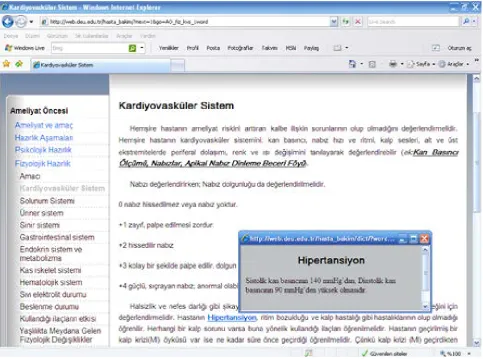
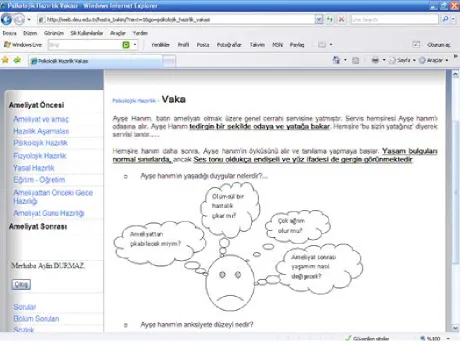
The care management content in the SBCS was prepared by two educators in the nursing school who had doctoral degrees in surgical nursing, and was further evaluated by four specialist instructors with similar doctorates in surgical nursing. In the SBCS, pre-postoperative care management topics were explained using textual information, images, flow charts, tables, sample cases and videos. There is no comparable simulation available in Turkey. In the first stage of the project, a randomized controlled trial was conducted using the SBCS to teach pre-postoperative care management to second-year nursing undergraduate students (Durmaz,
Dicle, Cakan, Cakır, 2012).
Figure 1. Sample screen view
Figure 2. Sample case page
2.2. Ethical considerations
Ethics committee approval was obtained from Dokuz Eylul University and permission was obtained from the nursing school. The aim of the study was explained to the students both in written form and orally. Written consent was obtained from the students who had volunteered for the study. It was also explained to them that an audio recorder would be used and that the study data would be kept confidential.
2.3. Data collection
In this study, data were collected in two focus group interviews in 2010. The focus group interviews were carried out in a silent, well-lit and well-aerated room in the nursing school. The room where the focus group interviews were carried out was comfortable and all the necessary equipment was present.
Interviews were recorded on an audio recorder. They lasted for an average of 60 minutes. During the data collection, semi-structured open-ended questions were used. Prior to the interviews, the opinions of two qualitative research specialists about what to ask were sought. In the focus group interviews, students were then asked the following open-ended questions:
How do you think the SBCS has contributed to your learning? How do you think the SBCS has contributed to your practice?
What has been the effect of the SBCS on your clinical decision making? What is your assessment of your own ability to use the SBCS?
During the focus group interview, a ‘manager’ and an ‘observer’ were both present. The manager spoke to the student, while the observer noted specific discussion points, the students’ body language and their emotional state. The main researcher, who had previously received training on how to conduct focus group interviews, took the role of manager in the first interview. This researcher was also the one who had prepared the content of the simulation content and collected the data. Therefore, when the first focus group interview was assessed, it was thought that the students may have had difficulty in expressing their real opinions to this interviewer. In the second focus group interview, the management was thus undertaken by another person who was not involved in the study, but who had also been trained in interviewing, and who had previously conducted focus group and personal interviews.
2.4. Data analysis
The data collected in the focus group interviews were transferred from the audio recorder to a computer. The data were recorded in the computer using codes for the students’ names. The data recordings of the focus group interviews were made by the first author. For data analysis, the content analysis method was used. Content analysis was performed using the inductive method, which requires coding-based content analysis
(Yıldırım & Şimşek, 2011). In the content analysis, similar data were classified under specific concepts and
themes, and commented on after having been arranged in an understandable way.
In order to improve the reliability and credibility of the data analysis, the statements of the students were analyzed independently by two people and coded separately. These two people were one of the researchers and another individual who was not involved in the content of the study but who had experience with qualitative studies. Each of them performed the data analysis, drew up a code list, and decided on the theme and the sub-themes independently. The analyses were then compared, differences were discussed and common codes were determined. This process allowed for the dependability and confirmation of the research
data (Elo & Kyngos, 2008; Graneheim & Lundman, 2004; Yıldırım & Şimşek, 2011).
3. Results
Five main themes were determined from the data obtained as a result of interviews with the students. These themes were ‘learning’, ‘practice’, ‘barriers’, ‘attraction’ and ‘recommendations’.
3.1. Theme 1: Learning
Most of the students stated that the SBCS provided detailed and sufficient information about pre-postoperative care, and that it integrated previously learnt information with new knowledge. Most of the students reported that learning pre-postoperative care management using a computer was appropriate for understanding the subject. The students explained the effects of the SBCS on their learning as follows:
• ‘Better than the skills laboratory, because the amount of information was higher; it was more detailed and
explained more; we experienced many new things in the project.’
• ‘The information in the application changed my point of view’.
• ‘It was comprehensive; I think it contributed a great deal to my knowledge.’
3.2. Theme 2: Practice
Most students stated that the SBCS on clinical practice improved their self-confidence, made their decision-making more effective and decreased the number of mistakes they made. They also stated that videos in the simulation were very effective and beneficial in their communication with patients. In particular, the students said that their concerns in initiating an interview with a patient had been resolved as a result of watching the videos. Some of the students’ statements with regard to their practice were as follows:
• ‘I think I easily used my knowledge in practice…This training was very helpful for me. I think I transferred the
information I acquired into practice.’
• ‘I think that I had sufficient proficiency on this subject. I easily took care of my patients…We made very few mistakes in preoperative and postoperative care.’
• ‘It made it easier for me to decide what to do.’
• ‘Since detailed information was given, our decision-making process was shorter. We could predict probabilities
in advance.’
• ‘The videos demonstrated how to communicate properly with patients...It taught me a great deal about practice
and communication. It was good in this respect.’
3.3. Theme 3: Barriers
About half of the students stated that they usually had technical problems using the SBCS. These barriers to use were technical problems, such as problems with internet access or their connection. Some of the students’ statements about the barriers they faced in using the simulation were:
• ‘We don’t have access to free internet in our dorms…so we couldn’t log in.’
• ‘I couldn’t use it properly. I tried to use the simulation, but it was disconnected…Internet access was difficult.’
• ‘I had no internet access! So I had problems.’
3.4. Theme 4: Attraction
Most of the students found the visual material and the figures in the SBCS understandable and attractive. Presenting the training material using a pedagogic approach facilitated their learning. They found the ability to re-use the simulation very helpful. In particular, they liked that the videos were in their native language. Some of the students’ statements with regard to the theme of ‘attraction’ were as follows:
• ‘I liked the videos so much! It was good to see what to do and what to say to patients in the videos...The figures
given about the subject were clear…It made our understanding easier. ’
• ‘When I wished to remember specific points, I could just open the program and watch it anywhere and anytime.
So I think it was very helpful for us.’
• ‘I also think it is good for the program to be online! I could access it whenever I wanted. We can use it whenever
we find a computer with internet access, everywhere and all the time.’
3.5. Theme 5: Recommendations for the simulation
Most of the students suggested that the visual material (number of videos, photographs and other images) in the SBCS for care management should be increased in order to better contribute to learning and practice. They said that the meaning of medical terms, particularly in cases related to the subject and research results, should be provided. Finally, they emphasized self-assessment; they requested that tests be included and that answers be evaluated with immediate feedback. They also wished to have the chance to provide feedback to the educator. Some of the students’ statements related to these suggestions were:
• ‘There are many words that we don’t know or whose meanings we get confused about. It would be perfect if
their meanings were given.’
• ‘In the online training, sample cases and questionnaires or short tests could be given after each topic.’
• ‘It is important to have tests. In particular, if feedback were given about our mistakes and the correct answers
were explained, we would be able to remember them better.’
Although the students felt that the SBCS was very useful, they said that it should be supported by practice in the skills laboratory, since it is not solely sufficient for their learning.
• ‘It is not sufficient to read about a subject or watch something on a screen. I think that I understand better, do
things better and learn more when I practice something in the skills laboratory. Hence, I think computers are
not sufficient.’
• ‘It would be better to learn not only professional skills but also communication techniques. It may be more helpful
to demonstrate the right and wrong ways to communicate.’
These results revealed the students’ ideas about the benefits and limitations of SBCS. Furthermore, the students’ views about the characteristics they found impressive and those that they felt needed improvement have also been given.
4. Discussion
This qualitative research shed light on undergraduate nursing students’ views, perceptions and recommendations with regard to the SBCS. Almost all the students said that the SBCS provided detailed and sufficient information on pre-postoperative care management, integrated previous and new information, and that it included interventions for nursing care. In the study of Leski (2009), nursing students stated that web and computer-based training which provides new and integrated knowledge also creates a new point of view. It is thought that the SBCS provided the information needed by the students for pre-postoperative care management; it was helpful for them to be able to correlate videos with specific cases and knowledge.
Most of the students said that learning care management through the SBCS was useful, but that it was not sufficient alone and that it should be supported by skills laboratory practice. In the study of Leski (2009), the negative aspect of web and computer-based training expressed by nursing students was the lack of practical experience involved. Students said that computer and web-based training was not useful in acquiring skills, but was helpful for clinical preparation. In the study of Terzioglu et al. (2012), the nursing students stated that simulation training is beneficial.
In another study, all students thought that simulations were insufficient for clinical practice (Baxter et al., 2009). Our findings are similar to the results of this study. The students assessed the lack of practical experience in the simulation as negative. Despite this fact, the students stated that they felt themselves competent in clinical practice and were self-confident. In addition, they said that the simulation made decision-making easier, decreased the number of mistakes made, and that the videos helped them in communicating with patients. In spite of the limitations in practice, students had acquired knowledge. The practical limitations experienced could be decreased by including virtual reality elements in the simulations. However, due to the expense, it may be more helpful to plan the training for topics with high cognitive content and requiring communication management, rather than for practical skills.
In learning communication techniques that can be difficult to put into practice, a simulation may have an advantage, as it can be easily and repeatedly re-used. Furthermore, the students’ statements suggested that they had made safe decisions for their patient in clinical practice. In this regard, an SBCS may be used as a training method for transferring knowledge into practice and accomplishing reliable patient care.
The use of the internet can be a double-edged sword. The web can offer opportunities to engage students in a dynamic learning experience, but it can also present challenges in the appropriate use of the technology (Hart, 2012). About half of the students stated that they had problems using the SBCS. Factors that hinder the use of simulations include technical problems such as troubles with internet access and connections, and materials, such as programs or videos, that cannot be opened. In the systematic review of Childs et al. (2005) on obstacles to learning in an electronic environment, inadequate technology was among the main barriers. In the study of Salyers (2007), nursing students who received web-based training displayed low satisfaction due to problems with technology, software and hardware. In the study of Blake (2010), students stated the barriers to using web-based learning methods were the inadequacy of computer facilities, problems with online connections and other technical problems. These obstacles were similar to those found in previous studies. Minimizing the barriers preventing the use of these methods may increase their use. To achieve this, an adequate technological infrastructure needs to be created.
In terms of pre-postoperative care management taught using an SBCS, most of the students stated that visual materials (images, videos etc.) should be included, content should be provided in a step-by-step manner, and they also said they were pleased that they could connect to it whenever they wished. In other studies, students said that web-based methods allowed them to study where and how they wished (Gerdprasert et al., 2010; Koch et al., 2010). In the study of Blake (2010), students stated that the repeated use of web-based training was important. Being able to access knowledge whenever and wherever it is wanted and the presence of
understandable visual material increases usage. Web-based training is often preferred to other training methods due to its low cost and ease of access. It should be considered as an alternative option due to these characteristics.
Most of the students stated that the SBCS was appropriate and made learning pre-postoperative care easier. Since second year students are obliged to incorporate previous and new knowledge in the management of pre-postoperative care, they can face difficulties in making connections between the two and have problems in applying them in clinical environment. The students were satisfied that the simulation helped solve these problems. As a result of these assessments, it would be helpful if web-based simulations were improved and used for topics which students have difficulty learning and understanding.
This study assessed the views, perceptions and recommendations of undergraduate nursing students who had received pre-postoperative care management through an SBCS. An SBCS allows students to access education whenever they want to and wherever they are, which strengthens self-learning in student-centered training models. In conclusion, the results of this study suggest the use of an SBCS is beneficial in aiding communication with patients and supports self-learning. The results also emphasize that web-based learning methods need to be improved.
In future studies, it is necessary that simulations specific to different clinical conditions be developed and that their effects on transferring knowledge into practice in nursing education be evaluated. It is recommended that the focus be placed on simulations directed towards developing problem-solving and decision-making in nurses.
Acknowledgements
We are grateful to Emre Cakan and Assistant Professor Dr. Sen Cakır in the Department of Computer Science, Institute of Science, Dokuz Eylul University (DEU), who prepared the SBCS. We would also like to thank Pınar
Sercekus in the Obstetrics and Gynecology Nursing Department, Health Sciences Institute, DEU, who carried out the content analysis and focus interview.
References
Baxter, P., Akhtar-Danesh, N., Valaitis, R., Stanyon, W., Sproul, S. (2009). Simulated experiences: Nursing students share their perspectives. Nurse Education Today, 29(8), 859–866. doi:10.1016/j.nedt.2009.05.003 Blake, H. (2010). Computer-based learning objects in healthcare: the student experience. International Journal
of Nursing Education Scholarship, 7(1):Article 16. doi: 10.2202/1548-923X.1939
Childs, S., Blenkinsopp, E., Hall, A., Walton, G. (2005). Effective e-learning for health professionals and students barriers and their solutions. A systematic review of the literature-findings from the HeXL project. Health Information and Libraries Journal, 22(Suppl.2), 20–32. doi:10.1111/j.1470-3327.2005.00614.x Decker, S., Sportsman, S., Puetz, L., Billings, L. (2008). The evolution of simulation and its contribution to
competency. The Journal of Continuing Education in Nursing, 39(2), 74–80.
Durmaz, A., Dicle, A., Cakan, E., Cakır, S. (2012). Effect of screen-based computer simulation on knowledge and skill in nursing students’ learning of preoperative and postoperative care management: a randomized controlled study. CIN: Computers, Informatics, Nursing. 30(4), 196-203. doi: 10.1097/NCN.0b013e3182419134.
Durmaz Edeer, A. ve Dicle, A. (2014). Ameliyat Öncesi ve Sonrası Bakım Yönetiminin Bilgi İşleme Kuramına Dayalı Bilgisayar Destekli Simülasyonda Yapılandırılması, DEUHYO ED. 7(3),212-217.
Elo, S., Kyngas, H. (2008). The qualitative content analysis process. Journal of Advanced Nursing, 62(1), 107-115. doi:10.1111/j.1365-2648.2007.04569.x.
Gerdprasert, S., Pruksacheva, T., Panijpan, B., Ruenwongsa, P. (2010). Development of a web-based learning medium on mechanism of labour for nursing students. Nurse Education Today, 30(5), 464–469. doi: 10.1016/j.nedt.2009.10.007
Hart, C. (2012). Technology and Nursing Education: An Online Toolkit for Educators, The Journal of Continuing
Education in Nursing, 43(9), 393-394.
İşman, A. (2006). Computers and education Ankara: Sempati Yayıncılık, 222-224. (in Turkish)
Koch, J., Andrew, S., Salamonson, Y., Everett, B., Davidson, P.M. (2010). Nursing students’ perception of a web-based intervention to support learning. Nurse Education Today, 30(6), 584–590. doi: 10.1016/j.nedt.2009.12.005
Leski, J. (2009). Nursing student and faculty perceptions of computer-based instruction at a 2-year college.
Journal of Nursing Education, 48(2), 91-95. doi: 10.3928/01484834-20090201-09
Moyle, K. (2010). Building Innovation: Learning with Technologies, Australian Council for Educational Research, 4-5.
Salyers, V.L. (2007). Teaching psychomotor skills to beginning nursing students using a web enhanced approach: a quasi-experimental study. International Journal of Nursing Education Scholarship, 4(1), article 11.
Terzioğlu, F., Kapucu, S., Özdemir, L., Boztepe, H., Duygulu, S., Tuna, Z., Akdemir, N. (2012). Simülasyon yöntemine ilişkin hemşirelik öğrencileriningörüşleri. Hacettepe Üniversitesi Sağlık Bilimleri Fakültesi Hemşirelik Dergisi, 16-23.
Yıldırım, A., Şimşek, H. (2011). Qualitative Research Methods in Social Sciences, Ankara:Seçkin Yayıncılık,
151-273. (in Turkish)
World Health Organization. (2009). Nursing & Midwifery Human Resources for Health, Global standards for the initial education of professional nurses and midwives, World Health Organization, Department of Human Resources for Health. (Cited 13 April 2011) Available from URL: http://www.who.int/hrh/nursing_midwifery/hrh_global_standards_education.pdf.