Some EP-cordial Graphs
MukundBapat
1. Abstract: In EP cordial labeling first time the number -1 was also considered in images of labelling function. We show that Tail graph of C3, FL(C3) (k), FL(C4) (k), <K1:n:K1>,kite(3,m),One point union of k-copies of kite(3,2) are EP cordial.
Key words : EP cordial, kite, tailgraph, Flag.
Subject Classification: 05C78
2. Introduction: The graphs considered are finite,simple and undirected.We refer Dynamic survey of graph labeling by Gallian[] and Harary[] for definitions and terminology.Sundaram, Ponraj, and Somasundaram [] introduced the notion of EP-cordial labeling (extended product cordial) labeling of a graph G as a function f from the verticies of a graph to {0,1,-1} such that if each edge uv is assigned the label f(u)f(v),then |vf(i)-vf(j)|≤1 and ef(i)-ef(j)|≤1 where i,jϵ{0,1,-1} and vf(k) and ef(k) denote the number of vertices and edges respectively labeled with k. An EP-cordial graph is one that admits an EP-cordial labeling.To know the work done sofar in this labeling one should refer J.Gallian[]
We use new terminology as vf(0,1,-1) = (a,b,c).That mean number vertices with label 0 are a in number ,with label 1 are b in number and that with label -1 are c in number. Similarly for ef(0,1,-1)=(a,b,c) means number edges with label 0 are a in number ,with label 1 are b in number and that with label -1 are c in number.
3. Definitions:
3.1defination : tail(G,m,t).It is a graph with a path of length m attached to some vertex of Gand end vertex of degree t.(t>2).If G is (p,q) graph then p=q and Tail(G,m,t) has p+m+t-1vertices and p+m+t-1 edges.
3.2Definition:kite (n, t) is a cycle of length n witha t-edge path attached to one vertex. Theorem 4.1 Tail graph tail(C3,m,3)of C3 is EP cordial.
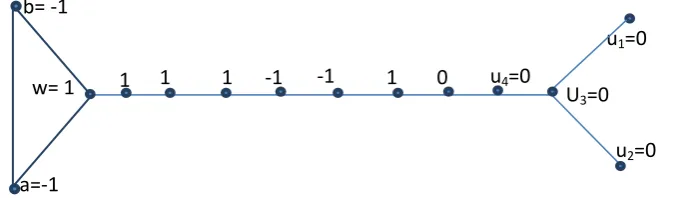
Proof: Legraph G= tail(C3,m,3). It has m+ 5 vertices and m+5 edges.For m=1,2 the figures below gives EP- labelingscheme.We give ordinary labeling to G as follows .The two pendent vertices be u1,u2 and the consecutive vertices on path Pm+1 be the 3-degree vertex be u3 then consecutively u4,u5,..um+2,and three vertices on cycle are um+3,um+4,um+5
Define f:V(G)→{0,1,-1} as
Case 1 p≡0( mod 3).Take p = 3x we must get vf(0,1,-1) = (x,x,x)=ef(0,1,-1) subcase x is even number f(ui)=0 for i = 1,2,..x.f(um+4)=f(um+5)=-1.f(ux+i)=1 for i ≡1(mod 3) and i ≤3y , ( 2y = x-2). f(ux+i)=-1 for i ≡2,0(mod 3) and i ≤3y.f(ux+i)=1 for 3y<i ≤(q-3-x-3y).This gives the desired result vf(0,1,-1) = (x,x,x)=ef(0,1,-1)
subcase x is oddnumber f(ui)=0 for i = 1,2,..x.f(um+4)=f(um+5)=-1f(ux+i)=-1 for i ≡1,0(mod 3) and i ≤3y+1.( 2y = x-3) f(ux+i)=1 for i ≡2(mod 3) and i ≤3y.f(ux+i)=1 for 3y+1<i ≤(q-3-x-3y).This gives the desired result vf(0,1,-1) = (x,x,x)=ef(0,1,-1) case 2
u
1=0
u
2=0
w= 1
b= -1
a=-1
U
3=0
Fig 3.1 :Tail(C
3,9,3):with EP cordial labeling.
v
f(0,1,-1) = (5,5,4)=e
f(0,1,-1)
u
4=0
0
1
-1
-1
1
1
gives the desired result vf(0,1,-1) = (x+1,x,x)=ef(0,1,-1) subcase x is odd number f(ui)=0 for i = 1, 2, .. x, x+1.f(um+4)=f(um+5)=-1.f(ux+2)=-1,f(ux+2+i)=1 for i ≡1(mod 3) and i ≤3y , ( 2y = x-3). f(ux+2+i)=-1 for i ≡2,0(mod 3) and i ≤3y.f(ux+2+i)=1 for 3y<i ≤(q-3-x-3y).This gives the desired result vf(0,1,-1) =
(x+1,x,x)=ef(0,1,-1) case 3 p≡2(mod 3)
subcase x is even numberf(ui)=0 for i = 1,2,..,x,x+1..f(um+4)=f(um+5 )=-1.f(ux+1+i)=1 for i ≡1(mod 3) and i ≤3y , ( 2y = x-2). f(ux+1+i)=-1 for i ≡2,0(mod 3) and i ≤3y.f(ux+i)=1 for 3y<i ≤(q-3-x-3y).This gives the desired result vf(0,1,-1) = (x+1,x+1,x)=ef(0,1,-1) subcase x is odd number
f(ui)=0 for i =
1,2,..x,x+1.f(um+4)=f(um+5)=-1.f(ux+2)=-1,f(ux+2+i)=1 for i ≡1(mod 3) and i ≤3y , ( 2y = x-3). f(ux+2+i)=-1 for i ≡2,0(mod 3) and i ≤3y.f(ux+2+i)=1 for 3y<i ≤(q-4-x-3y).This gives the desired result vf(0,1,-1) =
(x+1,x+1,x)=ef(0,1,-1)
Theorem 4.2: One point union of k- copies of C3 flag i.e.FL(C3)(k) is EP cordial.Proof.For k= 1,K=2 and k=3 we draw separate figures. By suitable combination on these
`
copies desired Labeled copy of FL(C3) (k) is obtained.In all the three structures above the vertex that will be common to all copies of FL(C3) is u and has label 1 under f :V(G) →{1,0}.The table below gives scheme of obtaining FL(C3) (k) for different values of k.
k structure to use v(0,1,-1) e(0,1,-1)
1 A V(1,2,1) e(2,1,1)
2 B v(2,3,2) e(3,3,2)
3 c v(3,4,3) e(4,4,4)
3x x times C v(3x,3x+1,3x) e(4x,4x,4x) 3x+1 x times C + A v(3x+1,3x+2,3x+1) e(4x+2,4x+1,4x+1) 3x+2 x times C + B v(3x+2,3x+3,3x+2) e(4x+3,4x+3,4x+2) v(a,b,c) indicates number vertices with label 0 are a in number ,with label 1 are b in number and that with label -1 are c in number.Similar
understanding for e(a,b,c) on edges. Fig.4.3
Theorem 4.3 One point union of k- copies of C4 flag i.e.FL(C4) (k) is EP cordial. Proof: For k= 1,K=2 and k=3 we draw separet figures. By suitable combination on these copies desired Labeled copy of FL(C4)
(k) is obtained.
f(v
3)=-1
f(u)=1
f(v
1)=1
f(v
2)=-1
f(c
2)=0
f(c
3)=0
f(c
1)=1
f(u)=1
0
0
0
1
-1
1
1
-1
-1
Structure B
f(u)=1
f(u
1)=1
f(u
2)=0
f(u
3)=-1
Fig.4.2 :Labeled Copies Of structures A,B and C
Type C
Structure A
Structure C
-1
0
0
1
1
1
-1
-1
tail (C
3,3,3)
0
0
1
1
1
-1
-1
tail(C
3,2,3)
-1
-1
11
1
-1
-1
10
-1
10
-1
1In all the three structures above the vertex that will be common to all copies of FL(C3) is u with f(u)=1 under f :V(G) →{1,0}.The table below gives scheme of obtaining FL(C4) (k) for different values of k.
k structure to use v(0,1,-1) e(0,1,-1)
1 A V(1,2,2) e(2,2,1)
2 B v(3,3,3) e(4,3,3)
3 C v(4,5,4) e(5,5,5)
3x x times C v(4x,4x+1,4x) e(5x,5x,5x) 3x+1 x times c + A v(4x+1,4x+2,4x+2) e(4x+2,4x+24x+1) 3x+2 x times C + B v(4x+3,4x+3,4x+3) e(4x+4,4x+3,4x+3) v(a,b,c) indicates number vertices with label 0 are a in number ,with label
1 are b in number and that with label -1 are c in number.Similar understanding for e(a,b,c) on edges.
Fig.4.4
Theorem 4.4 G=<K1:n:K1:n>is EP cordial.
Proof. Of the three verticesu,v and w on G , v and w are central vertices of K1,n.These two are joined to vertex vby a leaf each of K1,n.The vertices incident to u be given by u1,u2,..,un-1. And that incident to w be
w1,w2,w2,w3...,wn-1.Note that |V(G)| = 2n+1 and |E(G)| =2n .Define a function f:V(G)→{1,0} as
f(u)=f(v)=f(w)=1 case 1:2n-2 is of type 3x
f(ui) =0 for i = 1,..x+1,f(ui) = -1 for i= x+2,,,n-1 f(vi) = 1 for i = 1,2,..,x-2,f(vi) = -1 for i =x-1, x,x+1,..,n-1 This results in number distribution on vertices as vf (0,1,-1)=(x+1,x+1,x+1) and numbers on edges are ef(0,1,-1)=(x+1,x,x+1)
case 2 When 2n-2 is of the type 3x+1.
f(ui) =0 for i = 1,..x+1,f(ui) = -1 for i= x+2,,,n-1.
f(vi) = 1 for i = 1,2,..,x-1,f(vi) = -1 for i = x,x+1,..,n-1 This results in number distribution on vertices as vf (0,1,-1)=(x+1,x+2,x+1) and numbers on edges are ef(0,1,-1)=(x+1,x+2,x+1) case 3 When 2n-2 is of the type 3x+2.
f(ui) =0 for i = 1,..x+2,f(ui) = -1 for i= x+3,,,n-1, f(vi) = 1 for i = 1,2,..,x-1,f(vi) = -1 for i = x,x+1,..,n-1 This results in number distribution on vertices as vf(0,1,-1)=(x+2,x+2,x+1) and numbers on edges areef(0,1,-1)=(x+2,x+1,x+1) #
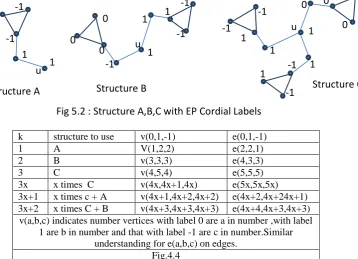
Theorem 4.5.Let G’ be the kite-(3,2).The one point union of k copies of G’i.e.G=(G’)(k) is EP cordial graph. Proof:G’ be a C3 attached with a 2-edge path at one vertex.We design three structures A,B and C.These are
f(u)= 1
1
-1
-1
0
Structure A
Structure B
Structure B
1
1
-1
-1
f(u)=1
-1
0
0
0
f(u)=1
-1
1
-1
1
-1
1
1
0
0
0
0
-1
Structure C
k structure to use v(0,1,-1) e(0,1,-1)
1 A V(1,2,2) e(2,2,1)
2 B v(3,3,3) e(4,3,3)
3 C v(4,5,4) e(5,5,5)
3x x times C v(4x,4x+1,4x) e(5x,5x,5x) 3x+1 x times c + A v(4x+1,4x+2,4x+2) e(4x+2,4x+24x+1) 3x+2 x times C + B v(4x+3,4x+3,4x+3) e(4x+4,4x+3,4x+3) v(a,b,c) indicates number vertices with label 0 are a in number ,with label
1 are b in number and that with label -1 are c in number.Similar understanding for e(a,b,c) on edges.
Fig.4.4
The tabel above eleborates how to obtain a EP-cordial copy of (G’)(k)where G’ is the kite-(3,2).
Theorem 4.6kite(3,m) is EP-cordial.
Proof: kite(3,m) has a cycle C3 attached at one point with a path of length m.It has m+3 vertices and m+3 edges. For m>2 Let the consecutive vertices on path from pendent vertex be v1,v2,..vm,vm+1.Note that vm+1 is degree 3 vertex common to C3 and pm+1.The two degree vertices on C3 are u and v respectively.
case 1 m = 3x.subcase x is even.Take x-2 =2y
f(u)=f(v)=-1 f(v1)=1,f(vi)=0 for i = 2,3,..,x+1,f(vx+i+2) = -1 for i ≡2,3(mod3) and i≤3y.f(vx+2+i) = 1 for i≡0 (mod 3) and i≤3y. The numbers on vertices and edges are vf(0,1,-1)=(x,x,x),ef(0,1,-1)=(x+1,x,x)
subcase 2 x is odd f(u)=f(v)=-1 f(v1)=1,f(vi)=0 for i = 2,3,..,x+1,f(vx+1+i)= -1 for i≡0,2(mod 3)and i≤3y,where 2y = x-1,f(vx+1+i)=1for ≡1(mod 3).and i≤3y,f(v1+x+i)=1for i = 3y+1,3y+2,..,m+1
The numbers on vertices and edges are vf(0,1,-1)=(x,x+1,x+1), ef(0,1,-1)=(x+1,x+1,x+1) case 2 m = 3x+1
f(u)=f(v)=-1 f(v1)=1 subcase x is even take x-2 = 2y.
f(v1+i)=0 for i = 1,2,..x.f(v1+x+i)=-1 for i≡0,2(mod 3)and i ≤3y f(vi+x+1) = 1for i≡1(mod 3)and i ≤ 3y.Further f(v1+x+i)=1 for i= 3y+1,3y+2,..,m+1. The numbers on vertices and edges are vf(0,1,-1)=(x,x+1,x), ef (0,1,-1)=(x+1,x+1,x) subcase x is odd.take 2y = x-1, f(u)=f(v)=-1 f(v1)=1,f(v1+i)=0 for i=1,2,3,..,x. f(vx+1+i) =-1 for i≡0,2(mod 3) and i≤3y. f(vi+x+1) =1 for i≤3y.f(vx+i)=1 for i = 3y+1,3y=2,...,m+1. The numbers on vertices and edges are vf(0,1,-1)=(x,x,x+1), ef(0,1,-1)=(x+1,x,x).Thus fis EP cordial function.
case 3 m = 2+3x.We give diagrams for x = 1,2..Define F : V(G)→{0,1} as follows. f(u)=f(v)=-1
f(v1)=1 Subcase1:x is even.take
𝑥 2 =y. f(vi)=0 for fori = 2,3,...,x f(vx+i+2)=-1 for i ≡o,1(mod3)and i<3yand f(vx+2+i)=-1for i = 3y+2,3y+3,3y+4
Structure C
1
-1 1
1
1
1
-1
-1
-1
0
u
1
Structure B
1
1
-1
-1
0
0
0
u
Structure A
-1
1
1
-1
0
u
Fig 5.2 : Structure A,B,C with EP Cordial Labels
-1
1
-1
0
1
Fig 1.2.v
f(0,1,-1)=(1,2,2),e
f(0,1,-
1)=(2,2,1)
Fig 1.3.v
f(0,1,-1)=(2,3,3),e
f(0,1,-
1)=(3,3,2)
0
1
f(vx+2+i) = 1 for i≡2(mod3) and i ≤3y+1.f(vi) = 1 for i>3y=4 and i≤m+1 vf(0,1,-1)=(x,x+1,x+1),
ef(0,1,-1)=(x+1,x+1,x) subcase 2:x is odd.Take x-1 =2y.
f(vi) = 0 for i = 2,3,..,x+1. f(vx+2+i)=-1 for i≡0,1(mod
3).and i ≤3y.f(vx+2+i)=1for i=3y+1,3y+2,..m+1.The numbers on vertices and edges are vf(0,1,-1)=(x,x+1,x+1), ef(0,1,-1)=(x+1,x,x+1)
References:
[1] Bapat M.V. Some vertex prime graphs and a new type of graph labelling Vol 47 part 1 yr2017 pg 23-29 IJMTT
[2] BapatMukundV. Ph.D.Thesis ,University of Mumbai 2004.
[3] Harary,GraphTheory,Narosa publishing ,New Delhi
[4] Jonh Clark, D. A. Holtan Graph theory by allied publisher and world scientist
[5] M. Sundaram, R. Ponraj and S. Somasundaram, EP-cordial labeling of graphs,
Varahmihir J. Math. Sci., 7 (2007) 183-194.
1
Mukund Bapat, At and Post Hindale.Tal: Devgad. Sindhudurg,