
On Measures For The Formation and Development of The
Business Environment in The Countries of The World
Aripov Oybek Abdullayevich
PhD in Economics, Senior Researcher at Namangan State University, Namangan, Republic of Uzbekistan
Introduction
While globalization is gaining momentum, much attention is paid to the development of small business and private entrepreneurship in various countries. Because doing business is becoming a profitable business in any country. In this regard, different conditions have been created in different countries for the development of small business and private entrepreneurship. At the same time, these conditions are called the “business environment” in the new term.
In different countries of the world, measures have been developed aimed at creating a business environment for small businesses. In particular, in developed countries, the ease of doing business is wider, and it is worth examining their experience. In particular, measures are being taken to further develop the business environment in Uzbekistan. Especially in the last two or three years, this has had an impact on the development of small business and private entrepreneurship and the improvement of the business environment through unprecedented approaches.
The business environment is the creation of favorable business conditions for entrepreneurs and manufacturers in each country. Economists in an English-speaking country are increasingly aware of the influence of external factors on the formation and development of the business environment.
However, a study of the economies of the countries of the world and an analysis of the levels of social development in them show that the business environment in different countries varies greatly. For example, the business environment is wider in conditions of macroeconomic stability, peace and an economy with an open economy. In these countries, freedom of small business is ensured. This freedom is explained as follows:
- Entrepreneurs are confident in their actions;
- There is great potential for inflow and attraction of investments;
- freely convertible currencies;
- economic relations are based on modernization and diversification;
- anti-corruption laws are strictly enforced; - antitrust laws work efficiently;
- wide possibilities of using innovations, etc.
In our opinion, well-being is ensured in countries with the most favorable business environment. Per capita income is quite high. In general, in countries with a favorable business environment,
business and entrepreneurship are developing more and more opportunities to open new areas of entrepreneurship.
Measures to improve the business environment in different countries of the world have played an important role not only in improving the business environment, but also in improving the well-being of the population. At first glance, these reforms may seem simple, but creating a favorable business environment and then being among the countries that benefit the most is not as simple as we say.
Therefore, it is important to recognize that in some countries the conditions for small business are not sufficiently developed. In these countries, it is hardly possible to save not only the convenience of doing business, but also the peaceful life of the population.
Today, there are countries in which the living conditions and prosperity of society are the most difficult, and indigenous peoples have no peace, that is, the country has been surrounded by civil war for many years. These countries include Afghanistan, Somalia, Congo, Sierra Leone, North Korea, Nigeria, Bangladesh, Burundi, Liberia and Zimbabwe. The economies of these countries are destroyed, and the socio-economic situation is in serious condition. These include constant wars, conflicts between populations, poverty, hunger, the spread of infectious diseases and widespread loss of life.
In our opinion, before taking serious measures to improve the business environment in these countries, serious reforms of the country’s socio-economic development should be launched. Without this, it is impossible to introduce a mechanism for developing a business environment or supporting entrepreneurs.
Uzbekistan is also making efforts to develop the business environment. As a result, during 2007-2019, i.e. 12 years, our country has risen from 146th to 76th place in the ranking of doing business of the World Bank and the International Finance Corporation. If we analyze the annual average rating of Uzbekistan, we see that in each year it grew by an average of 5.8 positions. We accept this positively. But today, our goal is to achieve a strong position in the top 20 by 2022. However, it is impossible to reach such a peak in a short period. At the same time, there are still bureaucratic barriers in our economy, such as obtaining building permits, property registration, and international trade.
Abstract
Today, almost all countries are paying close attention to the development of small business and private entrepreneurship. Each state is approaching its policy of state regulation and revitalization of this sector. Measures aimed at creating a business environment for small businesses in different countries of the world are developing. Especially in developed countries, the convenience of the business environment is more extensive, and it is desirable to study their experience. The article was widely used in the Doing Business polls in the process of globalization.
Keywords
Literature Review
Business environment is the creation of favorable business conditions for entrepreneurs and manufacturers in each country. Economists of the English-speaking country are increasingly aware of the influence of external factors on the formation and development of the business environment [7; 8; 9; 10; 13; 15; 16; 18]. Among them are those who recognize the role of the state. For example, a number of economists, such as J. Goodman, J. Meany, L.Pate (1992), B. Mokry (1988), E. Segura (1988), and P. Westhead (1990) are essential for the formation and development of an entrepreneurial environment. - Emphasize the role of the government or the state in creating conditions and opportunities [11; 14; 17; 19].
One of Russia’s Internet sites states that the business environment is “a combination of political, economic, social and technological factors (SIITs) that exist outside of control and business impacts, which can have a positive and negative impact on business”. According to the well-known economists VYGorfinkel, VA Shandar, EM Kupryakov, “there must be certain economic, social, legal and other conditions for the establishment of entrepreneurship ...” [4] and these conditions should encourage the development of entrepreneurship. provides.
At present, economic Uzbek-language economic resources do not contain definitions that characterize the concept of “business environment.” Nevertheless, A. Hadjimuratov, M. Mirsaidov, O. Abdullaev, and R. Ismoilov [3; 5; 6] the theories of economists such as theoretical study of small business and entrepreneurship, as well as the development, structure, scope, organization of entrepreneurship, financial support and creation of conditions. Indeed, in recent years, Uzbekistan has adopted a broad set of measures to further advance the path of deepening market reforms and liberalizing the economy, improving the business environment, promoting competition, and promoting the rapid development of small businesses and private entrepreneurship. In other words, it is a broad enforcement of government regulations to support entrepreneurs. With government regulation of small business and private entrepreneurship, it is necessary to take measures to expand the business environment.
Analysis ad Results
However, the study of the economies of the world countries and the analysis of the levels of social development in them show that the business environment varies widely in different countries. For example, the business environment is widespread in macroeconomic stability, peacekeeping and open economies. In these countries, the freedom of small businesses is ensured. This freedom is explained as follows:
- Entrepreneurs are confident in their actions;
- there is great potential for investment inflow and attraction;
- freely convertible currencies;
- economic relations are based on modernization and diversification;
- Anti-corruption laws are strictly followed; - Antimonopoly laws work effectively; - wide opportunities for innovation use, etc.
From the foregoing, we can say that in countries with a favorable business environment, the well-being of the population is very high. The per capita income is quite high. In general, countries with a favorable business environment are increasingly developing business and entrepreneurship, with more opportunities to open up new areas of entrepreneurship.
The World Bank’s Doing Business (WB) study shows that the countries listed in Table 1 have a very good business environment. Such countries have all the freedoms for the economic activities of small businesses. If there are any artificial barriers in the business, a mechanism to overcome them is easily introduced. As can be seen from this table, New Zealand is ranked No. 1 in the World Bank’s Doing Business Index over the past three years.
It should be noted that Singapore was ranked first in 190 countries in the World Bank’s ranking in 2007-2016. In the DB-2019 report rankings, Singapore ranked second in the DB-2006 report. Denmark, Hong Kong, Norway, USA, UK, 2006-2019 are among the top 10 countries with the most favorable business environment.
Table 1 : The top 10 countries in Doing Business ranked by the World Bank[22]
Countries Position in the rankings by years
2019 2018 2017 2016 2015 2014 2013 2012 201
1
2010 2009 2008 2007 2006
New Zealand 1 1 1 2 2 3 3 3 3 2 2 2 2 1
Singapore 2 2 2 1 1 1 1 1 1 1 1 1 1 2
Denmark 3 3 3 3 4 5 5 5 6 6 5 5 7 8
Hong Kong 4 5 4 5 3 2 2 2 2 3 4 4 5 7
Korea Resp 5 4 5 4 5 7 8 8 16 19 23 30 23 27
Georgia 6 9 16 24 15 8 9 16 12 11 15 18 37 100
Norway 7 8 6 9 6 9 6 6 8 10 10 11 9 5
USA 8 6 8 7 7 4 4 4 5 4 3 3 3 3
Great Britain 9 7 7 6 8 10 7 7 4 5 6 6 6 9
Macedonia 10 11 10 36 30 25 23 22 38 32 71 75 92 81
The most notable case in Table 1 is that Georgia ranked 100th in the former Soviet Union in the DB-2006 report. For the last 13 years, that is, in the report of DB-2019, Georgia ranked 6th in this rating.
The Doing Business report also saw similar jumps in business rankings in Macedonia (81st, 10th) and the Republic of Korea (27th and 5th).
In our opinion, the economies of those countries listed in Table 1 have undergone significant positive changes. In the former Soviet Union, unprecedented results of business reforms in Georgia are shown only in the table.
Kazakhstan has also used Georgia’s experience. In turn, Georgian experts provided consultations to Kazakhstan. Georgia has been instrumental in the development and implementation of strategies for effective business operations in Kazakhstan. As a result, with the help of the Nike Giluari team, Kazakhstan was ranked 35th in the Doing Business Index ranking [21].
By 2016, “Kazakhstan has become the country with the most reforms since the first edition of the World Bank Doing Business report. A year later, Kazakhstan was ranked 35th, and this time the World Bank recognized 18 reforms in 7 regions. Kazakhstan was also named the second largest reformer of the year and was ranked among the top three most reformed countries since 2004 (after Georgia and Macedonia).
In fact, Georgia has provided advice not only to Kazakhstan but to over 200 countries. For example, “… Estonia is introducing new principles of simplified taxation, and this time Nigeria is trying to make real progress in reform, based on Georgia’s experience. There have been attempts in this country before. ”[23]
Measures to improve the business environment in various countries
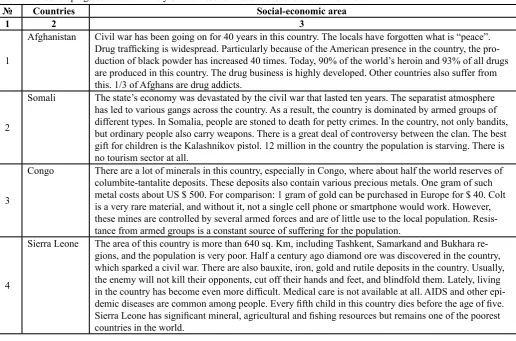
around the world have played an important role not only in the conduct of business, but also in the welfare of the population as a whole. At first glance, these reforms may seem simple, but creating a favorable business environment and then being among the countries that benefit most is not as simple as we say. Therefore, it is important to recognize that in some countries the conditions for small businesses are underdeveloped. In these countries, it is hardly possible to save not only the conveniences of doing business but also the peaceful life of the population. Today there are countries where living and living conditions are the most difficult and the indigenous people have no peace, that is, the country has been surrounded by civil war for many years. Such countries include Afghanistan, Somalia, Congo, Sierra Leone, North Korea, Nigeria, Bangladesh, Burundi, Liberia and Zimbabwe (see Table 2). The economies of these countries are in ruin, and the socio-economic environment is in a dire state. These include constant wars, conflicts between the population, poverty, famine, the spread of infectious diseases, and the widespread loss of life.
Thus, when we look at the description of the countries listed in Table 2, it is not hard to imagine that these countries have a completely negative socio-economic environment for small business and entrepreneurship. Before talking about the development of small business and entrepreneurship in these countries, one has to think about creating macroeconomic peace in the country. Giving priority to the economy over politics, preventing wars, poverty, famine, is becoming more relevant today. It is a dream for people living in such countries to eat well, have a hard time, have a rest, and live a comfortable life in general.
Table 2 : In developing countries with very difficult economies socio-economic environment № Countries Social-economic area
1 2 3
1
Afghanistan Civil war has been going on for 40 years in this country. The locals have forgotten what is “peace”. Drug trafficking is widespread. Particularly because of the American presence in the country, the pro-duction of black powder has increased 40 times. Today, 90% of the world’s heroin and 93% of all drugs are produced in this country. The drug business is highly developed. Other countries also suffer from this. 1/3 of Afghans are drug addicts.
2
Somali The state’s economy was devastated by the civil war that lasted ten years. The separatist atmosphere has led to various gangs across the country. As a result, the country is dominated by armed groups of different types. In Somalia, people are stoned to death for petty crimes. In the country, not only bandits, but ordinary people also carry weapons. There is a great deal of controversy between the clan. The best gift for children is the Kalashnikov pistol. 12 million in the country the population is starving. There is no tourism sector at all.
3
Congo There are a lot of minerals in this country, especially in Congo, where about half the world reserves of columbite-tantalite deposits. These deposits also contain various precious metals. One gram of such metal costs about US $ 500. For comparison: 1 gram of gold can be purchased in Europe for $ 40. Colt is a very rare material, and without it, not a single cell phone or smartphone would work. However, these mines are controlled by several armed forces and are of little use to the local population. Resis-tance from armed groups is a constant source of suffering for the population.
4
5 North Korea The People’s Democratic Republic of Korea is one of the most closed countries in the world. As a result, it is difficult to know which of the information concerning this country is true and which is false. If anyone commits a crime in that country, their parents and children will also be arrested.
6 Nigeria The police in this country do what they want. For example, a policeman may shoot someone if he does not like it (for no reason). This is how citizens live. It is natural that they shoot and kill each other. In a word, Nigeria has no money, but guns always exist.
7
Bangladesh The population of this state, which is almost equal to that of the Republic of Karakalpakstan and Jiz-zakh region, exceeds the population of Russia. One of the main problems in this country is unemploy-ment. Children under 10 are not registered in this country. This is because most children cannot live before the age of 10. Two major rivers (Brahmaputra and Ganges) that cross the country occasionally cause floods. Most of the country is only a few meters above sea level, and if the sea level rises by one meter, then 10% of the country is naturally flooded. Currently, Bangladesh is the weakest country in the world due to climate change.
8
Burundi When surveying which country’s citizens feel happier, Burundi is likely to be last. There is interethnic slaughter in the country from time to time. All universities in this country are closed and social net-works are banned. There are many soldiers and police on the streets. They behave badly. Police can put an innocent person in jail or kill him right here.
9
Liberia It has experienced civil war for the past 20 years. The unemployment rate is almost 100%. The local population is heavily subsidized by international organizations. City waste can not be disposed of for years. People in this country treat their children with cruelty. In Liberia, there is a custom of sacrifice. For example, local people sell babies for $ 50-100 worth of sacrifice to make them happy. People (more babies) who are trafficked are burned alive.
10
Zimbabwe The most disastrous situation in this country is that all of the qualities listed above apply to this coun-try. Moreover, the country has its own disadvantages. Unemployment is very high. The value of the national currency is very low (US $ 1 = 35,000,000,000,000,000) Another record is life expectancy. Almost the majority of Zimbabweans live under the age of 35. In the country, infectious diseases are widespread.
Source: The table is compiled by the author based on various political, economic, and social resources. Separate data source: Географический справочник ЦРУ. - Ekateringburg: U-Factor, 2005.
In our opinion, serious reforms on the socio-economic development of the country should be initiated before taking serious measures to improve the business environment in these countries. Without this, it is impossible to introduce a mechanism for developing a business environment or supporting entrepreneurs.
Uzbekistan is also making efforts to develop the business environment. As a result, during 2007-2019, ie 12 years, our country rose from 146th to 76th in the World Bank and International Finance Corporation’s business rating. If we analyze the average rating of Uzbekistan annually, we can see that it rose by 5.8 positions. It is a joy. But our goal today is to reach a solid position in the top 20 by 2022. However, it is impossible to reach the top. At the same time, there are still unhealthy bottlenecks in our economy, such as obtaining permits for construction, registration of property and international trade.
Table 3 : Procedures effective and effective from March 1, 2019 to improve the ease of doing business in Uzbekistan [24] Indicator name From March`1, 2019 organization Responsible
Orders activing from March`1, 2019
1 2 3
Simplification of state registration of business entities
The bank can open bank accounts remotely during state registration of entrepreneurs Ministry of Justice
Facilitate proce-dures for obtain-ing construction permits
- the order of intended use of land parcels is canceled when a complete list of banned or allowed objects on the parcel is presented and auctioned in “E-Performance Auc-tion”;
- functions of the architectural and town planning councils to coordinate the design and estimate documentation;
- Receipt of completed buildings and structures is issued simultaneously with the certificate of state registration of rights to real estate;
- economic sanctions for unauthorized withdrawal of consumers from electricity.
In our opinion, the overall performance of the Doing Business Group’s 10 indicators is 6-7, but the lower overall rating is likely to be worse if it falls below 3-4. That is why the government has announced effective and voided procedures since March 1, 2019 to facilitate business in the country [24]. These procedures are summarized in Table 3.
Conclusions and Suggestions
Thus, the following conclusions from the analysis of the business environment in the regions:
- First of all, the business environment varies widely in different countries;
- peace must be ensured in the country so that entrepreneurship becomes more active;
- In the war-torn countries, that is, in a war-torn country, the business environment is very poor and the business support system is in ruin.
- Effective functioning of the mechanism of market economy is necessary for business environment;
- The business environment in developed countries is well-established, but the measures aimed at expanding its accessibility are still regulated by the state;
- Great attention is being paid to improving the business environment in almost all MHD countries. In this regard, the best practices of the developed countries are being studied; In general, the Government of Uzbekistan is taking steps to regulate small business and private entrepreneurship. Continuous reforms in this area have had a positive impact on the socio-economic development of the country. In this regard, in order to strengthen the business environment and ensure its broad development in the country, we consider the following proposals:
- Strengthening Anti-Corruption Reforms and Enhancing Quality in Public Services;
- Reforming the tax system to facilitate business activities; - Wide application of situational approaches in organization of
vertical communication and relations in the administrative management system and monitoring of positive results;
- Involving qualified, experienced and experienced specialists in public service and streamlining business relationship management;
- Strengthening the legal protection of small businesses; - adaptation of social protection reforms to the modern
requirements.
Proposals based on these points will help to improve the business environment in the country. It is also important to pay close attention to the development of the business environment in Uzbekistan, primarily by expanding the market infrastructure.
References
Statement of the President of the Republic of Uzbekistan [1].
Shavkat Mirziyoev to the Oliy Majlis // People’s word. December 29, 2019.
Decree of the President of the Republic of Uzbekistan On [2].
measures to further radically improve the business environment and to provide greater freedom of entrepreneurship. No. PF-4455. July 18th. 2012.
Abdullaev O., Ismoilov R. Small and Medium Business
[3].
Management. - Namangan: NaMPI, 2001. - 115 p.
Entrepreneurship course: Textbook for universities. / V.Ya. [4].
Gorfinkel, V.A. Shvandar, E.M. Kupryakov and others; –M
.: Finance, UNITI, 1997. S. 15.
Mirsaidov MS Basics of business. –T .: Uzbekistan, 2002.
[5].
- 272 b.
Khadzhimuratov A.A. Entrepreneurship: Essence and [6].
core components. –SPb .: Ed. St. Petersburg University of Economics and Finance. 1995.S. 73.
Dana L.P. (1987). Entrepreneurship and venture creation-An [7].
international comparison of five commonwealth nations.
In N. C. Churchill, J. A. Hornaday, B. A. Kirchhoff, O.J. Krasner, & K. H. Vesper (Eds.), Frontiers of entrepreneurship
research, pp. 573-583.
Wellesley, MA: Babson College.: Dana, L. P. (1990). Saint [8].
Martin/Sint Maarten: A case study of the effects of culture oneconomic development. Journal of Small Business Management, 28 (4), 91-98.
Eliminating factors that impede prop-erty registration
- the application for the state registration of real property rights and the cadastral −
registration can be submitted on the basis of the principle of extraterritoriality; - Notary offices shall submit the application for state registration of real estate −
and the relevant documents to the body carrying out state registration on a free basis through the information and communication systems;
- An electronic filing and preparation mechanism for preparing cadastral docu-−
ments will be introduced;
Ergeodezka Committee
Protecting minority
shareholders - Shareholders are entitled to prosecute a member of the Supervisory Board in judicial proceedings for damage caused to the Company as a result of major transactions and affiliates with 10% or more of the Company’s net assets;
Capital Mar-ket Develop-ment Agency Enforcement of
contracts - the mechanism of payment of dividends on shares through the Central Securities Depository or investment intermediaries will be introduced; Supreme Court
Order canceled March 1, 2019 Facilitate
proce-dures for obtain-ing construction permits
- to require stamping of entrepreneurs’ documents by state authorities and other −
organizations;
- obtaining permits for construction and installation works by introducing a noti-−
fication mechanism;
- Procedures for concluding contracts for the control over the observance of town −
planning legislation by the territorial inspections of the construction industry.
Doutriaux J.A. (1988). Government procurement and [9].
research contracts at start-up and success of Canadian
high-tech entrepreneurial firms. In B.A.Kirchhoff, W.A.Long,
W.E. McMullan, K.H. Vesper, W.E. Wetzel (Eds.), Frontiers of entrepreneurship research, pp. 582-594. Wellesley, MA: Babson College.
Davidsson P. (1991). Continued entrepreneurship. Ability, [10].
need, and opportunity as determinants of small firm growth. Journal of Business Venturing, 6, pp. 405-429.
Devi R. Gnyawali, & Daniel S. Fogel. (1994) Environmentsfor [11].
Entrepreneurship Development: Key Dimensionsand ResearchImplications. / Journal of Entrepreneurship theory and practice. p. 44. (gen.art. pp. 43-62).
Goodman J.P., Meany J.W., & Pate L.E. (1992). The [12].
government as entrepreneur. Industrial development and the creation of new ventures. In D.L. Sexton & J.D. Kasarda (Eds.), The state of the art on entrepreneurship. Boston. PWS-Kent.
Gilauri N. Practical Economics: Economic Transformation
[13].
and Government Reform in Georgia 2004–2012. Page 94. // DOI 10.1007/978-3-319-45769-7
Hawkins D.L. (1993). New business entrepreneurship in
[14].
the Japanese economy. Journal of Business Venturing, 8,
pp. 137-150.
Mokry B.W. (1988).
[15]. Entrepreneurship and public policy. Can government stimulate start ups? New York. Quorum Books.
Pennings J.M. (1982). Organizational birth frequencies an [16].
empirical investigation. Administrative Science Quarterly, 27, pp. 120-144.
Swanson D., & Webster L. (1992).
[17]. Private sector
manufacturing in the Czech and Slovak Republic: A survey of firms. Washington, DC: The World Bank
Segura E. (1988). Industrial, trade and financial sector
[18].
policies to foster private enterprises in developing countries.
Columbia Journal of World Business, 23(1), 19-27. Takyi-Asiedu S. (1993). Some socio-cultural factors
[19].
retarding entrepreneurial activity in sub-Saharan Africa.
Journal of Business Venturing, 8, pp.91-98.
Westhead P. (1990). A typology of new manufacturing [20].
firms in Wales Performance measures and public policy implications. Journal of Business Venturing, 5, 103-122.
[21]. http://www.cecsi.ru/coach/business_environment. html
[22]. https://www.worldbank.org/content/dam/doingBusiness/ media/Annual-Reports/English/DB2019-report_ web-version.pdf
https://ru.wikipedia.org/wiki/ Business Introduction
[23].
Report.
[24]. https://minbar.uz/post.
![Table 1 : The top 10 countries in Doing Business ranked by the World Bank [22]](https://thumb-us.123doks.com/thumbv2/123dok_us/9743669.1958684/2.595.36.557.540.779/table-countries-doing-business-ranked-world-bank.webp)
![Table 3 : Procedures effective and effective from March 1, 2019 to improve the ease of doing business in Uzbekistan [24]](https://thumb-us.123doks.com/thumbv2/123dok_us/9743669.1958684/4.595.39.563.533.751/table-procedures-effective-effective-march-improve-business-uzbekistan.webp)
