The Thirty-Third AAAI Conference on Artificial Intelligence (AAAI-19)
Abstractive Text Summarization by Incorporating Reader Comments
Shen Gao,
1Xiuying Chen,
1Piji Li,
3Zhaochun Ren,
4Lidong Bing,
5Dongyan Zhao,
1,2Rui Yan
∗1,21Institute of Computer Science and Technology, Peking University, Beijing, China 2Center for Data Science, Peking University, Beijing, China
3Tencent AI Lab, Shenzhen, China 4JD.com, Beijing, China
5R&D Center Singapore, Machine Intelligence Technology, Alibaba DAMO Academy
{shengao, xy-chen, zhaody, ruiyan}@pku.edu.cn, [email protected], [email protected], [email protected]
Abstract
In neural abstractive summarization field, conventional sequence-to-sequence based models often suffer from sum-marizing the wrong aspect of the document with respect to the main aspect. To tackle this problem, we propose the task of reader-aware abstractive summary generation, which uti-lizes the reader comments to help the model produce better summary about the main aspect. Unlike traditional abstractive summarization task, reader-aware summarization confronts two main challenges: (1) Comments are informal and noisy; (2) jointly modeling the news document and the reader com-ments is challenging. To tackle the above challenges, we de-sign an adversarial learning model named reader-aware sum-mary generator (RASG), which consists of four components: (1) a sequence-to-sequence based summary generator; (2) a reader attention module capturing the reader focused aspects; (3) a supervisor modeling the semantic gap between the gen-erated summary and reader focused aspects; (4) a goal tracker producing the goal for each generation step. The supervisor and the goal tacker are used to guide the training of our frame-work in an adversarial manner. Extensive experiments are conducted on our large-scale real-world text summarization dataset, and the results show that RASG achieves the state-of-the-art performance in terms of both automatic metrics and human evaluations. The experimental results also demon-strate the effectiveness of each module in our framework. We release our large-scale dataset for further research1.
Introduction
Abstractive summarization can be regarded as a sequence mapping task that the source text is mapped to the target summary, and has drawn much attention since the deep neu-ral networks are widely applied in natuneu-ral language process-ing field. Recently, sequence-to-sequence (seq2seq) frame-work (Sutskever, Vinyals, and Le 2014) has been proved ef-fective for the task of abstractive summarization (Chopra, Auli, and Rush 2016; See, Liu, and Manning 2017) and other text generation tasks (Tao et al. 2018; Gao et al. 2019). In this paper, we use “aspect” to denote the topic described in a specific paragraph or a sentence of a news document, and use “main aspect” to denote the central
∗Corresponding author: Rui Yan ([email protected])
Copyright c2019, Association for the Advancement of Artificial Intelligence (www.aaai.org). All rights reserved.
1http://t.cn/EAH5JxS
Table 1: Examples of the text summarization. The text in italic style denotes the focused aspect by the good summary, while the text in bold is described by the bad summary. The text with underline is the focused aspect by reader com-ments.
document On August 28, according to a person familiar with the matter, Toyota Motor Corporation will invest 500 million U.S. dol-lars into the Uber, a taxi service company, with a valuation of up to 72 billion U.S. dollars.The investment will focus on driverless car technology. However, its development path is not smooth. In March of this year,a Uber driverless car hit a woman and caused her death.In last year, Softbank also invested into Uber with a valuation of $48 billion.
comments Toyota’s investment in Uber is a wise choice.$500 million investment is really a lot of money!
goodsummary Toyota invests $500 million into Uber with a valuation of $72 billion
badsummary An Uber driverless car hits a passerby to death
topic which the author tends to convey to the readers. Al-though a document may describe an event in many differ-ent aspects, the summary of this documdiffer-ent should always focus on the main aspect. As shown in Table 1, the good summary describes the main aspect and the bad summary describes another trivial aspect that is not the main point of the document. To focus on the main aspect, some sum-marization methods (Sun et al. 2018; Zhou et al. 2017; Bansal and Chen 2018) first select several sentences about the main aspect and then generate the summary. However, it is very challenging to discover which is the main aspect of the news document.
abstractive text summarization. We name such paradigm of extension asreader-aware abstractive text summarization.
The effect of comments or social contexts in docu-ment summarization have been explored by several pre-vious works (Hu, Sun, and Lim 2008; Yang et al. 2011; Li et al. 2015; Li, Bing, and Lam 2017). Unlike these approaches that directly extract sentences from the origi-nal document (Hu, Sun, and Lim 2008; Yang et al. 2011; Li et al. 2015), we aim to generate a natural-sounding sum-mary from scratch instead of extracting words from the doc-ument.
Generally, existing text summarization approaches con-front two challenges when addressing reader-aware summa-rization task. The first challenge is that reader comments are very noisy and informative. Not all the information provided by the comments is useful when modeling the reader focused aspects. Therefore, it is crucial to make the model own the ability of capturing main aspect and filtering noisy infor-mation when incorporating reader comments. The second challenge is how to generate summaries by jointly modeling the main aspect of document and the reader focused aspect revealed by comments. Meanwhile, the model should not be sensitive to the diverse unimportant aspects introduced by some reader comments. Thus, simply absorbing all the reader aspect information to directly guide the model to gen-erate summary is not feasible, as it will make the generator lose the ability of modeling the main aspect.
In this paper, we propose a summarization framework named reader-aware summary generator(RASG) that
in-corporates reader comments to improve the summarization performance. Specifically, a seq2seq architecture with atten-tion mechanism is employed as the basic summary gener-ator. We first calculate alignment between the reader com-ments words and document words, and this alignment in-formation is regarded as reader attention representing the “reader focused aspect”. Then, we treat the decoder atten-tion weights as the focused aspect of the generated summary,
a.k.a.,“decoder focused aspect”. After each decoding step,
a supervisor is designed to measure the distance between the reader focused aspect and the decoder focused aspect. Given this distance, a goal tracker provides the goal to the decoder to induce it to reduce this distance. The training of our framework RASG is conducted in an adversarial way. To evaluate the performance of our model, we collect a large amount of document-summary pairs associated with several reader comments from social media website. Extensive ex-periments conducted on this dataset show that RASG signif-icantly outperforms the state-of-the-art baselines in terms of ROUGE metrics and human evaluations.
To sum up, our contributions can be summarized as fol-lows:
•We propose a reader-aware abstractive text summariza-tion task. To solve this task, we propose an end-to-end learn-ing framework to conduct the reader attention modellearn-ing and reader-aware summary generation.
•We design a supervisor as well as a goal tracker to guide the generator to focus on the main aspect of the document.
• To reduce the noisy information introduced by the reader comments, we propose a denoising module to identify
which comments are helpful for summary generation auto-matically.
•We release a large scale abstractive text summarization dataset associated with reader comments. Experimental re-sults on this dataset demonstrate the effectiveness of our pro-posed framework.
Related Work
Text summarization can be classified into extractive and ab-stractive methods. Extractive methods (Jadhav and Rajan 2018; Narayan, Cohen, and Lapata 2018) read the article and get the representations of the sentences and article to se-lect sentences. However, summaries generated by extractive methods always suffer from redundancy problem. Recently, with the emergence of neural network models for text gen-eration, a vast majority of the literature on summarization is dedicated to abstractive summarization (Bansal and Chen 2018; Ma et al. 2018b; Zhou et al. 2018). On the text sum-marization benchmark dataset CNN/DailyMail, the state-of-the-art abstractive methods outperform the best extractive method in terms of ROUGE score. Most methods for ab-stractive text summarization are based on the sequence-to-sequence model (Sutskever, Vinyals, and Le 2014), which encodes the source texts into the semantic representation with an encoder, and generates the summaries from the rep-resentation with a decoder. To tackle the out-of-vocabulary problem, some researchers employ the copy mechanism to copy some words from the input document to summary (Gu et al. 2016; See, Liu, and Manning 2017). To capture the main aspect of document, Chenet al.(2018) propose to
se-lect salient sentences and then rewrite these sentences to a concise summary. This approach achieves the state-of-the-art of text summarization on CNN/DailyMail benchmark dataset. Unlike document summarization that needs to en-code a long text, social media summarization usually reads short and noisy text and has become a popular task these days. After Huet al.(2015) propose a short text
summariza-tion dataset on social media and many researchers follow this task. Linet al.(2018) propose a seq2seq based model
which uses an CNN to refine the representation of source context. Wanget al.(2018) use convolutional seq2seq model
to summarize text and use the policy gradient algorithm to directly optimize the ROUGE score. However, these sum-marization models do not utilize the reader’s comments in generating summaries.
To consider the reader’s comments into text summariza-tion, the reader-aware summarization is proposed and it mainly takes the form of extractive approaches. Graph-based method has been used for comment oriented summariza-tion task such as (Hu, Sun, and Lim 2007; 2008), where they identify three relations (topic, quotation, and men-tion) by which comments can be linked to one another. Recently, Nguyen et al. (2016) publish a small extractive
sentence-comment dataset which can not be used to train neural models due to its small size. Li et al. (2015)
latent semantic of original article and reader comments. Dif-ferent from our abstractive summarization task, these related works are all based on extractive or compressive approaches.
Problem Formulation
Before presenting our approach for the reader-aware sum-marization, we first introduce our notations and key con-cepts.
To begin with, for a documentXd ={xd
1, xd2, . . . , xdTd},
we assume there is a comment setXc ={c1, c2, . . . , cTc}
whereci = {xci,1, xci,2, . . . , xci,Tc
i} is thei-th comment,x d i
denotes the i-th word in document Xd, and xc
i,j denotes
thej-th word ini-th comment sentenceci. Given the
doc-umentXd, the summary generator reads the commentsXc,
then generates a summaryYˆ ={yˆ1,yˆ2, . . . ,yˆ
TYˆ}. Finally,
we use the difference between generated summary Yˆ and
ground truth summaryY as the training signal to optimize
the model parameters.
The Proposed RASG Model
Overview
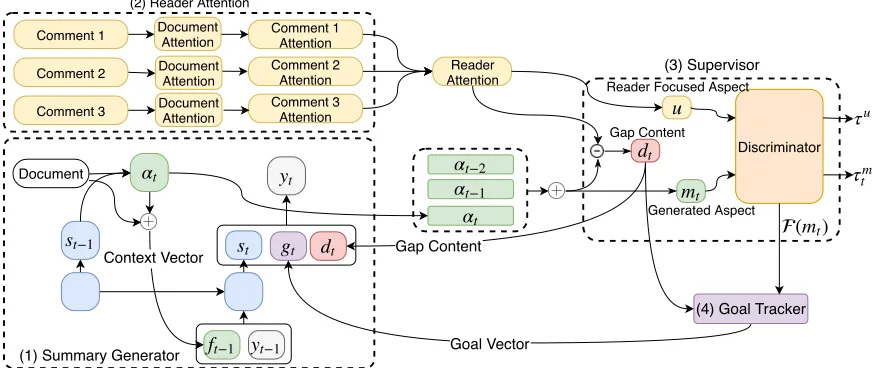
In this section, we propose ourreader-aware summary gen-erator, abbreviated as RASG. The overview of RASG is
shown in Figure 1 which can be split into four main parts: •Summary generatoris a seq2seq based architecture with
attention and copy mechanisms.
• Reader attentionmodule learns a semantic alignment
between each word in document and comments, thus cap-tures the reader focused aspect.
•Supervisormeasures the semantic gap between decoder
focused aspect and reader focused aspect. There is also a dis-criminator which uses convolutional neural network to ex-tract features and then distinguishes how similar is decoder focused aspect to reader focused aspect.
•Goal trackerutilizes the semantic gap learned by
super-visor and the features extracted learned by the discrimina-tor to set a goal, which is further utilized as a more specific guidance for summary generator to produce better summary.
Summary generator
At the beginning, we use an embedding matrixeto map
one-hot representation of each word in the document Xd and
comments Xc to a high-dimensional vector space. We
de-notee(x)as the embedding representation of wordx. From
these embedding representations, we employ a bi-directional recurrent neural network (Bi-RNN) to model the temporal interactions between words:
hdt =Bi-RNNd(e(xdt), h d
t−1), (1)
wherehdt denotes the hidden state oft-th step in Bi-RNN
for documentXd. We denote the final hidden statehd Td of
Bi-RNNdas the vector representation of the documentXd.
Following (See, Liu, and Manning 2017; Ma et al. 2018a), we choose the long short-term memory (LSTM) as the Bi-RNN cell.
Then we apply a linear transform layer on the input doc-ument vector representationhdTdand use the output of this
layer as the initial state of decoder LSTM, shown in Equa-tion 2. In order to reduce the burden of compressing docu-ment information into initial states0, we use the attention
mechanism (Bahdanau, Cho, and Bengio 2015) to summa-rize the input document into context vector ft−1
dynami-cally and we will show the detail of these in the following sections. We then concatenate the context vectorft−1with
the embedding of previous step outpute(yt−1)and feed this
into decoder LSTM, shown in Equation 3. We use the notion
[·;·]as the concatenation of two vectors.
s0=WdhdTd+bd, (2)
st=LSTM(st−1,[ft−1;e(yt−1)]). (3)
Att-th decoding step, we use the decoder statest−1to attend
to each the document stateshdand resulting in the attention
distributionαt ∈ RT d
, shown in Equation 5. Then we use the attention distributionαtto weighted sum the document
states as the context vectorft−1.
α0t,i=Wa|tanh Wsst+Whhdi
, (4)
αt,i= expα0t,i/PTj=1d expα0t,j, (5)
ft−1=PT
d
i=1αt,ih
d
i. (6)
Finally, an output projection layer is applied to get the fi-nal generating distributionPv over vocabulary, as shown in
Equation 7. We concatenate goal vectorgt, gap contentdt,
and the output of decoder LSTMstas the input of the
out-put projection layer. The goal vectorgtrepresents the goal
of current generation step, the gap contentdtdenotes the
se-mantic gap between generated summary and reader focused document and we will show the details of these variables in the following sections.
Pv=softmax(Wv[st;gt;dt] +bv), (7)
In order to handle the out-of-vocabulary (OOV) problem, we equip the pointer network (Gu et al. 2016; Vinyals, Fortu-nato, and Jaitly 2015; See, Liu, and Manning 2017) with our decoder, which makes our decoder capable to copy words from the source text. The design of the pointer network is the same as the model used in (See, Liu, and Manning 2017), thus we omit this procedure in our paper due to the limited space. We use the negative log-likelihood as the loss func-tion:
Lg=−PT ˆ Y
t=1logPv(yt). (8)
Denoising module
Due to the fact that reader comments are a kind of infor-mal text, they may consist of many noisy information, and not all the comments are helpful for generating better sum-maries. Consequently, we employ a denoising moduleto distinguish which comments are helpful. First, we employ an Bi-RNNcto model the comment word embeddings:
hci,t=Bi-RNNc(hci,t−1, e(x
c
i,t)), (9)
wherehc
i,tdenotes the hidden state oft-th word ini-th
(2) Reader Attention
(3) Supervisor Comment 1
Comment 2
Comment 3
Document
Comment 1 Attention Comment 2
Attention Comment 3
Attention
Reader Attention
Gap Content
Discriminator
Goal Vector
(4) Goal Tracker Reader Focused Aspect
Generated Aspect Gap Content
Document Attention
Document Attention Document
Attention
Context Vector
(1) Summary Generator
Figure 1: Overview of RASG. We divide our model into four parts: (1)Summary generatorgenerates a summary to describe
the main aspect of document. (2)Reader attentionmodule models the readers attention of document. (3)Supervisormodels the
gap of focused document aspect between generated summary and reader comments. (4)Goal trackersets a goal of summary
generator according to gap given by supervisor.
hidden states to produce a vector representation ai of i-th
comment, shown in Equation 10. Finally, we apply a lin-ear transform with sigmoid function to predict whether the comment is useful, and the sigmoid outputβiˆ ∈(0,1)also
can be seen as a salience score ofi-th comment given the
document representationhd Td.
ai=avg({hci,1, hci,2, . . . , hci,Tc
i}), (10)
ˆ
βi=sigmoid(Ws[ai;hdTd] +bi), (11)
To train the denoising module, we use the cross entropy loss to supervise this procedure.
Ld=− PTc
t=1βˆilog(βi). (12)
whereβi ∈ {0,1}is the ground truth salience score of com-ments. βi = 1denotes the i-th commentci is helpful for
generating summary and vice-versa.
Reader attention modeling
To model the reader focused aspect, we first calculate the word alignment of reader comments towards the document. We use the embeddings of words in document and com-ments to calculate the semantic alignment score. Precisely,
γi,j,kis the alignment socre between thei-th document word xd
i and thek-th word in thej-th commentxcj,k, as shown in
Equation 13:
γi,j,k=e(xdi)>e(x c
j,k), (13)
δi,j= max({γi,j,1, . . . , γi,j,Tc
j}), (14)
In Equation 14, we use a max-operation over the alignment
γi,j,·to signify whether thei-th word of document is focused
by thej-th comment. We regard the alignment scoreδi,jas
the reader attention weight for thej-th reader comment to
thei-th document word.
In order to reduce the interference caused by the noisy comments, we employ the comment salience scoreβjˆ
ob-tained from the denoising module to weighted combine the
j-th reader attentionδi,j, as shown in Equation 15. It means
that noisy comments will contribute less in the procedure of reader attention modeling.
0i =PTj=1c δi,jβˆj, (15)
i = exp0i/PTj=1d exp0j. (16)
Finally, we get the reader attentioni∈Rfori-th document
word after a softmax function as shown in Equation 16.
Supervisor
To model the semantic gap between the generated summary and the reader focused aspects, we design a supervisor mod-ule. First, for the decoder, we need to know which aspect in document has been focused by our summary generator in the past decoding steps. We sum up the latestkattention
distri-butions{αt, αt−1, . . . , αt−k+1}and result inνt ∈ RT d
as the focus distribution of generated summary overTd
doc-ument words, shown in Equation 17. Then we use νt to
weighted sum the document hidden stateshd
· and result in mt:
νt= 1/kPk−i=01αt−i, (17)
mt=PTi=1d νt,ihd
i, (18)
wheremtrepresents the focused aspect by the latestk
de-coding steps,a.k.a.,decoder focused aspect.
Next, we use the reader attention·to weighted sum the
document hidden stateshd·:
whereurepresents the reader focused aspect.
For encouraging the decoder focused aspect become sim-ilar to the reader focused aspect, we employ an CNN based discriminator to signify the difference between the decoder focused aspectmt and the reader focused aspect u. Then
we can use this difference to guide the decoder focus on the reader focused aspect. Typically, the discriminator is a binary classifier which can be decomposed into a convolu-tional feature extractorF shown in Equation 20 and a sig-moid classification layer shown in Equation 21 and 22.
F(x) =relu(Wc⊗x), (20) τtm=sigmoid(WfF(mt) +bf), (21) τu=sigmoid(WfF(u) +bf), (22)
where⊗denotes the convolutional operation, trainable pa-rameterWc denotes the convolutional kernel, andτtm and τuare both the classification probabilities.
Note that a token generated at timet will influence not
only the gradient received at that time but also the gradient at subsequent time steps. Intuitively, the decoding attentionνt
of latter decoding step is more similar to the attention of final summary than the earlier steps. Thus we propose to define the cumulative loss with a discount factorϕ∈ (0,1]as the
loss functions. Note that the training objective for discrim-inator can be interpreted as maximizing the log-likelihood for classification, whether the inputxin Equation 20 comes
from reader focused aspect or from decoder focused aspect. Ld
c = PTd
t=1ϕ
Td−t(logτu+ log(1−τm
t )), (23)
Lgc = PTd
t=1ϕ
Td−t
(log(1−τm
t )). (24)
In order to model the gap between reader focused aspect and decoder focused aspect, we subtract the reader atten-tion∈RT
d
byνt∈RT d
resulting in attention difference
ζt∈RT d
, shown in Equation 25. Then we use the attention differenceζtto sum up the document hidden stateshd·:
ζt=−νt, dt= PTd
i=1ζt,ihdi. (25)
wheredt denotes the semantic of unfocused document
as-pects by summary generator,a.k.a.,gap content. To
encour-age the summary generator focus on the unfocused docu-ment aspects, we feed the gap contentdtto the generator, as
shown in Equation 7.
Goal tracker
Since the discriminator only provides a scalar guiding sig-nalτtmat each decoding step, it becomes relatively less
in-formative when the sentence lengthTYˆgoes larger. Inspired
by LeakGAN (Guo et al. 2018), the proposed RASG frame-work allows discriminator to provide additional information, denoted as goal vectorgt. In view of there is certain
relation-ship between the goal of current decoding step and previous steps, we need to model the temporal interactions between the goal of each step. More specifically, we introduce agoal trackermodule, an LSTM that takes the extracted feature vectorF(mt)and gap contentdtas its input at each stept
and outputs a goal vectorgt:
gt=LSTM(gt−1,[F(mt);dt]). (26)
In order to achieve higher consistency of reader focused as-pect, we feed the goal vectorgtinto the generator to guide
the generation of the next word, as shown in Equation 7.
Model training
As our model is trained in an adversarial manner, we re-split the parameters in our model into two parts: (1) genera-tion moduleincluding the parameters of summary generator,
reader attention module and goal tracker; (2)discriminator moduleincluding the parameters of CNN classifier. As for
training generation module, we sum up the loss function of denoising module Ld, cross entropy between ground truth
Lg and the result of discriminatorLgc, as shown in
Equa-tion 27. We use theLto optimize the parameters of genera-tion module.
L=Lg+Ld+Lgc, (27)
Next, we train the discriminator module to maximize the probability of assigning the correct label to both generated aspectmtand reader focused aspectu. More specifically, we
optimize the parameters of discriminator module according to the loss functionLd
c calculated in Equation 23.
Experimental Setup
Research questions
We list four research questions that guide the experiments:
RQ1: Does RASG outperform other baselines?RQ2: What is the effect of each module in RASG?RQ3: Does RASG capture useful information from noisy comments? RQ4: Can goal tracker give a helpful guidance to decoder?
Dataset
We collect the document-summary-comments pair data from Weibo which is the largest social network website in China, and users can read a document and post a com-ment about the docucom-ment on this website. Each sample of data contains a document, a summary and several reader comments. Most comments are about the readers’ opinion of their focused aspect in the document. In order to train the denoising module, we should give a ground truth label
βi for i-th comment. When there is at least one common
word in summary and comment, we regard such comment is helpful for generating summary. Accordingly, we give the
βi = 1toi-th comment when it contains at least one
com-mon word and giveβi = 0when it does not. In total, our
training dataset contains 863826 training samples. The av-erage length of document is 67.08 words, avav-erage length of comment is 16.61 words and average length of summary is 16.56 words. The average comments number of a document is 9.11.
Evaluation metrics
Table 2: Ablation models for comparison.
Acronym Gloss
RASG w/o DM RASG w/oDenoisingModule RASG w/o G RASG w/oGap content RASG w/o GT RASG w/oGoalTracker
RASG w/o GTD RASG w/oGoalTrackerDiscriminator
Table 3: ROUGE scores comparison between baselines.
ROUGE-1 ROUGE-2 ROUGE-L
S2S 23.86 9.86 23.83
S2SR 24.70 10.00 24.50
CGU 27.32 11.36 25.49
RASG 30.33 12.39 27.16
LEAD1 5.51 1.71 4.94
TextRank 13.5 4.55 11.46
Comparison methods
In order to prove the effectiveness of each module in RASG, we conduct some ablation models introduced in Table 2.
To evaluate the performance of our proposed dataset and model, we compare it with the following baselines:
(1) S2S: Sequence-to-sequence framework (Sutskever, Vinyals, and Le 2014) has been proposed for language generation task. (2) S2SR: We simply add the reader at-tention · on attention distribution αt,· in each decoding
step. (3) CGU: Lin et al. (2018) propose to use the
con-volutional gated unit to refine the source representation, which achieves the state-of-the-art performance on social media text summarization dataset. (4) LEAD1: LEAD1 is a commonly used baseline (Nallapati, Zhai, and Zhou 2017; See, Liu, and Manning 2017), which selects the first sen-tence of document as the summary. (5)TextRank: Mihal-ceaet al.(2004) propose to build a graph, then add each
sen-tence as a vertex and use link to represent semantic similar-ity. Sentences are sorted based on final scores and a greedy algorithm is employed to select summary sentences.
Implementation details
We implement our experiments in TensorFlow (Abadi et al. 2016) on an NVIDIA P40 GPU. The word embedding di-mension is set to 256 and the number of hidden units is 512. We set thek = 5in the Equation 17 andϕ= 0.5in
Equa-tion 23 and 24. We use Adagrad optimizer (Duchi, Hazan, and Singer 2010) as our optimizing algorithm. We employ beam search with beam size 5 to generate more fluency sum-mary sentence.
Experimental Results
Overall performance
For research question RQ1, we examine the performance of our model in terms of ROUGE. Table 3 lists perfor-mances of all comparisons in terms of ROUGE score. We see that RASG achieves a 11.0%, 9.1% and 6.6% increment over the state-of-the-art method CGU in terms of ROUGE-1,
Table 4: ROUGE scores of different ablation models.
ROUGE-1 ROUGE-2 ROUGE-L RASG w/o DM 27.29 11.01 24.64 RASG w/o G 28.03 11.24 25.28 RASG w/o GT 22.75 9.17 20.80 RASG w/o GTD 19.30 6.95 17.70 RASG 30.33 12.39 27.16
ROUGE-2 and ROUGE-L respectively. It is worth noticing that the baseline model S2SR achieves better performance than S2S which demonstrates the effectiveness of incorpo-rating reader focused aspect in summary generation. How-ever when compared with RASG, S2SR achieves lower per-formance in terms of all ROUGE score. Thus, simply adding the reader focused aspect into generation procedure is not a good reader-aware summarization method.
Ablation study
Next, we turn to research question RQ2. We conduct ab-lation tests on the usage of denoising module, supervisor as well as the goal tracker and the ROUGE score result is shown in Table 4. The discriminator provides the scalar training signalLg
cfor generator training and the feature
vec-tor F(mt) for goal tracker. Consequently, there is an
in-crement of 17.51% from RASG w/o GTD to RASG w/o GT in terms of ROUGE-L, which demonstrates the effec-tiveness of discriminator. As for the effeceffec-tiveness of goal tracker, compared with RASG and RASG w/o GT, RASG w/o GTD offers a decrease of 45.23% and 17.88% in terms of ROUGE-1, respectively. This demonstrates that the goal tracker with the feature from discriminator plays an impor-tant role in producing better summary. However, using the goal tracker without the feature extracted by the discrimi-nator does not help improve the performance of the sum-mary generator, shown by the performance of RASG w/o GTD. Finally, RASG w/o DM offers a decrease of 10.22% compared with RASG in terms of ROUGE-L, which demon-strates the effectiveness of denoising module.
Denoising ability
Next, we turn to research questionRQ3. Due to the fact that the denoising module is learned in a supervised way, there is a ground truth label associated with each comment. Thus when the predict salience scoreβiˆ > 0.5we classify it as
a helpful comment and vice-versa. As the denoising module can be regarded as a binary classifier to classify each com-ment toβiˆ = 1or βiˆ = 0, we calculate the classification
(a) (b)
Figure 2: (a) Cosine distance between decoding attention and reader attention. (b) Recall score of denoising module.
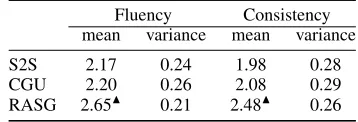
Table 5: Consistency and fluency comparison by human evaluation.
Fluency Consistency mean variance mean variance S2S 2.17 0.24 1.98 0.28 CGU 2.20 0.26 2.08 0.29 RASG 2.65N 0.21 2.48N 0.26
Analysis of goal tracker
In this section, we turn to research questionRQ4. The main purpose of employing goal tracker is to help the summary generator utilize the reader focused aspect. Intuitively, we want to know whether the summary generator follows the goal set by the goal tracker. Therefore, we calculate the co-sine distance between decoder attention νTYˆ ∈ R
Td
(in Equation 17) and reader attention∈RT
d
(in Equation 16). In Figure 2, we compare the cosine distance between the ab-lation model RASG w/o GTD and RASG. RASG observes a decrease of cosine distance and conversely, the RASG w/o GTD observes an increment of cosine distance. The fact that RASG can narrow the cosine distance proves that goal tracker and discriminator can lead the generator to follow the reader focused aspect.
Human evaluation
We ask three highly-educated Ph.D. students to rate 100 gen-erated summaries of different models according to consis-tency and fluency. These annotators are all native speakers. The rating score ranges from 1 to 3 and 3 is the best. We take the average score of all summaries as the final score of each model, as shown in Table 5. It can be seen that RASG outperforms other baseline models in both sentence fluency and consistency by a large margin. We calculate the kappa statistics in terms of fluency and consistency, and the score is 0.33 and 0.29 respectively. To prove the significance of the above results, we also do the paired student t-test between our model and CGU model (row with shaded background), the p-value are 0.0017 and 0.0012 for fluency and consis-tency respectively.
Figure 3: Cosine distance between current content and reader content.
Table 5: Consistency and fluency comparison by human evaluation.
Fluency Consistency mean variance mean variance S2S 2.17 0.24 1.98 0.28 CGU 2.20 0.26 2.08 0.29 RASG 2.65N 0.21 2.48N 0.26
Discussion
We also ask three highly-educated annotators to rate 100 generated summaries according to two aspects: consistency and fluency. The rating score ranges from 1 to 3, and 3 is the best. We finally take the average across summaries and annotators, as shown in Table 5. Significant differences are with respect to CGU (row with shaded background). In Ta-ble 5, we can see that RASG significantly outperforms other baseline models in both sentence fluency and consistency with the original document and comments of readers. To prove the significance of the above results, we also do the paired student t-test between our model and baseline meth-ods, the p-value are 0.0017 and 0.0012 for fluency and con-sistency respectively.
Table 6 shows an example and its corresponding gen-erated summaries by different methods. We observe that S2S only generates fluent summary, but are contradictory to the focus of reader and ground truth summary. However, RASG overcomes this shortcoming by using goal vector and gap content given by supervisor and goal tracker at training stage, and produce the summary not only fluent but also con-sistent with the focus of readers.
Conclusion
In this paper, we have proposed the task of reader-aware summary generation, which aims to generate summaries for text from social media incorporate the comments of read-ers. To address this task, we have proposed reader-aware summary generator (RASG): A sequence-to-sequence based summary generator is used to encode the document and then generate the summary sentence with attention and copy mechanism. In order to capture the focused aspect by the readers, we use a reader attention module to model the
align-Table 6: Examples of the generated summary by RASG and other models.
document êüh: -.Q·û⌃–õ?V/ ˙Àeh˝ D,€
e˘≤íTQ ⇢ åÑíTQ ⇢˝Ö⌦⇥I¯s?V ⇢«(∞˚QŸ8—∞˚∞⇧¡ UŒ⇢∫XY≤˘≠ I™Ω ™õS ∞íSsÑ˝∂ å;õõ⇥Ê¡Æ
Z(Lin Xu said that the Central Network Office will provide policy support to establish a nationwide capital to enter the cultivation of internet companies, improve the policies of domestic listing of internet companies; through the press on the news website to issue a press card, carry out education and training for practitioners, and strive to create new the national team and the main force of the media platform. See Long Weibo for details.)
comments
˝ D,≈{Àe(State-owned capital must be involved.) -.Q·û Åä>™=û(áˆ⌦ Å⌥ûÑgL (The Central Network Office should not implement the measures on the documents and must implement them in a practical way !) ⌘…óQ·ûÅ}}ªªŸõ≥§KlÜ(I feel that the Cen-tral Network Office should cure these black sheep.)
reference Q·û o; ˚⇢˙Àeh˝ D,€e˘≤íTQ ⇢(Deputy director of the Central Network Office: Establishing state-owned capital to cultivate internet enterprises)
S2S êü⇢™õS ∞íSsÑ˝∂ å˝∂ (Lin Xu : Na-tional team and naNa-tional team working hard to build a new media platform)
CGU ÆZ⇢-.Q·û⌃–õ?V/ ˙Àeh˝ D ,(Long Weibo: The Central Network Office will provide policy support to establish state-owned capital.)
RASG -.Q·û⇢™õS ∞íSsÑ˝∂ (Central Network Office: Working hard to build a national team of new media plat-form.)
ment of comments and document. We employ a supervi-sor to measure the semantic gap between aspect of gener-ated summary and reader-focused document. Finally, a goal tracker uses the information of semantic gap and the fea-ture extracted by the discriminator to produce a goal vec-tor to guide the summary generavec-tor. In our experiments, we have demonstrated the effectiveness of RASG and have found significant improvements over state-of-the-art base-lines in terms of ROUGE and human evaluations. Moreover, we have verified the effectiveness of each module in RASG for improving reader-aware summary generation.
Future work involves extending our model to improved adversarial training skills like Wasserstein GAN. Also, we plan to pursue a novel text matching method to denoising module for improving the accuracy.
Figure 3: Examples of the generated summary by RASG and other models.
Case analysis
Figure 3 shows a document and its corresponding sum-maries generated by different methods. We can observe that S2S does generate fluent summary. However, the generated aspect is contradictory to the focused aspect of reader or ground truth summary. Meanwhile, RASG overcomes this shortcoming by using goal vector and gap content given by goal tracker and supervisor at training stage, and produces the summary that is not only fluent but also consistent with main aspect of document.
Conclusion
In this paper, we propose a new framework named reader-aware summary generator(RASG) which aims to generate
Moreover, we have verified the effectiveness of each module in RASG for improving the summarization performance.
Acknowledgments
We would like to thank the anonymous reviewers for their constructive comments. We would also like to thank Zhu-jun Zhang, Sicong Jiang for their helps on this project. This work was supported by the National Key Research and Development Program of China (No. 2017YFC0804001), the National Science Foundation of China (NSFC No. 61876196, No. 61672058), Alibaba Innovative Research (AIR) Fund. Rui Yan was sponsored by CCF-Tencent Open Research Fund and Microsoft Research Asia (MSRA) Col-laborative Research Program.
References
Abadi, M.; Barham, P.; Chen, J.; Chen, Z.; Davis, A.; Dean, J.; Devin, M.; Ghemawat, S.; Irving, G.; Isard, M.; et al. 2016. Tensorflow: a system for large-scale machine learn-ing. InOSDI, volume 16, 265–283.
Bahdanau, D.; Cho, K.; and Bengio, Y. 2015. Neural ma-chine translation by jointly learning to align and translate. In
ICLR.
Bansal, M., and Chen, Y.-C. 2018. Fast abstractive summa-rization with reinforce-selected sentence rewriting. InACL.
Chen, X.; Gao, S.; Tao, C.; Song, Y.; Zhao, D.; and Yan, R. 2018. Iterative document representation learning towards summarization with polishing. InEMNLP, 4088–4097.
Chopra, S.; Auli, M.; and Rush, A. M. 2016. Abstractive sentence summarization with attentive recurrent neural net-works. InHLT-NAACL.
Duchi, J. C.; Hazan, E.; and Singer, Y. 2010. Adaptive subgradient methods for online learning and stochastic opti-mization.JMLR12:2121–2159.
Gao, S.; Ren, Z.; Zhao, Y. E.; Zhao, D.; Yin, D.; and Yan, R. 2019. Product-aware answer generation in e-commerce question-answering. InWSDM.
Gu, J.; Lu, Z.; Li, H.; and Li, V. O. K. 2016. Incorporat-ing copyIncorporat-ing mechanism in sequence-to-sequence learnIncorporat-ing.
CoRRabs/1603.06393.
Guo, J.; Lu, S.; Cai, H.; Zhang, W.; Yu, Y.; and Wang, J. 2018. Long text generation via adversarial training with leaked information.CoRRabs/1709.08624.
Hu, B.; Chen, Q.; and Zhu, F. 2015. Lcsts: A large scale chinese short text summarization dataset. InEMNLP.
Hu, M.; Sun, A.; and Lim, E.-P. 2007. Comments-oriented blog summarization by sentence extraction. InCIKM.
Hu, M.; Sun, A.; and Lim, E.-P. 2008. Comments-oriented document summarization: understanding documents with readers’ feedback. InSIGIR.
Jadhav, A., and Rajan, V. 2018. Extractive summarization with swap-net: Sentences and words from alternating pointer networks. InACL.
Li, P.; Bing, L.; Lam, W.; Li, H.; and Liao, Y. 2015. Reader-aware multi-document summarization via sparse coding. In
IJCAI.
Li, P.; Wang, Z.; Lam, W.; Ren, Z.; and Bing, L. 2017. Salience estimation via variational auto-encoders for multi-document summarization. InAAAI.
Li, P.; Bing, L.; and Lam, W. 2017. Reader-aware multi-document summarization: An enhanced model and the first dataset. InProceedings of the Workshop on New Frontiers in Summarization, 91–99.
Lin, J.; Sun, X.; Ma, S.; and Su, Q. 2018. Global encoding for abstractive summarization. InACL.
Lin, C.-Y. 2004. Rouge: A package for automatic evaluation of summaries.Text Summarization Branches Out.
Ma, S.; Sun, X.; Lin, J.; and Ren, X. 2018a. A hierarchical end-to-end model for jointly improving text summarization and sentiment classification. InIJCAI.
Ma, S.; Sun, X.; Lin, J.; and Wang, H. 2018b. Autoen-coder as assistant supervisor: Improving text representation for chinese social media text summarization. InACL.
Mihalcea, R., and Tarau, P. 2004. Textrank: Bringing order into text. InEMNLP.
Nallapati, R.; Zhai, F.; and Zhou, B. 2017. Summarunner: A recurrent neural network based sequence model for extrac-tive summarization of documents. InAAAI.
Narayan, S.; Cohen, S. B.; and Lapata, M. 2018. Ranking sentences for extractive summarization with reinforcement learning. InNAACL-HLT.
Nguyen, T.; Tran, C.-X.; Tran, D.-V.; and Nguyen, M.-L. 2016. Solscsum: A linked sentence-comment dataset for social context summarization. InCIKM.
See, A.; Liu, P. J.; and Manning, C. D. 2017. Get to the point: Summarization with pointer-generator networks.
arXiv preprint arXiv:1704.04368.
Sun, M.; Hsu, W. T.; Lin, C.-K.; Lee, M.-Y.; Min, K.; and Tang, J. 2018. A unified model for extractive and abstractive summarization using inconsistency loss. InACL.
Sutskever, I.; Vinyals, O.; and Le, Q. V. 2014. Sequence to sequence learning with neural networks. InNIPS.
Tao, C.; Gao, S.; Shang, M.; Wu, W. C.; Zhao, D.; and Yan, R. 2018. Get the point of my utterance! learning towards effective responses with multi-head attention mechanism. In
IJCAI.
Vinyals, O.; Fortunato, M.; and Jaitly, N. 2015. Pointer networks. InNIPS, 2692–2700.
Wang, L.; Yao, J.; Tao, Y.; Zhong, L.; Liu, W.; and Du, Q. 2018. A reinforced topic-aware convolutional sequence-to-sequence model for abstractive text summarization. In IJ-CAI.
Yang, Z.; Cai, K.; Tang, J.; Zhang, L.; Su, Z.; and Li, J.-Z. 2011. Social context summarization. InSIGIR.
Zhou, Q.; Yang, N.; Wei, F.; and Zhou, M. 2017. Selective encoding for abstractive sentence summarization. InACL.