The Thirty-Third AAAI Conference on Artificial Intelligence (AAAI-19)
Be Inaccurate but Don’t Be Indecisive:
How Error Distribution Can Affect User Experience
Rafael R. Padovani,
1Lucas N. Ferreira,
2Levi H. S. Lelis
1 1Departamento de Inform´atica, Universidade Federal de Vic¸osa, Brazil 2Department of Computational Media, University of California, Santa Cruz, USA[email protected], [email protected], [email protected]
Abstract
System accuracy is a crucial factor influencing user experi-ence in intelligent interactive systems. Although accuracy is known to be important, little is known about the role of the system’s error distribution in user experience. In this paper we study, in the context of background music selection for tabletop games, how the error distribution of an intelligent system affects the user’s perceived experience. In particular, we show that supervised learning algorithms that solely op-timize for prediction accuracy can make the system “indeci-sive”. That is, it can make the system’s errors sparsely dis-tributed throughout the game session. We hypothesize that sparsely distributed errors can harm the users’ perceived ex-perience and it is preferable to use a model that is somewhat inaccurate but decisive, than a model that is accurate but of-ten indecisive. In order to test our hypothesis we introduce an ensemble approach with a restrictive voting rule that instead of erring sparsely through time, it errs consistently for a pe-riod of time. A user study in which people watched videos of Dungeons and Dragons sessions supports our hypothesis.
Introduction
System accuracy is a crucial factor influencing user expe-rience in interactive and autonomous systems. For exam-ple, de Vries, Midden, and Bouwhuis (2003) and Desai et al. (2012) have linked system accuracy to trust in au-tonomous systems, and according to Lee and See (2004), the wrong level of trust can lead to system misuse or disuse. While it is known that system accuracy can affect user expe-rience in terms of trust, little is known about how the distri-bution of system errors affects user experience. For example, if system errors are inevitable, should one prefer a system whose errors are distributed uniformly during the system’s execution or a system whose errors occur in a period of time and is accurate for the rest of its execution?
In this paper we study how the error distribution of an intelligent system affects the user’s perceived experience. Our work is motived by the application domain of automatic background music selection for tabletop games. Padovani, Ferreira, and Lelis (2017) introduced Bardo, a system that uses supervised learning to identify through the players’ speech the emotion in the story being told in sessions of
Copyright c2019, Association for the Advancement of Artificial Intelligence (www.aaai.org). All rights reserved.
Dungeons and Dragons (D&D),1a storytelling-based table-top game. Bardo chooses a background song to be played according to the identified emotion. The domain of back-ground music selection for tabletop games is interesting be-cause it allows one to evaluate intelligent systems interacting with humans in a scenario in which system errors are in-evitable and directly affect the users’ perceived experience.
In this paper we show that supervised learning algorithms that solely optimize for prediction accuracy can make the se-lection system “indecisive”. That is, the system’s errors can be sparsely distributed throughout the game session. We call these sparsely distributed errorsshort misclassifications. We hypothesize that short misclassifications can harm the user’s perceived experience and that it is preferable to use classi-fication models that are somewhat inaccurate but decisive, than models that are accurate but often indecisive.
In order to test our hypothesis we introduce an ensem-ble classifier (Dietterich 2000), which we name EC, to min-imize short misclassifications. EC changes the background music only if all models composing its ensemble agree with the change. As a result of its voting rule, instead of erring sparsely throughout a game session, EC tends to err consis-tently for a period of time. In addition to showing that EC is expected to reduce the number of short misclassifications, we derive the conditions in which EC is expected to be more accurate than a classifierc. Namely, we show that if the emo-tion of the story does not change “too often” andcis “not too accurate”, then EC will be more accurate thanc.
Empirical results on Call of the Wild (CotW), a set of game sessions of D&D available on Youtube,2show that EC is able to dramatically reduce short misclassifications while being slightly more accurate than the models in the ensem-ble. We test our hypothesis that short misclassifications can harm the user’s perceived experience with a user study. In our study, people watched video excerpts of CotW with the background music selected by EC and by Bardo’s original model. In order to test our hypothesis, we select excerpts in which Bardo’s model is either as accurate or more accurate than EC and performs more short misclassifications than EC, thus giving Bardo’s model an advantage in terms of accu-racy. We approximate the user’s perceived experience with
1
http://dnd.wizards.com
2
the participants reported preferences for the music selected by the two approaches. The results of the study support our hypothesis that sparsely distributed errors can negatively af-fect the user’s perceived experience and that it might be pre-ferred to be somewhat inaccurate and decisive than accurate and indecisive in the context of background music selection. Although we evaluate our system with an ensemble of classifiers in the domain of background music selection, we expect our results to generalize to other classifiers and ap-plication domains. That is, in principle, any classifier that solely accounts for prediction accuracy can suffer from inde-cisiveness. Moreover, the negative effects of indecisiveness might arise in other application domains such as recommen-dation systems for financial investments (Chou et al. 1996; Seo, Giampapa, and Sycara 2004).
Related Work
The relation between system accuracy and user experience in terms of trust has been extensively studied, see the work of Yang et al. (2017) for a recent example. Most works on accuracy and trust involve one manipulating the error dis-tribution of an autonomous system and measuring the user’s trust on the system. Sanchez (2006) controlled system errors to occur either in the first or the second half of a simulated task. They found that the users’ trust was significantly lower if the errors occurred on the second half of the simulation. Desai et al. (2012) observed that users tend to switch an au-tonomous system to manual mode more often if the system errors occur in the middle of a task. In addition to studying the impact of system errors in user perceived experience, we introduce a learning model that shifts the prediction error distribution of a music selection system. Also, we measure the impact of the error distribution on how the users perceive the background music, and not the user’s trust on the system. An ensemble of diverse classifiers that perform slightly better than random guessing is known to result in accurate models (Hansen and Salamon 1990; Schapire 1990). Sev-eral algorithms were developed to create such ensembles. In Bagging, one trains several classifiers with a different sam-pling of the training data (Breiman 1996). AdaBoost also manipulates the training data by applying a weight to the training error of each training instance (Freund and Schapire 1997). Another way to create a set of potentially diverse classifiers is by training models on different subsets of the instances’ features (Cherkauer 1996). We use an approach similar to Cherkauer’s as we train a set of classifiers with and without a feature selection procedure to compose EC’s ensemble. Nonetheless, one could use any of the previous approaches to train a set of diverse classifiers to compose EC’s ensemble. In contrast with other ensemble methods which primarily try to improve prediction accuracy, EC is designed to alter the error distribution of its base classifiers. The problem of identifying which song to play in sessions of a tabletop game has a temporal structure that could be bet-ter captured by other models such as Hidden Markov Mod-els and Long-Short Term Memory networks (Hochreiter and Schmidhuber 1997). Moreover, aiming at having an accu-rate and decisive system, instead of training an ensemble of classifiers, one could train a model that directly minimizes
short misclassifications and maximizes prediction accuracy. Although we could have used in our experiments any of the approaches mentioned above, we note that the contribution of evaluating how the system’s error distribution affects user perceived experience is algorithm agnostic. This is because system indecisiveness can potentially occur with the use of any classifier that is solely concerned with prediction accu-racy. The use of an ensemble of classifiers is a solution to the short misclassification problem that allowed us to test our hypothesis that sparsely distributed errors can harm how the user perceives their experience in the context of back-ground music selection. We expect future works to develop other solutions to the system indecisiveness problem.
Bardo
Padovani, Ferreira, and Lelis (2017) introduced Bardo, a system that automatically selects background music for tabletop games. Bardo uses a speech recognition (SR) sys-tem to translate into text what players say during a game ses-sion. Since Bardo was originally tested with Youtube videos, Padovani et al. employed Youtube’s SR system, which is normally used to generate subtitles, to convert speech into sentences. We follow the same approach in this paper and what we refer as a sentence we mean a subtitle generated by the SR system. A Naive Bayes (NB) approach was then used in Bardo to classify each sentence being produced by the SR system into one of the four “story emotions”: Happy (H), Calm (C), Agitated (A), and Suspenseful (S). Bardo selects a song from a library of songs that corresponds to the current classified emotion (Bardo requires the songs to be labeled according to the four emotions). The selected song is then played as background music in the game session. Bardo op-erates in real time and switches the background music when-ever NB detects an emotion transition in the story.
Padovani et al. used a sliding window approach in which, instead of providing only the last sentence produced by the SR system to the classifier, Bardo provides the last z
sentences produced by the SR system. Also, as argued by Padovani et al., the sentences provided by the SR system are often noisy as the system captures the speeches of all players simultaneously. For that reason, Padovani et al. did not ex-tract the structure of the sentences and used the sentences as a bag of words for classification. We take the same approach in this paper. Whenever referring to a bag of words, we are referring to the lastzsentences returned by the SR system.
We use Padovani et al.’s dataset, which includes 9 episodes of CotW. The dataset contains 5,892 sentences and 45,247 words, resulting in 4 hours, 39 minutes, and 24 sec-onds of gameplay. There are 2,005 Agitated, 2,493 Sus-penseful, 38 Happy, and 1,356 Calm sentences in the dataset.
Sparsely Distributed Errors
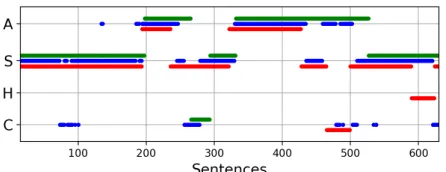
Figure 1: Comparison between the true labels (red lines), NS’s classifications (blue lines), and EC’s classifications (green lines) for an excerpt of episode 6. The y-axis shows the four different story emotions and the x-axis the sentences in the order of appearance in the episode.
Figure 1 shows the actual emotions and the classifications of two models in an excerpt of episode 6 of CotW. The x-axis shows the sentences of the episode ordered by appearance, and the y-axis the emotions. The red lines show the actual labels of the sentences, the blue lines show the classifications of Bardo’s original model, called NS, and the green lines show the classification of EC. As an example of how to read Figure 1, both NS and EC are accurate in the beginning of the episode as their classification match the actual emotion.
Although NS is more accurate than EC in episode 6 (NS has an accuracy of 69% and EC of 59%), we hypothesize that NS is more likely to harm the players’ perceived ex-perience than EC. This is because EC is consistent in the sense that its errors are not sparsely distributed in the ex-cerpt. For example, NS quickly switches between the Agi-tated and Calm emotions around sentence 500. We quantify these switches in terms of short misclassifications (SM),
SM(C, W) =|T(C, W)−T(W)|.
Here, C(w) is a classifier that receives as input a bag of wordswand returns forwa class in Padovani et al.’s emo-tion model. Also,W = {w1, w2,· · · , wm} is an ordered
collection of bag of words, whose order is defined by the order of appearance of themsentences of an episode. That is,wi is the bag of words of thei-th sentence appearing in
the episode. We refer to the subscripti as the time step in which the bag of words appears in the episode.T(C, W)is the number of timesCclassified two adjacent sentences in
W with different labels, formally defined as,
T(C, W) =|{wi|wi∈W∧C(wi)6=C(wi+1)}|.
T(W)is the number of actual emotion transitions inW,
T(W) =|{wi|wi∈W ∧L(wi)6=L(wi+1)}|.
Here,L(w)is the true label of sentencew.SM(C, W) mea-sures if C performs a number of emotion transitions sim-ilar to the actual number of emotion transitions inW. We useSM as a surrogate for short misclassifications. In the next section we introduce EC, an ensemble method that re-duces the value of T(C, W) by using a restrictive voting rule. Since in practice the value ofT(W)is small (the av-erage is 7 in Padovani et al.’s dataset) andT(C, W)tends to be larger thanT(W), by reducingT(C, W), EC reduces
SM(C, W).
Ensemble Classifier (EC)
Given a set of classifiersC, EC classifies the emotion of the first sentence in the episode according to a majority voting rule of the classifiers inC; ties are broken randomly. For any other bag of wordsw, Bardo with EC only transitions from one emotion to another emotioneif all classifiers inCagree thatwis of emotione. That is, for the first sentence in the episode EC uses a majority voting rule and for every other sentence EC uses a unanimity voting rule. This unanimity rule is a special case of the rule introduced by Xu, Krzyzak, and Suen (1992). In Xu, Krzyzak, and Suen’s rule a sample is “rejected” by the ensemble if all classifiers do not agree on the sample’s label. In our case, if the classifiers do not agree on a label, we assume the emotion has not changed.
Theoretical Analysis
Our analysis is divided into two parts. First, we show that EC is expected to perform fewer emotion transitions than a single classifier. Then, we show sufficient conditions for EC to be more accurate than a single classifier in expectation.
Reduced Number of Transitions LetEbe a set of emo-tions,Ca set of classifiers used with EC, andn=|C|. We assume the probability of a classifier c ∈ C classifying a bag of wordswof emotionej as being of emotioneito be
the same for all wof emotion ej. We denote such
proba-bility aspc(ei|ej). Similarly,pC(ei|ej)is the probability of
all classifiers inCclassifying anywof emotionejas being
of emotionei. We writepc andpinstead ofpc(ei|ej)and
pC(ei|ej)wheneverei,ej, andCare clear from the context.
Two events can occur in our problem: (i) EC correctly classifies the current emotionejor (ii) EC incorrectly
clas-sifies the current emotionej. In this part of the analysis we
assume these events to be independent (i.e., the chances of a bag of wordswt+1being of emotioneis independent of
the emotion ofwt). Assuming independence, the expected
number of trials EC performs for event (i) to occur is given byB(C, ej) = pC(ej|ej)−1. Similarly, the expected
num-ber of trials EC performs for event (ii) to occur is given by
R(C, ej) = bC(ej)−1. Here, bC(ej) = Pe∈E e6=ej
pC(e|ej).
R(C, ej)is the expected number of trials until all classifiers
agree on an emotion different thanej. We writebinstead of
bC(ej)wheneverej andCare clear from the context. Note
that EC withC={c}is equivalent tocalone.
The following observation states that Bardo using EC withn > 1is expected to change emotions less frequently than Bardo with any of its classifiers individually.
Observation 1 ForC = {c1, c2,· · · , cn} and a subset of
size oneC0={c}withcbeing any classifier inC, we have thatB(C, ej)≥B(C0, ej)andR(C, ej)≥R(C0, ej).
If all classifiers inCare identical,B(C, ej) =B(C0, ej)
and R(C, ej) = R(C0, ej), as the classifiers will always
agree on the emotion transitions. If the classifiers inCare in-dependent, thenpC(ei|ej) =Qc∈Cpc(ei|ej)and the values
ofB andRwill grow quickly with the size ofC. LargeB
reducing T(C, W) one is expected to reduce the value of
SM(C, W), our surrogate for short misclassifications.
Improved Overall Accuracy As one adds distinct classi-fiers intoC, EC will require an increasingly larger number of trials before detecting an emotion transition. In particular, if the number of trials is larger than the number of sentences in ascene, then EC might miss the emotion transition en-tirely. A scene is an excerpt of a game session composed of bag of words with the same emotion.
Definition 1 (Scene) Let S = {wi, wi+1,· · · , wj−1, wj}
be a subset ofW withi ≥ 1andj ≤m. Also, allw ∈ S
have the same emotioneand the emotions ofwi−1andwj+1
are different frome(ifi >1andj < m); we callSa scene.
The execution of EC withinS can be modeled with two states: X andY. EC is in X at time stept if it correctly identified the emotion ofwt−1. Sincewt−1andwthave the
same emotion (they belong to the same scene), if the classi-fiers do not agree on an emotion, then EC correctly classifies
wtby assuming it has the same emotion aswt−1. EC is in
Y at time steptif EC classifiedwt−1as being of an
emo-tion different fromwt’s actual emotion. In our analysis we
assume EC to start inY. EC starts inXif the classification performed by EC correctly identifies the emotion of the first bag of words in the first scene of an episode, or if it mis-classifies the last bag of words of a scene and the predicted emotion is the emotion of the next scene.
We define asqthe size of a scene S and model the ex-pected number of bag of words correctly classified by EC in
SasFY(q), which can be written with the recurrence:
FY(q) =p(FX(q−1) + 1) + (1−p)FY(q−1) (1)
FX(q) =bFY(q−1) + (1−b)(FX(q−1) + 1). (2)
Here, FY(0) = 0 and FX(0) = 0, and p and b are the
probabilities of EC correctly and incorrectly classifying the emotion of the current sentence of the scene, respectively. FunctionFY(q)reads as “the number of bag of words EC is
expected to correctly classify in the remainingqbags of the scene, given that EC is in stateY”. FunctionFX(q)can be
read similarly, except that it computes the expected number of bag of words classified correctly if EC is in stateX.
Once a scene starts inY, EC correctly classifies the cur-rent bag of words with probabilityp, thus adding one to the summation and transitioning to stateX withq−1 bag of words remaining in the scene (see first term ofFY(q)). EC
misclassifies the current bag of word with probability1−p
and remains in stateY withq−1bag of words remaining in the scene (see second term of FY(q)). Once in X, EC
correctly classifies the remaining bags of words if the clas-sifiers do not agree on an incorrect emotion (probabilityb). Equations 1 and 2 assumepandbto be the same for allw.
The following lemma shows thatFY(q)can be written as
a closed-form equation. The proof is in the Appendix.
Lemma 1 FY(q)can be written as follows,
p
(1−p−b)q+1+p+b−1 +q(p+b)
(p+b)2 .
FX(q)can be written as follows,
−b(1−p−b)q+1+p2q+pbq−pb−b2+b
(p+b)2 .
Lemma 1 allows us to derive the minimum size q of a scene to guarantee that EC is expected to be more accurate than a single classifier with accuracyk.
Theorem 1 LetSbe a scene of sizeq≥0andca classifier with accuracyk∈(0,1]inS. Assuming that the probability valuesp, b∈(0,1]are fixed for all bag of words inS, EC is more accurate thancifq > (p+pb2)2−kp−+ppb2−pb andk <
p p+b.
The proof of Theorem 1 is in the Appendix. Theorem 1 states that ifSis long enough andcis not too accurate, then EC is expected to be more accurate thancinS. Note that a regular classifier is a special case of EC with an ensemble of size one. In that case, b = 1−p, which according to Theorem 1,q >0as long ask < p, as one expects.
Our theoretical results suggest that EC is able to reduce short misclassifications and can be more accurate than a sin-gle classifier. On the other hand, EC might miss the emo-tion transiemo-tions of short scenes. This is because short scenes might finish before EC transitions from stateY to stateX.
Although EC uses the restrictive unanimity rule, our anal-ysis holds for other voting rules such as the majority rule. In that case, p and b mean the probability of the major-ity of the classifiers in the ensemble classifying a bag of words correctly or incorrectly, respectively. We chose to use the unanimity rule because this rule is expected to result in larger values ofBandR, which can potentially reduce the sparsely distributed errors and thus allow us to test empiri-cally our hypothesis that it might be preferred to be some-what inaccurate and decisive than accurate but often indeci-sive. Also, note that one could also analyze EC by treating it as a Markov Chain with statesX andY whose transition matrix is defined byp,p−1,b, andb−1.
Empirical Evaluation
In this section we evaluate variants of EC and Naive Bayes (NB) on the 9 episodes of CotW. The goal of this experiment is to show empirically that EC is able to reduce the number of short misclassifications and is thus suitable to test our hy-pothesis that short misclassifications can harm how the user perceives their experience with the system.
NB classifies a bag of wordsw according to the proba-bility of each word in wbelonging to a class and accord-ing to the a priori probability of a sentence belongaccord-ing to a class (Manning et al. 2008). Two of the NB models we use are created by choosing different sliding window sizes
Alg. Episodes Avg.
1 2 3 4 5 6 7 8 9
Accuracy
Baseline 10 53 35 44 75 64 29 24 47 42
NS 64 62 76 71 54 69 44 59 79 64
NHS 71 57 79 69 56 59 55 59 76 64
NM 64 62 80 72 52 60 43 61 78 64
NHM 68 57 79 69 47 65 56 61 76 64
EC(2) 71 60 78 69 54 59 56 59 81 65
EC(4) 76 59 79 70 50 59 55 64 80 65
SM
Baseline 7 8 5 12 8 9 4 6 4 7
NS 42 29 43 40 37 41 59 35 36 40
NHS 45 28 23 33 35 22 50 42 50 36
NM 40 24 39 27 45 30 58 31 36 36
NHM 47 28 19 29 33 37 49 25 50 35
EC(2) 14 4 4 10 9 0 25 10 13 9
EC(4) 5 3 4 6 5 0 12 2 11 5
Table 1: Accuracy and SM for different classification algo-rithms.
the cross-validation procedure; we call this model NS. The other model, called NM, is defined similarly, but by selecting the sliding window size that yields the model with lowest av-erageSM. We test windows with size:{20,25,30,35,40}. The classifier NS is identical to the one used by Padovani, Ferreira, and Lelis (2017).
We create two extra NB models by using a feature se-lection scheme. A NB model with feature sese-lection uses only the h words with largest mutual information (MI) value (Manning et al. 2008) in its classification procedure. The MI value of a word measures how discriminative the word is to identify or to rule out a given class. We then cre-ate NHS and NHM, which are similar to NS and NM, except that in the cross-validation procedure we choose the value of z and hthat maximizes accuracy (for NHS) and mini-mizesSM (for NHM). We test the following values ofh: {500,600,· · ·,1500}, resulting in a total of 55 values tested for NHS and NHM. We test two versions of EC, one with NS and NHS composing its ensemble (EC(2)) and one with NS, NHS, NM, and NHM in its ensemble (EC(4)).
Since the number of transitions is small in CotW and EC tries to minimizeSM by reducing the number of emotion transitions, a reasonable baseline is to assume Bardo plays as background music a song related to the Suspenseful emo-tion, which is the majority class in Padovani et al.’s dataset. We call this approach Baseline in our table of results.
We separate each episode to be tested and train the algo-rithms on the other episodes. For example, when testing a method on episode 1, we train it with episodes 2–9 and the resulting model is applied to episode 1.
Accuracy and
SM
Results
Table 1 shows the percentage accuracy (upper part) andSM
values (bottom part) of the tested algorithms (“Alg.”) in each
episode of CotW. The “Avg.” column shows the algorithm’s average results across all episodes. All numbers are rounded to the closest integer and the values in the “Avg.” column were computed before rounding the numbers. We highlight the background of a cell if the number in the cell represents the best result across all algorithms for a given episode. For example, NM has the has the highest accuracy in episode 3 and EC(4) has the lowestSM value in episode 4. We also highlight the best overall averages for each episode.
The EC approaches present a much lower SM than all classifiers. Namely, EC(4)’s SM is 7 times lower than NHM’s, the best performing individual classifier. EC(4) also has an averageSMlower than Baseline and a much higher accuracy. As suggested by our analysis, EC with a larger set of classifiers is expected to change the emotion less of-ten, potentially further reducing the value of SM. EC(2) and EC(4) have the same average classification accuracy, but EC(4)’sSMis nearly half of theSMvalue of EC(2).
TheSMreduction performed by EC(4) can be observed in Figure 1, which shows the EC(4) classifications in green in an excerpt of episode 6. EC(4) has a SM of 3 in the excerpt shown in Figure 1: there are 8 true emotion transi-tions shown in red while EC performs 5 transitransi-tions. TheSM
value of EC(4) is zero if one considers the entire episode (Episode 6 in Table 1). As anticipated in our theoretical analysis, EC’s misclassifications are not sparsely distributed, they usually happen at the beginning of a scene. For exam-ple, there is a change from Calm to Suspenseful around sen-tence 500 (see red lines in Figure 1) and EC only detects such a transition after approximately 20 sentences. Also, EC misses entirely some of the short scenes in the episode (e.g., the transitions in between sentences 400 and 500). The pres-ence of short scenes justify the individual classifiers being more accurate than EC in this episode (see Table 1), as sug-gested by Theorem 1.
User Study
The results presented so far show that EC is able to change the error distribution of its base classifiers. Instead of erring sparsely throughout an episode, EC tends to concentrate its errors in the beginning of the scenes, thus reducing the short misclassifications. In this section we test with a user study our hypothesis that the sparsely distributed errors can harm how the user perceives their experience.
Our system for background music selection can target two types of users: people playing the game (players) and peo-ple watching the game session (spectators). A player would need to commit a few hours to participate in our study. By contrast, spectators need to commit only a few minutes to watch video excerpts of game sessions. Since it is easier to enlist spectators than players, our study focus on measuring approximations of the spectator’s perceived experience. We approximate the spectator’s perceived experience with a set of pairwise preference comparisons of the background mu-sic selected by EC and by NS, Bardo’s original classification model, in video excerpts of people playing D&D.
video excerpts with different accuracy and SM values so that the excerpts cover a variety of scenarios that might arise in longer game sessions. Also, we do not use the baseline used in the previous experiment (play a song of the majority class throughout the excerpt). This is because while such a baseline might yield reasonable results in short excerpts, the results are unlikely to generalize to longer game sessions as playing the same type of song will likely bore the users and harm their perceived experience. Moreover, Padovani, Ferreira, and Lelis (2017) showed that NS is able to outper-form in terms of user preference a much stronger baseline, which is the background music selected by the authors of the videos used in our user study.
We compare NS with EC(4) (henceforth referred as EC). We selected five excerpts of the CotW. NS and EC are trained with episodes different than the one from which the excerpt is extracted (e.g., if an excerpt is extracted from episode 7, then NS and EC are trained with all episodes but 7). Each excerpt is approximately 2 minutes long. In order to test our hypothesis, we selected excerpts in which NS is either as accurate or more accurate than EC and has a larger
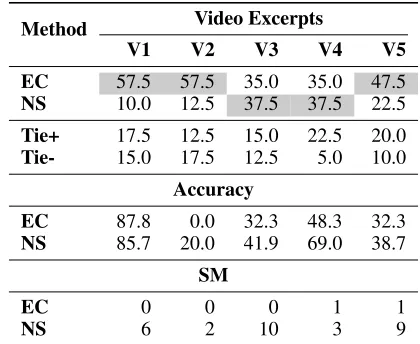
SMvalue, thus giving NS an advantage in terms of system accuracy. The accuracy andSMvalues of the video excerpts (V1, V2, V3, V4, V5) are shown at the bottom of Table 2.
The video excerpts we use have no sentences of the Happy emotion (Happy is a rare emotion in CotW), thus we use one song for each of the other emotions in our study. We used the songCall of the Ravenby Jeremy Soule for Calm,Hurricane Suiteby Naruto Shippuden OST I for Suspenseful andOpen the Gates of Battleby Casey Martin for Agitated. V1 is an excerpt starting at 3:22 and finishing at 5:20 of episode 2 of CotW; V2 starts at 25:10 and finishes at 26:32 of episode 6; V3 starts at 23:26 and finishes at 24:55 of episode 4; V4 starts at 17:26 and finishes at 18:56 of episode 3; V5 starts at 20:00 and finishes at 21:31 of episode 7.
Following Padovani et al.’s methodology, each participant listened to excerpts of all three songs after answering our consent form and before evaluating the video excerpts. We reduce the chances of a participant evaluating the quality of the songs instead of the song selection procedure by telling the participant which songs will be used as background mu-sic. After listening to the songs each participant watched two versions of the same video excerpt, one with the background music selected by NS and another by EC. The order in which the videos appeared was random to avoid ordering biases. We included a brief sentence providing context to the par-ticipant, to ensure they would understand to story being told in each excerpt. The participants could watch each video as many times as they wanted before answering the question: “Which video has the most appropriate background music according to the context of the story?”. The participant could choose one of the options: “Video 1”, “Video 2”, “The back-ground music used in both videos are equally appropriate”, and “The background music used in both videos are equally inappropriate”. After marking their answer, the participants evaluated another pair of excerpts. The order the video pairs were presented was also random. The participants answered a demographic questionnaire after evaluating all excerpts.
Our experiment was advertised in D&D communities in
Method Video Excerpts
V1 V2 V3 V4 V5
EC 57.5 57.5 35.0 35.0 47.5
NS 10.0 12.5 37.5 37.5 22.5
Tie+ 17.5 12.5 15.0 22.5 20.0
Tie- 15.0 17.5 12.5 5.0 10.0
Accuracy
EC 87.8 0.0 32.3 48.3 32.3
NS 85.7 20.0 41.9 69.0 38.7
SM
EC 0 0 0 1 1
NS 6 2 10 3 9
Table 2: User preference in emotion detected by EC and NS.
the social media. We had 40 participants, 39 males and 1 female, with average age of 25. All participants had some experience playing D&D. We report the results of 200 an-swers (5 pairs of videos for each participant).
User Study Results
The videos with background music selected by EC were pre-ferred 93 times by the participants, while NS’s videos were preferred 48 times, and the approaches tied 59 times. The difference between EC and NS is significant according to a two-sided binomial test (p<0.001).
Table 2 shows the detailed results for all 5 excerpts used in the study. The upper part of the table shows the percentage of times the participants preferred the videos edited by EC, by NS, and the percentage of times the participants thought the videos to be equally appropriate (Tie+), and equally inap-propriate (Tie-). For example, for the first two excerpts (V1 and V2), the participants preferred EC’s selection of back-ground music in 57.5% of the cases. The highlighted cells show the best performing approach (EC or NS) on a given excerpt. The bottom part of the table shows EC and NS’s accuracy and theSMvalue in each excerpt.
The results of our user study show a clear preference for the music selected by EC. In particular, the participants strongly preferred the selection performed by EC in V1, V2, and V5. V1 is an excerpt with two scenes in which both methods are accurate. While NS’s misclassifications are sparsely distributed in V1, EC’s misclassifications oc-cur in the beginning of one of the scenes due EC requiring a few sentences to detect the emotion change.
participants. V3 depicts a scene in which one of the players is sneaking in their enemy’s house. The use of an Agitated song instead of a Suspenseful seems to be more harmful to the user’s perceived experience than a large SM value in this particular case. Note, however, that that the participants only marginally prefer the selections made by NS in V3. A similar result is observed in V4, where EC is less accurate than NS but has a lower SM value and participants only marginally prefer NS’s selections. The accuracy of EC and NS are similar in V5, but the latter has a largeSMvalue. In this case the participants have a strong preference for EC’s selections.
The study supports our hypothesis that sparsely dis-tributed errors can be harmful to the user’s perceived expe-rience. The study also showed that in some cases it might be preferable to be inaccurate and decisive than accurate and indecisive (e.g., V2). Naturally, depending on the scene, the lack of accuracy can outweigh the system’s decisiveness (e.g., V3). Video excerpts V1 and V5 are the most represen-tative videos used in the study. This is because NS and EC are equally accurate (accuracy of approximately 60% con-sidering V1 and V5 altogether) and EC has a much smaller
SMvalue; Table 1 showed similar average accuracy results for EC. The participants showed a strong preference for EC’s selection in V1 and V5. Thus, overall, our results suggest that EC is the ideal method to be used for selecting back-ground music as it is able to reduce theSMvalue without sacrificing the accuracy of its base models.
Conclusions and Future Work
In this paper we studied how the error distribution of a sys-tem can affect the user perceived experience. We hypoth-esized that a system whose errors are sparsely distributed across a game session could harm the user perceived ex-perience and that it would be preferred to be somewhat in-accurate but decisive than in-accurate and indecisive. In order to test our hypothesis, we introduced an ensemble approach called EC that errs consistently in the beginning of scenes as opposed to erring sparsely through the scenes. Theoretical results showed that EC can reduce the sparsely distributed errors by performing fewer transitions. We also showed that if a sceneSis long enough and a classifiercis not too ac-curate, then EC is expected to be more accurate thancinS. Empirical results showed that EC is able to reduce short mis-classifications without sacrificing accuracy. A user study in which people watched videos of D&D with the background music selected by EC and by a classifier that does not ac-count for the error distribution supported our hypothesis.
Although we evaluated our system with an ensemble of classifiers in the domain of background music selection, our results might generalize to other classifiers and application domains. We expect future works to study how other clas-sifiers can be modified to cope with short misclassifications and how a system’s error distribution can affect user experi-ence in other application domains. Also as future work, we are interested in verifying if the findings of our study in-deed generalize to longer sessions. Longer experiments will also allow us to measure the impact of error distribution with
concrete metrics of user experience such as churn rate (in-stead of the user preference metric used in our study).
Appendix: Proofs
Lemma 1 FY(q)can be written as follows,p
(1−p−b)q+1+p+b−1 +q(p+b)
(p+b)2 .
FX(q)can be written as follows,
−b(1−p−b)q+1+p2q+pbq−pb−b2+b
(p+b)2 .
Proof. Our proof is by induction. Replacingq = 0 in the equations above we obtainFY(0) =p(1−p−b+p+b−1) =
0andFX(0) =−b+bp+b2−pb−b2+b= 0.
We assume as inductive hypothesis (IH) thatFY(q−1) =
p (1−p−b)q+p+b−1 + (q−1)(p+b)(p+b)−2and
FX(q−1) = −b(1−p−b)q+p2(q−1) +pb(q−1)−
pb−b2+b
(p+b)−2.
By replacingFY(q−1)andFX(q−1)according to the IH
in the recursive version ofFy(q)we obtain its closed form,
as stated in the lemma. Similarly, one obtains the closed-form version ofFX(q)by replacingFY(q−1)andFX(q−1)
according to the IH in the recursive version ofFX(q).
Theorem 1 LetSbe a scene of sizeq≥0andca classifier with accuracyk∈(0,1]inS. Assuming that the probability valuesp, b∈(0,1]are fixed for all bag of words inS, EC is more accurate thancifq > (p+pb2)2−kp−+ppb2−pb andk <
p
(p+b).
Proof.EC is expected to be more accurate thanCif
p (1−p−b)q+1+p+b−1 +q(p+b) (p+b)2 > kq (p+b)2kq
p −p−b+ 1−q(p+b)<(1−p−b)
q+1
Since(1−p−b)q+1≥0, the equation above holds if (p+b)2kq
p −p−b+ 1−q(p+b)<0 (3) q (p+b)2k−p2−pb< p2−p+pb (4)
q > p
2−p+pb
(p+b)2k−p2−pb (5)
In Equation 5,p2−p+pbis negative as one needsb+p > 1 for it to be positive, and b+p ≤ 1. Thus, Equation 5 holds if(p+b)2k−p2−pb < 0, ork < p
(p+b). Suppose (p+b)2k−p2−pb > 0, sincep2−p+pb <0, then one
needsq <0for Equation 4 to hold, butq≥0.
References
Breiman, L. 1996. Bagging predictors. Machine Learning
24(2):123–140.
Cherkauer, K. 1996. Human expert-level performance on a scientific image analysis task by a system using combined artificial neural networks. In Working Notes of the AAAI Workshop on Integrating Multiple Learned Models, 15–21. Chou, S.-C. T.; Yang, C.-C.; Chan, C.-H.; and Lai, F. 1996. A rule-based neural stock trading decision support system. InIEEE Conference on Computational Intelligence for Fi-nancial Engineering, 148–154.
de Vries, P.; Midden, C.; and Bouwhuis, D. 2003. The ef-fects of errors on system trust, self-confidence, and the al-location of control in route planning. Int. J. Hum.-Comput. Stud.58(6):719–735.
Desai, M.; Medvedev, M.; V´azquez, M.; McSheehy, S.; Gadea-Omelchenko, S.; Bruggeman, C.; Steinfeld, A.; and Yanco, H. 2012. Effects of changing reliability on trust of robot systems. In Proceedings of the Seventh Annual ACM/IEEE International Conference on Human-Robot In-teraction, 73–80. New York, NY, USA: ACM.
Dietterich, T. G. 2000. Ensemble methods in machine learn-ing. In Proceedings of the First International Workshop on Multiple Classifier Systems, 1–15. London, UK, UK: Springer-Verlag.
Freund, Y., and Schapire, R. E. 1997. A decision-theoretic generalization of on-line learning and an applica-tion to boosting. Journal of Computer and System Sciences
55(1):119–139.
Hansen, L. K., and Salamon, P. 1990. Neural network en-sembles. IEEE Transactions Pattern Analysis and Machine Intelligence12(10):993–1001.
Hochreiter, S., and Schmidhuber, J. 1997. Long short-term memory.Neural Computation9(8):1735–1780.
Lee, J. D., and See, K. A. 2004. Trust in automation: design-ing for appropriate reliance.Human Factors46(1):50–80. Manning, C. D.; Raghavan, P.; Sch¨utze, H.; et al. 2008. In-troduction to information retrieval, volume 1. Cambridge university press Cambridge.
Padovani, R.; Ferreira, L. N.; and Lelis, L. H. S. 2017. Bardo: Emotion-based music recommendation for tabletop role-playing games. InProceedings of the AAAI Conference on Artificial Intelligence and Interactive Digital Entertain-ment.
Sanchez, J. 2006. Factors that affect trust and reliance on an automated aid. Ph.D. Dissertation, Georgia Institute of Technology.
Schapire, R. E. 1990. The strength of weak learnability.
Machine Learning5(2):197–227.
Seo, Y.-W.; Giampapa, J.; and Sycara, K. 2004. Financial news analysis for intelligent portfolio management. Techni-cal report, Robotics Institute, Carnegie Mellon University. Xu, L.; Krzyzak, A.; and Suen, C. Y. 1992. Methods of com-bining multiple classifiers and their applications to
hand-writing recognition. IEEE Transactions on Systems, Man, and Cybernetics22(3):418–435.