PRACTICES ON COMPUTER AIDED LEARNING PROGRAMS AMONG STUDENTS
ATTENDING KENYA MEDICAL TRAINING COLLEGE, NAIROBI CAMPUS
Salim M. Omambia*
Kenya Medical Training College, Faculty of Information Technology and Medical Education, P.O. Box 30195-00100 Nairobi, Kenya.
Article Received on 04/12/2018 Article Revised on 25/12/2018 Article Accepted on 16/01/2019
I. INTRODUCTION
Computer Aided Learning (CAL) was one of the most commonly used acronyms within education. It was difficult to say exactly when the term CAL was first employed, however since the mid-1980s CAL has been increasingly used to describe the use of technology in teaching. The computer-aided learning program is an endeavour to make the content of textbooks easier, interactive and more stimulating. Research has shown that some of the contents, irrespective of the subject, are difficult to comprehend. To assist teachers interact better with students BRAC started the CAL program in 2004, where computers are used as a medium of teaching.[1] CAL played an important role and E-learner are individuals who uses the online material for learning purposes, they fairly independent, reads in their comfortable time and space .On the other hand
E-teaching is said to be a directives given via an electronic media in both virtual and face to face classrooms and E-teaching enable online communications and online sharing of course material. E-learning can be used in medical education to improve the efficacy of academic deliverance and make the learning sessions more captivating and retainable.
1.1 Statement of the Problem
There is little doubt that a chasm exists between the health IT ecosystem we have today and the one we need to routinely deliver high-value care. A study[7] argues that there is a need to meet the distinct needs of diverse stakeholders who are essential to health system transformation.While technologies such as virtual instruction and intelligent tutoring offer great promise, unless the challenges that are associated with
World Journal of Pharmaceutical and Life Sciences
WJPLS
www.wjpls.org SJIF Impact Factor: 5.008
*Corresponding Author: Salim M. Omambia
Kenya Medical Training College, Faculty of Information Technology and Medical Education, P.O. Box 30195-00100 Nairobi, Kenya.
ABSTRACT
Computer Assisted Learning (CAL) is a method of acquiring knowledge using electronic media which is gained using electronic media which is gaining recognition among students. This requires access to computers and considerable awareness on information technology. Previous empirical studies have underscored the important roles of instructional materials in the classroom studies. The objective of this study was to find out practices on computer aided learning programs among students attending Kenya Medical Training College, Nairobi campus. This study was an analytical study, the target population was 4,490 KMTC Nairobi Campus students. The study utilized structured questionnaires for 263 respondents, analysis was done through SPSS, Ms Excel and Ms Word software’s with univariate, bivariate and thematic statistics being utilized. Data presentation was in form of descriptive statistics: pie charts, percentages, bar charts and tables. One half of the participants agreed or strongly agreed that there was: lack of computer laboratories; inadequate number of computers; lack of access to computers; and insufficient pre-service training on CAL Females were more likely to have positive responses compared to males (72.3% versus 49.9%). Access point was also associated with perception (p = 0.005). Accessing computers in the computer lab was associated with higher Likert scale responses. Seventy percent of participants reported that they had other electronic devices in college. About (59.9%) participants reported that teachers used electronic devices to aid teaching on a weekly basis. In the face of all the challenges that the students faced with reputes to access in CAL, the students agreed that CAL made learning easy as students could access information online by a click of a button. KMTC should expand internet connection access points and computers, from the conventional computer laboratories to class rooms and the institutional accommodation areas and provide more training courses to lecturers on CAL and make it a requirement to anyone who wants to become a lecture at KMTC.
implementing them are fully understood and addressed their failure is almost surely guaranteed. To date, there is little evidence that digital learning can be implemented at scale in a way that improves outcomes for disadvantaged students.[3]
1.2 Study purpose
The main purpose of this study was to find out the practices on computer aided learning programs among students attending Kenya Medical Training College, Nairobi campus.
II. METHODS
The study was conducted in Kenya Medical Training College Nairobi Campus situated in Nairobi County and will use a descriptive research design. Descriptive research was used to obtain information concerning the current status of the phenomena to describe what exists, with respect to variables or conditions in a situation. Descriptive research aimed at gathering data without any manipulation of the research context and it is non-intrusive and deals with naturally occurring phenomena, where the researcher has got no control over the variables.[4]
The target population was the 4,490 KMTC Nairobi Campus students. The study investigated selected students and faculties in KMTC Nairobi Campus. The Nairobi Campus is the biggest and considered the epitome in the country and thus has got the most staff and students, being at the headquarters it are expected that it is the most equipped. The scope is deemed appropriate due to the fact that with rise in technology, urban areas and cities in specific embrace it with ease. The scope was also significant to minimize expenses which would otherwise be incurred outside the researchers’ residential city.
We had two types of sampling, probability sampling which is a sampling method where each population element has an equal and known (non-zero) chance of being chosen for the sample and non-probability sampling which is a method where we do not know the probability that each population element will be chosen, and we were not sure that each population element has a non-zero chance of being chosen.[5] Thus the researcher used random sampling and a random sample is a sample that is chosen randomly. It could be more accurately called a randomly chosen sample.
From the study the independent variables were the Knowledge, technological factors and practices influencing CAL in KMTC Nairobi Campus, since an independent variable refers to the status of the presumed cause whereas the dependent variable is the presumed effect. Effectual Implementation of CAL in KMTC Nairobi Campus thus depends on the knowledge, technological factors and practices on computer aided learning programs among students attending Kenya Medical Training College, Nairobi campus.
Data analysis was done using SPSS, Ms Excel and Ms Word software’s with univariate, bivariate and thematic statistics being utilized. Univariate analysis commonly involved reporting measures of central tendency. Bivariate analysis is one of the simplest forms of quantitative (statistical) analysis. It involves the analysis of two variables for the purpose of determining the empirical relationship between them in order to see if the variables are related to one another, Bivariate analysis can be helpful in testing simple hypotheses of association.
Before data collection, a permit was sort from the Kenya Medical Training College and the Medical Education department Kenya Medical Training College. After production of the research permit, permission to carry out research was granted by the research and ethics board team. The Administrators, staff and the support staff of the departments selected were informed in advance concerning the visits and for data collection in their respective departments and offices. The researcher ensured that confidentiality was paramount and that the information obtained was used only for the purpose of this study.
2.1 Conceptual Framework Dependent variable
Independent variables
The study conceptualized the dependent variable to be effective computer aided learning while the independent variables to be Knowledge, technological factors and practices on computer aided learning.
III. FIGURE AND TABLES
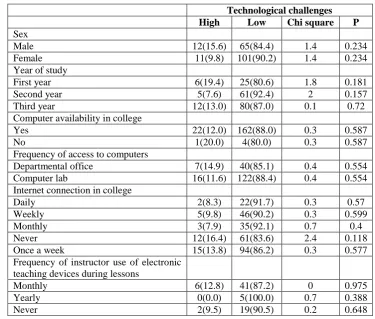
From our study majority 184 (97.4%) participants reported that computers were available in college, and 138 (74.6%) said that the access point was the computer laboratory. Approximately two thirds (69.5%) of participants had internet access in college, and 92.8% had internet server connection as opposed to paid modem connectivity. At least one-half (56.7%) of participants reported that they used internet for searching information. few challenges where we noted that Computers were not accessible within the classrooms were 73 (39.2%) participant had no accesses to internet connection in college, and for those who accessed them mostly had weekly (27.4%) access. About (59.9%) participants reported that teachers used electronic devices to aid teaching on a weekly basis. Approximately two thirds (69.5%) of participants had internet access in college, and 92.8% had internet server connection as opposed to paid modem connectivity. At least one-half (56.7%) of participants reported that they used internet for searching information. Females were more likely to have positive responses compared to males (72.3 versus 49.9%.
3.1 Practices on Cal
Technological factors affecting CAL were prevalent in KMTC. One half of participants agreed or strongly agreed that there was: lack of computer laboratories; inadequate number of computers; lack of access to computers; and insufficient pre-service training on CAL. This is echoed by[6] who noted that Although numerous research findings on CAL globally attest to its positive impact on students’ learning outcome, Kenyan medical lectures, practical teachers included have done very little to introduce this modern teaching approach in their classroom practice. This ends up leaving the student at a disadvantage to realize the full potential of CAL. Responses to items on technological factors affecting CAL were combined only 8% of participants either agreed or strongly agreed with most (at least 75%) of the items. This shows majority of the participants appreciated the effort the institution had put in place with reference to technological advancement.
Table 1: Practices factors and participant characteristics.
Technological challenges
High Low Chi square P
Sex
Male 12(15.6) 65(84.4) 1.4 0.234
Female 11(9.8) 101(90.2) 1.4 0.234
Year of study
First year 6(19.4) 25(80.6) 1.8 0.181
Second year 5(7.6) 61(92.4) 2 0.157
Third year 12(13.0) 80(87.0) 0.1 0.72
Computer availability in college
Yes 22(12.0) 162(88.0) 0.3 0.587
No 1(20.0) 4(80.0) 0.3 0.587
Frequency of access to computers
Departmental office 7(14.9) 40(85.1) 0.4 0.554
Computer lab 16(11.6) 122(88.4) 0.4 0.554
Internet connection in college
Daily 2(8.3) 22(91.7) 0.3 0.57
Weekly 5(9.8) 46(90.2) 0.3 0.599
Monthly 3(7.9) 35(92.1) 0.7 0.4
Never 12(16.4) 61(83.6) 2.4 0.118
Once a week 15(13.8) 94(86.2) 0.3 0.577
Frequency of instructor use of electronic teaching devices during lessons
Monthly 6(12.8) 41(87.2) 0 0.975
Yearly 0(0.0) 5(100.0) 0.7 0.388
Never 2(9.5) 19(90.5) 0.2 0.648
Figure 1: Overall rating of technical factors affecting CAL.
Factors affecting CAL were combined only 8% of participants either agreed or strongly agreed with most (at least 75%) of the items. This shows majority of the participants appreciated the effort the institution had put in place with reference to technological advancement.
3.2 Attitude on Computer Aided Learning Programs As technology changes, smaller devices will probably travel with users, who will expect wireless environments, the capacity to network with other devices and display vehicles, and access to power. From the research among the students at KMTC there was strong agreement or agreement with most Likert items on attitude on computer aided learning programs including the items: adoption and use of CAL in school will improve the operations in school; use of CAL in schools is beneficial;
CAL can improve education; use of CAL tools can be enjoyable and stimulating; CAL use is useful for the teacher only; and adoption and use of CAL improves critical thinking. The findings were slightly in agreement with[7] findings. The overall attitude of participants towards CAL programs based on the combination of all the Likert items. Twenty seven percent of participants showed a positive attitude towards CAL programs out of a record hundred percent. This finding means that seventy three percent of the participants overall outlook towards CAL was not positive. There was a significant association between attitude towards CAL programs and knowledge of ICT (p < 0.001). The participants with greater knowledge were at least four times more likely to show a positive attitude towards CAL programs compared to those with less knowledge.
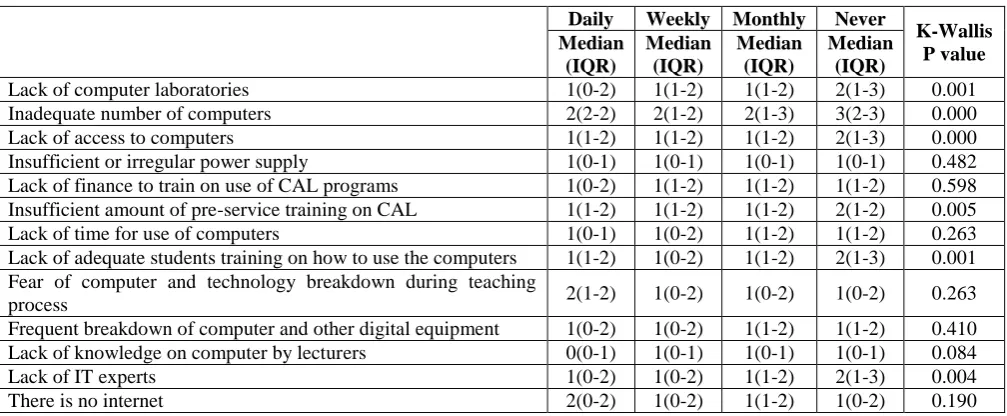
Table 2: Practices affecting CAL use on frequency of computer use.
Daily Weekly Monthly Never
K-Wallis P value Median
(IQR)
Median (IQR)
Median (IQR)
Median (IQR)
Lack of computer laboratories 1(0-2) 1(1-2) 1(1-2) 2(1-3) 0.001 Inadequate number of computers 2(2-2) 2(1-2) 2(1-3) 3(2-3) 0.000 Lack of access to computers 1(1-2) 1(1-2) 1(1-2) 2(1-3) 0.000 Insufficient or irregular power supply 1(0-1) 1(0-1) 1(0-1) 1(0-1) 0.482 Lack of finance to train on use of CAL programs 1(0-2) 1(1-2) 1(1-2) 1(1-2) 0.598 Insufficient amount of pre-service training on CAL 1(1-2) 1(1-2) 1(1-2) 2(1-2) 0.005 Lack of time for use of computers 1(0-1) 1(0-2) 1(1-2) 1(1-2) 0.263 Lack of adequate students training on how to use the computers 1(1-2) 1(0-2) 1(1-2) 2(1-3) 0.001 Fear of computer and technology breakdown during teaching
process 2(1-2) 1(0-2) 1(0-2) 1(0-2) 0.263
Frequent breakdown of computer and other digital equipment 1(0-2) 1(0-2) 1(1-2) 1(1-2) 0.410 Lack of knowledge on computer by lecturers 0(0-1) 1(0-1) 1(0-1) 1(0-1) 0.084
Lack of IT experts 1(0-2) 1(0-2) 1(1-2) 2(1-3) 0.004
There is no internet 2(0-2) 1(0-2) 1(1-2) 1(0-2) 0.190
Despite the good perception of CAL as demonstrated by[8] and other authors as shown in the literature review,
participants towards CAL programs based on the combination of all the Likert items. Twenty seven percent of participants showed a positive attitude towards CAL programs out of a record hundred percent. This
finding means that seventy three percent of the participants overall outlook towards CAL was not positive.
Figure 2: Overall rating of attitude towards CAL programs.
3.3 Student Perception of ICT Experience in Teaching and Learning
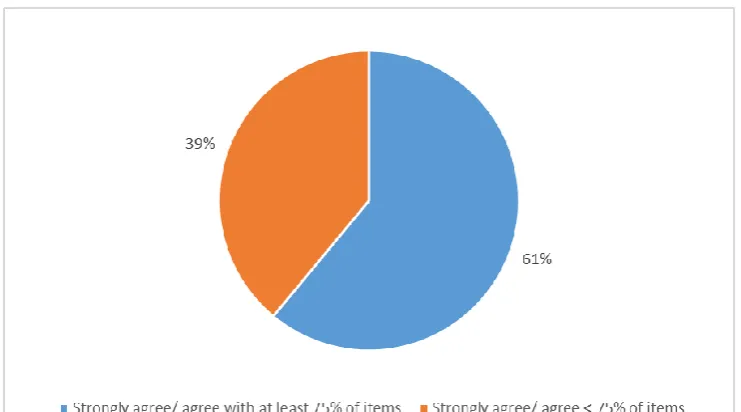
Computer Assisted Learning enhances the experience of both teaching and learning and it is the easiest method available for updating and use at ease Medical education is constantly increasing at a rapid speed and to keep the upcoming doctors and established physicians in par with the competitive world. Most students from the study either strongly agreed (66%) or agreed (29%) that learning computer would improve the presentation work in class and that computers increase the level of use of software applications (54% and 37%, respectively). Student perception to ICT experience in teaching and learning were combined, 61% of the participants either
agreed or strongly agreed. There was a significant association between knowledge and perception of ICT and participants sex (p = 0.001), Females were more likely to have positive responses compared to males (72.3 versus 49.9%). Access point was also associated with perception (p = 0.005). Accessing computers in the computer lab was associated with higher Likert scale responses.
When the responses to all items on student perception to ICT experience in teaching and learning were combined, 61% of the participants either agreed or strongly agreed with at least 75% of the items as shown in Figure 3.
Table 3: Attitude towards CAL programs versus technological factors.
Attitude towards CAL program
Positive Negative OR (95% CI) P
Technological challenges
Low (< 75% SA/ A) 66(23.5) 215(76.5) 1.00
High (≥ 75% SA/ A) 15(65.2) 8(34.8) 6.11(2.48-15.04) <0.001
There was a significant association between attitude towards CAL programs and technical factors hampering ICT use (p < 0.001). The participants reporting greater challenges were at least six times more likely to show a positive attitude towards CAL compared to those reporting less challenges.
IV. DISCUSSION
It is significant that students were particularly impressed by aspects of the program that could not be duplicated by a book; the interactive nature of the learning process and the ability to rotate the diagnostic casts. This highlights the need for CAL programs to use the full potential of computer capability, rather than merely replicate a textbook on a screen.
There was a significant association between knowledge and perception of ICT and participants sex (p = 0.001). P value is used to help tell if the null hypothesis is true of false. When the p value is less than 0.05, this means that there is a statistical association between the observed measurements and we accept the null hypothesis. When the p value is greater than 0.05, it means that there is no statistical significance and we reject the null hypothesis and go with the alternative hypothesis. Females were more likely to have positive responses compared to males (72.3 versus 49.9%). Access point was also associated with perception (p = 0.005). Accessing computers in the computer lab was associated with higher Likert scale responses. The perception of CAL among the students was closely associated with how much the students access the CAL and their knowledge on computers at KMTC. One half of the participants agreed or strongly agreed that there was: lack of computer laboratories; inadequate number of computers; lack of access to computers; and insufficient preservice training on CAL. One half of the participants agreed or strongly agreed that there was: lack of computer laboratories; inadequate number of computers; lack of access to computers; and insufficient preservice training on CAL.
Also noted that, although numerous research findings on CAL globally attest to its positive impact on students’ learning outcome,[2,8] Kenyan medical lectures, practical teachers included have done very little to introduce this modern teaching approach in their classroom practice. This ends up leaving the student at a disadvantage to realize the full potential of CAL.Likert item responses to items on technological factors affecting CAL were combined and only 8% of participants either agreed or strongly agreed with most (at least 75%) of the items.
This shows majority of the participants appreciated the effort the institution had put in place with reference to technological advancement. In our study there were 92 (48.7%) third year students among the participants, 66 (34.9%) second year students and the remaining participants were first years. These verdicts showed that the old students at KMTC were more conversant with CAL as compared with the rest of the student body. Bulk of the students, 184 (97.4%) participants reported that computers were available in college, and 138 (74.6%) said that the access point was the computer laboratory.
Approximately two thirds (69.5%) of participants had internet access in college, and 92.8% had internet server connection as opposed to paid modem connectivity. At least one-half (56.7%) of participants reported that they used internet for searching information. Seventy percent of participants reported that they had other electronic devices in college. About (59.9%) participants reported that teachers used electronic devices to aid teaching on a weekly basis.
V. CONCLUSIONS
Based on the results and discussions, among the main problems that key informants described during the study, regardless of the fact that there was a significant association between knowledge and perception of ICT and participants gender, female students had more access to CAL facilities as compared to the male students. There was noteworthy strides that the institution had done with respect to providing the infrastructure to aid CAL, a number of students strongly agreed that there was lack of computer laboratories, inadequate number of computers; lack of access to computers; and insufficient pre-service training on CAL. In the face of all the challenges that the students faced with reputes to access in CAL, the students agreed that CAL made learning easy as students could access information online by a click of a button.
VI. RECOMMENDATIONS ON RESEARCH
FINDINGS
VI. ACKNOWLEDGEMENT
I would like to acknowledge my family, my supervisors and the entire Kenya Medical Training College Nairobi campus.
REFERENCES
1. Jwayyed S, Stiffler K, Wilber T, Southern A, Weigand J, Bare R, and Gerson W (2015).Technology-assisted education in graduate medical education: a review of the literature.J Surg Educ, 2015 Nov-Dec; 72(6): 1145-57. doi: 10.1016/j.jsurg.2015.05.008. Epub 2015 Jun 22. 2. Owston, R. D., The World Wide Web: A technology
to enhance teaching and learning? Educational researcher, 2016; 26(2): 27-33.
3. J.S., Armstrong, "Natural Learning in Higher Education". Encyclopedia of the Sciences of Learning. Heidelberg: Springer, 2012.
4. Abel M. Mugenda., Ministry of Education Science and Technology Sessional Paper, Nairobi; Government printers, 2008.
5. John D. Bransford, Ann L. Brown, and Rodney R. Cocking, How People Learn: Brain, Mind, Experience, and School Washington, D.C.: National Academies Press, 2015.
6. Omwenga, I. E., Pedagogical issues and e-learning cases: Integrating ICTs into teaching and learning process. Paper presented at the School of Computing and Informatics University of Nairobi. Nairobi, 2017.
7. Normaliza A, Malik F, Jiaguan Z, Otto Lok Tao Lam, Lijian Jin, and Colman McGrath. Effectiveness of computer-aided learning in oral health among patients and caregivers: a systematic review. J Am Med Inform Assoc, 2017; 24(1): 209-217.