Volume 2, Issue 7, 2015, pp. 105-122 Available online at www.jallr.ir ISSN: 2376-760X
* Correspondence: Ali Taghinezhad, Email: [email protected] © 2015 Journal of Applied Linguistics and Language Research
On the Role of First Graffito in the Emergence of More
Vandalism
Laleh Sheivandi
Sheikhbahaee University, Isfahan, Iran
Ali Taghinezhad *
Department of Foreign Languages and Linguistics, Shiraz University, Iran
Zahra Bazyar
Department of Foreign Languages and Linguistics, Vali-e-Asr University of Rafsanjan, Rafsanjan, Iran
Sayed Javad Tabaeifard
PhD Candidate in TEFL, University of Tehran, Iran
Abstract
This article focused strictly on how a total number of one hundred collective textual memoranda provoke people to add to previous vandalism in Iranian culture. The study was guided by Wilson and Kellingʼs (1982) theory of Broken Window. In the main, collective written evidence was collected based on Broken Window Theory (BWT) suggesting that signs of disorderly and petty criminal behavior trigger more disorderly and petty criminal behavior, thus causing the behavior to spread. BWT gives no insight into what is and what is not a condition of disorder that will spread. As part of the scrutiny process, this study focused on the ways different messages were presented by means of graffiti and the ways they had aroused the others to write or paint graffiti following the first one. To do so, 413 graffiti (first graffito and responses) scribed on different surfaces in Iran were studied and categorized according to Gadsbyʼs Taxonomy (1995) and Blumeʼs (1985) two major classifications of motivations beneath graffiti. 219 related graffiti and 194 non-related graffiti in the groups were found. The data analysis demonstrated that people would add to previous vandalism either they wanted to discuss the same issue or just wanted to write something. The largest collective group contained 26 graffiti to the extent of a wall in bathroom of a university. Furthermore, the results revealed that when people observed that others violated a certain social norm or a legitimate rule, they were more likely to violate norms or rules, which caused disorder to spread.
INTRODUCTION
According to Rose (2002), all different sorts of technologies and images present the world in visual terms. It seems true because our contemporary environment is full of visual elements both natural and human product which everyday people use consciously or unintentionally. In fact, these communicational elements within our society are displayed in a wide range of implications, including traffic signs, fire sign, advertisings, guidance symbols of buildings, and the like. Overall city space surrounds us with the different billboards. As a matter of fact, we live among the signs, symbols and images, presented on these billboards. Billboards, panels and wall writings displaying many religious and symbolic aspects are considered as legal forms of graffiti, and they have a commercial value and authorities don’t clear or remove them as nonstandard presentation.
Apparently, Graffiti is cultural phenomenon. Graffiti writers try to convey their messages what they are feeling whether racism issues about gender, ethnicity, aesthetics into something that is beautiful or utilization of graffiti writing as a means of communicating political messages and reflecting social climate, public opinions, protests or dissatisfactions towards ongoing events and governmental activities. For this reason, graffiti is an ambivalent and multifaceted phenomenon and reflected in various terms and aspects (Harris, 1995; Kirsch, 1995). One may think that graffiti is relatively recent phenomenon, which occurred in the middle of 20th century, and in fact, it is true regarding wall writings in its contemporary form but many people know its history. Plenty of researchers agree that graffiti is rooted in ancient times and prehistoric period (Mullen, 2008; Coppens, 2003; Ambrose, 2006; Iyer, 2001). Countless ancient cave paintings and engravings all around the world can be considered as ‘predecessors of contemporary graffiti. At first, during the prehistoric period, the primitive human used many creative symbols, markings and magic tool on the surfaces merely for the sake of maintaining art (Ambrose, 2006). Contemporary graffiti is surely indispensable to turn towards its roots.
perceive that graffiti serves to express or perpetuate negative ideas about other groups. Graffiti constitutes an act of self-disclosure and an expression of a very personal nature, but maintains the writer’s privacy through anonymity (Gross, 1997).
REVIEW OF THE LITERATURE
Graffiti as a Reflection
Graffito is utilized to define any inscriptions, drawings or markings on the surfaces of exteriors and interiors of different buildings, regardless of their function, remarkably, usually made without owner of property’s consent (Whitford, 1992) so it is considered rebellious in nature and illegal in practice. Much of it has to do with tagging, putting a name down so as to label the selected area as one’s own. People—‘wall writers’—also use their creativity in innovating new techniques. As it is already mentioned at introduction, graffiti has originated of prehistoric walls and since then evolved and developed into present contemporary graffiti. Therefore, graffito could appear almost on the all walls of ordinary apartment blocks, on governmental buildings, even places of worship and on each other surfaces. Apart from forms and symbols, color is one of the elements, which plays a major role in graffiti work. Most of the graffiti are made by black and red colors, which have specific meaning in different culture. According to Danesi (2004) “colors are, in effect, signs that we can use to represent whatever we deem appropriate” (p. 75). Interestingly, color may carry a lot of symbolic significance, especially in the context of different cultures and religions and therefore, can be understood and interpreted in many various ways according to psychological view; colors can express inner spirits of a person. For instance, red color in one culture shows the bad characteristics. It is symbol of war, slaughter, dominance, and violence while in another culture it may represent vitality and entertainment (Morton, 1997).
Nowadays, due to its rapid spread into visual language of mainstream, graffiti have been utilized as powerful marketing tool. This phenomenon can largely be attributed to the key features of graffiti: accessibility and anonymity. Because of possessing strong communicative properties and possibility for writers to keep their anonymity, graffiti as a psychological weapon turn into one of the dominant mediums to reflect social conditions, transmit political statements and share information. However, graffiti as a valued mean for ordinary individuals and groups, and a different quality from other more “legitimate” forms of media has come to scene. It as “one of the easiest and most efficient” way to declare protest and anger and variety of socio alienation and political opinions, anti-system ideas and concerns is a faceless agent for communicating social attitudes within particular economic, political and social settings (Chaffee, 1990).
Broken Window Theory: graffiti as negative phenomenon
researchers, in one way or another refer to “Broken Window Theory” in order to underline and strengthen idea of graffiti as negative, destructive phenomenon.
In the late 80's, New York experienced a high rate of violence and crack was everywhere. In 1985 when George L. Kelling, coauthor of the article "Broken Windows", was hired as a consultant to the New York City Transit Authority, the subway was awful. Kelling implemented new measures. He made every graffiti disappeared and cleaned every station. Day after day after day, new graffiti would be made in the night and removed during the day, until one day the new policy started to be successful and graffiti progressively disappeared. Mayor and police department of New York also employed the same method, they implemented a zero tolerance policing with easier arrestee procedure. Police started enforcing the law very strictly, against subway fare evasion, public drinkers, urinators, and the like. The rates of both petty and serious crime fell suddenly and significantly.
The “Broken Windows” theory is a criminological theory of the norm-setting and signaling effect of urban disorder and vandalism on additional crime and anti-social behavior developed in a 1982 article by James Wilson and George Kelling. The article received a great deal of attention and was very widely cited. As a matter of fact, many foes of graffiti often utilize this core idea of “Broken Window Theory”, which claims that “if a window in a building is broken and is left unrepaired, all the rest of the windows will soon be broken” to support anti-graffiti arguments. The title comes from the following example:
Consider a building with a few broken windows. If the windows are not repaired, the tendency is for vandals to break a few more windows. Eventually, they may even break into the building, and if it's unoccupied, perhaps become squatters or light fires inside. Or consider a pavement. Some litter accumulates. Soon, more litter accumulates. Eventually, people even start leaving bags of refuse from take-out restaurants there or even break into cars. (Willson and Kelling, 1982, p.2)
A successful strategy for preventing vandalism, say the book's authors, is to fix the problems when they are small. Repair the broken windows within a short time, say, a day or a week, and the tendency is that vandals are much less likely to break more windows or do further damage. Clean up the sidewalk every day, and the tendency is for litter not to accumulate (or much less litter accumulation). The theory states that maintaining and monitoring urban environments in a well-ordered condition may stop further vandalism and escalation into more serious crime.
breakdown of community controls” (p. 3). They state that graffiti along with trash, broken windows, and other forms of urban decay supports this idea that things go from bad to worse when vandalism is left unchecked. Citizens no longer feel safe, and try to avoid areas such as these. This leads to an increase in delinquency and criminal activities.
It is assumed that under the broken windows theory, an ordered and clean environment – one which is maintained – sends the signal to criminals that the area is monitored and that criminal behavior will not be tolerated. In reverse, a disordered environment – one which is not maintained (broken windows, graffiti, excessive litter) – transmits the message that a community displays a lack of informal social control and is therefore unable to or unwilling to defend itself against a criminal invasion actually it is an area with little risk of detection. "Broken window theory says that if there are broken windows in houses, it will lead to more disorder and a degrading neighborhood," says Keizer (2007). Blume (1985) outlines two major classifications for motivations behind writing graffiti: Conversational and Declarative. Conversational graffiti solicits a written response from some known or unknown person. The most common place to find conversational graffiti is in the restroom thought it is not exclusively latrinalia and it is possible to see some in library carrels, public walls other places. Moonwomon (1995) studied conversational graffiti discussion. One short graffito resulted in thirty-six responses regarding an occurrence of great local significance. Many of the comments were questions, inviting further response to the discussion. A person writing declarative graffiti is not attempting to obtain any written response from his/her readers. The graffito simply states a point of view or humorous comment. Artistic graffiti or tags would also fall into this category as does the vast majority of the graffiti fall (Posener, 1982, 32-34).
Keizer puts forward that nevertheless the theory is from 1982, no one had conclusively demonstrated it's true, so he and his colleagues, Siegwart Lindenberg and Linda Steg, created six field experiments to put it to the test. In each of the experiments, the researchers set up real-life situations in Groningen in which random citizens would be tempted to do something unruly, illegal, or antisocial by imitating norm-breaking behavior of others. The passing individuals or groups were not realizing they were under observation. Then, they discreetly watched what happened in the setting.
Range of types and styles of graffiti
Halsey and Young also outline the following motivations (p. 279): -aesthetical appeal of graffiti; -opportunity of social interaction; -powerful emotional and physical sensations in the act of writing (e.g. pride, pleasure, recognition obtained from writing community, etc.); litical events.
An article, retrieved from the internet page of Vandal Watch Society, presents quite detailed list on types and styles of graffiti. Referring to Vandal Watch Society, there are the following different types of graffiti:
- “Hip Hop or Wild Style”: is a form of graffiti characterized by complexity of shapes and colors, complicated interlocking letters and connecting points, arrows, and embellishment usually pre-planned (Chalfant, 1984).; involves incorporation of graffiti maker’s tag, where typographical elements are presented in three-dimensional or bubble-like forms); Hip hop graffiti, originated in the United States, usually comprise 'tagging' and mural paintings. It is referred in the literature as the most common form of graffiti. Like all forms of graffiti, it is spray painted on different surfaces frequently illegally. Writing an alias on surfaces such as walls, fences and public transport facilities is the most visible and abundant form of it (Halsey & Young 2002).
- “Tag or Signature”: It is the most common form of graffiti. Name of a graffiti maker that usually writing of which does not require much time and consists of what appears to be scrawl. Material used for this type generally are spray or marker of single color; Tagging, similar to gang graffiti, shows a kind of personalized signature and stylized name left by individual as signifier to mark his/her presence in a place, (Whitehead, 2004). Tags can contain subtle and sometimes allusive messages, and may mingle the graffiti writer's crew initials or other letters.
- “Gang”: emerged in U.S. and implied by gangs’ groups to mark territorial boundaries (Stowers, 2009). In recent years anthropologists study gang culture increasingly. Phillips (1999) clarifies gangs are relied on the larger context from which they are born. This reflects perhaps a disputable form of what Turner (1969) referred to as "antistructure": the antithesis of the larger system.
- “Non-descript”: considered to be meaningless in terms of writer. For example it might be written name of music band or favorite sport team
- “Bubble gum”: the eternal proclamation of love
- “Socio-political”: predominantly related to adult members of society, and involves statements and criticism of particular socio-political situations and events
- “Skateboard”: drawing graffiti on skateboard
- “Satanic”: illustrates occult and satanic symbols. Pentagrams, crosses, inverted chalices, satanic words, and skeletal figures are a few examples of this category.
- “Religious”: religious reference in graffiti
- “Stencil”: is a form that makes use of stencils made out of paper, cardboard, or etc. by holding the stencil against the wall and spraying very quickly. It usually implied for the purpose of reflecting socio-political statements; the use of graffiti as a communication medium and as “a social and political” by many different political forces, including those who are marginalized in the struggle over power (Chaffee, 1990).
- “Eulogy”: graffiti in memory of friends or the loved ones
Some of the most common styles of graffiti have their own names. Nowadays, there is a great variety of graffiti’s kinds and styles (some of them are like pervious classification), already partially outlined and listed, ranging in accordance with techniques and tools implied (e.g. stencils), location and placement (e.g. private; public), as well as peculiarity of visual features (e.g. tags; pieces) and underlying messages (e.g. socio-political):
1. Longencker (1977) in the article “Sequential Parody Graffiti” argues about a type of private graffiti known as ‘latrinalia’, simply saying the writings which can be confronted in public bathrooms. According to Kane (2001), “bathroom” graffiti existed all history at different locations and civilizations, and been produced generally by socially repressed individuals (slaves, prisoners). Longencker with reference to Dundes’s terminology (1966), introduces ‘latrinalia’ as ‘traditional inscriptions’ which might be called as ‘commentary graffiti’. Besides, Longencker presents Dundes’s classification of ‘latrinalia’ graffiti into five categories, where name of each category talks for the purposes of writer:
Advertisements or solicitations;
Requests or commands;
Directions;
Commentaries;
Personal laments or introspective; (in Longencker, p. 355)
Furthermore, there is an interesting research by Cassar (2007) that considers writings in the female bathroom of postsecondary school in Malta. He renders that educational aspects of graffiti is silent and mindless protest for girls against lack of sexual education at school and, is used as communicative medium among girls to share experiences, ask questions and make commentaries.
Nevertheless, according to Snyder (2009), there is a great range of public graffiti, created with specific intentions and purposes. The most common and known types of public graffiti have been listed and defined as follows:
3. Another form is the "throw-up", also known as a "bombing". This type sacrifices aesthetics for speed. It is normally painted very quickly with two or three colors, but can also be outlined on a surface with one color.
4. A "piece" is a more elaborate representation of the artist's name, incorporating more stylized letters, usually incorporating a much larger range of colors. This of course, is more time-consuming and for this reason it is the most likely the artist getting caught. It is almost always done in a block-shaped style, done directly to cover a large surface solidly with two contrasting colors. Murals or pieces are the more artistic types of graffiti. These usually contain large complex lettering and are often a form of tagging that cannot be easily deciphered. Halsey and Young (2006) believe predominantly type of graffiti called “pieces” is considered as art due to the fact that it displays immense skills, intent, and aesthetics
5. A more complex style is "wildstyle". In previous paragraph it is said that wildstyle is other name of Hip Hop
6. Graffiti has been displaced by a new type of highly damaging graffiti known as etching. Etching is very common on buses and trains and involves the scratching of glass surfaces with a drill bit or sharp implement. Etching has become a serious problem for transport organizations and they have expressed concerns about the increasing costs of replacing etched glass.
7. General graffiti (racist, obscene, consisting of political slogans) etc. Beck (1982) suggests that graffiti may educate about humor, as well as great deal of “poetic and other stepped-up language” (p. 74).
RESEARCH QUESTIONS
The study attempted to answer the following research questions:
How much does the first graffito lead to more vandalism?
What is the reaction of other individuals towards a graffito? METHODOLOGY
Materials
Procedures
According to BWT one hundred collective memories and writings, actually amount to 400 graffiti which can be commonly encountered in society were collected. All these included writings on the walls, engraving on the trees, tables and other objects of public use. Then collective memories were classified according to the purpose of their writer and the different kinds of graffiti and reply to them were specified. Part of the problem with graffiti research, as outlined in the review of literature, is that so many approaches are being employed and expansive range of types and styles of graffiti being analyzed. This makes it difficult for researchers to determine types of the available material. Therefore, Gadsbyʼs Taxonomy of Graffiti Texts (1995) was used. The rationale behind using this Taxonomy is that it is almost broad enough to analyze collected graffiti according to existing types and styles. And also as Dundes (1966) pointed out, the term "graffiti" is too broad for accurate usage as "it included all kinds of inscription and marks placed on walls", it is possible there be graffiti outside of scope of taxonomy, in this case, they are considered according to others classification. Following are the brief definitions of the six common types taken from Gadsby (1995):
1. Latrinalia: This term was first coined by Dundes to refer to graffiti found in restrooms, because, as he states in his article "Here I Sit--A Study of American Latrinalia," it is preferable to the term "shithouse poetry". Latrinalia is the most common type of studied graffiti since "one of the few places where dirt is displayed and discussed in American culture is the bathroom, private and public."
2. Public: Quite often graffiti written on exterior walls of buildings or subway cars, etc., is just referred to as "graffiti." This type of graffiti is far too important not to be recognized as distinct. Therefore, I use the term public since these graffiti are often territorial or contain messages offered for mass consumption. These graffiti usually appear outdoors or in high traffic indoor areas such as bus stations or libraries.
3. Tags: Often tags are part of public but not always. They do utilize the same locations and surfaces but the basic difference is that the message is meant only for insiders to the community. Those who study graffiti will start to recognize that each tag is unique and represents a person. This is much more individualized than a mere name, since many people can have the same name. It is closer to being like a fingerprint--no two people have the same tag. A tag usually involves the blending of several different elements, piecing together a part of the writer's name or initials, their street number, a symbol or something else of significance to them. Norman Mailer (1974) includes quite a list of these tags in his book “The Faith of Graffiti”, including such examples as CAY 161 or TAKI 183.
through other historical or archival sources. The most famous examples of this type are the wall writings of the people of Pompeii which have been examined by people like Lindsay (1960) or Tanzer (1939).
5. Folk Epigraphy: This type of graffiti is, as the name implies, the carvings of the common people. Usually folk epigraphy is craved into rock, trees or finished wood surfaces. However, in Lindsay (1960) the people of Pompeii carved graffiti into the walls around them. Read (1977) accumulated an early collection of folk epigraphy when he travelled the United States in 1928. Folk epigraphy seems to be a dying art form, especially since the advent of spray cans and magic markers which are faster and easier to use.
6. Humorous: The humorous category is a very difficult one to pin down. A lot of the graffiti accumulated through the entertainment methodology (such as the books by Colombo and Mockridge) fall into this grouping but there is more to humorous graffiti then that. Beck (1982) and Warakomski (1991) look at this graffiti linguistically or to analyze the motivations of the writers.
It is important to remember that a single piece of graffiti could be considered as more than one type. The identified variables were classified, counted and specified their numbers. The results would be presented.
RESULTS
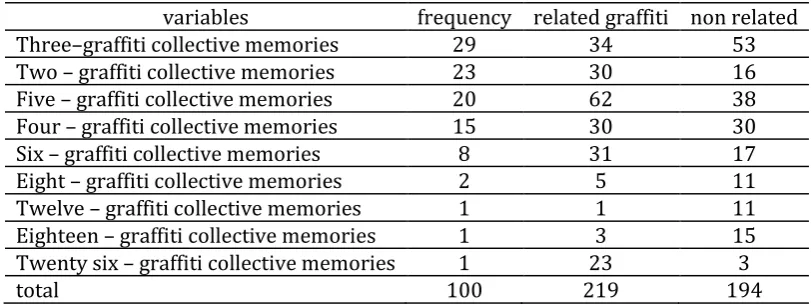
Table 1. Quantitative Analysis of collective graffiti
variables frequency related graffiti non related
Three–graffiti collective memories 29 34 53
Two – graffiti collective memories 23 30 16
Five – graffiti collective memories 20 62 38
Four – graffiti collective memories 15 30 30
Six – graffiti collective memories 8 31 17
Eight – graffiti collective memories 2 5 11
Twelve – graffiti collective memories 1 1 11
Eighteen – graffiti collective memories 1 3 15
Twenty six – graffiti collective memories 1 23 3
total 100 219 194
Each of these ten variables (collective memories), followed by its examples, is presented briefly in the next sections. The members of each group were analyzed and specified the type of graffito.
Three–graffiti collective memories
29 three–graffiti collective memories were found. This example shows Conversational motivation. Conversational graffiti solicits a written response from other person. Two of these graffiti, based on Gadsbyʼs Taxonomy, are tag because the message is meant only for insiders to the community and one (darband) is humor. However, according to Kaneʼs categories, “it’s none of your beeswax!” is a general graffito (obscene).
.1
"
یت افّ اجک ؟یریه
"
"Going-you where fair-weather?" Where are you fair-weather going?)
)
".2
ذٌترد
"
(Darband) .3
َت ْت ؟َچ
"
(It's none of your beeswax!) Two – graffiti collective memories
Among collected graffiti, 23 three–graffiti collective memories were found. Most of these groups contained advertising Graffiti and Commercial ads. This category presents product, which hold commercial values and don’t mention personal issues, or non-profit concepts oriented towards advantage for humanity. Here first graffito simply introduces an agency, a plunger and a sad poem. According to Blume (1985), they are declarative graffiti which are not attempting to obtain any written response from his/her readers and are not inviting discussion. In a two-member group, when the first graffito was commercial usually the second was commercial too. In some cases, one of the graffiti was advertising or commercial and in some other cases, both graffiti were from other types of graffiti.
classification of ‘latrinalia’, "Sorrow in my heart is like the size of world" is a personal lament: .4 " صًاژآ ىاشکِک " (Kahkeshan agency) " صًاژآ ىاریلد " (Daliran agency) .5 “ َلْل یٌکزات ،یرذیح َت ترْص رایض "
"Ambulant as, Heidari plumbers"
(Heidari plunger as ambulant.)
ات فیفخت ٍژیّ " "
"Specific discount with" (With specific discount)
.6 " نغ رد لد يه َت رذل َولاع "
“World-is to the extent of I heart in sorrow
"
(Sorrow in my heart is like the size of world)
" لایخیت اتات ظزرا ٍراذً "
"Doesn’t have value man come on" (Come on man, it doesn’t worth) Five – graffiti collective memories
20 five–graffiti collective memories were specified. This example is declarative graffiti that contains two public graffiti (advertising) and three tags (according to Kaneʼs categories, one of them, poem, is general graffiti and both are a part of the writer's name or initials, their street number, a symbol or something else of significance to them.)
".7 ظّرف ّ ةصً يیترّد َتطتراذه "
"Closet Circuit television installing and selling" (Selling and installing of Closet Circuit television) 8 ". تطتراد لْضر " (Rasoul scaffold) .9 " یا َشداپ ىاتْخ داد زا نغ ییاٌِت "
"Loneliness anguish of cry king O!" (O! king of goods, save us all from loneliness anguish) Four – graffiti collective memories
In data, the number of four – graffiti collective memories was 15. The example below show a Four – graffiti collective group. Two of them are tag (according to existing categories first graffiti is eulogy) and two else are the ironic answers with swearword, actually humor graffiti. According to Kaneʼs categories, they all are general graffiti. The last graffito is not in response to other graffiti at all. Although first graffiti is declarative but acted as conversational and has caused others to react.
"I-Love-you much that wow" (Wow, I love you so much) ".11
غّرد یگیه
"
"Tell-you lie" (You are lying) 12 ”. ًَ َت اذخ تضار نگیه "
"Say-I true by gum no" (By gum, honesty I say) ".13 رگا كشع ىداتطیا رض َچْک تضا صپ قرتریت كشاع يیرت تضا "
"Is the most lover lamppost thus is top alley standing love if" (If love is standing on the top of alley, the lamppost is the most lover person) Six – graffiti collective memories
The number of this category was not so much. Most of 8 six – graffiti collective memories were advertising graffiti and commercial ads. They are not inviting discussion and thus motivations behind them were declarative. In this group and four other groups, when the first graffito was commercial the others was commercial too. Just in one group, kind of graffiti is different. First and second graffiti (advertising) are public. The rest are tag (However, based on Vandal Watch Society they can be gang too and also "War of ameniea" is considered to be meaningless thus is non-descript:
" ُْ یلع یلاْه ىایمته " .14
“pious individuals superior Ali he" (He is Ali superior of pious individuals) "تلاذصیطکات" .15 (Sedaghat Taxi)
Hassan taheri .16 War of ameniea .17 Eight – graffiti collective memories
It is 2 groups in all. Most of them were advertising graffiti but some bubble gum, non-descript, gang and eulogy were found among them. According to Gadsby, graffiti in these two groups were public and tag. Motivation of graffiti of this group is not conversational.
ْت سگرُ
"
B" .18 "Without you never" (It is impossible without you)
" یکی دْت مزٌُْ تطُ " .19
“Is yet-also was one" (One was and yet also is) S: A .20 Suzuki .21
"
يیتْکیً
(Nicotine)
"
کراپ
=
یرچٌپ
" .23 "Blowout = park"
(Park = blowout) I love you .24 Zizo .25 A: M .26 Twelve – graffiti collective memories
This group with 1frequancy is full of tag and public graffiti. But if narrow downing, these graffiti are advertising and non-descript thus those are categorized as graffiti with declarative motivations.
27.
"
jushkari sayyâr
"
(Mobile welding) Skyboy .28 Ahmad & vahid .29 Armin .30 "M2 dash âkol”.31 "M2 Akol bro"
)
M2 Bro Akol) “ tâksi ghods” .32
(Ghods taxi) Masoud .33 Reza .34 Mohammad .35 "zud gul mikhori" .36 "Get tricked- you soon" (You get tricked easily) Mohammad javâd.37 (Mohammad javad) A: h .38 Eighteen – graffiti collective memories
This group with 1frequancy like previous collective memories not only is full of tag and public graffiti but also with narrow downing, its graffiti including very non-descript graffiti are a little strange. They are not with conversational motivations. Some of these graffiti are as following:
"
یطکات يضْت
رحض
" .39 "Sahar tosan taxi" (Tosan Sahar taxi)
ماها
" " .41 (Emam) Kickboxing .41 "شرپطکایهاک ".42 (Express Kami)
رْشرایخ
" " .43 (Pickle) " داد ّ یْل " .44 "Strong and crying" (Crying and strong) Masoud .45 Twenty six – graffiti collective memories
And the last and most interesting collective group is belonging to graffiti written on the wall of restroom in a university. Although the first graffito is declarative graffiti which does not attempting to obtain any written response from his/her readers and are not inviting discussion but this statement is so controversial that converted to features of a graffito with conversational motivation and solicits the written response from different students. Many of the comments invited further response to the discussion and this issue results in 25 responses covered the whole wall.
The first graffito is actually a tag or in exact meaning a personal lament that made other students angry and incited them to brag about their cities with abusive and courteous graffiti. In some cases, graffiti is highly offensive and inflammatory, being used as a form of attack against an individual or group of people. Individuals vent their anger and frustration on bathroom’s wall. Some graffiti are shown below:
".46 نلاح ِت ن یه ٍرْخ زا يیا بارخ ٍذش یک َشیه مْوت َشت نیرت رِش ىْهدْخ "
I'm getting sick and tired of this cheap garbage. When does it finish and we will come back our city?
تدْخ مْوت یشت لاغشآ
" " .47 "Crap die-you yourself" (You yourself die, crap!)
ترْثجه ىدرکً اجٌیا یًْوت ّرت ْشوگ
" " .48 "Get out the way stay-you here don’t haven to- you- they"
(Get out the way; nobody forces you stay here!)
اْعد ذیٌکً َوُ یاج ىاریا یارض يه تضا " ".49
"Is I home Iran all anywhere don’t quarrel"
)don’t argue, all places in Iran is my home)
َلتا
" ".50
)idiot(
يیتضاْخیه ّراجٌیا باختًا ذیٌکً ریصمت ًَْتدْخ
" ".51
(You didn’t have to choose here, it is your fault.) DISCUSSION AND CONCLUSION
According to information, gathered through literature review, contemporary graffiti greatly ranges in styles and types, along with intentions and purposes of the writer. Regarding types of graffiti, nowadays there is differentiation between tags, gang graffiti, latrinalia and many others, where each kind can be characterized by particular features not only by means of application but also in terms of ideological content. In this study, based on BWT, all collective memories and writings were collected and counted the number of members (graffiti) in the group. There was a group of graffiti that had covered all surface of a wall and had the highest frequency among all one hundred collective graffiti with 26 members. Gadsbyʼs Taxonomy of Graffiti Texts (1995) and Blumeʼs (1985) two major classifications of motivations were used to categorize gathered graffiti and based on graffiti categorization, the frequency of both related and non-related were determined. Regarding the above analyses, Results indicated that people write graffiti for a variety of reasons. They that become involved in graffiti don’t want just to participate in discussion. In most of cases, all graffiti in a group were not related to each other and people have not always replied to other graffiti and had seen graffiti as a way of achieving identity and etc. and an opportunity to be noticed or venting their inner emotions and excitements. By analyzing data, Willson and Kellingʼs theory was confirmed i.e. graffiti on the surfaces of public and private properties encouraged people to add to them, regardless any motivation. This study was done based on Broken Window Theory as its framework. Similar studies can be done using other frameworks investigating this issue.
REFERENCES
Abel, E. & Buckley, B. (1977). The Handwriting on the wall: Toward a sociology and psychology of graffiti. London: Greenwood Press.
Ambrose, D. (2006). 30,000 BC: painting animality-deleuze and prehistoric painting. Angelaki Journal of the Theoretical Humanities, 2(2), pp. 137-152.
Beck, J. (1982). Graffiti: The vulgar blackboard’s wit. The English Journal, 71(3), 73-74. Blume, R. (1985). Graffiti. In T. A. van Dijk (Ed.), Discourse and literature (pp. 137-148).
Amsterdam: John Benjamins Publishing Company.
Cassar, J. (2007). Unveiling desires: Adolescents' hidden graffiti about sexualities and romantic relationships in schooled Settings. The International Journal of Humanities, 5 (4), 179-183.
Chaffee, L. (1990). The popular culture political persuasion in Paraguay: Communication and Public Art. Studies in Latin American Popular Culture, 9, 127-148.
Coppens, P. (2003.). Cave Paintings: Entrancing the otherworld. Retrieved from: http://www.philipcoppens.com/cavepaintings.html
Danessi. (2004). Messages, signs and meanings: A basic textbook in semiotics and communication theory. Canadian Scholars Press: Toronto.
Dundes, A. (1966). Here I sit: A study of American Latrinalia. Kroeber Anthropological Society Paper, 34, 91-105.
Ferrell, J. (1993). Crimes of Style: urban graffiti and the politics of criminality. Journal of Criminal Justice and Popular Culture, 3(4), 98-101.
Ferrell, J. (1995). Urban graffiti: Crime, control and resistance. Youth & Society, 27(1), 73–92.
Gadsby, J. (1995). Looking at the writing on the wall: A critical review and taxonomy of graffiti texts. Unpublished M.A thesis. Boston: USA.
Gross, D.D. & Walkosz, B. (1997). Language boundaries and discourse stability: Tagging as a form of graffiti. ETC: A Review of General Semantics, 54(3), 274 – 286.
Gross, D. & Gross, T. (1993). Changing visual patterns and the rhetorical implications of a new form of graffiti. A Review of General Semantics 50(3), 250-264.
Halsey, M. & Young, A. (2002). The meanings of graffiti and municipal administration. The Australian and New Zealand journal of criminology 35(2): 165–186.
Halsey, M. & Young, A. (2006). Our desires are ungovernable: Writing graffiti in urban space, Theoretical Criminology, 10(3), 275-306.
Harris, R. (1995). Signs of writing. London/New York: Routledge.
Holquist, M. ed. (1981). The dialogic imagination: Four essays by M.M Bakhtin. Austin, TX: University of Texas Press. p. 423.
Iyer, L. (2001). Cave paintings and wall writings, Blanchot’s signature. Angelaki Journal of the Theoretical Humanities, 6 (3), 31-43.
Kalerante E., & Mormori, P. (2005). Graffiti as a form of social and cultural conflict: the Greek case. The 3rd International Conference on New Directions in the Humanities, United
Kingdom.
Kan, K.H. (2001). Adolescents and graffiti. Art Education, 54 (1), 18-23.
Kane, S. C. (2009). Stencil graffiti in urban waterscapes of Buenos Aires and Rosario, Argentina. Crime Media, Culture, 5 (1), 9–28.
Keizer, K. (2007). Can the can. The Economist.
Keizer, K; Lindenberg, S. & Steg, L (2008). The spreading of disorder". Science, 322(2008), 1681–1685.
Kirsch, H. (1995). Taking the message to the streets: Graffiti campaigns and community mobilization. In H. W. Kirsch, et al. (Eds.) Drug lessons and education programs in developing countries (pp. 263-270). New Brunswick, NJ: Transaction.
Longenecker, G. J. (1977). Sequential parody graffiti. Western Folklore, 36, 354– 364. Moonwomon, B. (1992). The writing on the wall: A border case of race and gender. In
Hall, K. and Bucholtz, M. (Eds.).
Phillips, S. (1999). Wallbangin’: Graffiti and gangs in L.A. Chicago: University of Chicago Press.
Rose, Gillian (2002) Visual Methodologies. London: Sage Publications.
Rychlicki, T. (2008). Legal questions about illegal art. Journal of Intellectual Property Law & Practice, 3 (6), pp. 393-401.
Shivandi, L.; Taghinezhad, A.; Alishavandi, A.; Ranjbar, S. (2015). Exploring linguistic aspects in Iranians’ graffiti. Journal of Applied Linguistics and Language Research, 2(5), 62-73.
Snyder, G. J. (2009). Graffiti lives: Beyond the tag in New York’s urban underground. NYU Press.
Stowers, G. (1997). Graffiti Art: An essay concerning the recognition of some art form as graffiti art.
Stowers, C. L. (2009). American graffiti: The tradition of illegal public name writing in the United States. The Global Journal of Hip-Hop Culture, 62-68.
Whitehead, J. (2004). Graffiti: The use of the familiar. Art Education, 57(6), 25-32. Whitford, M.J. (1991) Getting rid of graffiti. A practical guide to graffiti removal and
anti-graffiti protection. New York: Van Nostrand Reinhold, Inc.