Journal of Applied Linguistics and Language Research Volume 3, Issue 4, 2016, pp. 211-216
Available online at www.jallr.com ISSN: 2376-760X
* Correspondence: Kobra Davoodi, Email: [email protected] © 2016 Journal of Applied Linguistics and Language Research
On the Use of Interpersonal Metadiscourse Markers in
Conclusion Section of Language Testing Articles
Kobra Davoodi *
MA student of TEFL, Islamic Azad University, Torbat-e-Heydariyeh Branch
Abstract
The present study examined the use of interpersonal metadiscourse markers in 100 conclusions of testing articles written by Iranian & European language testing experts. The selected corpus was analyzed through the Dafouz’s (2003) taxonomy of interpersonal metadiscourse markers model. The results revealed the metadiscursive resources are used differently between the two languages. As for the two authors, the results revealed that interpersonal markers were present in both groups of texts while Iranian scholars use interactional elements more frequently in comparison with their Europeans.
Keywords: interpersonal metadisourse markers, testing articles, Iranian authors, European authors
INTRODUCTION
The focus of this study is on use of metadiscourse as an essential characteristic of a text. The interactive metadiscourse markers used in the conclusion part of 10 Iranian and10 European testing articles will be compared to see whether there is any similarity or differences between the two in the use of these metadiscourse markers. In fact, this study aimed at examining the interpersonal metadiscourse categories mostly used in these two groups of texts and identifying the similarities and differences between their writers in this regard. Before going any further into the research there is need for some definition and clarification.
much favor with those who adopt a process orientation to teaching writing (Leki, 1991). Although mainly concerned with student essay writing in its first 30 years, the area of study today contributes to knowledge about preferred patterns of writing in many English for special purposes situations.
In contrastive rhetoric the concept of tertium comparationis or common platform of comparison is important at all levels of the research: in identifying texts for building comparable corpora, selecting textual concepts to be examined across the corpora, and identifying and distinguishing between different types of linguistic resources used to realize these concepts (Connor-Moreno, 2005). If we are going to do a contrastive rhetoric analysis we should try to compare things together which have similarities in their text form, genre, mode, participants, writers’ level of expertise, purpose of communication, and so on and so forth. Then after identifying these similarities in our corpus we should search for differences.
The analysis of discourse is the analysis of language in use, the ways linguistic forms are employed for social purposes - what language is used for. But when linguists first started to look beyond grammatical structures to see how people actually used language in their everyday lives, they tended to adopt a limited approach to what these purposes might be, drawing a broad distinction between transactional and interactional uses of language: the function which language serves to express ‘content’ and the function used to express personal relations and attitudes (e.g. Brown & Yule, 1983; Jacobson, 1960). According to Swales (1990), any discourse community has a broadly agreed set of common public goals; has mechanisms of intercommunication among its members; utilizes and hence possesses one or more genres in the communicative utterance of its aims; and has the least number of members with a suitable degree of relevant content and discursive expertise. Following Swales (1990), the academic community is a typical discourse community. Yet, the disciplinary communities can be assumed to be more specific discourse communities within the academic discourse community. Anyway, discourse communities are quite established and can be said to show a high level of linguistic and non-linguistic complexity. Inevitably, then, the multilingual members of these communities manifest more or less similar patterns of behavior in order to keep their membership.
Metadiscourse is a widely used term in current discourse analysis and language education, referring to an interesting, and relatively new, approach to conceptualizing interactions between text producers and their texts and between text producers and users (Hyland, 2005).
1993), whereas later models have distinguished between ‘interactional’ and ‘interactive’ (Hyland and Tse 2004) or ‘intra-textual’ and ‘inter-textual’ (Ifantidou, 2005) markers. Some scholars (Mauranen, 1993, 2008) have used the terms ‘text reflexivity’ or ‘discourse reflexivity’ to refer to metadiscoursal uses of language.
Metadiscourse thus offers a framework for understanding communication as social engagement. It illuminates some aspects of how we project ourselves into our discourses by signaling our attitude towards both the content and the audience of the text. With the judicious addition of metadiscourse, a writer is able not only to transform what might otherwise be a dry or difficult text into coherent, reader-friendly prose, but also to relate it to a given context and convey his or her personality, credibility, audience-sensitivity and relationship to the message (Hyland, 2000).
METHOD
This study reviewed 20 testing articles from two cultures (Iranian and European cultures). From each corpus 10 testing articles were chosen from different sources. The study included a contrastive quantitative analysis in which the conclusion genres of testing articles were studied in order to find out any similarities and differences in the use of metadiscourse markers.
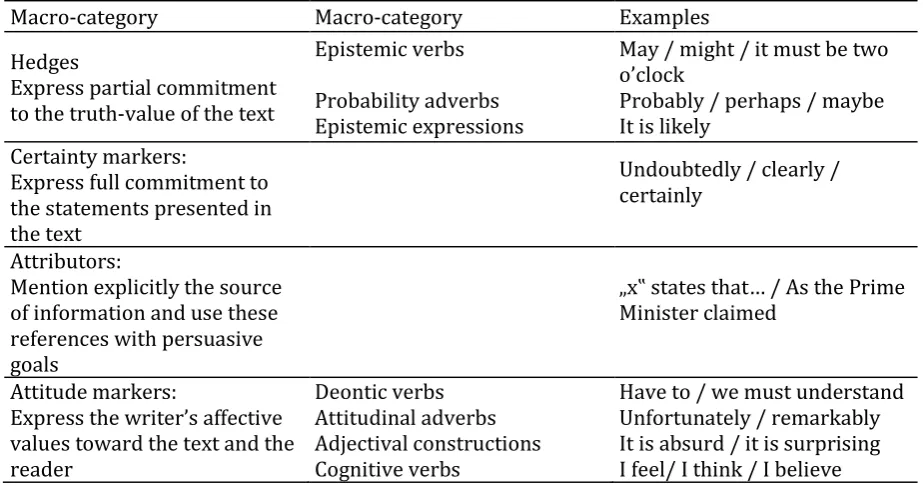
The analysis of the selected texts was closely based on Dafouz‟s (2003) taxonomy of interpersonal metadiscourse markers (see Table).
Table 1. Interpersonal metadiscourse markers
Macro-category Macro-category Examples
Hedges
Express partial commitment to the truth-value of the text
Epistemic verbs
Probability adverbs Epistemic expressions
May / might / it must be two o’clock
Probably / perhaps / maybe It is likely
Certainty markers:
Express full commitment to the statements presented in the text
Undoubtedly / clearly / certainly
Attributors:
Mention explicitly the source of information and use these references with persuasive goals
„x‟ states that… / As the Prime Minister claimed
Attitude markers:
Express the writer’s affective values toward the text and the reader
Deontic verbs Attitudinal adverbs Adjectival constructions Cognitive verbs
Have to / we must understand Unfortunately / remarkably It is absurd / it is surprising I feel/ I think / I believe
As the title of the present paper suggests, while studies like this can investigate various genres of communication from different discourse communities, this study sought to examine the genre of testing article for the following reasons. Firstly, the testing articles are an outstanding and widely used genre of communication among academia. Secondly, a large number of rejections of non-native writers’ articles in international scholarly journals are said to be due to language problems. Finally, non-native writers have recently shown a stronger tendency to join their relevant disciplinary communities, mostly through writing research articles specifically in testing. Such a trend might be due to the fact that publication is more considerably appreciated in hiring, promotion and continued employment in recent regulations throughout the world.
RESULTS AND DISCUSSION
The findings (Table 2) disclosed interesting quantitative similarities and differences between the two sets of data. Comparing the total number of interpersonal markers used in both groups of texts revealed that metadiscourse elements were employed more frequently in the conclusion of language testing articles written by Iranian writers than European writers. As we can see, the total sum of metadiscourse markers used in the conclusion of Iranian language testing articles is 75 while the total sum of metadiscourse markers used in the conclusion of European articles is 30. These quantitative results show that academic texts are made up of a relatively large number of metadiscourse elements, which can clearly be conducive to the quality, intelligibility and communication in the academic contexts. Interestingly, the results reject the idea that metadiscourse is just marginal to the texts (Crismore and Farnsworth, 1990).
Table 2. Interpersonal metadiscourse markers
Macro-category Language teaching Veterinary
Hedges 24 61
Certainty markers 1 3
Attributors 2 2
Attitude markers 3 7
According to the table 2 it can be said that the Iranian authors of language testing articles tend to interact more efficiently with their readers by showing the greater guidance to and involvement of the readers in the text with the use of more metadiscourse markers which signals his attitude toward both the content and the reader of the texts.
The analysis of the data revealed that hedges toke a high position in both sets of data. This was in line with the findings of many studies (Abdi, 2002; Dafouz, 2003, 2008; Hyland, 1999) in which it was shown that hedges hold a predominant position among different interpersonal metadiscourse categories. It was also found that both groups of writers favored the use of epistemic verbs, specifically modal verbs. This was also consistent with other studies in which modal epistemic verbs were used as the predominant strategy for hedging. In general, hedges have shown to be an essential element of different genres such as research articles (Hyland, 1998, 1999), advertisements (Fuertes-Olivera et al., 2001) as well as newspaper opinion articles (Dafouz, 2003, 2008) and editorials (Abdollahzadeh, 2007). Hedging shows the degree of tentativeness, possibility and/or politeness that writers use in their texts. According to Camiciottoli (2003), hedges can function to mitigate the writers’ authorial position which makes the text more reader friendly. Hedging then can be considered as an important characteristic of professional writing. The ability to hedge effectively and successfully is a rather difficult skill, especially for EFL students, and needs to be considered seriously by both teachers and students.
Certainty markers were another interpersonal marker present in the corpus. These items (also called emphatics or boosters) are regarded as an important aspect of articles since they allow readers to find out about the writers’ opinion and they create a sense of solidarity with readers (Dafouz, 2008). Although the results of this study revealed that the two groups did not differ some much in the use of certainty markers, it was found that the Iranian scholars used them more. In fact, this type of marker showed a lower occurrence in the European articles. The reason could be that the European tried to be more considerate and polite to their audience by limiting the use of certainty markers. On the other hand, the more frequent use of this marker by the teachers could indicate that they are probably more assertive in their writing.
Regarding the use of attributers in this study, we can see there is no difference between the two groups in the use of this metadiscourse marker. Since it helps writers to provide support and justification for their arguments, language testing scholars tend to use them more to show that what they are saying is justified by other research and scholars. At the other hand, because most of the research in testing field is empirical and based on observation of a specific kind, these researchers tend to use less attributer in their studies.
CONCLUSION
This paper was an attempt to examine the role of interpersonal markers in the conclusion genre of research articles written by scholars from two different groups Iranian and European experts. The results revealed that interpersonal markers were present in both groups of texts. This finding substantiated the view that metadiscourse, particularly interpersonal, is an essential feature of professional rhetorical writing. The results of this study are suggestive of community based distinct conventions. As regards the languages concerned, the selected Iranian conclusions outweighed their European counterparts, by capitalizing more on metadiscourse elements. These findings lend support to the idea that different communities and cultures rely on specific use of metadiscourse, making them understandable to their readership differently.
REFERENCES
Ädel, A. (2006). Metadiscourse in L1 and L2 English. John Benjamins B.V.Connor, U. & A. Moreno. (2005). Tertium comparationis: a vital component in contrastive rhetoric research. In Bruthiaux, P., D. Atkinson, W. Eggington, W. Grabe & V. Ramanathan.
Directions in Applied Linguistics: Essays in honor of Robert B. Kaplan, pp. 153-164.
Cleveland: Multilingual Matters.
Dafouz, E. (2003). Metadiscourse revisited: A contrastive study of persuasive writing in professional discourse. Estudios Ingleses de la Universidad Complutense.
Hyland, K. (2005). Metadiscourse: Exploring interaction in writing. Oxford: Continuum. Hyland, K. (2004). Disciplinary interactions: Metadiscourse in L2 postgraduate writing.
Journal of Second Language Writing, 13, 112-132.
Leki, I. (1991). Twenty-five years of contrastive rhetoric: Text analysis and writing pedagogies. TESOL Quarterly, 25(1), 123-143.
Noorian, M. & Biria, R. (2010). Interpersonal Metadiscourse in Persuasive Journalism: A Study of Texts by American and Iranian EFL Columnists1. Journal of Modern
Languages, 20, 78-96.
Swales, J. (1990). Genre analysis. English in academic and research settings. Cambridge: Cambridge University Press.
Vande Kopple, W. J. (1985). Discourse about discourse. College Composition and Communication.
Zarei ,G. R. & Mansoori, S. (2011). A Contrastive Study on Metadiscourse Elements Used in Humanities vs. Non Humanities across Persian and English. Journal of English