Volume 6, Issue 1, 2019, pp. 199-209 Available online at www.jallr.com ISSN: 2376-760X
* Correspondence: Narges Seidi, Email: narges.seidi yahoo.com © 2019 Journal of Applied Linguistics and Language Research
Post-method Pedagogy in EFL Context: Does It Minimize
Teachers’ Burnout
?
Narges Seidi *
English Department, University of Guilan, Rasht, Iran
Abstract
Historically the field of language teaching has been under rigorous changes through time. The inefficiency of language teaching methods in fulfilling the needs of all types of learners
led to “Death of Method” (Allwright, 2003). Questioning the concept of method and its nature, Kumaravadivelu (1994) introduced “Post method” era. However, in Iran educational context EFL teachers are not fully aware of this concept or even implement its basics in their teaching if possible. On the other hand, teacher burnout (a state of physical and emotional exhaustion emerging from work conditions) is directly related to the quality of
teaching and also is effective in the learners’ and consequently teachers' performance. So,
this study tries to investigate the relationship between post-method implementation and
teachers’ burnout and also, the teachers’ level of willingness and conformity to the principles
of post-method pedagogy. To this aim, Iranian EFL teachers completed post-method pedagogy and burnout inventories. The results of Pearson Correlational analysis revealed that method is negatively correlated with burnout implying that involvement in post-method pedagogy is associated with less burnout. The results also determined that
Post-method pedagogy was not highly applied in teachers’ performance in the classroom.
Keywords: Iranian EFL learners, Post-method pedagogy, Teacher burn out
INTRODUCTION
Early years of twenty century faced with fundamental shifts in language teaching and language learning, the emergence of post-method pedagogy as one of these basic turning points, is believed the most significant one. Dissatisfaction with existed methods and approaches (methods of teaching) led teachers and practitioners start to grow filling of anti-methods. Around 1980 experienced the beginning of this process which further cause to ample of the researches (e.g. Bax ,2003; Pennycook,1989; Philipson,1992; Prabhu,1990). In fact, post-method pedagogy was a reaction to inability of communicative language teaching (CLT) in the learners and the teacher’s needs
(Huda, 2013) .
s/he relies more on their intuitive ability and avoid teaching techniques that change according to the current fad (p.50)”. In this regard, Richards and Rogers (2001) added
that implementation of a particular method subjugates the role of a teacher in the classroom where they do not have any options of voicing their own opinions or judgements, leading to producing a cohort of “passive learners” who are ultimately rule -bound. Supporting this argument, Clark (1994) says that methods, thus, only consider
“cognitive phenomenon” and ignore important aspects such as institutional, political,
contextual and social restrictions that a teacher faces.
Also, it has been found that methods undermine the role of the teachers and the
learners. Learners’ various styles, preferences, and needs as well as teacher reflection
and creativity were marginalized in this teaching context. Additionally, methods were developed by European ideologies which were dictated to the other countries. This
cultural imperialism marginalizes the learners’ local culture (Larsen-Freeman, 1986, Stern, 1992).
As a matter of fact, post-method pedagogy developed as a reaction to researchers and language teachers endeavor in seeking for optimum ways to handle language teaching profession. Indeed, it is believed to be the most optimal way of language teaching that releases language teachers from the method-based stronghold (Bell, 2003).
However, death of the methods raises an important question, that is what teachers should follow to have successful teaching. Hence, Kumaravadivelu in (2006) introduced a strategic framework for second language teaching included macro strategies and micro strategies, which create bundle of crucial findings of second language acquisition researches, including output hypotheses, input hypotheses, autonomy, and strategy training (Alemi & Daftarifard, 2010).The macro strategies generate from actual classroom data , maximizing learning opportunities, facilitating negotiated interaction, minimizing perceptual mismatches, activating self-discovery, promoting learner autonomy, fostering learner awareness, contextualizing linguistic input, integrating language skills, ensuring social relevance and raising cultural consciousness are some of those macro-strategies .
Teacher burnout
Nowadays stress and tension become an inevitable part of life. Not related to the age or social status, people are stricken by stress. Accordingly, Researchers’ investigations
depicted that stress is an omnipresent affective factor that is extant in all settings and in work places (Jennett, Harris, & Mesibov, 2003).
The prominent role of the teachers in any educational setting is an undeniable fact.
According to (Celik, Arikan, & Caner, 2013), “more can be done to improve education by improving the effectiveness of teachers than by any other single factor (p.92).”
However, in English Language Teaching field (ELT), teachers have not received attention properly, even though their prominent roles have been acknowledged (Akbari & Tavassoli, 2011; Hastings & Brown, 2002). A great body of the researches revealed
Tomic, 2005; Whipp & Geronime, 2015). Burnout is defined as from long-term work-related stress, chiefly among human service workers, including teachers (Jennett et al., 2003). Maslach and Jackson (1981) depicted burnout as a multidimensional construct with three related components: emotional exhaustion is the feelings of being overpressured, emotionally drained, and physically depleted which lead to cognitively distancing oneself from one's work.
Depersonalization refers to negative, pessimistic and uncaring attitudes and feelings about one's students or colleagues which may, in turn, lead to detachment from them. A reduced sense of personal accomplishment is a tendency on the part of the teacher to evaluate himself and his job as not working anymore or being useless and meaningless. LITERATURE REVIEW
Post-method pedagogy
Post-method pedagogy underlies three principles of language teaching which were proposed by Kumaravadivelu (2001) include: practice, context, empowerment. First, it should be the pedagogy of particularity: language teaching is locally based, it means that teachers, learners with definite sets of goals in a particular socio-cultural context are effective. Second, it is recommended that teachers generate their own theories that further enable them to construct their own theory of practice embarking on what Prabhu (1990, p.172) calls teachers’ sense of plausibility. The last principle addresses
the empowerment of both teachers and students to facilitate the process of identity formation and social transformation.
According to Kumaravadivelu (2006), macro strategies are broad guidelines which are theory-neutral and method-neutral because they are not based on underlying assumptions of one specific theory, or on a single set of principles or procedures associated with any language method. Teachers can use them to best suit their own context-specific and needs-based micro strategies.
Although it has been great controversy over post-method pedagogy, the number of studies dealing with it in the second language teaching is few.
A study conducted by Atai and Gheitanchian (2009) investigated any possible relationship between teachers' attitudes towards post-method pedagogy and their students' achievement. To this aim, a questionnaire was designed to reveal Iranian EFL teachers' beliefs about dominant teaching methods preceding and succeeding communicative language teaching. After analyzing the data, results showed that Iranian EFL teachers had different attitudes towards dominant methods of language teaching
but no significant relationship was found between the teachers’ attitudes towards
post-method pedagogy and their students’ achievement (Atai & Gheitanchian, 2009).
Razmjoo, Ranjbar and Hoomanfard (2013) examine the familiarity of Iranian EFL teachers and learners with post-method and its realization. The findings of the study raised uncertainties about the feasibility, possibility or practicality of a fully post-method based teaching pedagogy and queried its emergence into Iranian context. It also
Khani and Darabi (2014) investigated the reflection of principle-based and post-method
pedagogy in teachers’ performance in Iranian ELT context. The results determined that principle-based and post-method pedagogy are not highly applied in Iranian classrooms. In the same token, Mardani and Moradian (2016), in a mix-method research, asserted that while well aware of the principles of post-method era, Iranian EFL teachers face many limitations in implementing the teaching practice based on its criteria. Motallebzadeh, Garmabi and Bakhtiari Fayendari (2017) in their study
examine the relationship between EFL teachers’ conformity to post-method principles and their academic success.
The results indicated that Iranian EFL teachers do not show significantly high level of willingness and conformity to the principles of post-method pedagogy. Also educational
level does not play any significant role on the teachers’ conformity to post-method principles.
Teacher burnout
Burnout is a prominent concept in educational setting from different perspectives, for example teachers may quite their jobs, even worse, uninterested teachers keep on their professions demotivationaly which is very harmful for educational context. Keeping this in mind, ample of researches investigated various dimensions of teacher burnout. (Khani & Mirzaee, 2014; Yaghubinejad, Zarrinabadi & Nejadansari, 2016). Lau, Yuen, & Chan (2005) worked on the role of the demographic characteristics in facing burnout. The results indicated that men scored higher on depersonalization while women were higher in emotional exhaustion and reduced sense of accomplishment also, younger teachers experience more burnout than the old ones. Further, (Mills & Huebner, 1998) reported neuroticism and introversion, (Mahmoodi-Shahrebabaki, 2016) negative perfectionism and anxiety (Khani & Mirzaee, 2014) low self-efficacy related to teacher burnout in various context.
Friedman (1995) believed that some contextual features like lack of respect for the teacher and their inattentiveness in the class leads to burnout . Weiqi (2007) unfolded that student quality, leadership and administration, working conditions and salary were some significant sources of teacher burnout and job dissatisfaction.
Other empirical studies demonstrated that teacher perceptions, attitudes, and attributions are important characteristics to consider in understanding teacher burnout. Vanheule and Verhaeghe (2004) contend that burnout is heavily influenced by teacher attitudes and expectations of achievable outcomes.
Closely related to the concept of burnout is teachers’ demotivation. One of these studies
Shirazizadeh and Moradkhani (2018) investigated the effect of teacher reflective practices on minimizing the burnout. The results indicated that reflection is negatively correlated with burnout implying that involvement in reflective practice is associated with less burnout.
With regard to the significance of burnout in teachers’ professional carrier, there are few empirical researches in the literature on post-method principles. In a nutshell, the present study aims to answer to the following questions:
1. To what extent EFL teachers implement principles of post-method pedagogy in their classes?
2. Is there any relationship between EFL teachers ’willingness and conformity to
the principles of post-method pedagogy and teachers’ burnout?
METHOD
Participants
A total of 86 EFL English teachers from different language institutes, and with different educational degrees (BA and MA) took part in the study. They range in age from 21 to 45. Both male and female teachers participated in this study (42.6 percent were males and 57.4). They have teaching experience from 2 to 23 years. They were ensured that the results of this study would be confidential. The participants were selected on the basis of convenience sampling method.
Instruments
Persian version (Akbari, Ghafar Samar, Kiany and Eghtesadi, 2011) of Maslach Burnout Inventory-Educators Survey (Maslach, Jackson, & Leiter, 1996) was used to measure teachers' burnout. The instrument has 22 items measuring three components namely emotional exhaustion (9 items), depersonalization (5 items) and reduced personal accomplishment (8 items).
In order to measure teachers’ conformity and willingness to post-method principles, the Postmethod Pedagogy Questionnaire, designed and validated by Fathi et al. (2015) was employed. It includes 29 items developed on the basis of three factors of teacher sense of social justice, teacher autonomy, and teacher sense of academic enthusiasm. Each item is followed by a 6-point Likert scale, ranging from ‘strongly agree’ to ‘strongly disagree’. The reliability of the questionnaire, computed by Crobach alpha, was reported to be 0.78.
Procedure
In order to determine the relationship between the participants' conformity and willingness to postmethod and their level of burn out, the two instruments were simultaneously administered to the participants of the study. Then they filled out them and returned them to the researcher. The necessary instruction regarding how to fill each questionnaire was given before completing them by the participants.
Scores from each of the instruments were computed and entered into SPSS version 20. First, addressing the first research question one-sample T-test run on the mean score of the conformity to post-method principles. Based on the Postmethod Pedagogy Questionnaire, the maximum score that can be obtained and implies the highest degree of conformity to the proponents of a postmethod-based pedagogy equals 139 ,64 as a lowest degree of conformity and 101 is middle score. So 101 is considered as critical value.
Table 1. One-sample T-test results for the mean score of the conformity to post-method
pedagogy principles
N Mean deviation Standard Standard error mean t Df Sig Post method
conformity 86 82.12 17.37 1.71 -2.14 86 0.008
As it can be seen, there is a significantly low level of willingness and conformity to the principles of post-method among the teachers (t= -2.14, p<0.05).
Next, normality of the distributions was examined using Kolmogorov-Smirnov test. Then, a correlational design using Pearson product-moment correlation coefficient was manipulated to answer the research question of the study.
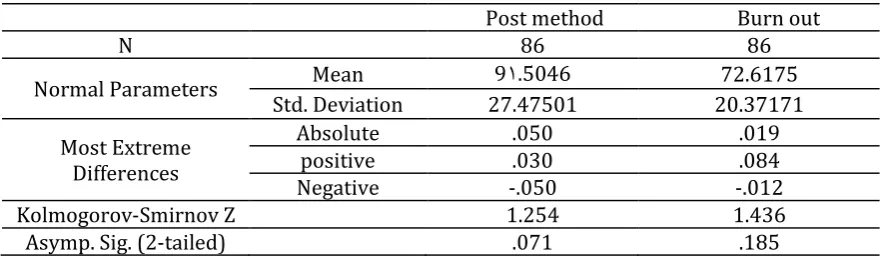
Regarding to the second research question, first the normality of distribution for the scores was investigated. To check the normality assumption, one sample Kolmogorov-Smirnov (K-S) test was conducted on both post-method and burn out scores. In one-sample Kolmogorov-Smirnov (K-S) test, if the significance level is larger than .05, it shows that the data are normally distributed. As it clears in Table 1 the results of one-sample K-S test revealed that the data was normally distributed.
Table 2. One-Sample Kolmogorov-Smirnov Test
Post method Burn out
N 86 86
Normal Parameters Mean 91.5046 72.6175
Std. Deviation 27.47501 20.37171
Most Extreme Differences
Absolute .050 .019
positive .030 .084
Negative -.050 -.012
Kolmogorov-Smirnov Z 1.254 1.436
Asymp. Sig. (2-tailed) .071 .185
To examine the effect of postmethod pedagogy on teachers’ burnout, Pearson product–
moment correlation was conducted. The results revealed significant negative correlations between post-method pedagogy and burnout (r=-0. 65, p<0.01).
Post-method Pedagogy Teacher burnout
Post- method pedagogy Pearson Correlation 1 -0.65**
Teacher burnout PearsonCorrelation -0.65** 1
**. Correlation is significant at the 0.01 level (2-tailed).
DISCUSSION
Postmethod pedagogy recognizes the teacher’s previous and current knowledge, and
their potential to teach and act autonomously, which promotes the ability of the teacher to know how to develop a reflective approach to his own teaching, how to analyze and evaluate his own teaching acts, how to initiate change in his classroom, and how to monitor the effects of such changes (Wallace, 1991).This capacity can develop provided that the teacher has tendency to keep an optimum degree of autonomy in pedagogy in decision making .The teachers need to grow personal knowledge of learning and teaching to be free from the barrier concept of the method. What post-method pedagogy assumes is that this kind of personal knowledge the teacher develops over time will eventually lead them to construct their own theory of practice (Kumaravadivelu, 2006). The present study probed into willingness and conformity of EFL teachers to the principles of post-method pedagogy and its effects on teachers’ burnout in the EFL
context. The results indicated that EFL teachers did not show high level of willingness and conformity to the principles of post-method pedagogy. This is in line with the previous studies by Khani and Darabi (2014), Razmjoo, et al. (2013), and Mardani and Moradian (2016), which believed that postmethod pedagogy is not reflected in EFL Iranian classes. Further, Pishghadam, Askarzade, and Navari (2009) and Pourali (2011)
also pointed that Iran’s educational system, in both schools and universities, is still
follow Behaviorist views of learning. This is because of reasons, first, the educational system in Iran follows a top-down approach which is highly based on authority and discipline. In addition, the textbooks are designed and administered by Ministry of education, so the teachers are expected to manage classroom to fulfills the textbooks needs.
Second, in EFL context of Iran, public schools along with private language institutes are in charge of teaching English. Surprisingly, these two organizations manipulate different methodologies in their teaching. While in the public schools the textbooks, methodology and teachers recruiting system are in hand of Ministry of Education, private institutes are somehow more independent in their actions. Third, unfortunately the language institutes consider their activities more as a business than teaching as a very precious job. Crowded classes which equipped with minimum amount of facilities demands a vast amount of energy on the part of the teachers who are not paid enough. In such a context, these factors demotivate teachers to be up to date and follow new trends in language teaching.
class in a short amount of time, not enough payments, learners’ diversity as well as
inefficiencies in teacher training courses (TTCs) and teacher education programs are
the teachers’ barriers in application of the post method pedagogy.
Addressing the second research question, the results indicated significant negative
relationship between teachers’ burnout and willingness and conformity to principles of
post-method pedagogy. It implied that more commitment to principles of post-method pedagogy lead to decrease the level of teachers’ burnout.
Shirazizadeh and Moradkhani (2018) in their study indicated that preplanned syllabi,
textbooks and tests, limit the teachers’ performance and practice even when they decided that they have to. These findings are in harmony with the ones by Sugino (2010) and Yaghubinejad et al. (2016) who believed that inflexible methodology,
students’ attitudes and large class size are some major demotivating factors for teachers. But in post-method condition, teachers are supposed to have the power and
authority to decide based on their learners’ needs and context and their own reflection
of different situations. Similarly, Akbari (2008) argues that in post-method pedagogy, the practitioners are free to make their voices heard; use their background knowledge and their life experiences are respected and valued.
Post-method pedagogy helps local teachers to develop their teaching in an optimum way through theorizing what they do and to practice what they theorized. Ganyaupfu (2013) writes that teachers in post-method pedagogy are the best knower of the
learners’ needs, interests, backgrounds and classroom environment, which are the
guiding elements for selecting effective and efficient alternatives. CONCLUSION
This study intended to examine the relationship between EFL teachers’ burnout and
postmethod pedagogy and also the level of its implementation in the EFL context. The results showed that there was a negative relationship between variables, implies that
more postmethod pedagogy in the classroom, the less level of teachers’ burnout would
be. Further, it was found that the level of reflection of postmethod pedagogy in the EFL classes was low. The findings of the study might offer some theoretical and practical implications as far as teacher education program is concerned.
There should be programs in Teacher education services to deal with teachers’ burnout as a serious issue in language learning. Improving teachers’ financial status, making
situation in which teacher more likely have authority and autonomy in their teaching as well as testing are some steps that can prevent burnout.
Teachers’ responsibilities should be redefined in teacher education systems to make the room for teachers’ involvement, participation and voice. To this aim, a bottom up and
flexible education program is needed to train teachers who have autonomy and authority in theory and practice.
classrooms, constantly train teachers even experience ones to promote its application in EFL classes are helpful steps.
However, there are some serious problems regarding teacher training course held by language institutes. Although such courses are devoted to language learning and teaching theories , they are in a very short time. Teacher students confirm that transfer of all complexities of language teaching in these courses is not possible. In addition, private institutes recruit graduate learners or even unauthorized trainers to run these courses.
Also, there should be sense of cooperation among teachers’ education system, syllabus
designers, test developers and policy makers to yield the optimum outcomes. Teachers
supervision, observation and evaluation increase teachers’ motivation to implement their alternative strategies in case of unexpected problem in the classrooms.
REFERENCES
Akbari, R. (2007). Reflections on reflection: A critical appraisal of reflective practices in L2 teacher education. System, 35(2), 192-207.
Akbari, R. (2008). Post-method discourse and practice. TESOL Quarterly, 42(4), 641-652. Alemi, M., &Daftarifard, P. (2010). Pedagogical innovations in language teaching
methodologies. Journal of Language Teaching and Research, 1(6), 765-770.
Arikan, A. (2006). Postmethod condition and its implementations for English language teacher education. Journal of Language and a Linguistics Studies, 2(1), 1-11.
Akbari, R., & Tavassoli, K. (2011). Teacher efficacy, burnout, teaching style, and emotional intelligence. Possible relationships and differences, 14(2), 31-61.
Atai, M. R., & Gheitanchian, M. (2009). Iranian EFL teachers’ attitudes towards teaching
methods and materials of high school English Textbooks. Journal of Education, 4(4), 115-130.
Bax, S. (2003). The end of CLT: A context approach to language teaching. ELT Journal, 57(3), 278-287.
Bell, D.M. (2007). Do teachers think that methods are dead? ELT journal, 61(2), 135-143. Brouwers, A., & Tomic, W. (2000). A longitudinal study of teacher burnout and perceived self-efficacy in classroom management. Teaching and Teacher education, 16(2), 239-253.
Brouwers, A., Tomic, W., & Boluijt, H. (2011). Job demands, job control, social support and self-efficacy beliefs as determinants of burnout among physical education teachers. Europe’s Journal of Psychology, 7(1), 17-39
Celik, S., Arikan, A., & Caner, M. (2013). In the Eyes of Turkish EFL Learners: What Makes an Effective Foreign Language Teacher? Porta Linguarum: revista internacional de did´actica de las lenguas extranjeras, 1(20), 287-297.
Friedman, I. A. (1995). Student Behavior Patterns Contributing to Teacher Burnout. The Journal of Educational Research, 88(5), 281-289.
Ganyaupfu, E. M. (2013). Teaching methods and students' academic performance. International Journal of Humanities and Social Science Innovation, 2(9), 29-35. Hastings, R. P., & Brown, T. (2002). Coping strategies and the impact of challenging
behaviors on special educators’ burnout. Mental retardation, 40(2), 148-156.
Huda, M. E. (2013). Post-method pedagogy and ELT in Bangladesh. Global Journal of Human Social Science Linguistics and Education. 13(7), 6-14.
Jennett, H. K., Harris, S. L., & Mesibov, G. B. (2003). Commitment to philosophy, teacher efficacy, and burnout among teachers of children with autism. Journal of Autism and Developmental Disorders, 33(6),
583-Kumaravadivelu, B. (1994). The post-method Condition: Emerging strategies for second/foreign language teaching. TESOL Quarterly, 28, 27-48.
Kumaravadivelu, B. (2001). Towards a postmethod pedagogy. TESOL Quarterly, 35(4), 537-560.http://dx.doi.org/10.2307/3588427.
Kumaravadivelu, B. (2006). Understanding Language Teaching: From Method to Postmethod. London:Lawrence Erlbaum Associates.
Khany, R., & Darabi, R. (2014). ELT in Iran: Reflectionof the principle-based and post-method pedagogy in language teaching. Procedia Social and Behavioral Sciences, 98, 908-916. 10.1016/j.sbspro.2014.03.499.
Khani, R., & Mirzaee, A. (2015). How do self-efficacy, contextual variables and stressors affect teacher burnout in an EFL context? Educational Psychology, 35(1), 93-109. Larsen-Freeman, D. (1986) Techniques and principles in language teaching. Oxford:
Oxford University Press.
Mardani, M., & Moradian, E. (2016). Postmethod pedagogy perception and usage by EFL teachers and learners and its limitations, symbols, and viewpoints. International Journal of Language Learning and Applied Linguistics World, 11, 75-88.
Maslach, C., Jackson, S., &Leiter, M. (1996). Maslach Burnout Inventory Manual. (3rd ed.). Palo Alto, CA: CPP.
Maslach, C., & Jackson, S. E. (1981). The measurement of experienced burnout. Journal of Organizational Behavior, 2(2), 99-113.
Mills, L. B., & Huebner, E. S. (1998). A Prospective Study of Personality Characteristics, Occupational Stressors, and Burnout among School Psychology Practitioners. Journal of School Psychology, 36(1), 103-120.
Mahmoodi-Shahrebabaki, M. (2017). The effect of perfectionism on burnout among English language teachers: The mediating role of anxiety. Teachers and Teaching, 23(1), 91-105.
Pishghadam, R., Askarzadeh, R. A., & Navari, S. (2009). Metaphor analysis of teachers’
beliefs and conceptions of language teaching and learning in Iranian high schools and language institutes: A qualitative study. Iranian EFL Journal, 4, 6-40.
Pennycook, A. (1989). The concept of method, interested knowledge, and the politics of language teaching. TESOL Quarterly, 23(4), 589-618.
Pourali, S. (2011). Metaphor analysis of beliefs about teaching and learning in the current and ideal situations: A case of professors and students majoring in English language teaching and literature. Unpublished MA thesis, Ferdowsi University of Mashhad.
Richards, J.C., & Rodgers, T.S. (2001). Approaches and Methods in Language Teaching.Cambridge:Cambridge University Press.
Razmjoo, S.A. Ranjbar, H, & Hoomanfard, M.H. (2013). On the familiarity of Iranian EFL teachers with post-method, and its realization. The International Journal of Language Learning and Applied Linguistics World, 4(1), 6-16.
Shirazizadeh, M.Moradkhani ,Sh.(2018) Minimizing Burnout through Reflection: The Rocky Road ahead of EFL Teachers :Teaching English Language ,12(1),135-154. Stern, H. H. (1992). Issues and Options in Language Teaching. Oxford: Oxford University
Press.
Sugino, T. (2010). Teacher demotivational factors in the Japanese language teaching context. Procedia - Social and Behavioral Sciences, 3, 216-226.
Vanheule, S., & Verhaeghe, P. (2004). Powerlessness and impossibility in special education: A qualitative study on professional burnout from a Lacanian perspective. Human Relations, 57(4), 497–519.
Whipp, J. L., & Geronime, L. (2015). Experiences that predict early career teacher commitment to and retention in high-poverty urban schools. Urban Education, 10(4), 346-379.
Weiqi, C. (2007). The structure of secondary school teacher job satisfaction and its relationship with attrition and work enthusiasm. Chinese Education & Society, 40(5), 17-31.
Wallace, M. J. (1991). Training Foreign Language Teachers: A Reflective Approach. Cambridge: Cambridge University Press.
Widdowson, H. G. (1990). Aspects of Language Teaching. Oxford: Oxford University Press.