An Improved Representation of
Mathematical Modelling for Teaching,
Learning and Research
Collin Grant Phillips
Corresponding author: [email protected]
Mathematics Learning Centre, University of Sydney, Sydney NSW 2006, Australia
Keywords: mathematical modelling, image of modelling, pedagogical mathematical modelling
Abstract
Modelling real-world physical or natural systems with mathematics is one of the cornerstones of scientific endeavour. A review of past works reveals significant differences and inconsistencies between the analysis and representations or images of mathematical modelling. New definitions are developed of a system, such as real-world problem, mathematical problem and mathematical solution; the process of relating and transforming one system to another, such as mathematising a real-world problem into a mathematical one, and modelling one system as another. The new definitions are then used to analyse and reconcile past images. To improve past images the following two new systems are introduced: the written-word description of a real-world problem, and the written-word description of the mathematical solution. The new systems provide a more realistic representation of what students experience in the classroom. The new definitions and systems are used to produce an improved image of mathematical modelling for pedagogy. This new image is a valuable tool for representing systems and processes of pedagogical modelling. This new image provides an anatomy of modelling that can be used to teach and identify different forms of learning, teaching and research modelling. The new image also provides a method of diagnosing students’ difficulties and targeting help.
International Journal of Innovation in Science and Mathematics Education, 23(4), 51-63, 2015.
Introduction
Relating a real-world system to mathematics has provided valuable insight into many natural phenomena, both in gaining an insight into the mechanisms at play in nature, and in predicting future behaviour of these real-world systems under different conditions. These processes and others are often referred to as ‘mathematical modelling’.
Past authors have developed different representations of the processes and concepts of mathematical modelling, such as in Figures 1-3 below. Analysing mathematical modelling and forming a representation is itself forming a model of mathematical modelling. Thus there is the potential for confusion between the initial mathematical model and the process of modelling it with an image, such as in Figures 1-4 below. To distinguish between the mathematical model and the process of modelling it, in this paper we use the term image of modelling. Thus image refers to the process of modelling the mathematical model and modelling refers to the mathematical modelling process itself.
In this work previous images of mathematical modelling are reviewed and compared. These previous images are used to develop a set of definitions for the different components of modelling. To develop an improved image of modelling for teaching and learning, new systems are developed in the mathematical modelling process. Furthermore, new processes between all the systems are examined. The new systems and processes are included in a new image to acknowledge and recognise important processes in the classroom.
improved theory of pedagogical modelling. The new image can also be used to represent learning, teaching and research modelling using the same template. The new image thus provides a method of describing the anatomy of modelling and a tool to diagnose individual student’s difficulties with specific processes in mathematical modelling.
Previous Images of Mathematical Modelling
To simplify our discussion, and the comparison of past images of modelling, we identify different components of mathematical modelling. One of the many processes of mathematical modelling is identifying a real-world problem and using this problem to formulate a related mathematical problem. The real-world problem may be considered as a physical system of, for example, forces and objects. The related mathematical problem can be thought of as a second mathematical system of mathematical objects and operations. The formulation of a real-world system into a mathematical system may thus be considered as a process. This particular process is often referred to as mathematising a real-world problem into a mathematical one.
Of course there are many other important processes in mathematical modelling, such as solving the mathematical system and comparing the solution back to the real world. It is useful to identify the different systems and processes in past images of mathematical modelling whilst analysing these past images. These terms will be formalised below. The theory will then be used to construct an overarching theory under which all past images may be reconciled.
Early images of mathematical modelling partitioned the processes of mathematical modelling into discrete steps. The following quote from Haines and Crouch (2010; p.222) describes these earlier images:
The cyclic representations developed in the late 1970s in undergraduate engineering mathematics courses, focussed on student activity at six discrete stages…with the addition of a seventh reporting stage, transition between the stages did not at that time receive much attention.
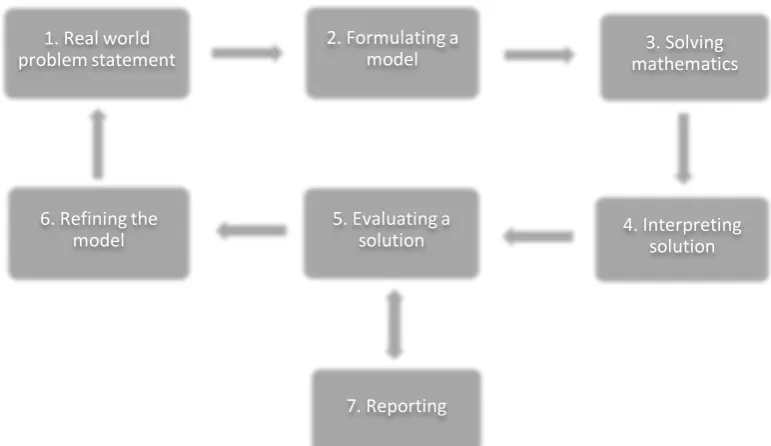
The different stages of these early images are represented as Image 1 in Figure 1.
Figure 1. Image 1: early image of modelling. The stages 2-7 represent processes in mathematical modelling. Stage 1 represents the system of the real-world problem statement.
In this early image of modelling (Figure 1), the stages 2 to 7 around the diagram represent the processes in modelling. For instance, stage 3, Solving mathematics, represents the process of taking a mathematical
2. Formulating a
model mathematics3. Solving
4. Interpreting solution 5. Evaluating a
solution
7. Reporting 6. Refining the
problem and producing a mathematical solution. Just as importantly, the systems, between which the processes act, are implied. For instance the following systems are implied: (i) the real-world physical system, (ii) the mathematical system and the (iii) mathematical solution. The fact that stage 1 refers to a system, that of the real-world problem statement, and not a process, as per stage 2-7, adds to the confusion. Because the image can start at a process and return through a series of other stages to the same, albeit refined process, this image is often referred to as a modelling cycle. For more detail see Berry and Davis (1996). In Image 1, processes 2-7 are depicted at different stages around the representation, and the systems apart from 1 are implied by arrows.
A second important image of modelling, Image 2, is that of Voskoglou (2007). A representation of Image 2 is given in Figure 2.
Figure 2. Image 2: image of mathematical modelling proposed by Voskoglou (2007). The stages 1-5 represent processes in mathematical modelling.
The stages around Image 2 represent the following processes of mathematical modelling:
P1:analysis of the problem,
P2:mathematising, including the formulation of the real situation,
P3:solution of the model, achieved by proper mathematical manipulation,
P4:validation of the model, usually achieved by reproducing the behaviour of the real system,
P5:interpretation of the final mathematical results and relating them to the real system.
Voskoglou (2007) modelled the transitions as stochastic or probabilistic processes. Image 2 extends Image 1 by treating the system as a stochastic or probabilistic process. Image 2 also extends Image 1 by incorporating the following processes:
1. An arrow from P4 to P2: modelling the effect of P4 (validation) of the model on P2 (mathematising), 2. An arrow from P3 to P2: the effect of P3 (solution) of the model on P2 (mathematising),
3. An arrow from P2 to P1: the effect of P2 (mathematising) on P1 (analysis) of the problem.
For Image 2, as with Image 1 in stages 2-7, each stage of the image represents a process. For instance, P2
(mathematising) represents the process of taking a physical system and producing a related mathematical system. Likewise, as with Image 1, the systems, between which the processes interact, are implied (apart from Image 1, stage 1). For example, the real-world system and the system of mathematical objects are implied.
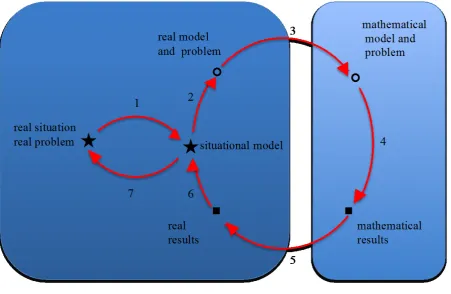
Figure 3. Image 3: image of mathematical modelling proposed by Blum and Leiß (2006), see also Borromeo Ferri (2006).
In Images 1 and 2 processes are generally represented by stages around the image and systems are represented by arrows. This contrasts to Image 3 where systems are represented by stages around the image and processes are represented by arrows. Thus Image 3 represents an inversion of the concepts from Image 1 and 2.
It is possible to transform from the Images 1 or 2 to an image similar, but not identical to image 3 by transforming the stages of Images 1 or 2 to the arrows of Image 3 and transforming the arrows of Image 1 or 2 to the stages of Image 3. However, the picture of modelling by Blum and Leiß (2006) extends beyond simply re-labelling stages as arrows and arrows as stages. Image 3 allows identification of different domains. In Image 3 the mathematical problem and mathematical solution are identified as part of the mathematics domain and the other stages are identified as the rest-of-world domain (see, Blum, Galbraith and Niss 2007).
The images of modelling presented above are a small selection of those proposed by others. They have been presented to provide a brief description of some proposed perspectives of the field and are in no way exhaustive. For reviews of the field see for instance, Ärlebäck (2009), and Haines and Crouch (2010).
New Definitions for Mathematical Modelling
From even a brief review of past images of mathematical modelling it is clear that there are significant inconsistencies between the representation of different systems and processes. To add to the confusion some images cofound these concepts. Much of this inconsistency is due to the fact that there are no readily accepted definitions of the two critical concepts of a system and a process.
There are many different component processes of mathematical modelling, such as: mathematising--using a physical system to develop a related mathematical system; solving--starting with a mathematical problem and producing a related mathematical solution; and comparison--relating a mathematical solution back to the real world. Significantly, each of these component processes involves transforming one system into another related system, whether the systems are mathematical, physical or otherwise. Thus each component process of mathematical modelling models one system as another, whatever the systems may be. For this reason, we purposefully develop definitions of modelling that are as general as possible, and thus can be applied to any single component of the mathematical modelling process. This approach acknowledges that each individual step in mathematical modelling is itself modelling, and that one does not have to complete a full cycle of mathematical modelling to be using significant and important modelling skills.
Consider the first three definitions of the word to model that areprovided by the Macquarie Dictionary (1981).
Model n., adj., v., 1. a standard or example for imitation or comparison; a pattern. 2. a representation, generally in miniature, to show the construction or serve as a copy of something. 3. an image in clay, wax or the like to be reproduced in more durable material…
The most important concept in modelling is the identification of relationships within one system that possess similarities to the relationships within a different system. For instance, the relationship between the arms, torso and legs in a statue will bear a similarity to the relationship between the body parts of the original human model. Alternatively, the relationship between architectural elements in a model of a building will be similar to the relationship between these elements in the actual building.
The significance of this concept of modelling is that the relationships within a system may be similar to the relationships within a different system, even though the two systems may bear no other similarities. Models may be made of very different stuff to the system they are modelling. Marble statues, architectural models, wooden patterns or mathematical models are constructed from materials vastly different from what they are modelling. They may also be of a very different scale. These fundamental concepts of modelling are universal, in that they apply to all of the dictionary definitions above and to every individual component of mathematical modelling.
The following is an example of these concepts applied to mathematical modelling: A radioactive element may decay to half of its weight after one half-life in time has passed. Alternatively, as part of a different mathematical system the function 𝑊𝑊(𝑡𝑡) =𝑊𝑊0𝑒𝑒−𝑘𝑘𝑘𝑘, where 𝑘𝑘> 0, has the property that 𝑊𝑊�𝑡𝑡1/2�, where
radioactive substance or the cardboard in a model and the bricks and mortar in a building. The fact that we can study the relationships without having to use the original materials—radioactive substances or bricks and mortar--makes modelling powerful.
The Concept of Correspondences Between Relationships Within Two Systems in Modelling
This mathematising step in modelling is not simply finding how a physical object relates to a mathematical one, but how the relationships between physical objects correspond to the relationships between mathematical objects. This concept of finding correspondences between relationships, rather than objects, is at the heart of modelling and has the potential to compound the difficulty of learning modelling.
In general if the relationships within one system, have a correspondence to the relationships within a second system then this characterises a model, even though the elements of the two systems may bear no other similarity. To develop a robust image of mathematical modelling and to reconcile this new image with the past disparate images it is necessary to properly define a system, a model and the process of modelling.
Definitions of Modelling
We define a system as a set of elements, where every element in the set is related to at least one other element in the set. Thus both elements and relationships determine a system. Some of the systems above are the weights of radioactive substances, the mathematical objects 𝑊𝑊(𝑡𝑡), physical or natural real-world systems, human models, statues, patterns etc.
We now define a model of a first system as: a second system that has relationships within it that share at least one like property to the relationships within the first system.
The process of modelling then will include, but is not restricted to, identifying or establishing relationships within one system that correspond to the relations within a second system. We note that in general neither system need be mathematical. For example, we may model a real-world problem as a description of objects and relationships in the written-word problem. Here we are modelling a real-world problem as a system of written-words.
Applications of the Definitions of a System, Process and Modelling
We now use the definitions above to reconcile the disparate and inconsistent past images of mathematical modelling. The image of early representations of modelling presented by Haines and Crouch (2010; p.222) has processes, such as formulating a model, or solving mathematics illustrated at stages 2 to 7 around the diagram. However, in Image 1 stage 1 is a system—that of a real-world problem statement. Apart from stage 1, all systems in Image 1, such as the real-world problem, mathematical problem or solution, are implied by arrows around the diagram.
In Image 2 proposed by Voskoglou (2007), stages around the diagram represent processes, such as mathematising, solution and validation. However, it would seem that arrows also depict processes. For example, the arrow from P5 to P1 seems to depict the process of comparing the model to the original problem. Moreover, because only processes are described, the systems are not explicitly labelled in the diagram. For instance it must be assumed that P4, the process of validation, is to act between the solution and the real-world system. However, P5 theinterpretation and relation of the final mathematical results will also act between the solution and the real-world problem. Image 2 would be improved by explicitly describing each of the systems and representing the processes exclusively as either stages or arrows, but not both.
only processes are represented by arrows between the systems. This approach of delineating between systems and processes eliminates confusion between concepts. Moreover, this provides a method for the partition of groups of systems into domains. The mathematical problem and solution are thus identified as a mathematical group in Image 3. The other systems are categorised as the ‘rest of world’.
New Systems for Mathematical Modelling
Students are often asked to formulate a written-word problem into a mathematical system. That is, many of the problems that are set in the classroom ask students to formulate words into mathematics, not nature or physical systems directly into mathematics. Here we will use the term written-word to denote a description in a language such as English, German or Mandarin etc. The term written-word is used to distinguish from a description in mathematics. Thus, the term written-word is used in preference to description in language because mathematics can also be considered as a language.
Here we use the technique of representing systems at stages around our image as in Image 3. This allows us to introduce the new systems of the written-word description of a real-world problem and the written-word description of the mathematical solution. We note that the definition of a system above is not limited to real-world systems or mathematical systems and encompasses the concept of a written word system.
Crouch and Haines (2004) conclude
Successful mathematical modelling involves an ability to move between the real world and the mathematical world…These processes are demonstrably difficult for students in a variety of countries who are new to modelling.
Crouch and Haines (2004) go on to cite various studies that reinforce this point for students in different countries including the UK (Haines and Crouch, 2001 and Haines, Crouch and Fitzharris, 2003), Japan (Ikeda and Stephens, 2001), and for students from Australia, Finland, France, New Zealand, Russia, South Africa, Spain, Ukraine and the UK (Klymchuk and Zverova, 2001). One reason to identify the written-word description of a real-world problem as a separate system is that the process of using a written-word description to formulate a mathematical model is the most difficult process for many if not most students. The fact that modelling from the real-world to mathematics is demonstrably difficult for students and that most students are given modelling questions written in words, means that the students experience difficulties in modelling the written-word questions as mathematics.
Identifying the written-word system allows us to decompose the process of modelling a real-world system as a mathematical system into two component processes: (1) modelling the real-world system as a written-word description and (2) using this description to produce a relevant mathematical system. The written-word system is important, even critical, for students and teachers of mathematical modelling, as this will be the first stage that many students encounter in learning mathematical modelling. Indeed, for many a student the written-word description of a real-world phenomenon will be as close as they get to a problem in modelling. Moreover, the first process (1) of formulating a written word problem is often the realm of a teacher, author or course designer, whereas the second process (2) of using the description to formulate a mathematical model is often all that a student may encounter. The different practitioners of (1) and (2) make this decomposition of mathematisation into parts (1) and (2) critical in the analysis of mathematical modelling for pedagogy.
mathematical formulae alone is of little or no use. Moreover, it is little value using algebraic symbols in an answer when the person who posed the question may have little or no knowledge of their meaning. Report writing is also critical in disseminating research work even in a mathematical research discipline. Thus this process of producing a written-word description of the mathematical solution should be included in any image of pedagogical or even research modelling. It is, however, often ignored as in Images 1-3 above. The process of converting the mathematical solution to a written description is acknowledged as an important independent process. ‘Converting’ mathematics to words should be as valued as converting words to mathematics.
An Improved Image of Pedagogical Mathematical Modelling
Here we identify five systems critically important for teaching and learning mathematical modelling.
𝑺𝑺𝟏𝟏∶= the physical system in the man-made world or in nature,
𝑺𝑺𝟐𝟐∶= the description of the real-world problem in written-word language,
𝑺𝑺𝟑𝟑∶= the mathematical problem: represented in a system of mathematical objects and operations,
𝑺𝑺𝟒𝟒∶= the mathematical solution: a related form of 𝑺𝑺𝟑𝟑, but a distinct mathematical representation,
𝑺𝑺𝟓𝟓∶= the statement of mathematical solution (𝑺𝑺𝟒𝟒) in written-word language.
Thus the process of mathematising (given by arrow 3 in Image 3 or P2 in Image 2) can now be decomposed into (1) representing 𝑺𝑺𝟏𝟏as 𝑺𝑺𝟐𝟐,and (2) representing 𝑺𝑺𝟐𝟐as 𝑺𝑺𝟑𝟑as described above.
Image 4, in Figure 4, is a new image of modelling that incorporates the new written-word systems. As described above, systems such as 𝑺𝑺𝟏𝟏= real-world system are represented as stages around the image and processes between systems, such as 𝑺𝑺𝟏𝟏 → 𝑺𝑺𝟑𝟑 are represented as arrows.
Every Process in Image 4 Represents Significant Modelling Skills
Many students only ever engage in a subset of the processes in Image 4. Likewise, many teachers of modelling will only use a subset of the processes in Image 4 along with finely honed skills to design well-graded and appropriate-level questions for students. In many cases the students or teachers will not progress through a ‘full cycle’ of modelling. For these reasons our definitions of modelling above are specifically designed to apply to each and every process in Image 4. Furthermore, our new image can be used to represent any subsystem of processes as modelling, including those practised by students and teachers as described below. It is indeed shortsighted to limit a representation of modelling to apply only to a full cycle of processes.
New Representation of Pedagogical Modelling Processes
Figure 4. Image 4: a new representation of pedagogical mathematical modelling. The image includes important new systems at stages. Processes are represented by arrows. The image is a completely connected network.
Likewise, a teacher designing questions engaging in the 𝑺𝑺𝟏𝟏→ 𝑺𝑺𝟐𝟐 process is producing a description of written-word elements and carefully describing the relationship between these elements so that a student can identify the elements and the relationships and then mathematise the described problem. The 𝑺𝑺𝟏𝟏→ 𝑺𝑺𝟐𝟐 process is modelling a real-world system as a written word description. This process must use important skills of the teacher if the students are to readily recognise written-word elements and relationships and then identify known related mathematical systems. Moreover, the teacher will often specifically design questions to translate to appropriate-level mathematical problems that have a solution where the solution is within the mathematical abilities of the student, often using recently learnt mathematical techniques. In fact this 𝑺𝑺𝟏𝟏→ 𝑺𝑺𝟐𝟐 process is seldom acknowledged and does not appear in any of the milestone images of mathematical modelling in Images 1-3. For any of these processes significant modelling skills are required. Again, for these reasons our definitions of modelling are deliberately designed to apply to the progression from any one system to any other. Moreover, as for 𝑺𝑺𝟏𝟏 → 𝑺𝑺𝟐𝟐 where the process transforms from a physical system to a written-word system, our definitions of modelling encompass modelling where neither system is necessarily mathematical.
reserving the terminology, definitions and images of mathematical modelling to only apply to a ‘full’ cycle of the processes. Indeed, it is somewhat selective or even exclusive to limit a representation of modelling to a full cycle and thus depict modelling as the exclusive domain of the research scientist.
The new definitions and systems allow Image 4 to represent three domains of modelling. The mathematical problem and solution constitute the mathematical domain. The written-word problem and solution now form the written-word domain important for all pedagogical modelling as well as research modelling. This domain has seldom been acknowledged in the past. The real world is identified as the third domain.
The image represents processes from any system to any other system. In this sense the image represents a completely connected network. We have outlined some of the interactions between systems, but a discussion of the complete network of interactions is held over for development in future work.
Discussion
Reconciling Learning, Teaching and Research Modelling in One Image
The most important purpose of research modelling is to find a mathematical solution for a physical problem. The primary purpose of this type of modelling is to identify a mathematical model that informs us about a physical system and may even predict the behaviour of the physical system. Here the physical problem determines the modelling process and the mathematics alone does not dictate the physical problem that we consider. Importantly, there is no guarantee that there is a known method of solving any true research mathematical modelling problem. In fact it may be necessary to develop a completely new branch of mathematics to solve the resulting problem. This contrasts, in some cases starkly, to the primary aim of learning and teaching mathematical modelling, which is to help students understand the principles, methods and techniques of mathematical modelling. Perhaps more importantly the written-word questions are often pre-designed to readily ‘translate’ into a mathematical problem with a solution that is within the mathematical abilities of the students. Moreover, often the question transforms to a problem that may be solved by using the most recent mathematical methods explored in class. In fact, one could not blame a student for classifying mathematical modelling as modelling ‘with what we just learned’. Thus the primary aim of pedagogical modelling—advancing students’ understanding of modelling and mathematics—may contrast starkly to the principal aim of research modelling—advancing the understanding and prediction of physical systems. Image 4 is specifically designed to readily demonstrate the different processes of both research and pedagogical modelling in the same image.
Implications for Teaching: Demonstrating the Relationship Between Different Forms of Modelling
Significantly, not only does Image 4 represent important pedagogical processes—such as 𝑺𝑺𝟏𝟏→ 𝑺𝑺𝟐𝟐creating written problems, 𝑺𝑺𝟐𝟐→ 𝑺𝑺𝟑𝟑, mathematising a written question and 𝑺𝑺𝟒𝟒→ 𝑺𝑺𝟓𝟓formulating a solution in words, but the one image can be used to reconcile and even contrast all forms of mathematical modelling—learning, teaching and research. Students new to the subject will primarily use the 𝑺𝑺𝟐𝟐 → 𝑺𝑺𝟑𝟑 → 𝑺𝑺𝟒𝟒 subset of processes. Some students will be expected to progress to a written word solution using 𝑺𝑺𝟐𝟐 → 𝑺𝑺𝟑𝟑→ 𝑺𝑺𝟒𝟒→ 𝑺𝑺𝟓𝟓. Teachers will often carefully craft a worded question that may be readily solved by students with a recently learned mathematical technique. This may be represented by 𝑺𝑺𝟒𝟒→ 𝑺𝑺𝟑𝟑→ 𝑺𝑺𝟐𝟐. Reverse processes such as 𝑺𝑺𝟒𝟒 →
𝑺𝑺𝟑𝟑 → 𝑺𝑺𝟐𝟐will be explored in future work. The process of completing a full cycle of research modelling may be represented by 𝑺𝑺𝟏𝟏→ 𝑺𝑺𝟐𝟐→ 𝑺𝑺𝟑𝟑 → 𝑺𝑺𝟒𝟒→ 𝑺𝑺𝟓𝟓→ 𝑺𝑺𝟏𝟏 or, if no stages are described in words, 𝑺𝑺𝟏𝟏 → 𝑺𝑺𝟑𝟑 →
no more than what they have learned in class. Students should not leave the classroom thinking they have experience the full gambit, and all of the pitfalls of research modelling.
Implications for Teaching: Anatomy and Diagnosis of Modelling difficulties
Image 4 permits the modelling process to be decomposed into its most important component processes. This provides a universal anatomical map of mathematical modelling for every important system and process in pedagogical and research modelling. Hence the image can be used as a standard for communicating how different forms of modelling relate to each other for, not just students, but also teachers and researchers. Image 4 can thus be used to demonstrate how the systems and processes of one form of modelling relate to any other.
Because Image 4 is a more realistic representation of learning modelling than past images it is a useful tool for diagnosing students’ difficulties. The image provides a more realistic method of breaking up the modelling process into the component parts that most students will experience in the classroom, and thus represents a more realistic anatomy of pedagogical modelling. Once the student is aware of the different component parts of the modelling process, each process can be examined independently. Image 4 provides a more realistic map for students themselves to identify processes with which they need help. For instance it is not possible for any student to point to any part of images 1-3 to demonstrate that they have difficulty specifically using a question written in words to construct or identify a related system of mathematical objects and operations. After all, it is little use concentrating on advancing students’ mathematical abilities 𝑺𝑺𝟑𝟑→ 𝑺𝑺𝟒𝟒 if they are having difficulty with 𝑺𝑺𝟐𝟐 → 𝑺𝑺𝟑𝟑in the first place. Likewise, it is little use concentrating on mathematising 𝑺𝑺𝟐𝟐 → 𝑺𝑺𝟑𝟑or solving
𝑺𝑺𝟑𝟑 → 𝑺𝑺𝟒𝟒if a student has difficulty expressing the mathematical solution in words 𝑺𝑺𝟒𝟒→ 𝑺𝑺𝟓𝟓.
Conclusions
A review of past images of mathematical modelling reveals that, whilst some images are apt at representing the processes of research modelling—such as Voskoglou (2007), Blum and Leiß (2006) and Borromeo Ferri (2006)—there is a need to represent components of pedagogical modelling. Consideration of just a few past works also reveals an inconsistency in representing concepts of modelling. Thus to advance the representation of mathematical modelling to encompass teaching and learning and reconcile past works, we have developed a new set of definitions for systems, processes between systems and modelling. These definitions are deliberately designed to encompass modelling any system as any other i.e. 𝑺𝑺𝒏𝒏 → 𝑺𝑺𝒎𝒎.
The new systems of the written-word description of the real-world problem and the written-word description of the mathematical solution are introduced because they are critical to teaching and learning mathematical modelling. Many students first experience mathematical modelling through the written-word description. Producing a written-word answer to the mathematical solution is also a critically important skill for students to master. These two new systems constitute a new written-word domain to complement the mathematical and real-world domains. These new definitions span the process of formulating a written word question, often the realm of a course designer and using the written word question to formulate a mathematical model, often the stumbling block for students.
Image 4 is completely backwards compatible in that all elements of the past images discussed here can be represented in Image 4. For example the ‘extra-mathematical’ domain of Blum and Leiß (2006) corresponds to the union of the real-world domain and the written-word descriptions in Image 4, and arrow 3 of Blum and Leiß (2006) or the mathematising stage of Voskoglou (2007) given by P2 in Figure 2 correspond to the combination of the 𝑺𝑺𝟏𝟏 → 𝑺𝑺𝟐𝟐 and 𝑺𝑺𝟐𝟐→ 𝑺𝑺𝟑𝟑 processes.
Most importantly, Image 4 can be used to represent, compare and analyse a wide variety of mathematical modelling including research, teaching and learning. In this respect, Image 4 improves past representations of mathematical modelling by providing an overarching anatomy of modelling. This provides a method of communicating ideas of mathematical modelling, comparing different past images and representing different modes of modelling. The new image thus provides a language for promoting discussion about different concepts and techniques in different forms of modelling. In particular the new image can be used to educate students about what the different forms of modelling entail, how they differ and how they relate to each other. It can be used to demonstrate to students that much work goes on behind the scenes to produce a supportive, smooth transition through the mathematical modelling process. The image provides a more realistic and honest representation of what students learn in the classroom, how this relates to research modelling and what they can expect in the research or even teaching world of modelling. The new image can also be used to demonstrate to research modellers that designing modelling courses may entail different processes and require special expertise beyond that required in research modelling.
The new image represents all of the important processes of pedagogical modelling and thus can be used to diagnose problems with any individual process either by a teacher or by the student themselves. This is exemplified by the fact that there is no specific process in any of the images prior to Image 4 to identify that the student is experiencing difficulty modelling a written-word question as mathematics. Likewise, a student cannot point to any process in previous images to indicate a problem expressing a mathematical solution as a worded answer. Both of these processes are critically important to modelling in the classroom and should be represented in any model of mathematical modelling.
Acknowledgements
Assistance for this research was provided by a small TIES (Teaching Improvement and Equipment Scheme) grant from the University of Sydney. The valuable suggestions of Sue Gordon, Jackie Nicholas, Collin Zheng and Laurence Cantrill are gratefully acknowledged. Thanks also to the wordsmiths Laurence Cantrill and Joyce Ford.
References
Ärlebäck, J. B. (2009). PhD Thesis, Mathematical modelling in upper secondary mathematics education in Sweden.
Department of mathematics, Linköping University, Sweden
Berry, J. & Davies, A. (1996). Written reports. In C. R. Haines, & S. Dunthorne (Eds.), Mathematical Learning and assessment: sharing innovative practices (3.3-3.11). London: Arnold.
Blum, W., Galbraith, P.L., & Niss, M. (2007). Introduction. In W. Blum, P. L. Galbraith, H. Henn & M. Niss (Eds.),
Modelling and applications in mathematics education (pp. 3-32). New York: Springer.
Blum, W. & Leiß, D. (2006). How do students and teachers deal with modelling problems? In C. Haines, P. Galbraith, W. Blum & S. Kahn (Eds.), Mathematical modelling (ICTMA12): education, engineering and economics (pp. 222-231). Chichester: Ellis Horwood Limited.
Borromeo Ferri, R. (2007). Modelling problems from a cognitive perspective. In C. Haines, P. Galbraith, W. Blum & S. Kahn (Eds.), Mathematical modelling (ICTMA12): education, engineering and economics (pp. 260-270). Chichester: Ellis Horwood Limited.
Crouch, R. & Haines, C. (2004). Mathematical modelling: transitions between the real world and the mathematical model.
International Journal of Mathematical Education in Science and Technology, 35(2), 197-206.
Haines, C. & Crouch, R. (2010). Remarks on a modelling cycle and interpreting behaviours. In R. L. Galbraith, W. Blum & S. Khan (Eds.), Mathematical modelling (ICTMA12): education, engineering and economics (pp. 222-270). Chichester: Ellis Horwood Limited.
Haines, C., Crouch, R. & Fitzharris, A. (2003). Deconstructing mathematical modelling: Approaches to problem solving. In Q. Ye, W. Blum, K.S. Houston, & Q. Jiang (Eds.), Mathematical modelling in education and culture (pp. 41-52). Chichester: Ellis Horwood Limited.
Ikeda, T. & Stephens, M. (2001). The effects of students' discussion in mathematical modeling. In J. F. Matos, W.Blum, S. K.Houston, & S.P.Carreira (Eds.), Modelling and Mathematics education: ICTMA9 applications in science and technology (pp. 381-400). Chichester: Ellis Horwood Limited.
Klymchuk, S. & Zverkova, T. (2001). Role of mathematical modelling and applications in university service courses: An across countries study. In J. F. Matos, W.Blum, S. K.Houston, & S.P.Carreira (Eds.), Modelling, Applications and Mathematics education-trends and issues (pp. 227-235). Chichester: Ellis Horwood Limited
The Macquarie Dictionary (1981). Sydney, NSW: Macquarie Library Pty. Ltd.
Skov Hansen, N., Holm, C. & Troels-Smith, K. (1999). Modelkompetencer. Nomad Nordic Studies in Mathematics Education, 3-4(7), 7-33.